
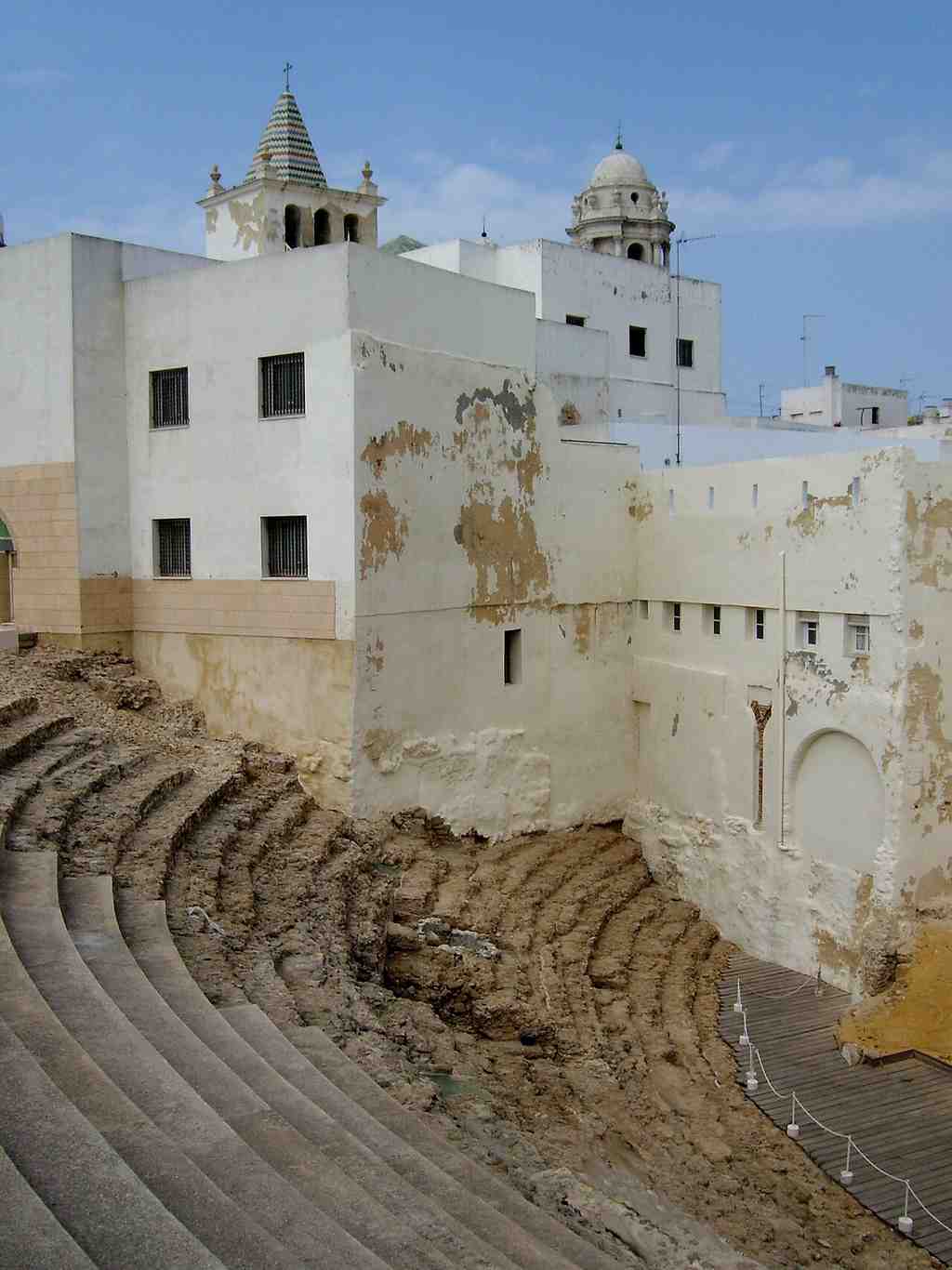
On your left, look for a wide semicircle of pale stone seating cut into the ground, edged with rough oyster-stone blocks and marked by a surviving curved wall that reveals the old Roman cavea, the seating bowl.
This is the Roman Theatre of Cádiz, also called the Theatre of Balbus, and for a very long time it played a superb trick on the city... it hid in plain sight. Archaeologists only identified it in nineteen eighty, when they were digging for the medieval Castle of the Villa and unexpectedly hit something much older. People had noticed underground galleries here before, but no one knew what building they belonged to. Then, all at once, Cádiz found itself staring at one of the great public monuments of Roman Hispania.
And not a modest one, either. This theatre measured about one hundred and eighteen meters across and held around ten thousand spectators. For a city of roughly fifty thousand people, that is a serious crowd. It ranks as the second largest Roman theatre in Hispania, just behind Córdoba, and as one of the oldest known on the Iberian Peninsula. The Romans did not exactly think small when they wanted to impress the neighbors.
The driving force here was the Balbus family, local power players from Gades. Balbus the Younger helped expand the city with a new district, the Neápolis, and this theatre formed part of that grand urban plan, built in imitation of Rome itself. Ancient writers actually mentioned it by name. Strabo wrote about the enlarged city, and Cicero heard reports from Cádiz colorful enough to survive two thousand years. In one letter, the governor Asinius Pollio says Balbus staged his own autobiographical play here, reserved the first fourteen rows for the equites, the wealthy knight class, rewarded one actor with a knight’s ring... and ordered another actor executed for being too ugly. Roman public entertainment could turn savage with very little notice.
If you imagine the full building, the social map becomes clear. The best seats sat closest to the stage: the proedria, a few front rows for magistrates, priests, and the top tier of society. Behind that came the ima cavea and media cavea, the lower and middle seating for well-off citizens and the general public. Higher still, the summa cavea held those furthest from status and from the action. Even leisure came with assigned rank. Very Roman.
What survives here is only a portion, but it tells the story well. Builders used Roman concrete, lime mortar, marble, and piedra ostionera, that local oyster-rich stone you see all over Cádiz. They carved the theatre into the natural slope of the ground, then ran vaulted passages under the seats. Those passages are called vomitoria, meaning entrances and exits for crowds, not evidence of a catastrophic snack break. Some original ramps and unfinished steps still reveal changes made while the theatre was being built.
Later, the theatre fell out of use in late Roman times. People stripped stone from it, reused parts as storage and housing, and Muslim builders raised an alcazaba, a fortified citadel, over the ruins. After Alfonso the Tenth took the city, he expanded that fortress into the medieval castle. That is why so much of the theatre still lies under the buildings of El Pópulo, including the Posada del Mesón, the Casa de Estopiñán, and other later structures layered over the Roman shell.
If you want more, the interpretation center usually opens Monday through Saturday from eleven to five, and Sunday from ten to two.
This place is a reminder that Cádiz did not merely inherit history; it kept building on top of it.
Take a moment here, and when you’re ready, we can continue to the Admiral’s House.




