
Ljubljana Audio Tour: Historic Heart
Ljubljana masks a battlefield of iron and ink behind its emerald river and ornate bridges. Beneath the picture-perfect streets lie centuries of political bloodbaths and whispered betrayals that carved the soul of this defiant capital. Unlock these secrets with this self-guided audio tour. Wander beyond the standard tourist trail to uncover hidden narratives and gritty chapters that most visitors completely overlook. Why did a desperate rebellion turn the city Cathedral into a site of chilling retribution? What restless spirit is said to still haunt the silent corridors of the Castle walls? And which specific window on Prešernov trg witnessed a scandal that nearly toppled a powerful dynasty? Pace through the winding stone alleys as history unfolds in your ears. Transform your perspective as you track the ghosts of past power struggles and forgotten triumphs. Begin your journey now and pull back the curtain on the real Ljubljana.
Tour preview
About this tour
- scheduleDuration 90–110 minsGo at your own pace
- straighten3.4 km walking routeFollow the guided path
- location_on
- wifi_offWorks offlineDownload once, use anywhere
- all_inclusiveLifetime accessReplay anytime, forever
- location_onStarts at Dragon Bridge
Stops on this tour
lock_open 3 free previews · 9 unlock with purchase
Before you spans a sweeping reinforced concrete arch bridge, framed by decorative stone balustrades and anchored at its corners by massive, oxidized green copper dragons perched…Read moreShow less
Open dedicated page →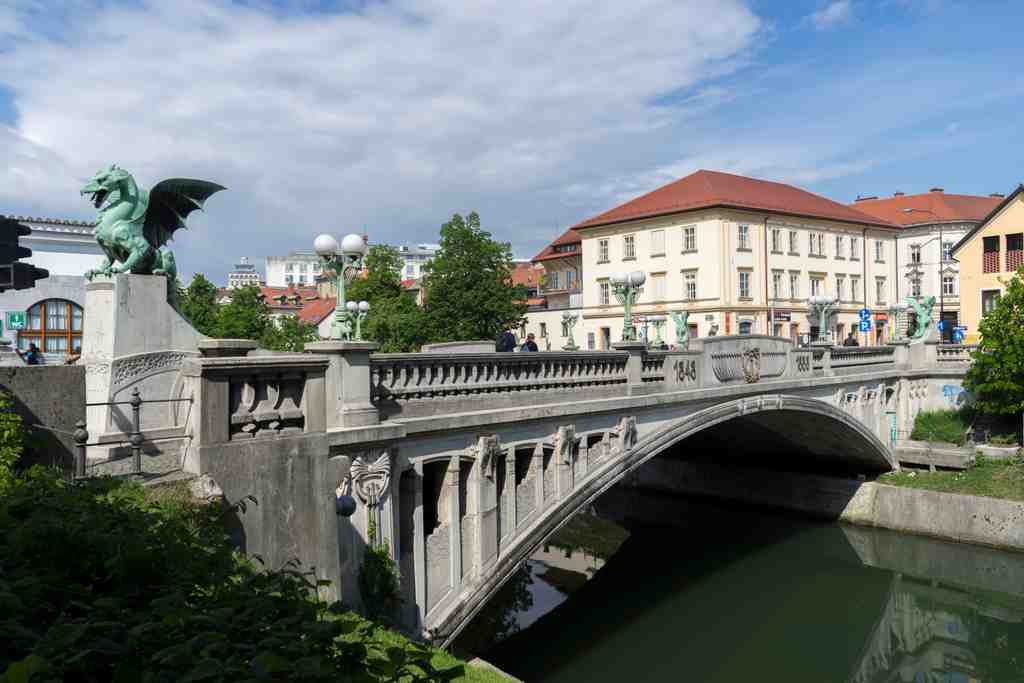
Dragon BridgePhoto: Thomas Ledl, Wikimedia Commons, CC BY-SA 4.0. Cropped & resized. Before you spans a sweeping reinforced concrete arch bridge, framed by decorative stone balustrades and anchored at its corners by massive, oxidized green copper dragons perched on imposing pedestals.
It is a brilliant piece of engineering, but the story of how it got here begins with utter ruin. In 1895, a catastrophic earthquake ripped through Ljubljana. It tore apart much of the medieval city, leaving behind a sprawling landscape of rubble. It was a violent, devastating end to the old world, but it also served as the unlikely catalyst for a spectacular reinvention. Mayor Ivan Hribar looked at the devastation and saw a blank canvas. He envisioned a completely modern capital built in the latest artistic styles to replace the wreckage.
When it came time to replace an old, damaged oak bridge right here, Hribar and the city chose a radical new material called reinforced concrete. They did this largely because it was significantly cheaper than traditional stone, allowing them to stretch their tight reconstruction budget further. But there was a bit of imperial politics at play, too. The Austro-Hungarian authorities in Vienna were nervous about using this untested engineering method back home. So, they used provincial Ljubljana as a testing ground. If the massive thirty-three-meter arch collapsed, the political fallout would be far less embarrassing than a disaster in the imperial capital. Fortunately for everyone involved, the calculations were perfectly sound.
Take a close look at those fearsome green dragons guarding the bridgeheads. Can you imagine this iconic symbol of Ljubljana originally being a set of griffins?
That was exactly the original plan. The architect, Jurij Zaninović, initially submitted designs featuring mythological griffins. But in a sudden pivot, Zaninović swapped them out for dragons. The statues were manufactured in Vienna from thin copper sheets to save on weight and cost, though each hollow beast still weighs about a ton and a half. Over time, that copper has aged into the deep green finish you see today, a natural chemical oxidation process known as a patina.
They look positively ancient, connecting this marvel of twentieth-century modernization back to the myth of Jason and the Argonauts. Local lore says Jason founded the city after slaying a monster in the nearby marshes. By placing these beasts here, the architects transformed a creature of terror into a permanent protector of the people. And they also inspired a bit of local comedy. The fierce, unmoving glare of the statues earned it the nickname of the mother-in-law bridge among locals.
This open-air structure is accessible twenty-four hours a day, all week long. Let us leave these ancient legends to keep watch over the river, and make our way up to our next stop, Ljubljana Castle, which is about a fourteen-minute walk away.
Look to your right, where you will see the fortress complex built of rough-hewn stone and dark pitched roofs, anchored by a striking white observation tower with a large clock…Read moreShow less
Open dedicated page →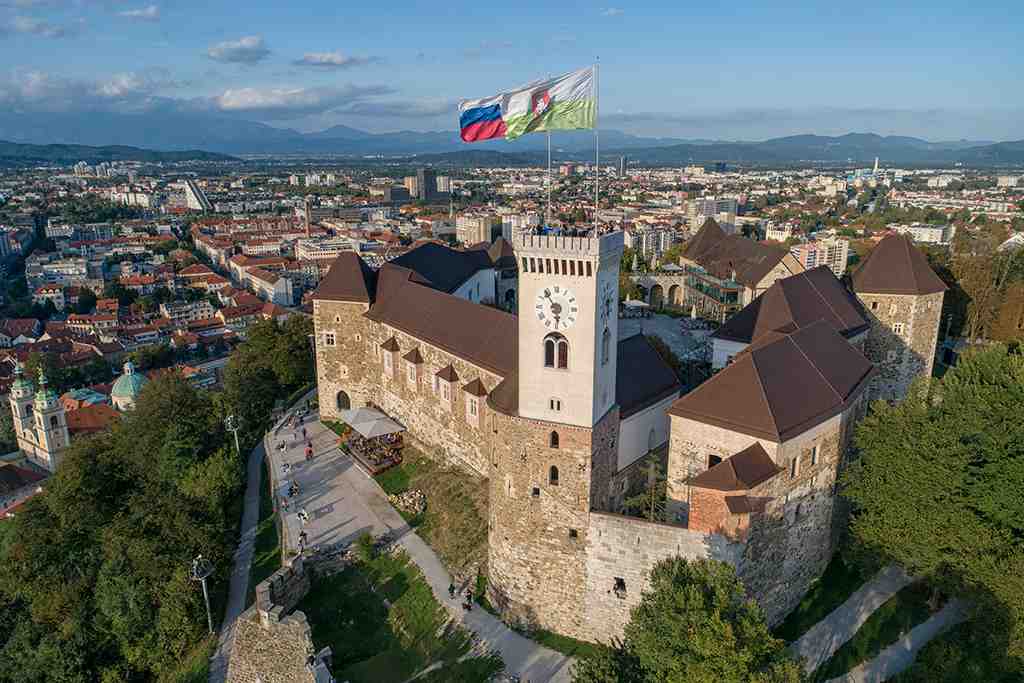
Ljubljana CastlePhoto: LjGrad, Wikimedia Commons, CC BY-SA 4.0. Cropped & resized. Look to your right, where you will see the fortress complex built of rough-hewn stone and dark pitched roofs, anchored by a striking white observation tower with a large clock face.
This summit has been watching over the valley for over four thousand years. Long before the Romans built stone watchtowers to monitor their trade routes, Bronze Age tribes sought refuge right where you are standing. Down at the river, we met the Dragon Guardian, that ancient swamp monster slain by Jason and his Argonauts. But up here on the hill, the myth evolved to fit the stones.
As the fortress took shape in the Middle Ages, the old pagan beast was replaced by a more refined narrative. Take a look at your screen to see the ornate altar ceiling of Saint George's Chapel located inside the castle walls. Local legends claim the patron saint defeated a dragon right here, one that demanded human sacrifices from the townsfolk below. The wild, fire-breathing beast of the marshes was tamed and transformed into a symbol of European chivalry.
Yet, the myth of invincibility did not protect the walls themselves. By the late eighteenth century, the fortress had become a massive financial burden. Bureaucrats in Vienna saw only a crumbling money pit and proposed tearing it all down to sell the stones for scrap. The castle narrowly escaped the wrecking ball, only to endure a dark era as a grim provincial prison and a military hospital.
By the dawn of the twentieth century, the complex was decaying into ruin. That is when Mayor Ivan Hribar made an incredible gamble. He purchased the rotting structure for the city for sixty thousand, two hundred Kronen, an amount equivalent to a few million dollars today. His vision was to create a cultural Acropolis, an elevated sanctuary of art and museums for the people. But realizing that dream would take nearly a century. In the meantime, to prevent the structure from totally collapsing, the city moved dozens of impoverished families into the drafty, abandoned military quarters. It is a strange twist of fate that the daily chores of ordinary citizens acting as unofficial guardians provided just enough upkeep to keep the ancient walls standing.
You can watch how the city below has grown and modernized over eight decades, while the ancient fortress continues to watch over Ljubljana from its increasingly forested hill, by checking out the historic image in your app.
Eventually, those families were relocated in the nineteen sixties, sparking a massive architectural revival. Engineers hollowed out the rock beneath the courtyard to install vast, invisible service areas, allowing the medieval shell to host modern events without losing its ancient soul. What was once destined for the scrap heap is now the crowning jewel of the city.
You can explore the castle grounds any day of the week between 9 AM and 7 PM. But as impressive as the view is from these towering heights, the true spirit of the city waits down below. Let us shift our focus from the fortress and head down toward the Archdiocese of Ljubljana, a walk of about eleven minutes.
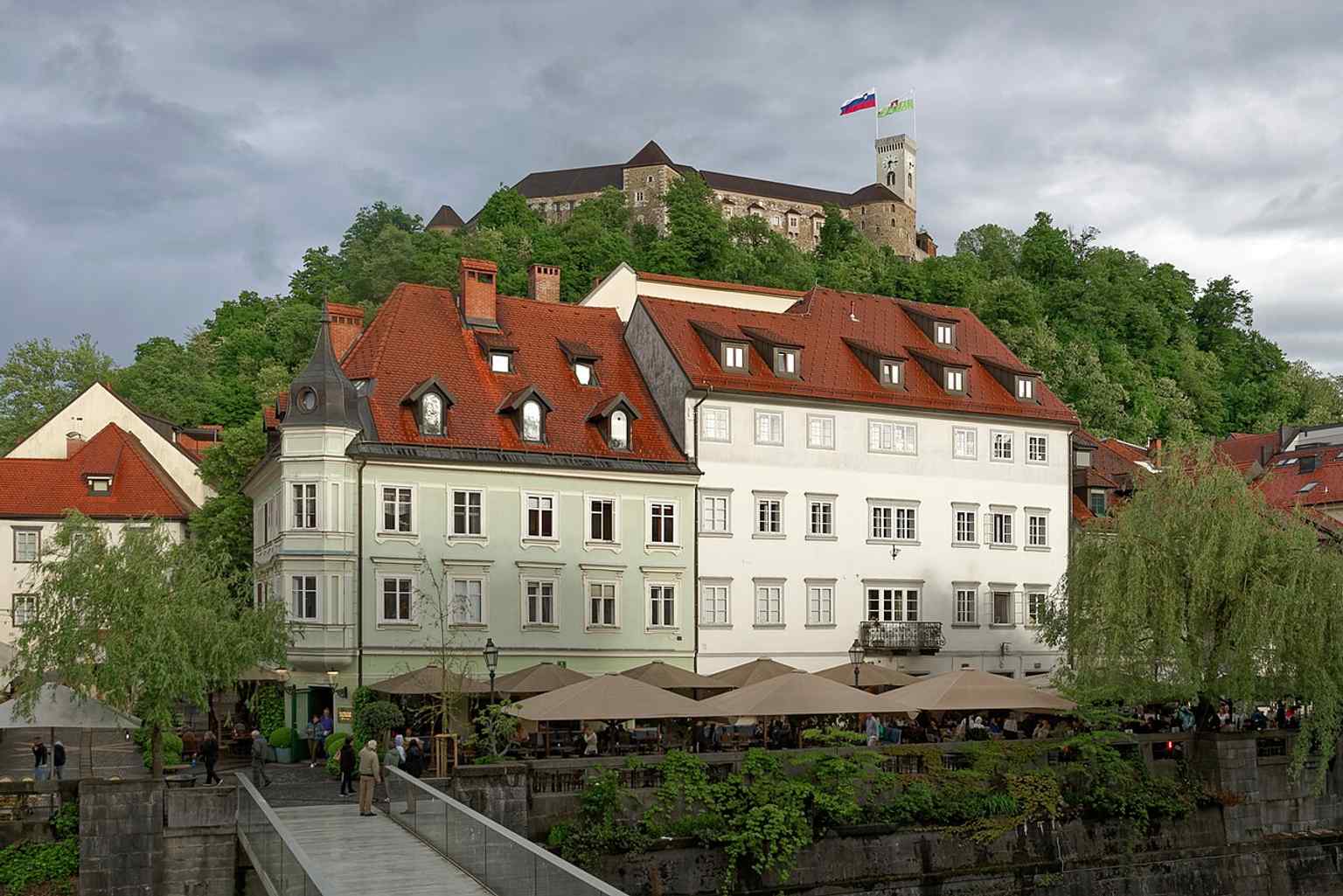
This broad view captures Ljubljana Castle, a medieval fortress that acquired its present outline with an almost complete overhaul in the 15th century, serving as a key landmark above the city.Photo: Arths-at, Wikimedia Commons, CC BY-SA 4.0. Cropped & resized. 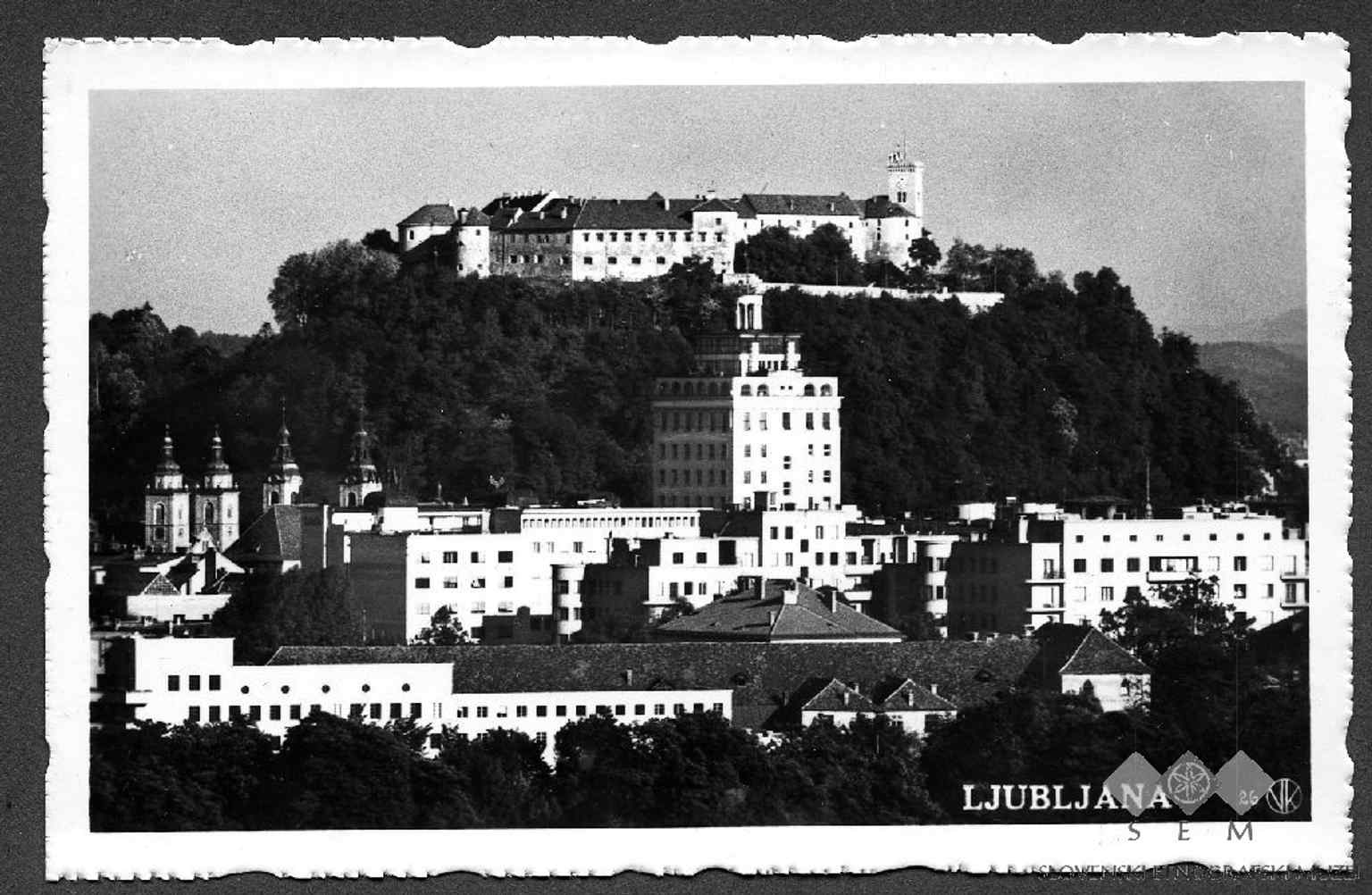
Ljubljana Castle illuminated at night, a testament to its modern use as a major cultural venue and host of numerous events.Photo: Saška Grušovnik, Wikimedia Commons, CC BY-SA 4.0. Cropped & resized. 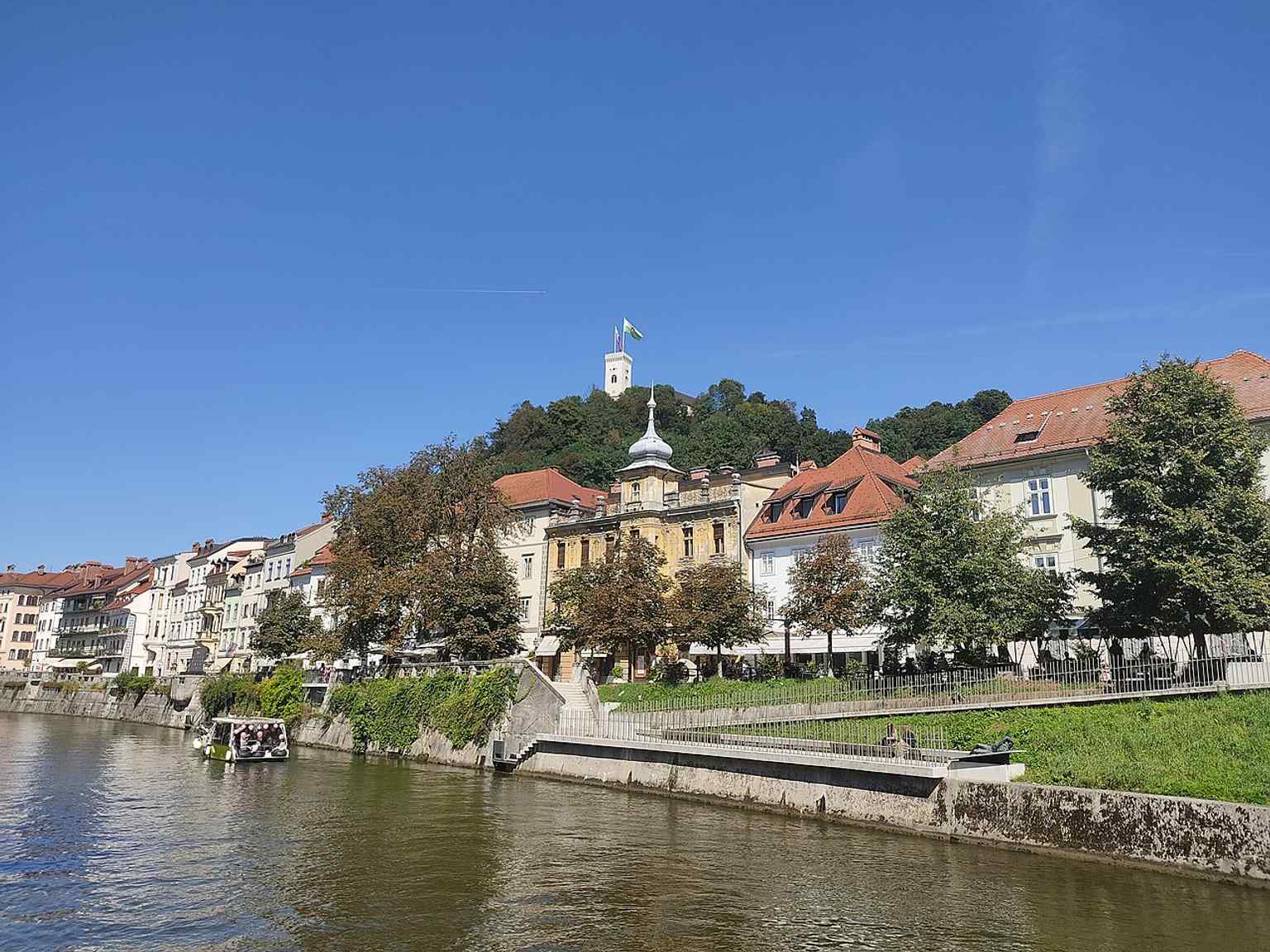
The castle's entrance bridge, restored to its medieval appearance, features a sculpture of the legendary dragon, a powerful symbol on Ljubljana's coat of arms.Photo: Robert Jahoda, Wikimedia Commons, CC BY-SA 4.0. Cropped & resized. 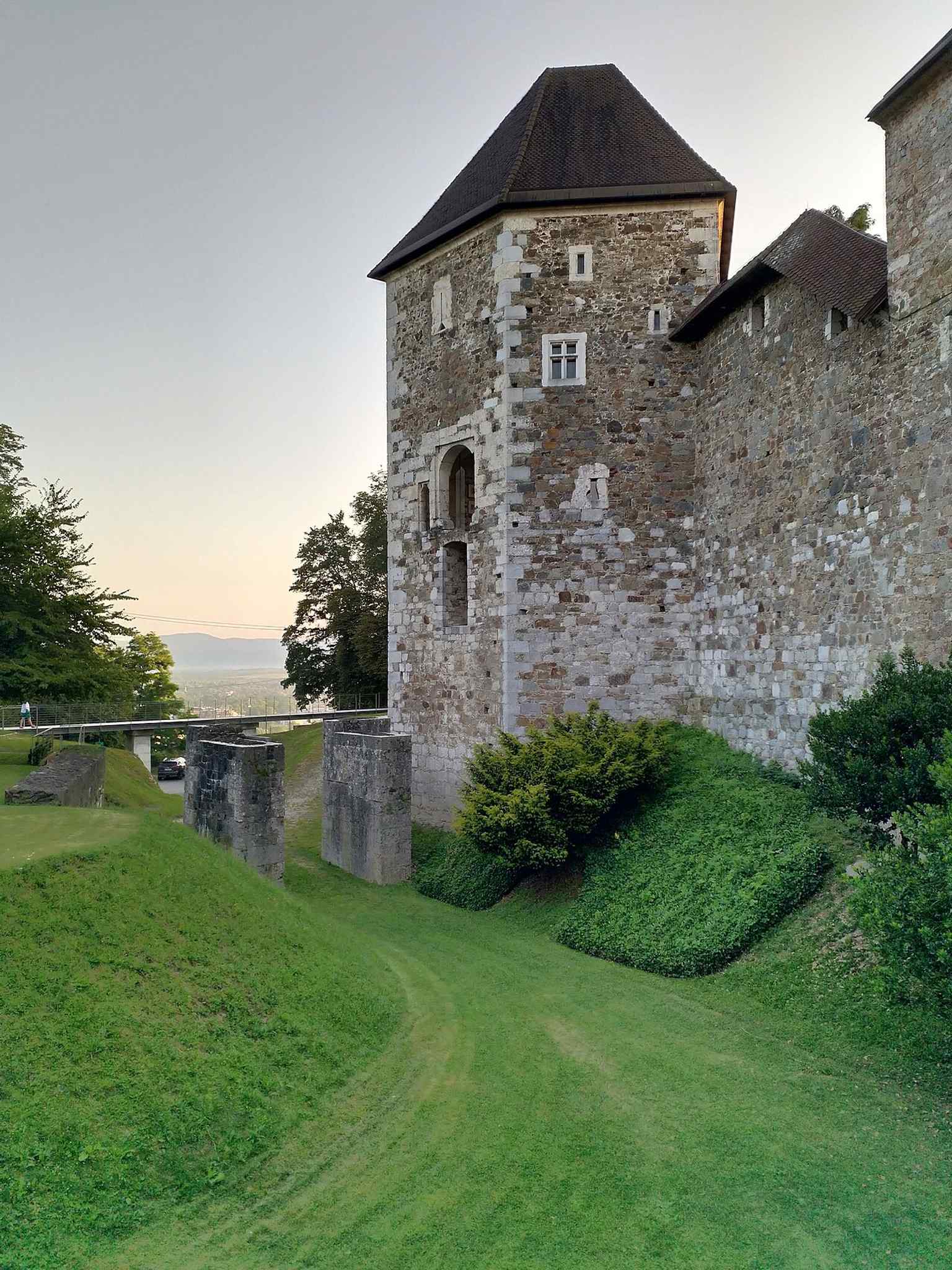
The inner courtyard, once used for military gatherings and later as a walking space for prisoners, now serves as a vibrant hub for events within the castle walls.Photo: Robert Jahoda, Wikimedia Commons, CC BY-SA 4.0. Cropped & resized. 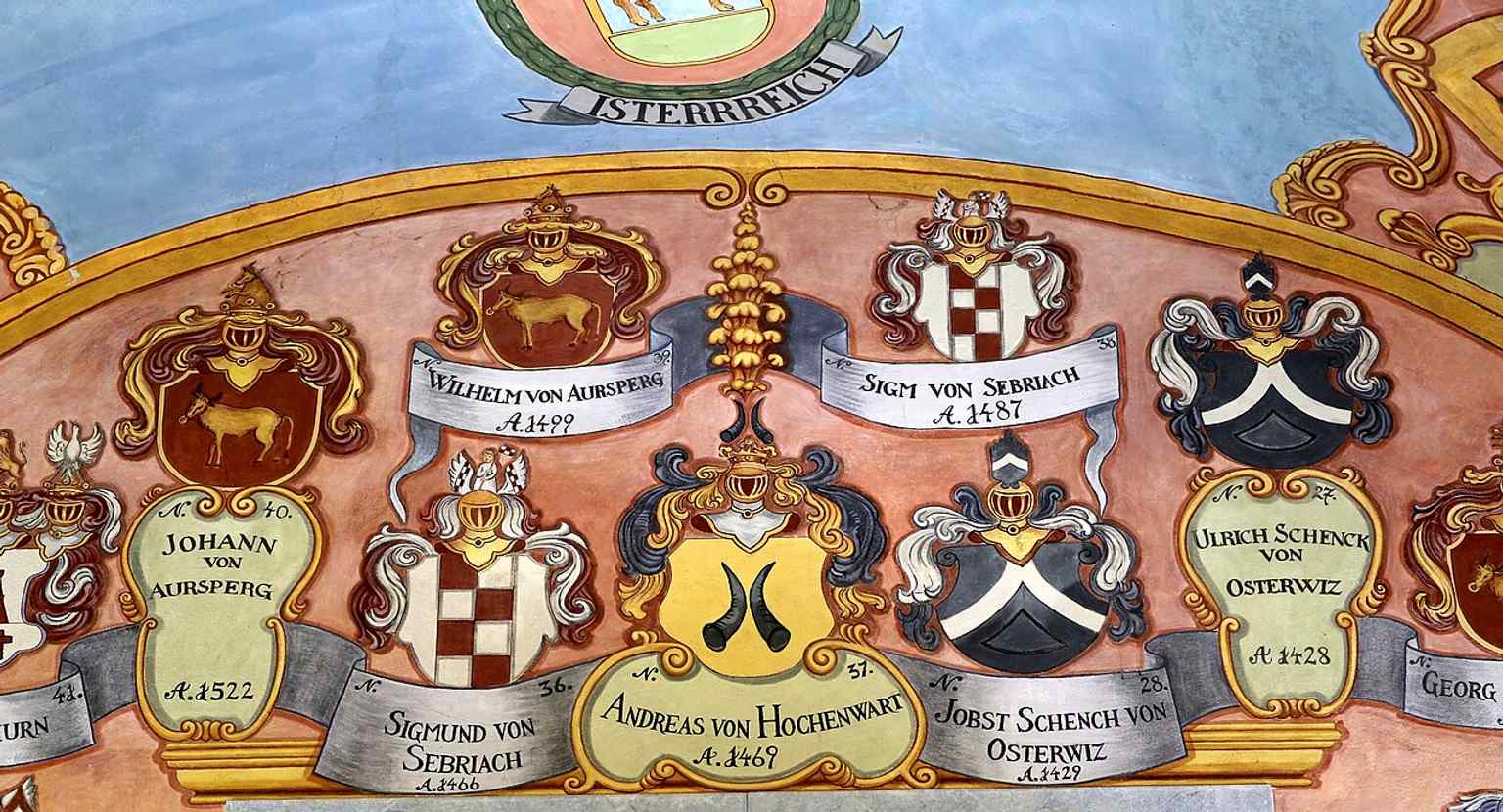
The distinctive double spiral staircase in the Panoramic Tower, rebuilt between 1845 and 1848, was designed to prevent guards ascending and descending from crossing paths.Photo: Sumitsurai, Wikimedia Commons, CC BY-SA 4.0. Cropped & resized. 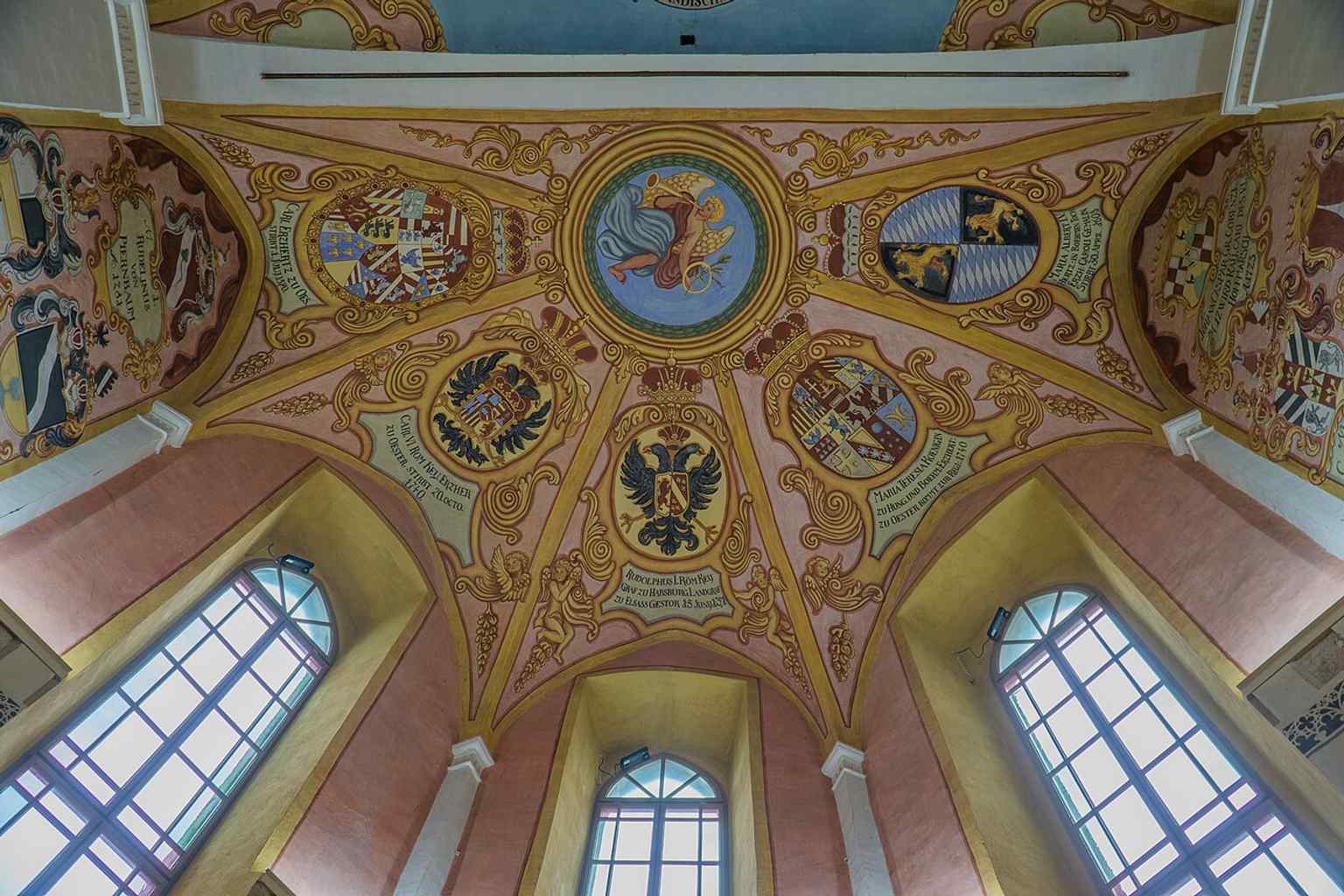
A panoramic view of Ljubljana from the castle at sunset, illustrating its historical role as a Roman army stronghold monitoring trade routes from the settlement of Emona.Photo: Saška Grušovnik, Wikimedia Commons, CC BY-SA 4.0. Cropped & resized. 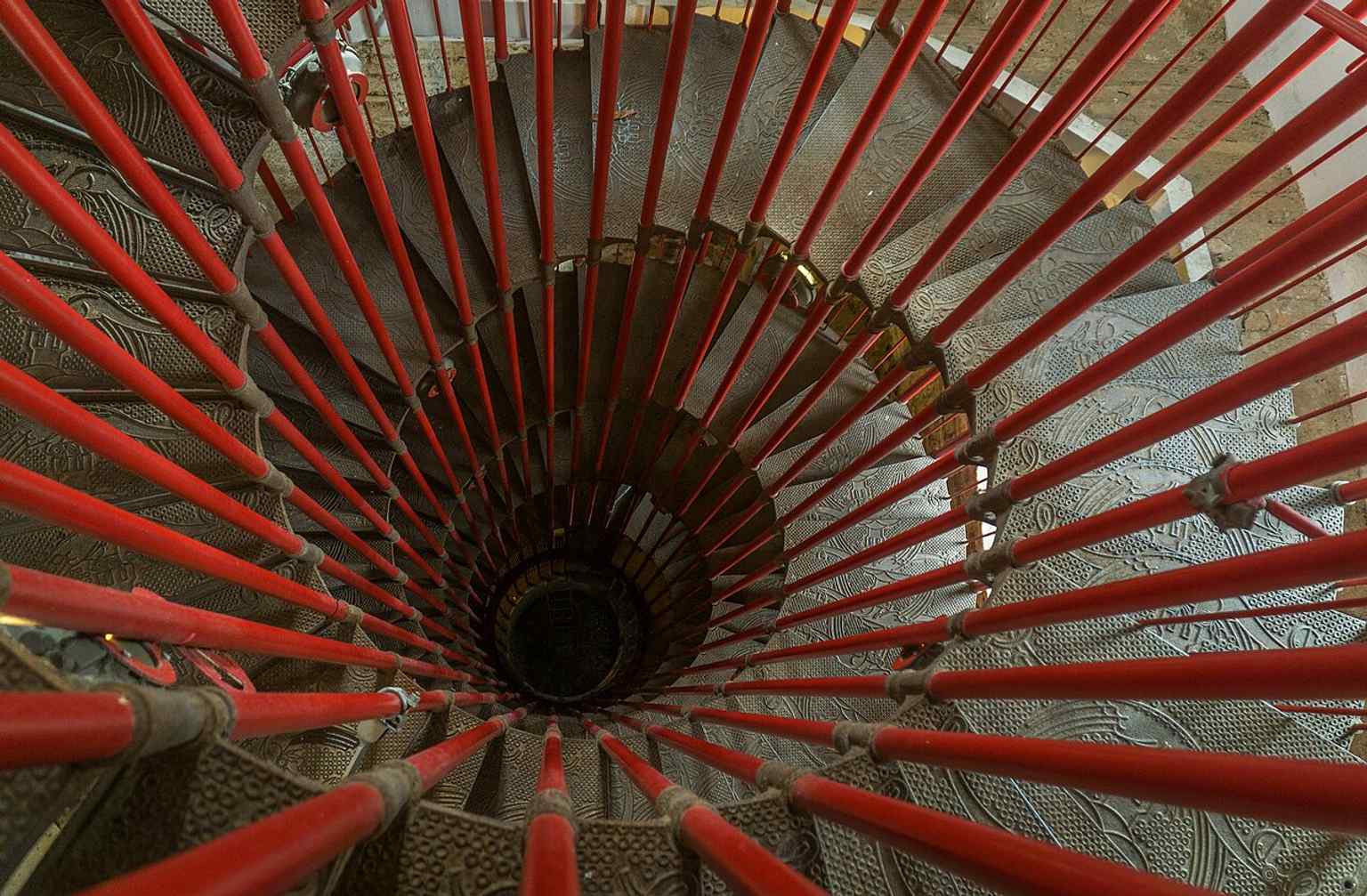
The castle's Viewing Tower, dating to 1848, once housed a guard who fired cannons to warn the city of fires or announce important events, and now flies the national flag.Photo: This Photo was taken by Miha Peče. Feel free to use my photos, but please mention me as the author. I would much appreciate if you send me an email [email protected] or write on my talk page, for my information. Please do not upload an edited image here without consulting me. I would like to make corrections only at my own source to ensure that the changes improve the image and are preserved.Otherwise you may upload an edited image with a new name. Please use one of the templates derivative or extract., Wikimedia Commons, CC BY-SA 4.0. Cropped & resized. 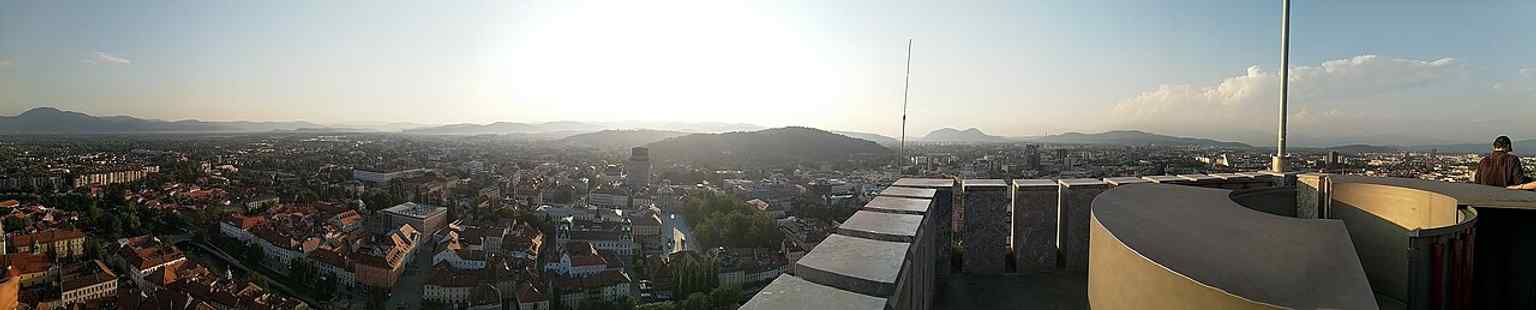
The exterior of St. George's Chapel, originally built in the 15th century, is one of the castle's most significant religious structures and part of its defense against Ottoman invasion.Photo: Sumitsurai, Wikimedia Commons, CC BY-SA 4.0. Cropped & resized. 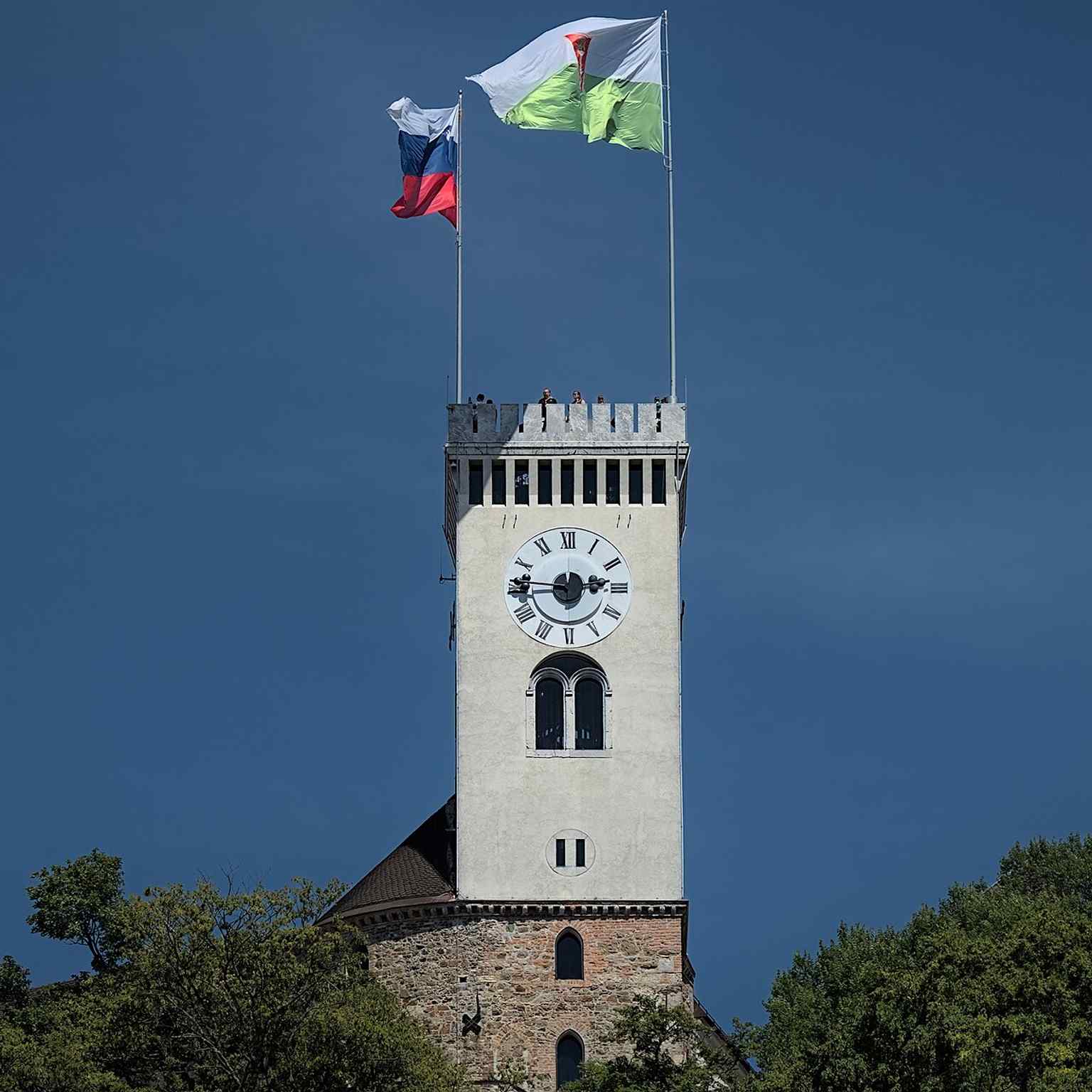
A segment of the castle's robust defense wall, parts of which were transformed into the Šance promenade by architect Jože Plečnik in the 1930s.Photo: Robert Jahoda, Wikimedia Commons, CC BY-SA 4.0. Cropped & resized. 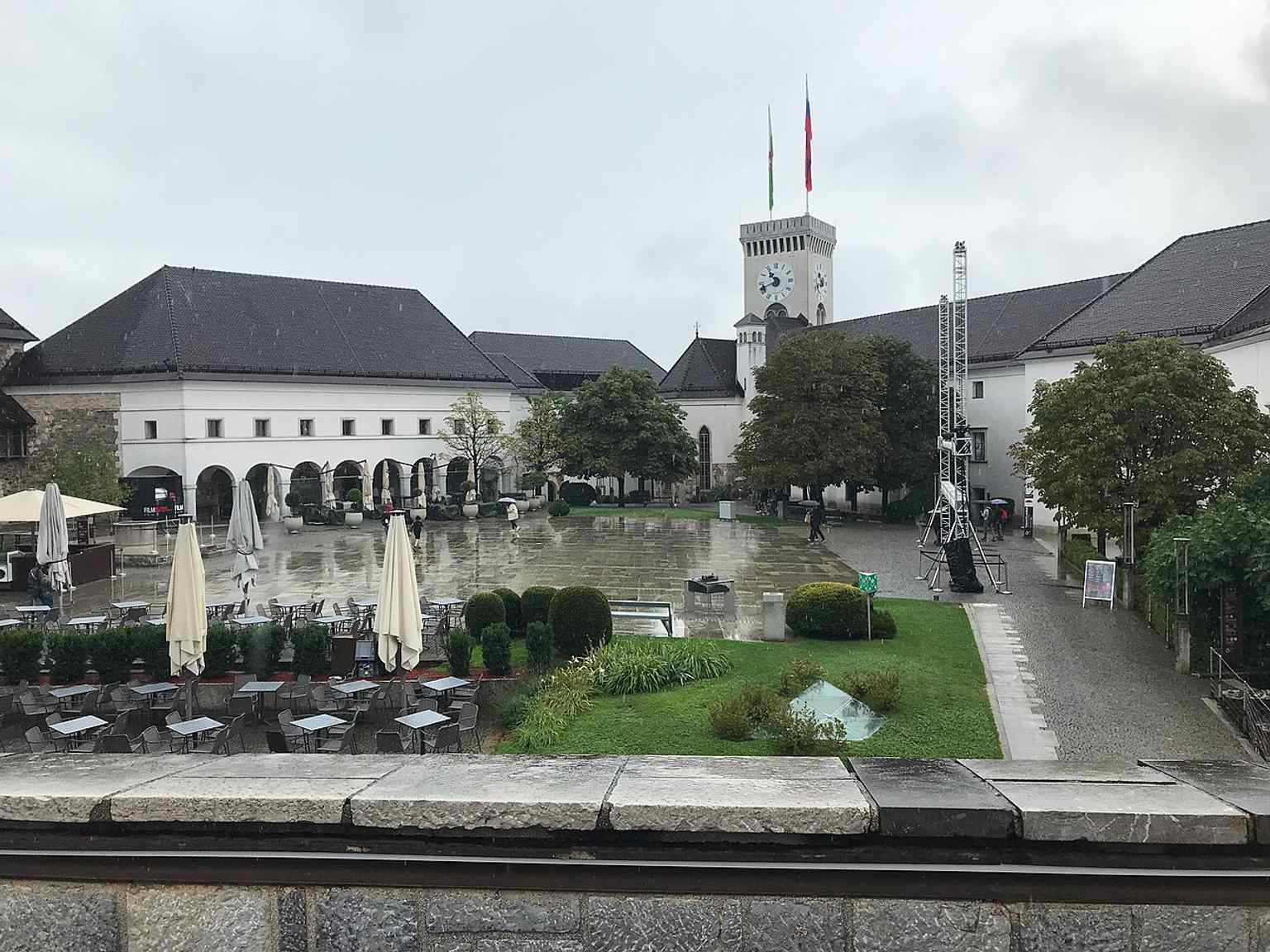
Ljubljana Castle perched atop Castle Hill, majestically overlooking Tivoli Park and the city, underscoring its permanent role as a defensive and administrative pivot point for the region.Photo: This Photo was taken by Miha Peče. Feel free to use my photos, but please mention me as the author. I would much appreciate if you send me an email [email protected] or write on my talk page, for my information. Please do not upload an edited image here without consulting me. I would like to make corrections only at my own source to ensure that the changes improve the image and are preserved.Otherwise you may upload an edited image with a new name. Please use one of the templates derivative or extract., Wikimedia Commons, CC BY-SA 4.0. Cropped & resized. 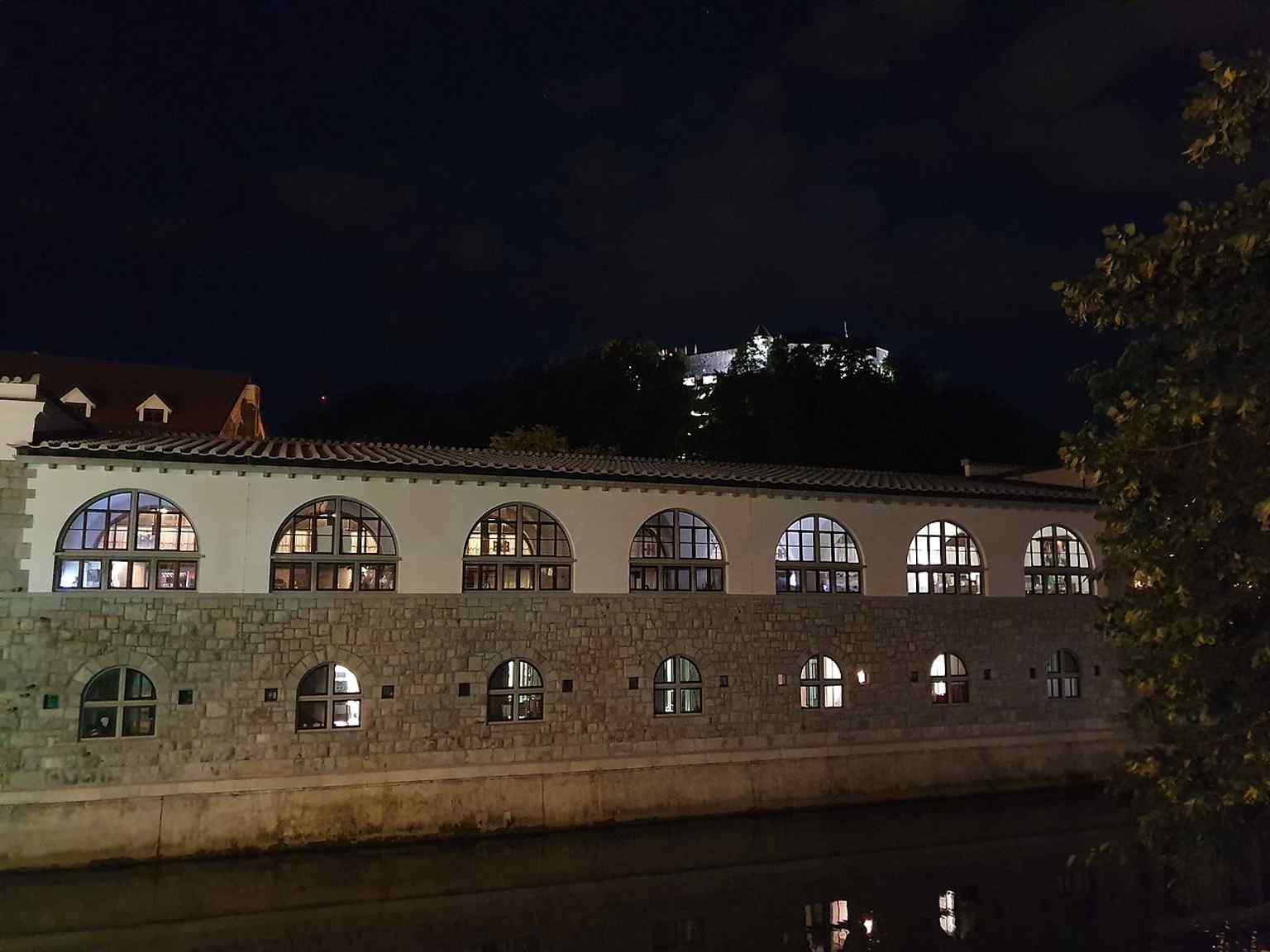
This stone-walled interior space represents the castle's adaptable nature, serving various functions over centuries, from military storage to living quarters for poor families.Photo: Antimuonium, Wikimedia Commons, CC BY-SA 4.0. Cropped & resized. On your right, you will see a pale, multi-story building featuring a prominent dark arched entryway, situated directly beside the cathedral's towering peach-colored belfries and…Read moreShow less
Open dedicated page →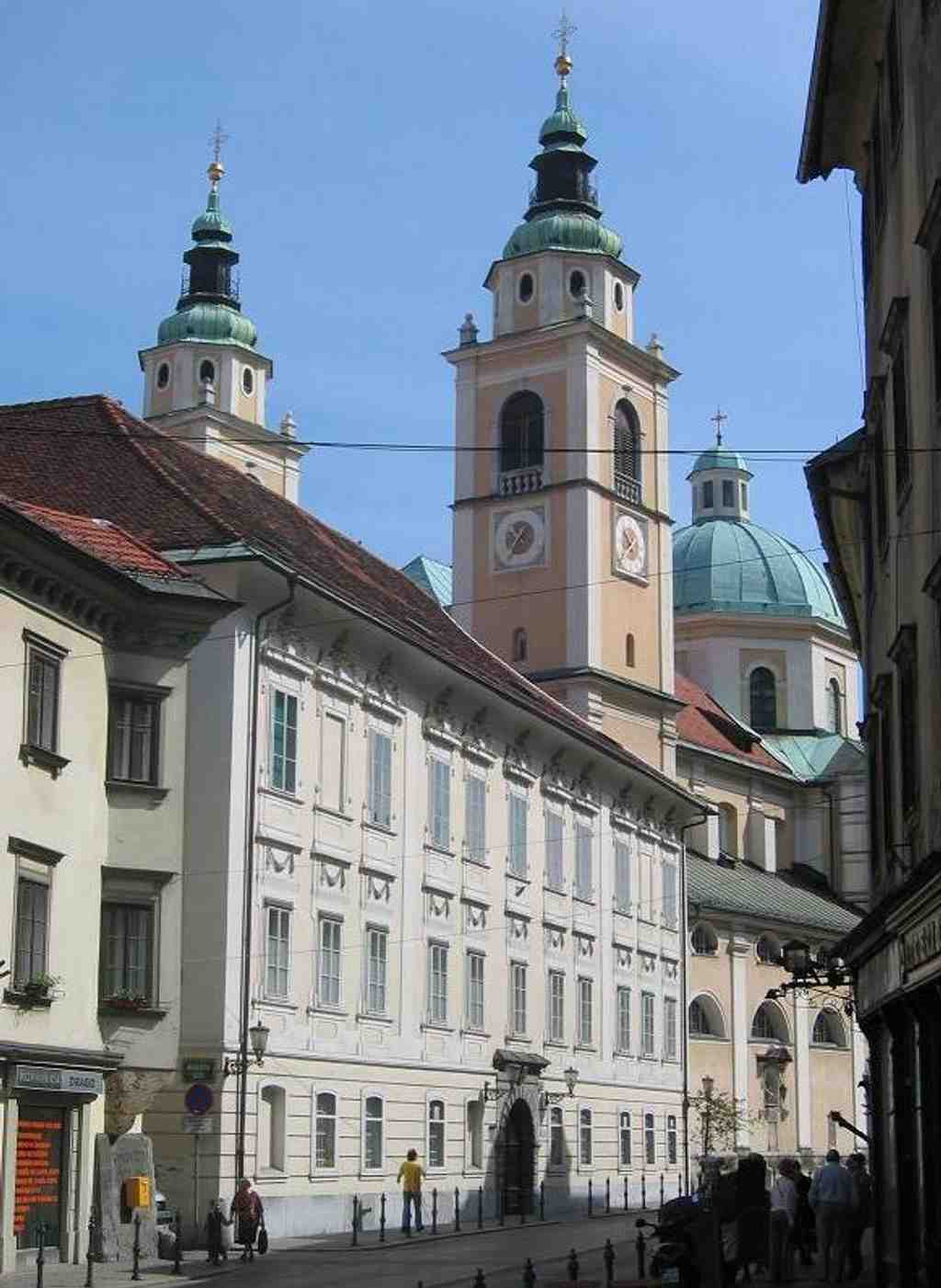
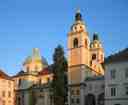
Archdiocese of LjubljanaPhoto: Žiga, Wikimedia Commons, Public domain. Cropped & resized. On your right, you will see a pale, multi-story building featuring a prominent dark arched entryway, situated directly beside the cathedral's towering peach-colored belfries and striking green domes. This is the headquarters of the Archdiocese of Ljubljana.
Christianity has deep, complicated roots in this soil. An ancient diocese existed here as early as the year 320, but the territory was repeatedly fractured by the crossfire of empires. In 1461, Emperor Frederick III officially established the Diocese of Ljubljana, but just eight years later, absolute disaster struck. The original medieval cathedral was soon lost to a devastating fire. From those literal ashes, the church was eventually reborn into the striking Baroque complex you see beside you today.
Take a glance at your screen to see the exterior of the magnificent cathedral that emerged from that era. During its construction in the early 1700s, the archdiocese was practically broke. Unable to afford a permanent stone dome, they hired a painter named Giulio Quaglio to create a cupola finta, essentially an illusionistic, three-dimensional painting of a dome on the flat ceiling. His perspective was so flawless that local legends say a bird once flew inside and repeatedly tried to escape through a painted window. It took over a century before a real dome was finally added.
The leaders working inside this building have always navigated a razor-thin line between faith, politics, and survival. Take Bishop Thomas Chrön in the early 1600s. He publicly burned thousands of Protestant books to restore Catholic supremacy, yet he secretly lobbied the Pope to save the first Slovene Bible translation, arguing his priests needed it to study. He effectively rescued the foundational text of the local language from his own fiery purge. Centuries later, in 1952, Archbishop Anton Vovk survived being doused in gasoline and set on fire by a communist mob. He bore horrific burns for the rest of his life but adamantly refused to step down or go into exile.
But today, the institution faces a different kind of reckoning, one stemming from its own internal secrets. In 2012, the Vatican ordered Archbishop Alojz Uran to quietly leave Slovenia for Italy. This was a rare, public disciplinary measure following persistent allegations that the Archbishop had broken his vows of celibacy and fathered two children. His successor did not fare much better, resigning just a year later over a massive financial fiasco. And in 2023, the archdiocese was rocked again when the Vatican dissolved a locally founded religious order following profound abuse allegations against its co-founder. The spiritual and moral burden of this leadership is heavy, a weight beautifully yet somberly symbolized on the cathedral's bronze side doors, where the faces of twentieth-century bishops are sculpted rising from a figure of the dead Christ.
The archdiocese offices are mostly open on weekday mornings and closed entirely on weekends, just as a passing administrative note. Let us keep moving toward our next stop a minute away, where we will trade the guarded secrets of the church for a striking monument of municipal ambition at the Robba Fountain.
Show 9 more stopsShow fewer stopsexpand_moreexpand_less
Take a look to your left at the tall stone obelisk rising gracefully from a three-lobed basin, anchored by bright white marble figures of muscular men clutching water jugs at the…Read moreShow less
Open dedicated page →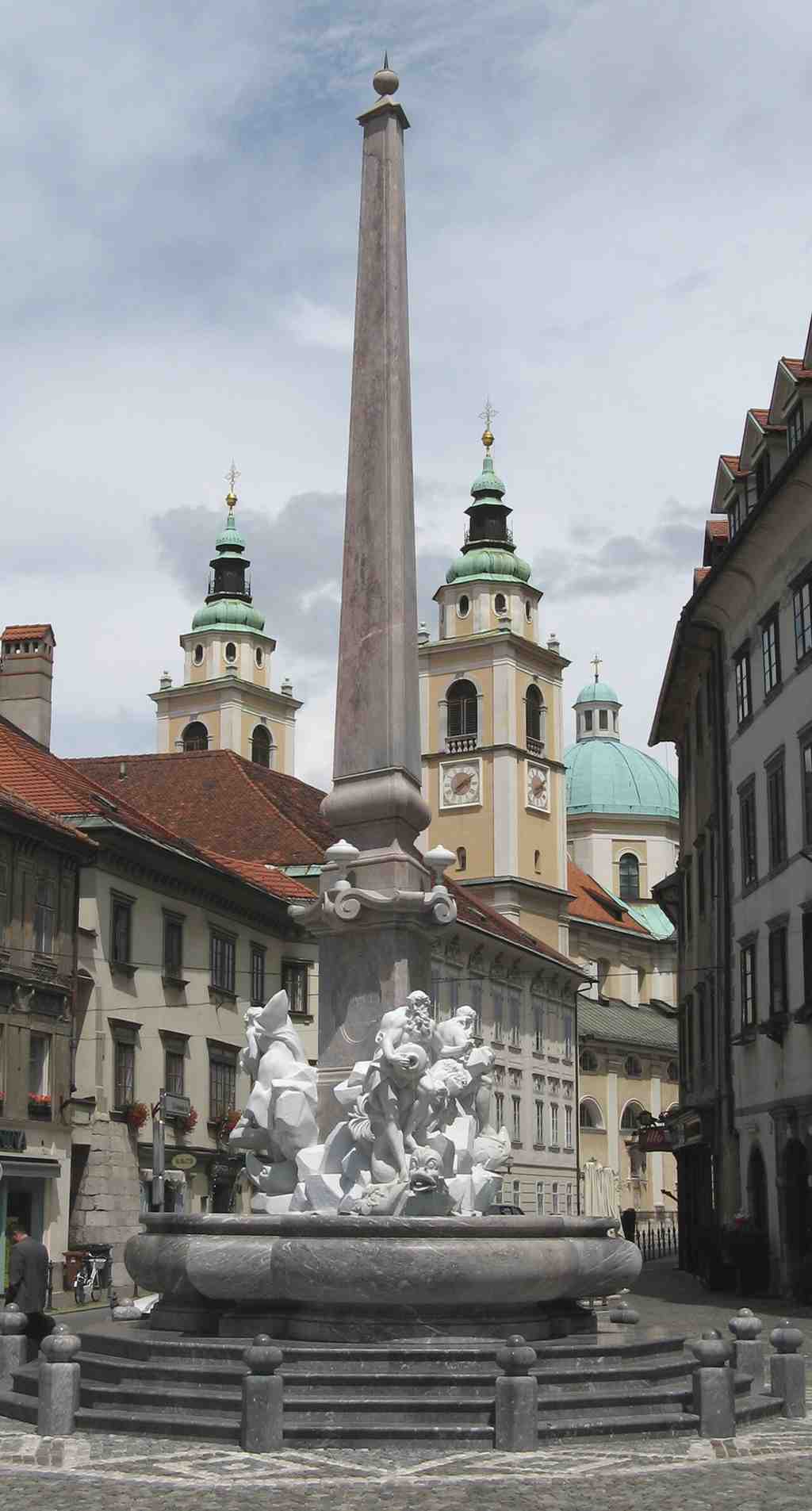
Robba FountainPhoto: User:Kaktus999, Wikimedia Commons, Public domain. Cropped & resized. Take a look to your left at the tall stone obelisk rising gracefully from a three-lobed basin, anchored by bright white marble figures of muscular men clutching water jugs at the base. This is the Robba Fountain, officially known as the Fountain of the Three Carniolan Rivers.
In seventeen forty-three, the city magistrates decided Ljubljana needed to step out of the shadows and emulate the artistic grandeur of major European capitals like Rome or Paris. They were a small municipality with a modest budget, but they were deeply eager to project an image of power and sophistication to the world. So, they demanded a decorative masterpiece that would prove their cultural primacy, while at the same time insisting it serve the highly practical everyday function of providing a clean drinking well for the townspeople.
They handed the immense job to Francesco Robba, the city's most prestigious craftsman and honorary citizen, a man whose brilliant rise to the top of his field would soon be eclipsed by a dramatic and ruinous fall.
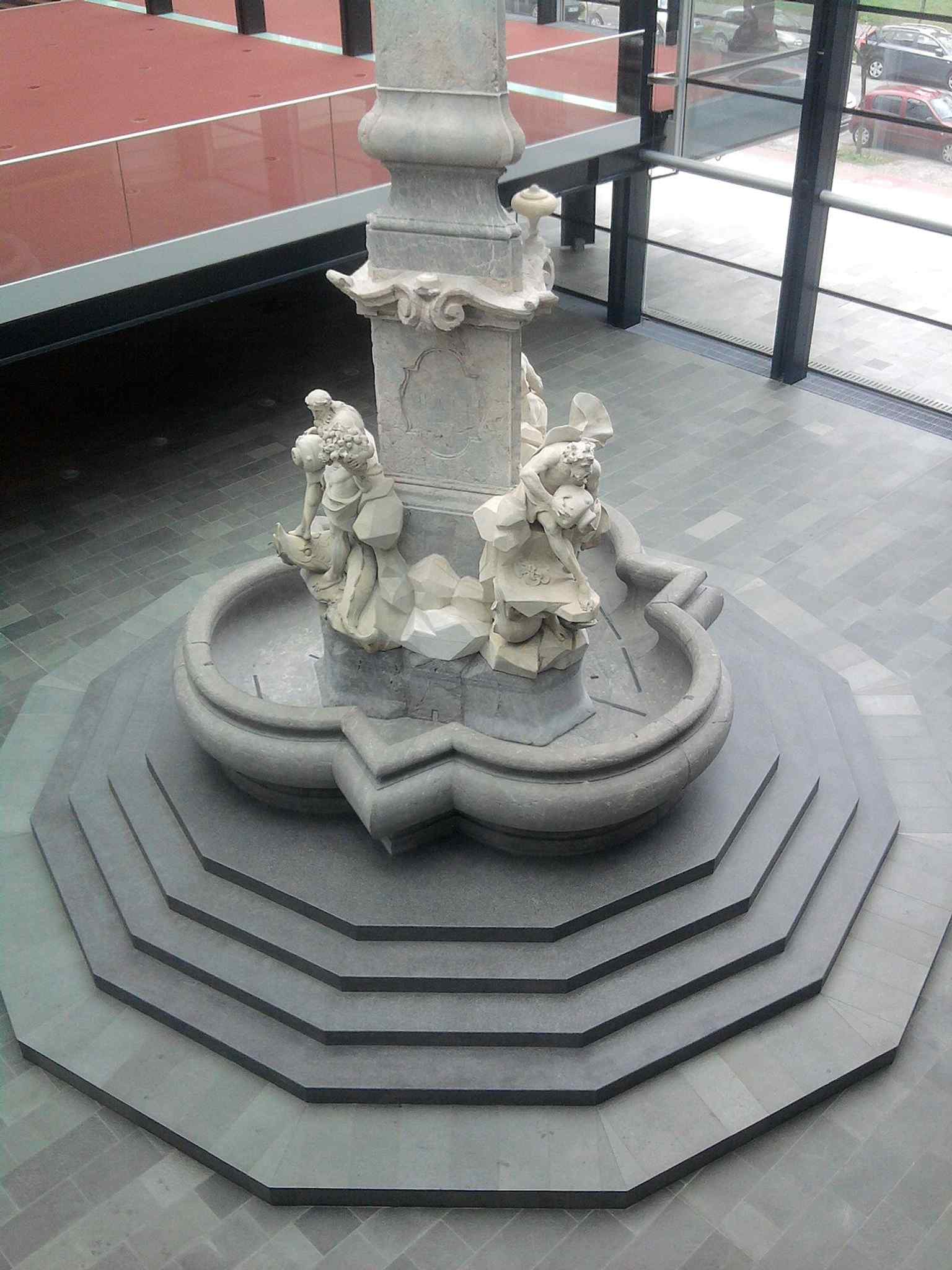
This fountain stands today as a stunning civic monument, but it is deeply marked by the staggering cost of personal ambition. Robba promised a dazzling, all-white marble vision, but when a ship carrying his expensive Carrara marble sank near Trieste, it was a sudden financial catastrophe that he had to shoulder entirely himself. Bankrupted and unable to afford replacement stone, he was forced into a scandalous compromise, substituting local gray and red limestone for the basin and the obelisk just to finish the job. You can actually see the pristine white marble that did survive the journey in the figures at the base, so take a look at your screen for a closer view of that exquisite carving.
That imported Italian luxury was considered so breathtakingly rare that the city actually posted a night guard right here to protect the statues from thieves. Transporting just the obelisk from the local quarry took nearly thirteen days and required up to twenty pairs of oxen. When the grueling project was finally unveiled in seventeen fifty-one, the city authorities claimed their funds were depleted and refused to pay his full, promised commission. Robba was left embittered and utterly bankrupt. Just four years later, he abandoned his home and family, fleeing to Zagreb where he died in obscurity, never returning to see his crushing failure eventually transform into a beloved national symbol.
Over the centuries, his fractured masterpiece found a magnificent second life, with those marble men organically evolving to represent the region's three mighty rivers. If you pull up the comparison image in your app, you can see how the monument anchored this square back in nineteen forty-one. The one standing before you now is actually a masterfully crafted replica, installed so the fragile, centuries-old original could finally be moved safely indoors away from pollution.
To know that your greatest work would cost you everything casts a different light on this beautiful stone. As you let that sink in, we will leave this beautiful testament to artistic sacrifice and head toward the administrative heart of the modern city. The Kresija Building is just a one-minute walk away. And just so you know, the square is open twenty-four hours a day, so this monument is always here to welcome you.
A wide view of the historic center, showcasing the fountain's central role in Ljubljana's urban planning and its location in front of the Town Hall.Photo: Robert Jahoda, Wikimedia Commons, CC BY-SA 4.0. Cropped & resized. 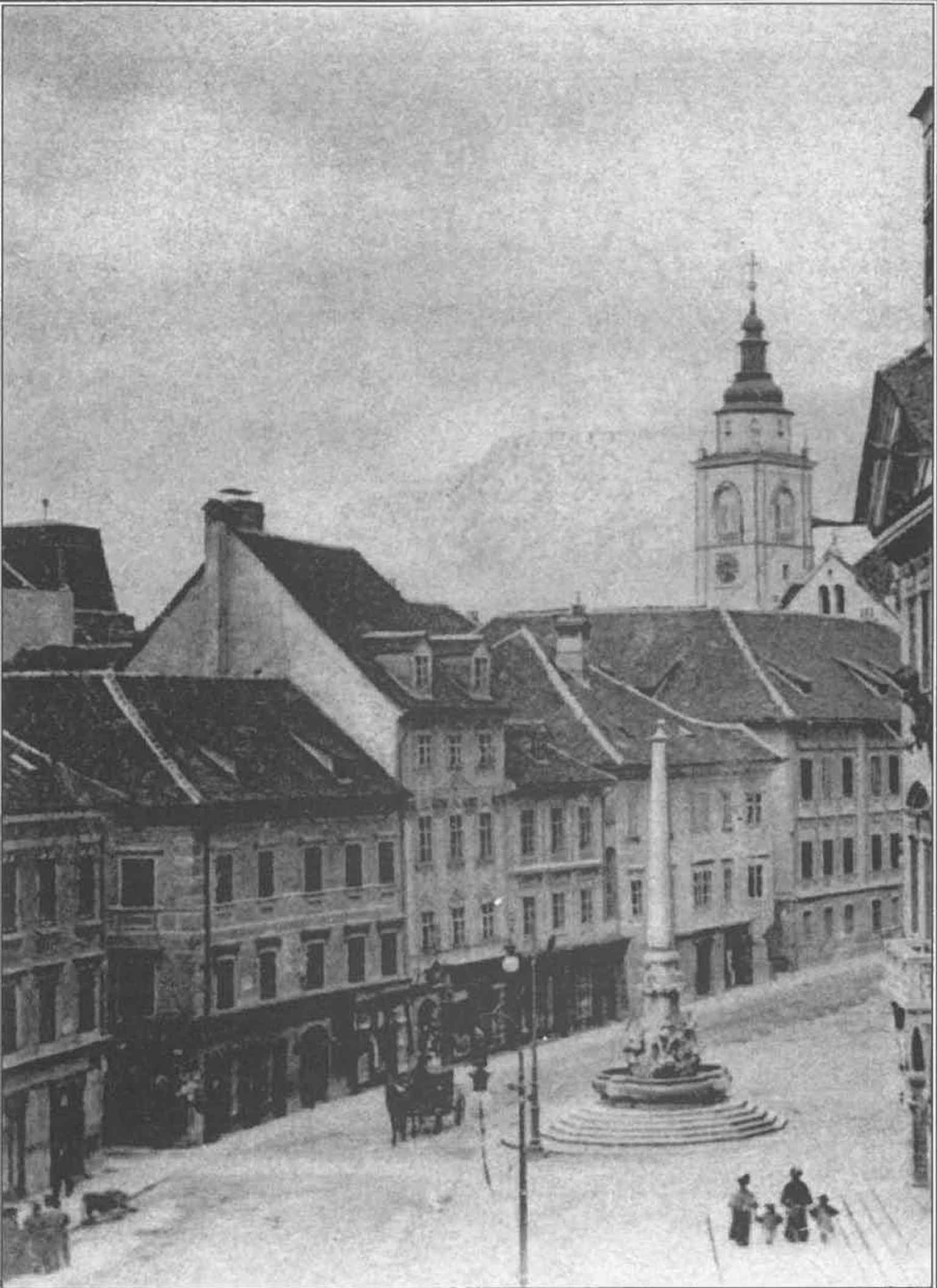
A historical photograph from 1895, showing the fountain and Town Square before many of its 19th and 20th-century alterations.Photo: Unknown authorUnknown author, Wikimedia Commons, Public domain. Cropped & resized. 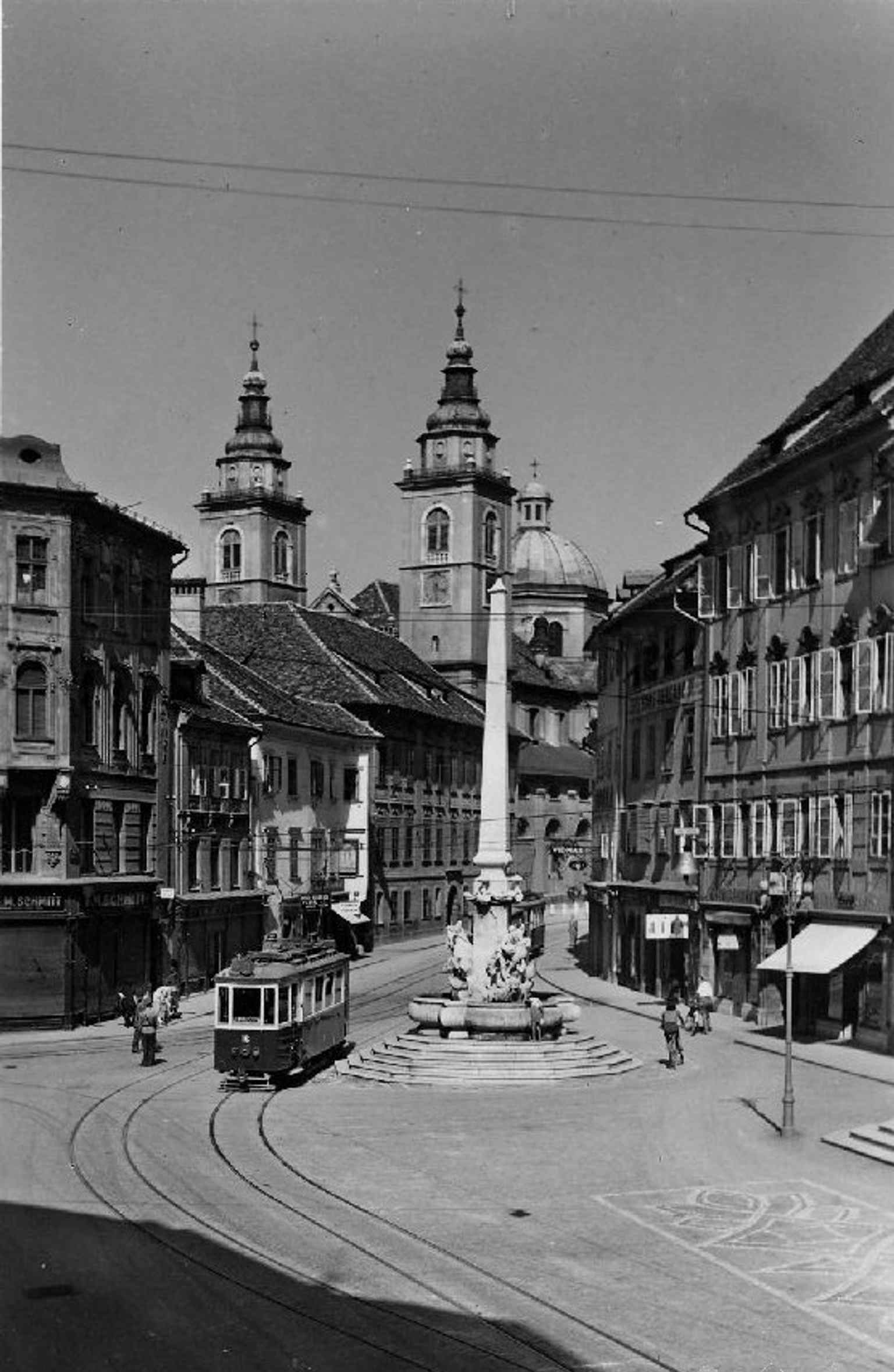
This 1941 postcard view shows the fountain in its original location, before the major conservation debate led to the replacement with a replica.Photo: Vekoslav Kramarič, Wikimedia Commons, Public domain. Cropped & resized. 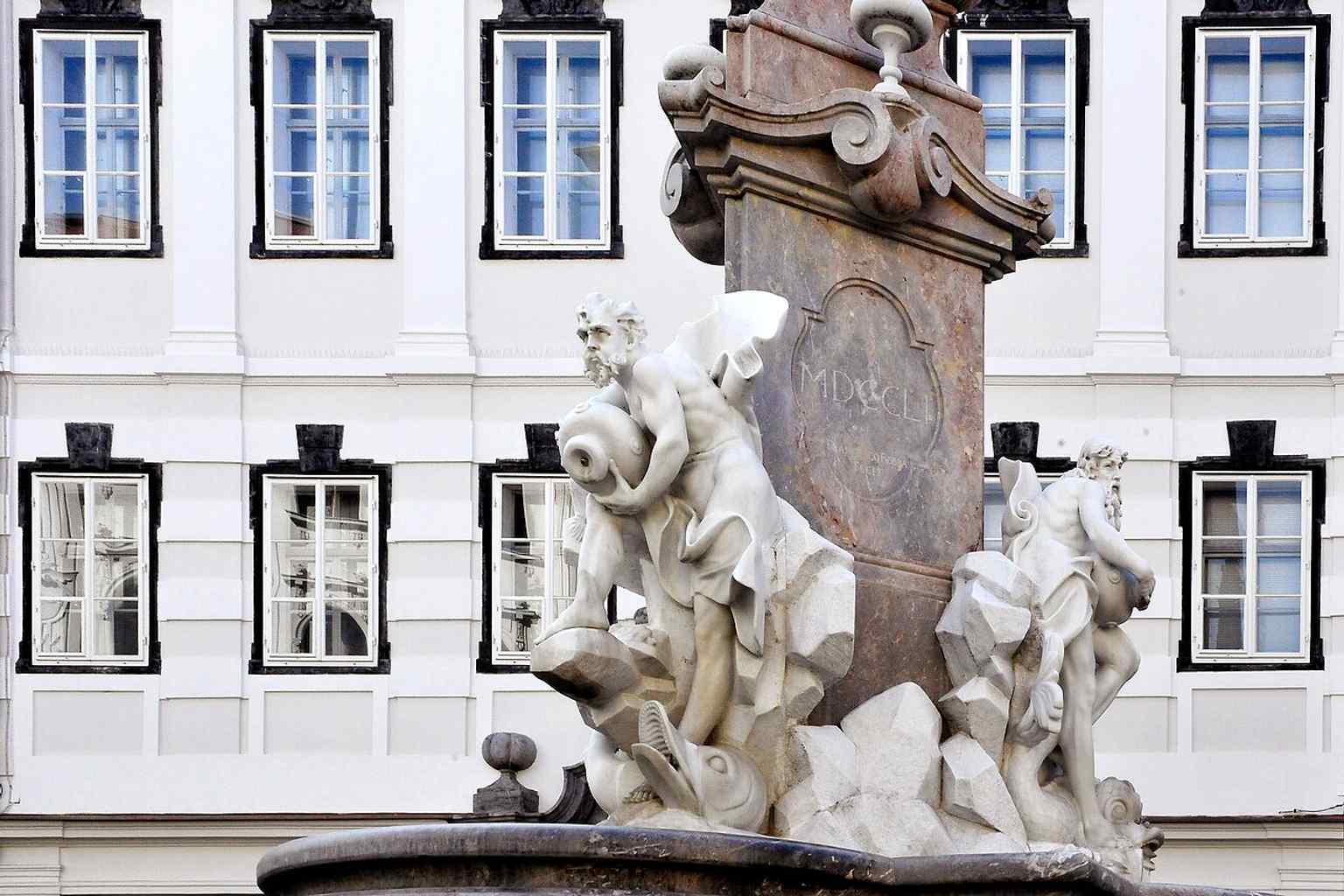
A detail shot highlighting the muscular male figures, each holding a water jug and accompanied by a dolphin, symbolising the rivers and territorial units of Carniola.Photo: LBM1948, Wikimedia Commons, CC BY-SA 4.0. Cropped & resized. 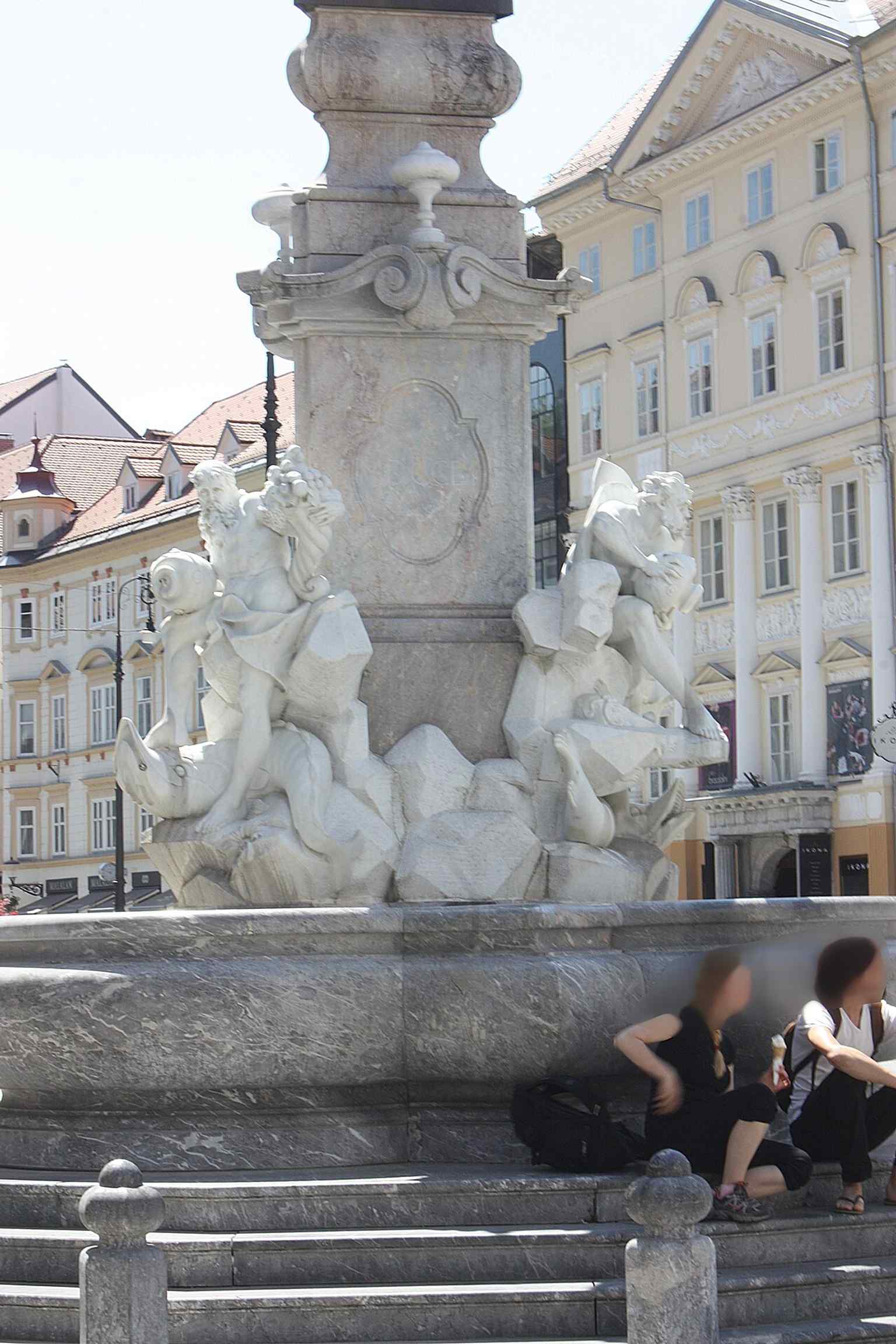
The trefoil-shaped basin above a stepped base represents the Carniolan mountains, a design choice mirroring Ljubljana's ancient three-leaf town seal.Photo: Dguendel, Wikimedia Commons, CC BY 3.0. Cropped & resized. To your right stands the Kresija Building, a massive pale stone structure with a symmetrical Neo-Renaissance facade, a style reviving the grand design of classical European…Read moreShow less
Open dedicated page →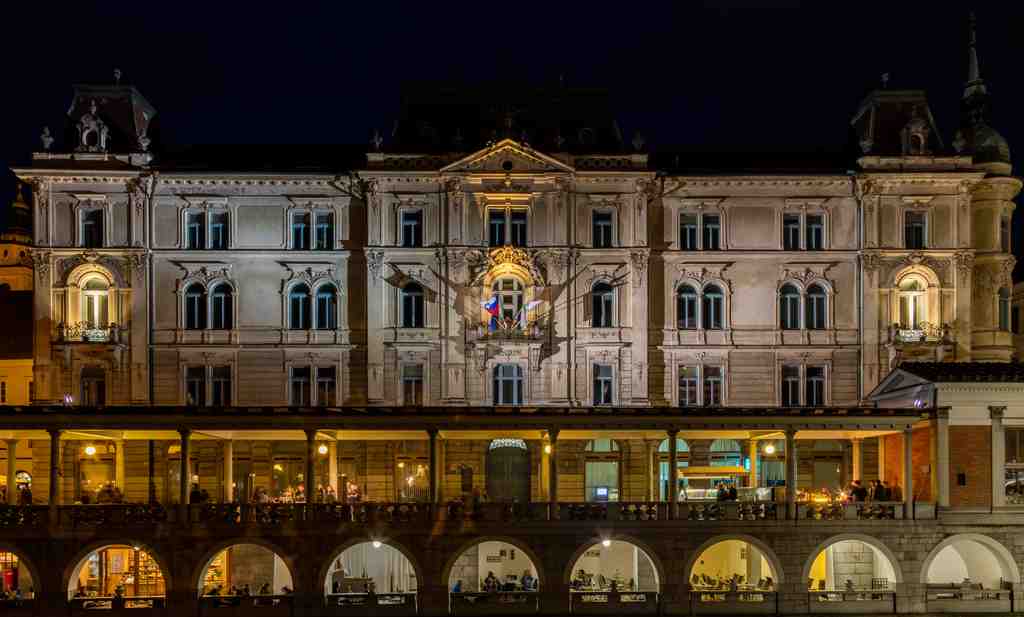
Kresija BuildingPhoto: Diego Delso, Wikimedia Commons, CC BY-SA 4.0. Cropped & resized. To your right stands the Kresija Building, a massive pale stone structure with a symmetrical Neo-Renaissance facade, a style reviving the grand design of classical European palaces, anchored by a prominent central balcony featuring a highly decorated coat of arms.
Check out the photo on your screen to get a better look at the details on that balcony. Those two sculpted figures flanking the coat of arms are genii, which are classical spirits meant to symbolize the civic virtues of Knowledge and Justice. It is a very deliberate display of municipal power and morality.
But the concept of justice here is deeply complicated. For over a century before this elegant palace was built, this exact spot was synonymous with the absolute poorest and most vulnerable people in the city.
Before the grand district offices moved in, a Foundling Hospital operated right here. It was a desperate last resort for destitute mothers who could not afford to keep their babies. Like many institutions of that era, it featured a revolving box built directly into the exterior wall. A mother could approach from the street, place her infant into a cylindrical compartment, ring a bell, and walk away. An attendant inside would rotate the box to safely receive the child. It was a heartbreaking system designed to prevent infants from being abandoned in the river just steps away.
Interestingly, the site also hosted an early medical school founded in 1753 by Gerard van Swieten, the personal physician to the Empress. He was a scientist best known for traveling across the empire to investigate an actual vampire hysteria. He proved the sightings of the undead were just natural decomposition, leading the Empress to formally ban the superstitious practice of staking corpses. His goal was to bring rational, clinical medicine to places like this very site.
But all of that layered history was quite literally shaken to its core by the 1895 Ljubljana earthquake. The massive tremor ruined the old hospital building. It barely remained standing, entirely structurally compromised and held up by a massive system of heavy wooden poles. It sat there like a haunting, skeletal reminder of the disaster for years.
You can actually see this dramatic transformation for yourself by checking out the before and after slider on your screen.
Eventually, city leaders decided to demolish the tragic ruins and build something visionary. Mayor Hribar wanted a grand gateway to the old town, a proud symbol of the city rising from the rubble. So, in 1897, this building was erected. Its name, Kresija, comes from Kreisamt, the German word for the local district administrative office. The city essentially swapped a site of desperate survival for a bold monument of modern administration.
It is a striking contrast, knowing the crushing poverty of the past is buried beneath the confident architecture of the future. The building is still used for municipal offices today, and is generally open to the public daily from ten to six, though it closes at two on Saturdays and one on Sundays.
Take a moment to absorb the weight of that history. When you are ready, let us keep moving. Head toward the bustling riverside right in front of you, and we will follow it down to the lively Ljubljana Central Market, which is just about a five minute walk away.
To your left stands the cathedral, easily spotted by its pale stucco facade, the prominent green copper octagonal dome, and twin rectangular bell towers topped with matching green…Read moreShow less
Open dedicated page →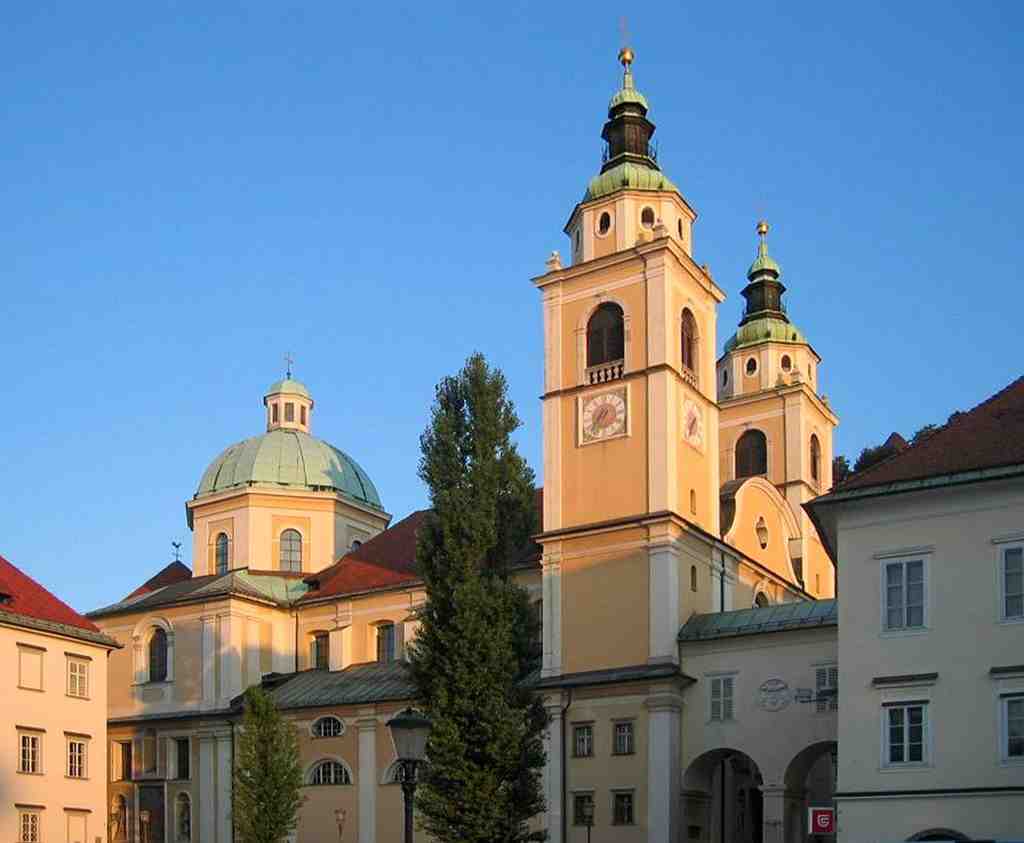
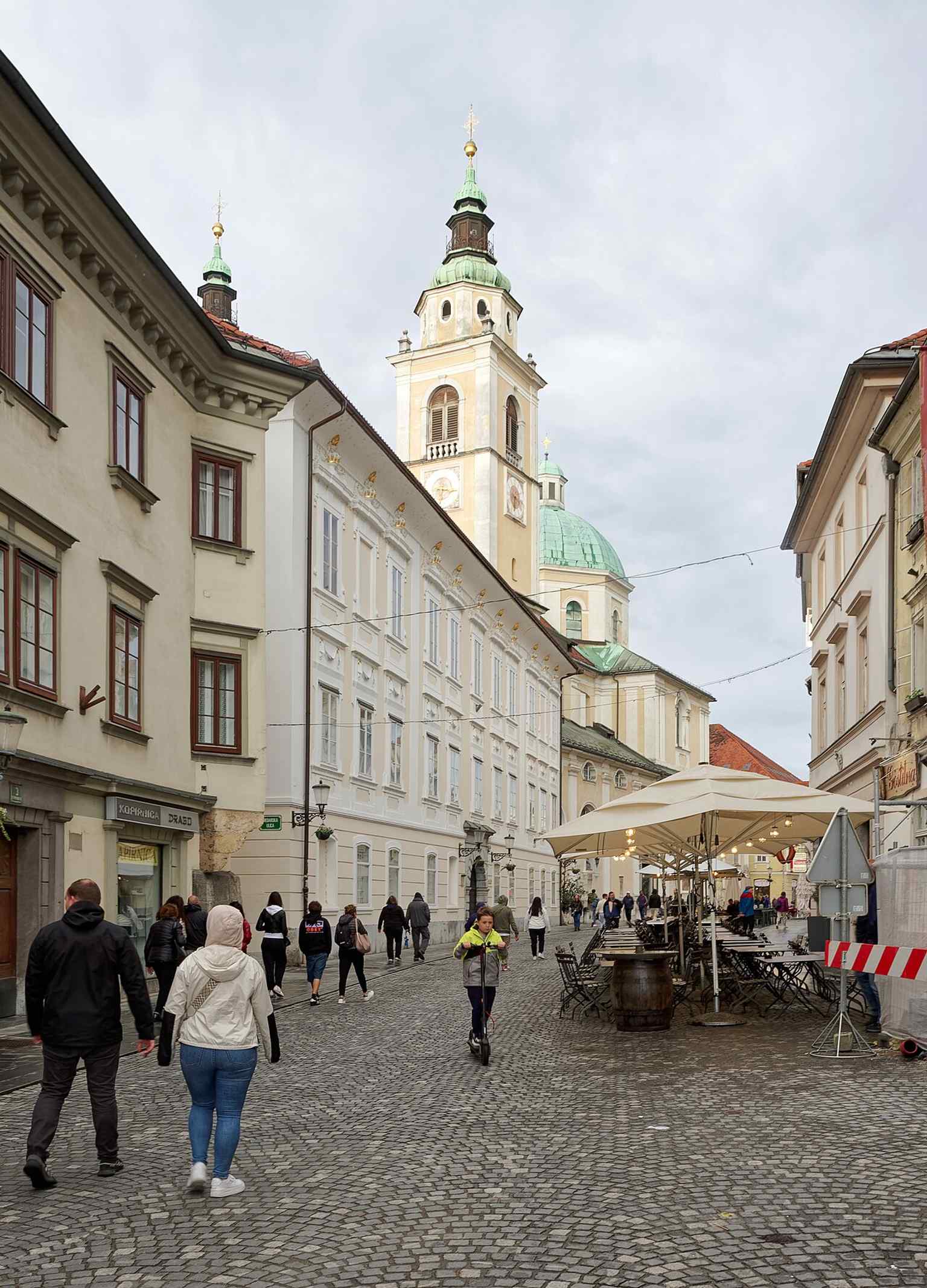
Ljubljana CathedralPhoto: Žiga, Wikimedia Commons, Public domain. Cropped & resized. To your left stands the cathedral, easily spotted by its pale stucco facade, the prominent green copper octagonal dome, and twin rectangular bell towers topped with matching green spires. This is Ljubljana Cathedral, officially Saint Nicholas's Church.
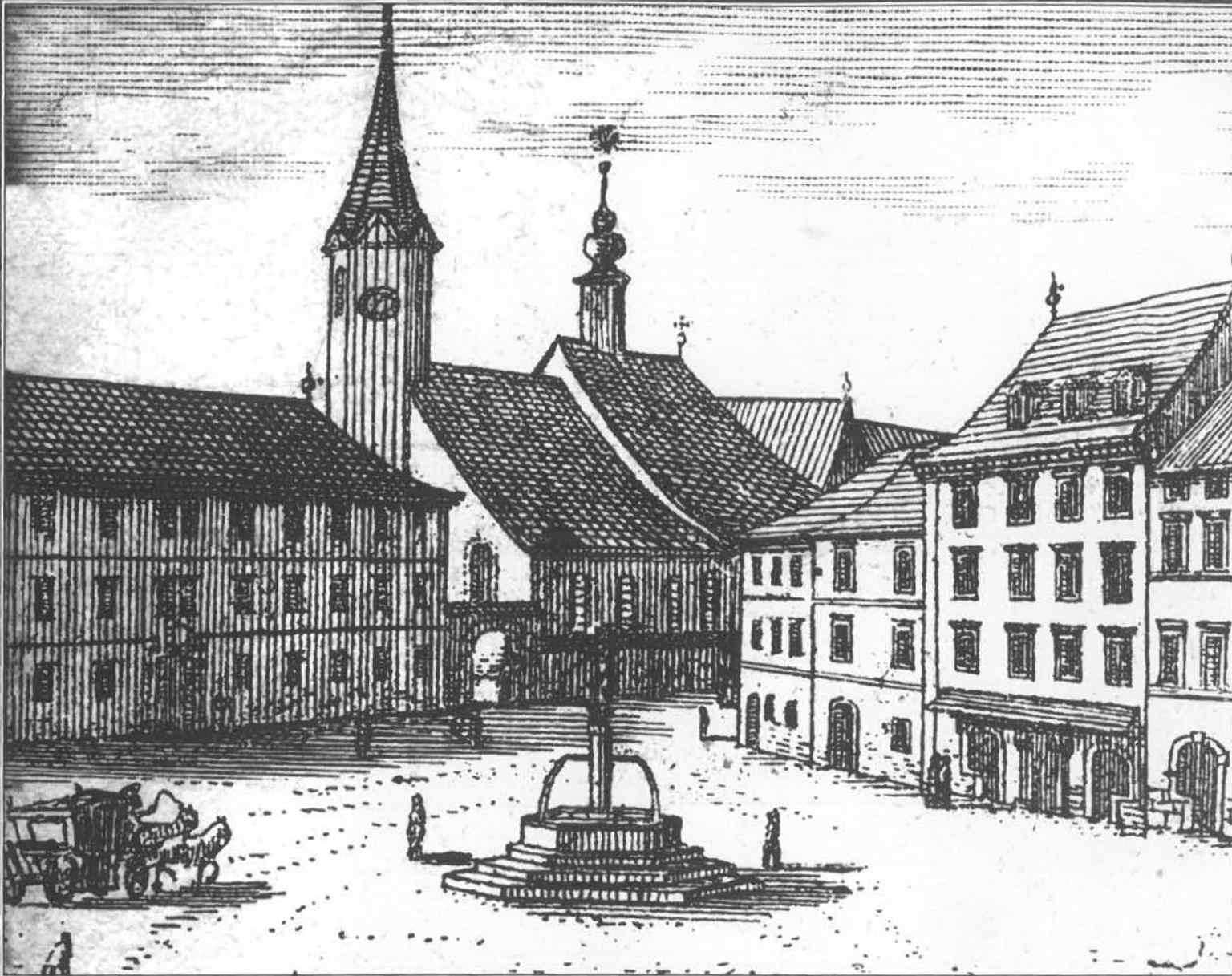
Its elegant exterior hides a rather dramatic past. Take a look at your screen for a 1689 engraving of this site's previous Gothic church. Back in 1469, just eight years after the church was elevated to a cathedral, it burned to the ground. The fire was a devastating blow, widely believed to be an act of arson by Ottoman forces raiding the territory. The ruins left a fragile structure that remained vulnerable for over two centuries. But out of that ash came a fierce desire to build something enduring.
Enter Dean Janez Gregor Dolničar. In the early 1700s, Dolničar became the relentless engine behind a grand Baroque masterpiece, acting as the project's main agitator. He faced tremendous hurdles. Ljubljana was in the middle of a massive building boom, meaning construction materials were incredibly scarce, and the wages for masons had absolutely skyrocketed. Dolničar spent years navigating these economic pressures before finally securing basilica plans from the renowned Jesuit architect Andrea Pozzo.
To overcome the staggering costs of the construction, Dolničar embraced a bold compromise. He hired Italian master Giulio Quaglio to paint the intricate Baroque ceiling frescoes you can see on your screen. Quaglio also painted the famous illusionistic fake dome, the cupola finta, which served as a dazzling placeholder for over a century. Quaglio even snuck his only known self-portrait into the presbytery frescoes.
Admire the intricate Baroque ceiling frescoes by Italian master Giulio Quaglio, part of the extensive decoration work completed between 1703–1706 and 1721–1723.Photo: Petar Milošević, Wikimedia Commons, CC BY-SA 4.0. Cropped & resized. A real octagonal dome was finally added in 1841. But the building's trials were not over. During the great earthquake, the tremor severely compromised the cathedral's facade. The original Baroque semi-circular gable between the towers was deemed too unstable and had to be replaced with a simple triangular one. It took nearly a century until a 1989 structural assessment finally allowed the city to reconstruct the original, sweeping Baroque design you see today.
It seems this building just refuses to stay down. If you look up at the belfries, those golden apples at the very top are actually time capsules, holding relics and parchments since 1706. The towers also house a medieval bell cast in 1326, a rare survivor from the original ruined church.
If you want to explore the interior, the cathedral is generally open daily from eleven to six, with slightly shorter split hours on Sundays.
Now, let us continue our walk toward the striking red facade of the Church of the Annunciation, which is about a six minute walk away.
See the dome frescoes depicting the Holy Spirit and angels, painted by Matej Sternen in 1843–44, replacing the original illusionistic 'cupola finta'.Photo: Petar Milošević, Wikimedia Commons, CC BY-SA 4.0. Cropped & resized. 
Experience the grandeur of the Baroque interior, where much of the original decor and vibrant frescoes by Giulio Quaglio remain.Photo: Thaler Tamas, Wikimedia Commons, CC BY-SA 4.0. Cropped & resized. 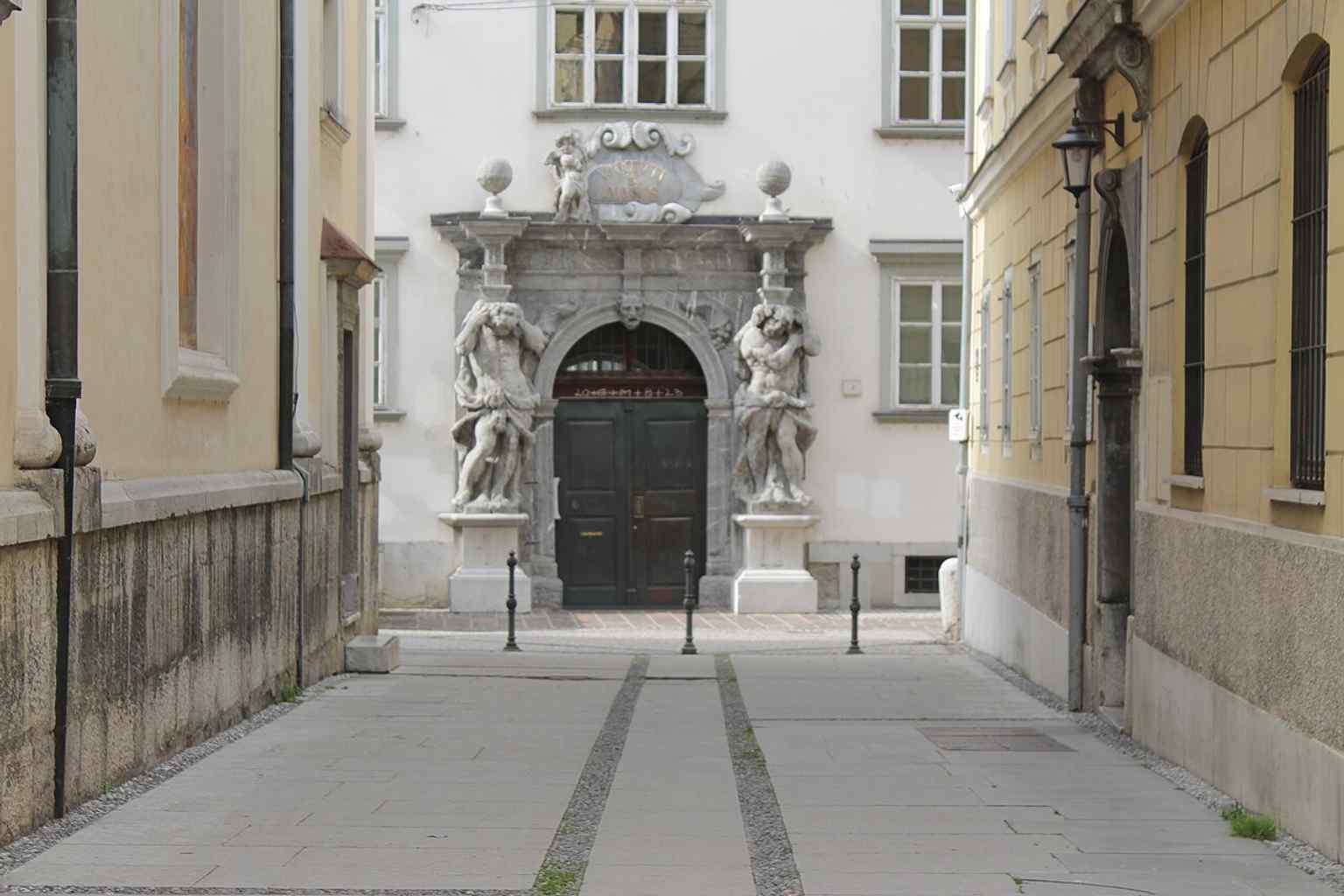
The cathedral is an easily recognizable landmark of Ljubljana, featuring its prominent green dome and distinctive twin towers.Photo: John Samuel, Wikimedia Commons, CC BY-SA 4.0. Cropped & resized. 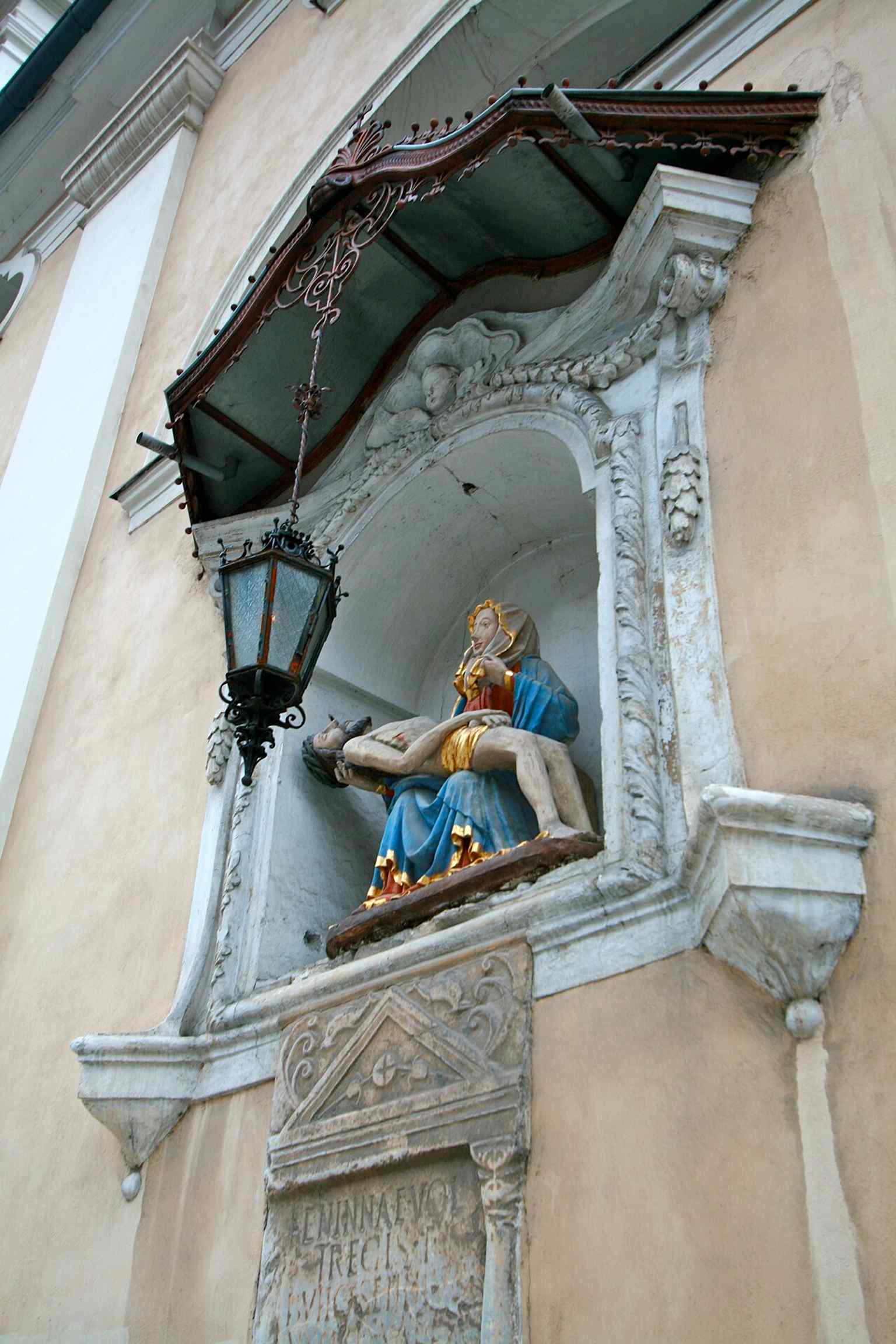
Look closely at the western facade for a plaque with a ceiling boss, a 'Memoria veteris ecclesiae cathedralis' relic from the original Gothic church.Photo: John Samuel, Wikimedia Commons, CC BY-SA 4.0. Cropped & resized. 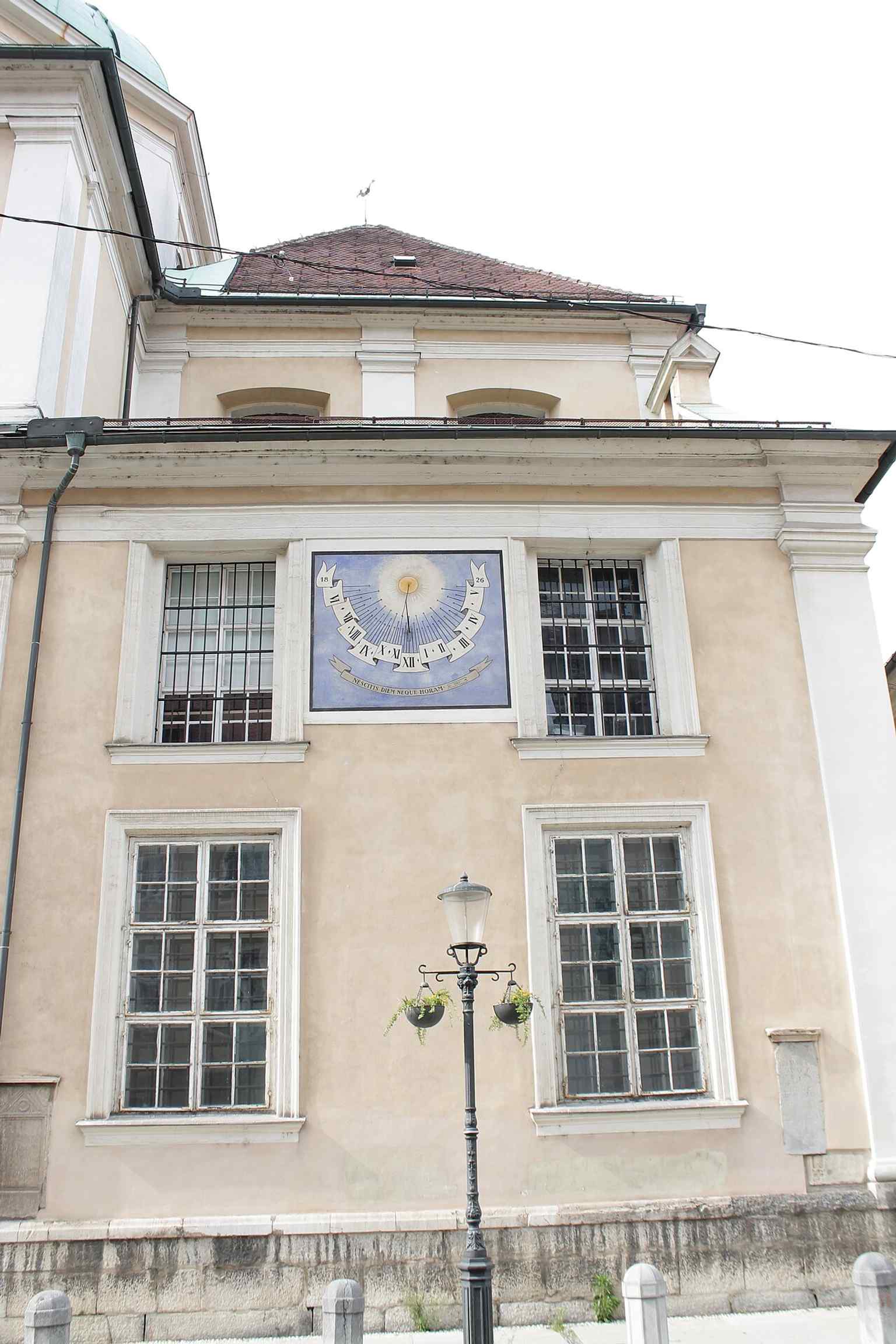
Notice the 1826 sundial on the southern facade, inscribed with the Latin motto 'Nescitis diem neque horam' (You don't know the day or the hour).Photo: John Samuel, Wikimedia Commons, CC BY-SA 4.0. Cropped & resized. 
View the southern facade, which features the historic sundial and the niche containing a copy of the Gothic Pietà.Photo: John Samuel, Wikimedia Commons, CC BY-SA 4.0. Cropped & resized. 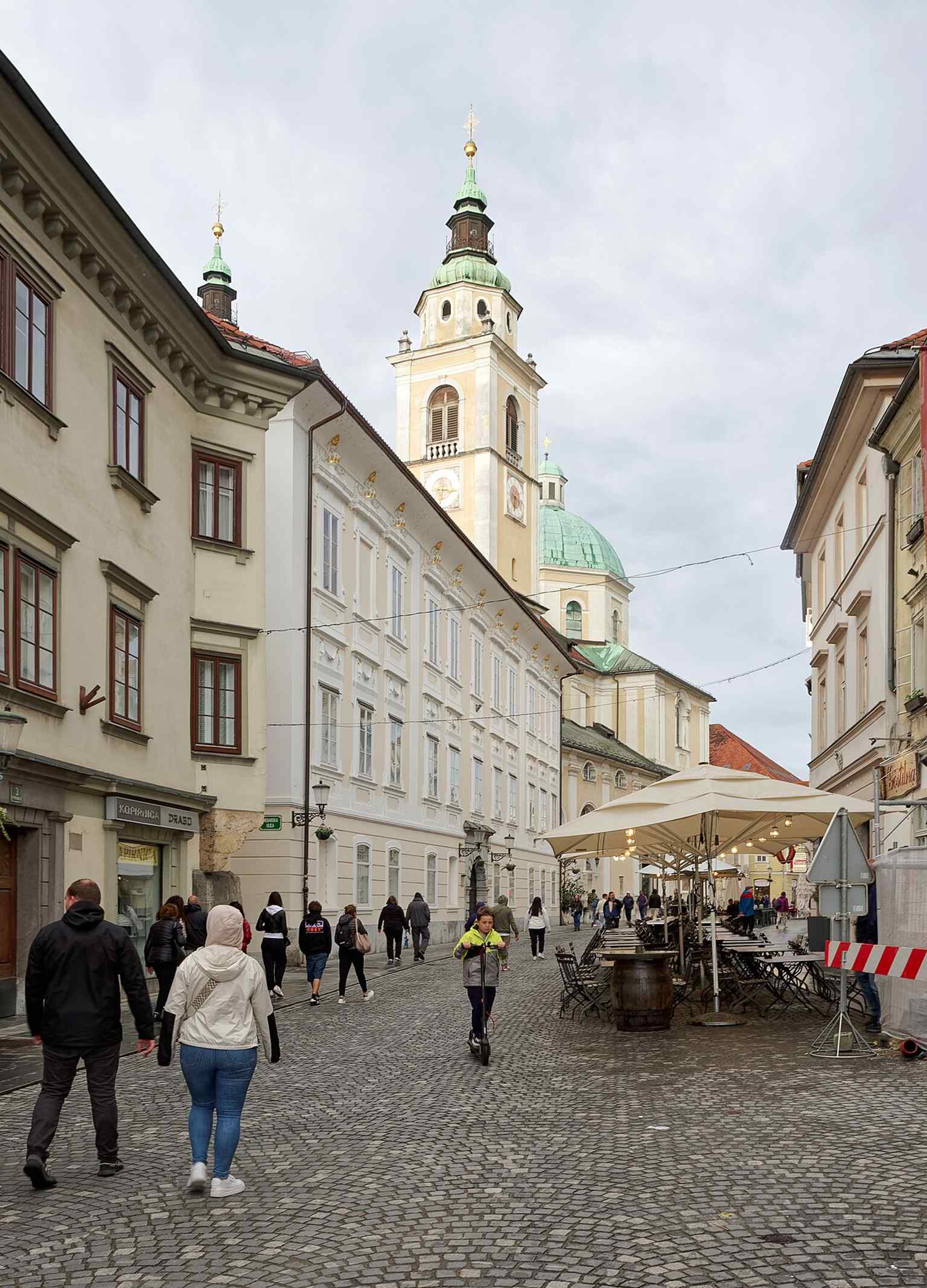
An exterior view showing the cathedral situated at Cyril and Methodius Square, by the nearby Central Market and Town Hall.Photo: Jakub Hałun, Wikimedia Commons, CC BY 4.0. Cropped & resized. On your left stands the Church of the Annunciation, defined by its smooth salmon-pink walls, tall white rectangular columns called pilasters, and a striking copper statue standing…Read moreShow less
Open dedicated page →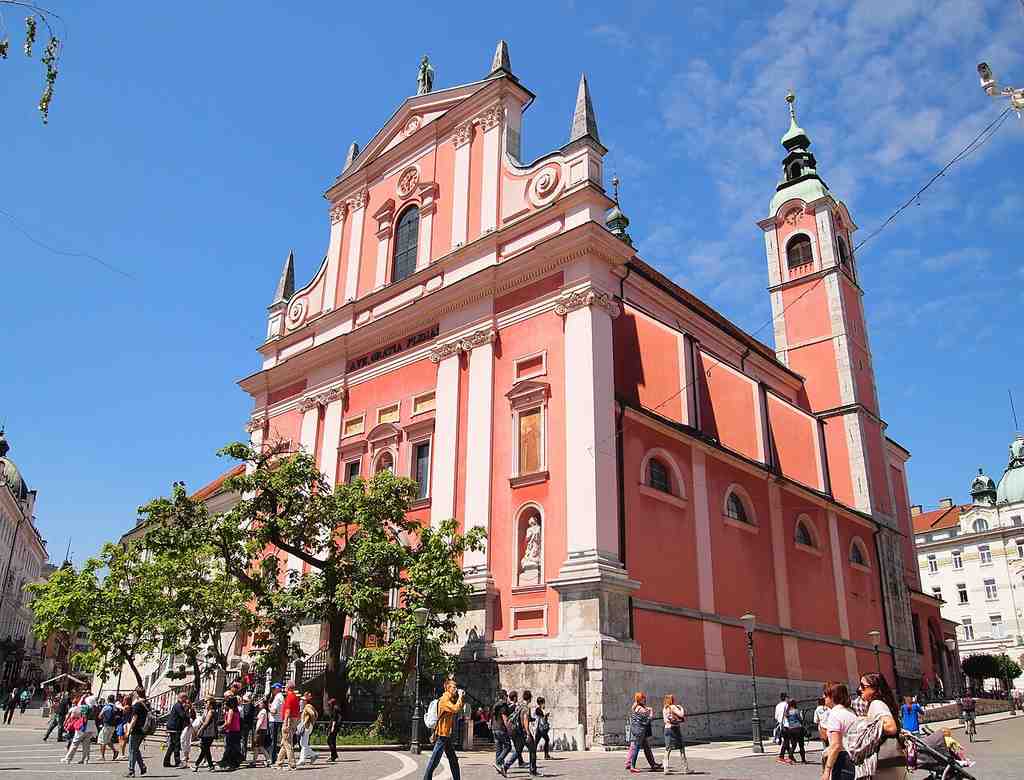
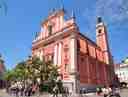
Church of the Annunciation, LjubljanaPhoto: Tiia Monto, Wikimedia Commons, CC BY-SA 3.0. Cropped & resized. On your left stands the Church of the Annunciation, defined by its smooth salmon-pink walls, tall white rectangular columns called pilasters, and a striking copper statue standing at the very top of its triangular roof.
The story of this ground begins with the Augustinian Order, a Catholic community of monks dedicated to poverty and education, who laid the groundwork here by building a modest church in sixteen twenty-eight. But in sixteen forty-five, a devastating fire tore through the structure, reducing decades of devotion to ash and charred timber.
Yet, from absolute ruin, a profound new vision took shape, driven by a tragedy far deeper than losing a building.
In that same year, a wealthy nobleman named Baron Konrad Ruessenstein received the kind of news that permanently breaks a person. His son, Janez Karel, had traveled to Rome for his studies... and he never came back. The young man died suddenly, leaving his father completely shattered.
The Baron was left with a vast sum of money, his son's entire inheritance, and a crushing void. He decided he could not keep the wealth meant for a future that would never happen. So, he took every single coin of that inheritance and poured it into the ashes of the ruined Augustinian church. He bankrolled an entirely new, massive structure in the early Baroque style, an architecture known for its dramatic, soaring spaces meant to inspire deep emotion.
But the Baron had one condition. He required the builders to create a Loreto chapel inside the church. A Loreto chapel is a specific type of shrine modeled after the purported childhood home of the Virgin Mary, and the Baron needed it to serve as a family tomb. It was to be a sacred vessel to hold his son's remains, and his memory, forever.
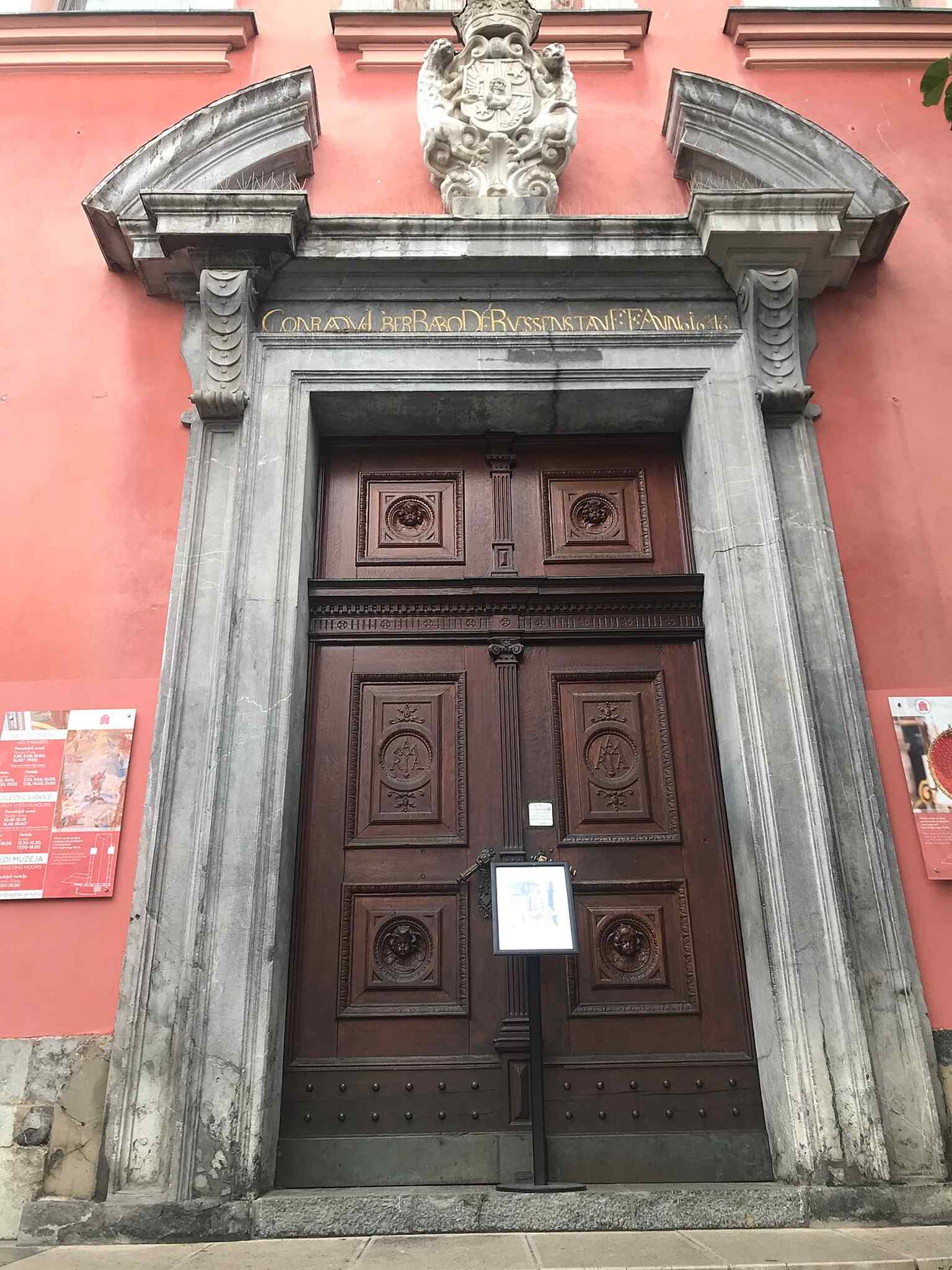
Take a look at the image on your screen. Just above the main entrance doors, you will notice a large, heavy stone coat of arms supported by two lions. That is the Ruessenstein family crest. It hangs there as a permanent, silent testament to a father's grief, carved in stone for all of Ljubljana to see.
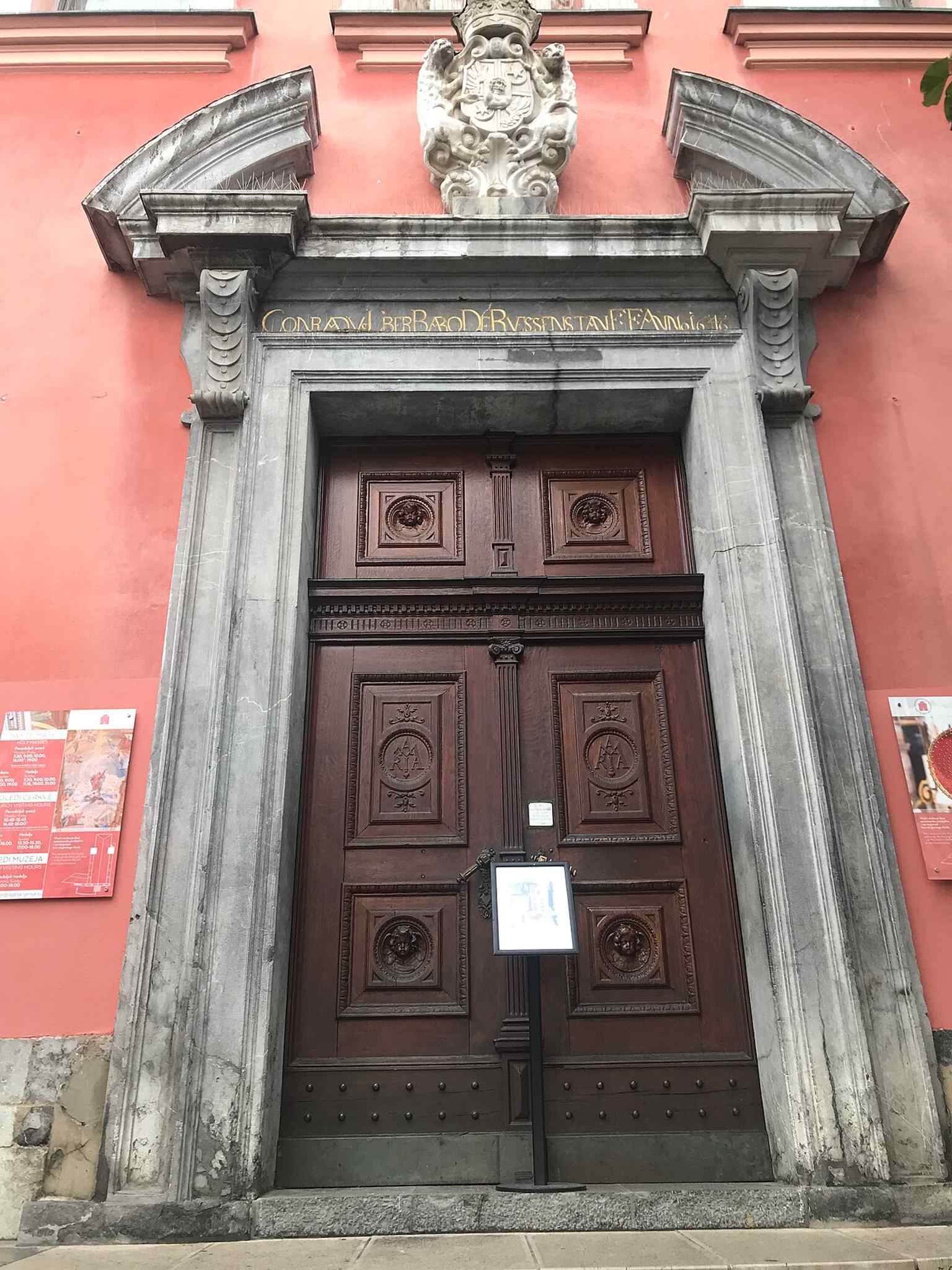
The main entrance door, part of the early Baroque design, leads into the church, which became the home of the Franciscans after the Augustinian order was abolished in the late 18th century.Photo: Antimuonium, Wikimedia Commons, CC BY-SA 4.0. Cropped & resized. By the late eighteenth century, government reforms abolished the Augustinian order, and the Franciscans moved in to take over the church. They painted the exterior a vibrant red, the symbolic color of their order, but decades of relentless sun eventually faded that striking red into the gentle salmon-pink you see today. The locals fell in love with the softer hue, and so it remained.
The church is still active, with opening hours running through most of the day and pausing briefly in the late afternoon. Take a moment to look closely at those heavy stone details above the door, and feel the weight of the history resting there. Next, we will transition seamlessly to the Franciscan Church of the Annunciation, right here where you stand.
The salmon-pink exterior of the Church of the Annunciation, a color preserved by citizens' preference despite original plans to return to red, stands prominently on Prešeren Square.Photo: Thaler Tamas, Wikimedia Commons, CC BY-SA 4.0. Cropped & resized. 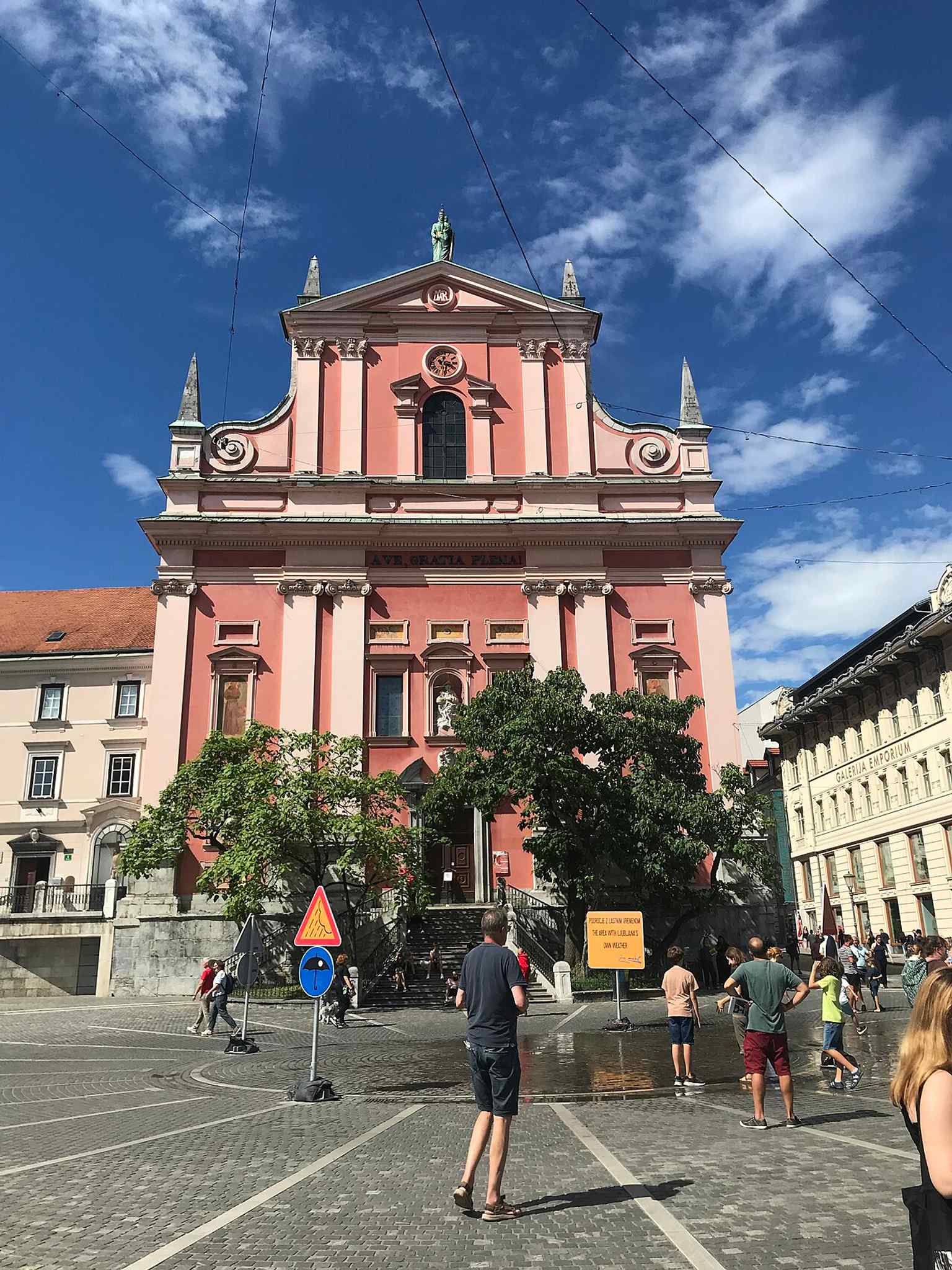
A vibrant view from Prešeren Square, showing the Church of the Annunciation, whose salmon-pink color represents the faded symbolic red of the Franciscan order.Photo: Antimuonium, Wikimedia Commons, CC BY-SA 4.0. Cropped & resized. 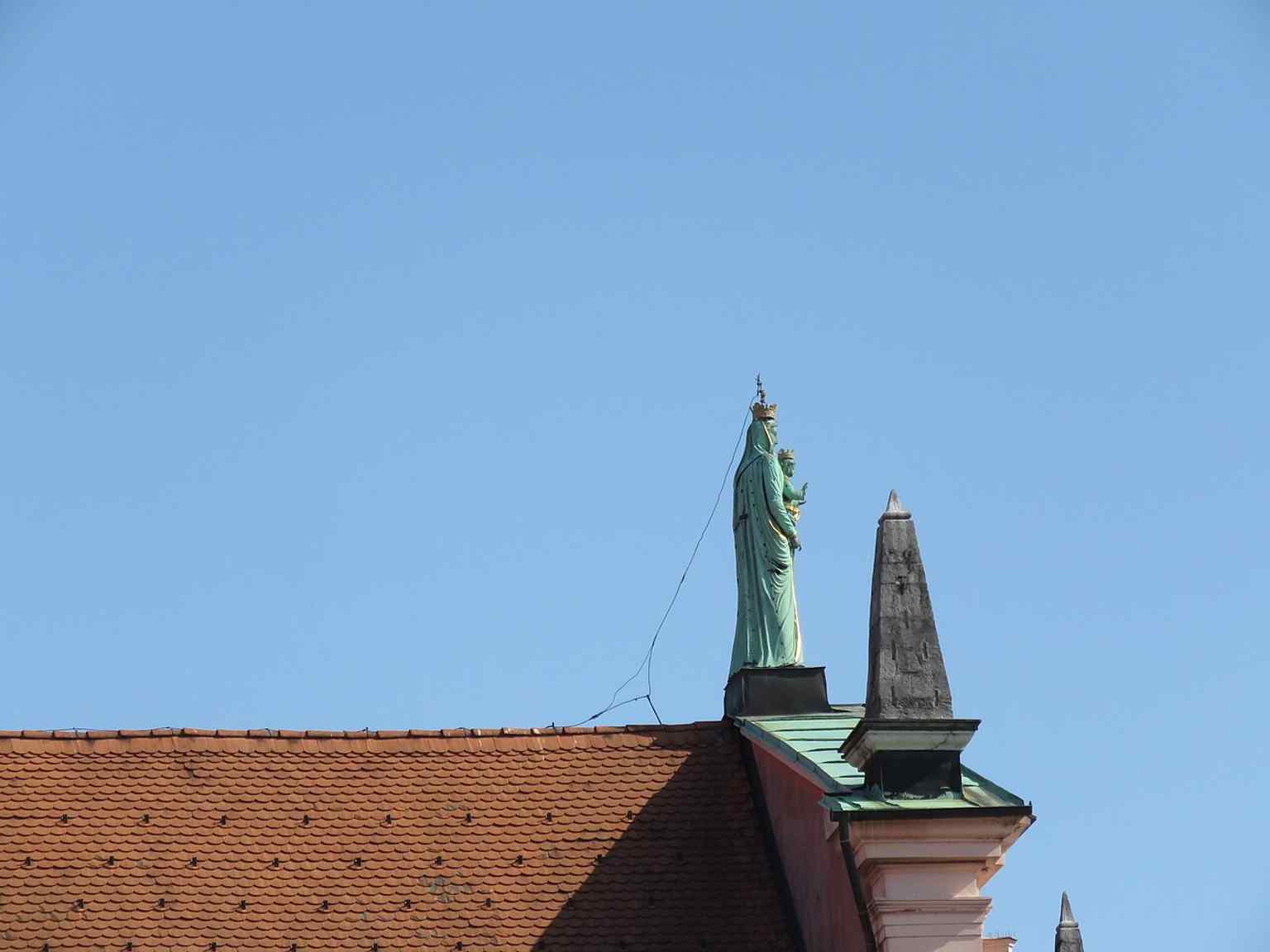
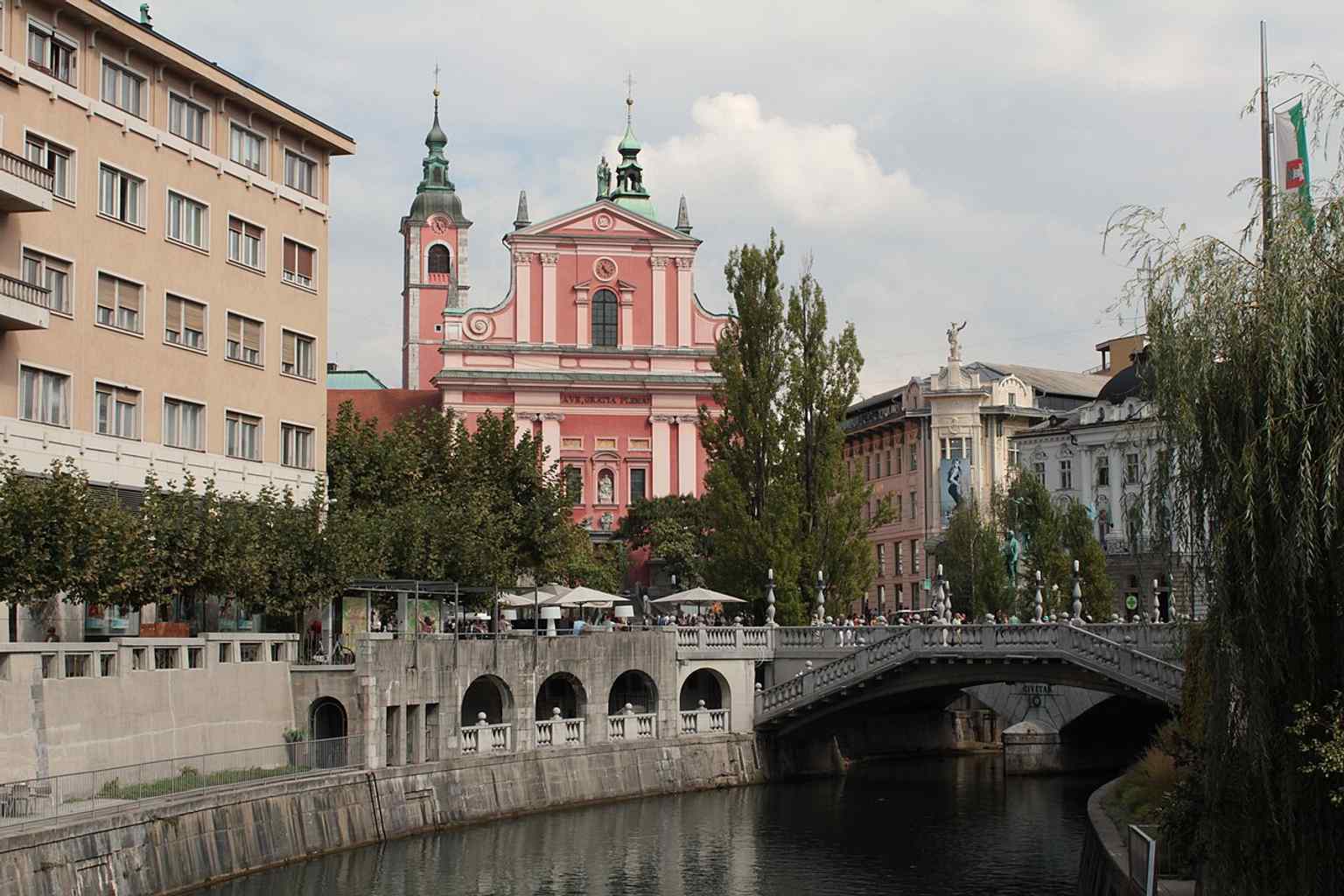
The church's early Baroque facade, designed with powerful pilasters and a triple-arched staircase, faces the Ljubljanica River.Photo: John Samuel, Wikimedia Commons, CC BY-SA 4.0. Cropped & resized. 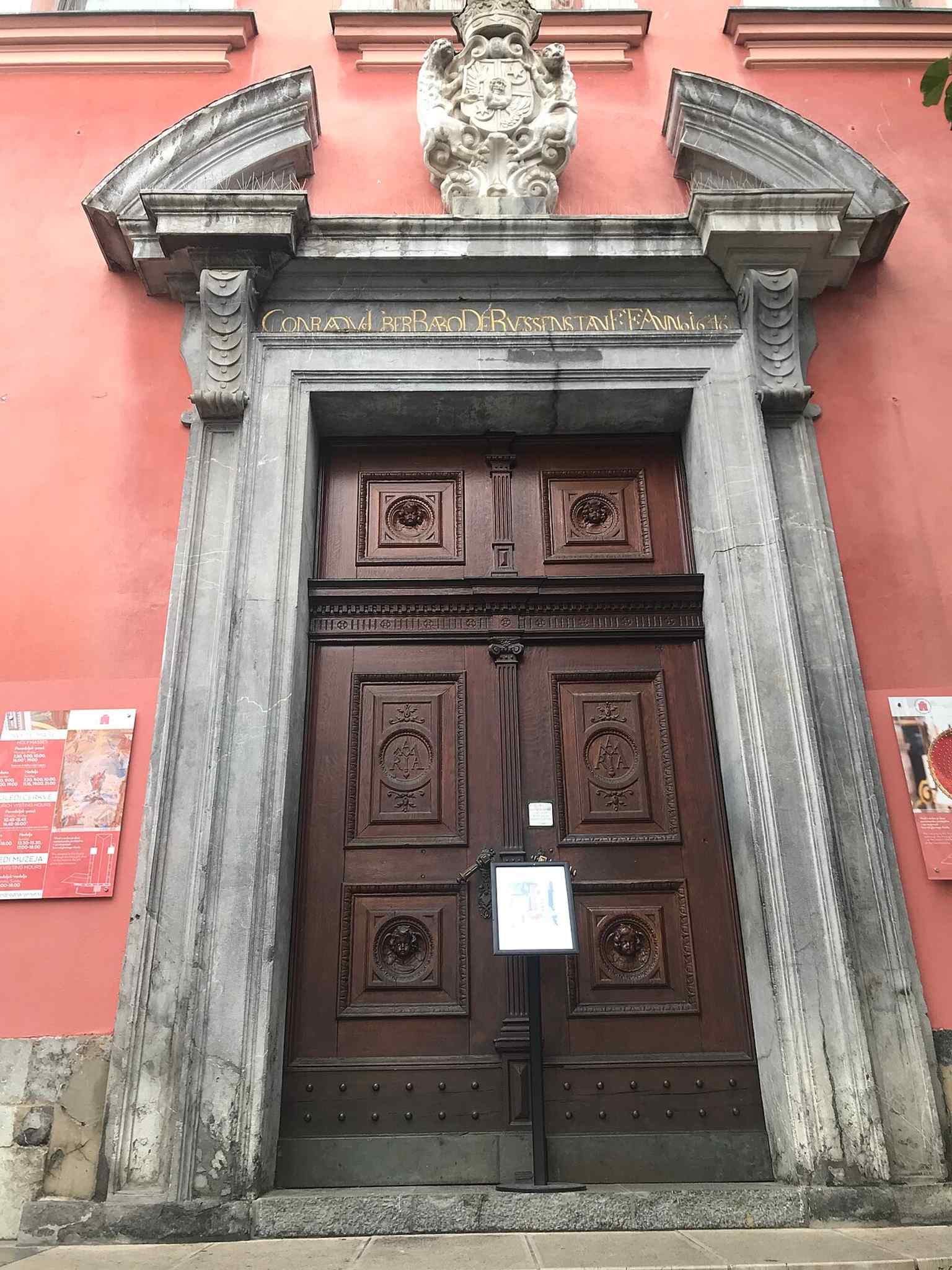
The largest copper statue of the Madonna in Ljubljana crowns the church's pediment, created in 1858 to replace an older wooden 'Black Madonna' statue.Photo: G-Cup, Wikimedia Commons, CC BY-SA 4.0. Cropped & resized. 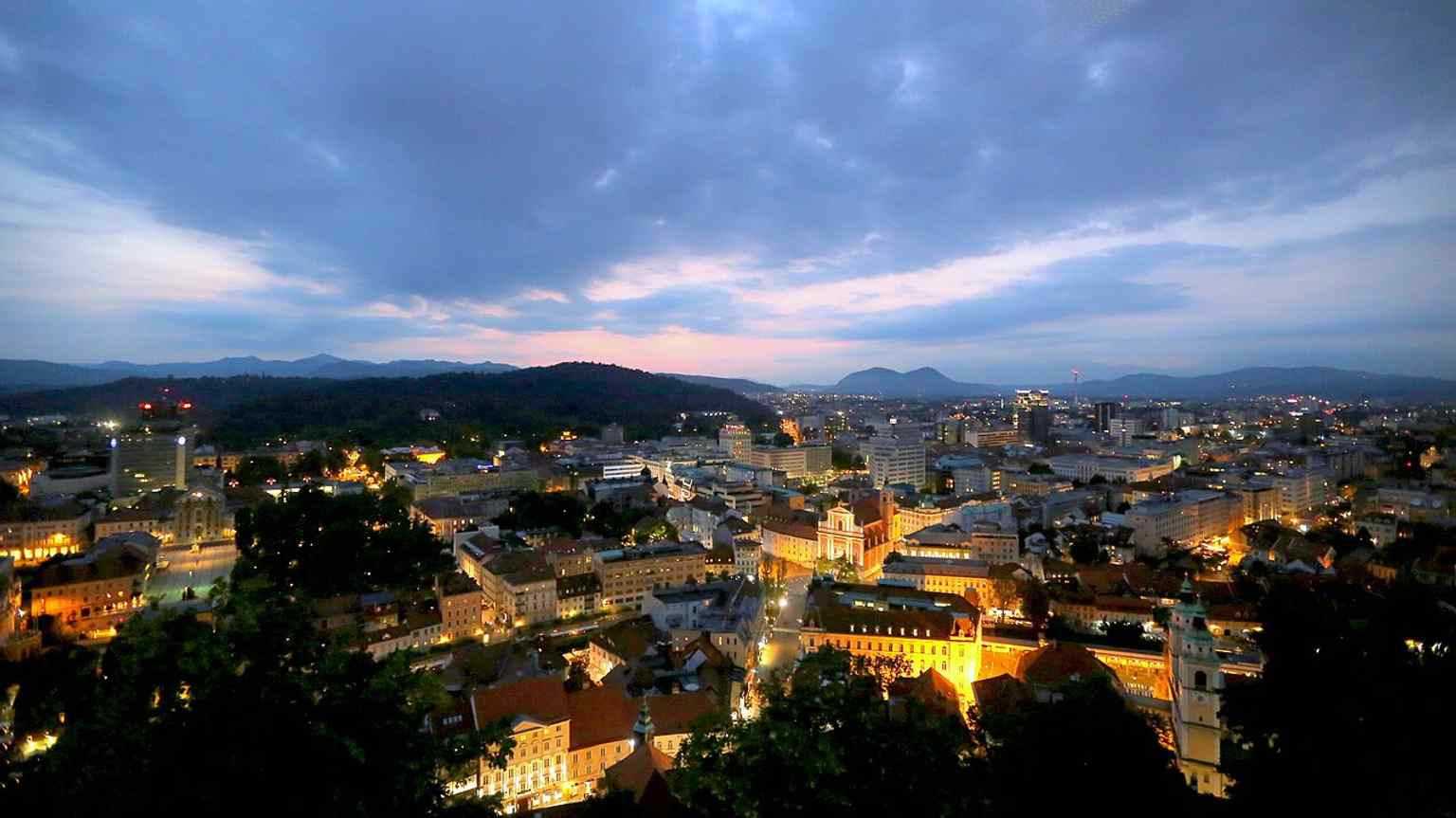
The church's front facade, originally built facing the Ljubljanica River, is now complemented by the triple-ramped staircase leading to its entrance.Photo: Jakub Hałun, Wikimedia Commons, CC BY 4.0. Cropped & resized. 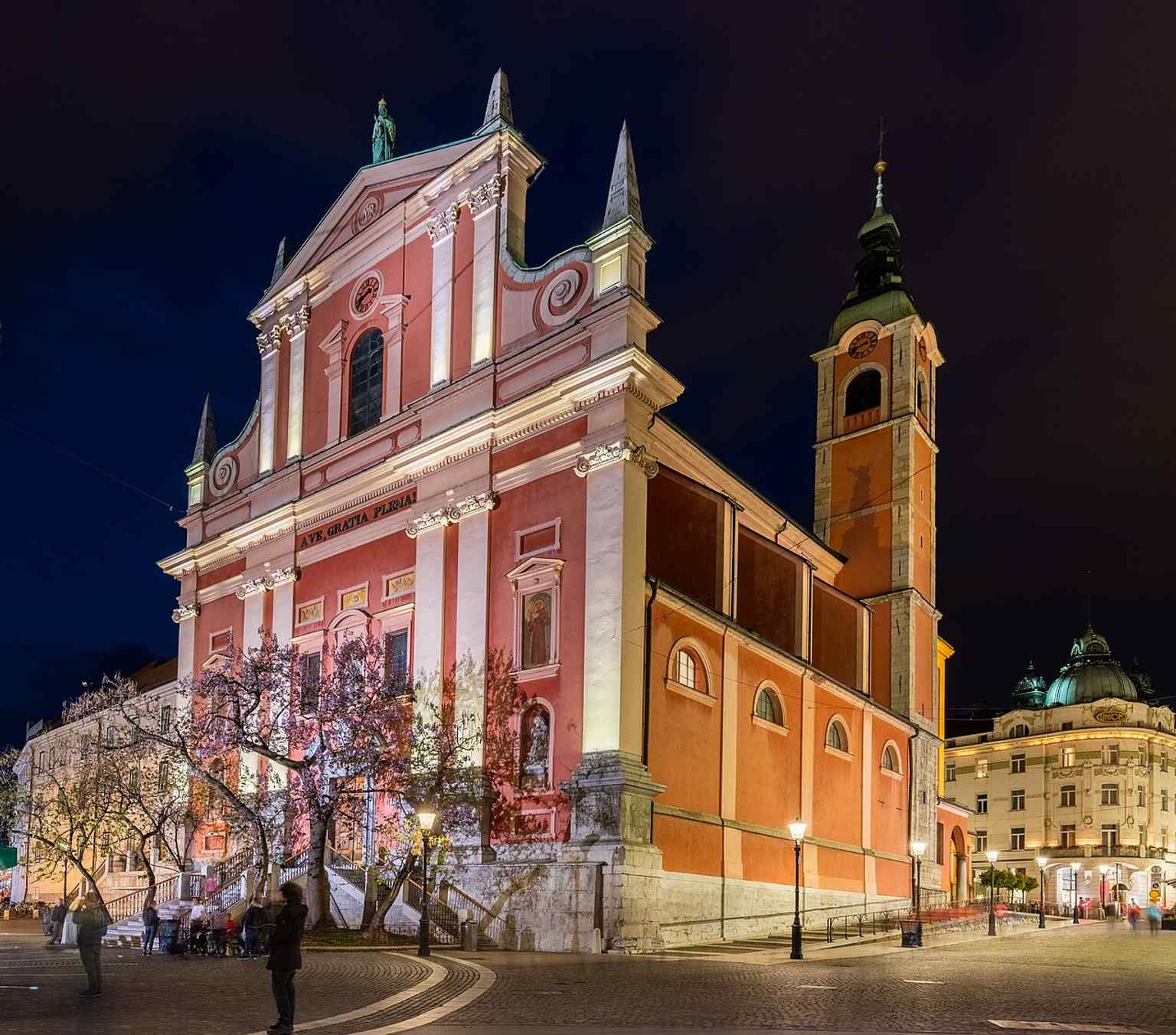
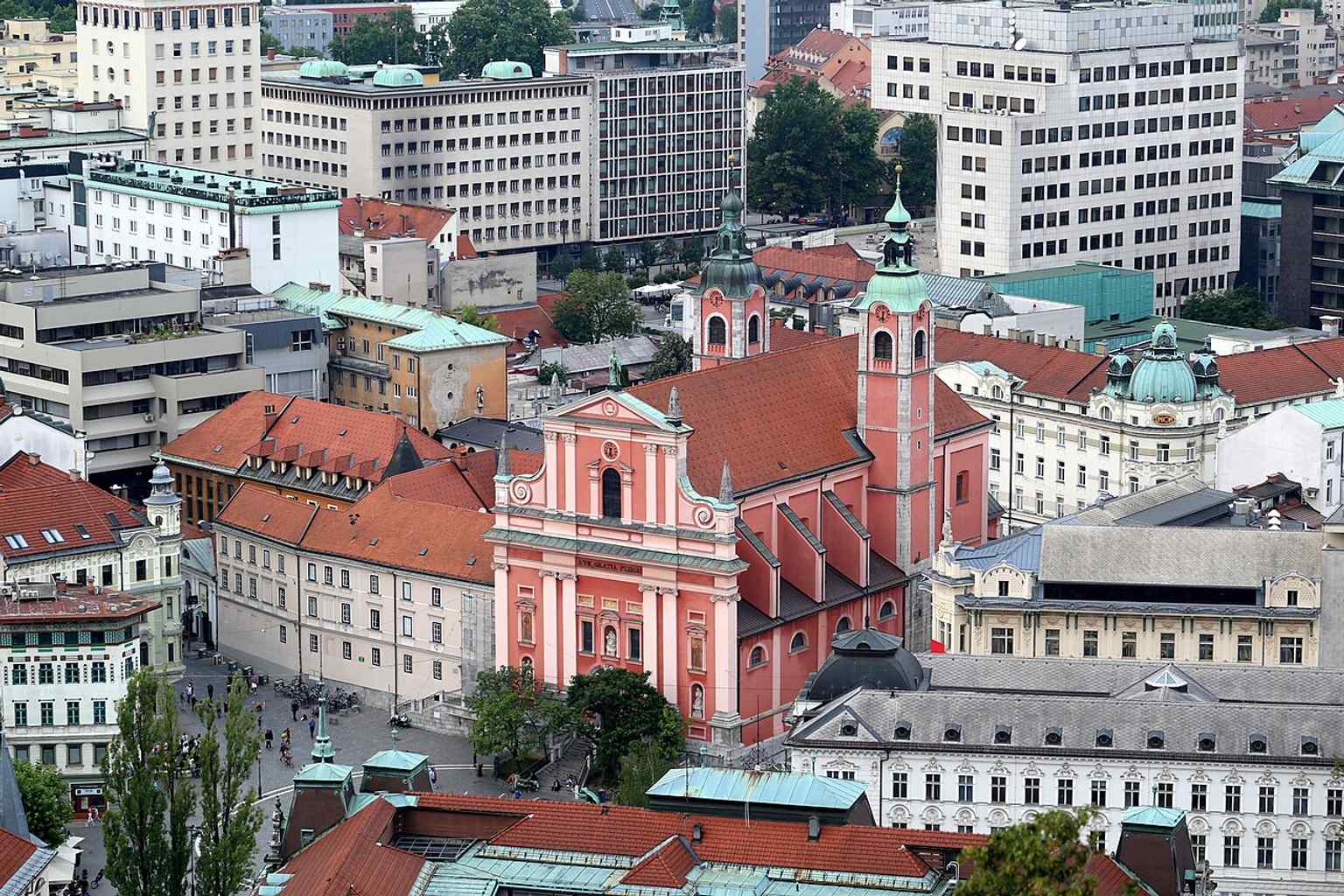
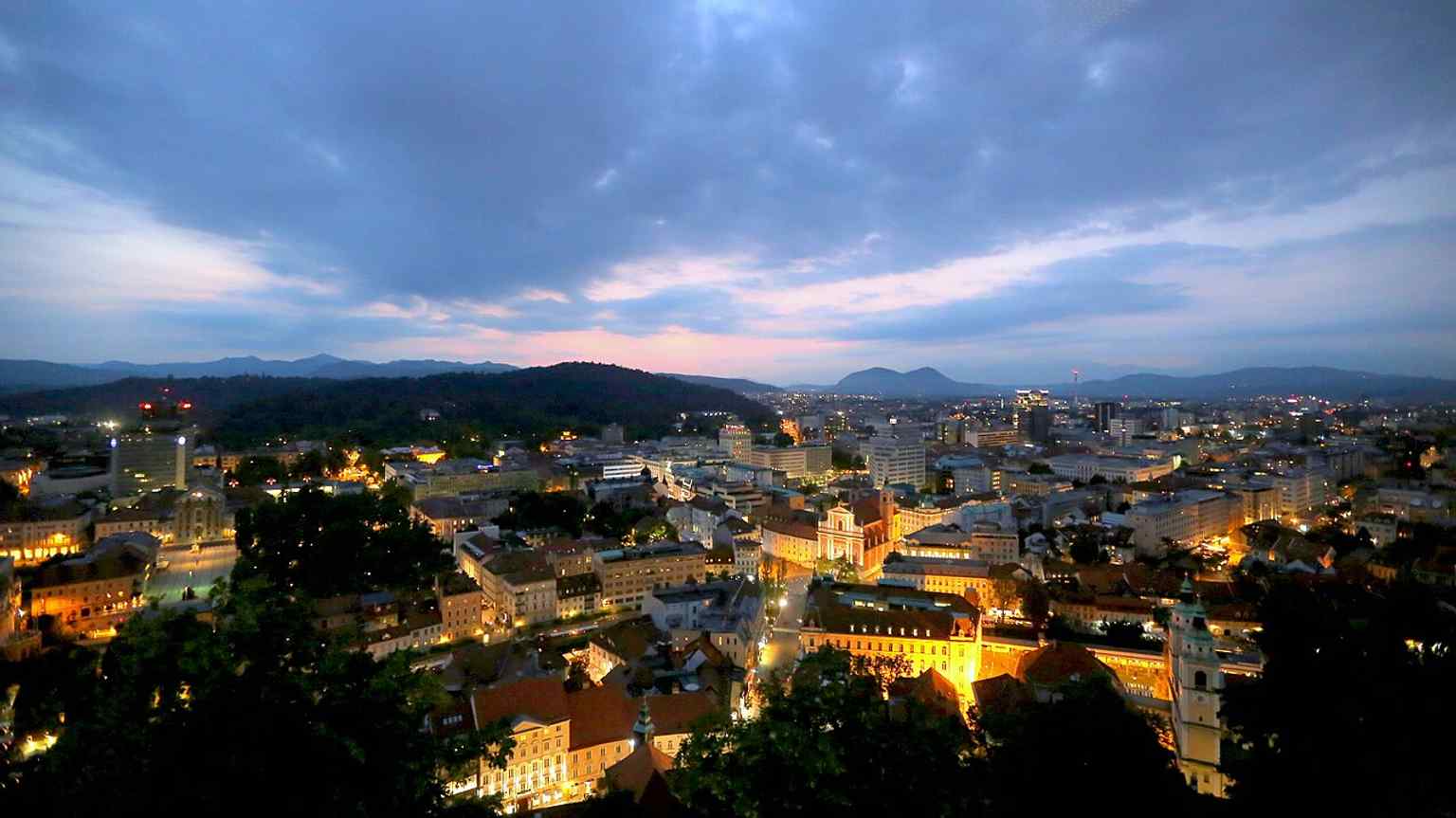
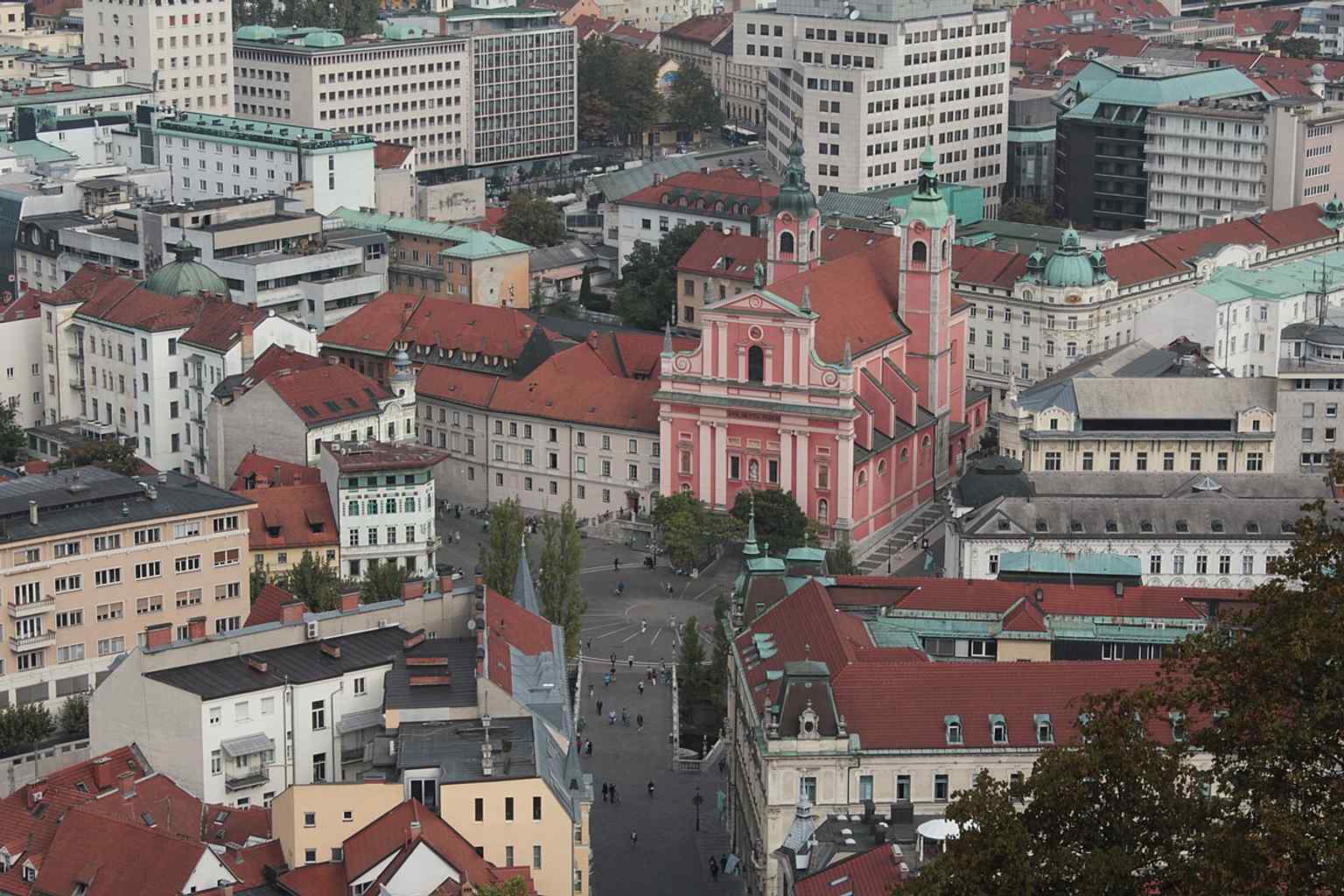
An aerial view from Ljubljana Castle highlights the church's strategic location near Prešeren Square, making it one of the city's most visited churches.Photo: Thaler Tamas, Wikimedia Commons, CC BY-SA 4.0. Cropped & resized. 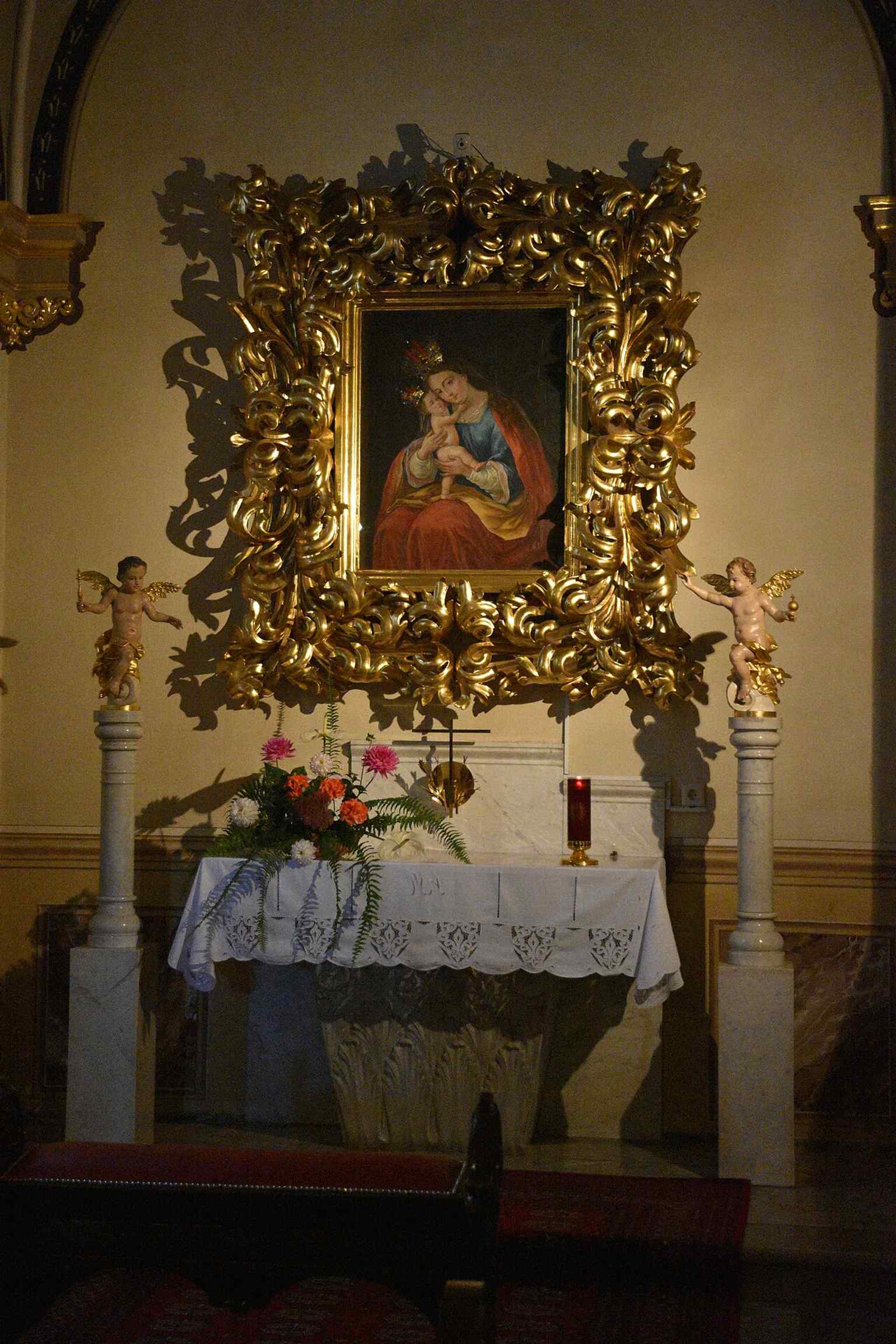
The monumental Baroque main altar, a masterpiece by Venetian sculptor Francesco Robba, was completed posthumously after his death in 1757.Photo: Arths-at, Wikimedia Commons, CC BY-SA 4.0. Cropped & resized. 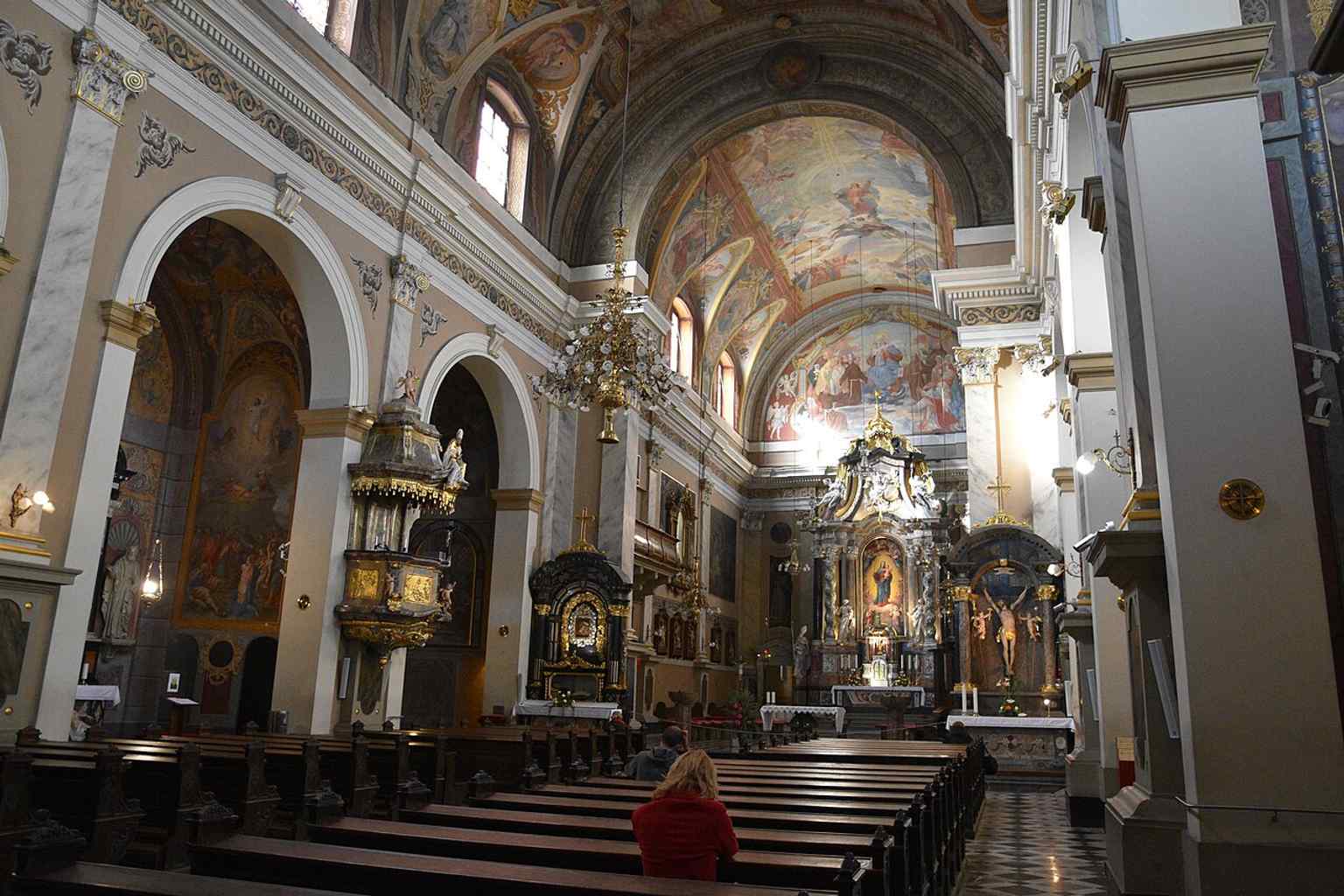
A detailed view of the main altar by Francesco Robba, near which lie the remains of St. Deodatus in a glass coffin.Photo: Arths-at, Wikimedia Commons, CC BY-SA 4.0. Cropped & resized. 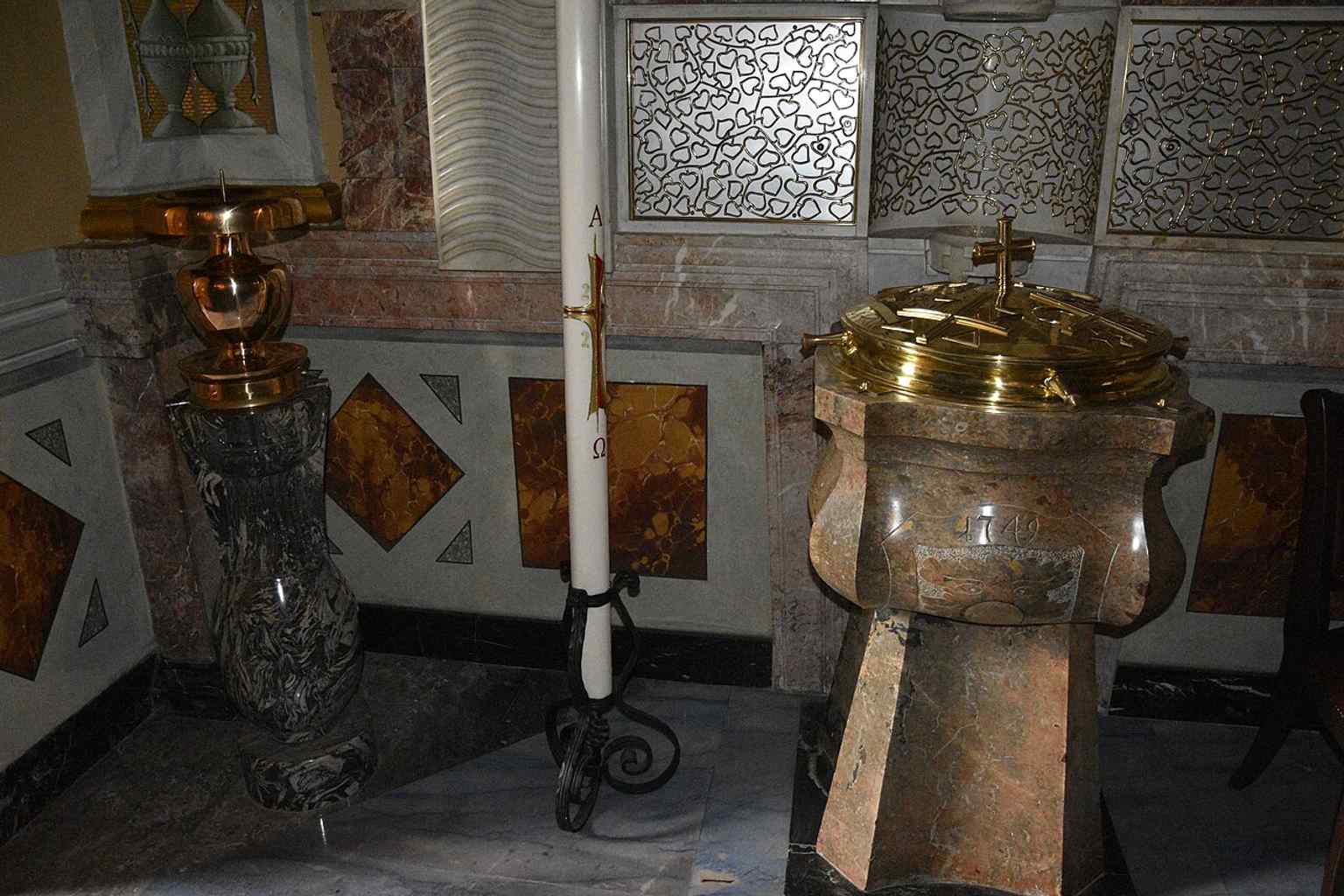
This ornate side chapel, featuring a baptismal font and rich altar equipment, showcases the early Baroque design of the church's single-nave hall with multiple chapels.Photo: Arths-at, Wikimedia Commons, CC BY-SA 4.0. Cropped & resized. 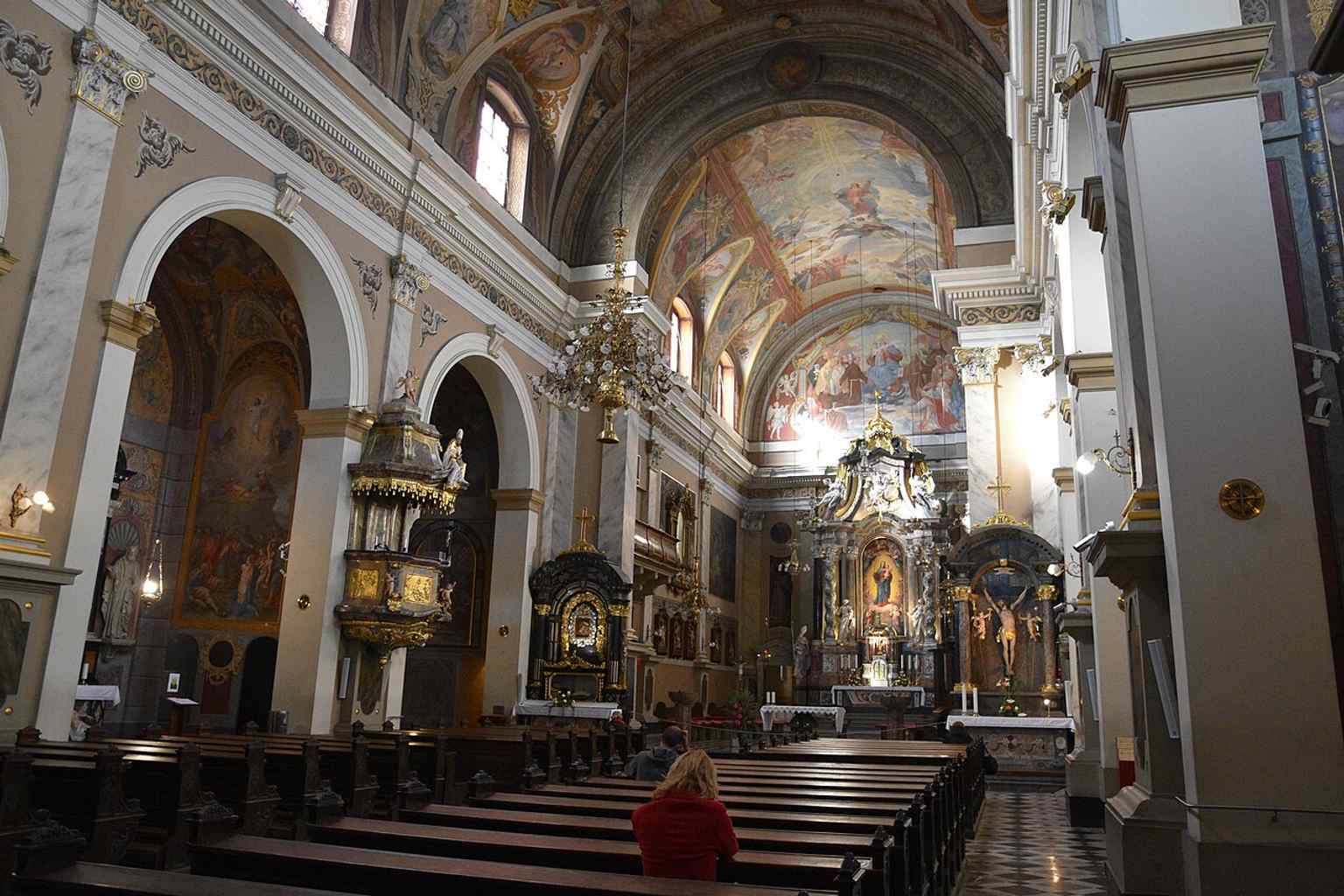
The stunning illusionistic Baroque frescoes on the nave ceiling were painted by modernist Matej Sternen in the 1930s, preserving the church's architectural harmony after earthquake damage.Photo: Arths-at, Wikimedia Commons, CC BY-SA 4.0. Cropped & resized. 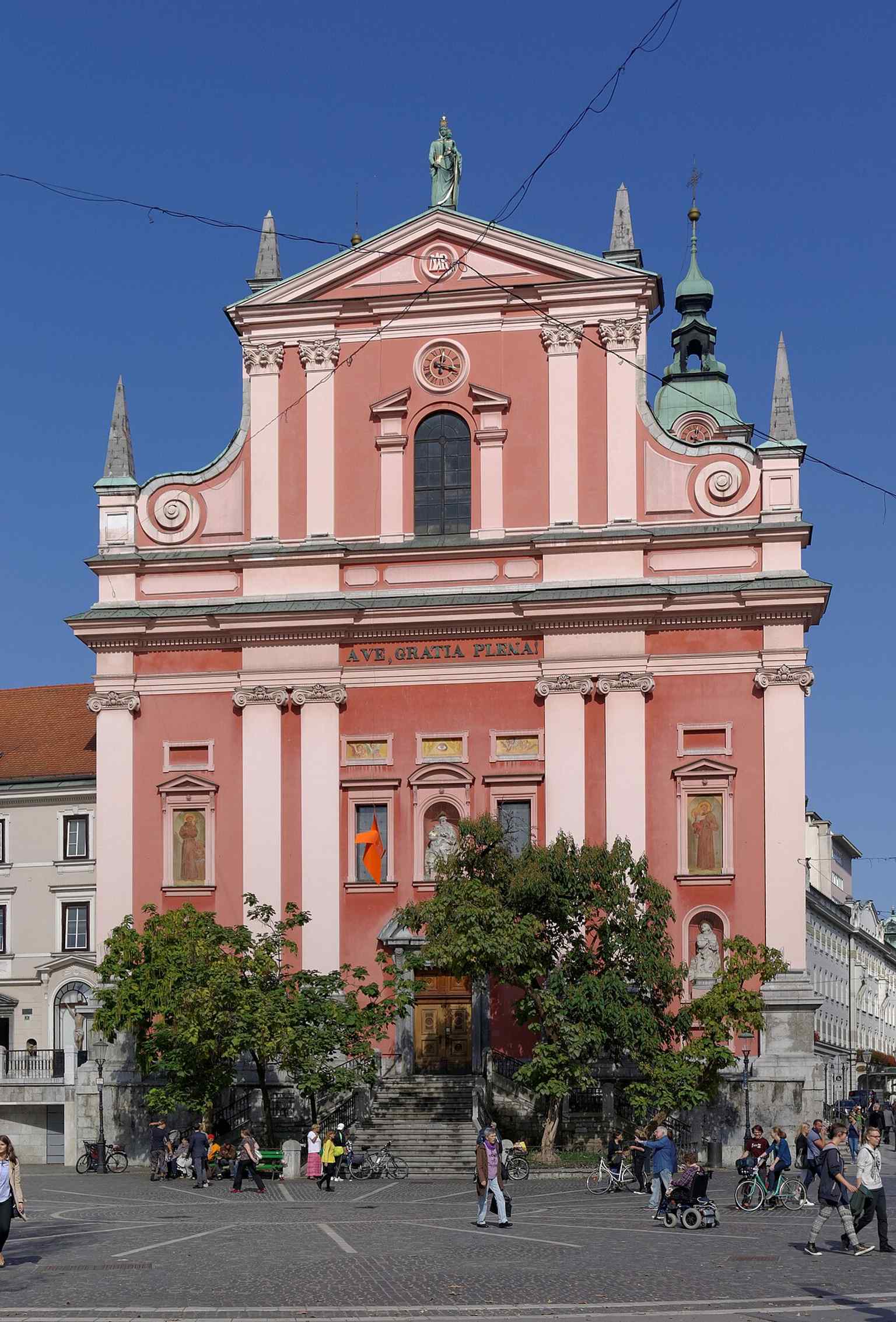
The church's two bell towers, completed in 1719, rise above the facade, a later addition to the original 17th-century construction.Photo: Berthold Werner, Wikimedia Commons, CC BY-SA 3.0. Cropped & resized. On your left is a towering, salmon-pink stone church framed by twin domed belfries and crowned with a dark copper statue on its highest peak. You are looking at the Franciscan…Read moreShow less
Open dedicated page →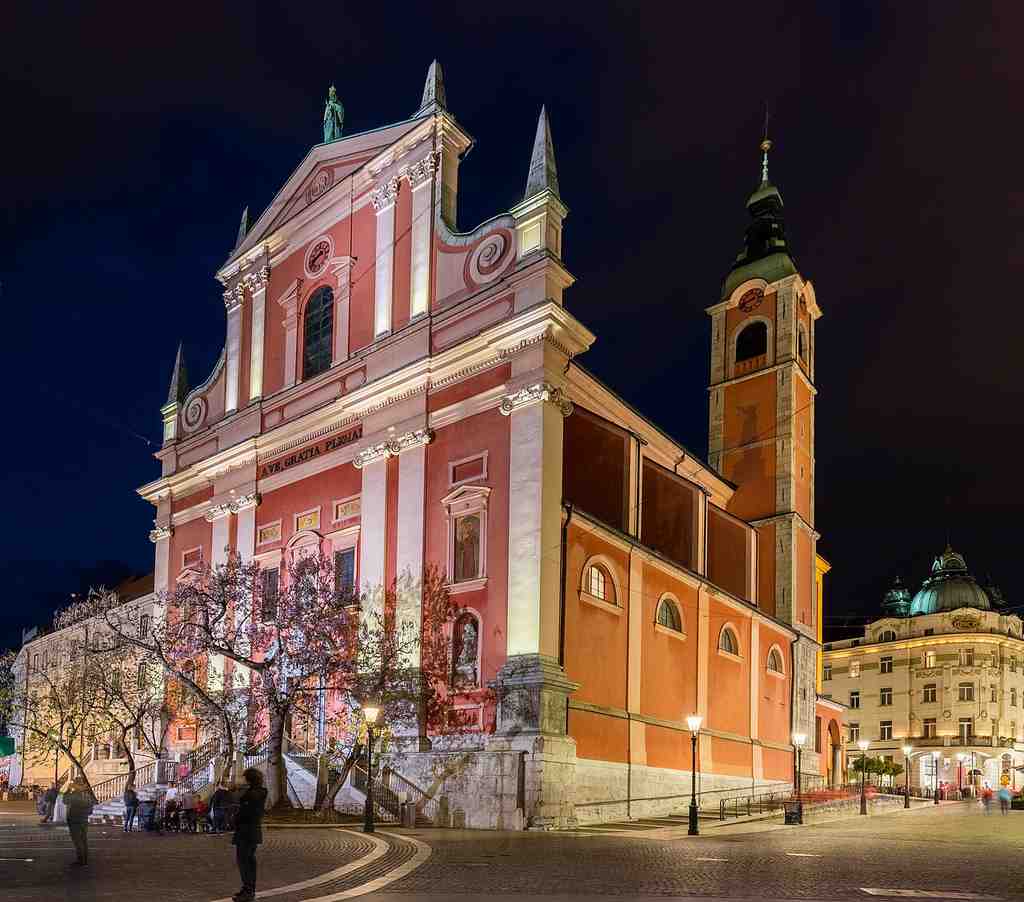
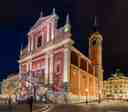
Franciscan Church of the AnnunciationPhoto: Diego Delso, Wikimedia Commons, CC BY-SA 4.0. Cropped & resized. On your left is a towering, salmon-pink stone church framed by twin domed belfries and crowned with a dark copper statue on its highest peak.
You are looking at the Franciscan Church of the Annunciation. As you may recall, the Franciscans took over this site from the Augustinians in the late eighteenth century. The signature soft pink color you see today, beloved by the locals, is the faded remnant of the original, vibrant Franciscan red.
If you look at your screen, you can see the magnificent interior. The monumental Baroque main altar was designed by Francesco Robba. You might remember him from the fountain we saw a little while ago. Robba originally came to Ljubljana from Venice for a quick temporary commission, but he fell in love with a local woman and decided to stick around. His altar here is a masterpiece of intricate marble craftsmanship.
Marvel at the monumental Baroque main altar, a masterpiece designed by the celebrated Italian sculptor Francesco Robba, who settled in Ljubljana permanently.Photo: Arths-at, Wikimedia Commons, CC BY-SA 4.0. Cropped & resized. Take a moment and look up at the towering statue of Our Lady of Loretto right at the top of the facade. That heavy beaten-copper statue replaced an older wooden figure. It stands as a steady guardian over a building that has seen its fair share of devastating loss and visionary renewal. Inside, the mid-nineteenth century ceiling frescoes were originally painted by Matevž Langus. He spent years painstakingly covering the vault with scenes inspired by Raphael. Sadly, the cost of ambition can be unexpectedly steep. Langus died of cholera the very night before his masterpiece was scheduled to be consecrated, leaving the city to mourn him at the exact moment they gathered to celebrate his work.
Decades later, the devastating earthquake cracked the church open, destroying much of that artistic legacy. The interior sat scarred and bare until the 1930s, when Slovenian painter Matej Sternen stepped in. You can see his brilliant restoration on your phone. Sternen used trompe-l'œil, an artistic technique that uses realistic imagery to create a three-dimensional optical illusion, perfectly recreating the illusion of depth that had been lost to the disaster.
Look up at the vibrant ceiling frescoes, painstakingly restored in the 1930s by Matej Sternen in a Baroque 'trompe-l'œil' style, replacing those ruined by the 1895 earthquake.Photo: Arths-at, Wikimedia Commons, CC BY-SA 4.0. Cropped & resized. The church is filled with incredible hidden layers, from a vast library holding over seventy thousand ancient volumes protected from future quakes, to a slightly spooky glass coffin containing the skeletal remains of a seventh-century French hermit named Saint Deodatus.
Let us step back from the church to take in the sprawling space it oversees, Prešeren Square, which is our very next stop. The church is open to visitors most days between late morning and late afternoon if you wish to explore the interior later.
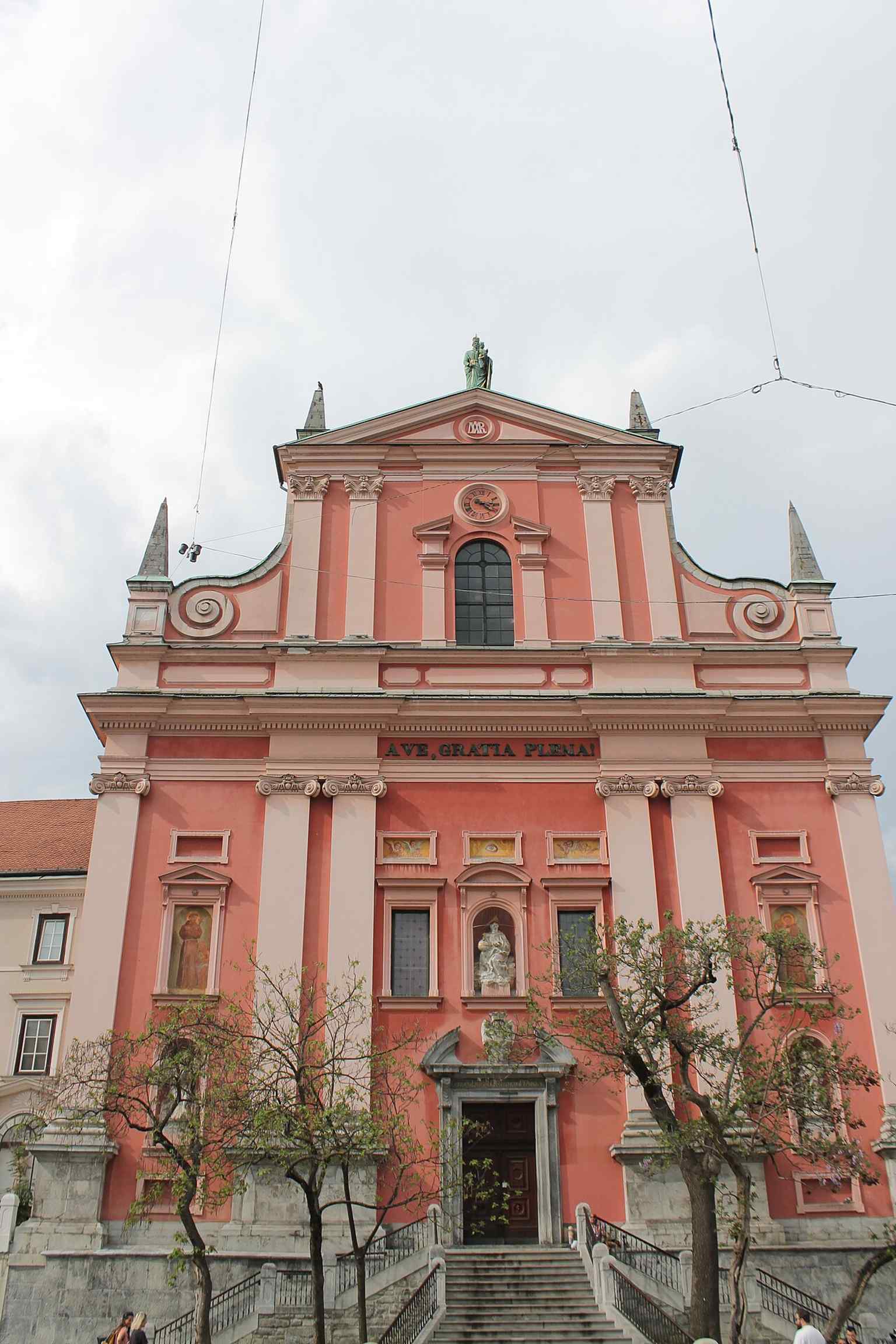
The church's salmon-pink facade, seen here overlooking Prešeren Square, was originally a bold red but is now officially protected in its unique faded hue thanks to a citizen's campaign.Photo: Thaler Tamas, Wikimedia Commons, CC BY-SA 4.0. Cropped & resized. 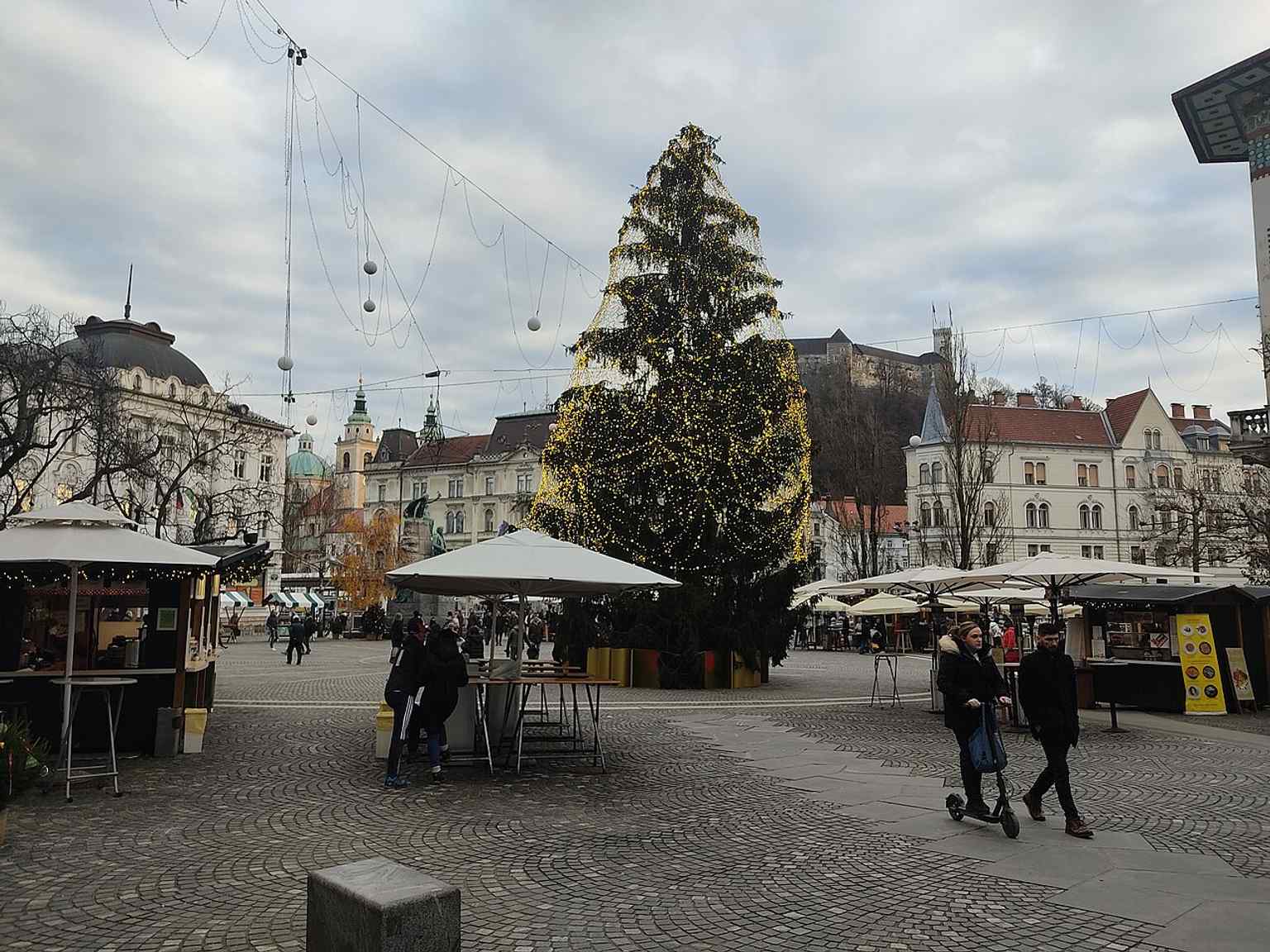
View the Franciscan Church of the Annunciation alongside the Ljubljanica River, highlighting its prominent position in Ljubljana's cityscape.Photo: Jakub Hałun, Wikimedia Commons, CC BY 4.0. Cropped & resized. 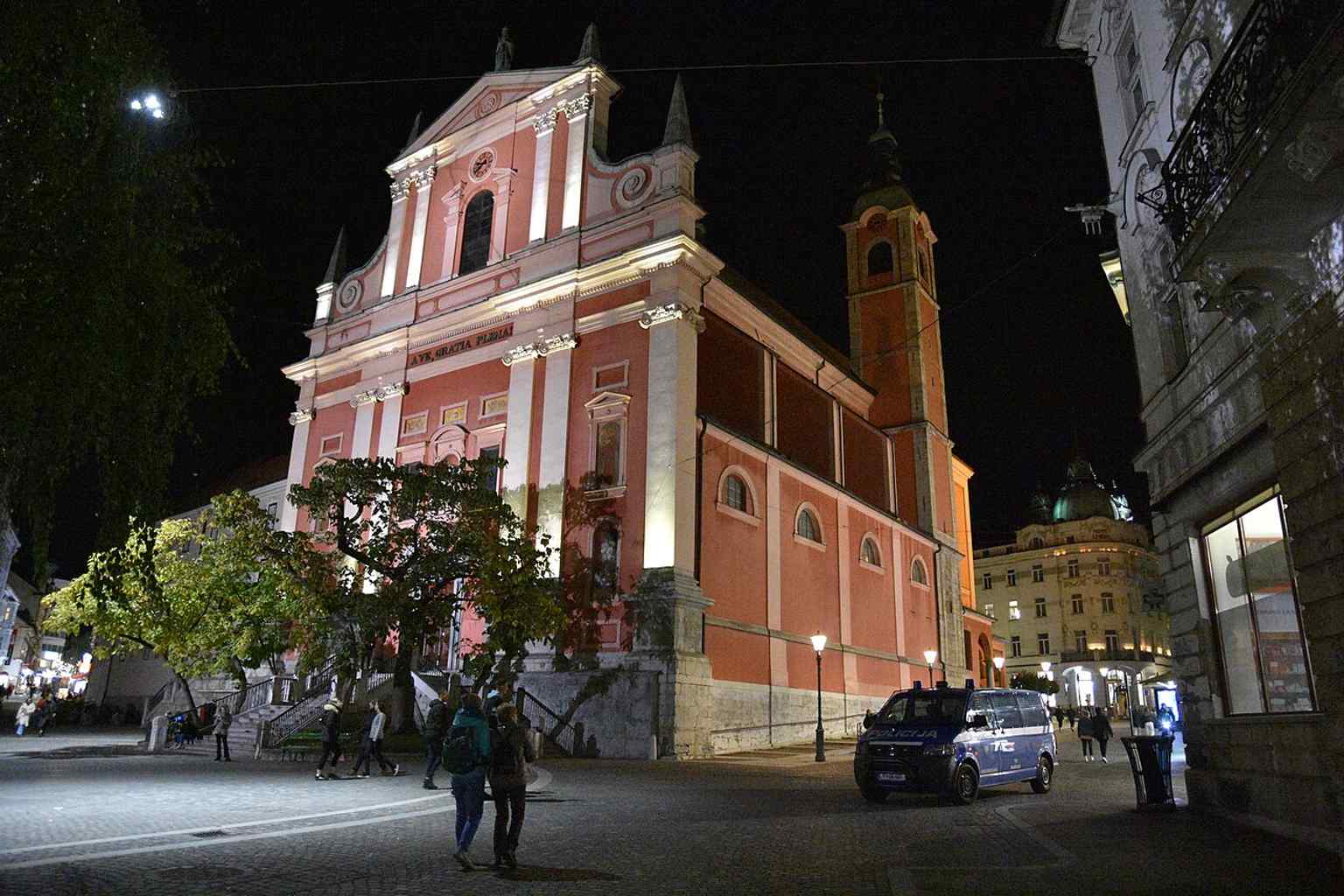
An aerial perspective shows the Franciscan Church of the Annunciation's central location in Ljubljana, a key factor in the Franciscans' late 18th-century relocation.Photo: Thaler Tamas, Wikimedia Commons, CC BY-SA 4.0. Cropped & resized. 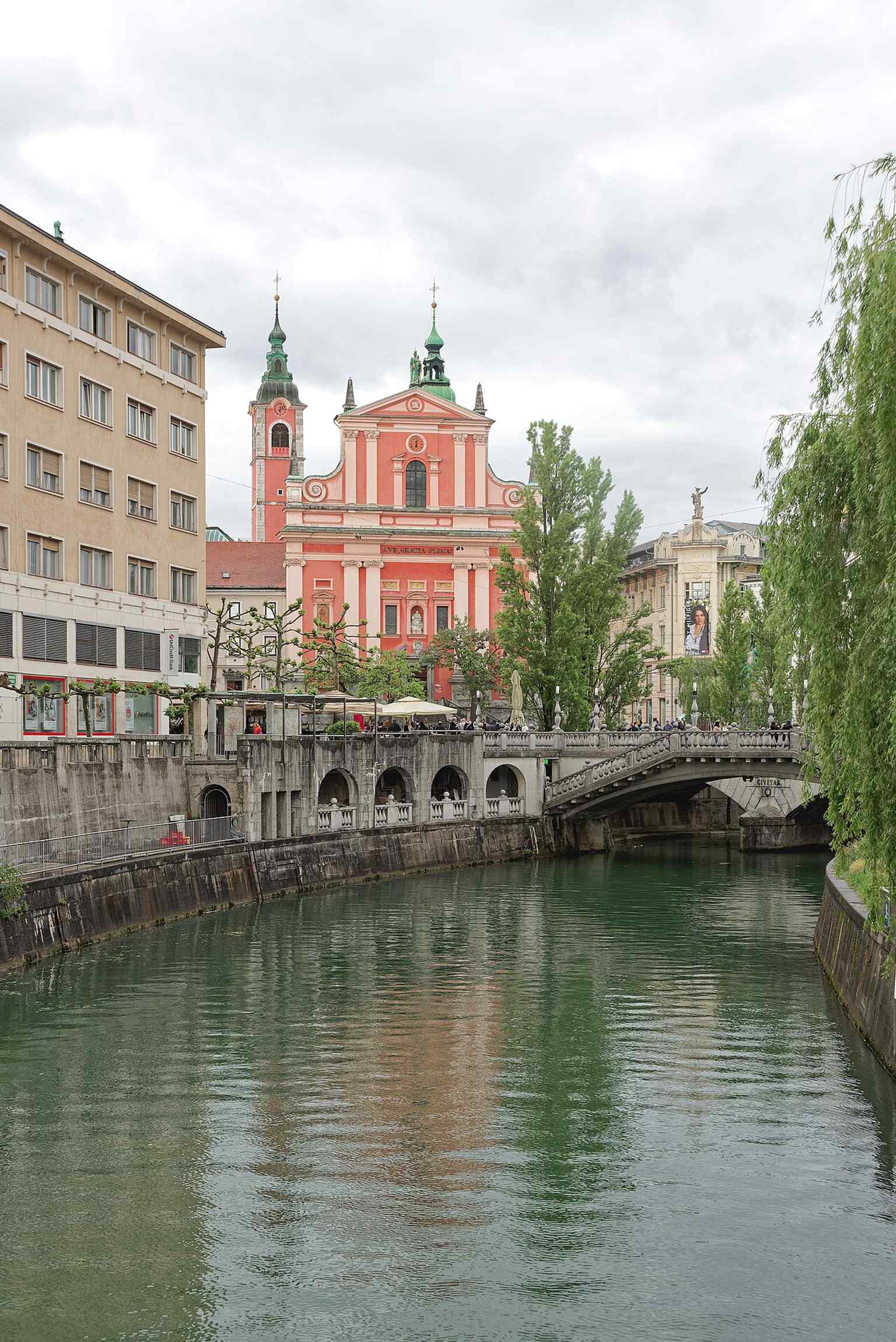
The Franciscan Church of the Annunciation illuminated at night, a beacon in Prešeren Square, where its distinct salmon-pink facade is a beloved landmark.Photo: Arths-at, Wikimedia Commons, CC BY-SA 4.0. Cropped & resized. 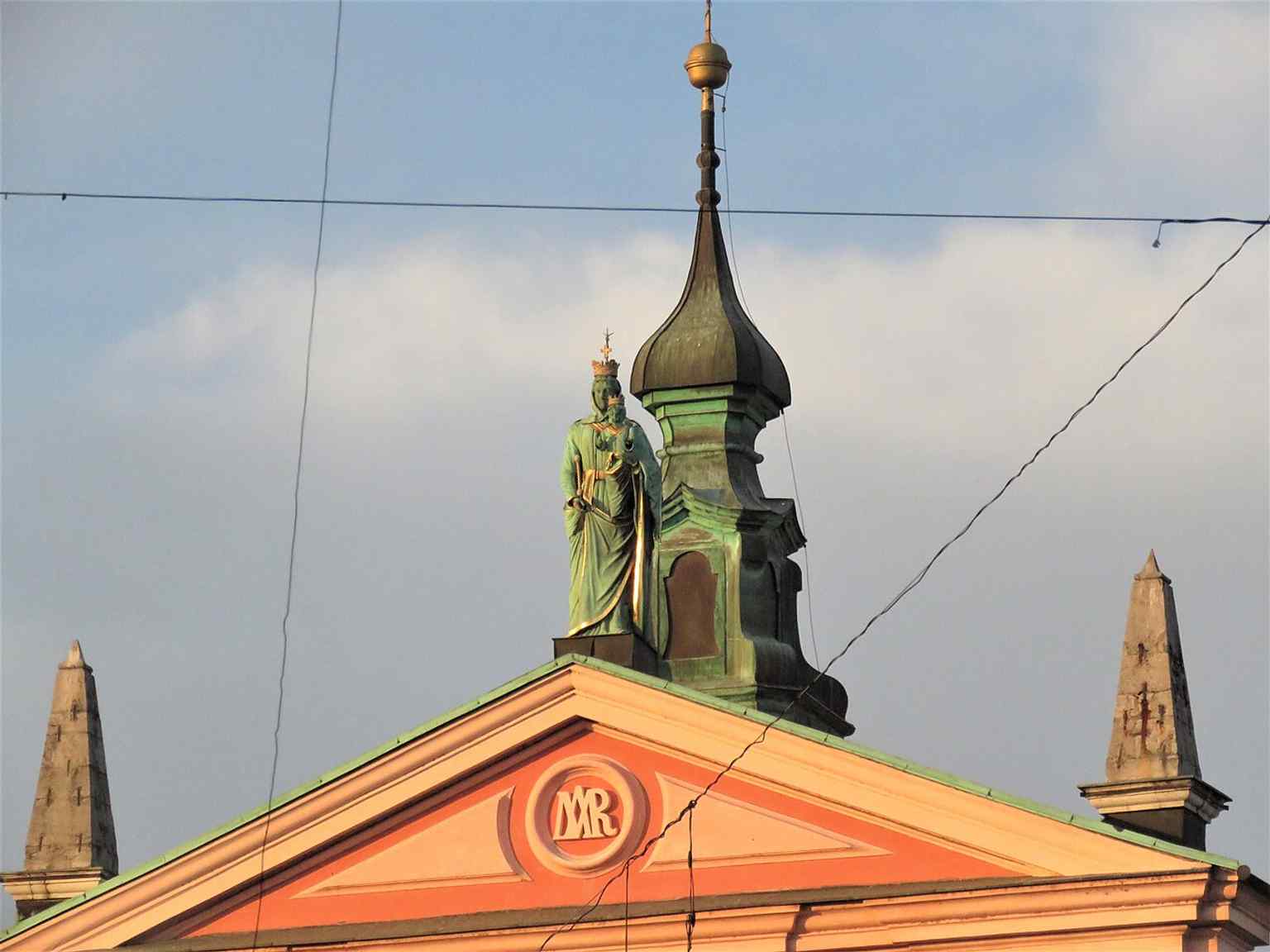
High atop the facade, this nearly four-meter-tall, 448-kilogram beaten copper statue of Our Lady of Loretto replaced an older 'Black Madonna' in 1858.Photo: G-Cup, Wikimedia Commons, CC BY-SA 4.0. Cropped & resized. 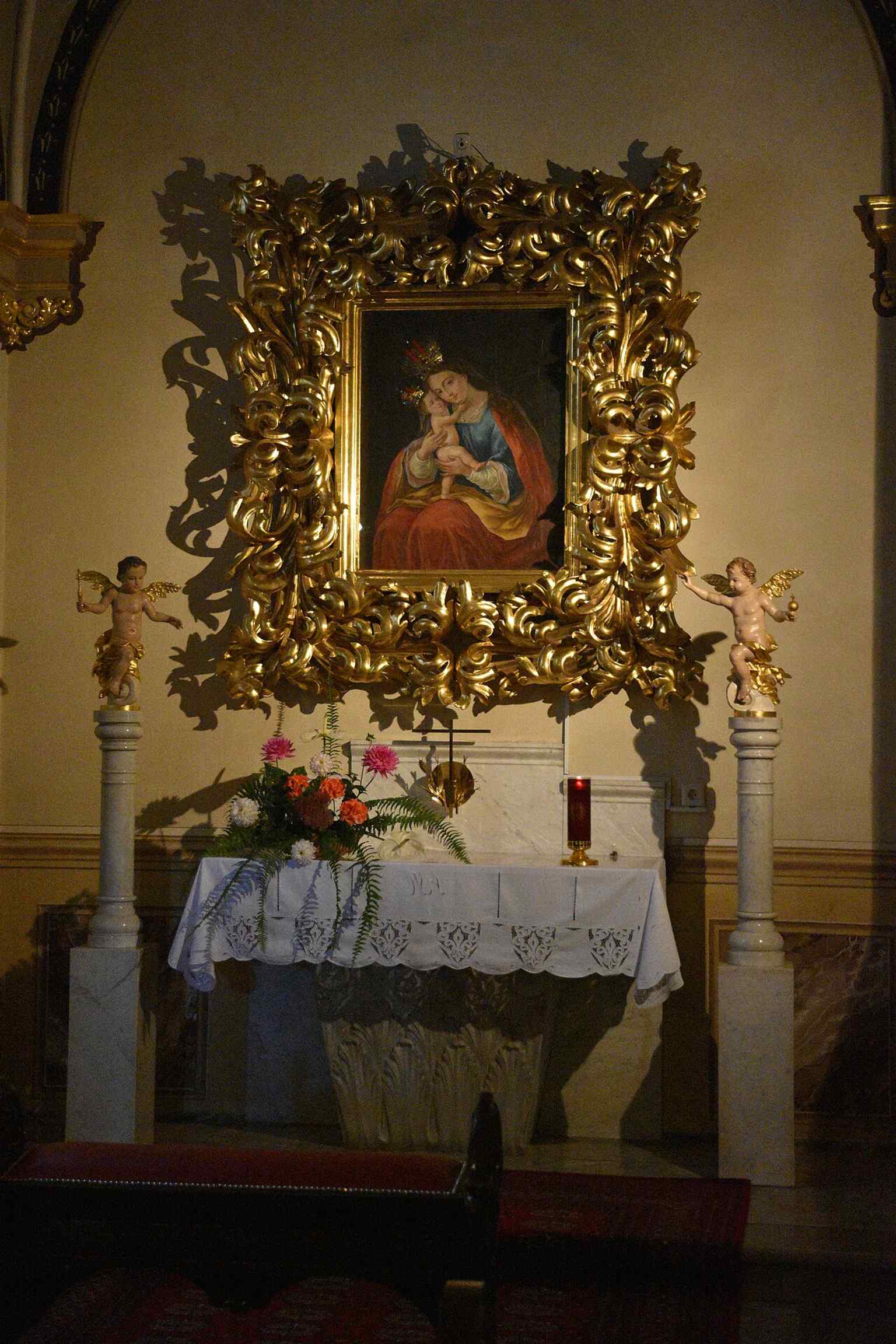
The church's imposing main door, a testament to its 17th-century Baroque architecture, welcomes visitors into its historical interior.Photo: Antimuonium, Wikimedia Commons, CC BY-SA 4.0. Cropped & resized. 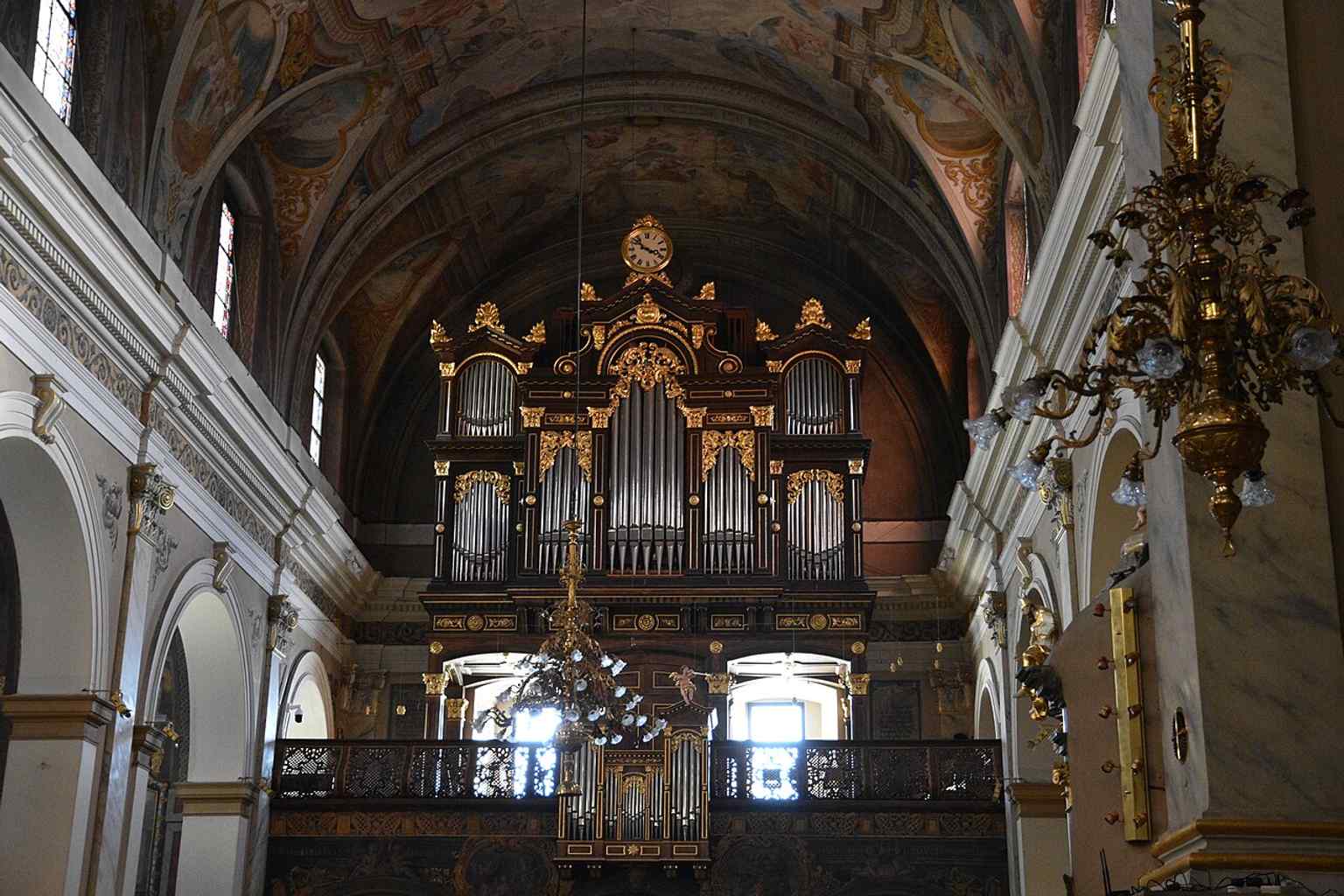
Walk through the spacious nave of the Franciscan Church, originally constructed by the Augustinians between 1646 and 1660.Photo: Thaler Tamas, Wikimedia Commons, CC BY-SA 4.0. Cropped & resized. 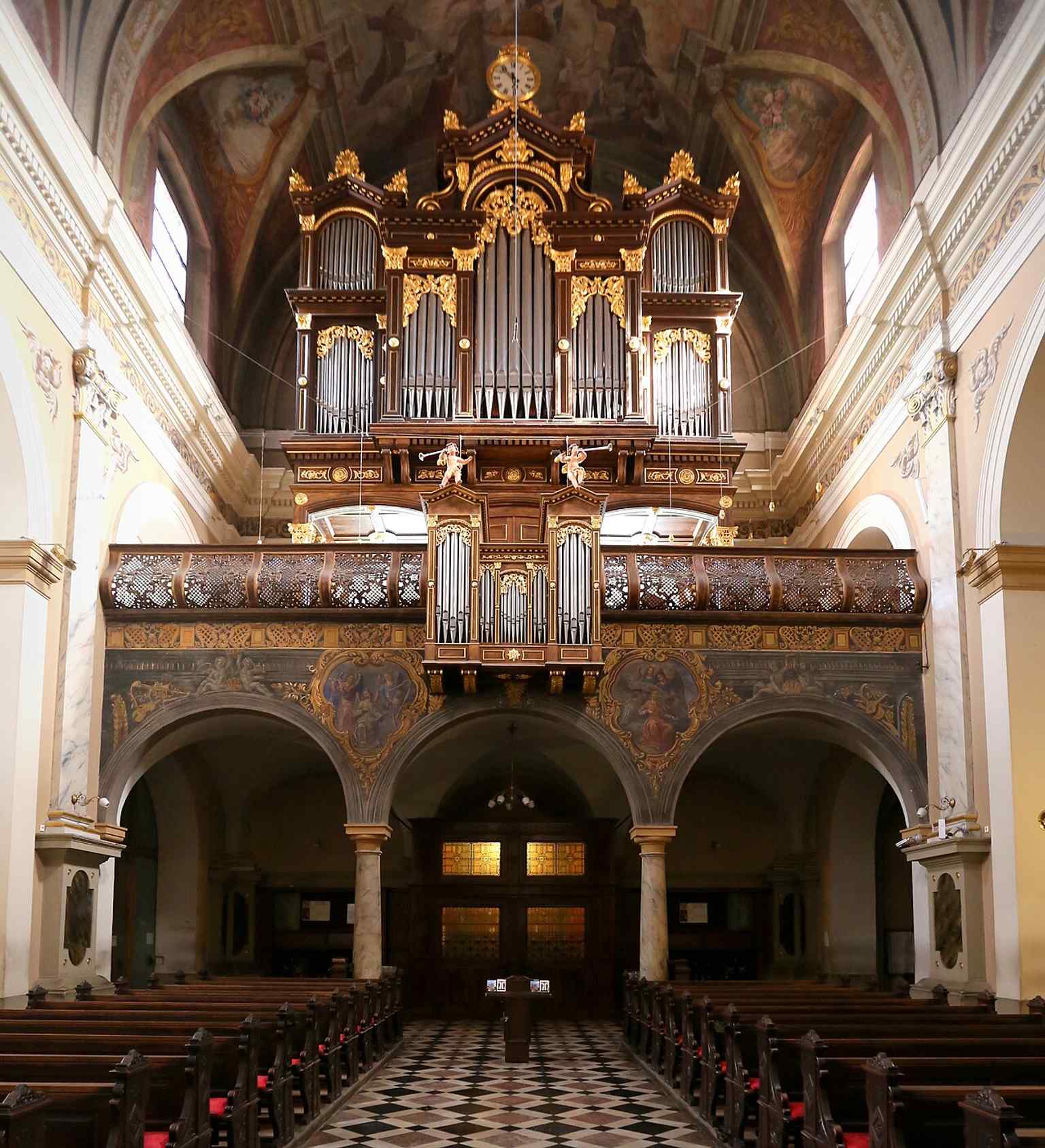
One of the church's richly decorated side altars, showcasing the intricate marble craftsmanship and gilded splendor typical of its Baroque interior.Photo: Arths-at, Wikimedia Commons, CC BY-SA 4.0. Cropped & resized. Here we are at Prešeren Square, just on your left. This is the absolute nexus of Ljubljana. Notice how the space forms a natural funnel, pouring the energy of seven different…Read moreShow less
Open dedicated page →Here we are at Prešeren Square, just on your left. This is the absolute nexus of Ljubljana. Notice how the space forms a natural funnel, pouring the energy of seven different avenues into one vibrant, bustling focal point.
For centuries, this was just a medieval crossroads outside the old city gates. But as is so often the case, the identity of a place is often forged in catastrophe. When the earthquake brought the medieval structures crumbling down, the ruins became a blank canvas. Out of that destruction came a wave of visionary rebuilding. Take the Hauptmann House, for example. It was one of the few buildings to survive the quake, but it soon received a stunning facelift in the Vienna Secession style, an architectural movement known for breaking away from historic traditions to use modern, geometric forms. The architect covered the building in colorful ceramic tiles arranged in a checkerboard pattern, bringing a striking new energy to the old walls.
But the true anchor of this space is the bronze monument of France Prešeren, Slovenia's national poet, erected in 1905. You might think a monument to a poet would be a quiet affair, but this one caused a spectacular scandal. Check out the photo on your screen to see the details. Notice the muse holding a branch above his head? Well, the local Bishop was absolutely horrified. He fired off a furious letter to the mayor, declaring her a wantonly exposed female figure, completely inappropriate for a statue facing a church. He demanded she be taken down, or at least given some decent clothes. Naturally, the mayor refused. In protest, the Bishop supposedly ordered the church doors kept locked at certain hours so his congregation wouldn't have to endure such indecency.
The Prešeren Monument, unveiled in 1905, famously stirred scandal with its "wantonly exposed" muse, and poet Prešeren's gaze is directed towards the relief of his unrequited love, Julija Primic.Photo: Viktar Palstsiuk, Wikimedia Commons, CC BY-SA 4.0. Cropped & resized. Beyond the scandal, the statue holds a quiet, poetic secret. Follow the bronze poet's gaze across the square toward Wolf Street. He is staring eternally at a small relief portrait on the facade of a building there. It depicts Julija Primic, his great, unrequited love. Even in bronze, he never stops looking at her.
Before we move on, look down at the ground. In 1987, architect Edvard Ravnikar redesigned this paving. Pull up the next image in your app to see the pattern clearly from above. Those radiating lines of white Macedonian stone form a massive circle. The diameter is exactly forty-one and a half meters, a strict mathematical choice that perfectly matches the dimensions of the Triple Bridge right next to it. Ravnikar actually wanted to drop a massive modern fountain right in the middle of it, but the citizens revolted, fearing it would upstage their beloved poet. The people won, and the circle remained wonderfully, stubbornly empty.
The granite and white stone paving of the square features a central circle designed by Edvard Ravnikar in 1987, precisely matching the dimensions of Plečnik's Triple Bridge.Photo: Viktar Palstsiuk, Wikimedia Commons, CC BY-SA 4.0. Cropped & resized. It is just as well. This public square is open twenty-four hours a day, serving as the city's natural stage for everything from quiet reflection to massive protests. Now, let's walk from this lively transit hub toward a space designed for grand gatherings, making our way to Congress Square, which is about a five-minute walk away.
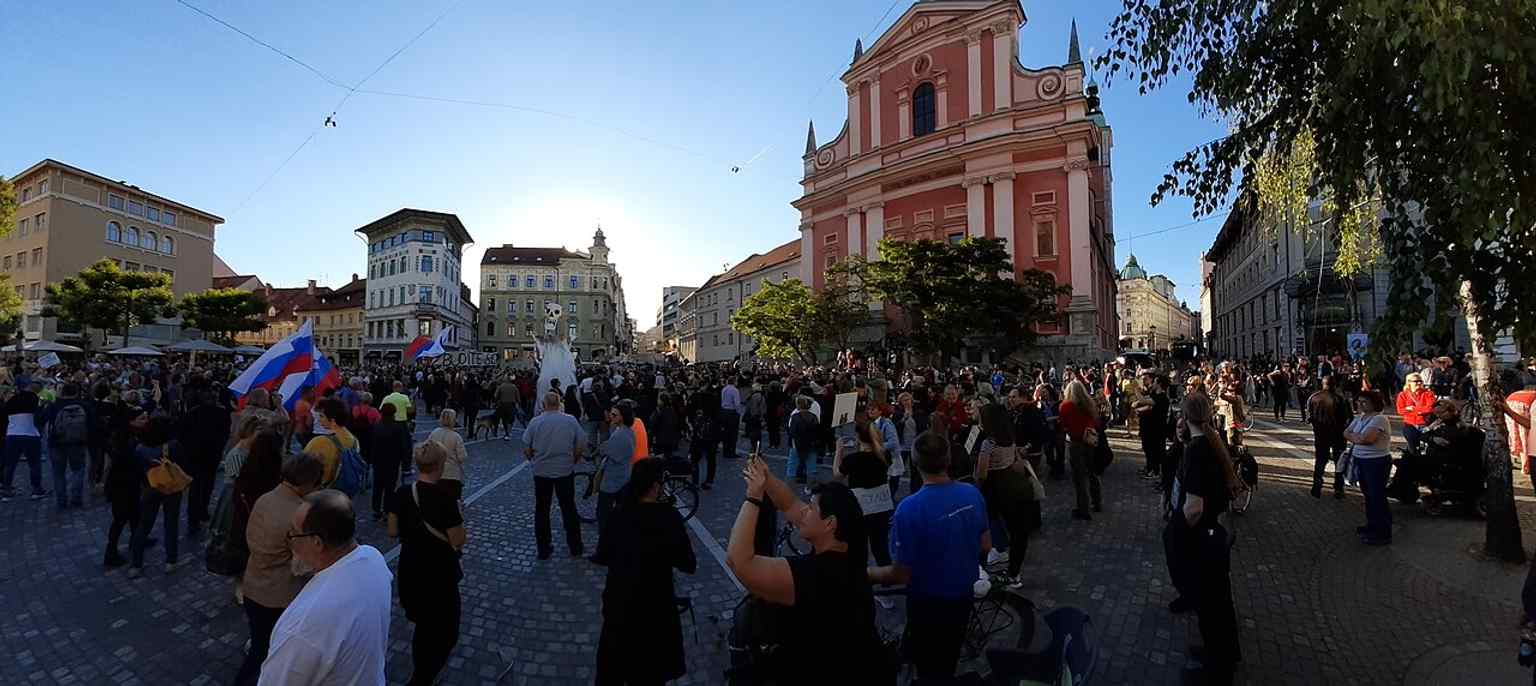
Protesters gather in Prešeren Square, continuing a tradition of public dissent where the square serves as a key gathering point for movements, including those during WWII.Photo: Yerpo, Wikimedia Commons, CC BY-SA 4.0. Cropped & resized. 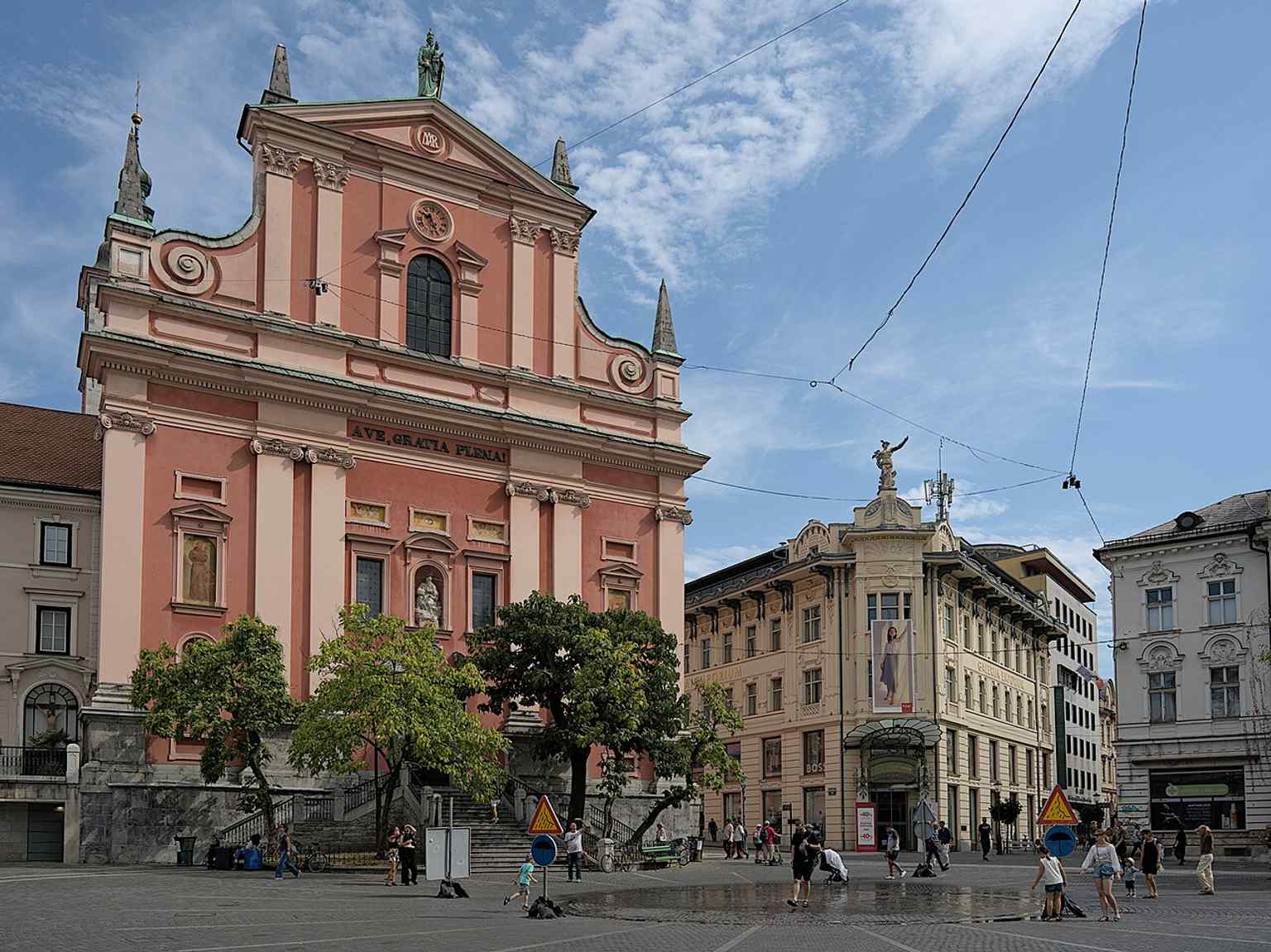
A general view of Prešeren Square in summer, showing its role as a vibrant crossroads where seven streets converge, defining its funnel-shaped layout.Photo: This Photo was taken by Miha Peče. Feel free to use my photos, but please mention me as the author. I would much appreciate if you send me an email [email protected] or write on my talk page, for my information. Please do not upload an edited image here without consulting me. I would like to make corrections only at my own source to ensure that the changes improve the image and are preserved.Otherwise you may upload an edited image with a new name. Please use one of the templates derivative or extract., Wikimedia Commons, CC BY-SA 4.0. Cropped & resized. 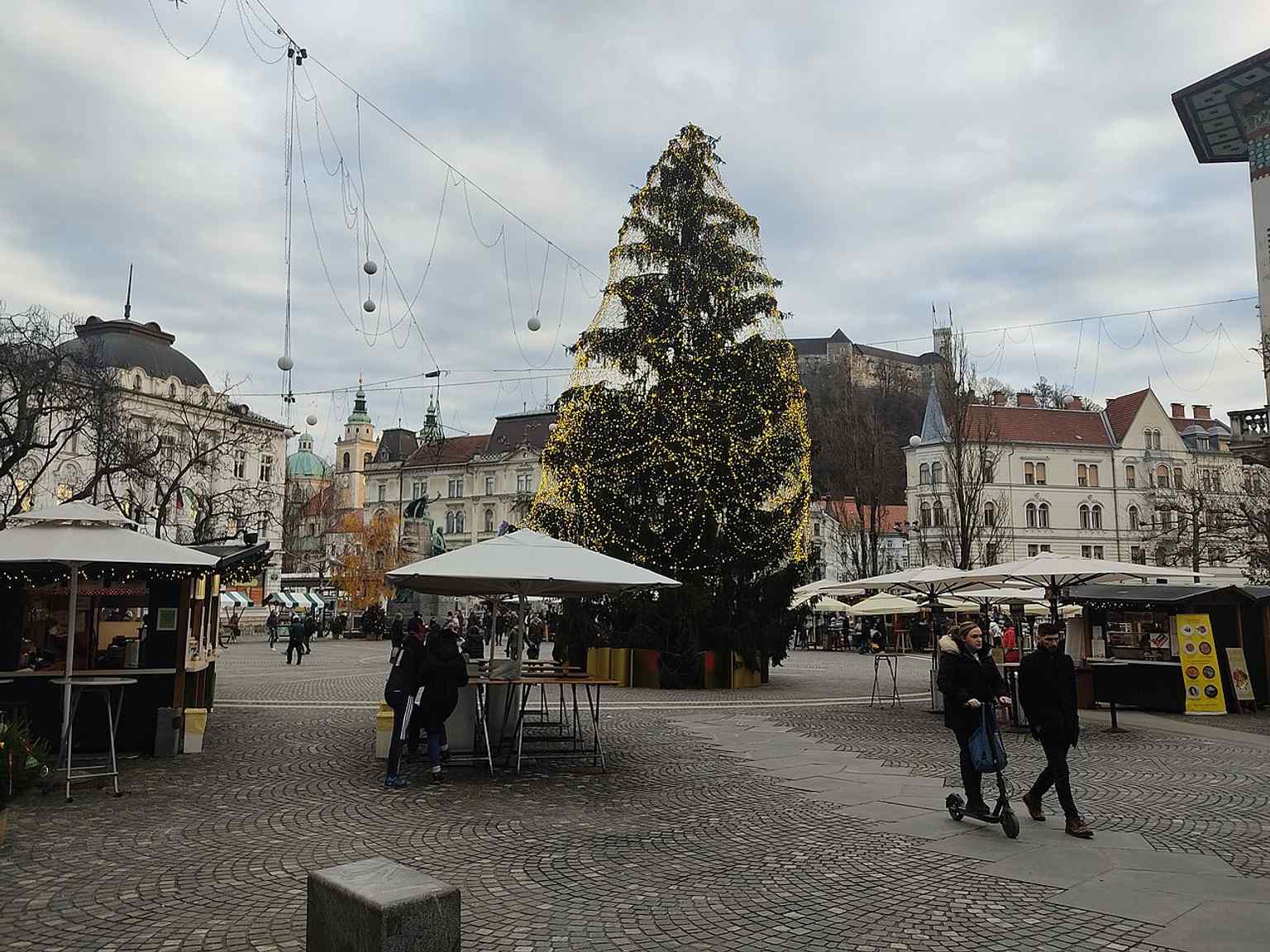
The iconic red facade of the Franciscan Church of the Annunciation dominates the square, a color symbolizing the Franciscan order and housing Ljubljana's largest copper statue of Mary.Photo: Viktar Palstsiuk, Wikimedia Commons, CC BY-SA 4.0. Cropped & resized. 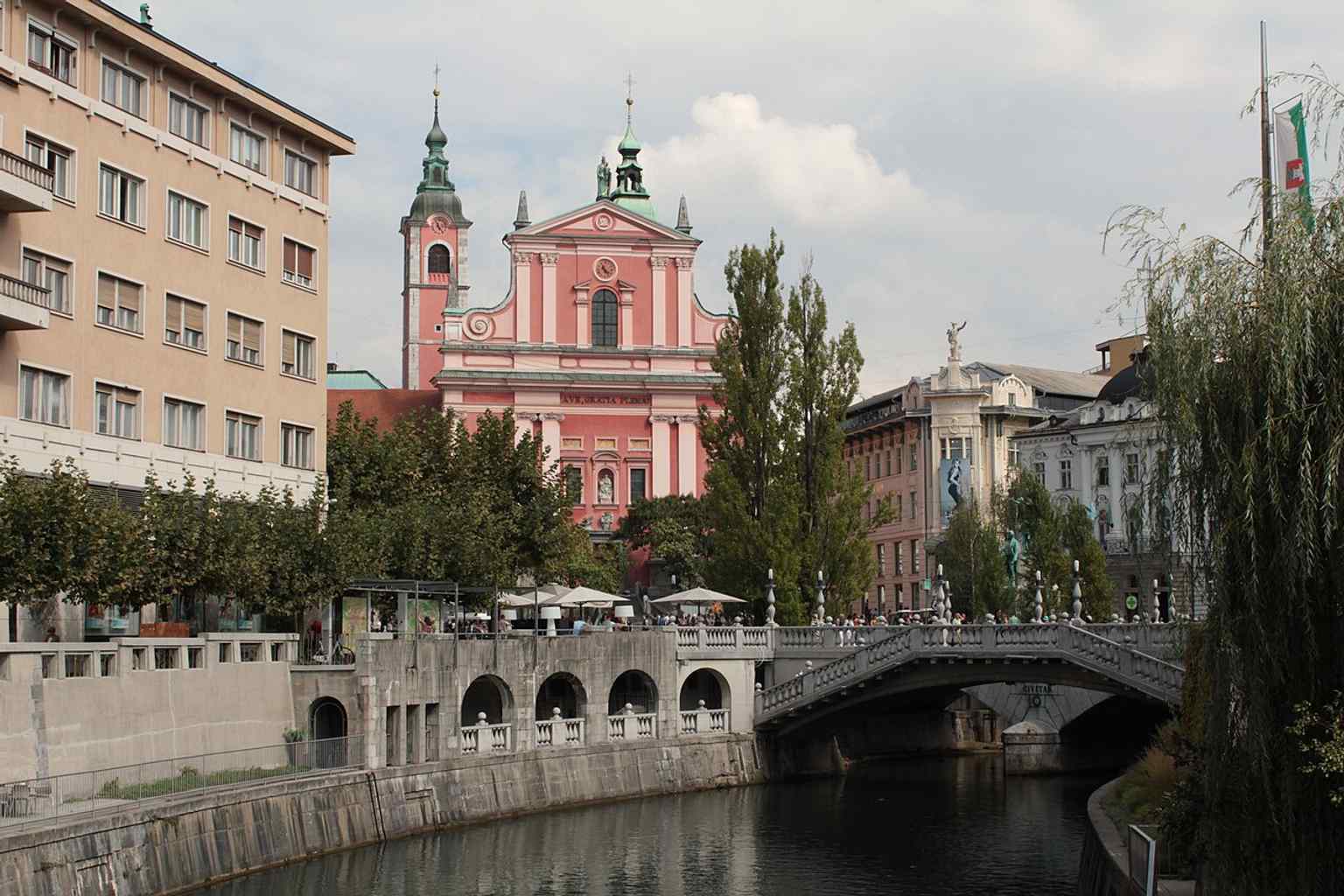
The Triple Bridge, a key work by Jože Plečnik, extends from Prešeren Square over the Ljubljanica river, linking it to the medieval city center.Photo: Valerio2468, Wikimedia Commons, CC BY-SA 4.0. Cropped & resized. 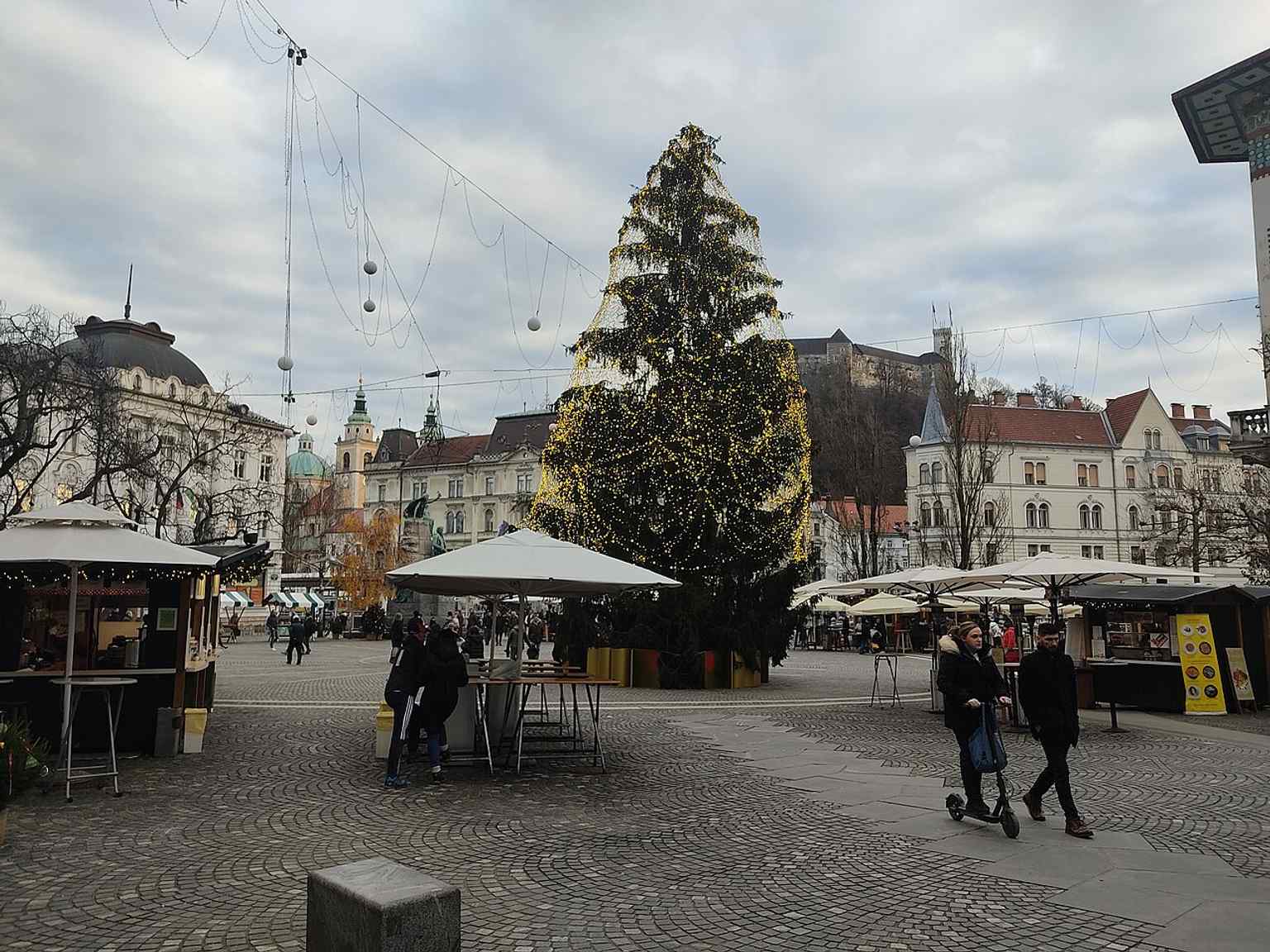
An aerial perspective from Ljubljana Castle illustrates the square's unique funnel shape, a hub connecting various streets that extend in different directions.Photo: Valerio2468, Wikimedia Commons, CC BY-SA 4.0. Cropped & resized. 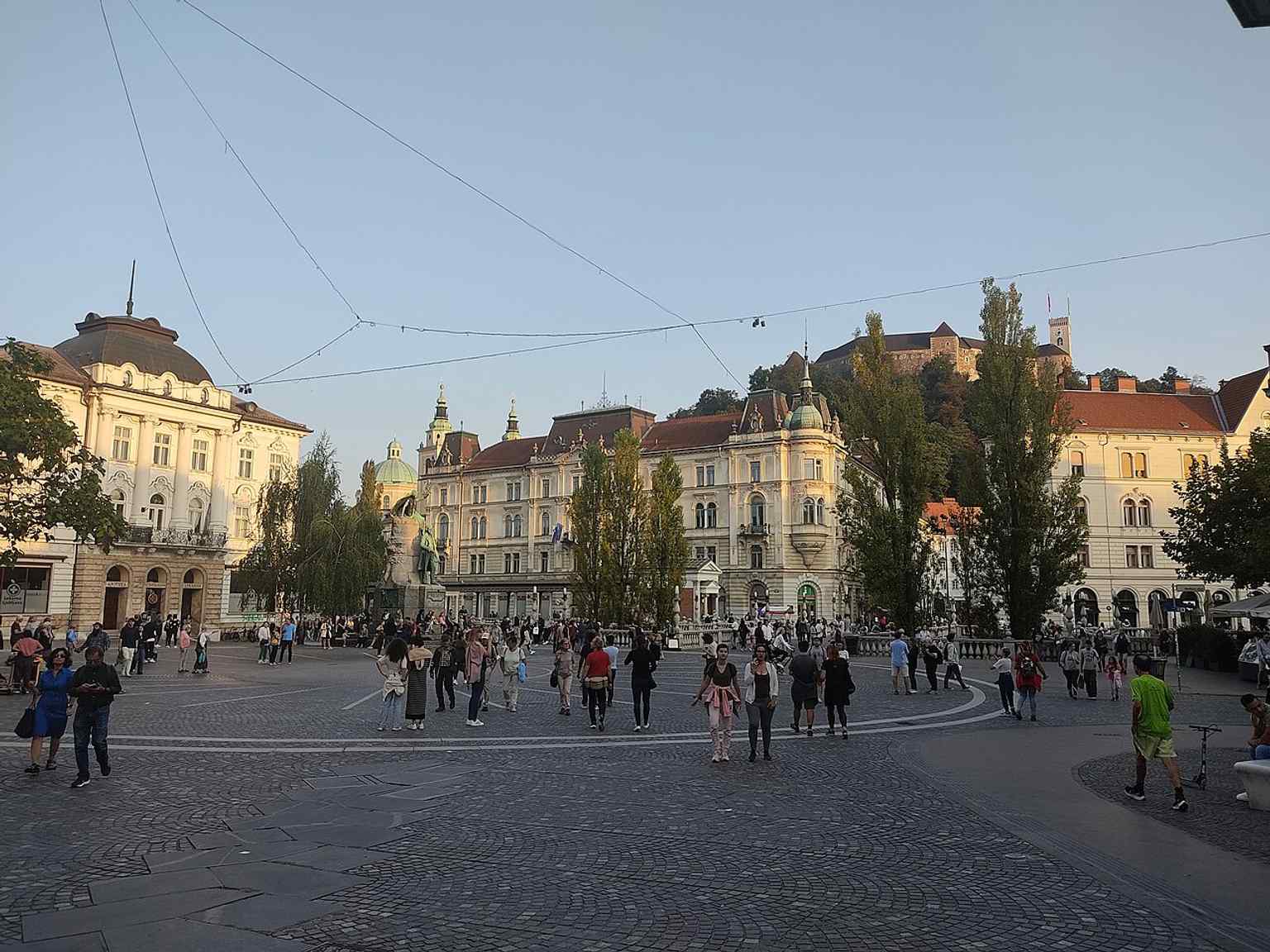
The distinctive facade of the Hauptmann House, redesigned in 1904 by Ciril Metodi Koch in Vienna Secession style, uniquely features colorful ceramic tiles in a geometric checkerboard pattern.Photo: Viktar Palstsiuk, Wikimedia Commons, CC BY-SA 4.0. Cropped & resized. Look to your right for a pale, rectangular stone building topped with a prominent triangular roof structure that houses a distinct, circular clock face. This is the Lontovž…Read moreShow less
Open dedicated page →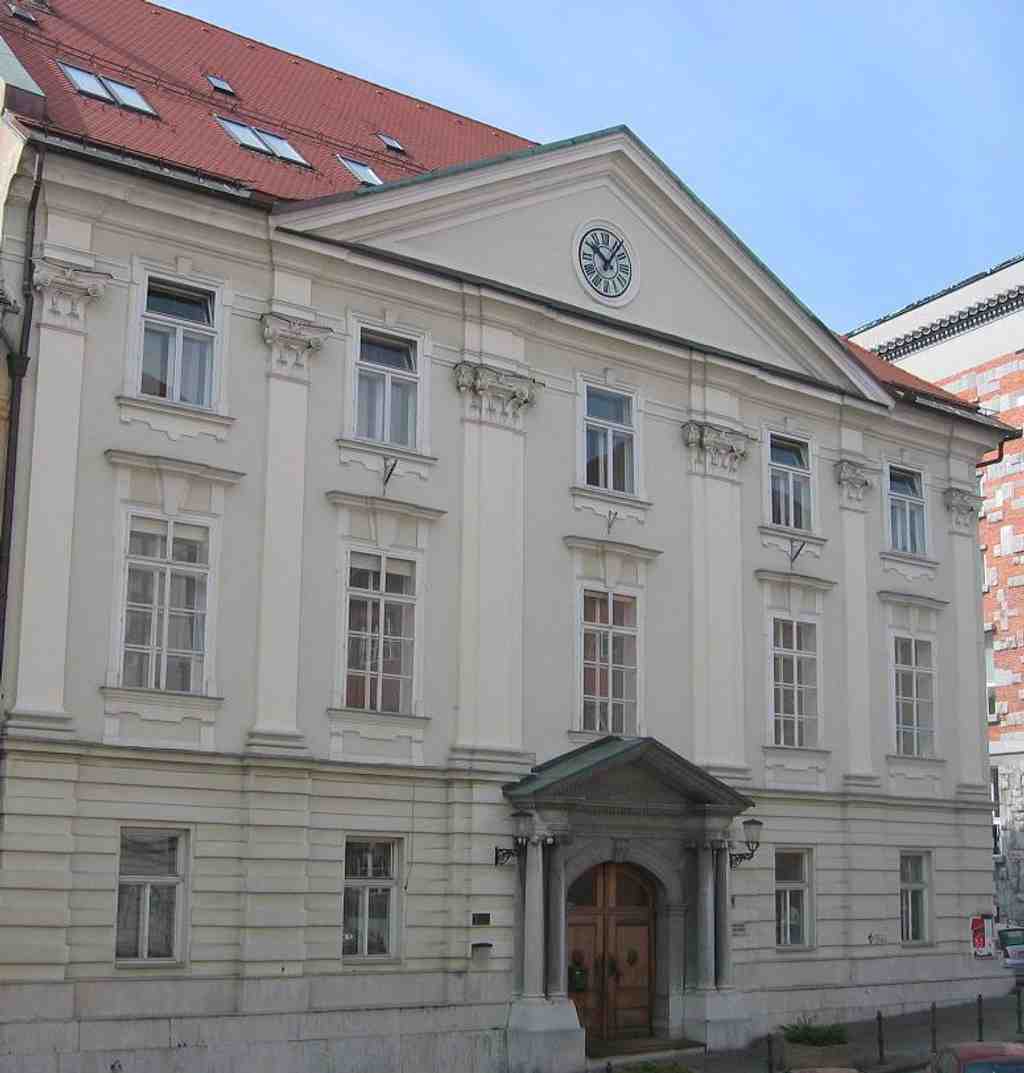
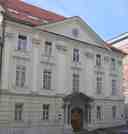
Slovenian Academy of Sciences and ArtsPhoto: Žiga, Wikimedia Commons, Public domain. Cropped & resized. Look to your right for a pale, rectangular stone building topped with a prominent triangular roof structure that houses a distinct, circular clock face. This is the Lontovž Palace, the headquarters of the Slovenian Academy of Sciences and Arts.
If you check your app, you can see the full expanse of this 18th-century noble residence. But what you cannot see are the layers beneath the floorboards. The palace was built directly over a Hallstatt-period burial ground, an early Iron Age cemetery, as well as the ruined stone walls of the original Roman city of Emona. Out of a literal graveyard and the dust of a collapsed empire, Slovenia erected its highest sanctuary for intellectual and artistic achievement.
That cycle of fracture and renewal is deeply woven into the academy itself. During the Second World War, Slovene cultural workers initiated a cultural silence, boycotting all events sponsored by the occupying forces to protest the invasion. Inside these walls, a fierce family drama played out over how to survive. Milan Vidmar, an engineer and world-class chess grandmaster, used his influence with the Italian-backed collaborationist mayor to legally secure the word Slovenian in the academy's name. Meanwhile, his brother Josip was a leader in the communist resistance. Their heated debates over how to best protect their heritage echoed down these very halls.
After the war, the ideological tearing of the academy only worsened. You have to appreciate the tragic paradox of the post-war era. The academy's president, literary historian France Kidrič, fought desperately to preserve the institution's scholarly independence. At the exact same time, his own son, Boris Kidrič, was leading the new National Government that ruthlessly stripped that autonomy away. This political takeover led to a purge where founding members were forced out. By 1949, the government created a legal loophole allowing membership for people whose deeds had special significance, a vague phrase used to force political figures like Josip Broz Tito into honorary seats.
Yet, the academy survived this era of strict state control and eventually flourished, shifting its focus back to genuine discovery. Today, it oversees seventeen autonomous research institutes. In 2023, a team from their Institute for Anthropological and Spatial Studies used aerial laser mapping to pierce the dense Mexican jungle. They discovered Ocomtun, a massive, previously unknown Mayan city with fifteen-meter-high pyramids that had been lost for a millennium.
This relentless drive to uncover the truth connects directly back to the academy's deepest roots. Long before this building was secured, the first iteration of the academy began in 1693 as a tight-knit society of twenty-three industrious men. They made their grand public debut in 1701 at the Bishop's Palace, illuminated by white wax torches and backed by trumpet music. The society was propelled by pioneers like physician Marko Gerbec and the tireless historian Janez Gregor Dolničar. When Dolničar passed away in 1725, the society temporarily collapsed without his vital energy.
But his vision did not stay buried. As we end our walk here in front of the academy, it is clear that while old walls crumble and political regimes fracture, the determination to rebuild and understand the world always endures.
Frequently asked questions
How do I start the tour?
After purchase, download the AudaTours app and enter your redemption code. The tour will be ready to start immediately - just tap play and follow the GPS-guided route.
Do I need internet during the tour?
No! Download the tour before you start and enjoy it fully offline. Only the chat feature requires internet. We recommend downloading on WiFi to save mobile data.
Is this a guided group tour?
No - this is a self-guided audio tour. You explore independently at your own pace, with audio narration playing through your phone. No tour guide, no group, no schedule.
How long does the tour take?
Most tours take 60–90 minutes to complete, but you control the pace entirely. Pause, skip stops, or take breaks whenever you want.
What if I can't finish the tour today?
No problem! Tours have lifetime access. Pause and resume whenever you like - tomorrow, next week, or next year. Your progress is saved.
What languages are available?
All tours are available in 50+ languages. Select your preferred language when redeeming your code. Note: language cannot be changed after tour generation.
Where do I access the tour after purchase?
Download the free AudaTours app from the App Store or Google Play. Enter your redemption code (sent via email) and the tour will appear in your library, ready to download and start.
If you don't enjoy the tour, we'll refund your purchase. Contact us at [email protected]
Checkout securely with 






![This Photo was taken by Miha Peče. Feel free to use my photos, but please mention me as the author. I would much appreciate if you send me an email [email protected] or write on my talk page, for my information. Please do not upload an edited image here without consulting me. I would like to make corrections only at my own source to ensure that the changes improve the image and are preserved.Otherwise you may upload an edited image with a new name. Please use one of the templates derivative or extract.](https://upload.wikimedia.org/wikipedia/commons/d/de/StolpLjGrad.jpg)

.jpg)

![This Photo was taken by Miha Peče. Feel free to use my photos, but please mention me as the author. I would much appreciate if you send me an email [email protected] or write on my talk page, for my information. Please do not upload an edited image here without consulting me. I would like to make corrections only at my own source to ensure that the changes improve the image and are preserved.Otherwise you may upload an edited image with a new name. Please use one of the templates derivative or extract.](https://upload.wikimedia.org/wikipedia/commons/d/d5/Tivoli_park_in_Ljubljan.jpg)


.jpg)
.jpg)


%2001.jpg)


![This Photo was taken by Miha Peče. Feel free to use my photos, but please mention me as the author. I would much appreciate if you send me an email [email protected] or write on my talk page, for my information. Please do not upload an edited image here without consulting me. I would like to make corrections only at my own source to ensure that the changes improve the image and are preserved.Otherwise you may upload an edited image with a new name. Please use one of the templates derivative or extract.](https://upload.wikimedia.org/wikipedia/commons/d/d3/Pre%C5%A1ernov_trg1.jpg)


