
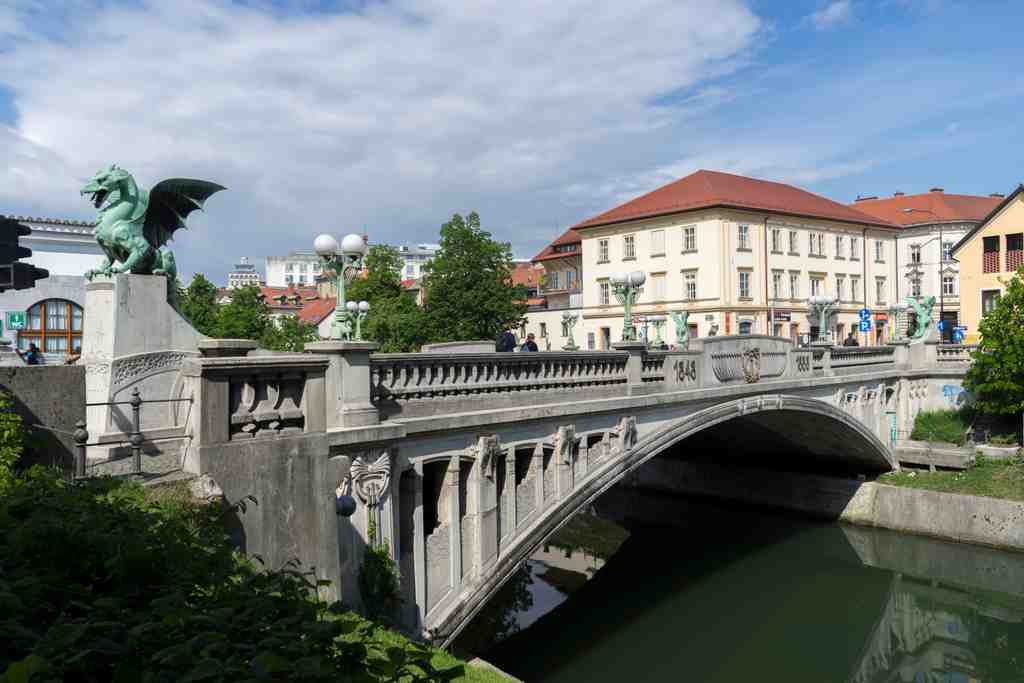
Before you spans a sweeping reinforced concrete arch bridge, framed by decorative stone balustrades and anchored at its corners by massive, oxidized green copper dragons perched on imposing pedestals.
It is a brilliant piece of engineering, but the story of how it got here begins with utter ruin. In 1895, a catastrophic earthquake ripped through Ljubljana. It tore apart much of the medieval city, leaving behind a sprawling landscape of rubble. It was a violent, devastating end to the old world, but it also served as the unlikely catalyst for a spectacular reinvention. Mayor Ivan Hribar looked at the devastation and saw a blank canvas. He envisioned a completely modern capital built in the latest artistic styles to replace the wreckage.
When it came time to replace an old, damaged oak bridge right here, Hribar and the city chose a radical new material called reinforced concrete. They did this largely because it was significantly cheaper than traditional stone, allowing them to stretch their tight reconstruction budget further. But there was a bit of imperial politics at play, too. The Austro-Hungarian authorities in Vienna were nervous about using this untested engineering method back home. So, they used provincial Ljubljana as a testing ground. If the massive thirty-three-meter arch collapsed, the political fallout would be far less embarrassing than a disaster in the imperial capital. Fortunately for everyone involved, the calculations were perfectly sound.
Take a close look at those fearsome green dragons guarding the bridgeheads. Can you imagine this iconic symbol of Ljubljana originally being a set of griffins?
That was exactly the original plan. The architect, Jurij Zaninović, initially submitted designs featuring mythological griffins. But in a sudden pivot, Zaninović swapped them out for dragons. The statues were manufactured in Vienna from thin copper sheets to save on weight and cost, though each hollow beast still weighs about a ton and a half. Over time, that copper has aged into the deep green finish you see today, a natural chemical oxidation process known as a patina.
They look positively ancient, connecting this marvel of twentieth-century modernization back to the myth of Jason and the Argonauts. Local lore says Jason founded the city after slaying a monster in the nearby marshes. By placing these beasts here, the architects transformed a creature of terror into a permanent protector of the people. And they also inspired a bit of local comedy. The fierce, unmoving glare of the statues earned it the nickname of the mother-in-law bridge among locals.
This open-air structure is accessible twenty-four hours a day, all week long. Let us leave these ancient legends to keep watch over the river, and make our way up to our next stop, Ljubljana Castle, which is about a fourteen-minute walk away.




