
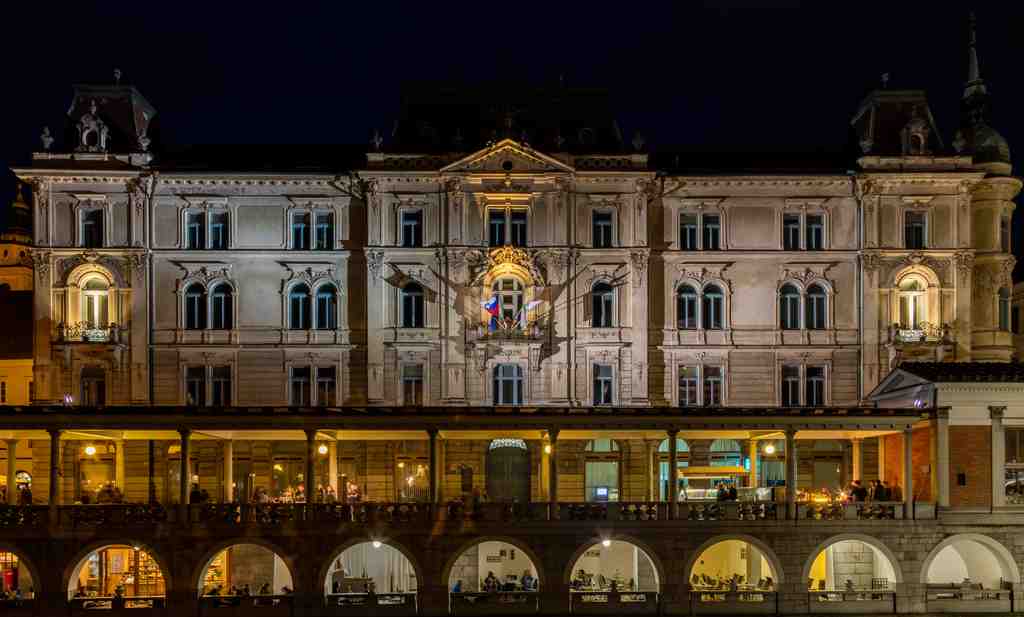
To your right stands the Kresija Building, a massive pale stone structure with a symmetrical Neo-Renaissance facade, a style reviving the grand design of classical European palaces, anchored by a prominent central balcony featuring a highly decorated coat of arms.
Check out the photo on your screen to get a better look at the details on that balcony. Those two sculpted figures flanking the coat of arms are genii, which are classical spirits meant to symbolize the civic virtues of Knowledge and Justice. It is a very deliberate display of municipal power and morality.
But the concept of justice here is deeply complicated. For over a century before this elegant palace was built, this exact spot was synonymous with the absolute poorest and most vulnerable people in the city.
Before the grand district offices moved in, a Foundling Hospital operated right here. It was a desperate last resort for destitute mothers who could not afford to keep their babies. Like many institutions of that era, it featured a revolving box built directly into the exterior wall. A mother could approach from the street, place her infant into a cylindrical compartment, ring a bell, and walk away. An attendant inside would rotate the box to safely receive the child. It was a heartbreaking system designed to prevent infants from being abandoned in the river just steps away.
Interestingly, the site also hosted an early medical school founded in 1753 by Gerard van Swieten, the personal physician to the Empress. He was a scientist best known for traveling across the empire to investigate an actual vampire hysteria. He proved the sightings of the undead were just natural decomposition, leading the Empress to formally ban the superstitious practice of staking corpses. His goal was to bring rational, clinical medicine to places like this very site.
But all of that layered history was quite literally shaken to its core by the 1895 Ljubljana earthquake. The massive tremor ruined the old hospital building. It barely remained standing, entirely structurally compromised and held up by a massive system of heavy wooden poles. It sat there like a haunting, skeletal reminder of the disaster for years.
You can actually see this dramatic transformation for yourself by checking out the before and after slider on your screen.
Eventually, city leaders decided to demolish the tragic ruins and build something visionary. Mayor Hribar wanted a grand gateway to the old town, a proud symbol of the city rising from the rubble. So, in 1897, this building was erected. Its name, Kresija, comes from Kreisamt, the German word for the local district administrative office. The city essentially swapped a site of desperate survival for a bold monument of modern administration.
It is a striking contrast, knowing the crushing poverty of the past is buried beneath the confident architecture of the future. The building is still used for municipal offices today, and is generally open to the public daily from ten to six, though it closes at two on Saturdays and one on Sundays.
Take a moment to absorb the weight of that history. When you are ready, let us keep moving. Head toward the bustling riverside right in front of you, and we will follow it down to the lively Ljubljana Central Market, which is just about a five minute walk away.




