
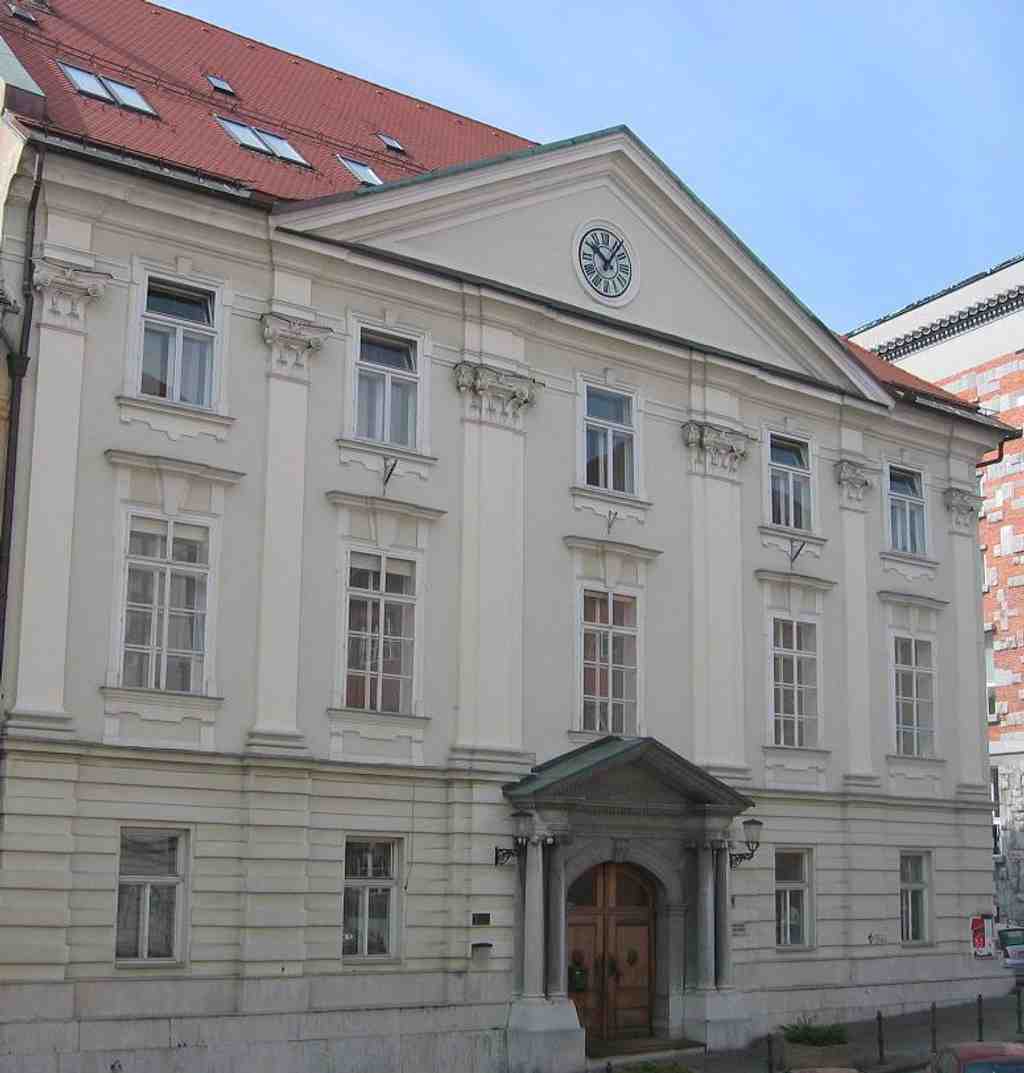
Look to your right for a pale, rectangular stone building topped with a prominent triangular roof structure that houses a distinct, circular clock face. This is the Lontovž Palace, the headquarters of the Slovenian Academy of Sciences and Arts.
If you check your app, you can see the full expanse of this 18th-century noble residence. But what you cannot see are the layers beneath the floorboards. The palace was built directly over a Hallstatt-period burial ground, an early Iron Age cemetery, as well as the ruined stone walls of the original Roman city of Emona. Out of a literal graveyard and the dust of a collapsed empire, Slovenia erected its highest sanctuary for intellectual and artistic achievement.
That cycle of fracture and renewal is deeply woven into the academy itself. During the Second World War, Slovene cultural workers initiated a cultural silence, boycotting all events sponsored by the occupying forces to protest the invasion. Inside these walls, a fierce family drama played out over how to survive. Milan Vidmar, an engineer and world-class chess grandmaster, used his influence with the Italian-backed collaborationist mayor to legally secure the word Slovenian in the academy's name. Meanwhile, his brother Josip was a leader in the communist resistance. Their heated debates over how to best protect their heritage echoed down these very halls.
After the war, the ideological tearing of the academy only worsened. You have to appreciate the tragic paradox of the post-war era. The academy's president, literary historian France Kidrič, fought desperately to preserve the institution's scholarly independence. At the exact same time, his own son, Boris Kidrič, was leading the new National Government that ruthlessly stripped that autonomy away. This political takeover led to a purge where founding members were forced out. By 1949, the government created a legal loophole allowing membership for people whose deeds had special significance, a vague phrase used to force political figures like Josip Broz Tito into honorary seats.
Yet, the academy survived this era of strict state control and eventually flourished, shifting its focus back to genuine discovery. Today, it oversees seventeen autonomous research institutes. In 2023, a team from their Institute for Anthropological and Spatial Studies used aerial laser mapping to pierce the dense Mexican jungle. They discovered Ocomtun, a massive, previously unknown Mayan city with fifteen-meter-high pyramids that had been lost for a millennium.
This relentless drive to uncover the truth connects directly back to the academy's deepest roots. Long before this building was secured, the first iteration of the academy began in 1693 as a tight-knit society of twenty-three industrious men. They made their grand public debut in 1701 at the Bishop's Palace, illuminated by white wax torches and backed by trumpet music. The society was propelled by pioneers like physician Marko Gerbec and the tireless historian Janez Gregor Dolničar. When Dolničar passed away in 1725, the society temporarily collapsed without his vital energy.
But his vision did not stay buried. As we end our walk here in front of the academy, it is clear that while old walls crumble and political regimes fracture, the determination to rebuild and understand the world always endures.




