
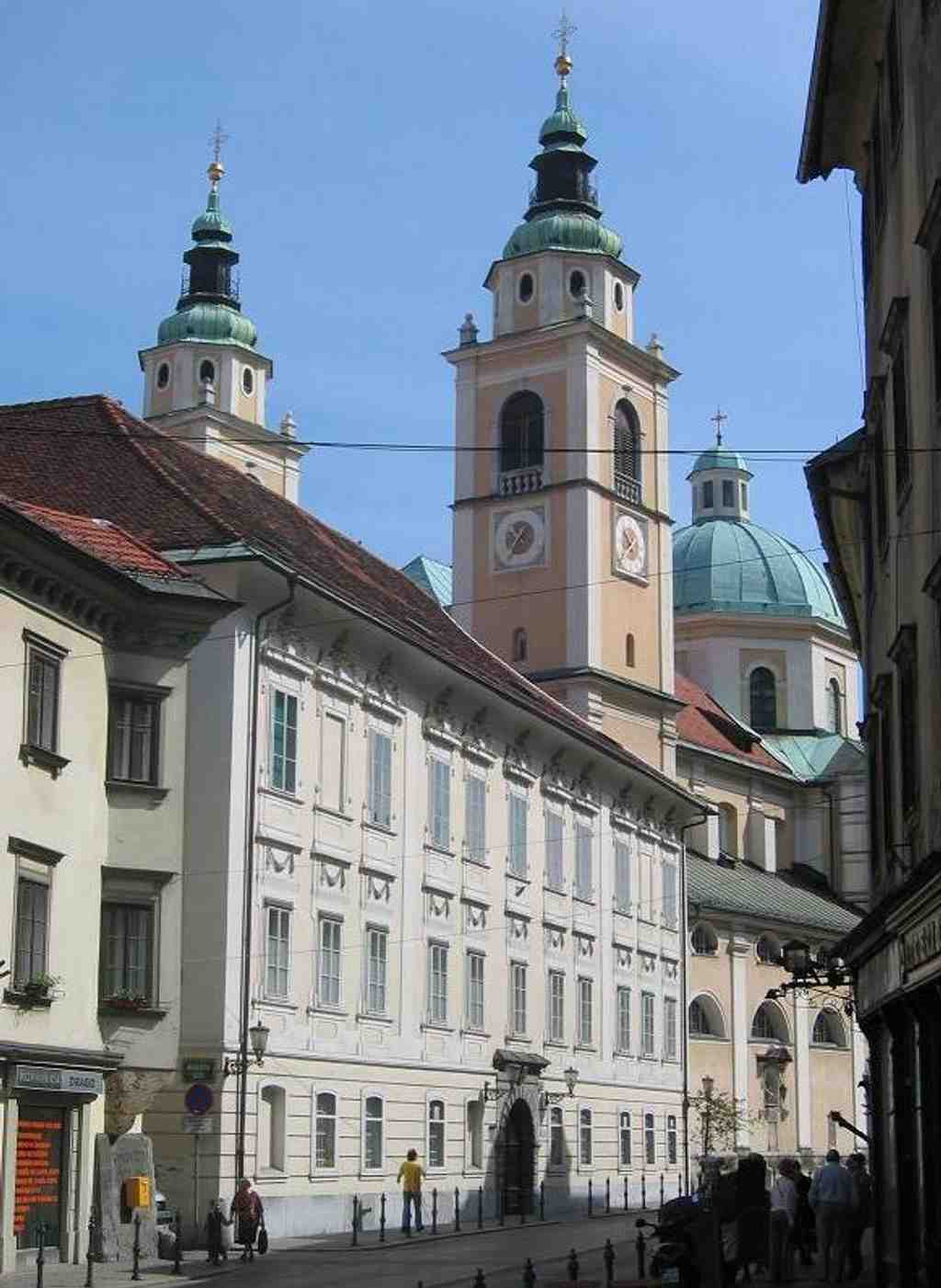
On your right, you will see a pale, multi-story building featuring a prominent dark arched entryway, situated directly beside the cathedral's towering peach-colored belfries and striking green domes. This is the headquarters of the Archdiocese of Ljubljana.
Christianity has deep, complicated roots in this soil. An ancient diocese existed here as early as the year 320, but the territory was repeatedly fractured by the crossfire of empires. In 1461, Emperor Frederick III officially established the Diocese of Ljubljana, but just eight years later, absolute disaster struck. The original medieval cathedral was soon lost to a devastating fire. From those literal ashes, the church was eventually reborn into the striking Baroque complex you see beside you today.
Take a glance at your screen to see the exterior of the magnificent cathedral that emerged from that era. During its construction in the early 1700s, the archdiocese was practically broke. Unable to afford a permanent stone dome, they hired a painter named Giulio Quaglio to create a cupola finta, essentially an illusionistic, three-dimensional painting of a dome on the flat ceiling. His perspective was so flawless that local legends say a bird once flew inside and repeatedly tried to escape through a painted window. It took over a century before a real dome was finally added.
The leaders working inside this building have always navigated a razor-thin line between faith, politics, and survival. Take Bishop Thomas Chrön in the early 1600s. He publicly burned thousands of Protestant books to restore Catholic supremacy, yet he secretly lobbied the Pope to save the first Slovene Bible translation, arguing his priests needed it to study. He effectively rescued the foundational text of the local language from his own fiery purge. Centuries later, in 1952, Archbishop Anton Vovk survived being doused in gasoline and set on fire by a communist mob. He bore horrific burns for the rest of his life but adamantly refused to step down or go into exile.
But today, the institution faces a different kind of reckoning, one stemming from its own internal secrets. In 2012, the Vatican ordered Archbishop Alojz Uran to quietly leave Slovenia for Italy. This was a rare, public disciplinary measure following persistent allegations that the Archbishop had broken his vows of celibacy and fathered two children. His successor did not fare much better, resigning just a year later over a massive financial fiasco. And in 2023, the archdiocese was rocked again when the Vatican dissolved a locally founded religious order following profound abuse allegations against its co-founder. The spiritual and moral burden of this leadership is heavy, a weight beautifully yet somberly symbolized on the cathedral's bronze side doors, where the faces of twentieth-century bishops are sculpted rising from a figure of the dead Christ.
The archdiocese offices are mostly open on weekday mornings and closed entirely on weekends, just as a passing administrative note. Let us keep moving toward our next stop a minute away, where we will trade the guarded secrets of the church for a striking monument of municipal ambition at the Robba Fountain.




