
Treviso Audio Tour: Historic Gems
Beneath the placid surface of Treviso lie bloodstained cobblestones and whispers of forgotten rebellions that the guidebooks dare not mention. Unlock the city with this self guided audio tour. Wander beyond the typical tourist path to uncover scandals and clandestine meetings hidden in plain sight. Why did the Duomo once serve as a fortress for warring factions? What secret pact was sealed inside the velvet shadows of Teatro comunale Mario Del Monaco? And why does the gargoyle in Piazza dei Signori seem to track every passerby with a mocking gaze? Navigate these ancient streets and feel the weight of history pulling at your sleeves. Transform a simple walk into an immersive descent through layers of political intrigue and architectural drama. See the city for what it truly is. Put on your headphones and start your descent into the dark heart of Treviso today.
Tour preview
About this tour
- scheduleDuration 90–110 minsGo at your own pace
- straighten2.7 km walking routeFollow the guided path
- location_on
- wifi_offWorks offlineDownload once, use anywhere
- all_inclusiveLifetime accessReplay anytime, forever
- location_onStarts at Church of San Martino Urbano
Stops on this tour
lock_open 3 free previews · 17 unlock with purchase
On your right, look for the pale marmorino facade, split by four tall Corinthian pilasters, topped with a triangular pediment, and marked by the statue of Christ the Redeemer in…Read moreShow less
Open dedicated page →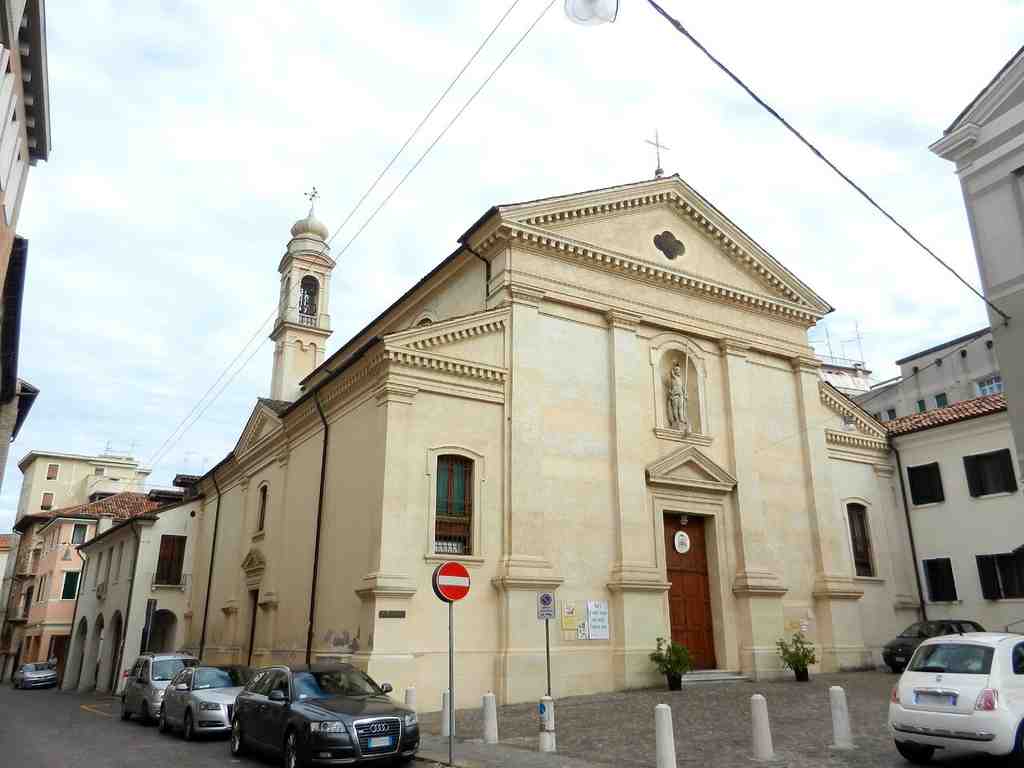
Church of Santo StefanoPhoto: Geobia, Wikimedia Commons, CC BY-SA 4.0. Cropped & resized. On your right, look for the pale marmorino facade, split by four tall Corinthian pilasters, topped with a triangular pediment, and marked by the statue of Christ the Redeemer in the niche above the main door.
Santo Stefano is one of Treviso’s old survivors... the kind of church that has been here so long it appears in written records around the year one thousand, with roots reaching back to the Lombard age. That makes it one of the city’s earliest known places of worship, dedicated to Saint Stephen, the first Christian martyr.
The facade tells a quieter, later chapter. In the eighteen hundreds? Not quite. The church you see now took shape in the eighteenth century, when the Treviso architect Ottavio Scotti designed it with a sober elegance. Corinthian means the pilasters, those flat column-like strips, wear capitals decorated with carved leaves... classical good manners in plaster. The side sections came later, in the first half of the nineteenth century, when builders added the lateral aisles. Then the twentieth century layered in the interior wall decoration, because churches, like families, rarely stop editing themselves.
Its bell tower shared in that long story, too. Builders rebuilt it with the church, but an earthquake brought it down in the sixteenth century... a blunt reminder that stone can be proud, but not invincible. More recently, restorers gave the whole church a careful renewal between two thousand eleven and two thousand twelve.
If you step inside another time, look for the high altar Scotti designed, Guarana’s Martyrdom of Saint Stephen, and a wooden crucifix linked to Francesco Terilli. For all its age, this church feels remarkably composed. When you’re ready, continue on and let the next corner of Treviso speak up.
Treviso Theatre
Show 17 more stopsShow fewer stopsexpand_moreexpand_less
On your right, look for a long white plastered palace with three levels, a darker block-patterned ground floor, and a central three-part window with a slim iron balcony. The…Read moreShow less
Open dedicated page →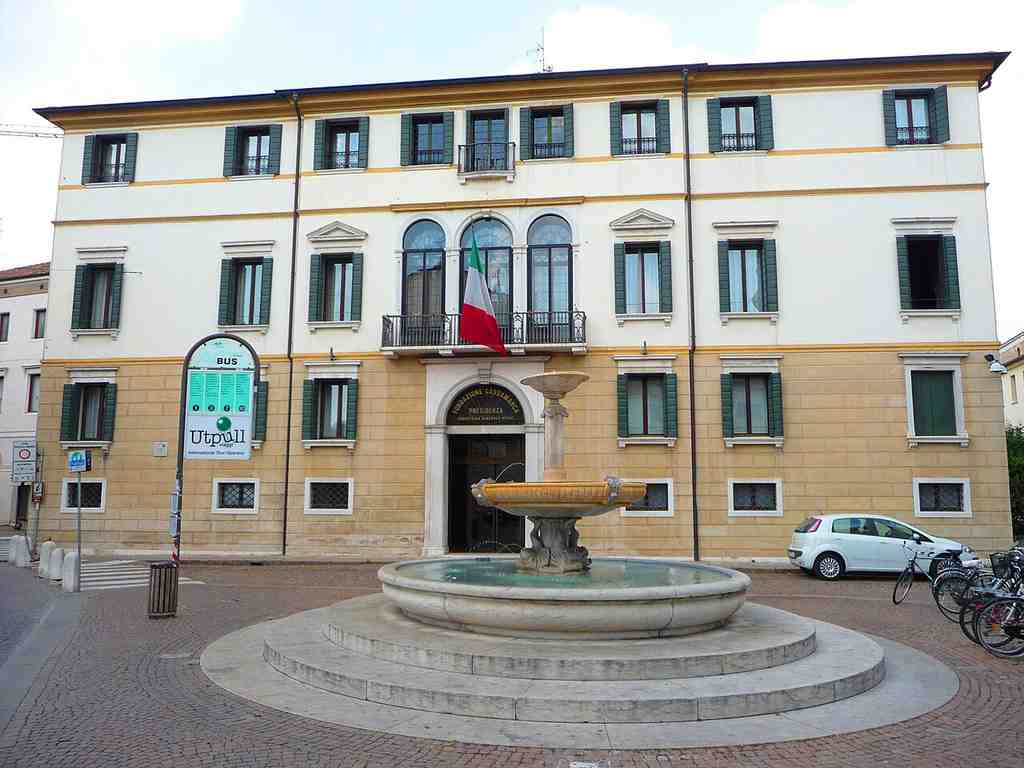
Ca' SpinedaPhoto: Appo92, Wikimedia Commons, CC BY-SA 3.0. Cropped & resized. On your right, look for a long white plastered palace with three levels, a darker block-patterned ground floor, and a central three-part window with a slim iron balcony.
The Spineda family commissioned this palace in the later fifteen hundreds, then kept enlarging and refreshing it through the seventeen hundreds... because noble families rarely met a building they couldn’t improve. The façade is disciplined but elegant: ochre bands divide the floors, stone frames sharpen the windows, and the main level centers on that trifora, a window split into three openings, flanked by two taller windows with little triangular crowns. If you check your screen, you can catch the full balance of the front all at once.
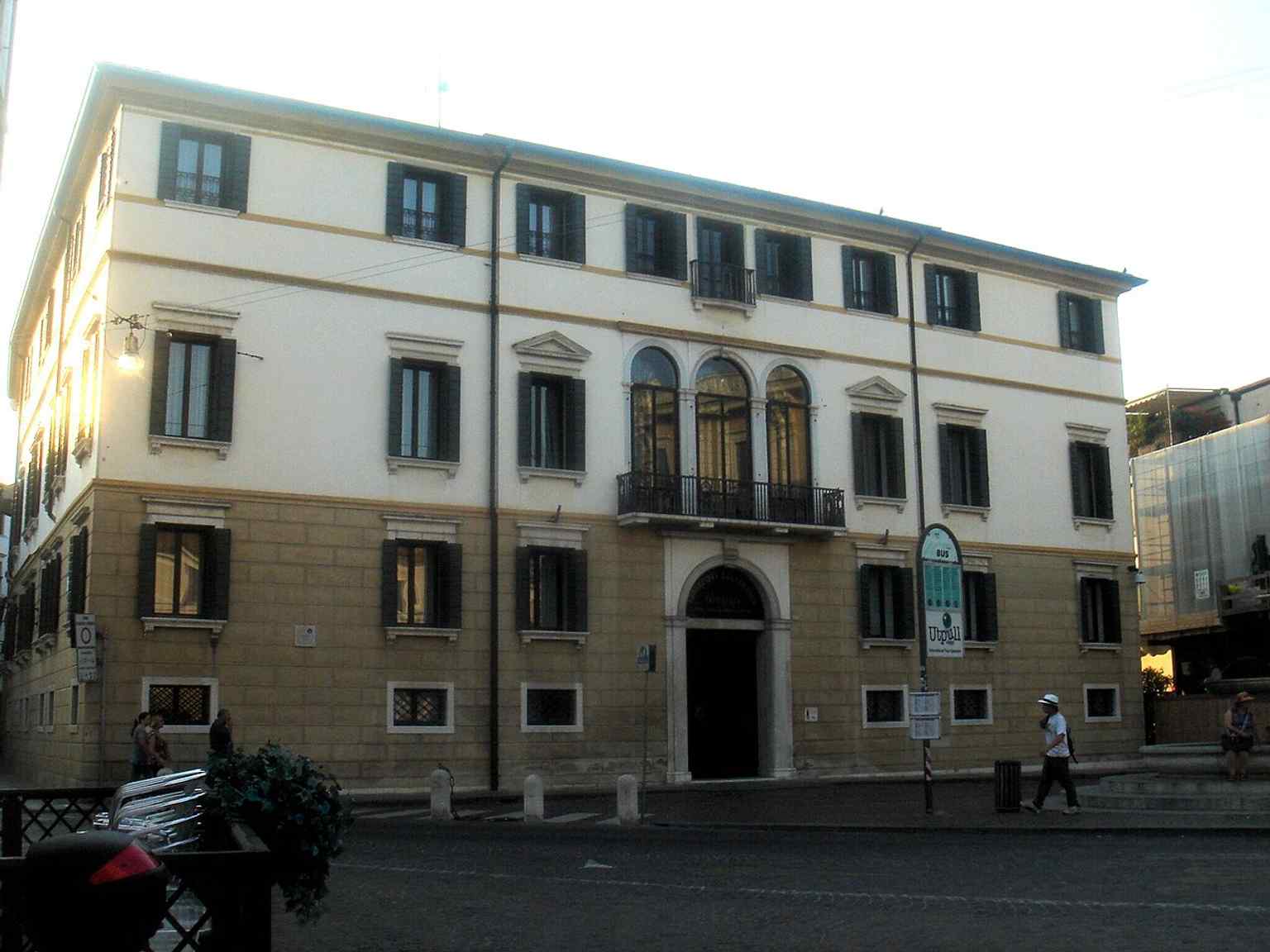
Ca' Spineda’s white, three-story façade in Treviso — home of the Cassamarca Foundation since 1935.Photo: Paolo Steffan, Wikimedia Commons, CC BY 3.0. Cropped & resized. Inside, it turns unexpectedly grand. An eighteenth-century ballroom rises through two stories with a gallery, its frescoes linked to Basilio Lasinio, and a sweeping staircase carries decoration by Gaspare Diziani. On the fifteenth of November, eighteen sixty-six, King Vittorio Emanuele the Second stayed here. Since nineteen thirty-five, Ca’ Spineda has housed the Cassamarca Foundation.
This is Treviso in one façade: status, polish, and a very good memory.
When you’re ready, continue toward the next stop.
On your right, look for a tall square brick tower rising from the palace, marked by a small stone clock face and a crown of forked battlements at the top. This is Treviso’s civic…Read moreShow less
Open dedicated page →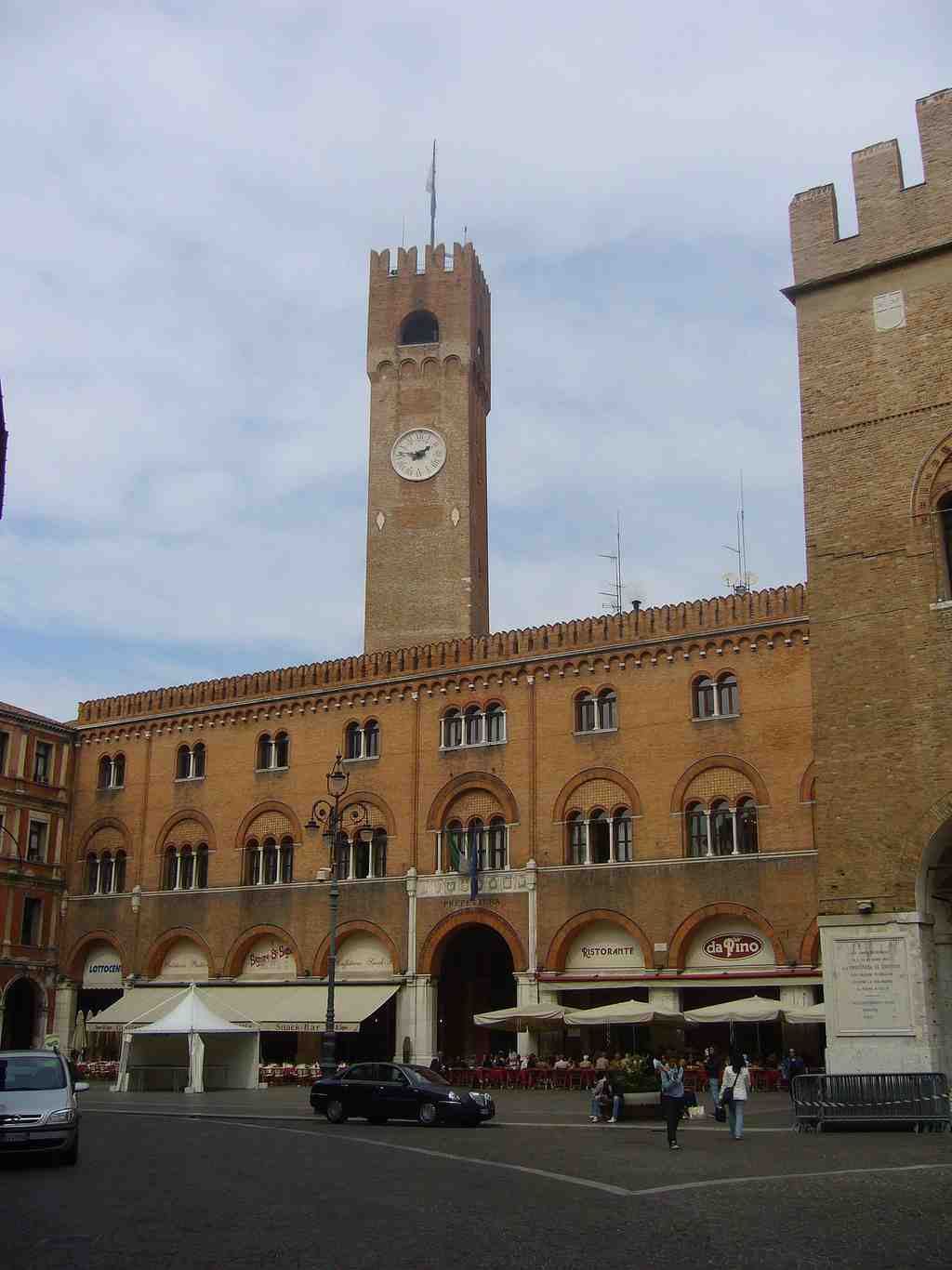
Civic TowerPhoto: Pvt pauline, Wikimedia Commons, CC BY-SA 3.0. Cropped & resized. On your right, look for a tall square brick tower rising from the palace, marked by a small stone clock face and a crown of forked battlements at the top.
This is Treviso’s civic tower... forty-eight meters of medieval authority with a slightly rewritten ending. Town leaders raised it in twelve eighteen, during the communal age, as part of the Palazzo dei Trecento complex. Then, between twelve sixty-five and twelve sixty-eight, builders absorbed it into the westward expansion of the Palazzo del Podestà. Even in the Middle Ages, nobody could resist a renovation. Over time, they gave it a grand clock facing the square and a lantern above. In eighteen seventy-seven, engineer Antonio Monterumici rebuilt the ruined top, pushed it a little higher, and finished it with neo-Romanesque Ghibelline merlons... those swallowtail battlements that look ready for an argument. Inside hangs the civic bell, cast by De Poli in Vittorio Veneto, weighing about two thousand seven hundred kilograms and struck by hammer every hour. At twelve thirty on the seventh of April, nineteen forty-four, a siren up there warned of the American bombing. It’s a tower that carries both civic pride and a hard memory. When you’re ready, continue toward Calmaggiore; if access is available, visiting hours are generally nine to seven every day.
Look for a long, straight stone-paved street framed by brick-and-plaster arcades, with painted facades and the Duomo’s stout unfinished bell tower marking one end. This is…Read moreShow less
Open dedicated page →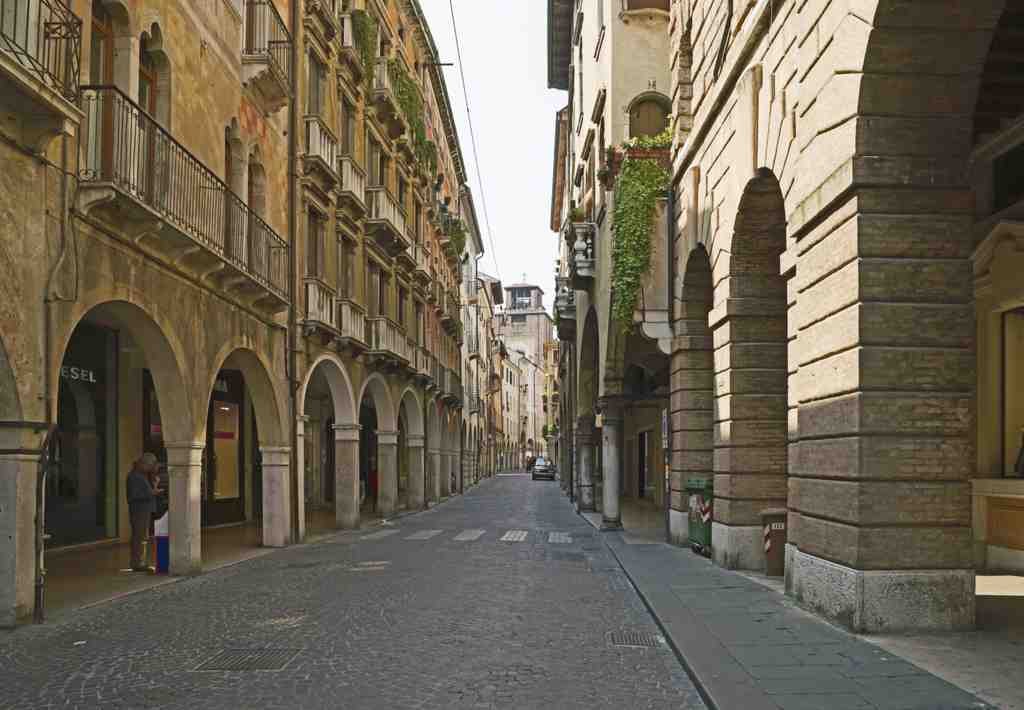
CalmaggiorePhoto: Didier Descouens, Wikimedia Commons, CC BY-SA 4.0. Cropped & resized. Look for a long, straight stone-paved street framed by brick-and-plaster arcades, with painted facades and the Duomo’s stout unfinished bell tower marking one end.
This is Calmaggiore... not, strictly speaking, “Via Calmaggiore.” Treviso likes precision when it feels like it. And this street has earned it. You’re standing on the city’s main historic spine, the route that links Piazza del Duomo with Piazza dei Signori. Long before shopfronts and porticoes took over, Roman Treviso laid this out as its cardo maximus, the town’s main Roman axis. It kept that line, stretching beyond today’s center toward the bridges of San Chiliano and Santa Margherita.
Romans paired a cardo with a decumanus, the main cross street... think of a giant urban plus sign. Scholars place that crossing near the Loggia dei Cavalieri, so this road sat right at the heart of the ancient plan.
In the Middle Ages, Calmaggiore gained a second life. It connected the cathedral, seat of spiritual power, with the palace of the Signoria and the Domus Nova Communis, now known as Palazzo dei Trecento, where civic power lived, argued, and probably overcomplicated things. So this street did more than move people around. It staged the conversation between church and government.
Its name likely comes from the Latin callis maior, meaning “greater road,” a later echo of cardo maximus. On both sides, palaces once showed off frescoes across their facades and even under the porticoes. And Calmaggiore still hides older layers. At the beginning of the street, Roman road remains survive below ground. Near the Duomo end, San Giovanni’s walls reuse Roman stone, and beside it sits a marble sarcophagus from the fifth or sixth century, decorated with a cross. Archaeologists found inside a little pectoral cross, a comb, and threads of brocade, which suggests the burial of a noble Lombard girl... a startlingly intimate trace of one small life on one very important road.
Calmaggiore is Treviso in a single line: Roman grid, medieval power, and a little human mystery under the plaster.
When you’re ready, continue along this old axis toward the next stop.
On your left, Piazza dei Signori opens as a broad stone rectangle framed by red-brick civic palaces, tall arched porticos, and the raised loggia of the Palazzo dei Trecento. This…Read moreShow less
Open dedicated page →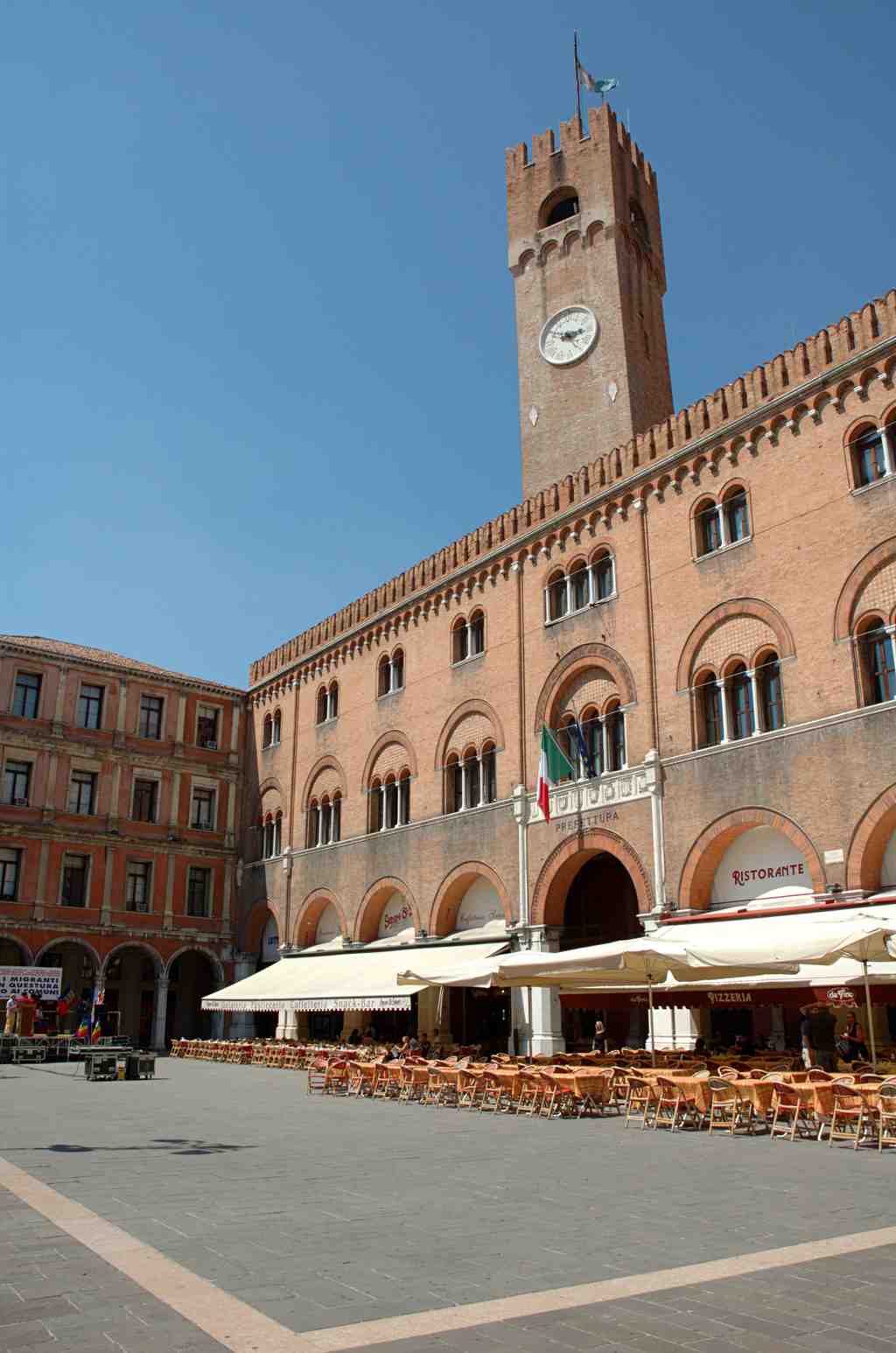
Piazza dei SignoriPhoto: Gary Houston, Wikimedia Commons, CC0. Cropped & resized. On your left, Piazza dei Signori opens as a broad stone rectangle framed by red-brick civic palaces, tall arched porticos, and the raised loggia of the Palazzo dei Trecento.
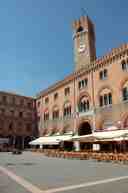
This is the central square of Treviso... not just the pretty heart of town, but the place where politics, gossip, ceremony, punishment, trade, and plain old hanging around all learned to share one address. Its current name, Piazza dei Signori, comes from the buildings around it: the Palazzo del Podestà, now the Prefecture; the Palazzo dei Trecento; and the Palazzo Pretorio. In other words, the square took its name from the people in charge. Cities do love a little branding.
The story goes back to the late twelfth century, when the first communal buildings began to rise here. Some historians think this area may overlap with the Roman quadruvium, a four-way crossing created where the main streets met at right angles. That might explain one of the square’s earliest names, Piazza del Carubio, a worn-down local version of quadruvium. Another theory places that Roman crossing nearby instead, so even the name carries a small scholarly argument... which feels appropriate for a civic square.
Over time, Treviso renamed this place with refreshing honesty. It was called Piazza delle Catene, the Square of Chains, and Piazza della Berlina, the place where condemned people were displayed to the public. Not subtle. Later came grander names like Piazza Grande, Piazza del Popolo, and Piazza dei Nobili. Every era left its own label, like a stack of official memos nobody quite had the heart to throw away.
Look at the eastern side and you’re looking at the Palazzo dei Trecento, begun in the early thirteen hundreds after an earlier town hall burned. This was the seat of the Maggior Consiglio, the Great Council of three hundred members. Three hundred politicians in one hall sounds less like efficient government and more like a medieval endurance test. The open ground-floor arcade, the Loggia dei Trecento, came later and gave the building the airy face you see now. If you want a closer look at those arches and openings, check the image on your screen.
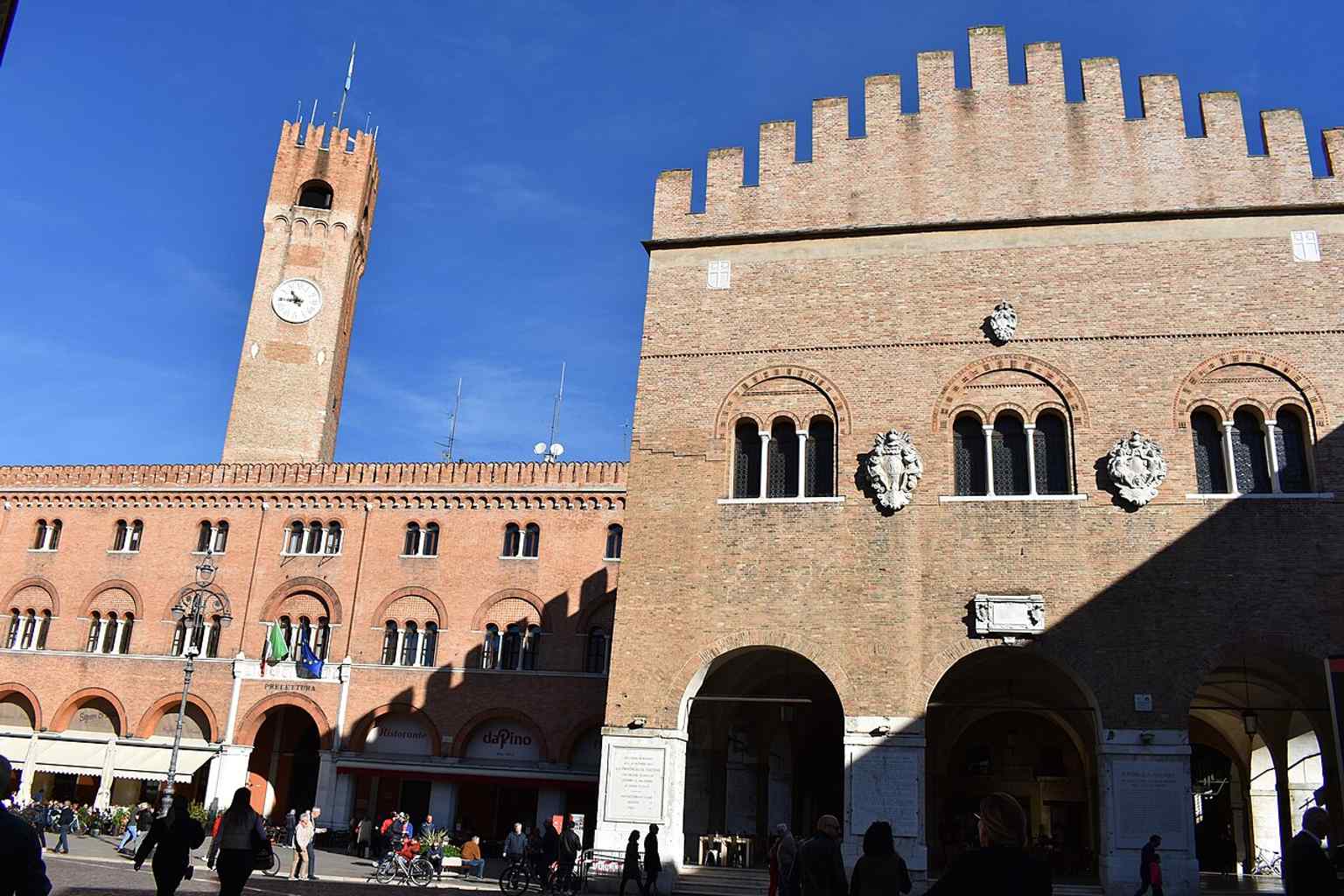
The Loggia dei Trecento in sharp detail — this open ground-floor arcade is one of the square’s defining features and once housed the city’s great council hall above.Photo: Maddalena Addeo, Wikimedia Commons, CC BY-SA 4.0. Cropped & resized. This square mattered for another reason too. The city placed its political center here, on the old Roman forum, and away from the Duomo. That was a very deliberate message: civic power stood on its own feet, thank you very much, and did not need to share a desk with religious authority.
The buildings around you changed over centuries. The Palazzo del Podestà took on its current neo-Gothic look in the eighteen seventies. The Palazzo dei Trecento suffered terrible damage in the bombing of Good Friday, nineteen forty-four, and engineer Ferdinando Forlati led the careful restoration that saved it, even straightening walls that had begun to lean. If you glance at the historical photo in the app, you can see how this square has long carried itself as Treviso’s public stage.
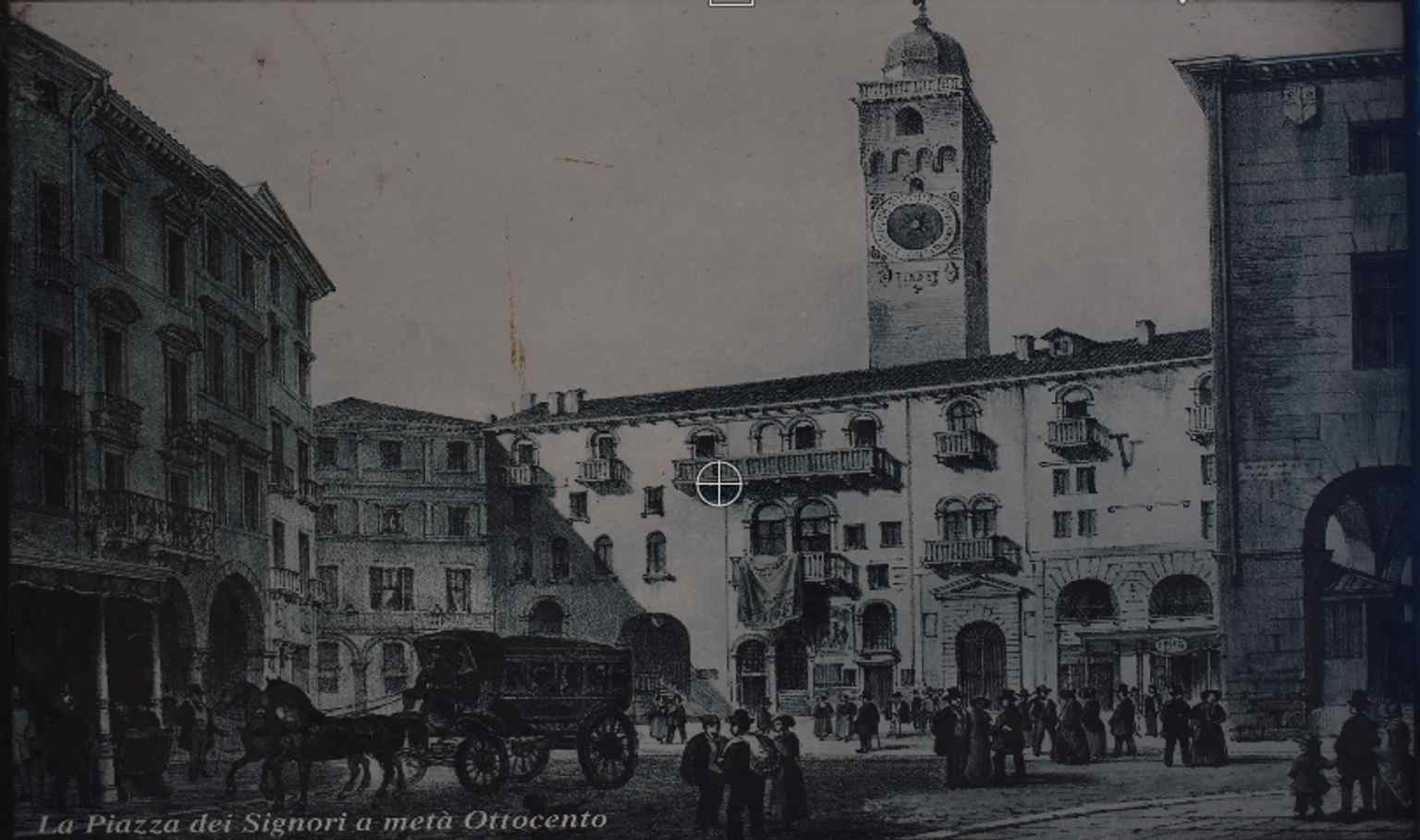
An 19th-century view of Piazza dei Signori, showing how the square has long been the city’s ceremonial and administrative center.Photo: Giaccai, Wikimedia Commons, CC BY-SA 4.0. Cropped & resized. There are smaller details too: lions of Saint Mark carved in relief, their open books recalling Venetian rule; the southern edge opening toward Calmaggiore; and the covered passage between the Palazzo del Podestà and the Palazzo dei Trecento, called the Portico dei Soffioni. That name does not come from a pleasant breeze, but from gunpowder charges once fired there during bull-chase spectacles to rile up the dogs. Medieval entertainment had... fewer safety meetings.
More than a square, this is Treviso’s civic memory laid out in stone. When you’re ready, continue on toward Ca’ dei Ricchi.
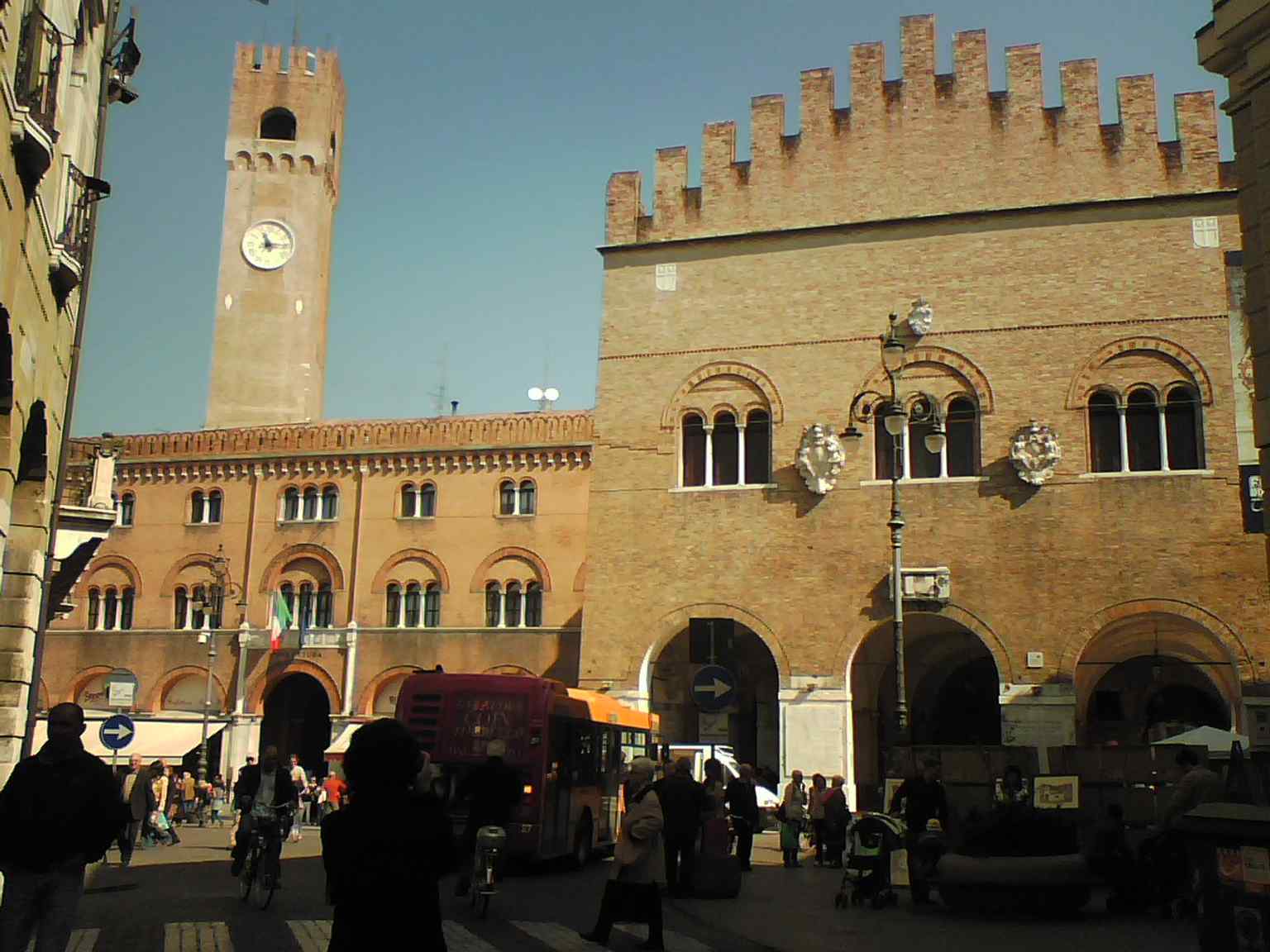
A broad view of Piazza dei Signori, the historic civic heart of Treviso framed by the city’s main medieval public buildings.Photo: Orledio, Wikimedia Commons, CC BY-SA 4.0. Cropped & resized. 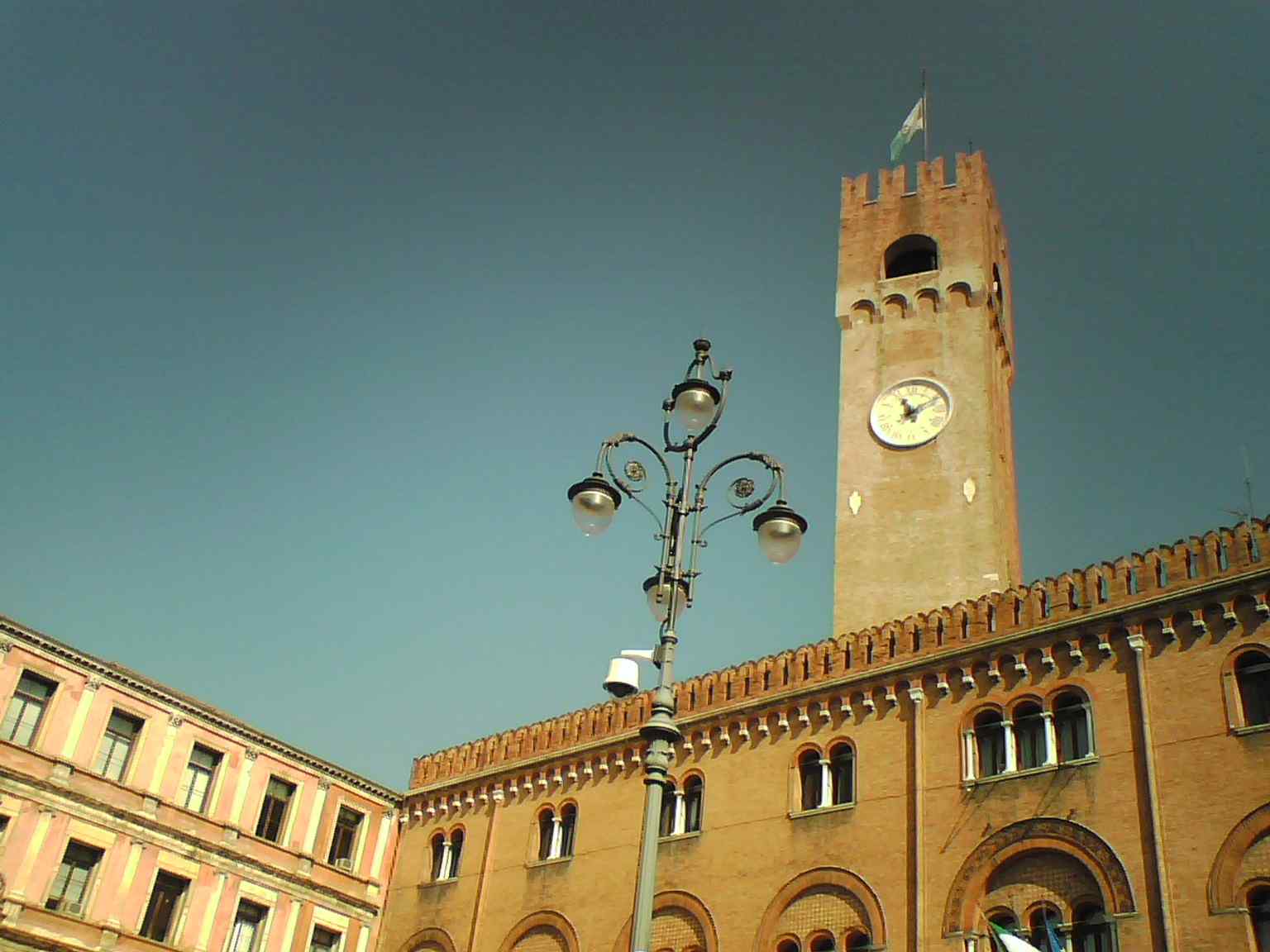
The Civic Tower beside the former Palazzo del Podestà, where the Marangona bell has marked Treviso’s public life since the 14th century.Photo: Orledio, Wikimedia Commons, CC BY-SA 4.0. Cropped & resized. Look for a tall Gothic brick façade with pointed Venetian-style windows and traces of painted floral patterns, a rare medieval survivor tucked between the street fronts. Ca' dei…Read moreShow less
Open dedicated page →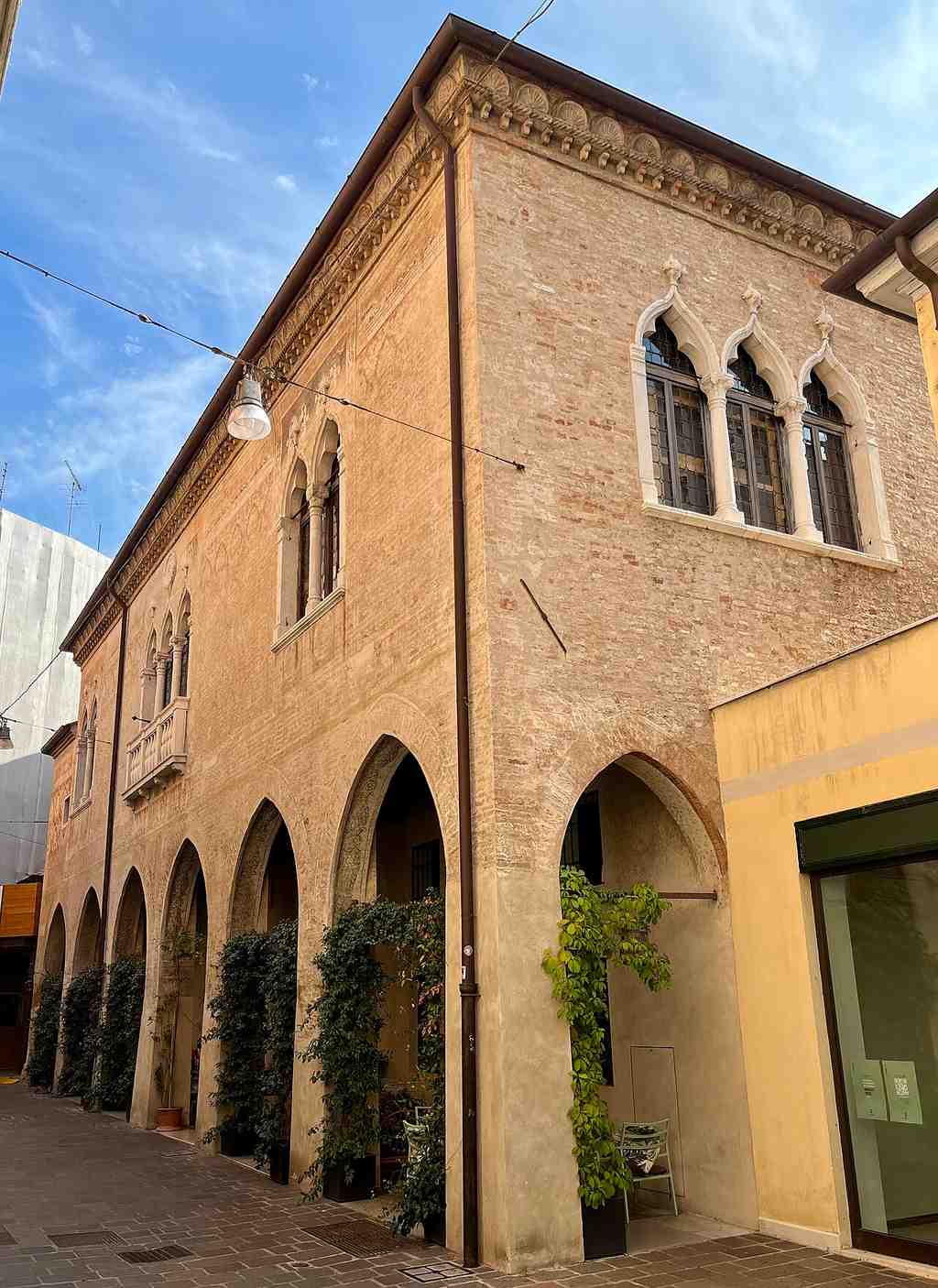
Ca' dei RicchiPhoto: Phante, Wikimedia Commons, CC BY-SA 4.0. Cropped & resized. Look for a tall Gothic brick façade with pointed Venetian-style windows and traces of painted floral patterns, a rare medieval survivor tucked between the street fronts.
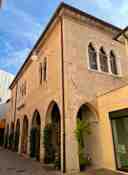
Ca' dei Ricchi carries the memory of Treviso’s fourteen-hundreds before you even step inside. The Azzoni Avogadro family raised it in the second half of the thirteen hundreds, and it still reads like a page left open from medieval Treviso. If you glance at your screen, the façade in the photo shows that mix of exposed brick and elegant window shapes beautifully. For a time, this palace hosted the Collegio dei Nobili, a school for young aristocrats, and later it served as the town hall... which is a fairly classic career change for a grand old building. Inside, the piano nobile, meaning the main ceremonial floor, keeps its refined decoration. After years of silence, architect Toni Follina led its restoration, and the city reopened it in two thousand thirteen. Since then, art shows, film screenings, and jazz concerts have filled these rooms again.
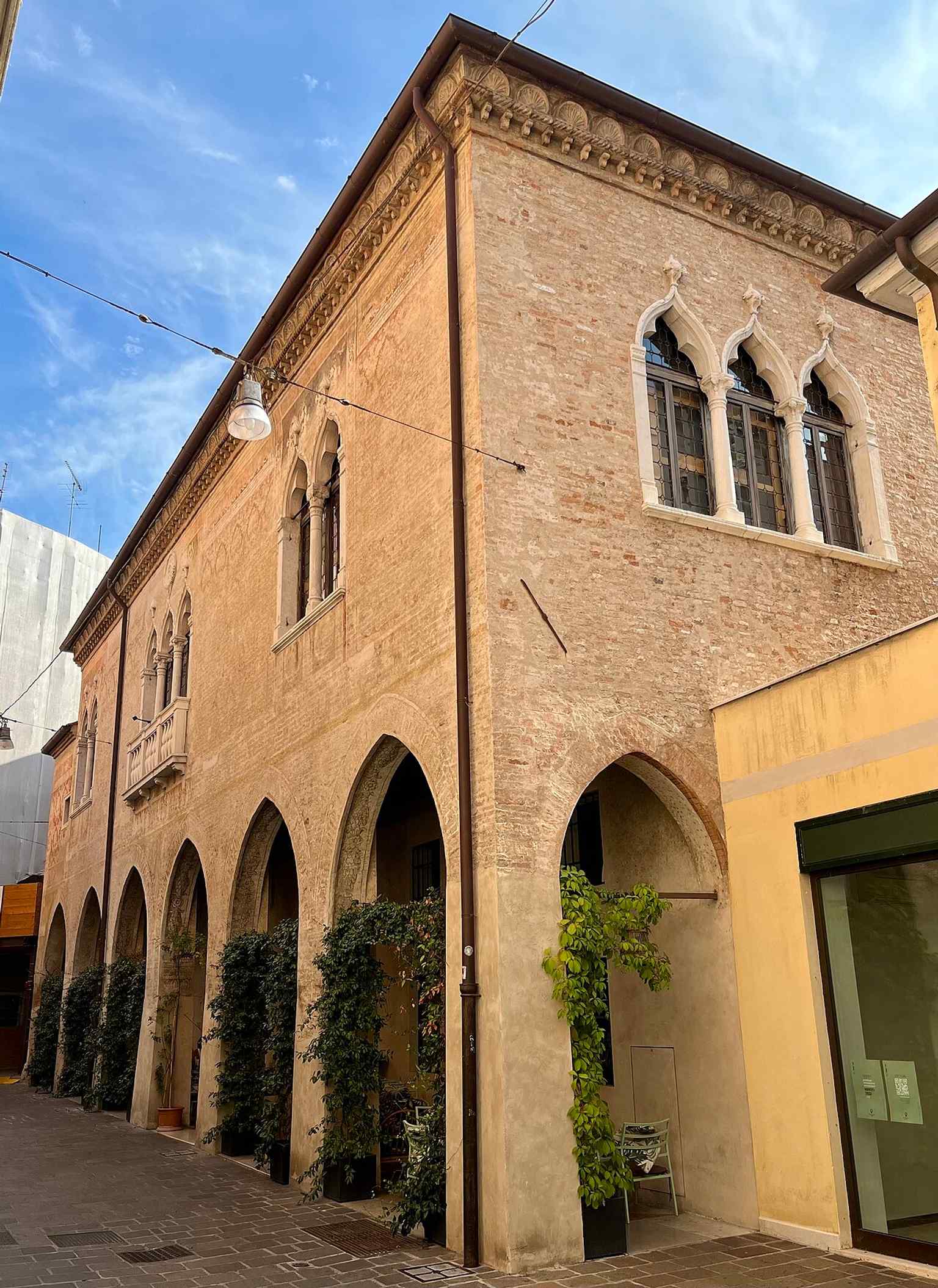
Ca' dei Ricchi’s Gothic brick façade in Treviso’s historic center, a rare surviving trace of the city’s medieval past.Photo: Phante, Wikimedia Commons, CC BY-SA 4.0. Cropped & resized. Practical note: this site is listed as open all day, with a moderate price level.
Ca' dei Ricchi proves Treviso never really threw away its medieval bones. When you’re ready, continue on toward the little fountain in Vicolo Pola.
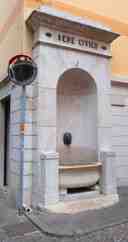
Look for a shallow Istrian-stone niche set into the building, with a cast-iron lion mask at its center and a stone basin standing on four lion paws. This little fountain hides in…Read moreShow less
Open dedicated page →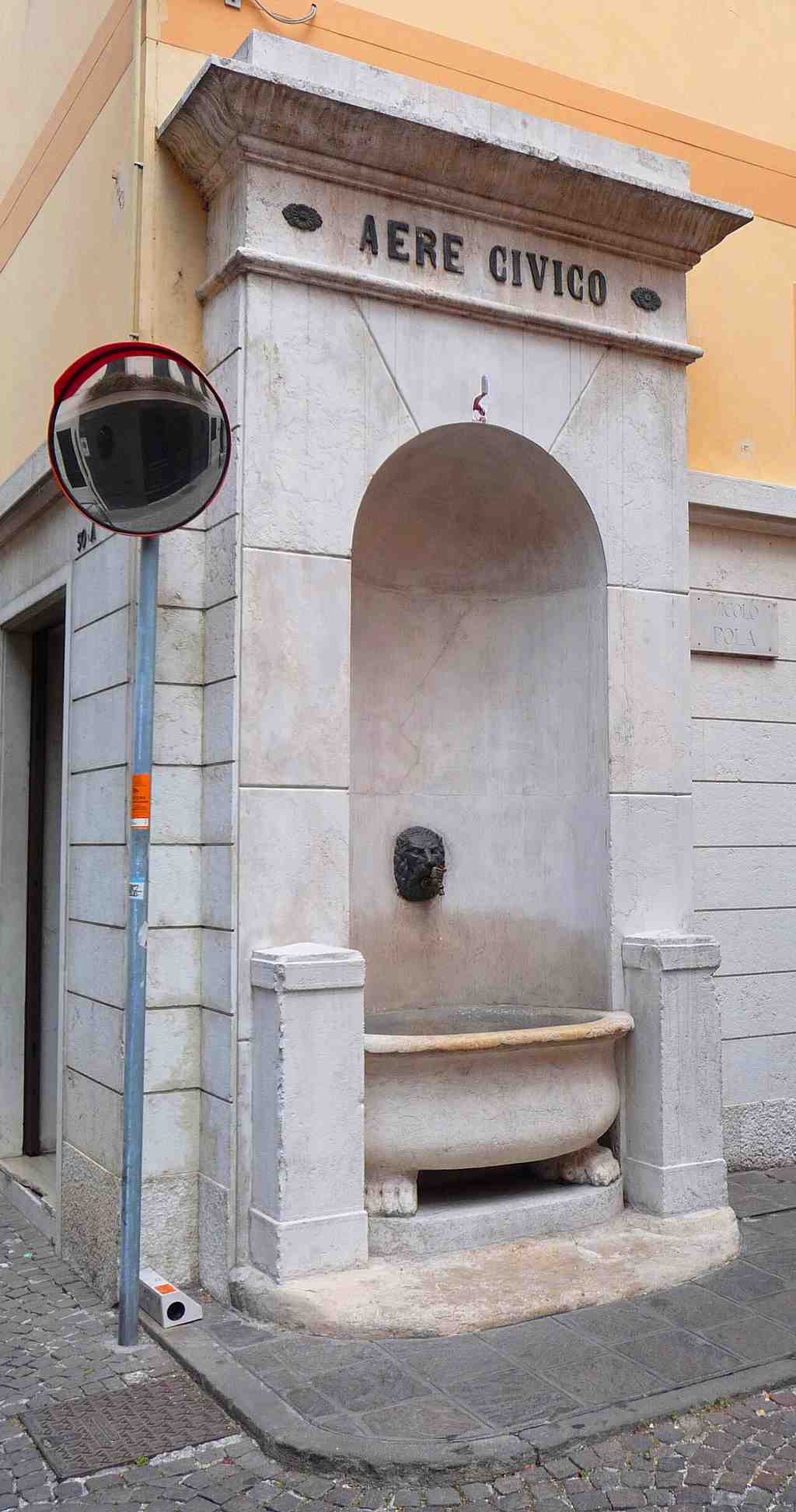
Fountain in Pula alleyPhoto: Appo92, Wikimedia Commons, CC BY-SA 3.0. Cropped & resized. Look for a shallow Istrian-stone niche set into the building, with a cast-iron lion mask at its center and a stone basin standing on four lion paws.
This little fountain hides in plain sight... and Treviso has taken it seriously for a long time. In the middle of the nineteenth century, Bartolomeo Zanon examined the water here along with five other city fountains. He tested its organoleptic qualities, meaning the things ordinary people actually notice: taste, smell, and feel. Then, in eighteen forty-seven, he gathered the results in a study called Analisi delle acque potabili di Treviso, an analysis of the city’s drinking water. Not glamorous, perhaps, but very civilized.
The design has its own pride. Water flows from the lion’s mouth through a push-button tap, collects in the stone basin below, and above the arch you can read the bronze words AERE CIVICO, “at civic expense.” Even the two stone bollards stand guard like dutiful bodyguards. It stays accessible all day and all night. Small fountain, serious character. When you’re ready, continue on toward the Diocesan Museum.
Look for a long, uneven stone piazza edged by pale masonry facades, with the cathedral’s broad front and the baptistery tucked beside it. This elongated, asymmetric square is…Read moreShow less
Open dedicated page →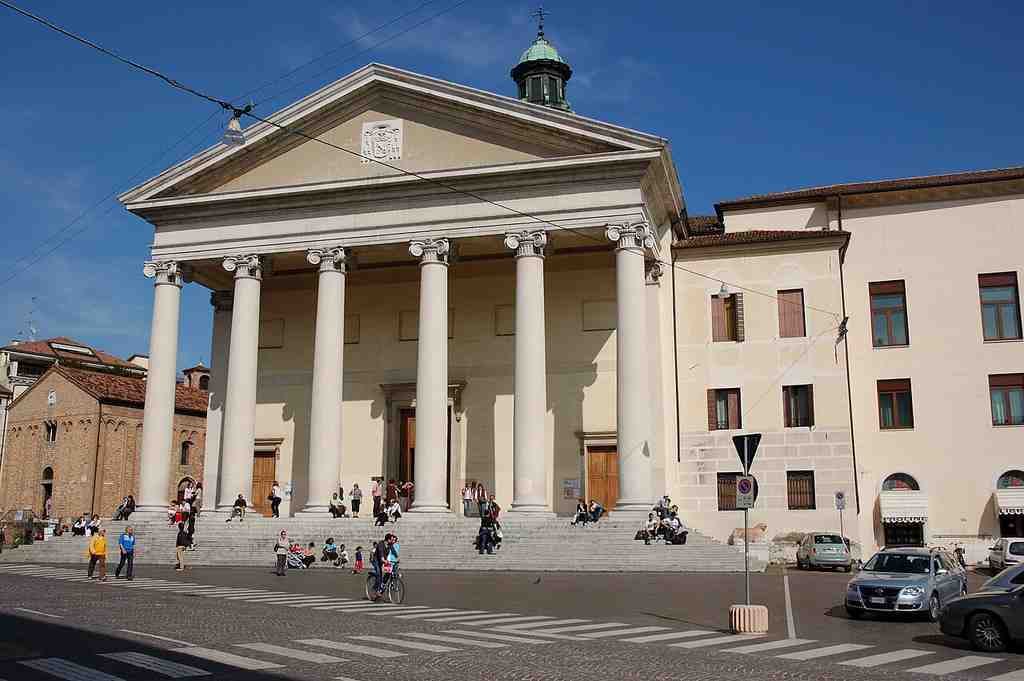
Piazza del DuomoPhoto: Morningfrost, Wikimedia Commons, Public domain. Cropped & resized. Look for a long, uneven stone piazza edged by pale masonry facades, with the cathedral’s broad front and the baptistery tucked beside it.
This elongated, asymmetric square is Treviso’s religious heart, the counterweight to Piazza dei Signori, where politics held court. Around you stand the cathedral, San Giovanni Battista - now the baptistery, the church used for baptisms - the episcopio, the bishop’s residence, and, in the recess between cathedral and baptistery, the Scuola del Santissimo Sacramento. Across from the cathedral is the former courthouse, later municipal offices until the two thousands. Treviso reuses its buildings. Earlier, this side held Ezzelino the Third da Romano’s palace, until citizens burned it in twelve sixty, then a grain warehouse turned wood store, which gave the square its old names: Piazza delle Biade and Piazza delle Legne. In nineteen thirty-five, workers demolished houses here during the restoration of San Giovanni Battista; then Anglo-American bombing in nineteen forty-four damaged the bishop’s palace and destroyed Casa Barisan, the Casa Rossa frescoed by Giovanni Matteo da Treviso in fifteen oh three. Fifteenth-century Casa Dal Corno still survives. This square wears history with little vanity. When you’re ready, continue toward the cathedral itself.
In front of you rises a pale stone façade with a wide staircase, a porch of six Ionic columns, and a triangular pediment marked with the cathedral chapter’s coat of arms. This is…Read moreShow less
Open dedicated page →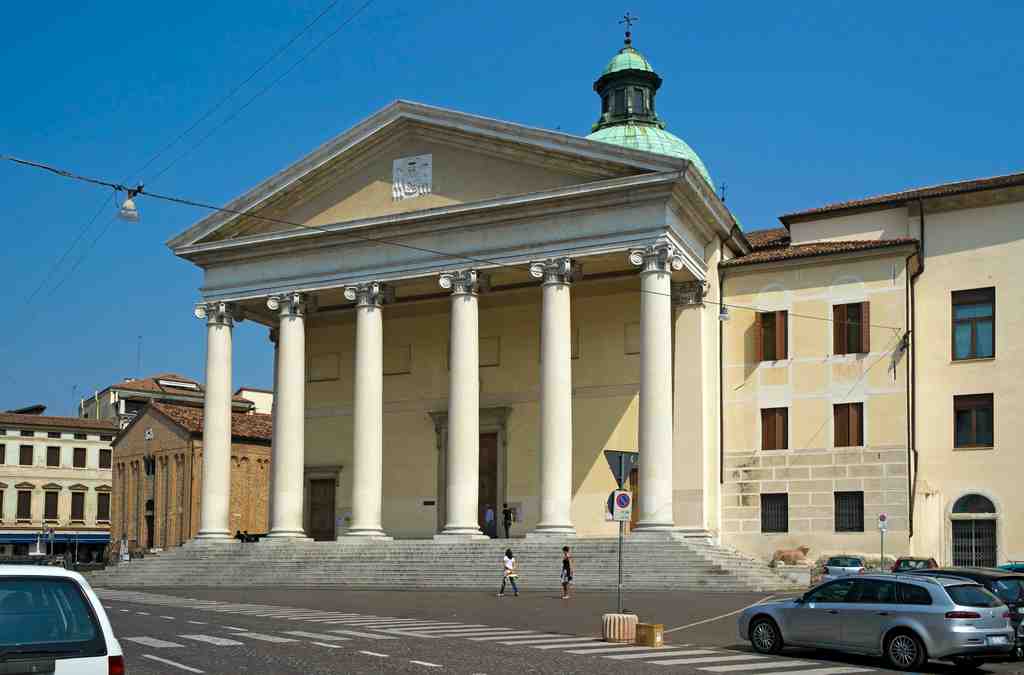
Cathedral of TrevisoPhoto: Didier Descouens, Wikimedia Commons, CC BY-SA 4.0. Cropped & resized. In front of you rises a pale stone façade with a wide staircase, a porch of six Ionic columns, and a triangular pediment marked with the cathedral chapter’s coat of arms.
This is the Cathedral of Saint Peter the Apostle, though everyone here sensibly calls it the Duomo. It is Treviso’s main church, the seat of the diocese, and the home of the bishop’s cathedra, meaning his ceremonial chair... the seat that gives us the word cathedral in the first place. So yes, this is the big one.
Its story reaches back to the sixth century, when Christians established a church here in the most important part of town. Archaeologists found traces of even older neighbors on this site: a Roman temple, a theater, and possibly baths. Treviso has never been shy about reusing prime real estate. In the eleventh and twelfth centuries, Bishop Rotario reshaped the complex in the Romanesque style. That phase has not vanished completely. The crypt below still belongs to that medieval cathedral, and out here, the two red Verona marble lions at the sides of the staircase once supported the old Romanesque porch.
What you see now is much later and much calmer in style, at least on the surface. In seventeen fifty-nine, the scholar and architect Giordano Riccati began a major rebuilding in the neoclassical taste. The project did not go smoothly. The cathedral took its time, which is a polite way of saying the plans changed, arguments flared, and the money ran out. Work stalled in seventeen eighty-two. Giannantonio Selva finished the interior from seventeen ninety, and the grand front you are facing now, with its deep porch - architects call that a pronaos, basically a formal temple-like entrance - and its broad stairway arrived in eighteen thirty-six through Francesco Bomben and Gaspare Petrovich.
Even so, the Duomo is not a clean break from the past. It keeps three old Lombard chapels at the rounded east end of the Romanesque church, and inside, in two thousand and five, workers reconstructed the old fifteenth-century portal that had been removed when this façade went up. The building also carries seven domes in total, five over the central nave - the long main hall of the church - and two above the side chapels in the cross arms.
If you go in later, the real rewards are layered. The crypt below rests on sixty-eight columns of differing shapes and holds the shrine of Saint Liberale, Treviso’s patron. The Malchiostro Chapel, created in the early sixteen hundreds? No - close, but not quite. It dates to about fifteen twenty, and that matters, because it brought together Tullio and Antonio Lombardo, Titian, and Il Pordenone in one remarkable Renaissance ensemble. Titian painted the Annunciation; Pordenone covered walls and dome with muscular frescoes shaped by his time in Rome. The cathedral also received a huge modern organ for the Jubilee of two thousand, with three thousand five hundred ninety-four pipes, because apparently salvation sounds better with proper engineering.
Beside the cathedral stands the stout, unfinished bell tower. Tradition says the doges of Venice blocked any plan that might let it outgrow Saint Mark’s campanile. Petty? Absolutely. Believable? Also absolutely.
If you want to step inside, the cathedral generally opens from seven thirty to noon and again from three to seven, with Sunday afternoon extending to eight.
For all its polished symmetry, this Duomo is really Treviso layered in stone: Roman ground, medieval memory, Renaissance brilliance, and a nineteenth-century face trying to keep everyone in order.
When you’re ready, continue on to the Church of San Giovanni Battista, where the cathedral complex turns older and more intimate.
On your left, look for the pale masonry palace with a broad rectangular front, lower side wings, and the footbridge linking the grounds across the Roggia canal. Palazzo Caotorta…Read moreShow less
Open dedicated page →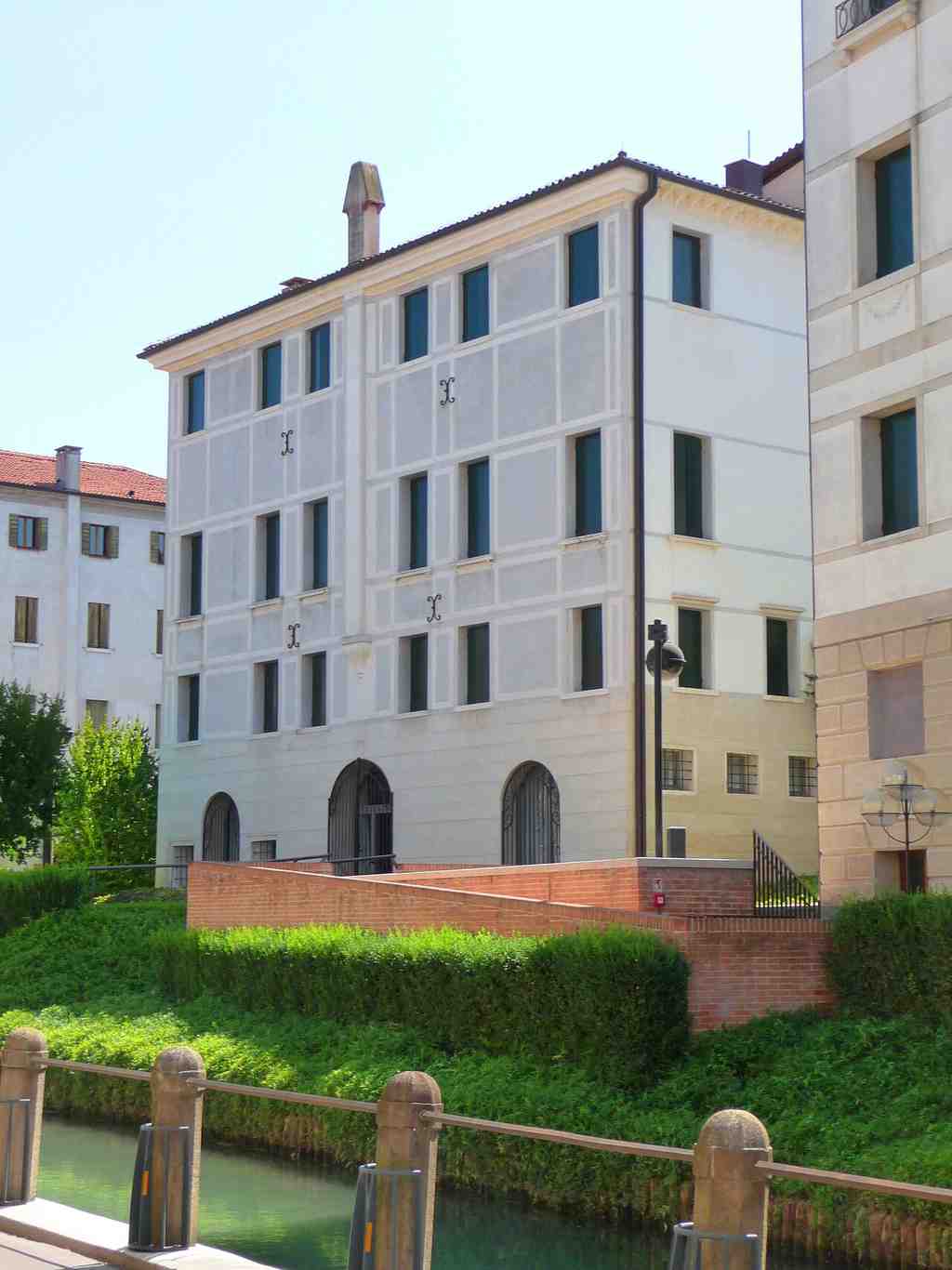
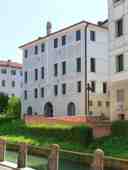
Caotorta PalacePhoto: Appo92, Wikimedia Commons, CC BY-SA 3.0. Cropped & resized. On your left, look for the pale masonry palace with a broad rectangular front, lower side wings, and the footbridge linking the grounds across the Roggia canal.
Palazzo Caotorta has lived several lives... and a few of them were frankly rough. A chronicler named Bartolomeo Burchiellati called this place an ancient and noble residence, and for centuries the cathedral canons lived here - church officials, in other words, with a very respectable address. Then, in the early sixteen hundreds, the Scotto brothers bought up several older buildings and stitched them together into one large palace, keeping parts of the older walls and covering open spaces that faced the Roggia.
By seventeen eighteen, a man named Cristoforo Como owned it. Later in that century, Girolamo Caotorta took over and gave the palace a major overhaul. In the eighteen sixties, workers cut back the smaller neighboring building to open a garden along the canal, and they split the main block into apartments. The Caotorta family stayed in the piano nobile... the grand main floor above street level, where families liked to show they were doing nicely, thank you very much.
Then came the seventh of April, nineteen forty-four. Anglo-American bombing damaged the palace so badly that people abandoned it, and because nobody moved quickly to protect it, more sections collapsed. That could have been the end. Instead, the Benetton Foundation bought the ruin in the nineteen nineties, and architect Tobia Scarpa led a careful restoration. Now it holds the foundation’s library and documentation center, with public cultural programs, while inside, a few painted rooms still survive from the early nineteenth century and later.
If you want to go in, it usually opens Monday through Friday from nine to one and from two to five thirty, and it stays closed on weekends.
Caotorta feels like a rescue story told in brick, plaster, and stubborn memory. When you’re ready, continue on toward Ca’ Sugana.
On your left, Ca' Sugana is a restrained neoclassical palace in pale masonry, with a round-arched central portal, rows of rectangular windows, and a small pediment holding a blind…Read moreShow less
Open dedicated page →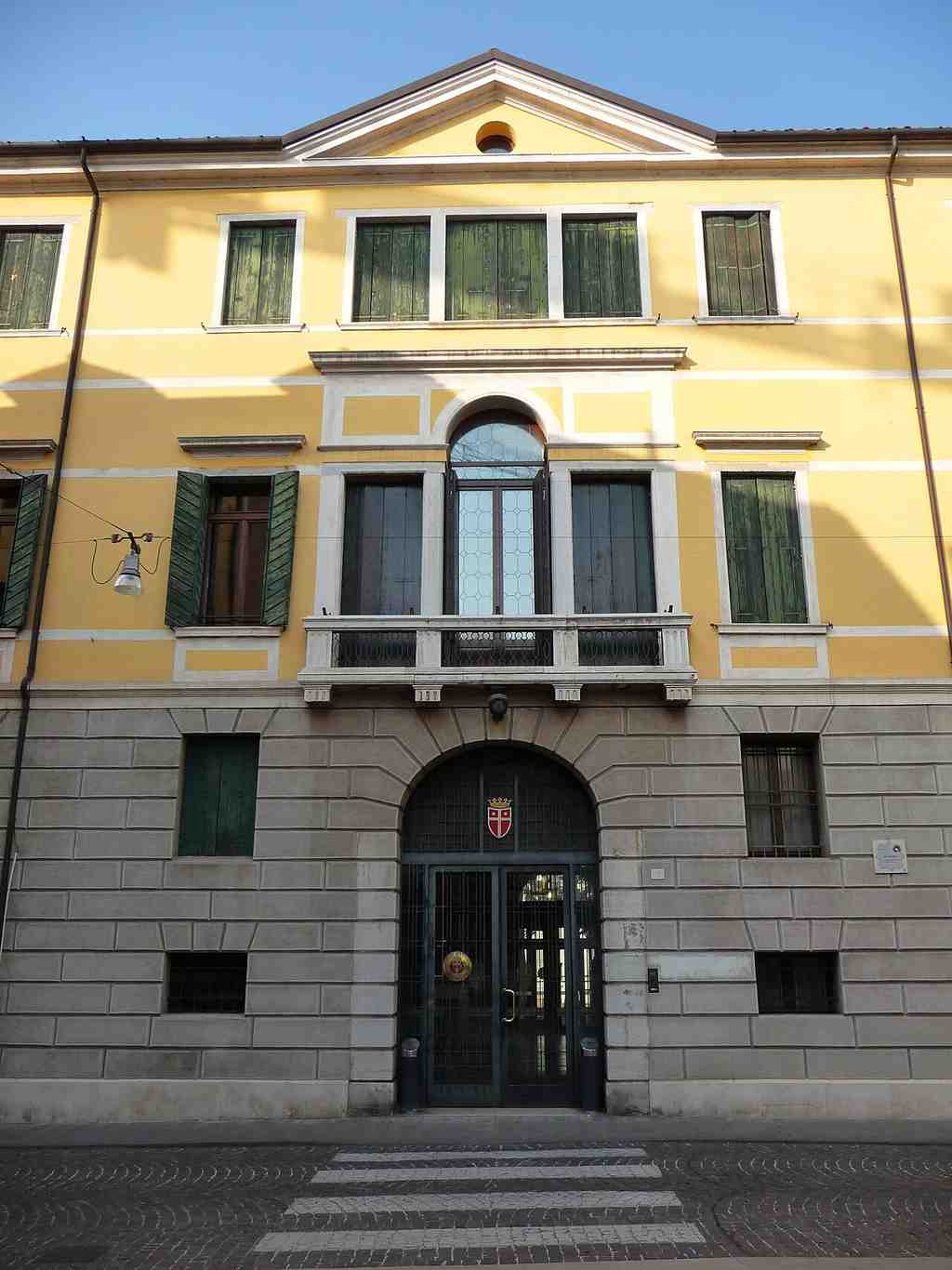
Ca' SuganaPhoto: Appo92, Wikimedia Commons, CC BY-SA 3.0. Cropped & resized. On your left, Ca' Sugana is a restrained neoclassical palace in pale masonry, with a round-arched central portal, rows of rectangular windows, and a small pediment holding a blind oculus.
This began as the Sugana family’s townhouse in the early nineteenth century; a local writer, Domenico Maria Federici, already mentioned construction here in eighteen hundred and three. Its façade still keeps that sober nineteenth-century look: the ground level uses rustication, stonework shaped to look chunky and grooved, and above the portal sits a Palladian window, a three-part window that adds just enough dignity to say, “Yes, official business happens here.” Italian buildings do enjoy rank.
In eighteen fifty-nine, the city bought the palace for the municipal grammar school. When the school moved to Borgo Cavour, Treviso gave the building a promotion, and since eighteen sixty-eight this has served as City Hall. In nineteen thirty-four they added the right wing, but only after demolishing the medieval Casa Gobbato, whose lost frescoes survive in Mario Botter’s drawings.
Ca' Sugana shows Treviso governing itself behind a very composed face.
When you’re ready, continue toward the next fountain and let the city loosen its collar a little.
On your left, look for a pale stone fountain with a broad octagonal basin, a round base beneath it, and a squat fluted column in the center ringed by four small carved water…Read moreShow less
Open dedicated page →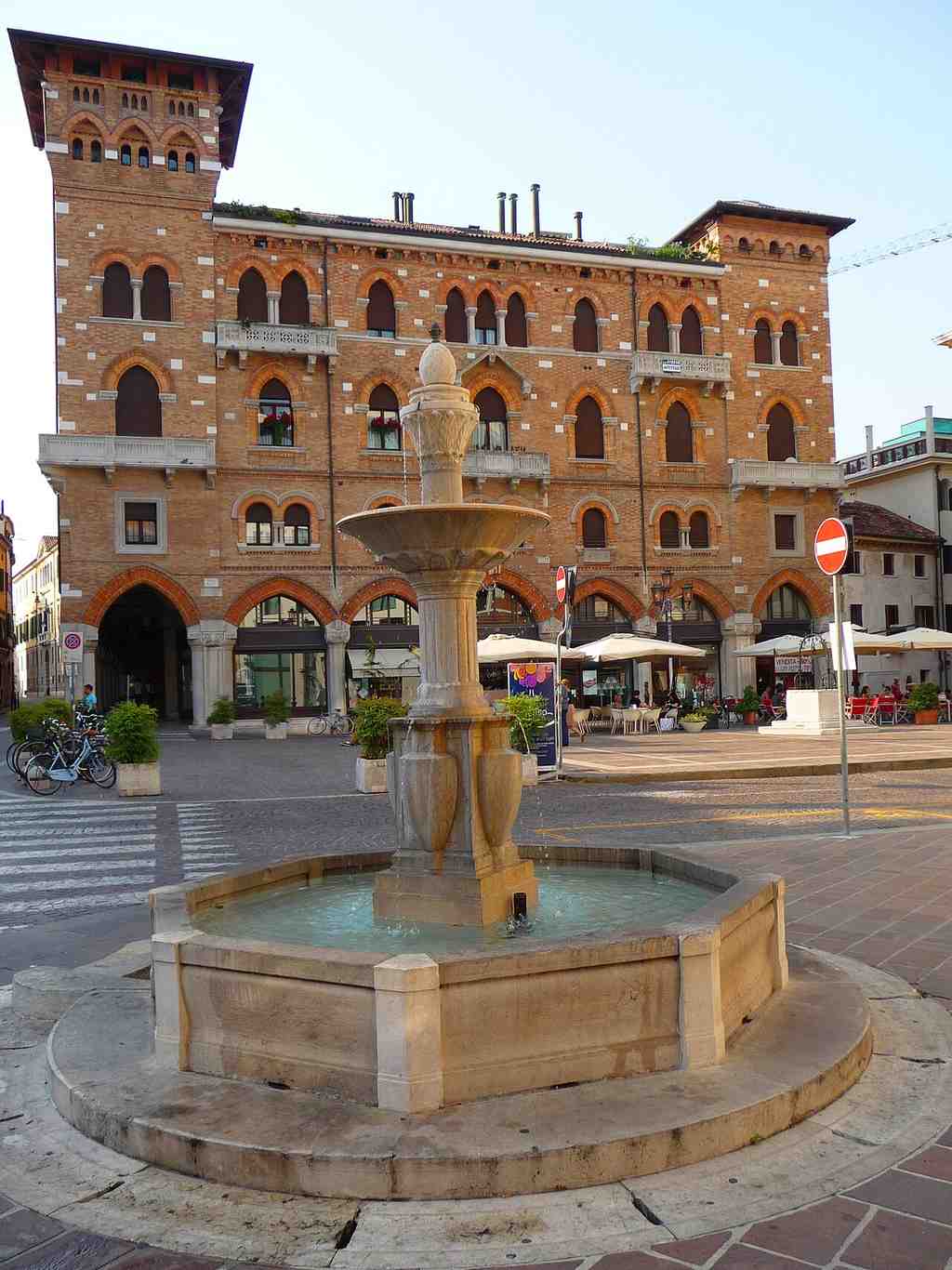
Fountain of Piazza San VitoPhoto: Appo92, Wikimedia Commons, CC BY-SA 3.0. Cropped & resized. On your left, look for a pale stone fountain with a broad octagonal basin, a round base beneath it, and a squat fluted column in the center ringed by four small carved water creatures.
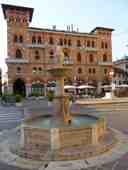
This is the Fountain of Piazza San Vito, set opposite the portal of the Church of San Vito and Santa Lucia, in a square once called Piazza delle Prigioni... which is a slightly less charming name if you’re trying to sell vegetables. Around nineteen thirty, this whole square became a testing ground for urban plans: new paving, a fruit and vegetable market, even proposals for a new Palazzo Littorio. Local shopkeepers pushed hard for a new fountain, and they paid for it as a thank-you to the city for keeping the market here.
On the twenty-eighth of October, nineteen thirty, the opening turned into a full civic performance. Contemporary reports describe flags everywhere, the Turazza band playing patriotic hymns, officials parading through the square, and then the prefect turning the device that set the water flowing. The jets leaped up, the crowd applauded, and Treviso congratulated itself very thoroughly.
The design looks back to the Italian seventeenth century, with a wide octagonal basin in Verona marble and Grisignana stone. At the center, two steps lift a base decorated with four hydras, little mythic water beasts, supporting a grooved column shaped like bundled stems, topped by a bowl like a water flower and a pinecone symbolizing the unity of the donors. At the foot, a steady spout served everyday needs, from household water to market business.
Like any sensible public fountain, it is accessible all day, every day.
Take one last look at this small burst of civic pride, then continue on when you’re ready.
On your left, Palazzo Rinaldi shows a pale stucco facade, a broad rectangular mass, and a formal stone portal that still gives off old noble-house confidence. This began as a…Read moreShow less
Open dedicated page →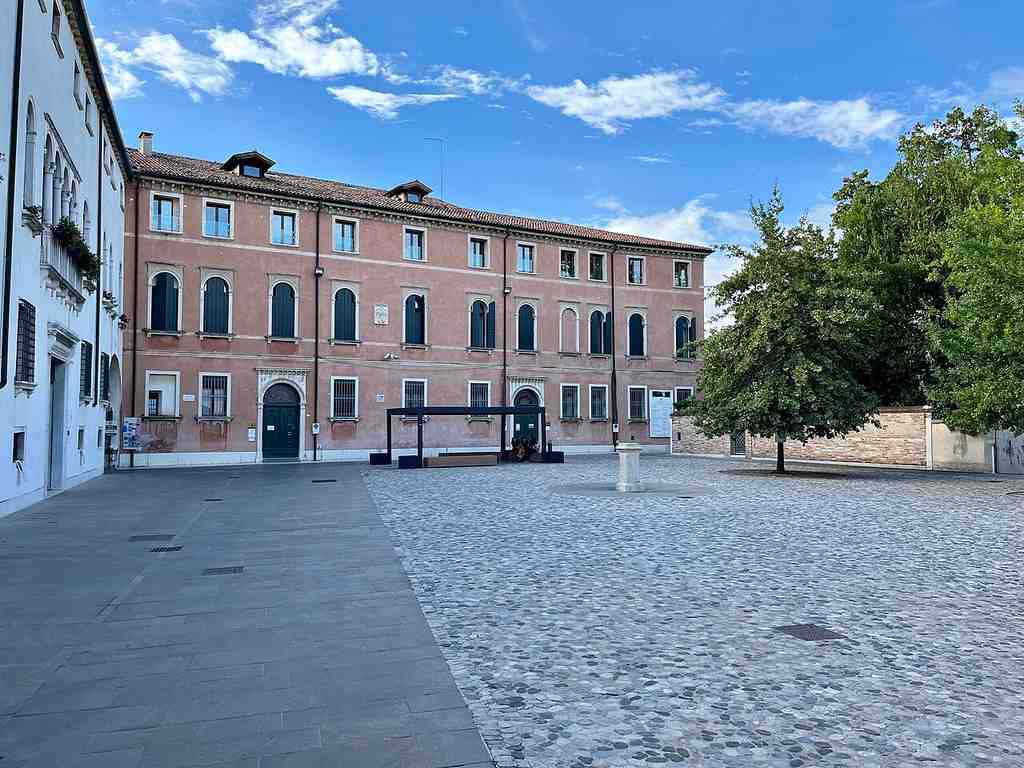
Rinaldi PalacePhoto: Phante, Wikimedia Commons, CC BY-SA 4.0. Cropped & resized. On your left, Palazzo Rinaldi shows a pale stucco facade, a broad rectangular mass, and a formal stone portal that still gives off old noble-house confidence.
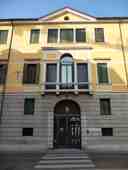
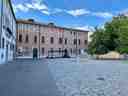
This began as a fifteenth-century residence near Piazza dei Signori, with its garden opening toward the Buranelli canal, and it now serves as Treviso’s second municipal seat after Ca’ Sugana. Inside, the city stages its more polished moments: conferences, weddings, exhibitions, and official meetings. The rooms are dressed for the part, with Venetian terrazzo floors - polished surfaces made from marble chips - and richly framed Renaissance-style ceilings inspired by Sansovino. The star attraction is a fresco by Pier Antonio Torri from the second half of the seventeenth century, showing the Fall of Phaethon... a myth that ends badly when a reckless young driver loses control of the sun’s chariot. Bureaucracy rarely aims that high. In two thousand and nineteen, the square in front stopped being a parking lot and became a larger public space for concerts and cultural events, while the canal-side garden took the name Children’s Rights and shares space with the Enzo Demattè children’s library.


Frequently asked questions
How do I start the tour?
After purchase, download the AudaTours app and enter your redemption code. The tour will be ready to start immediately - just tap play and follow the GPS-guided route.
Do I need internet during the tour?
No! Download the tour before you start and enjoy it fully offline. Only the chat feature requires internet. We recommend downloading on WiFi to save mobile data.
Is this a guided group tour?
No - this is a self-guided audio tour. You explore independently at your own pace, with audio narration playing through your phone. No tour guide, no group, no schedule.
How long does the tour take?
Most tours take 60–90 minutes to complete, but you control the pace entirely. Pause, skip stops, or take breaks whenever you want.
What if I can't finish the tour today?
No problem! Tours have lifetime access. Pause and resume whenever you like - tomorrow, next week, or next year. Your progress is saved.
What languages are available?
All tours are available in 50+ languages. Select your preferred language when redeeming your code. Note: language cannot be changed after tour generation.
Where do I access the tour after purchase?
Download the free AudaTours app from the App Store or Google Play. Enter your redemption code (sent via email) and the tour will appear in your library, ready to download and start.
If you don't enjoy the tour, we'll refund your purchase. Contact us at [email protected]
Checkout securely with 






.jpg)
