
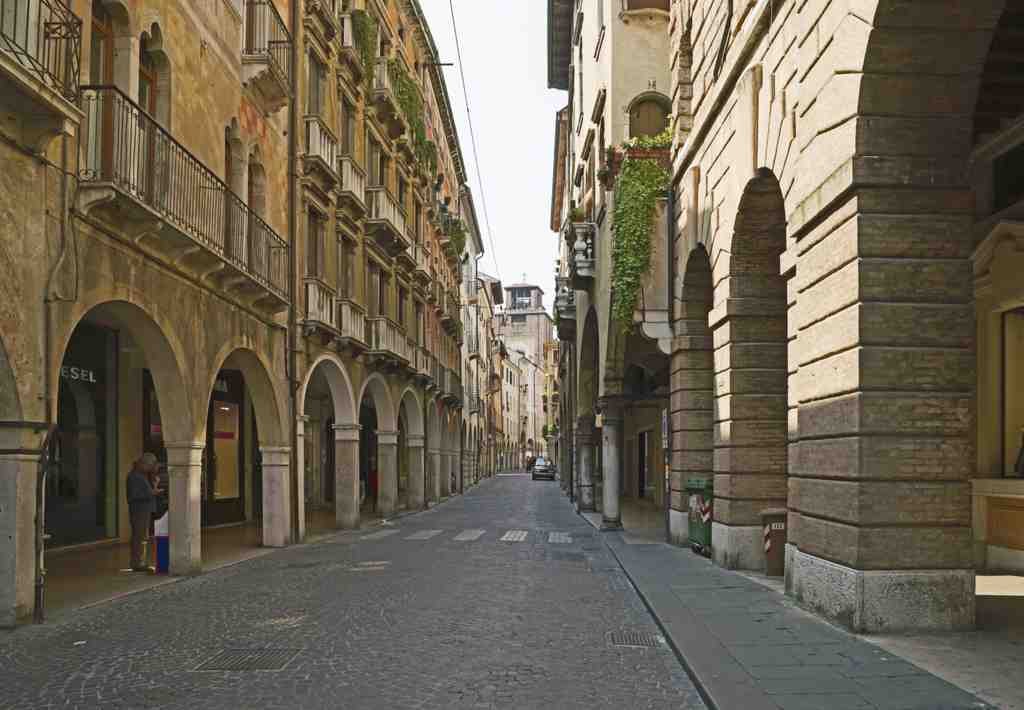
Look for a long, straight stone-paved street framed by brick-and-plaster arcades, with painted facades and the Duomo’s stout unfinished bell tower marking one end.
This is Calmaggiore... not, strictly speaking, “Via Calmaggiore.” Treviso likes precision when it feels like it. And this street has earned it. You’re standing on the city’s main historic spine, the route that links Piazza del Duomo with Piazza dei Signori. Long before shopfronts and porticoes took over, Roman Treviso laid this out as its cardo maximus, the town’s main Roman axis. It kept that line, stretching beyond today’s center toward the bridges of San Chiliano and Santa Margherita.
Romans paired a cardo with a decumanus, the main cross street... think of a giant urban plus sign. Scholars place that crossing near the Loggia dei Cavalieri, so this road sat right at the heart of the ancient plan.
In the Middle Ages, Calmaggiore gained a second life. It connected the cathedral, seat of spiritual power, with the palace of the Signoria and the Domus Nova Communis, now known as Palazzo dei Trecento, where civic power lived, argued, and probably overcomplicated things. So this street did more than move people around. It staged the conversation between church and government.
Its name likely comes from the Latin callis maior, meaning “greater road,” a later echo of cardo maximus. On both sides, palaces once showed off frescoes across their facades and even under the porticoes. And Calmaggiore still hides older layers. At the beginning of the street, Roman road remains survive below ground. Near the Duomo end, San Giovanni’s walls reuse Roman stone, and beside it sits a marble sarcophagus from the fifth or sixth century, decorated with a cross. Archaeologists found inside a little pectoral cross, a comb, and threads of brocade, which suggests the burial of a noble Lombard girl... a startlingly intimate trace of one small life on one very important road.
Calmaggiore is Treviso in a single line: Roman grid, medieval power, and a little human mystery under the plaster.
When you’re ready, continue along this old axis toward the next stop.




