
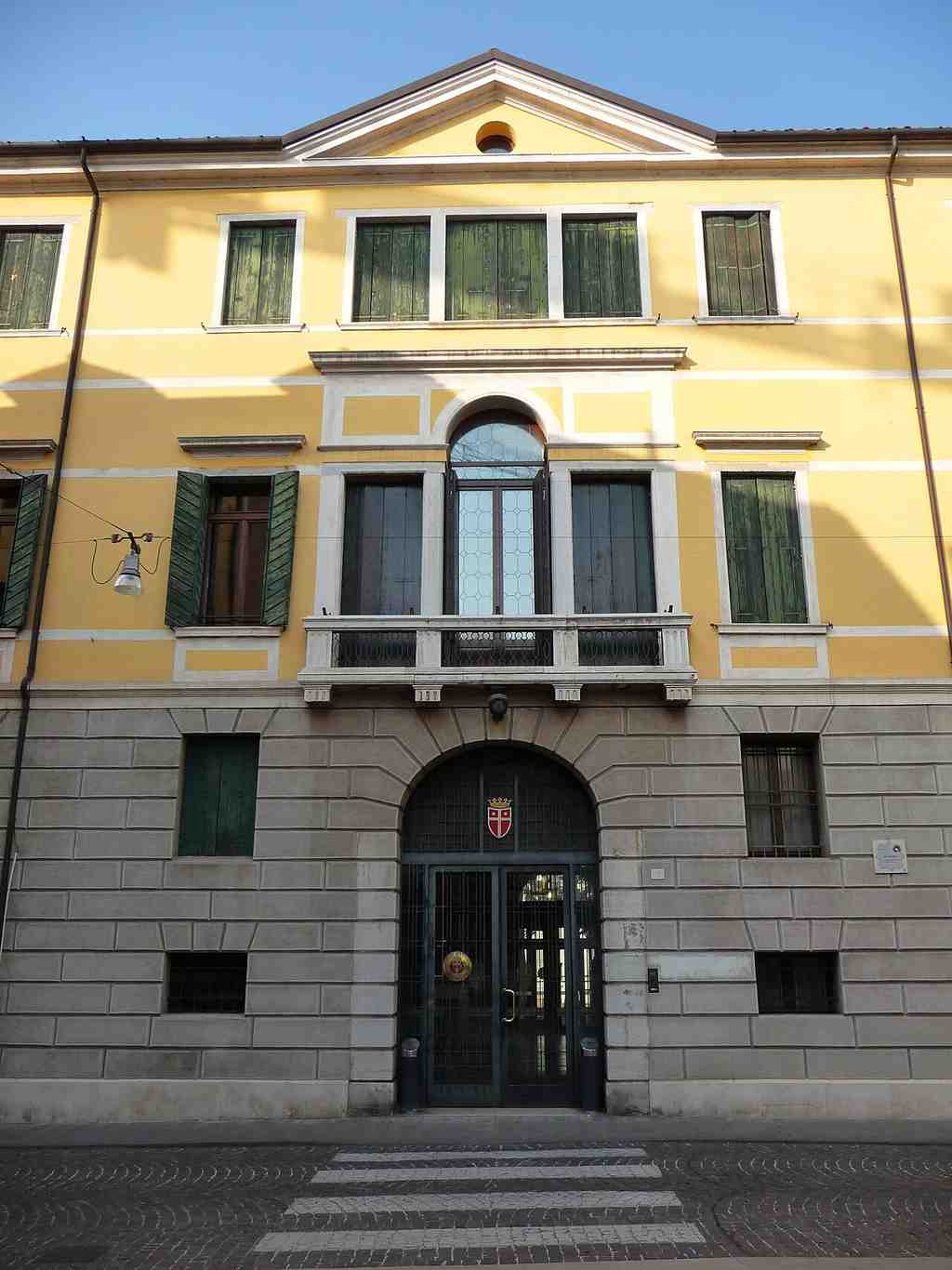
On your left, Ca' Sugana is a restrained neoclassical palace in pale masonry, with a round-arched central portal, rows of rectangular windows, and a small pediment holding a blind oculus.
This began as the Sugana family’s townhouse in the early nineteenth century; a local writer, Domenico Maria Federici, already mentioned construction here in eighteen hundred and three. Its façade still keeps that sober nineteenth-century look: the ground level uses rustication, stonework shaped to look chunky and grooved, and above the portal sits a Palladian window, a three-part window that adds just enough dignity to say, “Yes, official business happens here.” Italian buildings do enjoy rank.
In eighteen fifty-nine, the city bought the palace for the municipal grammar school. When the school moved to Borgo Cavour, Treviso gave the building a promotion, and since eighteen sixty-eight this has served as City Hall. In nineteen thirty-four they added the right wing, but only after demolishing the medieval Casa Gobbato, whose lost frescoes survive in Mario Botter’s drawings.
Ca' Sugana shows Treviso governing itself behind a very composed face.
When you’re ready, continue toward the next fountain and let the city loosen its collar a little.




