
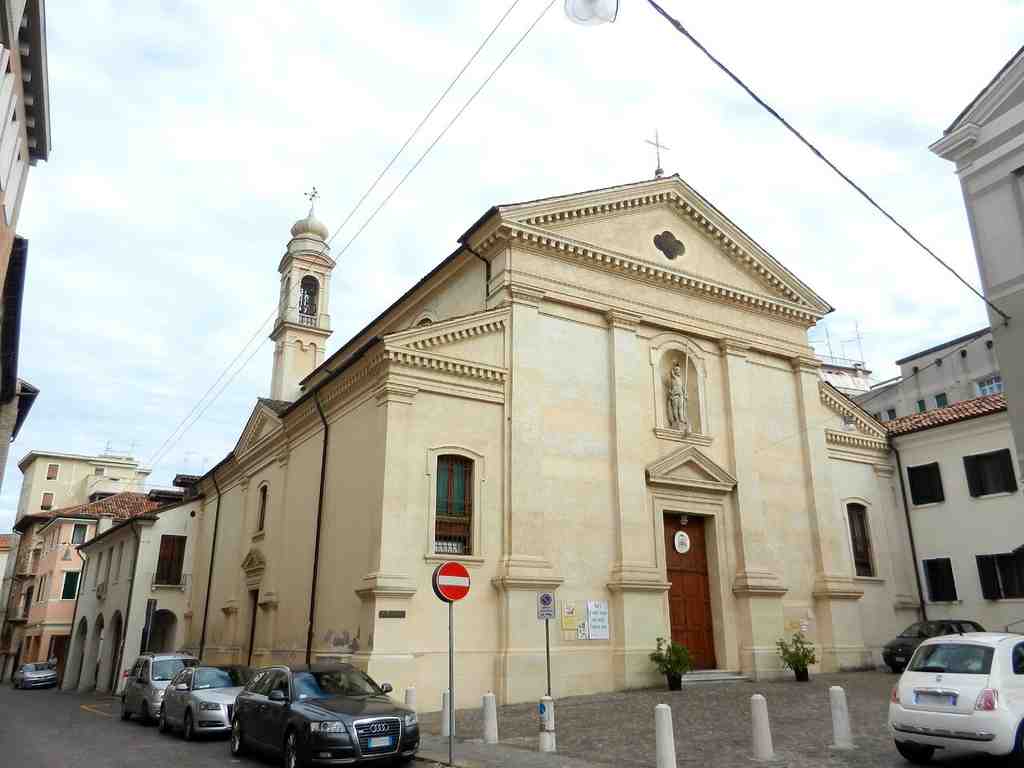
On your right, look for the pale marmorino facade, split by four tall Corinthian pilasters, topped with a triangular pediment, and marked by the statue of Christ the Redeemer in the niche above the main door.
Santo Stefano is one of Treviso’s old survivors... the kind of church that has been here so long it appears in written records around the year one thousand, with roots reaching back to the Lombard age. That makes it one of the city’s earliest known places of worship, dedicated to Saint Stephen, the first Christian martyr.
The facade tells a quieter, later chapter. In the eighteen hundreds? Not quite. The church you see now took shape in the eighteenth century, when the Treviso architect Ottavio Scotti designed it with a sober elegance. Corinthian means the pilasters, those flat column-like strips, wear capitals decorated with carved leaves... classical good manners in plaster. The side sections came later, in the first half of the nineteenth century, when builders added the lateral aisles. Then the twentieth century layered in the interior wall decoration, because churches, like families, rarely stop editing themselves.
Its bell tower shared in that long story, too. Builders rebuilt it with the church, but an earthquake brought it down in the sixteenth century... a blunt reminder that stone can be proud, but not invincible. More recently, restorers gave the whole church a careful renewal between two thousand eleven and two thousand twelve.
If you step inside another time, look for the high altar Scotti designed, Guarana’s Martyrdom of Saint Stephen, and a wooden crucifix linked to Francesco Terilli. For all its age, this church feels remarkably composed. When you’re ready, continue on and let the next corner of Treviso speak up.




