
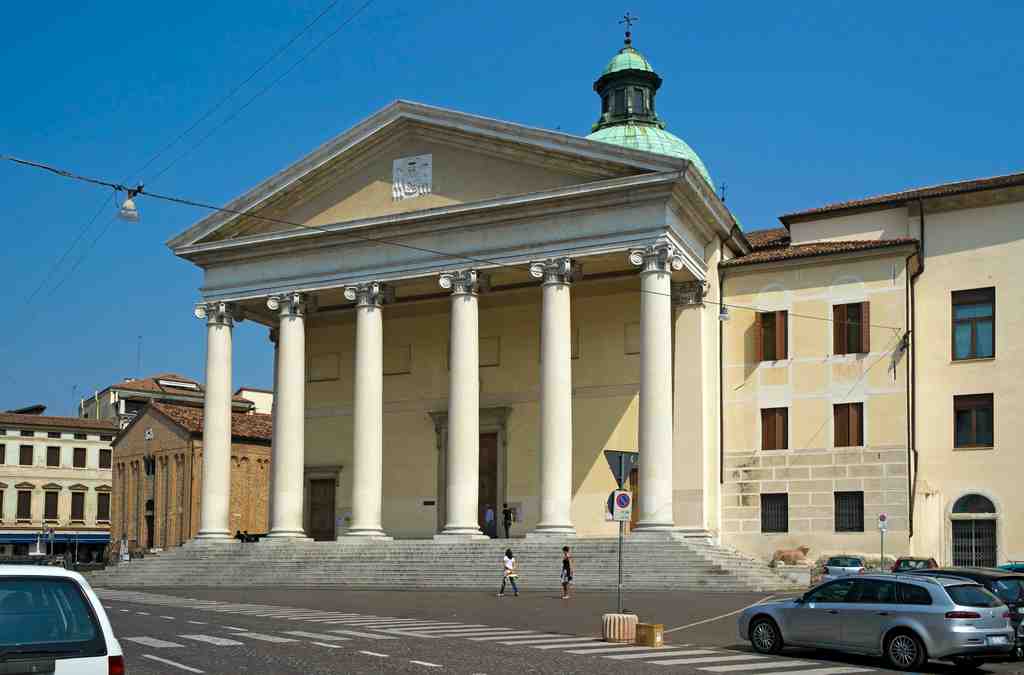
In front of you rises a pale stone façade with a wide staircase, a porch of six Ionic columns, and a triangular pediment marked with the cathedral chapter’s coat of arms.
This is the Cathedral of Saint Peter the Apostle, though everyone here sensibly calls it the Duomo. It is Treviso’s main church, the seat of the diocese, and the home of the bishop’s cathedra, meaning his ceremonial chair... the seat that gives us the word cathedral in the first place. So yes, this is the big one.
Its story reaches back to the sixth century, when Christians established a church here in the most important part of town. Archaeologists found traces of even older neighbors on this site: a Roman temple, a theater, and possibly baths. Treviso has never been shy about reusing prime real estate. In the eleventh and twelfth centuries, Bishop Rotario reshaped the complex in the Romanesque style. That phase has not vanished completely. The crypt below still belongs to that medieval cathedral, and out here, the two red Verona marble lions at the sides of the staircase once supported the old Romanesque porch.
What you see now is much later and much calmer in style, at least on the surface. In seventeen fifty-nine, the scholar and architect Giordano Riccati began a major rebuilding in the neoclassical taste. The project did not go smoothly. The cathedral took its time, which is a polite way of saying the plans changed, arguments flared, and the money ran out. Work stalled in seventeen eighty-two. Giannantonio Selva finished the interior from seventeen ninety, and the grand front you are facing now, with its deep porch - architects call that a pronaos, basically a formal temple-like entrance - and its broad stairway arrived in eighteen thirty-six through Francesco Bomben and Gaspare Petrovich.
Even so, the Duomo is not a clean break from the past. It keeps three old Lombard chapels at the rounded east end of the Romanesque church, and inside, in two thousand and five, workers reconstructed the old fifteenth-century portal that had been removed when this façade went up. The building also carries seven domes in total, five over the central nave - the long main hall of the church - and two above the side chapels in the cross arms.
If you go in later, the real rewards are layered. The crypt below rests on sixty-eight columns of differing shapes and holds the shrine of Saint Liberale, Treviso’s patron. The Malchiostro Chapel, created in the early sixteen hundreds? No - close, but not quite. It dates to about fifteen twenty, and that matters, because it brought together Tullio and Antonio Lombardo, Titian, and Il Pordenone in one remarkable Renaissance ensemble. Titian painted the Annunciation; Pordenone covered walls and dome with muscular frescoes shaped by his time in Rome. The cathedral also received a huge modern organ for the Jubilee of two thousand, with three thousand five hundred ninety-four pipes, because apparently salvation sounds better with proper engineering.
Beside the cathedral stands the stout, unfinished bell tower. Tradition says the doges of Venice blocked any plan that might let it outgrow Saint Mark’s campanile. Petty? Absolutely. Believable? Also absolutely.
If you want to step inside, the cathedral generally opens from seven thirty to noon and again from three to seven, with Sunday afternoon extending to eight.
For all its polished symmetry, this Duomo is really Treviso layered in stone: Roman ground, medieval memory, Renaissance brilliance, and a nineteenth-century face trying to keep everyone in order.
When you’re ready, continue on to the Church of San Giovanni Battista, where the cathedral complex turns older and more intimate.




