Harrogate railway station
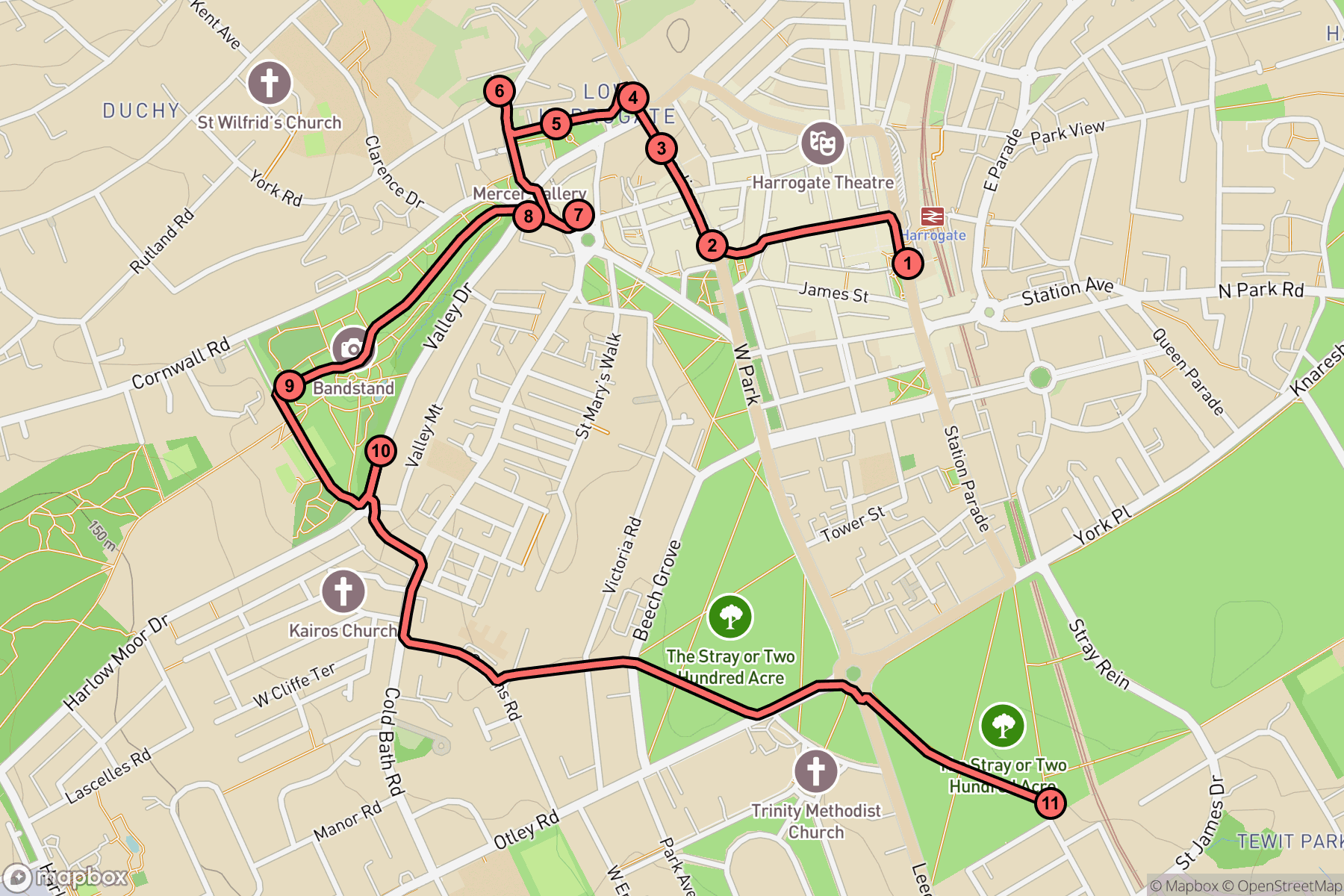
Bettys Café Tea RoomsThe site of the original Bettys Café Tea Room, opened on 17 July 1919 at 9 Cambridge Crescent by Frederick Belmont, a Swiss confectioner. The Parliament Street branch around the corner opened in 1976 following the 1962 merger with Taylors of Harrogate; this Cambridge Crescent address is where Belmont's enterprise began. He arrived in England in 1907 at King's Cross railway station, not knowing which city he was supposed to be heading to; he boarded a train to Bradford by luck. After working as a baker at Bonnet & Sons in Bradford, he opened the first Bettys on 17 July 1919. Takings on the first day were just £30. The name 'Bettys' has three possible origins: Betty Rose, grand-daughter of the company chairman; Betty Lupton, the spa's Queen of the Wells; or a 1914 musical called Betty. The company itself says the origin is unknown.
Turkish Baths HarrogateThe Grade II listed hydrotherapy palace at 5 Parliament Street, built by the Corporation of Harrogate at a cost of £120,000 and opened by the Duke of Cambridge on 23 July 1897. Designed by the London firm Baggallay and Bristowe, which won an open competition with 25 entries. Inside: Turkish baths, vapour baths, mud baths, needle baths, Vichy douches and electric treatments — around eighty different treatments in total. In August 1898 alone, 18,723 baths were administered. During the First World War the building was requisitioned as a military convalescent hospital; after 1945 it operated under NHS contracts providing roughly 150,000 treatments annually until the hydrotherapy programme ended in 1969. The Turkish baths section survives in operation today.
Royal HallBuilt in 1903 as the Kursaal (the German for 'Cure Hall') for the Corporation of Harrogate, designed by Robert Beale with the direct involvement of Frank Matcham, one of the most prolific theatre architects of his era. The funding came principally from Samson Fox (1838–1903), a Bradford-born engineer, industrialist and philanthropist who invented the corrugated boiler flue in 1877, founded the Leeds Forge Company in 1874, became Mayor of Harrogate for three successive years (1890–92), and donated £45,000 to build the Royal College of Music in London. Fox died in October 1903 — the same year the Kursaal opened. When the First World War began, the German name was dropped and the building renamed the Royal Hall.
Crescent GardensThe small public garden between the Royal Pump Room and the Royal Baths. In the Victorian and Edwardian periods, the top of Montpellier Hill at the edge of these gardens was where bath-chair proprietors ranked their vehicles — covered wheeled chairs hired by spa guests and pushed between hotels and spa buildings by bath-chair men. Mr Robinson, a named bath-chair proprietor, used his nineteenth-century bath chair until he retired in 1931. Victorian visitors to Harrogate recalled bath-chair men racing each other to reach customers first.
The Old Swan HotelThe hotel at Swan Road, Harrogate HG1 2SR, operating under the name Swan Hydropathic Hotel when, in December 1926, the novelist Agatha Christie registered here under the false name Mrs Teresa Neele. Christie had disappeared from her Surrey home eleven days earlier, prompting a national search involving hundreds of police officers across four counties and thousands of volunteers. She was first recognised by Rosie Asher, a chambermaid who noticed her unusual shoes and American-style zipper purse — but Asher stayed silent, later saying the trouble was not worth her job. It was Bob Tappin, a hired banjo player in the hotel's resident band, who alerted the police. Christie had been 'enjoying dinner alone in the Wedgwood Restaurant, walking the gardens, reading the papers.'