
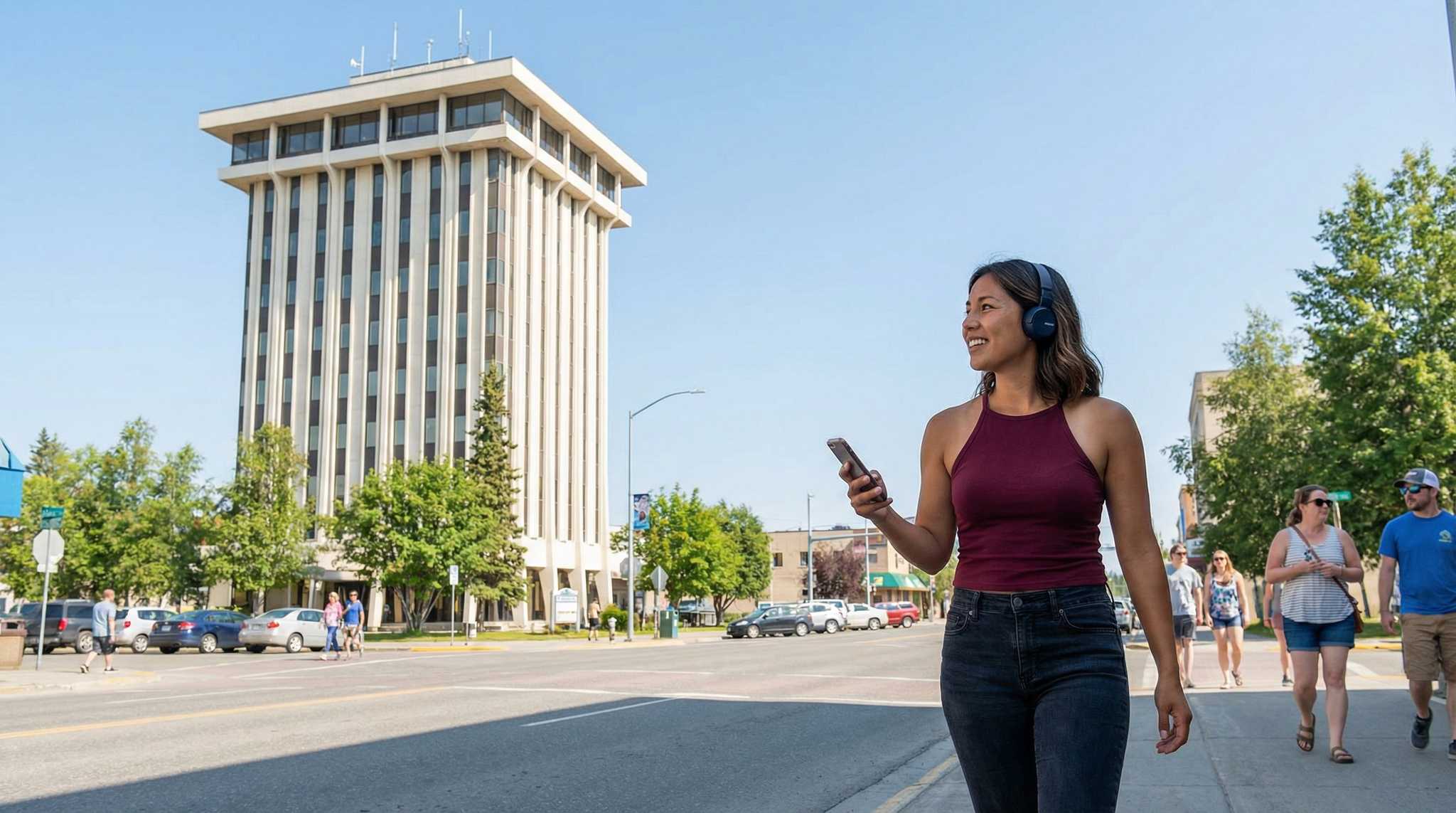
Fairbanks Audio Tour: Gold Rush Legacy and Timeless Landmarks
In Fairbanks, forgotten confrontations echo beneath the northern lights and rusted high-rises hide secrets from a fevered gold rush past. This self-guided audio tour plunges through the city’s storied heart, revealing hidden corners and untold tales that slip by even the most curious travelers. Unravel Fairbanks one story at a time and discover what really shaped its icy soul. Who locked themselves inside the eerie Polaris Building, desperate to outwit enemies in the dead of winter? What ghostly encounter still baffles researchers inside the George C. Thomas Memorial Library? Why were 1930s ice delivery men rallying at a nondescript spot deep inside the Illinois Street Historic District? Move between shadowed alleyways and sunlit brick, where political intrigue and local rebellion once sparked in secret meetings. This journey rewrites Fairbanks as a city of thrill, memory, and wild possibility. The next chapter in Fairbanks’ story begins right now. Ready to look beyond the surface?
Tour preview
About this tour
- scheduleDuration 80–100 minsGo at your own pace
- straighten3.4 km walking routeFollow the guided path
- location_onLocationFairbanks, United States
- wifi_offWorks offlineDownload once, use anywhere
- all_inclusiveLifetime accessReplay anytime, forever
- location_onStarts at Fairbanks Exploration Company Machine Shop
Stops on this tour
lock_open 3 free previews · 8 unlock with purchase
This is a broad, steel-framed, single-story industrial building, clad in plain metal, with a stepped roofline and a tall double door centered on the front wall. No architect lost…Read moreShow less
Open dedicated page →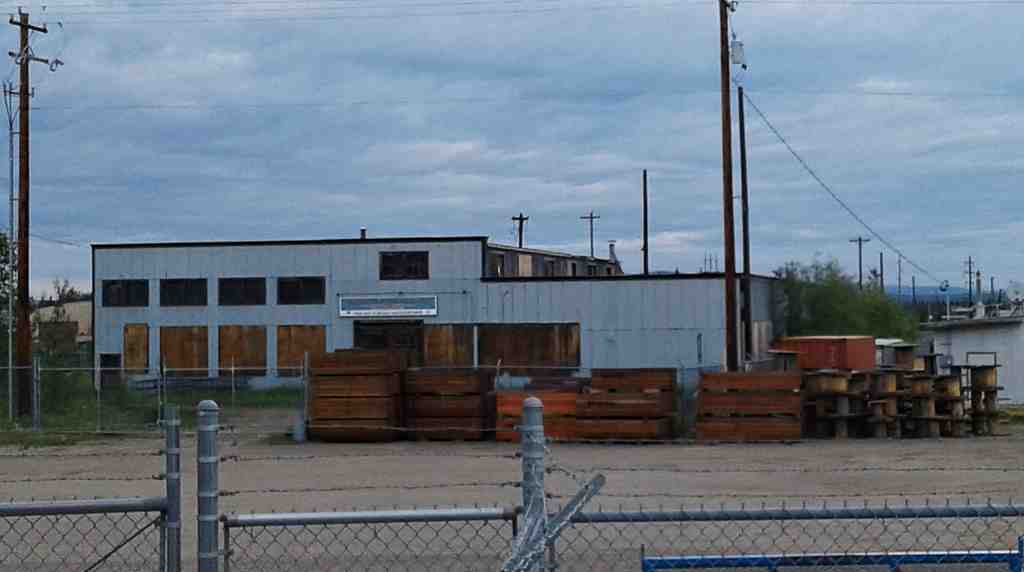
Fairbanks Exploration Company Machine ShopPhoto: RadioKAOS, Wikimedia Commons, CC BY-SA 3.0. Cropped & resized. This is a broad, steel-framed, single-story industrial building, clad in plain metal, with a stepped roofline and a tall double door centered on the front wall.
No architect lost sleep over prettiness here. In nineteen twenty-seven, the company put up this machine shop as the working heart behind its gold mines. The front section held big belt-driven lathes - a Sidney, a LeBlond, an American Electric, and two Drive-All machines - all powered from an overhead system suspended above the floor. In the middle came the harder, noisier business: welding, drill presses, a milling machine, a power hacksaw, and a horizontal press heavy enough to crush the daylights out of most problems.
Take a moment and look at the building’s plain scale and uneven height. One end rises higher because the shop needed room for cranes and the belts that carried power to the machines. Even from outside, you can read the layout: this place was arranged for motion, repair, and constant interruption, not display. From the outside, the building still makes that arrangement easy to read.
The gold story often celebrates what came out of the ground. This building tells you what kept that story alive. Machinists, electricians, carpenters, mechanics, and blacksmiths worked here making parts, fixing breakdowns, and improvising answers for a mining system that could not afford to stop. Showers, lockers, lavatories, even a tar-soaked fir floor were built into the daily rhythm of hard use.
And here is the detail locals tend to treasure: at the back, where the blacksmiths worked with a Buffalo Forge and an Erie Foundry air hammer, the floor stayed dirt. So inside one electric-age machine shop, an older frontier craft kept breathing.
Then, in nineteen forty-one, the company added a south wing for an automotive shop and an electrical shop. Even a blunt, practical building had to adapt as mining turned more motorized and more wired. This shop served not just one room, but a whole company town of offices, power generation, coal storage, warehouses, and barracks. When you’re ready, we’ll walk about five minutes to the Illinois Street Historic District, where that industrial world presented its tidier public face.
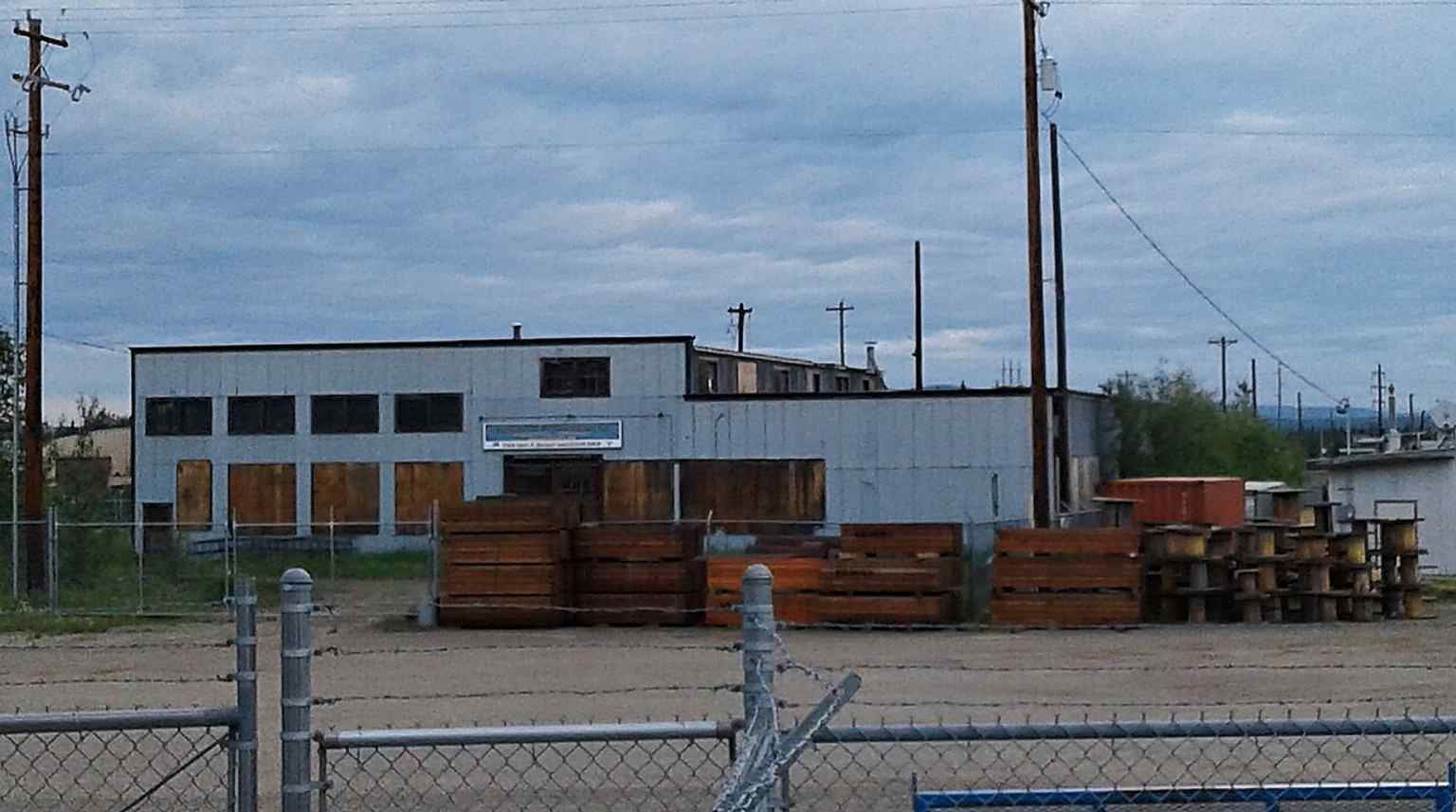
The machine shop’s steel-frame exterior, photographed in 2016 — the building that supported Fairbanks Exploration Company’s gold-mining operations and was listed on the National Register in 1995.Photo: RadioKAOS, Wikimedia Commons, CC BY-SA 3.0. Cropped & resized. Look for a line of wood-frame houses with simple gabled roofs along Illinois Street, with the sturdy rectangular Fairbanks Exploration Company office still anchoring the west side…Read moreShow less
Open dedicated page →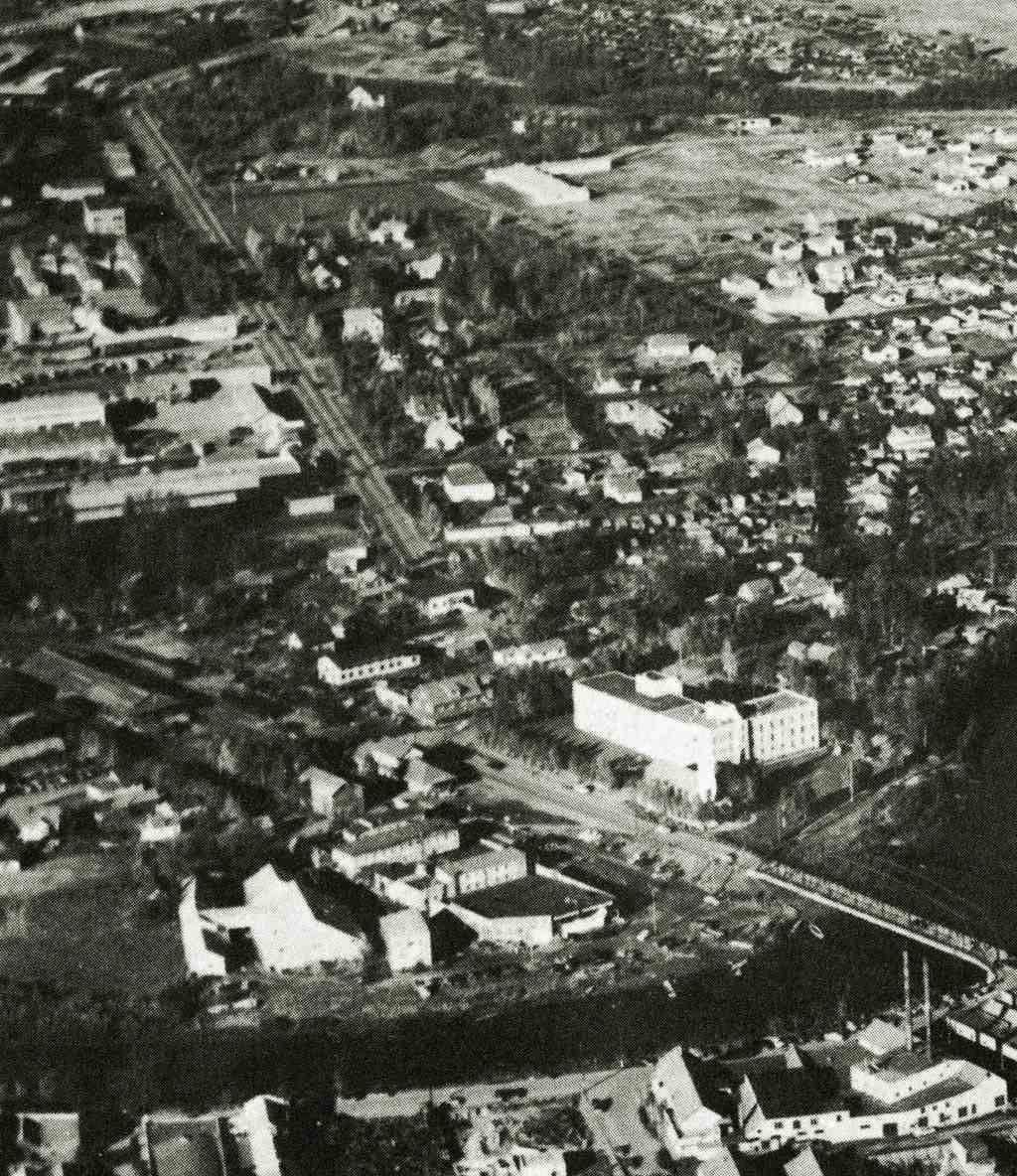
Illinois Street Historic DistrictPhoto: Fairbanks High School, Wikimedia Commons, Public domain. Cropped & resized. Look for a line of wood-frame houses with simple gabled roofs along Illinois Street, with the sturdy rectangular Fairbanks Exploration Company office still anchoring the west side of the corridor.
This stretch of road is not simply a historic district; it is the map of how raw gold fever matured into organised power. Illinois Street mattered because geography handed it an advantage. The route followed an older trail toward the northern goldfields, an Alaska Railroad spur already reached a sawmill near Noyes Slough - locals say “slew” - and Fred Noyes’s old Tanana Mill Company property gave the company a broad seventy-four-acre site to work with.
The Fairbanks Exploration Company, soon known all over town as the F-E Company, did far more than run dredges. It organised transport, payroll, housing, supervision, and status. At its height, almost a third of Fairbanks worked for it in some way. Here, on one street, the company arranged daily life into neat layers: surviving office and industrial buildings on the west side, employee housing and more privileged homes on the east.
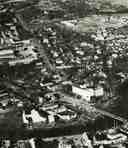
If you glance at the aerial view on your screen, you can see that arrangement clearly: not just a work yard, but a whole company neighbourhood stitched together along one corridor.
The human stories make the street far more interesting than the plan. Fred Noyes built his own showpiece house here around nineteen eleven and called it Essinoye - his surname reversed. It was likely the first three-story house in Fairbanks, a rather confident gesture in a young town. After the F-E Company bought it in nineteen twenty-five, the house changed character entirely. First it hosted visiting employees from United States Smelting, Refining and Mining Company. Then, in nineteen twenty-eight, the company cut it into two practical apartments for workers. A private landmark became corporate housing.
And that was not the end of its strange career. In the nineteen thirties, Leonhard Seppala - the famed dog musher from the nineteen twenty-five serum run to Nome - lived there as an F-E Company employee. Then, during the Second World War, after the War Production Board shut down gold mining as nonessential in October nineteen forty-two, the Army absorbed parts of this whole district. The machine shop, offices, housing, heavy equipment, even power supply all fed the war effort. One local detail most visitors miss: that old Noyes showpiece later sheltered Russian pilots ferrying lend-lease aircraft to the Soviet Union. Imagine that - a grand Fairbanks residence turned wartime stop on a global air route, and, by one Army account, a lively party house as well.
In about seven minutes, continue to the Rose Building, a structure whose very move across town shows how quickly fortune could shift here.
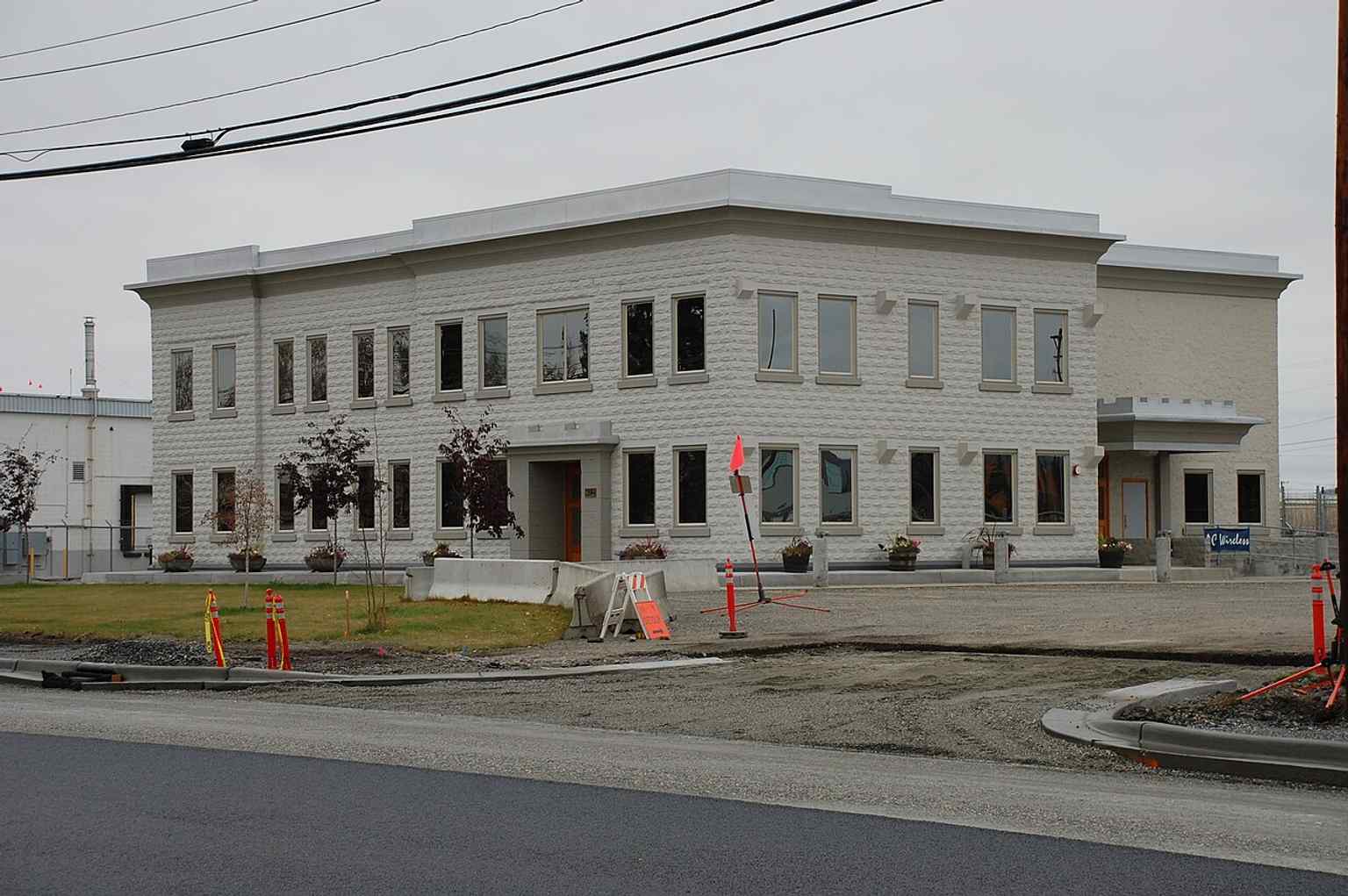
The surviving Fairbanks Exploration Company administrative building at 612 Illinois Street, one of the few industrial structures left from the district’s wartime headquarters corridor.Photo: Durkeeco, Wikimedia Commons, CC BY-SA 3.0. Cropped & resized. 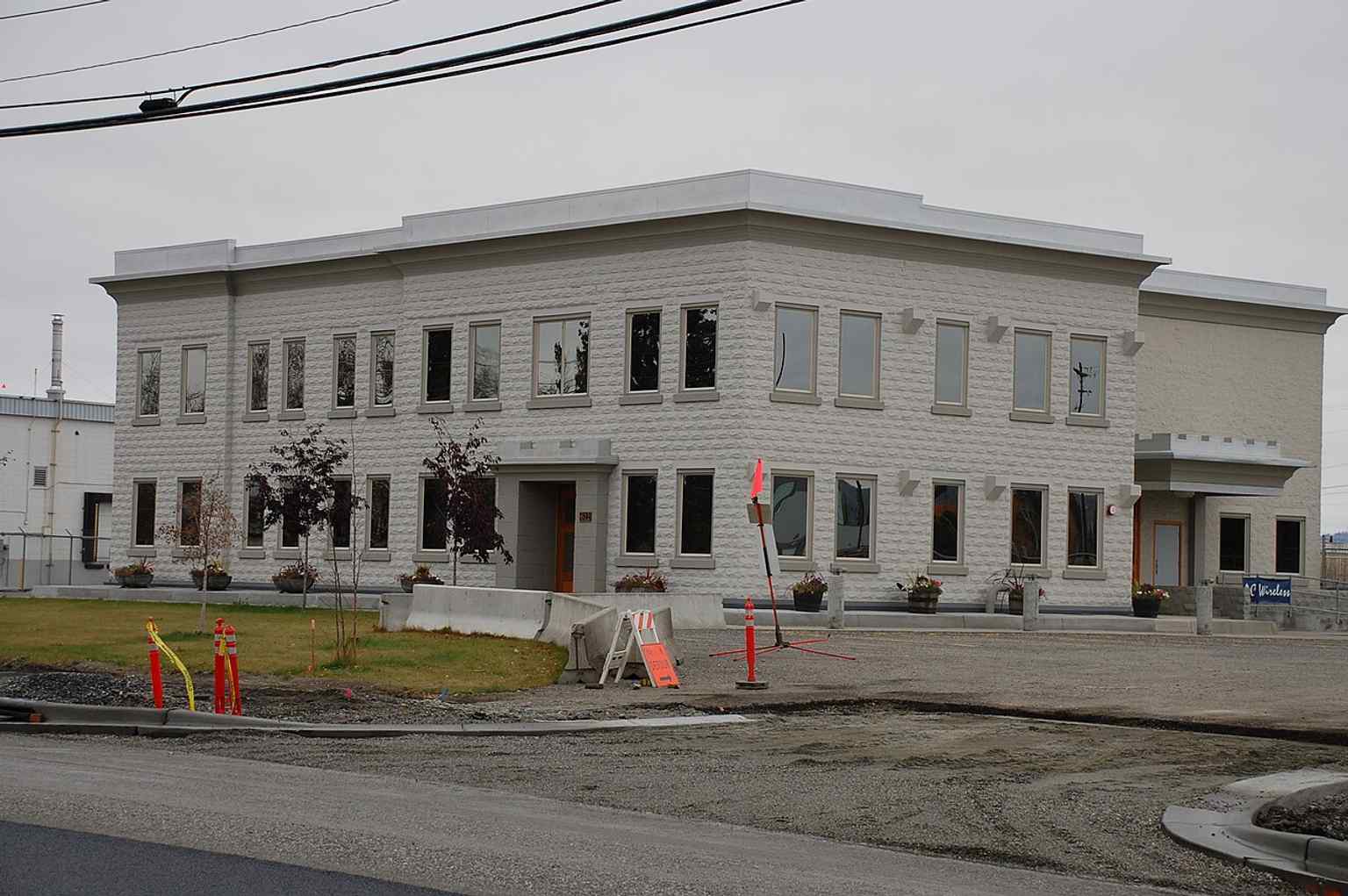
A 2012 view of the Illinois Street Historic District, where company housing and headquarters buildings lined the old trail to the goldfields.Photo: Durkeeco, Wikimedia Commons, CC BY-SA 3.0. Cropped & resized.
Show 8 more stopsShow fewer stopsexpand_moreexpand_less
On your right is a white-painted wooden church with a steep gabled roof, a square front steeple, and a cross marking the peak. This is Immaculate Conception Church, and in…Read moreShow less
Open dedicated page →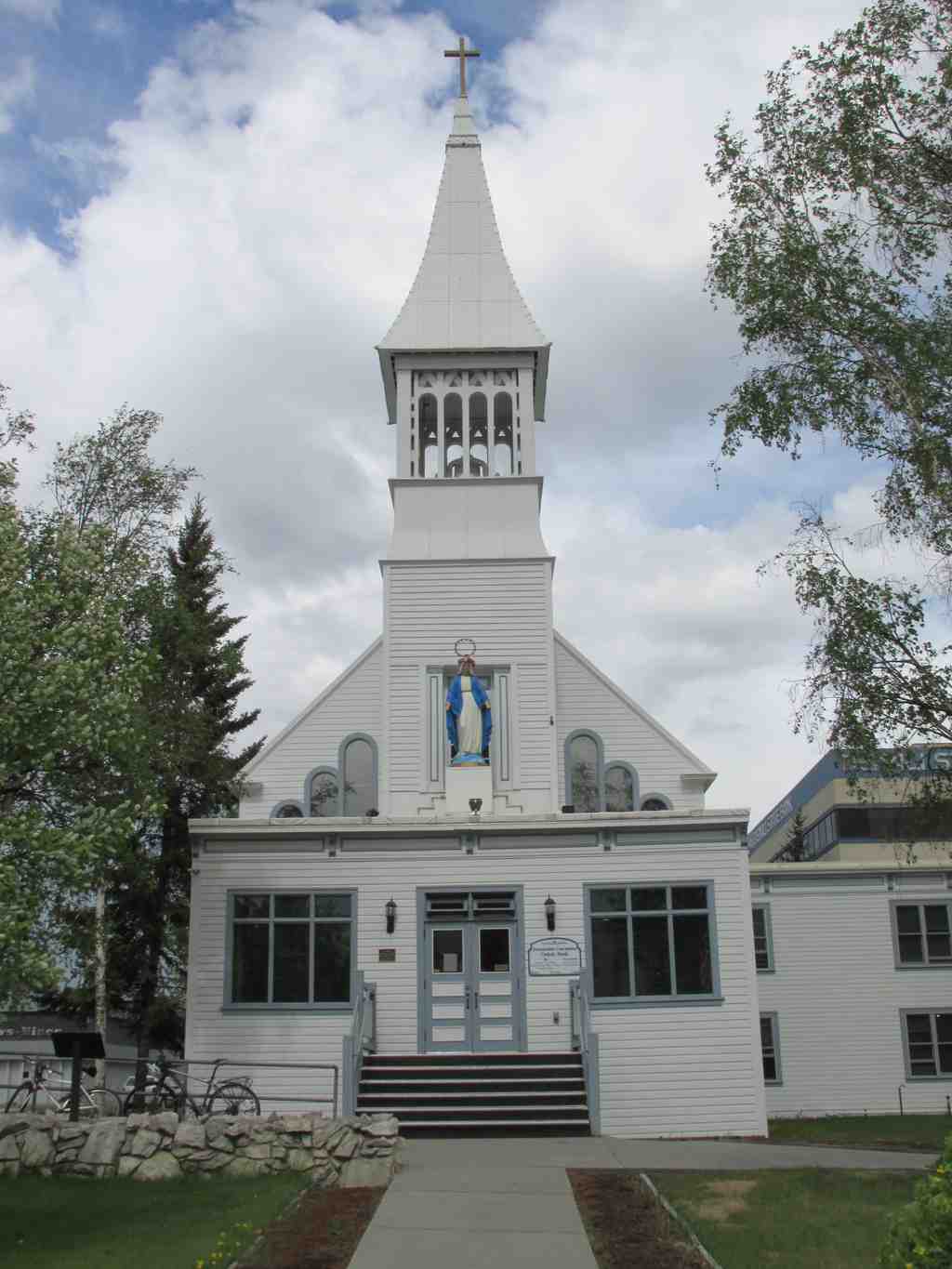
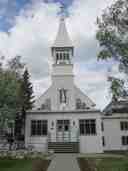
Immaculate Conception ChurchPhoto: RadioKAOS, Wikimedia Commons, CC BY-SA 3.0. Cropped & resized. On your right is a white-painted wooden church with a steep gabled roof, a square front steeple, and a cross marking the peak.
This is Immaculate Conception Church, and in Fairbanks even a church did not necessarily stay put. Priests and parishioners first raised it in nineteen oh four on Dunkel Street, making it the first Roman Catholic church in Alaska’s interior. Then, in the winter of nineteen eleven to nineteen twelve, they hauled the entire building across the frozen Chena River to this site, closer to Saint Joseph’s Hospital. In this town, movement often meant survival. Settlements shifted, trade routes changed, and here, even sacred ground learned to travel.
If you glance at the historic view in the app, you can see the church after that remarkable relocation, still recognizably modest, still determined. It sounds almost legendary, but the deeper story is wonderfully practical. This was not only a place for Mass. It served the Catholic nursing community tied to the hospital nearby. On the twenty-first of June, nineteen eleven, Father Francis Monroe led daily Mass here while Sister Agipit took her final vows and received her silver ring, a moment the hospital remembered as a celebration for both the sisters and the parish.
Then came Father Joseph Cote, a Jesuit priest with the soul of a mechanic. He wired the church for electricity, worked on the water plant, added a residence, and finished the downstairs parish hall. He did not separate spiritual care from physical repair; he treated both as necessary for a growing community.
The building itself kept changing. In nineteen fourteen, workers raised the roof, lifted the ceiling by five feet, added a choir loft, and built the belfry, that bell tower at the front, giving the church a stronger public face. The façade you see in the app reflects those changes. In the late nineteen twenties, Father Patrick O’Reilly added stained glass windows, said to be unusual in Alaska, and landscaped the grounds. When a rectory stovepipe caught fire in nineteen twenty-seven, he fought the blaze alone for about half an hour, then rebuilt more sensibly with a tall brick chimney, a concrete porch, and broad cement walks.
Later, the basement became a school. In nineteen forty-six, fifty-five children began classes there. In nineteen sixty-two, when Pope John the Twenty-Third created the Diocese of Fairbanks, this church briefly became the “Cathedral of the North” until Sacred Heart took over in nineteen sixty-six.
One cannot help wondering: if a town is willing to drag its church across a frozen river, where exactly does faith end and sheer resolve begin? That question lingers here. Ahead, at the Polaris Building, you’ll see Fairbanks begin to express that same confidence on a larger, more modern scale, about a one-minute walk away. If you hope to step inside another time, the church generally opens Tuesday through Friday from nine in the morning until three in the afternoon.
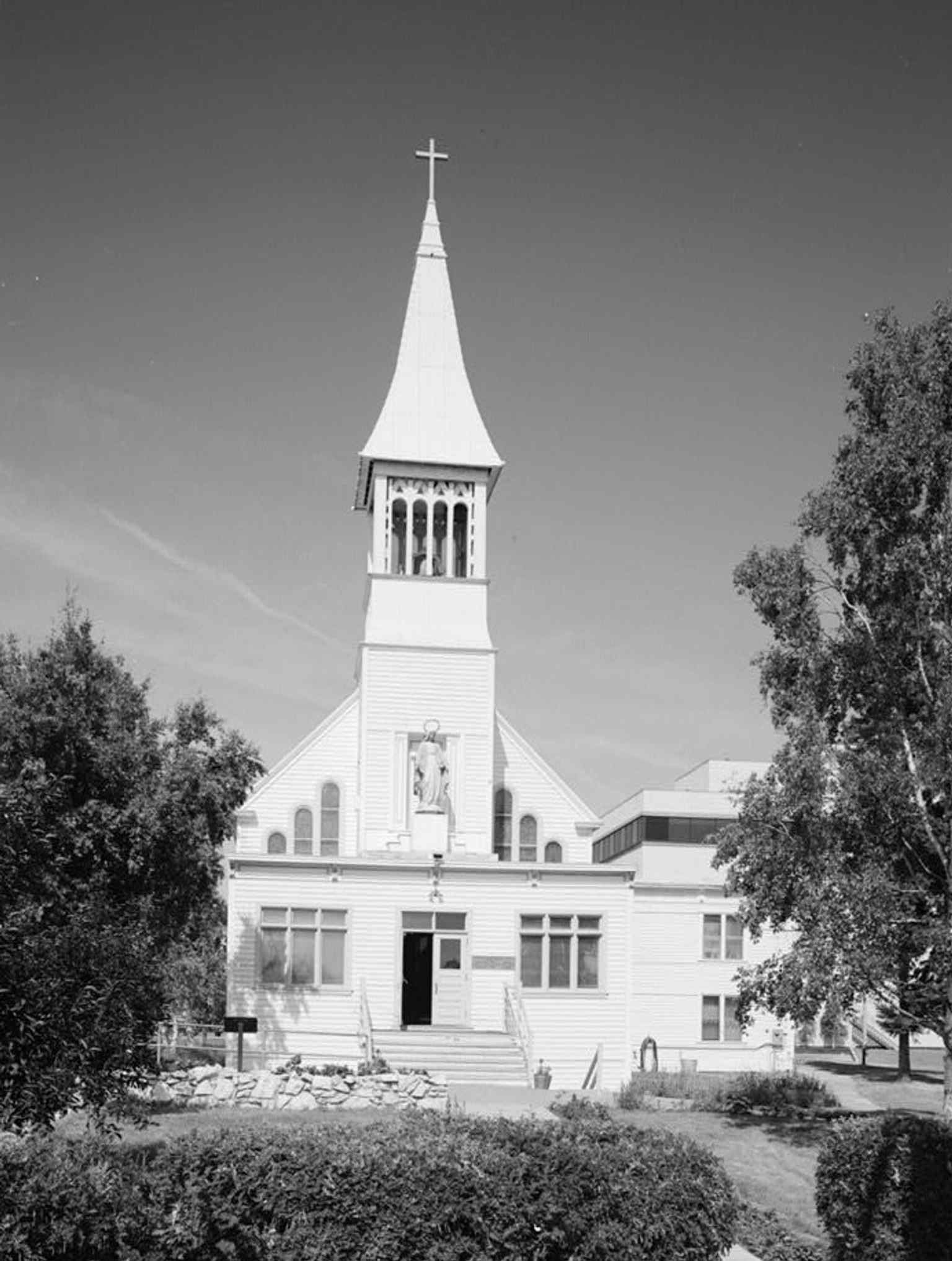
Historic HABS view of the church on Cushman Street, documenting the building that was moved across the Chena River in 1911–12.Photo: Jet Lowe, Wikimedia Commons, Public domain. Cropped & resized. 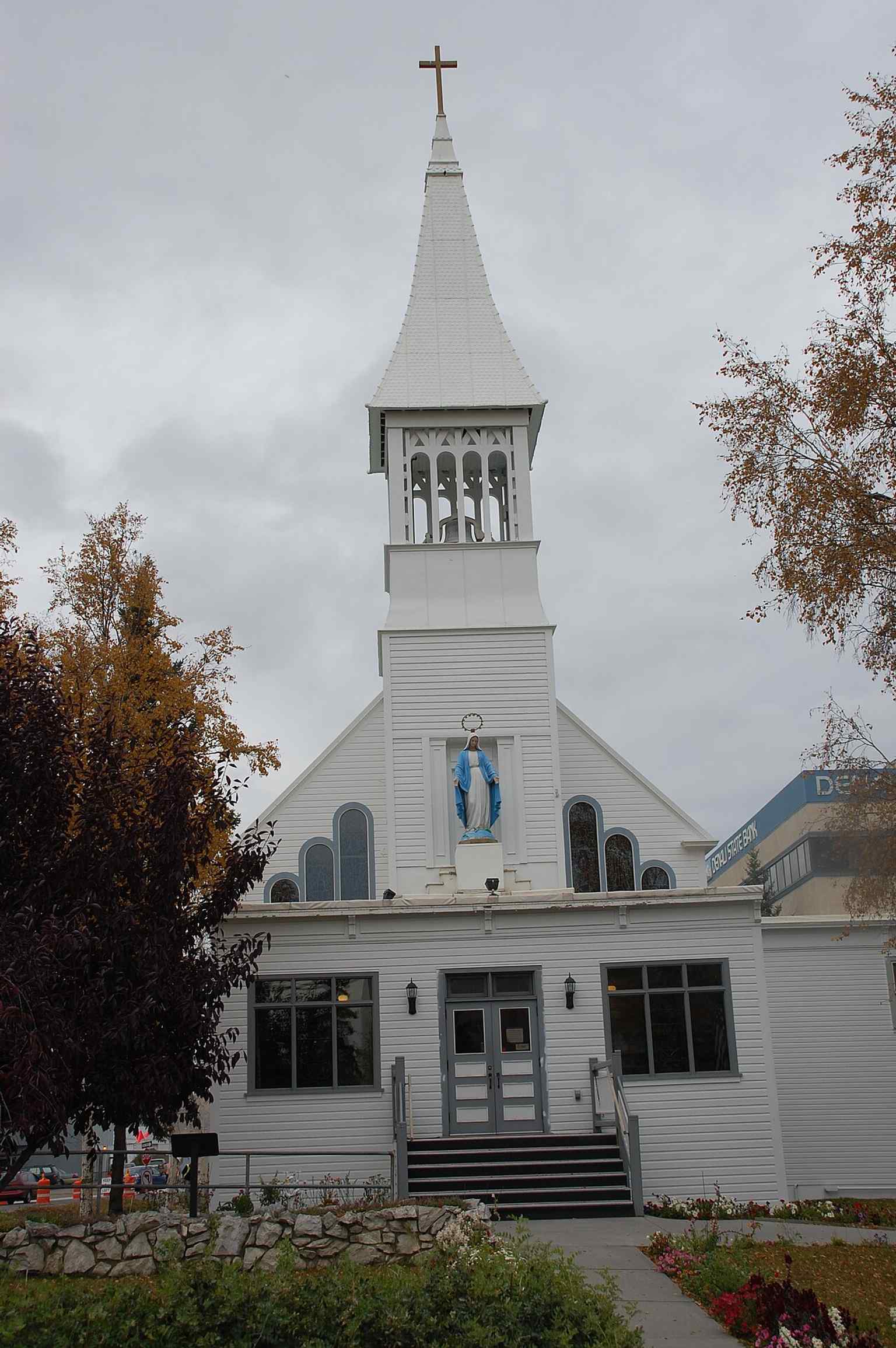
A clear modern exterior of Immaculate Conception Church, the former cathedral later known as the ‘Cathedral of the North.’Photo: Durkeeco, Wikimedia Commons, CC BY-SA 3.0. Cropped & resized. 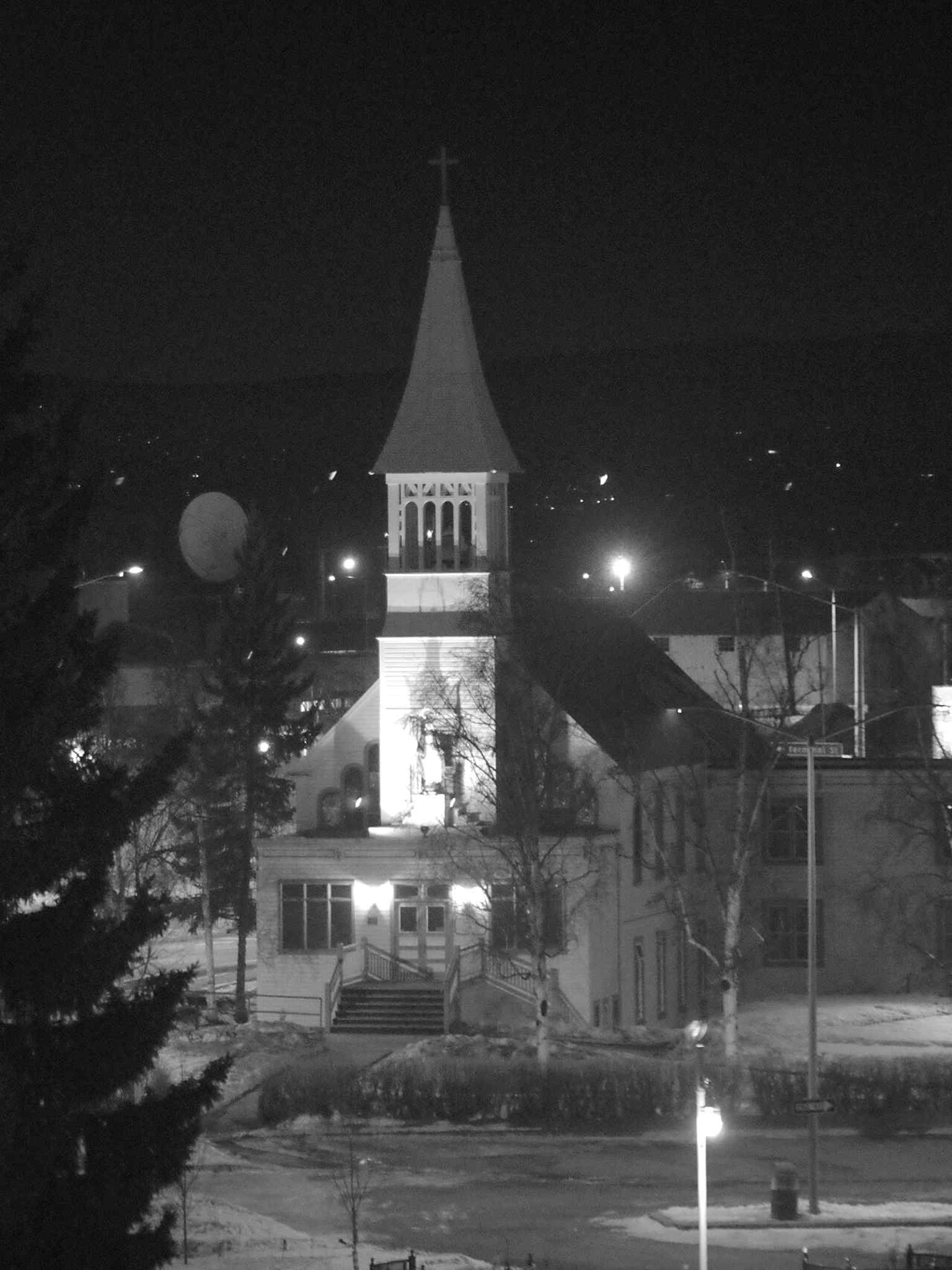
Another current exterior view showing the church’s distinctive steeple and front façade, added during the 1914 alterations.Photo: J Jakobson, Wikimedia Commons, CC BY-SA 3.0. Cropped & resized. On your left stood a tall concrete-and-glass slab with a flat roof and a boxy annex at its base, the kind of narrow high-rise that once served as downtown Fairbanks’s unmistakable…Read moreShow less
Open dedicated page →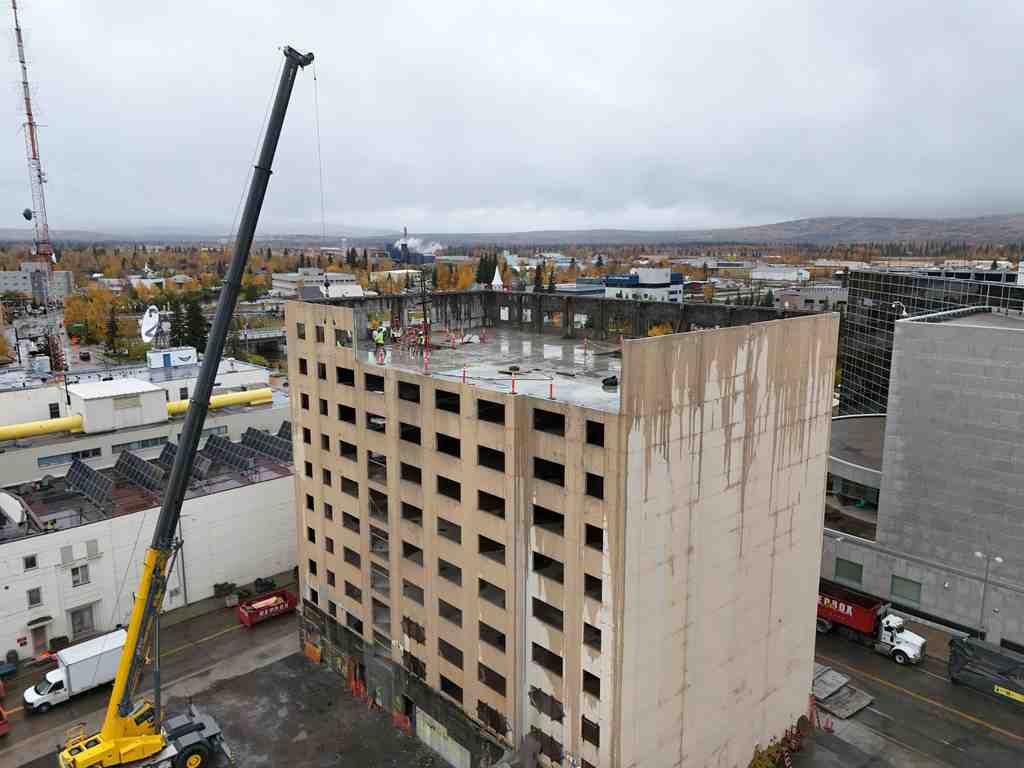
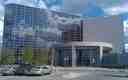
Polaris BuildingPhoto: Quintin Soloviev, Wikimedia Commons, CC BY 4.0. Cropped & resized. On your left stood a tall concrete-and-glass slab with a flat roof and a boxy annex at its base, the kind of narrow high-rise that once served as downtown Fairbanks’s unmistakable vertical marker.
The tower itself is gone now, demolished in late twenty twenty-five, but this corner still holds the shape of what Fairbanks once thought its future ought to look like. If the Fairbanks Exploration Company Machine Shop spoke for the muscular confidence of the gold era, the Polaris belonged to a newer force entirely: the Cold War boom. In the early nineteen fifties, federal money poured into Alaska’s defenses, Ladd Field and Eielson Air Force Base expanded, and Fairbanks suddenly needed housing faster than it could build it. So in nineteen fifty-two, the city reached upward. The Polaris opened as an eleven-story apartment building, the tallest thing downtown.
Locals still pass along one detail with a faintly knowing smile. In nineteen fifty-three, E. B. Collins and Charles Clasby opened law offices in the penthouse, advertised with a “breathtaking view of downtown Fairbanks.” That little boast tells you exactly how the building wished to be seen: not merely practical, but sophisticated, elevated, certain of itself.
And for a while, it worked. The building later shifted into hotel life as the Northern Lights Hotel. The upper floors kept trying on glamour: the Petroleum Club, then Tiki Cove, and later the Raven’s Nest all traded on the same promise that height could turn Fairbanks into something grander. But ambition here has never moved in a straight line. By the end of nineteen fifty-seven, the boom had already cooled, and roughly one thousand housing units stood vacant around Fairbanks. The city had built for a surge that did not fully stay.
If you look at the photo in the app, you can see the boarded-up tower in twenty twenty-one. It has the look of a ship left in dry dock too long, still upright, but no longer trusted.
Then came the disasters, one sudden and one slow. In nineteen sixty-seven, the great flood forced an evacuation here as downtown filled with water. On Second Avenue, the water reached five feet deep. Decades later, in two thousand and one, eight hundred thousand gallons flooded the basement. By the next year, the building stood abandoned.
People did try to save it. Mike Cusack Junior promised a revival. John Hovenden found the work far more expensive and difficult than expected. Developer Marc Marlow later tried to assemble tax credits and public programs for a mixed-use rebirth, with shops and offices below and apartments above, but the numbers never bent far enough. In twenty eleven, designer Candy Chang even turned the abandoned tower into a public conversation with a giant “Looking For Love Again” banner, asking the city what it wanted this empty giant to become.
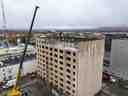
By twenty twelve, officials condemned it. A later assessment found asbestos, mold, mercury, and industrial chemicals called PCBs-persistent toxic compounds-and judged the structure unsafe in an earthquake. So the city took control after foreclosure and brought it down piece by piece. The image on your screen shows that long farewell.
But the clearest picture to carry from this stop is older: a modern tower emptied out while floodwater ran through downtown streets. Keep that in mind as you head to the Old Federal Building, about three minutes away, where Fairbanks placed its faith in something heavier and more permanent. The site remains accessible at any hour.
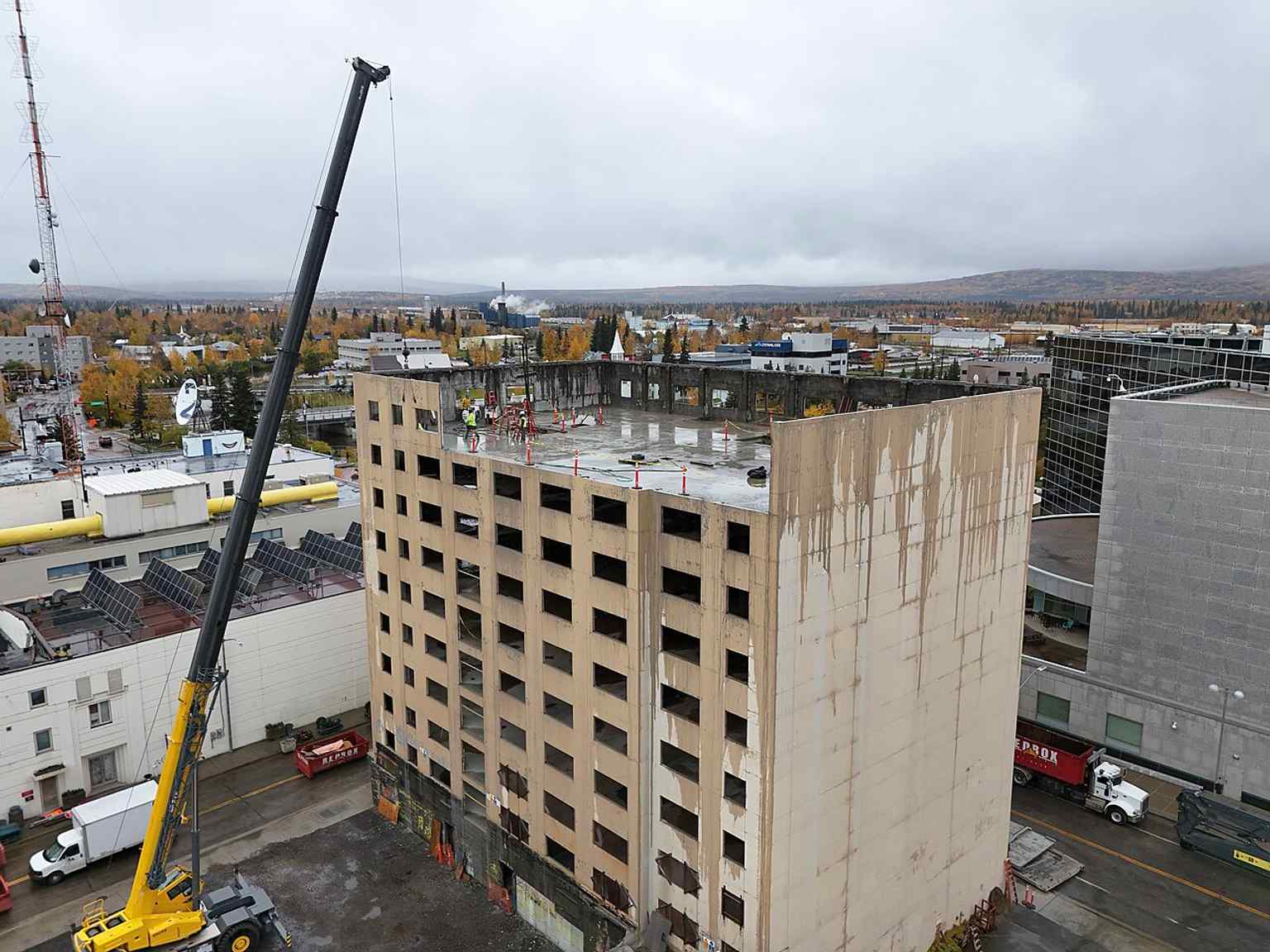
The Polaris Building coming down in 2024, part of the long demolition process that followed years of abandonment and environmental cleanup.Photo: Quintin Soloviev, Wikimedia Commons, CC BY 4.0. Cropped & resized. Look for the pale concrete block with a flat roofline, tall vertical window bands, and sharp V-shaped grooves carved into the facade. This building stands on one of Fairbanks’s…Read moreShow less
Open dedicated page →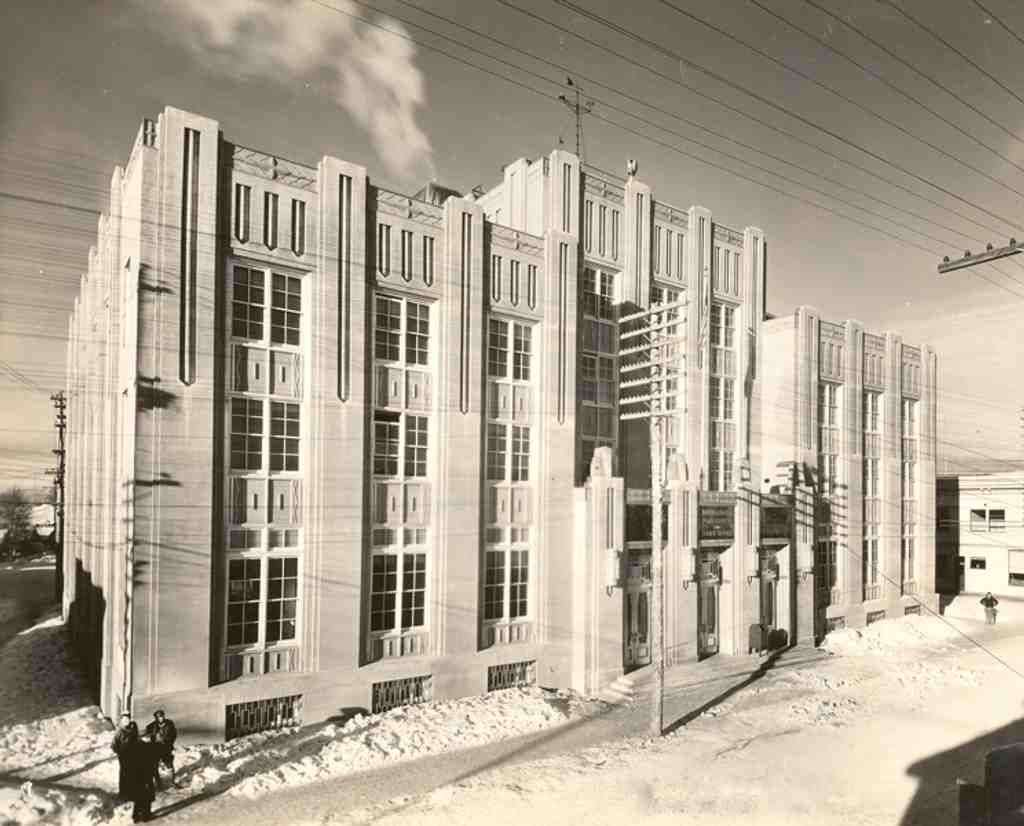
Old Federal BuildingPhoto: National Archives, Wikimedia Commons, Public domain. Cropped & resized. Look for the pale concrete block with a flat roofline, tall vertical window bands, and sharp V-shaped grooves carved into the facade.
This building stands on one of Fairbanks’s oldest and most consequential blocks. Before federal authority settled here in concrete, this ground formed part of E. T. Barnette’s trading post. When Barnette unloaded goods here in late nineteen oh-one, at the end of the sternwheeler route, he helped nudge a settlement into being. In nineteen oh-two, Barnette and James Wickersham tied the town’s name to Senator Charles Fairbanks. Wickersham, first as a judge and later as Alaska’s delegate to Congress, kept pressing for something more than a boomtown. He wanted the visible machinery of law and government.
That ambition had a darker apprenticeship. Wickersham’s first wood-frame courthouse burned in the great fire of nineteen oh-six. Its replacement turned out so poorly built that an engineer told the grand jury it ought to be condemned. And before this structure rose, the old jail yard here hosted hangings. So this was never merely a convenient address. It was a place where the town kept relearning, rather sternly, that authority needed sturdier walls.
Take a moment to study the weight of the building. Does it strike you as reassuring, imposing, or faintly controlling?
By nineteen fourteen, the local postmaster argued that Fairbanks served a region more than three hundred miles across and needed a proper federal building. He even called for concrete. Congress finally provided the money in nineteen thirty-one, and Wickersham pushed the project forward again. Treasury officials tested whether concrete could endure here; local engineers, including voices from the Fairbanks Exploration Company, said it could. Architect George N. Ray drew this Art Deco design, and William “Mac” MacDonald built it. When it opened in nineteen thirty-three, it was among the northernmost concrete buildings in the United States. You can see that crisp federal confidence in full view.
Inside, there were terrazzo floors, marble walls, and even a pressed copper courtroom ceiling. Today the building holds private offices. As you leave, notice how law and government tried to plant stability on this block. In about four minutes, the Rabinowitz Courthouse will show that effort continuing into the present.
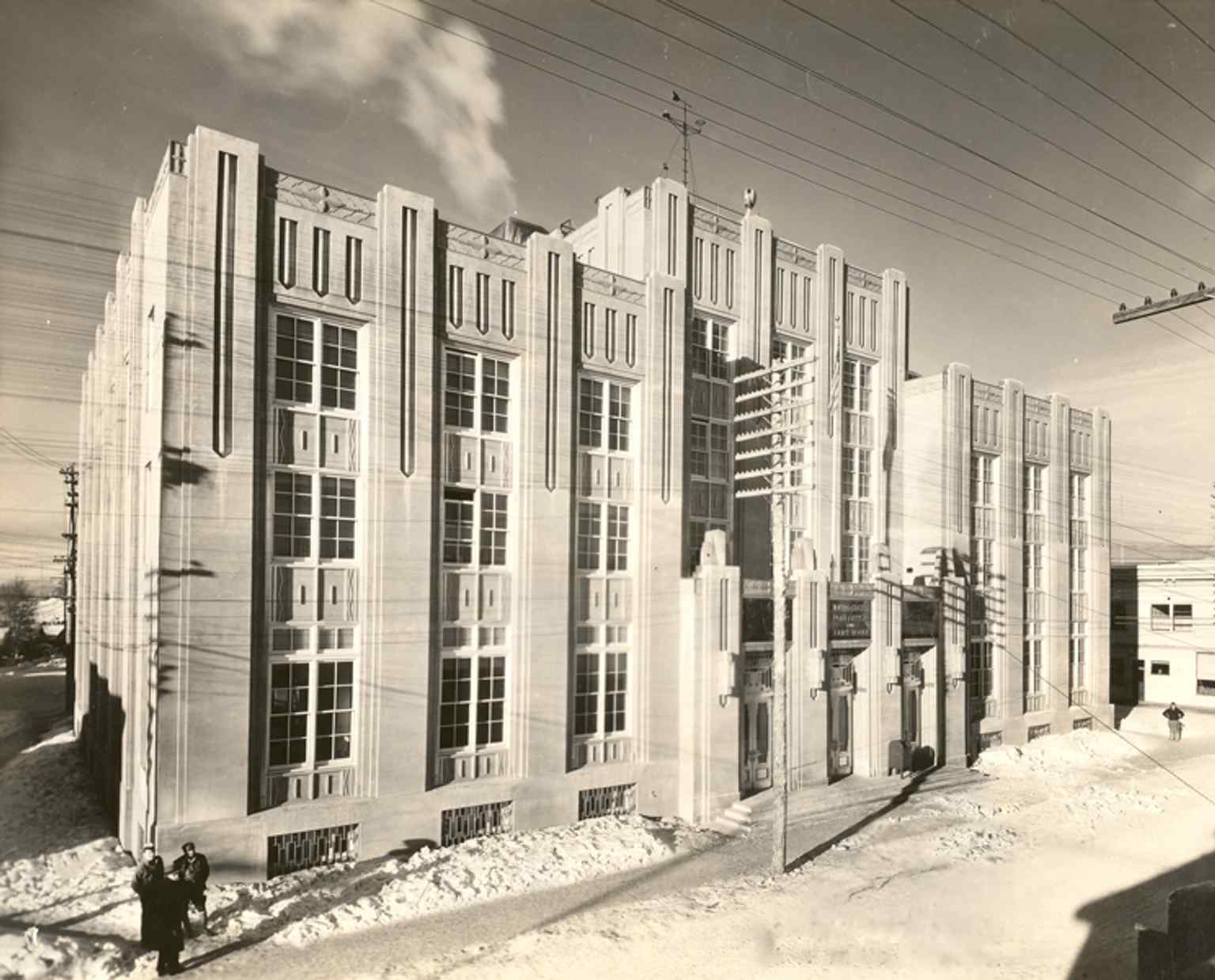
The Old Federal Building in downtown Fairbanks, completed in 1933, later housed the U.S. District Court until 1977 and is now privately owned.Photo: National Archives, Wikimedia Commons, Public domain. Cropped & resized. On your left is a pale concrete-and-glass civic block with a broad, low shape and a recessed entrance marked with the Rabinowitz name. Civic order on frontier ground is never…Read moreShow less
Open dedicated page →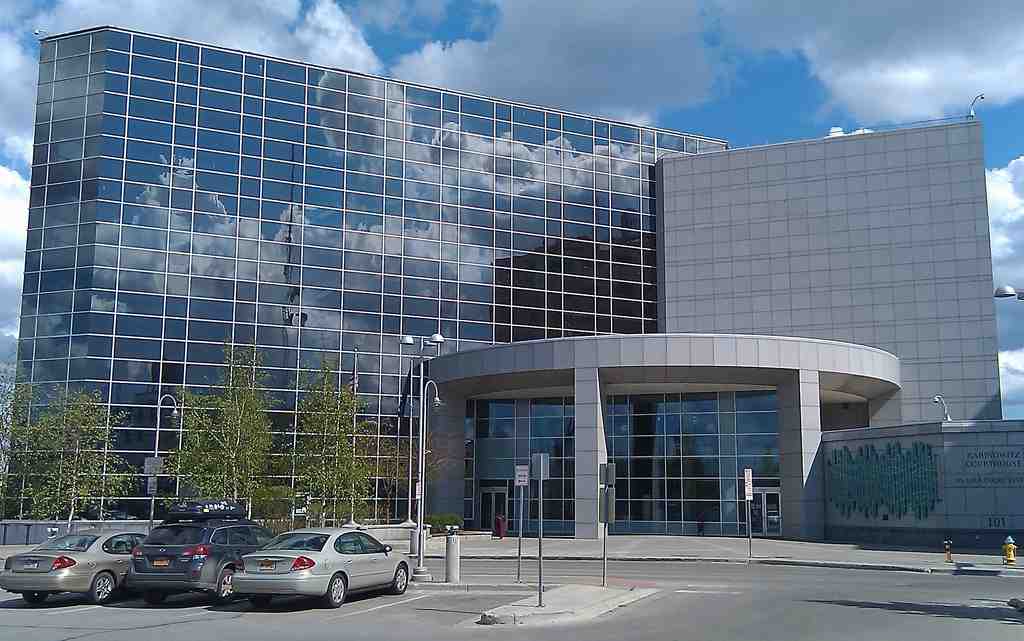
Rabinowitz CourthousePhoto: RadioKAOS, Wikimedia Commons, CC BY-SA 3.0. Cropped & resized. On your left is a pale concrete-and-glass civic block with a broad, low shape and a recessed entrance marked with the Rabinowitz name.
Civic order on frontier ground is never simple. Since the era of James Wickersham, Fairbanks has kept trying to turn a raw northern settlement into a place where law feels steady, public, and durable. This courthouse, beside the Chena River at one hundred one Lacey Street, is the modern expression of that effort.
Architects at Charles Bettisworth and Company worked with McCool Green Architects to complete it in two thousand one, the same year former chief justice Jay Rabinowitz died. That timing made the name feel almost elegiac. Before he became a statewide judicial figure, Rabinowitz served here in Fairbanks, and then spent thirty-two years on Alaska’s highest court. The exterior looks restrained, almost deliberately calm. Inside, though, the state filled it with Alaska art: Teri Rofkar’s Raven’s Tail weavings, Bill Brody’s copper mural, Kes Woodward’s winter scenes, Ron Senungetuk’s Sila, and a portrait of Rabinowitz by Evgeny Baranov.
And here is the turn in the story. Even mature institutions fail in human ways. After eleven years on the job, district accounting supervisor Katherine L. Turner admitted stealing two hundred thirty-seven thousand dollars in bail money; administrators discovered deposits delayed by weeks and months. So this building stands for justice, yes, but also for vigilance.
That tension matters, because people still bring the state’s hardest questions here, from arson victims’ testimony to Supreme Court arguments over ranked-choice voting. Next we turn toward an older kind of civic glue, the Masonic Temple, about seven minutes away. If you return on a weekday, the courthouse is generally open from eight to four-thirty, with Friday hours ending at noon.
Look for a two-story wooden building with a flat rectangular front, tall rectangular windows, and a neat cornice at the roofline. This site held one of Fairbanks’s great…Read moreShow less
Open dedicated page →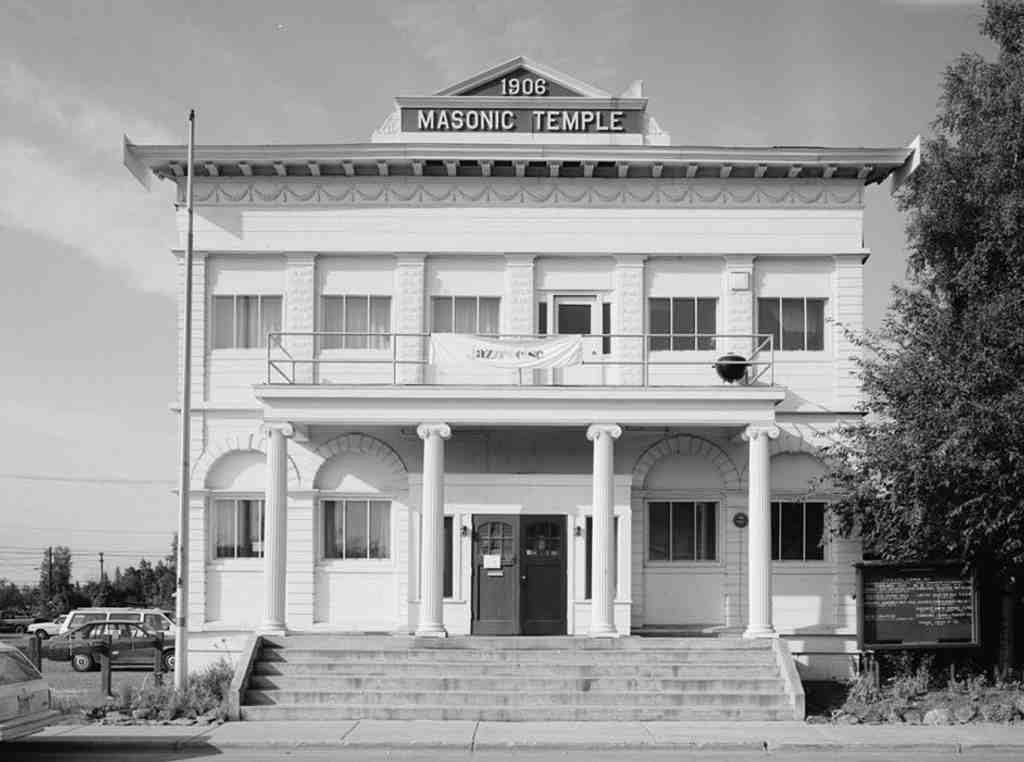
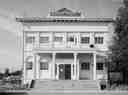
Masonic TemplePhoto: Jet Lowe, Wikimedia Commons, Public domain. Cropped & resized. Look for a two-story wooden building with a flat rectangular front, tall rectangular windows, and a neat cornice at the roofline.
This site held one of Fairbanks’s great survivors. In nineteen oh six, the downtown fire tore through the young business district and nearly reset the town in a single blow. The flames stopped about a block from here, and this building, first put up for the Tanana Commercial Company, remained standing while so much around it vanished.
Two years later, Tanana Lodge Number Three bought it. That matters, because the Masons were more than a fraternal club; they were part of the social framework that helped a rough mining town steady itself. They added lodge rooms at the rear and a main hall, then, in nineteen thirteen, did something most passersby would never suspect: they raised the entire building. That bold move created a seven-foot basement ceiling, as if Fairbanks had literally lifted its past to keep using it.
The formal facade added in nineteen sixteen gives this wooden structure a frontier version of Renaissance Revival style, borrowing the dignity of older city buildings. In nineteen twenty-three, President Warren G. Harding spoke from these steps during his Alaska journey. Less than three weeks later, he died in San Francisco.
Then came one last narrow escape. The roof collapsed in twenty eighteen, only about thirty minutes after restaurant workers next door had been inside. No one was hurt. The rest came down the next day. Hold in mind, then, not rubble, but a building raised above its first life. From here, continue to the George C. Thomas Memorial Library, where another kind of foundation took hold.
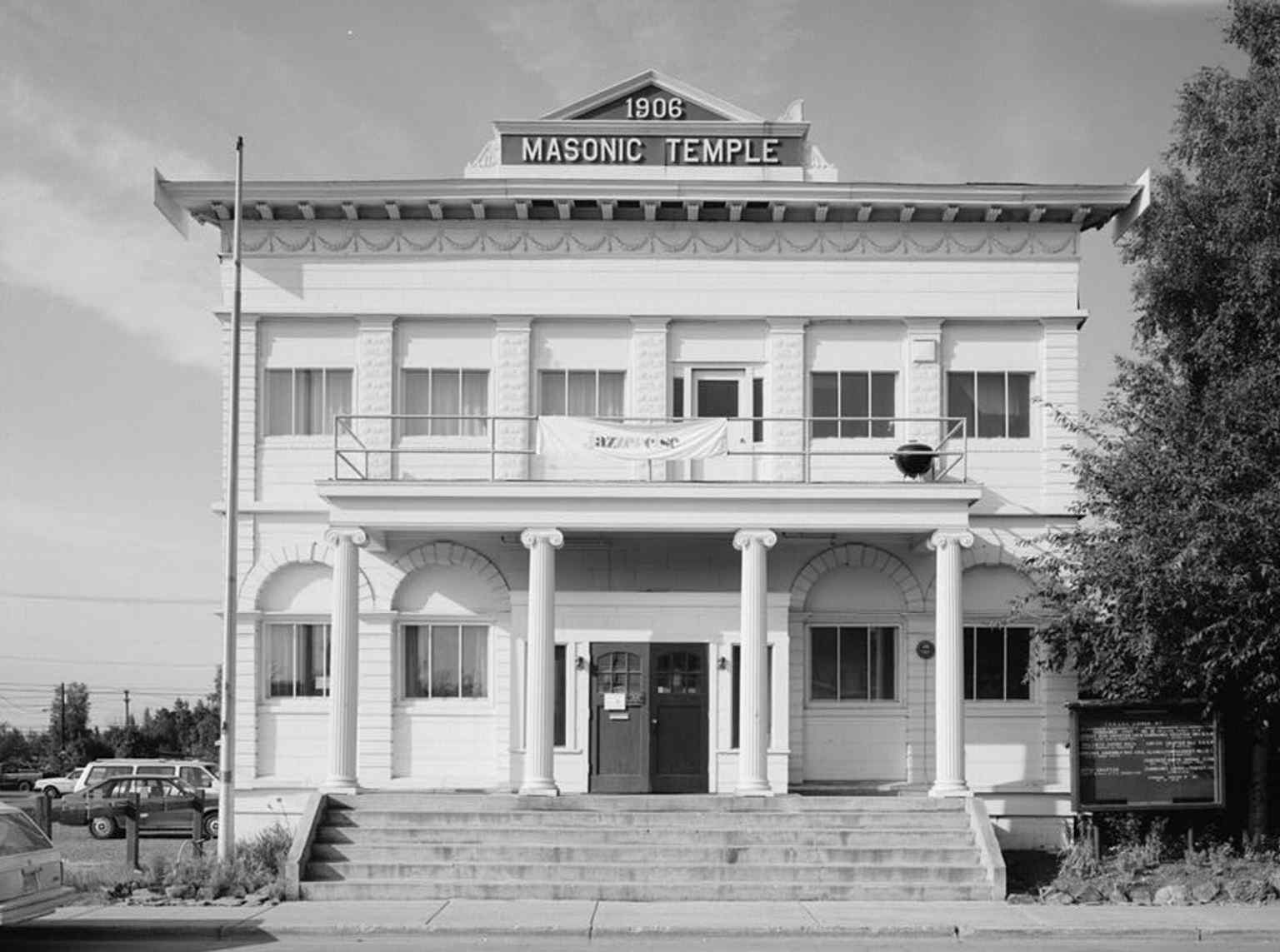
Historic HABS documentation of the Masonic Temple at 809 First Avenue — one of the few original Fairbanks buildings to survive the 1906 fire.Photo: Jet Lowe, Wikimedia Commons, Public domain. Cropped & resized. 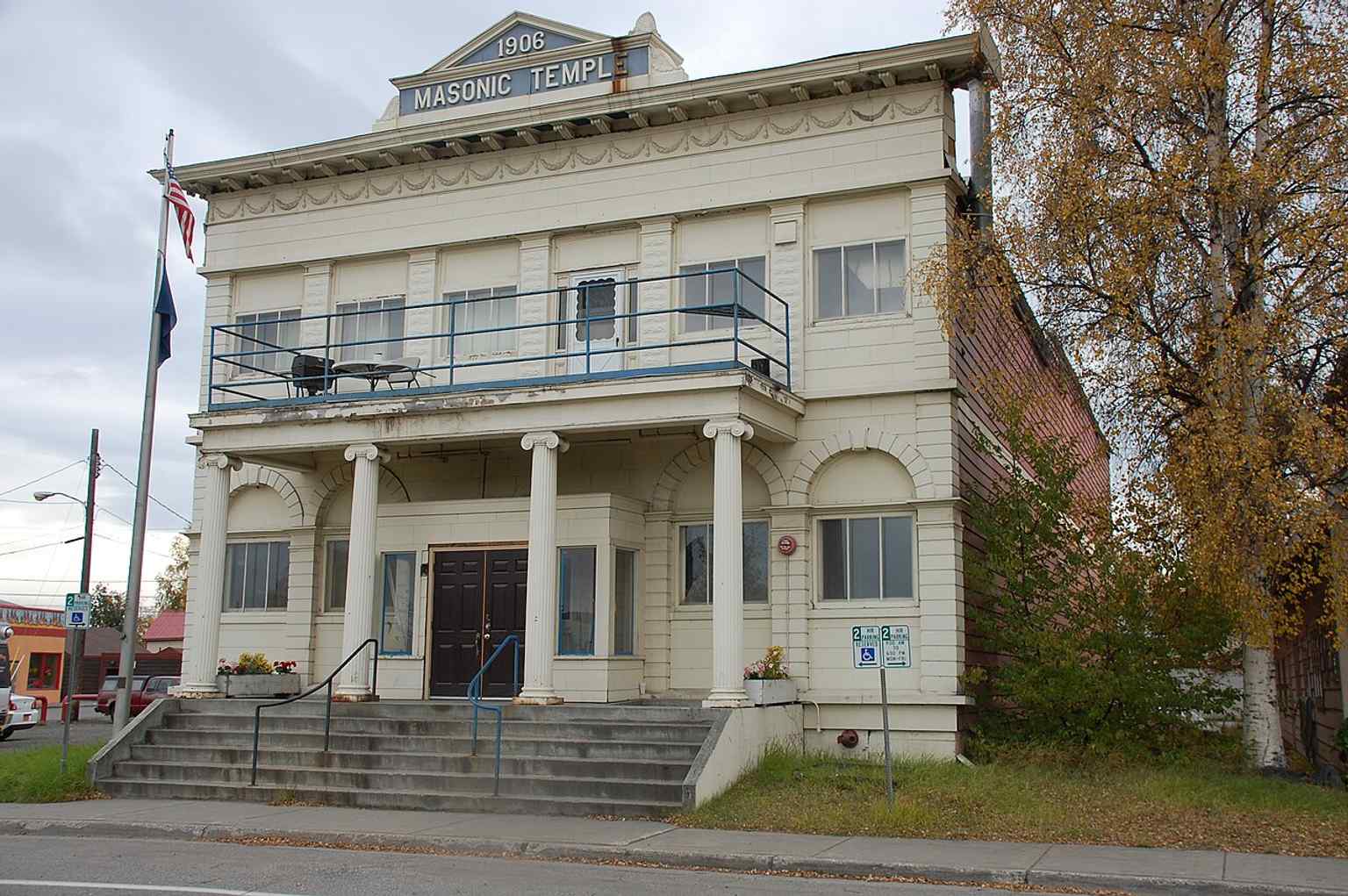
A later exterior view of the Fairbanks Masonic Temple, the building where the Masons added lodge space after buying it in 1908.Photo: Durkeeco, Wikimedia Commons, CC BY-SA 3.0. Cropped & resized. On your left stands a square log building with a broad hipped roof, a porch wrapping around two sides on thick log columns, and a main entrance tucked neatly into the corner. A…Read moreShow less
Open dedicated page →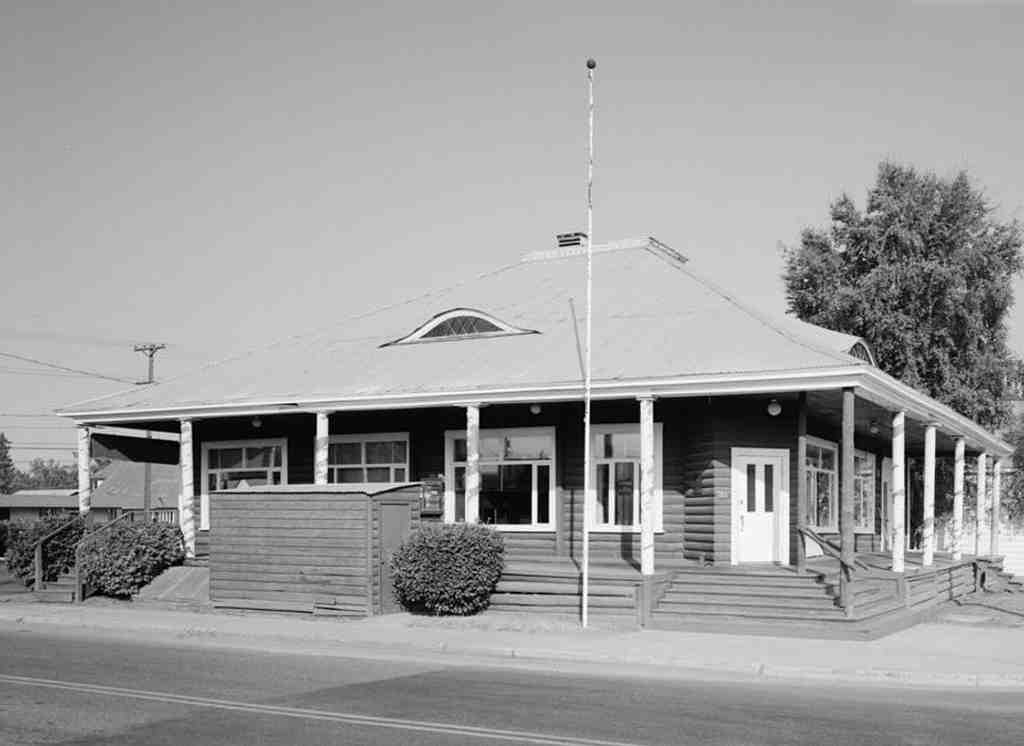
George C. Thomas Memorial LibraryPhoto: Jet Lowe, Wikimedia Commons, Public domain. Cropped & resized. On your left stands a square log building with a broad hipped roof, a porch wrapping around two sides on thick log columns, and a main entrance tucked neatly into the corner.
A city reveals what it chooses to remember by the names it fixes to its buildings. George C. Thomas never even visited Alaska, yet his name survives here because one distant gift met a very local need.
Before this library took shape in nineteen hundred and nine, St. Matthew’s Mission kept a reading room open around the clock. Miners came in, sourdoughs came in, and even inmates from the log jail borrowed newspapers and magazines. Archdeacon Stuck had donated about one thousand of the room’s fifteen hundred items himself. Local tradition says Thomas, a Philadelphia philanthropist, saw a photograph of that crowded room and remarked that it would be splendid if far-north prospectors had a place for their “books and tobacco together.” He paid for this building, then died before it was finished, so the trustees gave it his name almost as an act of gratitude and mourning at once.
You can see how recognisable the old form remains: the porch, the logs, the corner entrance that welcomed readers for generations.
Its opening on the fifth of August, nineteen hundred and nine, became a civic occasion. Archdeacon Stuck spoke. So did James Wickersham, the territorial delegate. And that is the point, really: this was never only a quiet room for books. It sat where reading, argument, politics, and everyday survival met.
What changes in a frontier town when a library becomes a place not merely to borrow a book, but to make a claim on the future?
In July of nineteen fifteen, that question turned urgent here. Six Tanana chiefs, several village headmen, an interpreter, and the missionary Reverend Guy H. Madara came to represent roughly twelve hundred to fifteen hundred Athabascan people. Across from them sat Wickersham, men from the Alaska Engineering Commission, and federal land officials. They discussed work, schooling, and above all land claims. Most striking of all, the Native delegation reportedly rejected the government’s offer of reservations. They insisted their rights be argued on their own terms. That long struggle would not reach settlement until the Alaska Native Claims Settlement Act in nineteen seventy-one.
The town kept relying on this place for decades. In nineteen forty, the owners sold it to Fairbanks for one dollar on the condition that it always house a library. After a fire in nineteen forty-nine destroyed about one-third of the collection, local clubs and donors from across the Lower Forty-Eight helped refill the shelves. By nineteen seventy-two, the library held about six thousand five hundred books, including geology and mining, and even mailed books to isolated readers far beyond town.
When the collection moved in nineteen seventy-seven, the building began another life. Fairbanks has a habit of doing that: keeping the shell, and finding new uses for memory. At the next stop, the story narrows from a public institution to a private house, where memory grows trickier and origins come with more than one version.
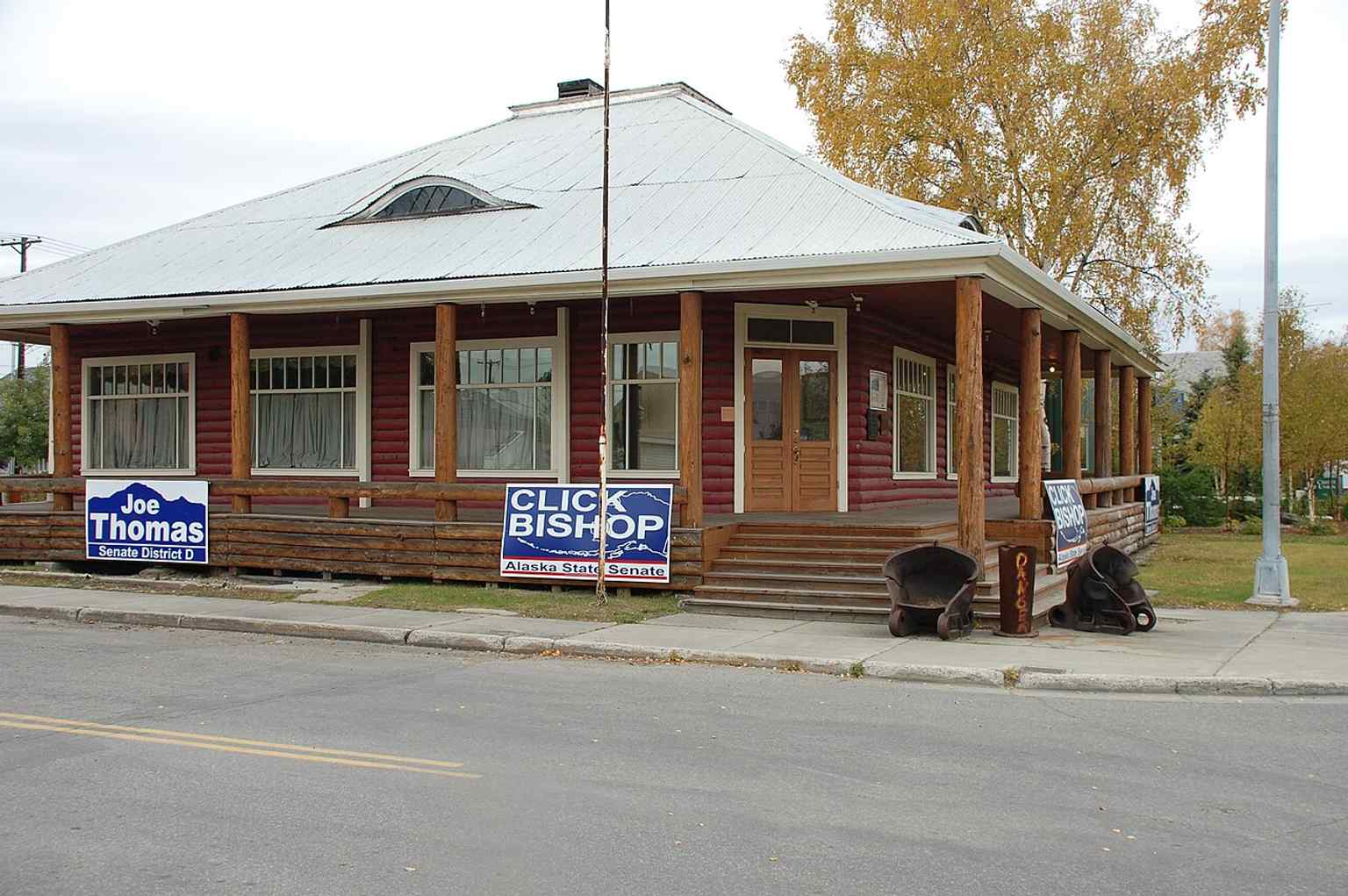
The surviving log library building in Fairbanks, still recognizable by its corner entrance and wraparound porch from the 1909 design.Photo: Durkeeco, Wikimedia Commons, CC BY-SA 3.0. Cropped & resized. 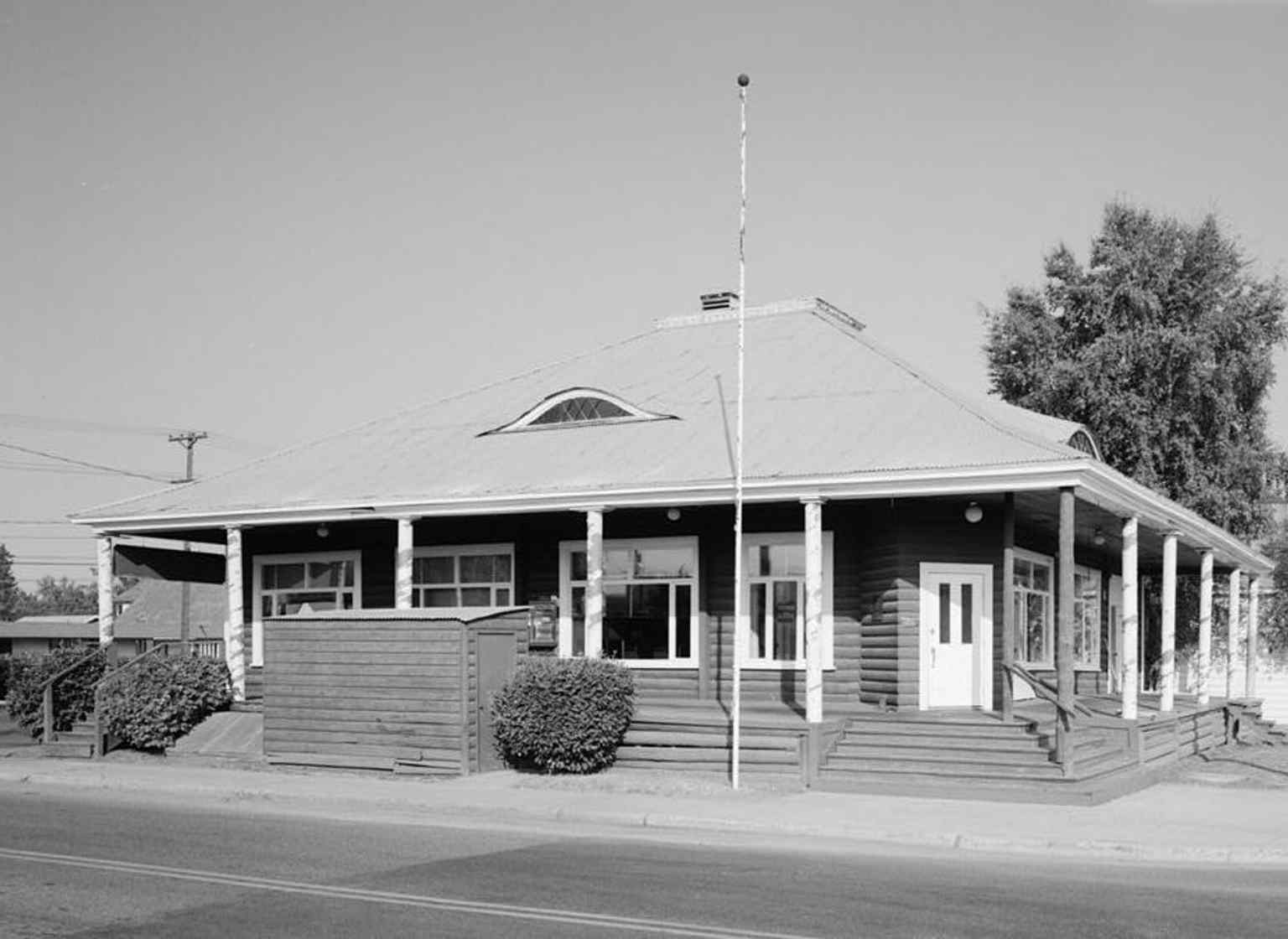
A historic view of the Thomas Library at 901 1st Avenue, the former public library that later became a National Historic Landmark for the 1915 Alaska Native conference.Photo: Jet Lowe, Wikimedia Commons, Public domain. Cropped & resized. On your right, look for a gray wooden bungalow with a low, broad roofline, a wide front veranda, and the green roof that long gave this house its signature. This house has the…Read moreShow less
Open dedicated page →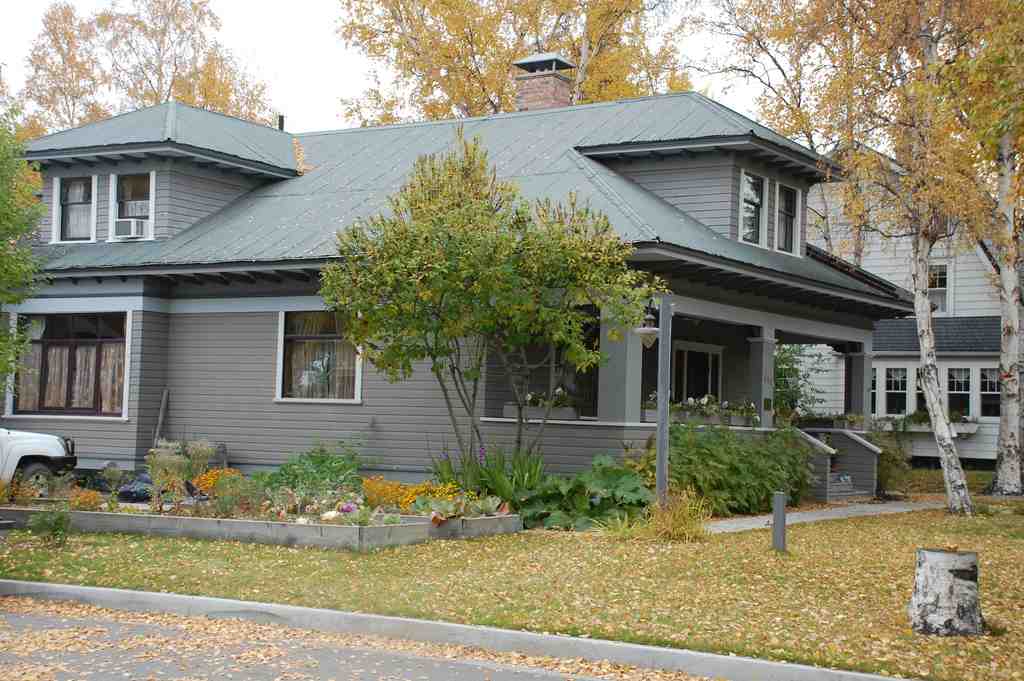
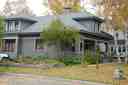
Mary Lee Davis HousePhoto: Durkeeco, Wikimedia Commons, CC BY-SA 3.0. Cropped & resized. On your right, look for a gray wooden bungalow with a low, broad roofline, a wide front veranda, and the green roof that long gave this house its signature.
This house has the sort of history Fairbanks seems to favour: important, well loved, and just slippery enough to keep people arguing. The plaque says nineteen oh six. The National Register record points instead to an unfinished house, probably completed by nineteen sixteen, after an earlier owner died and the project stalled. So whose version survives in the cityscape: the plaque’s, the gossip’s, or the paper trail? You can see official memory trying to settle the matter with one neat date.
And then there is the romantic version. Local tradition ties this place to Arthur Williams and Lucille McCarthy Williams. Depending on who is telling it, Lucille was either a visiting socialite or a Dawson good-time girl, which meant a woman from the dance-hall world of the northern gold rush. Arthur owned the Arcade Café and, by all accounts, built lavishly for her. Together they became visible figures in town life, backing public education, the Red Cross, street lighting, even a hometown baseball team. Then came a brutal turn. On the fifth of February, nineteen nineteen, fire tore through downtown Fairbanks and destroyed the Arcade Café. Arthur died of heart disease on the ninth of May. Lucille sold the house in June and left by steamship for Seattle in July. After that, the local record more or less lets her drift away.
But the house’s most solid identity, the one that holds when the rumours thin out, is Mary Lee Davis. Mary Lee Cadwell Davis arrived in Fairbanks with her husband, John Allen Davis, on the fifteenth of July, nineteen seventeen. John was a geologist sent to establish a mining experiment station. Mary arrived with rather more than frontier grit: a Wellesley degree, Phi Beta Kappa honours, and a master’s from Radcliffe. Whatever uncertain story came first, Mary and John finished this house and gave it many of the touches people still remember, including Fairbanks’s first residential coal heating system.
Mary did not treat the house as a private retreat. She used it as a base for civic work. During the First World War, she wrote newspaper features about Alaska’s role in the war effort, helped raise money for a bed at the American Hospital in France, and helped form the Alaska chapter of the American Red Cross. Later she helped found the territory’s first library, worked with Saint Matthew’s Episcopal Church, and served as a volunteer night nurse during the great flu pandemic of nineteen twenty.
She also made the place memorable in quieter ways: oak floors, built-in bookshelves, an open-hearth fireplace, indoor plumbing with porcelain fixtures, sawdust insulation, birch trees, and a wide veranda. In her own writing she called it a gray house with a green roof. You can see how that domestic scale still survives, even after all the lives layered onto it.
Later, the Fairbanks Exploration Company used it to house executives and entertain guests. Since then, owner followed owner, and that may be why it still feels alive rather than embalmed. It earned National Register status in nineteen eighty-two, underwent a major restoration in the early two thousands, and now lives on as the Alaska Heritage House, still the city’s oldest occupied residence.
So this corner leaves you with a gentle puzzle: memory here does not stay still, but some lives give it shape. Mary Lee Davis did exactly that.
From this contested house, we go on to a building that carried generations of Fairbanks children and later the city itself: Fairbanks City Hall, about eleven minutes away.
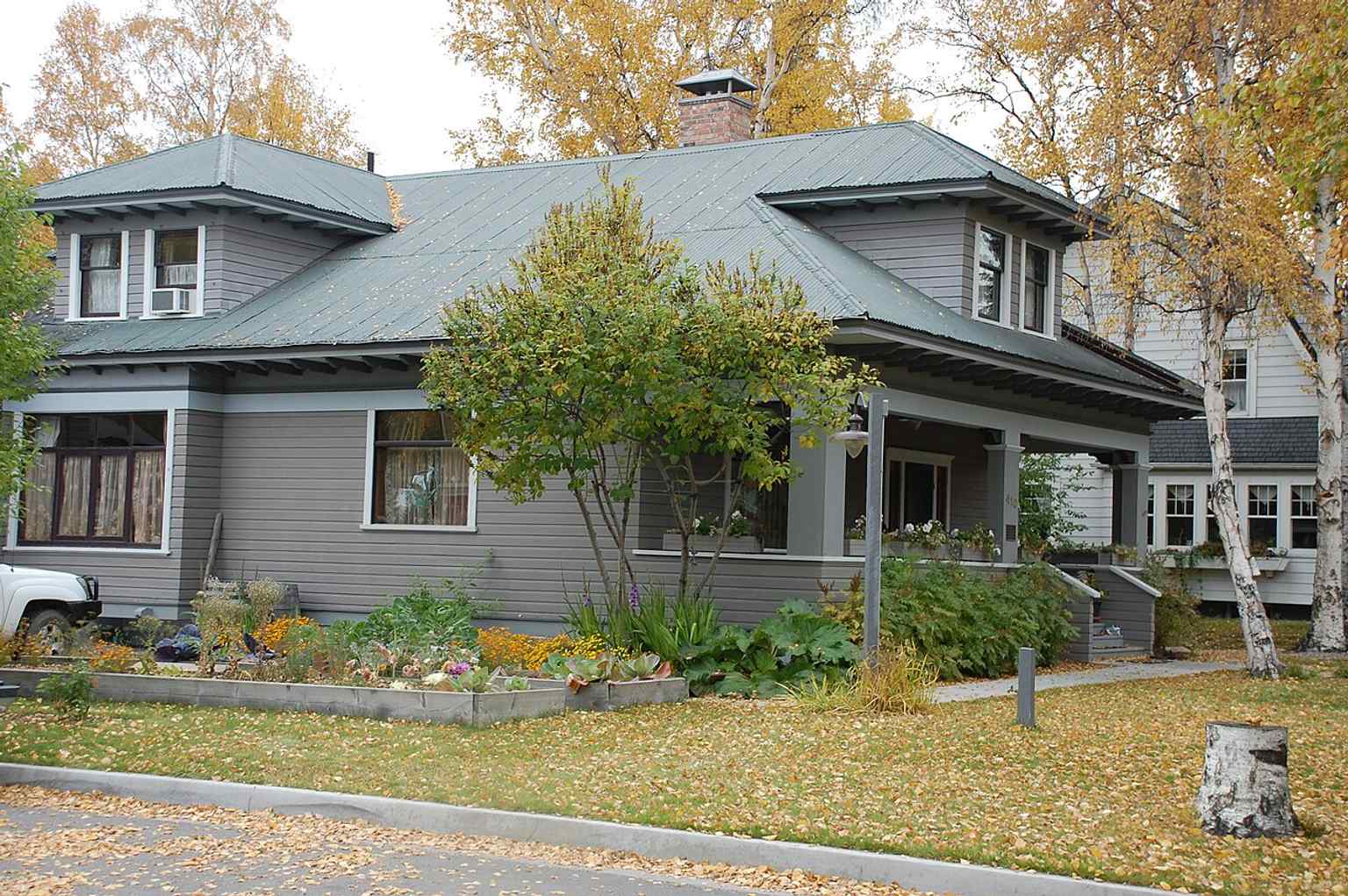
The Mary Lee Davis House in Fairbanks, now the Alaska Heritage House bed and breakfast, preserved as the city’s oldest occupied residence.Photo: Durkeeco, Wikimedia Commons, CC BY-SA 3.0. Cropped & resized. On your right stands a broad pale concrete building with a long rectangular front and crisp Art Deco lines gathered around its central entrance. This is Patrick B. Cole Fairbanks…Read moreShow less
Open dedicated page →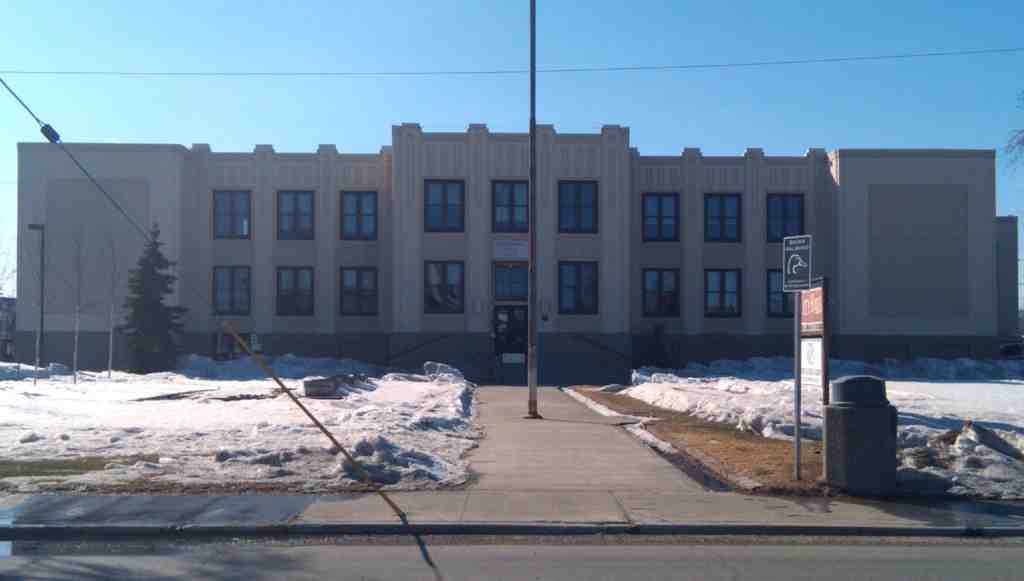
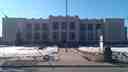
Fairbanks City HallPhoto: RadioKAOS, Wikimedia Commons, CC BY-SA 3.0. Cropped & resized. On your right stands a broad pale concrete building with a long rectangular front and crisp Art Deco lines gathered around its central entrance.
This is Patrick B. Cole Fairbanks City Hall, though for generations people called it Main School, or simply Old Main. Its story begins more modestly than this solid façade suggests. In the fall of nineteen oh-three, Fairbanks tried to run a public school in a small cabin at Wendell and Noble. There were thirteen students, one teacher, and not quite enough money; the school closed before Christmas. Four years later, a new school rose here on Cushman Street. Some school board members grumbled that the site sat too far from the centre of town, but once the building stood up among Fairbanks’s mostly one-story log cabins, a local pastor said it looked like an English cathedral.
Then came the fire of late nineteen thirty-two. The wooden school burned, and children scattered into churches and civic buildings for classes until this reinforced-concrete replacement opened on the twenty-second of January, nineteen thirty-four. That choice of concrete mattered. Fairbanks had learned, painfully, that wood could disappear in a night. As military growth swelled the town during the Second World War and the Cold War, crews added onto the building in nineteen thirty-nine and again in nineteen forty-eight. The additions made room for more students, and also made the interior so confusing that Chris Allen repeated an old joke: if a senior could find a way from the middle of the building to the outside, the staff ought to hand over a diploma immediately.
For years this was the city’s only school, then a junior and senior high school, then Main Junior High. Later it held alternative programs and school district offices. By nineteen ninety-three, after the district left, the ground-floor windows were boarded, the heat was off, and the place sat dark. Former mayor Jerry Cleworth, who had gone to school here himself, helped push the rescue: roof repairs, restored windows, refinished gym floor and bleachers, hallways opened again. You can see how a schoolhouse became the city’s civic heart.
Since nineteen ninety-four, city offices have worked here, and the old gym has served the Fairbanks Boys and Girls Club. In two thousand fourteen, the building took the name of Patrick B. Cole, a forty-year public servant who served eight mayors in the unglamorous work of keeping government running. That feels right. Fairbanks has always depended on people who repaired, taught, filed, argued, rebuilt, and carried on. This building matters for the same reason the whole city does: it did not stay the same, but it stayed useful, and in doing so it kept memory alive. If you want to go inside, city hall is generally open on weekdays from eight in the morning to five in the afternoon, and closed on weekends.
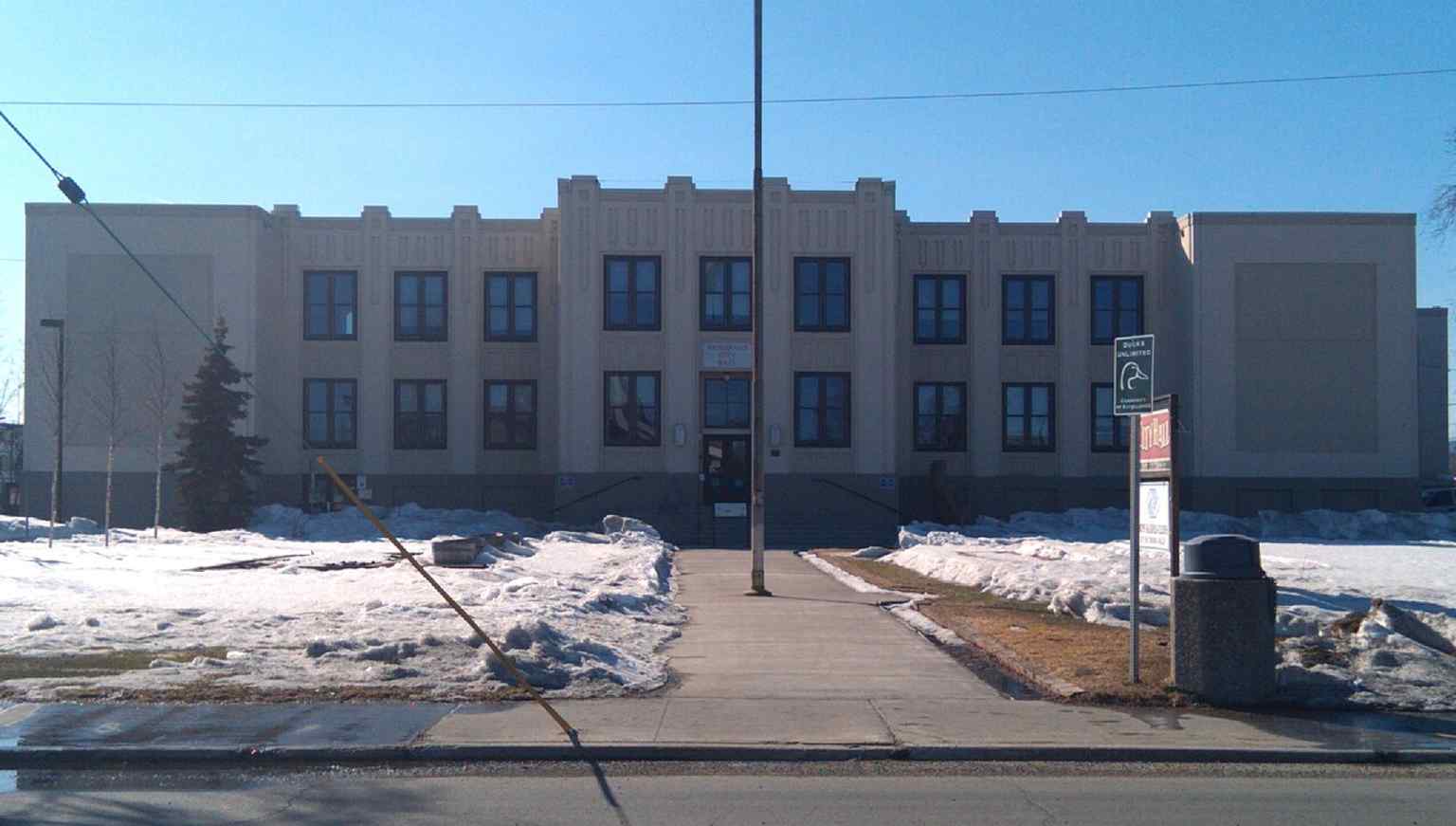
Fairbanks City Hall today on Cushman Street — the former school building that survived the 1932 fire and became the city’s main municipal offices.Photo: RadioKAOS, Wikimedia Commons, CC BY-SA 3.0. Cropped & resized. 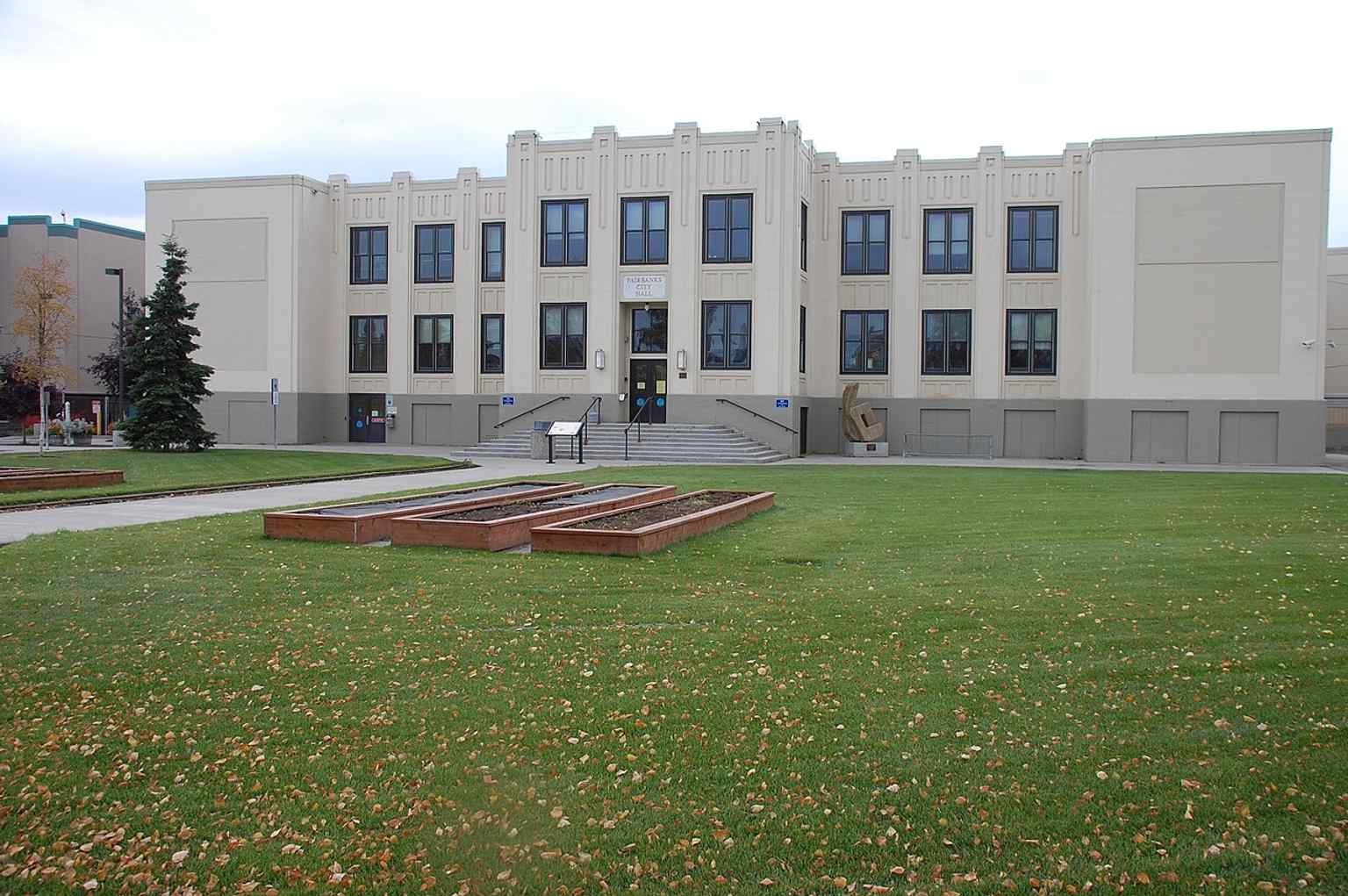
A clear 2012 view of Main School, the Art Deco concrete replacement built in 1934 after the original wooden school burned down.Photo: Durkeeco, Wikimedia Commons, CC BY-SA 3.0. Cropped & resized. 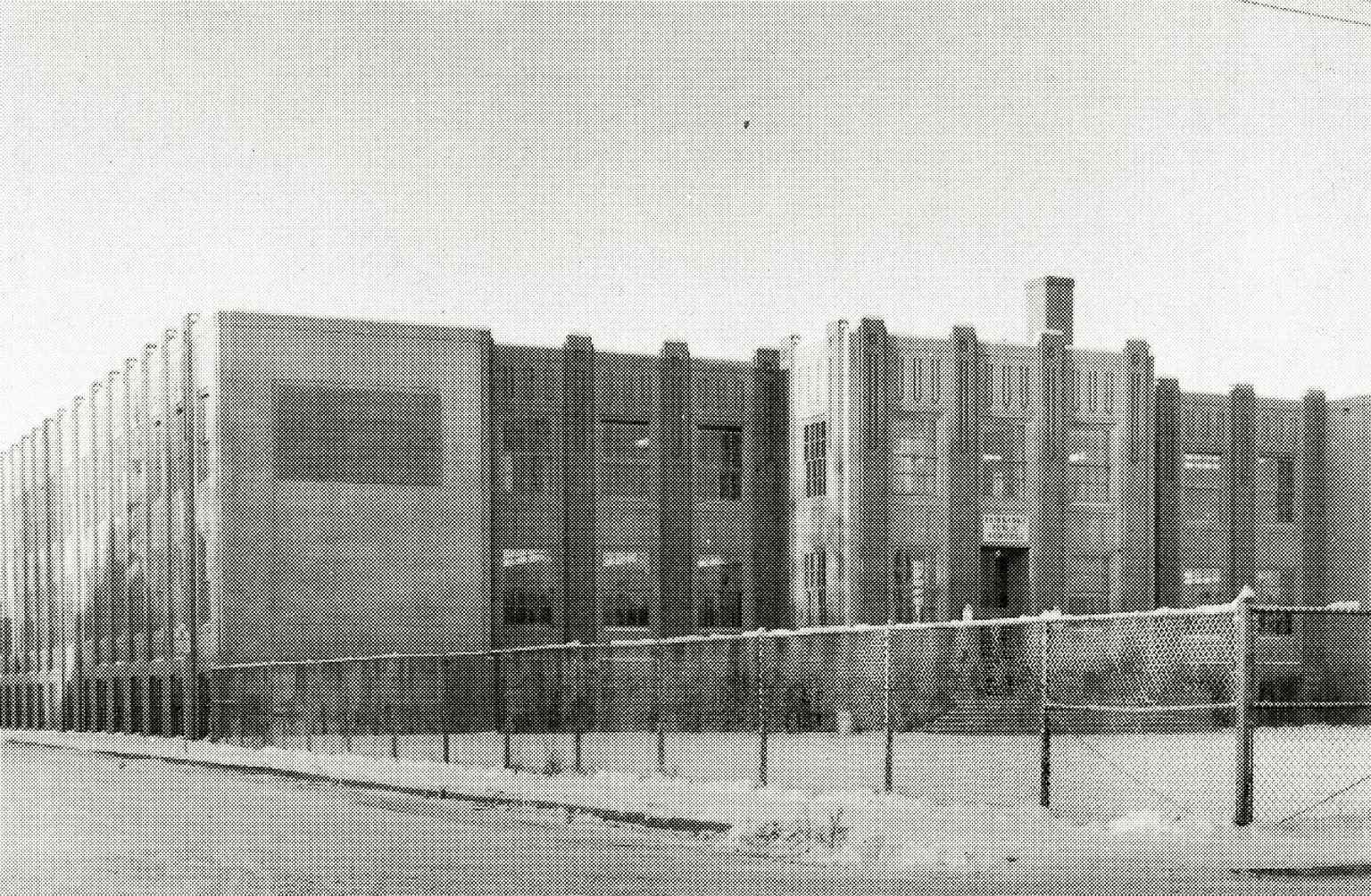
Main School in the early 1960s, when it served as Main Junior High and the additions had already made the building famously hard to navigate.Photo: Lathrop High School (or student class/group of the school), Fairbanks, Alaska, Wikimedia Commons, Public domain. Cropped & resized.
Frequently asked questions
How do I start the tour?
After purchase, download the AudaTours app and enter your redemption code. The tour will be ready to start immediately - just tap play and follow the GPS-guided route.
Do I need internet during the tour?
No! Download the tour before you start and enjoy it fully offline. Only the chat feature requires internet. We recommend downloading on WiFi to save mobile data.
Is this a guided group tour?
No - this is a self-guided audio tour. You explore independently at your own pace, with audio narration playing through your phone. No tour guide, no group, no schedule.
How long does the tour take?
Most tours take 60–90 minutes to complete, but you control the pace entirely. Pause, skip stops, or take breaks whenever you want.
What if I can't finish the tour today?
No problem! Tours have lifetime access. Pause and resume whenever you like - tomorrow, next week, or next year. Your progress is saved.
What languages are available?
All tours are available in 50+ languages. Select your preferred language when redeeming your code. Note: language cannot be changed after tour generation.
Where do I access the tour after purchase?
Download the free AudaTours app from the App Store or Google Play. Enter your redemption code (sent via email) and the tour will appear in your library, ready to download and start.
If you don't enjoy the tour, we'll refund your purchase. Contact us at [email protected]
Checkout securely with 






.jpg)


.jpg)

.jpg)


