
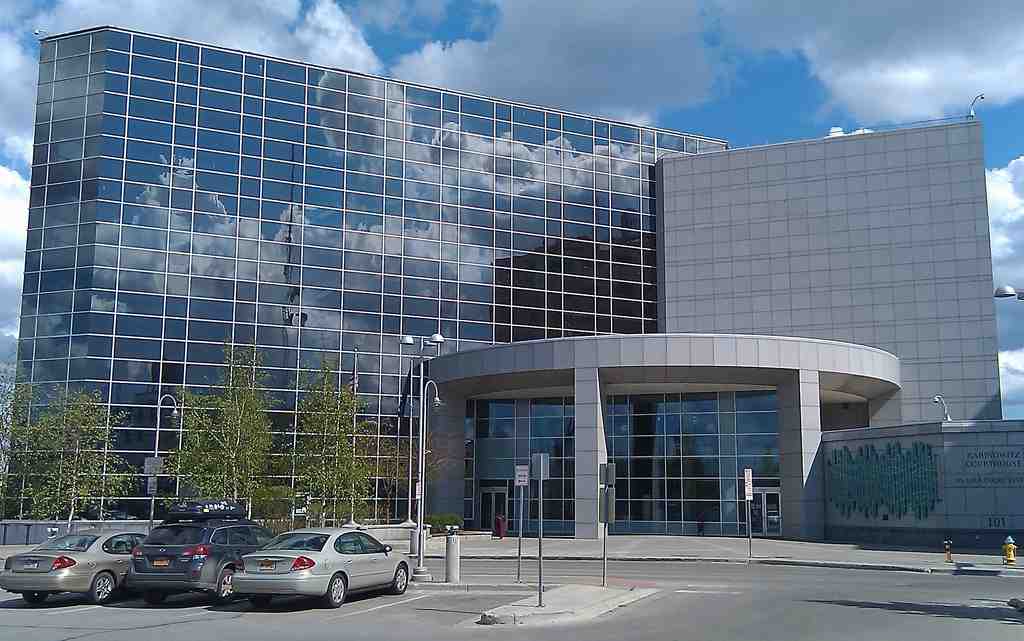
On your left is a pale concrete-and-glass civic block with a broad, low shape and a recessed entrance marked with the Rabinowitz name.
Civic order on frontier ground is never simple. Since the era of James Wickersham, Fairbanks has kept trying to turn a raw northern settlement into a place where law feels steady, public, and durable. This courthouse, beside the Chena River at one hundred one Lacey Street, is the modern expression of that effort.
Architects at Charles Bettisworth and Company worked with McCool Green Architects to complete it in two thousand one, the same year former chief justice Jay Rabinowitz died. That timing made the name feel almost elegiac. Before he became a statewide judicial figure, Rabinowitz served here in Fairbanks, and then spent thirty-two years on Alaska’s highest court. The exterior looks restrained, almost deliberately calm. Inside, though, the state filled it with Alaska art: Teri Rofkar’s Raven’s Tail weavings, Bill Brody’s copper mural, Kes Woodward’s winter scenes, Ron Senungetuk’s Sila, and a portrait of Rabinowitz by Evgeny Baranov.
And here is the turn in the story. Even mature institutions fail in human ways. After eleven years on the job, district accounting supervisor Katherine L. Turner admitted stealing two hundred thirty-seven thousand dollars in bail money; administrators discovered deposits delayed by weeks and months. So this building stands for justice, yes, but also for vigilance.
That tension matters, because people still bring the state’s hardest questions here, from arson victims’ testimony to Supreme Court arguments over ranked-choice voting. Next we turn toward an older kind of civic glue, the Masonic Temple, about seven minutes away. If you return on a weekday, the courthouse is generally open from eight to four-thirty, with Friday hours ending at noon.




