
On your left stood a tall concrete-and-glass slab with a flat roof and a boxy annex at its base, the kind of narrow high-rise that once served as downtown Fairbanks’s unmistakable vertical marker.
The tower itself is gone now, demolished in late twenty twenty-five, but this corner still holds the shape of what Fairbanks once thought its future ought to look like. If the Fairbanks Exploration Company Machine Shop spoke for the muscular confidence of the gold era, the Polaris belonged to a newer force entirely: the Cold War boom. In the early nineteen fifties, federal money poured into Alaska’s defenses, Ladd Field and Eielson Air Force Base expanded, and Fairbanks suddenly needed housing faster than it could build it. So in nineteen fifty-two, the city reached upward. The Polaris opened as an eleven-story apartment building, the tallest thing downtown.
Locals still pass along one detail with a faintly knowing smile. In nineteen fifty-three, E. B. Collins and Charles Clasby opened law offices in the penthouse, advertised with a “breathtaking view of downtown Fairbanks.” That little boast tells you exactly how the building wished to be seen: not merely practical, but sophisticated, elevated, certain of itself.
And for a while, it worked. The building later shifted into hotel life as the Northern Lights Hotel. The upper floors kept trying on glamour: the Petroleum Club, then Tiki Cove, and later the Raven’s Nest all traded on the same promise that height could turn Fairbanks into something grander. But ambition here has never moved in a straight line. By the end of nineteen fifty-seven, the boom had already cooled, and roughly one thousand housing units stood vacant around Fairbanks. The city had built for a surge that did not fully stay.
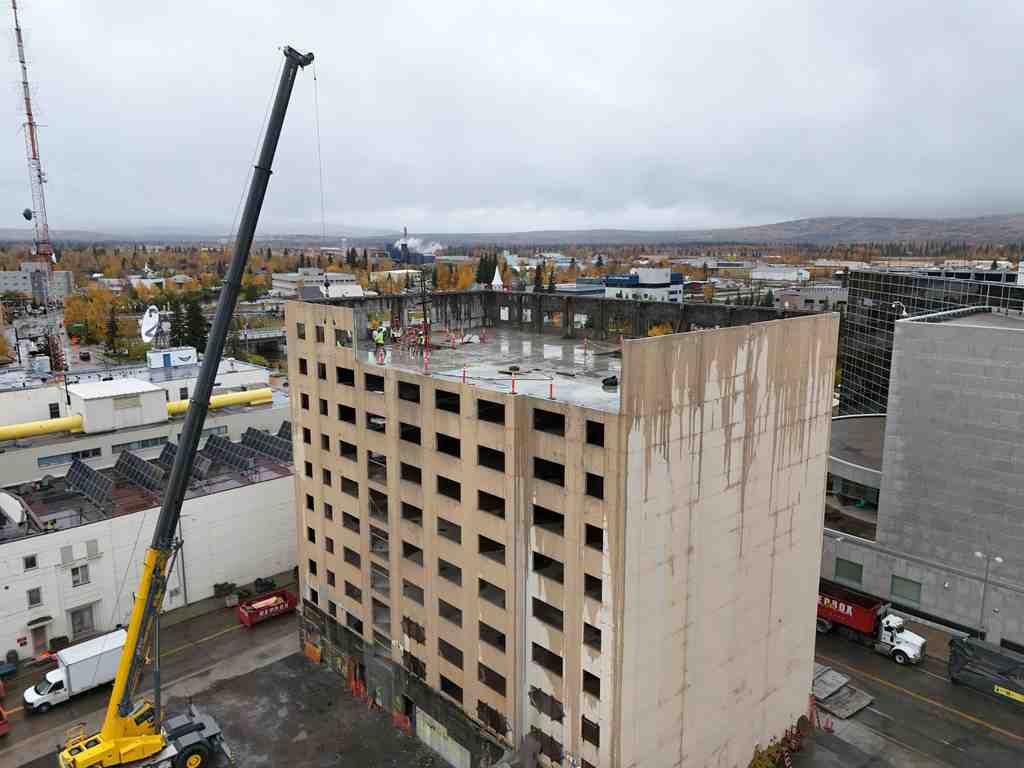
If you look at the photo in the app, you can see the boarded-up tower in twenty twenty-one. It has the look of a ship left in dry dock too long, still upright, but no longer trusted.
Then came the disasters, one sudden and one slow. In nineteen sixty-seven, the great flood forced an evacuation here as downtown filled with water. On Second Avenue, the water reached five feet deep. Decades later, in two thousand and one, eight hundred thousand gallons flooded the basement. By the next year, the building stood abandoned.
People did try to save it. Mike Cusack Junior promised a revival. John Hovenden found the work far more expensive and difficult than expected. Developer Marc Marlow later tried to assemble tax credits and public programs for a mixed-use rebirth, with shops and offices below and apartments above, but the numbers never bent far enough. In twenty eleven, designer Candy Chang even turned the abandoned tower into a public conversation with a giant “Looking For Love Again” banner, asking the city what it wanted this empty giant to become.
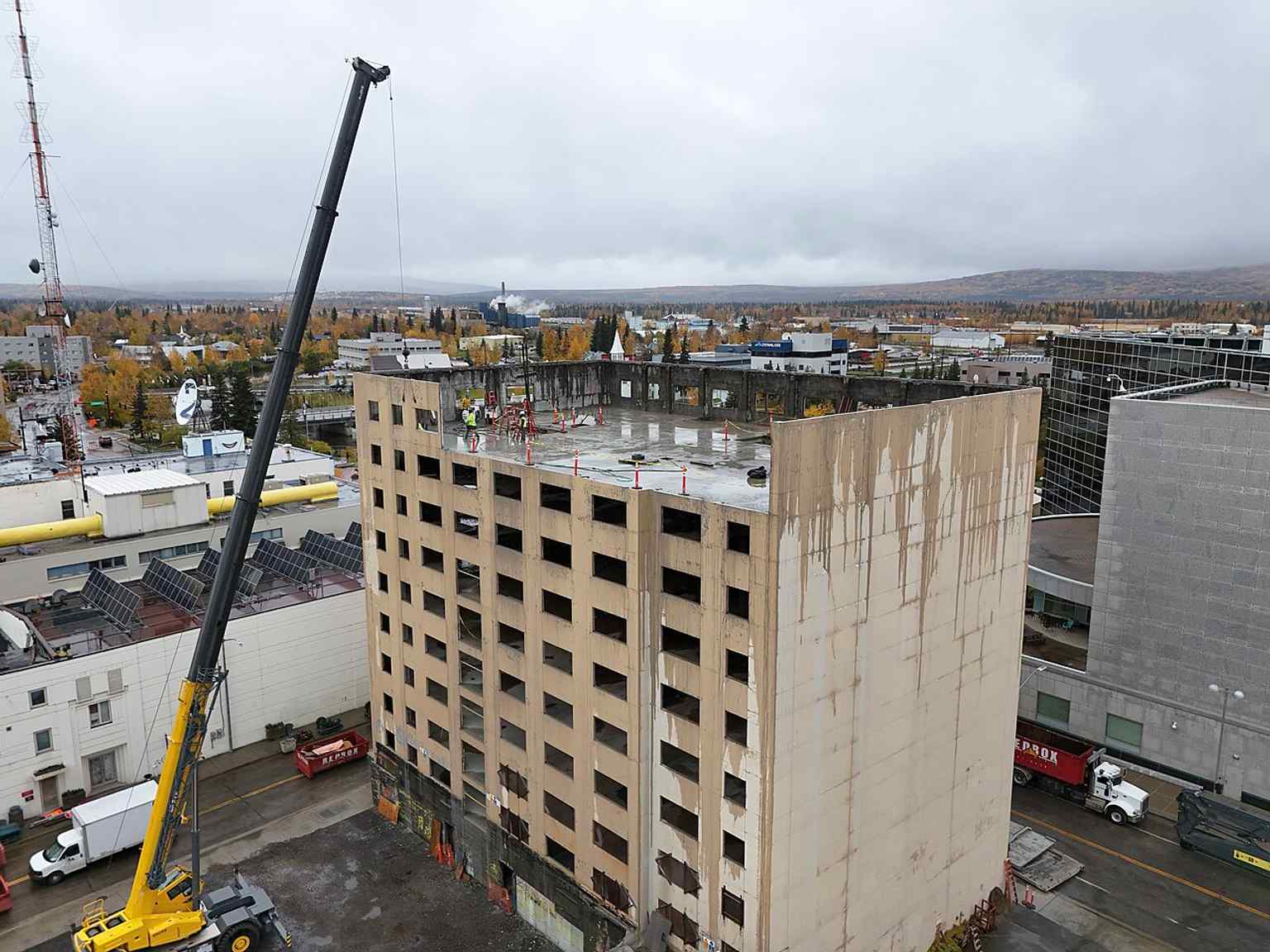
By twenty twelve, officials condemned it. A later assessment found asbestos, mold, mercury, and industrial chemicals called PCBs-persistent toxic compounds-and judged the structure unsafe in an earthquake. So the city took control after foreclosure and brought it down piece by piece. The image on your screen shows that long farewell.
But the clearest picture to carry from this stop is older: a modern tower emptied out while floodwater ran through downtown streets. Keep that in mind as you head to the Old Federal Building, about three minutes away, where Fairbanks placed its faith in something heavier and more permanent. The site remains accessible at any hour.





.jpg)