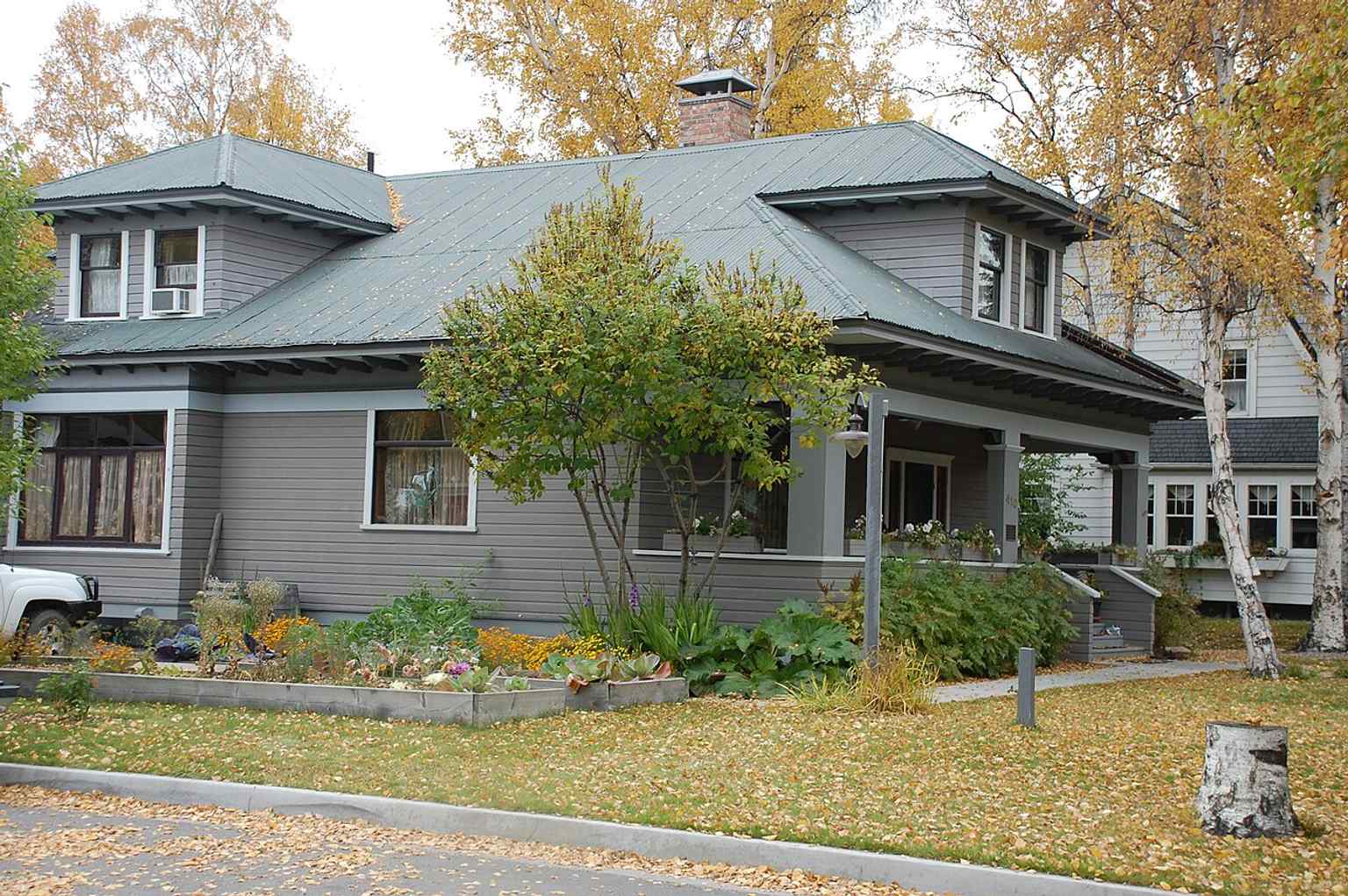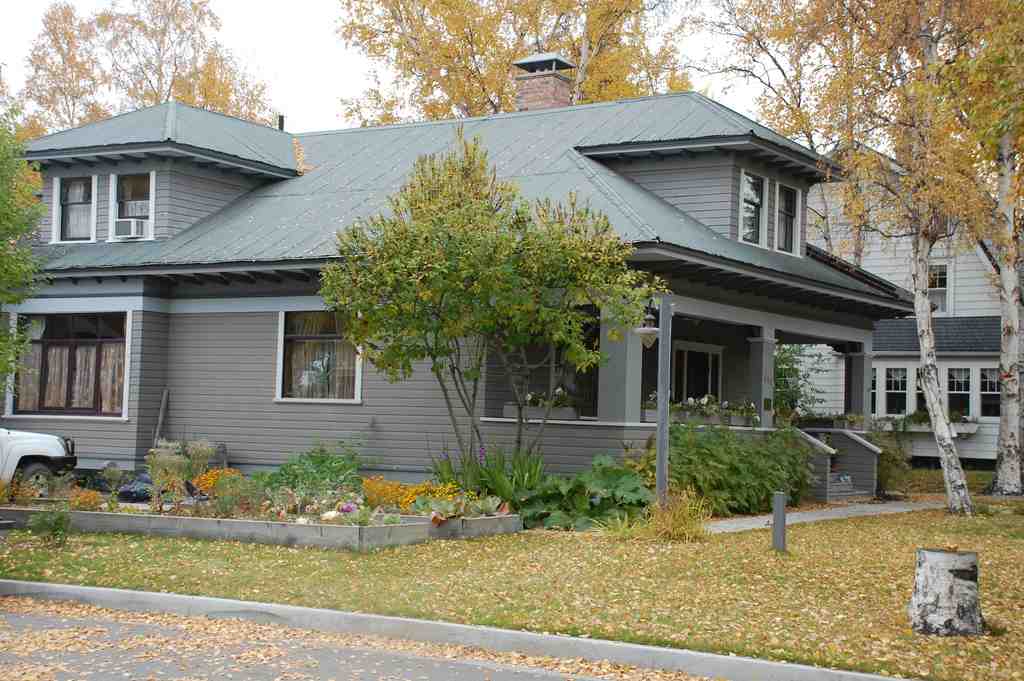
On your right, look for a gray wooden bungalow with a low, broad roofline, a wide front veranda, and the green roof that long gave this house its signature.
This house has the sort of history Fairbanks seems to favour: important, well loved, and just slippery enough to keep people arguing. The plaque says nineteen oh six. The National Register record points instead to an unfinished house, probably completed by nineteen sixteen, after an earlier owner died and the project stalled. So whose version survives in the cityscape: the plaque’s, the gossip’s, or the paper trail? You can see official memory trying to settle the matter with one neat date.
And then there is the romantic version. Local tradition ties this place to Arthur Williams and Lucille McCarthy Williams. Depending on who is telling it, Lucille was either a visiting socialite or a Dawson good-time girl, which meant a woman from the dance-hall world of the northern gold rush. Arthur owned the Arcade Café and, by all accounts, built lavishly for her. Together they became visible figures in town life, backing public education, the Red Cross, street lighting, even a hometown baseball team. Then came a brutal turn. On the fifth of February, nineteen nineteen, fire tore through downtown Fairbanks and destroyed the Arcade Café. Arthur died of heart disease on the ninth of May. Lucille sold the house in June and left by steamship for Seattle in July. After that, the local record more or less lets her drift away.
But the house’s most solid identity, the one that holds when the rumours thin out, is Mary Lee Davis. Mary Lee Cadwell Davis arrived in Fairbanks with her husband, John Allen Davis, on the fifteenth of July, nineteen seventeen. John was a geologist sent to establish a mining experiment station. Mary arrived with rather more than frontier grit: a Wellesley degree, Phi Beta Kappa honours, and a master’s from Radcliffe. Whatever uncertain story came first, Mary and John finished this house and gave it many of the touches people still remember, including Fairbanks’s first residential coal heating system.
Mary did not treat the house as a private retreat. She used it as a base for civic work. During the First World War, she wrote newspaper features about Alaska’s role in the war effort, helped raise money for a bed at the American Hospital in France, and helped form the Alaska chapter of the American Red Cross. Later she helped found the territory’s first library, worked with Saint Matthew’s Episcopal Church, and served as a volunteer night nurse during the great flu pandemic of nineteen twenty.
She also made the place memorable in quieter ways: oak floors, built-in bookshelves, an open-hearth fireplace, indoor plumbing with porcelain fixtures, sawdust insulation, birch trees, and a wide veranda. In her own writing she called it a gray house with a green roof. You can see how that domestic scale still survives, even after all the lives layered onto it.
Later, the Fairbanks Exploration Company used it to house executives and entertain guests. Since then, owner followed owner, and that may be why it still feels alive rather than embalmed. It earned National Register status in nineteen eighty-two, underwent a major restoration in the early two thousands, and now lives on as the Alaska Heritage House, still the city’s oldest occupied residence.
So this corner leaves you with a gentle puzzle: memory here does not stay still, but some lives give it shape. Mary Lee Davis did exactly that.
From this contested house, we go on to a building that carried generations of Fairbanks children and later the city itself: Fairbanks City Hall, about eleven minutes away.