
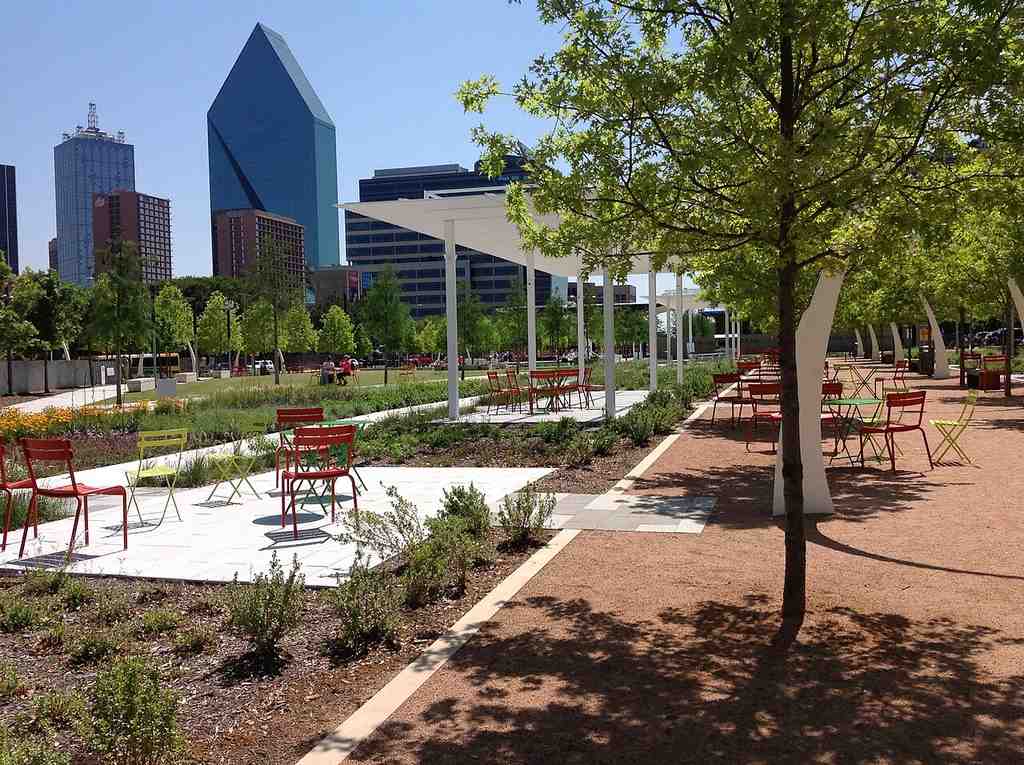
Look for a long green deck with pale concrete edges and straight walking paths, stretched in a broad rectangular band above the recessed Woodall Rodgers Freeway.
This is Klyde Warren Park... five point four acres of lawn, paths, play spaces, and public theater laid right on top of the traffic. Dallas opened it in twenty twelve, but the idea reaches back to the nineteen sixties, when Mayor J. Erik Jonsson pushed the freeway below grade. That left a scar with a lid waiting for it.
The modern campaign took off in two thousand and two, when John Zogg started rallying support. By two thousand and four, Jody Grant, Zogg, and Linda Owen had formed the Woodall Rodgers Park Foundation and turned a nice civic dream into the sort of project that needs donors, engineers, and a heroic tolerance for meetings. Landscape architect James Burnett shaped the park above, while Jacobs Engineering figured out how to hold a real park over a real freeway.
If you glance at your screen, the early image makes the trick plain: this is not a park beside the city, but a park stitching pieces of it together.
Kelcy Warren gave ten million dollars, the largest private gift, and used the naming rights for his nine-year-old son, Klyde. That stirred criticism. Warren reportedly felt stung by the reaction, and there was an odd little clause in the story: young Klyde was reportedly required to help clean up the park once a month. Dallas philanthropy... but with chores.
That tension matters here. This is public space, yes, but a private foundation runs it, programs it, and raises the money for its upkeep and roughly one thousand three hundred events a year. Even its success came with side-eye. Before opening, D Magazine argued the park would not magically fix Dallas. Fair point. No lawn, however stylish, can cure every urban headache.
Still, the place landed with force. More than forty-four thousand people showed up in the first two days. And the park changed the math around it: one analysis later found the city added fifty percent more office space and twice as many multifamily homes in the six years after the park than in the six years before. So yes, it is a civic gesture... and yes, it is also development fuel. Both things can be true, which is annoyingly realistic.
If you look at another photo, you can see how the deck turns a transportation trench into a front porch for downtown.
Standing over a freeway built to hurry people past one another, what kind of city do you think this park is trying to imagine? Maybe that is the final Dallas lesson: not erasing the old divisions underneath, but building across them anyway. The park is generally open from six in the morning to eleven at night. Dallas keeps building bridges, literal and symbolic, across histories it can neither erase nor fully resolve.




