
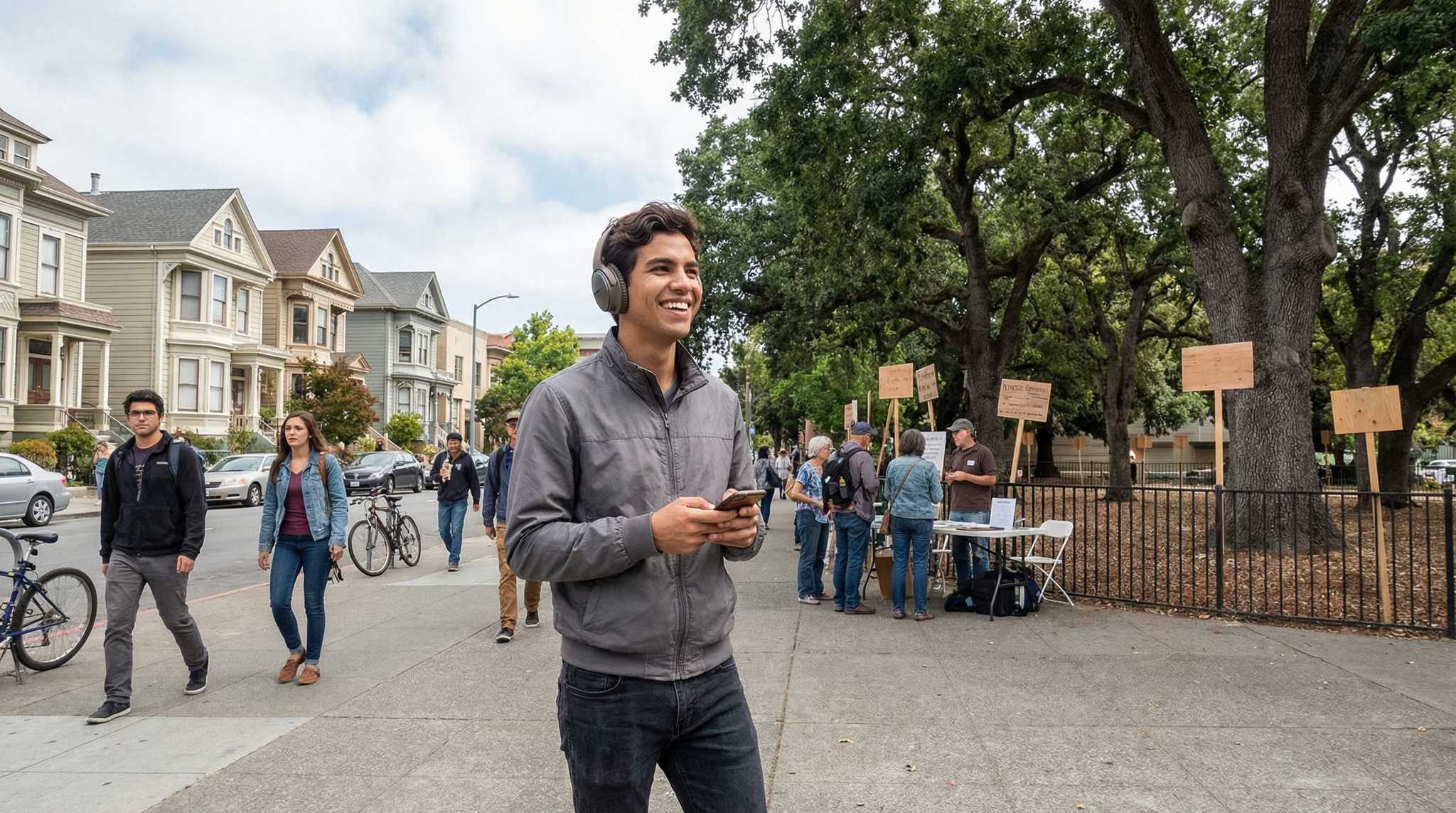
Berkeley Audio Tour: Echoes of Genius and Legends
A stadium erupts. Ancient oaks stand defiant. Tucked between bustling streets, secrets have shaped Berkeley’s soul for generations. This is no ordinary stroll—each stop on this self-guided audio tour unlocks drama and hidden chapters rarely noticed by visitors. Uncover how a college football cathedral sparked more than roaring fans. Trace the roots of a tree-sit protest that rocked a city’s very identity. Step inside a library where priceless manuscripts and whispers of mischief coexist. Did a single act of defiance change laws forever? Who hid forbidden documents beneath the library’s floors? And which anonymous donor paid for an entire forest to vanish overnight? Move through Berkeley’s iconic core surrounded by history, activism, and radical change. Hear echoes of rebellion, passion, and strange alliances as new perspectives reveal themselves at every turn. Ready to chase the heartbeat beneath Berkeley’s surface? Your journey begins now.
Tour preview
About this tour
- scheduleDuration 90–110 minsGo at your own pace
- straighten3.5 km walking routeFollow the guided path
- location_onLocationBerkeley, United States
- wifi_offWorks offlineDownload once, use anywhere
- all_inclusiveLifetime accessReplay anytime, forever
- location_onStarts at Doe Memorial Library
Stops on this tour
lock_open 3 free previews · 11 unlock with purchase
In front of you is a broad pale-stone library in the Neoclassical style, marked by a deep columned entrance, a triangular pediment, and Athena set above the main doorway. Doe…Read moreShow less
Open dedicated page →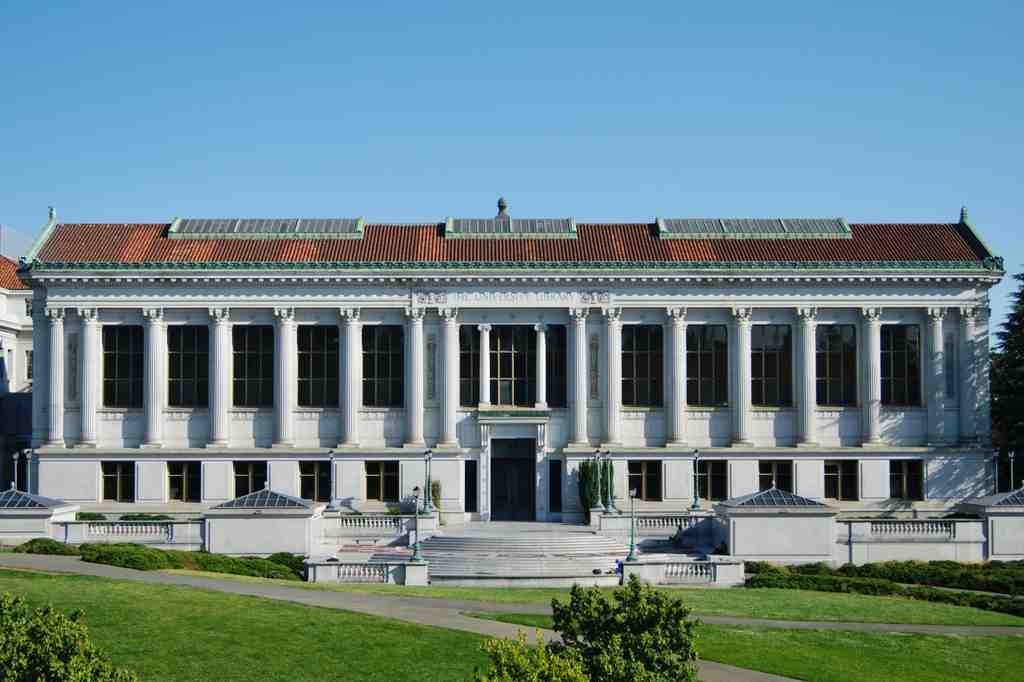
Doe Memorial LibraryPhoto: Louis H. G., Wikimedia Commons, CC BY-SA 4.0. Cropped & resized. In front of you is a broad pale-stone library in the Neoclassical style, marked by a deep columned entrance, a triangular pediment, and Athena set above the main doorway.
Doe Memorial Library opens this tour like a declaration. In nineteen hundred, the French architect Émile Bénard won the design competition, and by nineteen eleven this building stood here near the center of campus, facing Memorial Glade. Four years earlier, Charles Franklin Doe had left the money that made it possible. He did not simply fund a storage place for books... he helped stage a public idea of what Berkeley wanted to be.
That is why Athena matters. She is not just ornament over the door. Berkeley placed the goddess of wisdom there to announce its ambition to become the “Athens of the West,” a young university dressing itself in the language of civilization. If you want a closer look at that symbolic front door, glance at the image on your screen.
Before we go on, lift your eyes to the entrance and sit with that choice for a moment. What kind of campus puts wisdom above the threshold like a challenge?
Libraries are supposed to guard memory, but Doe also projected a future. In nineteen ninety-four, Berkeley dug up the entrance plaza and much of the glade to carve out the underground Gardner Main Stacks beneath your feet: four stories below ground, with fifty-two miles of shelving and four large skylights bringing light down into the earth. The work changed the landscape, stirred arguments over the new forecourt, and even tangled with plans for a memorial grove. Here, preserving the past has never meant standing still.
And then there is Mark Twain... or rather, the man many visitors swear is Albert Einstein. Outside this library stands a statue of Samuel Clemens holding Adventures of Huckleberry Finn, and people mistake him for Einstein so often that the confusion has become part of the place. Official meaning says one thing; public legend cheerfully rewrites it.
That Twain connection runs deeper than the statue. In nineteen forty-nine, Twain’s daughter, Clara Clemens Samossoud, gave Berkeley his papers: manuscripts, letters, sketches, notes, the private working life of a writer who became an American myth. So this building became both a temple of study and a storytelling machine, where scholarship keeps feeding folklore.
Most of Doe’s circulating books now sleep underground, while the rooms above serve readers and reference collections. Just next door, physically joined to Doe, Bancroft will take us further into Berkeley’s appetite to gather, sort, and claim the past for itself. Doe is generally closed Monday, and otherwise opens from morning into late evening, with a later start on Sunday.
On your left is a pale stone rectangle with a flat, dignified facade and a recessed entrance marked by the carved Bancroft Library name. This is Berkeley’s vault of memory...…Read moreShow less
Open dedicated page →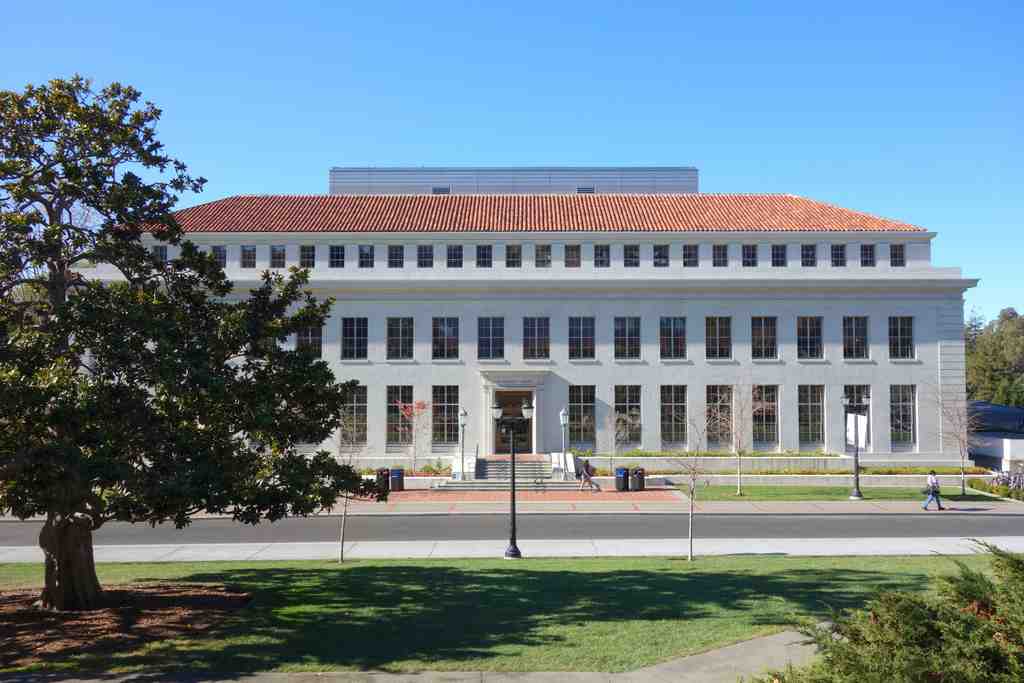
Bancroft LibraryPhoto: Daderot, Wikimedia Commons, CC0. Cropped & resized. On your left is a pale stone rectangle with a flat, dignified facade and a recessed entrance marked by the carved Bancroft Library name.
This is Berkeley’s vault of memory... and it began with a man who could not stop gathering. In eighteen fifty-nine, Hubert Howe Bancroft asked his employee, William H. Knight, to clear the shelves around his desk and pull every book in the store that had anything to do with this part of the world. Knight found only about fifty or seventy-five volumes. That tiny cluster should have been enough for a sensible person. Bancroft was not a sensible collector.
What grew here started as appetite and turned into obsession. When I say archives, I mean the raw materials of history: letters, maps, diaries, government papers, photographs, oral histories, the paper trail people leave behind without knowing posterity may someday lean over it. And this collection did not drift together gently. Bancroft hunted it. He searched bookshops and stalls in San Francisco, Sacramento, Portland, and Victoria, then secondhand stores in New York, Boston, and Philadelphia. When he reached London and Paris, he later admitted his “eyes began to open.” One thousand volumes became five thousand, then far more, until agents were buying for him across Europe and the Americas, and whole libraries were swallowed into the collection.
There is a slightly feverish quality to that story, isn’t there? Bancroft wanted nothing lost because it was expensive, distant, or inconvenient. By eighteen sixty-nine, he had about sixteen thousand volumes and pamphlets. Later estimates placed the collection at forty to sixty thousand items. Most tourists never hear the detail that really drove him: fear of fire. He worried constantly that one blaze could erase everything. That fear pushed him to move the collection in eighteen eighty-one into a fireproof building on Valencia Street in San Francisco. If you look at the old photograph on your phone, you can see the place that soothed his nerves for a while: sturdy, practical, built less for beauty than survival.
That fear turned out to be tragically justified. After the nineteen oh six earthquake and fires, many Spanish and Mexican government records for California disappeared. Some survive only because Bancroft and his researchers had copied them word for word, or at least captured notes before the originals vanished. So this library does more than preserve history. Sometimes it becomes the only reason history still exists.
The University of California bought the collection in nineteen oh five for two hundred fifty thousand dollars, roughly eight million dollars today, and Bancroft himself donated one hundred thousand of that price. Berkeley was still shaping its own stature then, and this purchase helped declare that scholarship here would not be decorative. It would be deep, primary, hard won.
That spirit never really left. Herbert E. Bolton, the founding director, turned Bancroft into a major research center. Decades later, Charles Reichmann found an eighteen seventy-seven speech here that helped force Berkeley to confront the racist legacy behind the Boalt name. This place keeps pulling forgotten things back into the light.
If you glance at the bookplate image in the app, that Tibetan label hints at how the collections later widened far beyond the old western obsession. Still, the heart of Bancroft remains the same: Berkeley does not simply store the past here. It goes after it.
When you’re ready, continue toward Sather Tower, about a two-minute walk away. If you want to come back inside later, the library is generally open Monday through Friday from ten thirty in the morning to four thirty in the afternoon.
On your left, look for a tall pale granite shaft rising to a square belfry, with clock faces on all four sides near the top. This is Sather Tower, though almost everyone calls…Read moreShow less
Open dedicated page →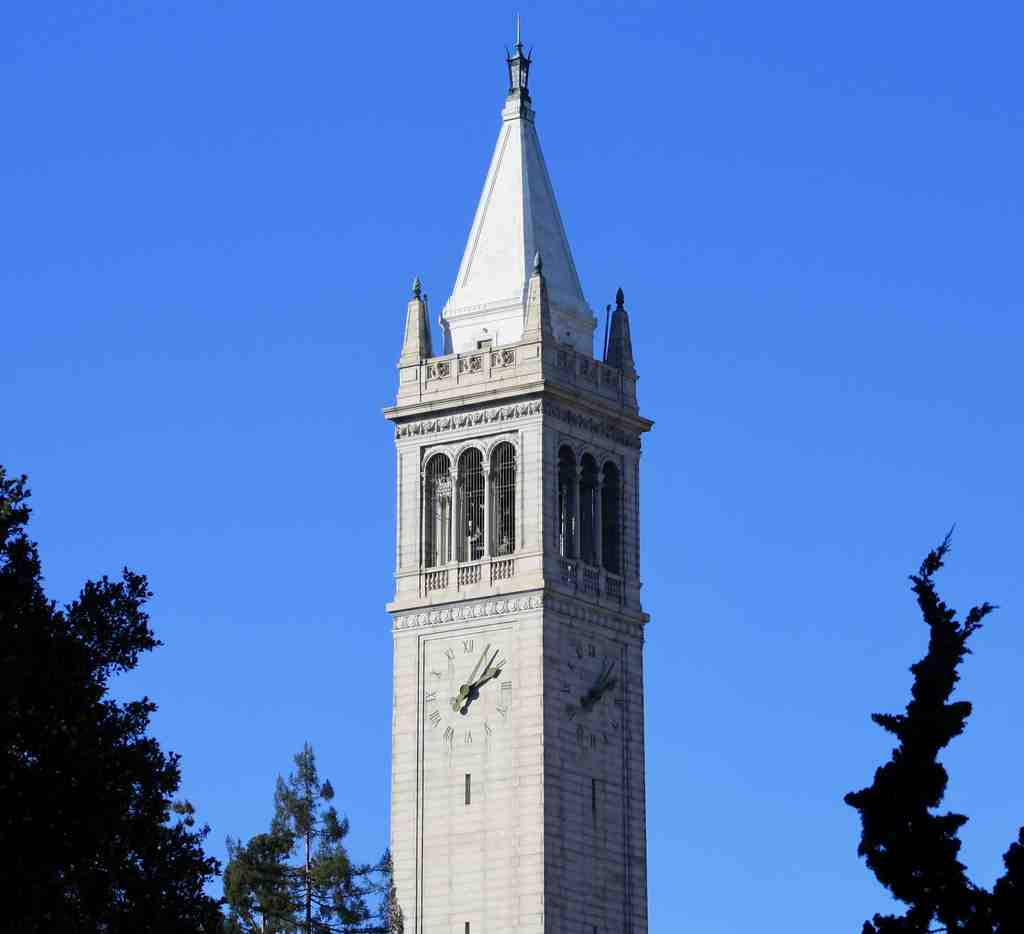
Sather TowerPhoto: Ryan Schwark, Wikimedia Commons, CC0. Cropped & resized. On your left, look for a tall pale granite shaft rising to a square belfry, with clock faces on all four sides near the top.
This is Sather Tower, though almost everyone calls it the Campanile... Berkeley’s own version of a Venetian bell tower. Jane K. Sather gave it to the university in memory of her husband, Peder Sather, and she gave the first bells too, turning private grief into a public landmark. John Galen Howard designed it after the famous campanile in Venice collapsed in nineteen oh-two. He loved its beauty, but he did not trust romance alone, so he chose a granite skin over a steel frame, something that could look graceful and still stand firm.
At three hundred seven feet, it became one of the university’s great claims to stature, and one of the tallest freestanding bell-and-clock towers in the world. Howard placed it so it could organize the campus almost like a compass point. If you glance at the image in the app, you can see how early he imagined that role in his planning sketch. Even before it fully opened in nineteen sixteen, the tower already carried a sense of ceremony. In January of nineteen fourteen, when the steel frame reached the future observation deck, President Benjamin Ide Wheeler celebrated with an open-air banquet up in the air... a construction milestone turned into campus theater.
But here is Berkeley’s sly little secret. This grand symbol of prestige also became a storage vault.
Berkeley has a habit of hiding astonishing collections inside ordinary-looking places. The libraries gather manuscripts and letters; this tower gathered bones. Tilt your gaze up the height of it for a moment and imagine its layers... clocks, bells, views, and inside, sealed away, the remains of vanished animals.
In nineteen thirteen, paleontologist John C. Merriam moved about twenty tons of La Brea fossil material into the unfinished Campanile from a basement in California Hall. He chose the tower for a practical reason: it stood closer to Bacon Hall, where paleontology worked. The cool, dry interior protected the specimens, so inside this ceremonial shaft sat saber-toothed cats, horses, camels, ground sloths, and birds pulled from the tar pits. That hidden scientific cargo still gives the tower one of the strangest jobs on campus.
And above those fossils, the bells kept building a different kind of memory. Jane Sather’s original twelve bells finally arrived after delays from World War One and U-S customs in San Francisco, and they first rang out on the third of November, nineteen seventeen, for the Big Game against Washington. Over time, Berkeley enlarged the instrument into the sixty-one-bell carillon you know now. If you look at the bell chamber image on your screen, you can glimpse that upper world where sound lives. One of the people who gave that sound its human heart was Margaret Murdock, who began playing in nineteen twenty-three and stayed with the bells for six decades, doing the kind of devoted, often unseen work universities depend on.
So from out here, the Campanile looks simple: stone, height, authority. But Berkeley’s monuments rarely stay that simple for long. In about five minutes, we’ll head toward the oak grove, where living landscape-not just buildings-became the center of a fierce argument about what a university should protect.
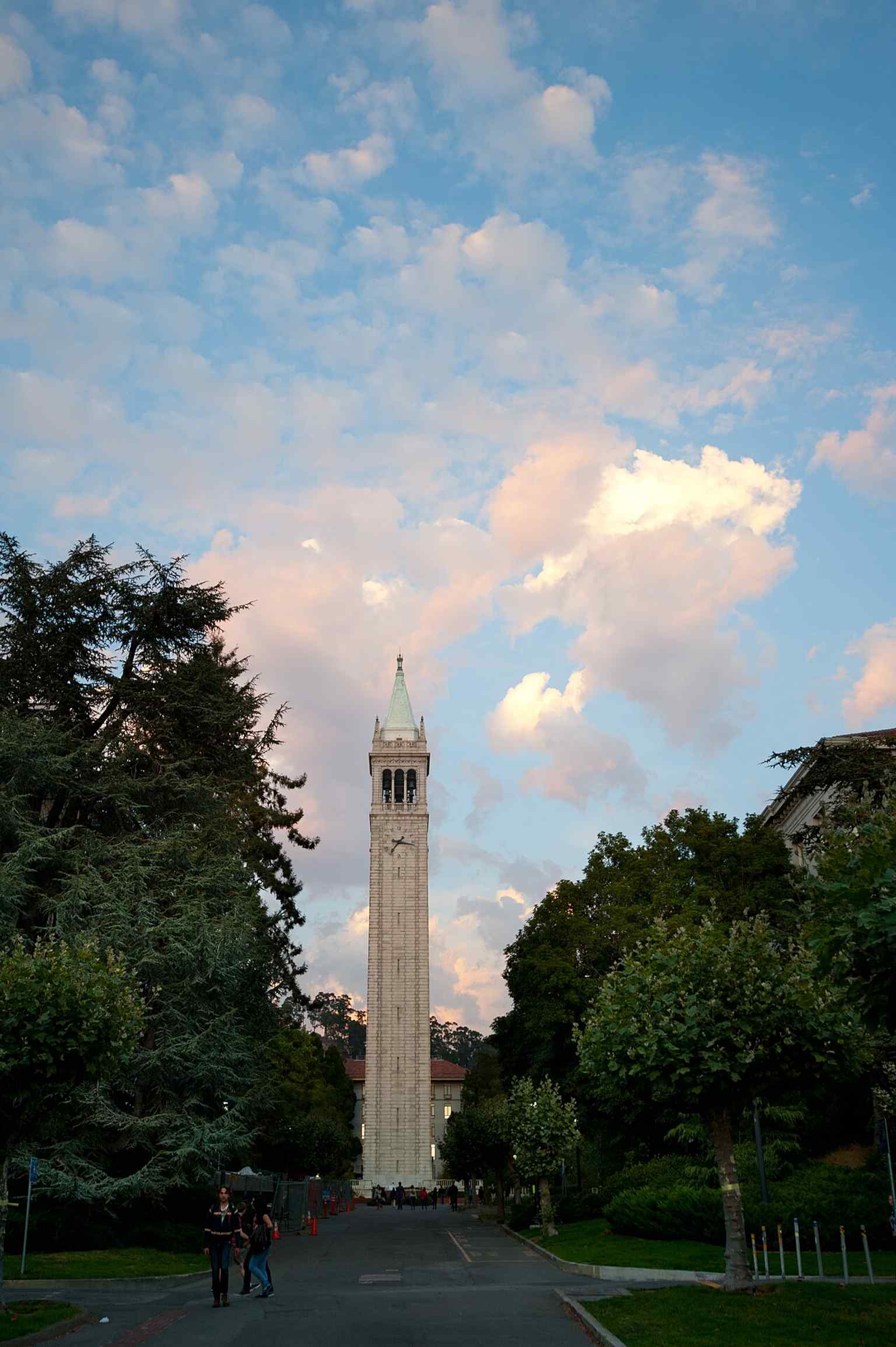
A strong full-height view of Sather Tower, the 307-foot Campanile that became Berkeley’s signature landmark.Photo: Almonroth, Wikimedia Commons, CC BY-SA 3.0. Cropped & resized. 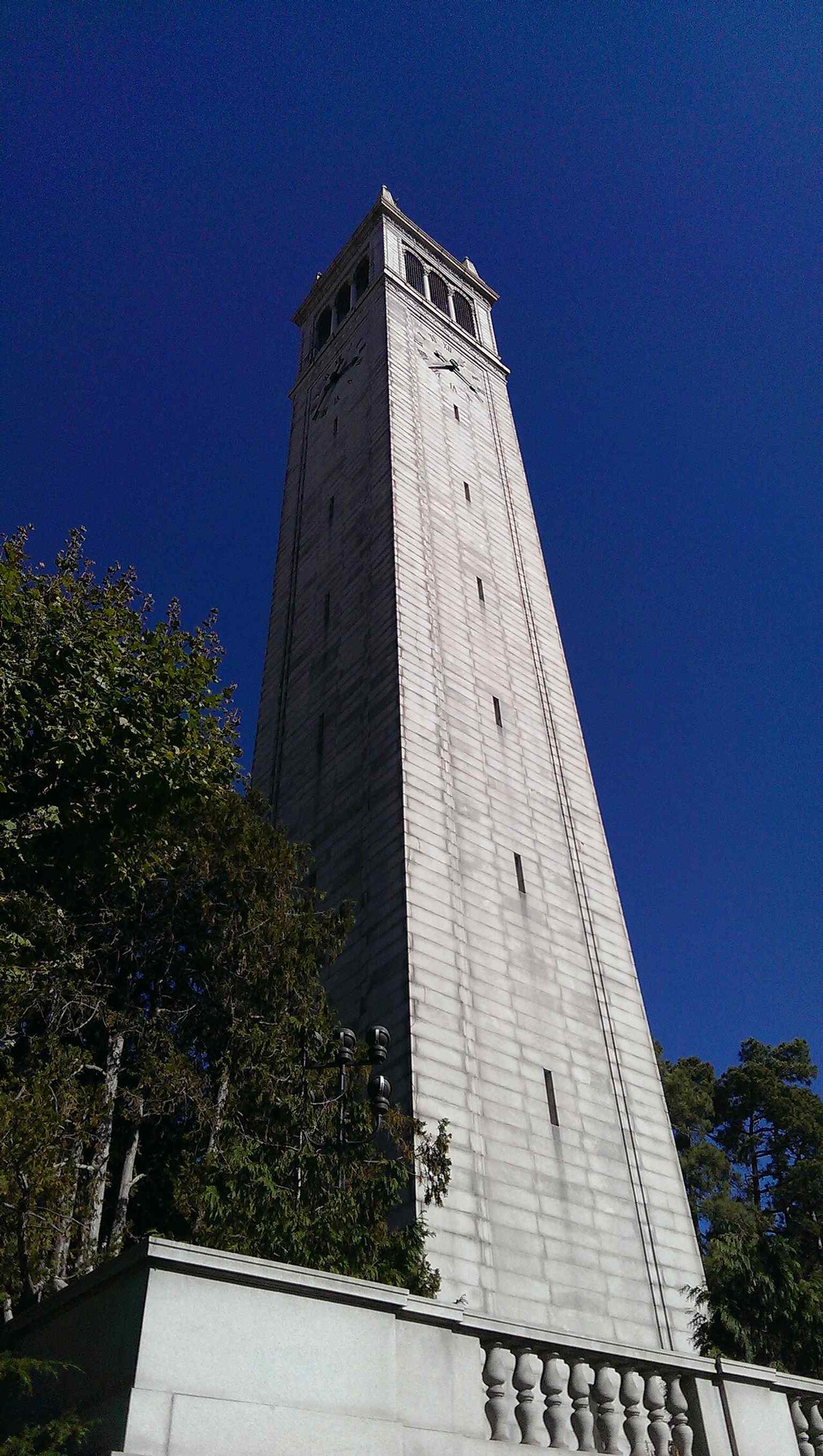
A close view of the tower’s stonework and clocks, highlighting the four-faced bell-and-clock design that made it a campus icon.Photo: EricDLee, Wikimedia Commons, CC BY-SA 3.0. Cropped & resized. 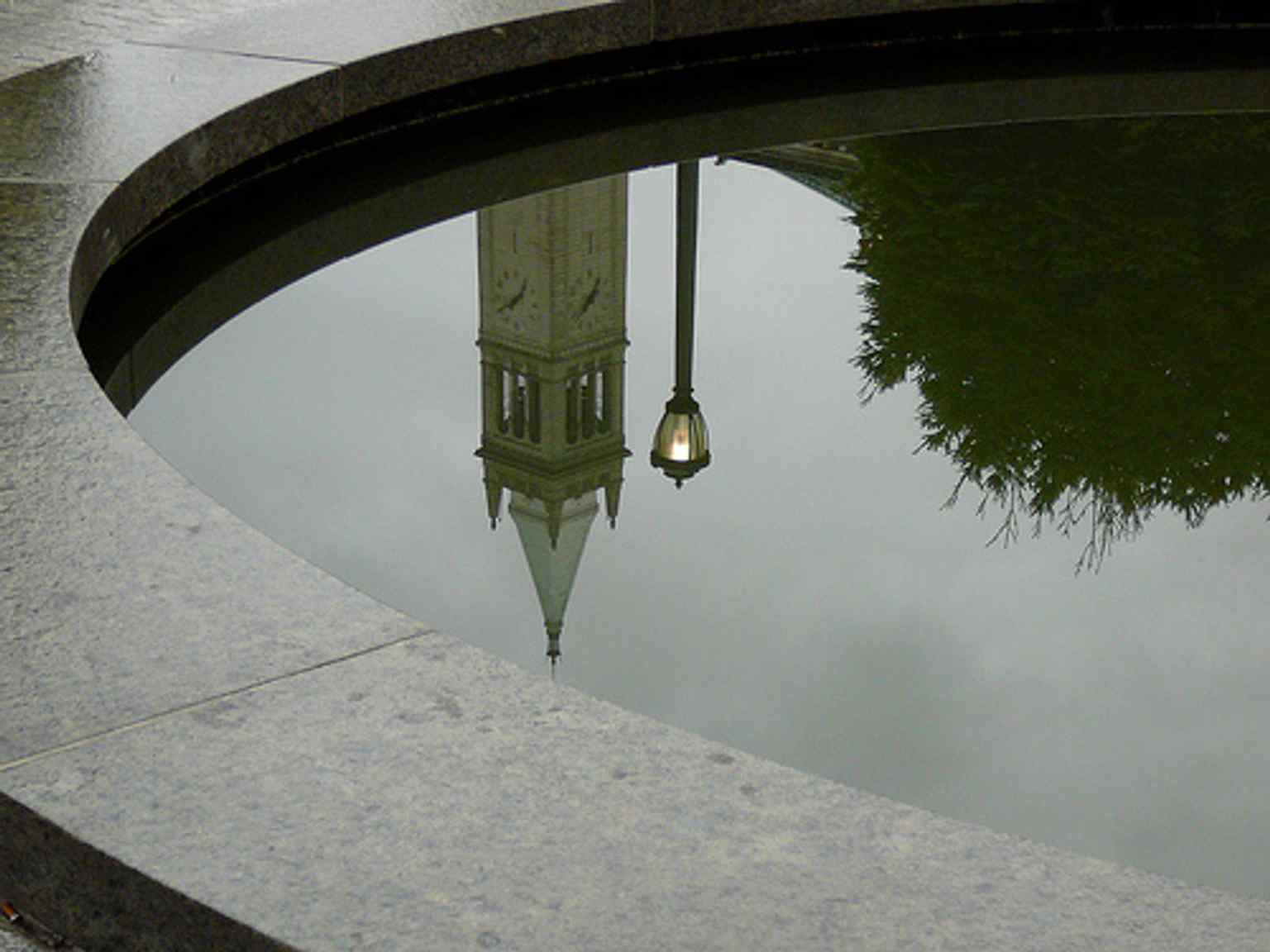
The Campanile mirrored in still water, a nice visual nod to the Venetian inspiration behind John Galen Howard’s design.Photo: Rose Vekony, Wikimedia Commons, CC BY-SA 3.0. Cropped & resized. 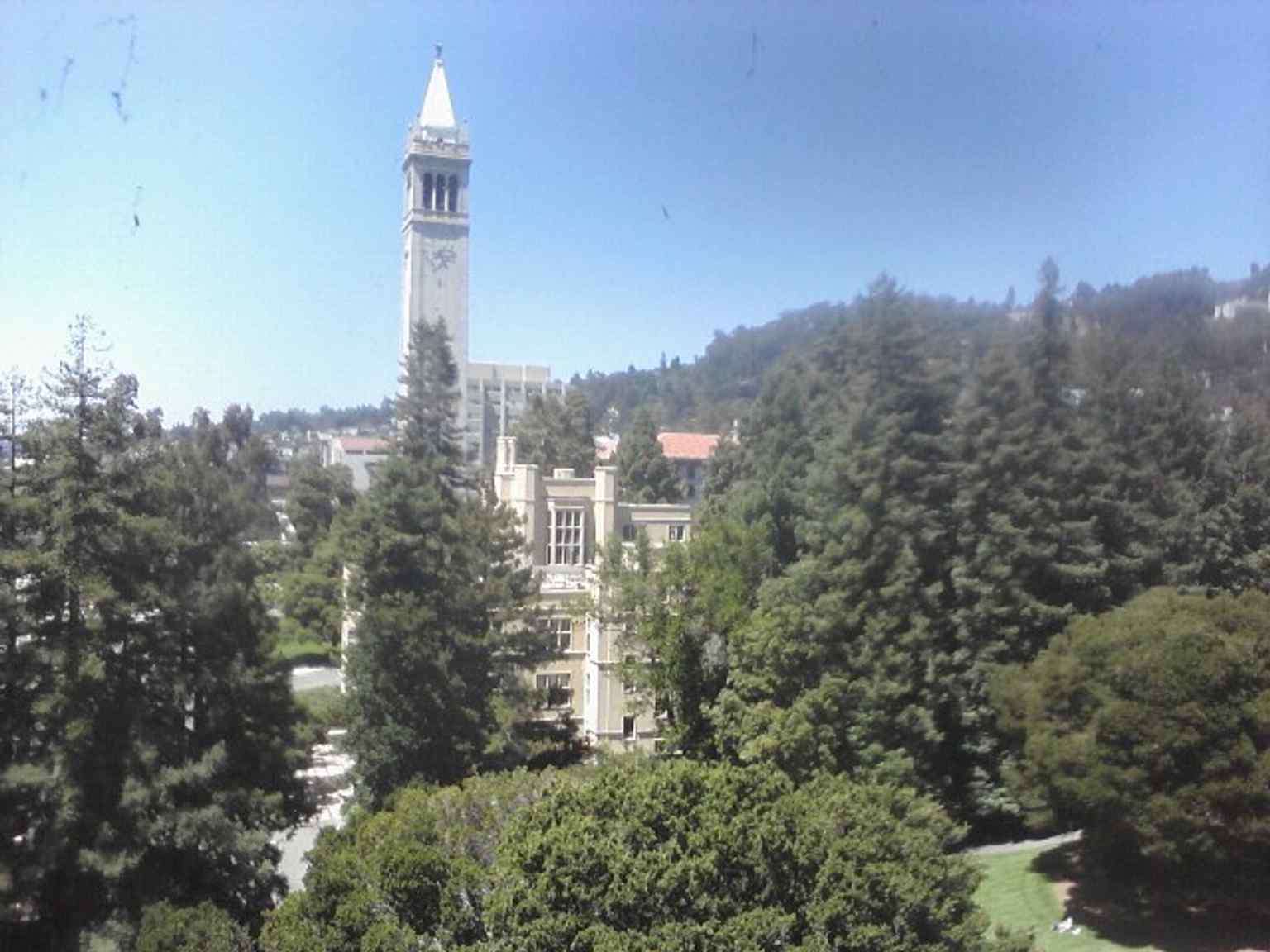
An earlier photo of the Campanile, useful for showing how long Sather Tower has stood as Berkeley’s recognizable symbol.Photo: Pollito310, Wikimedia Commons, CC BY-SA 3.0. Cropped & resized. 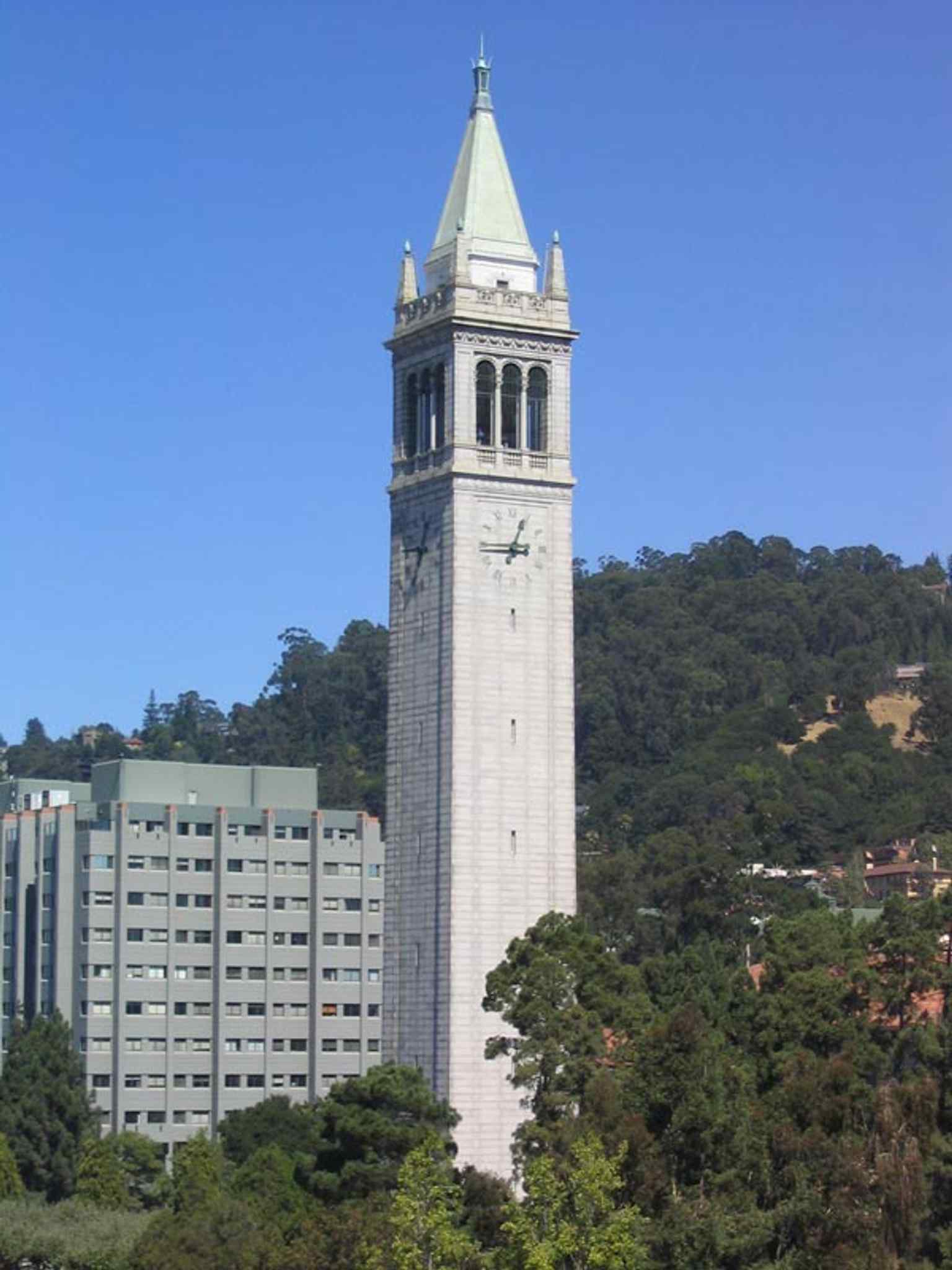
A classic campus view from 2003, with Evans Hall behind the Campanile and the tower anchoring Berkeley’s skyline.Photo: The original uploader was Minesweeper at English Wikipedia., Wikimedia Commons, CC BY-SA 3.0. Cropped & resized. 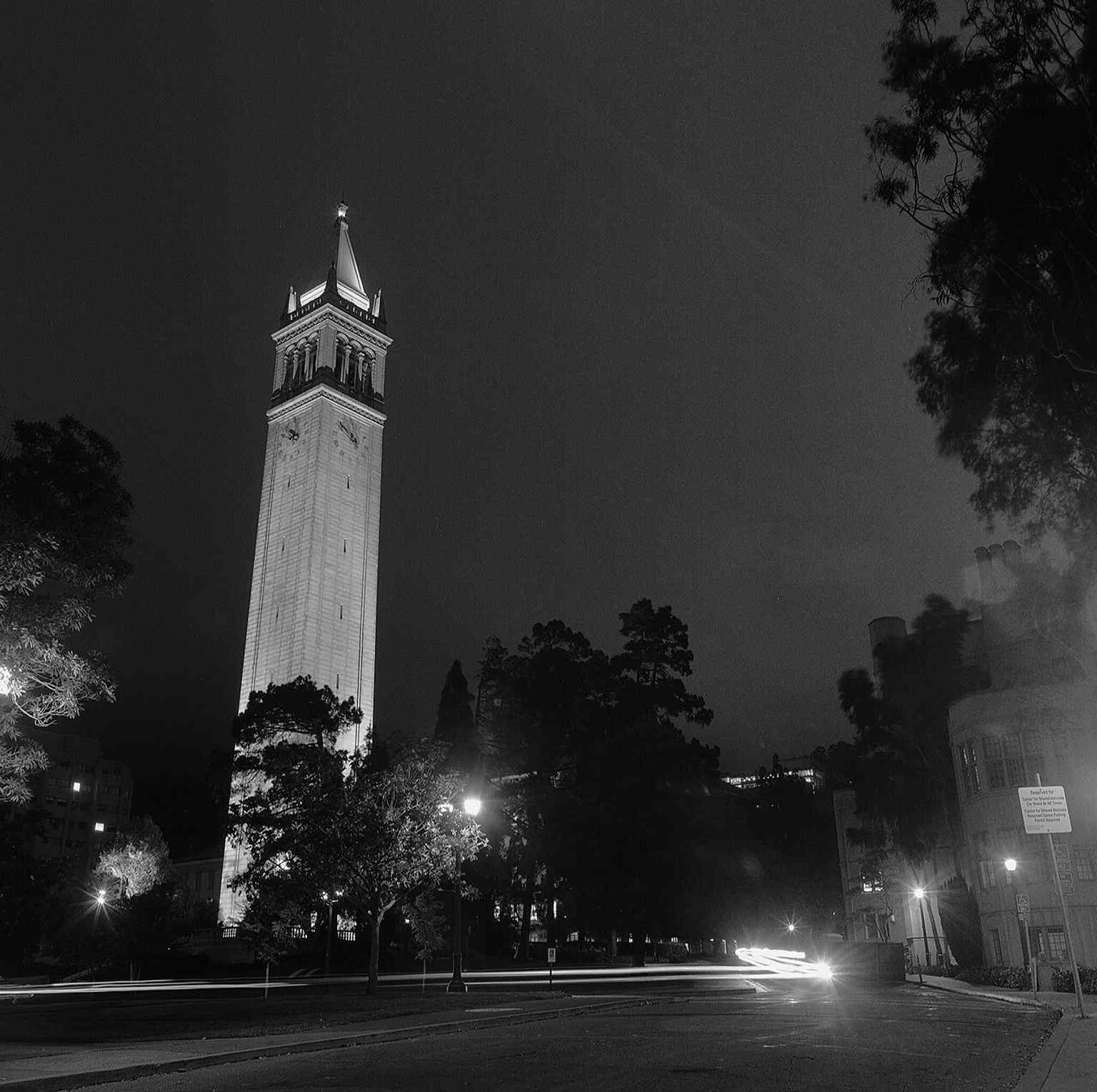
Sather Tower at night, when the illuminated bell tower stands out as one of Berkeley’s most familiar silhouettes.Photo: Kylejglenn, Wikimedia Commons, CC BY-SA 3.0. Cropped & resized.
Show 11 more stopsShow fewer stopsexpand_moreexpand_less
On your right, Gilman Hall is a pale stone, rectangular Beaux-Arts building with tall vertical windows and a formal central entrance framed by classical detailing. It has the…Read moreShow less
Open dedicated page →On your right, Gilman Hall is a pale stone, rectangular Beaux-Arts building with tall vertical windows and a formal central entrance framed by classical detailing.
It has the look of order... the kind of place that promises clean logic and careful thought. And for a while, that was the dream here. John Galen Howard designed Gilman Hall in the nineteen teens for Berkeley’s growing College of Chemistry, and Gilbert N. Lewis pushed hard to make it real after years of squeezing chemistry into a temporary wooden building. Lewis wanted a serious laboratory, a place where physical chemistry, inorganic chemistry, and later nuclear chemistry could grow up together.
He tied so much of himself to this building that, for part of his Berkeley life, he actually kept a tiny bedroom and shower up in the attic here during the week. His family lived farther out in the country, and only after the university objected did he move to the nearby Faculty Club. That little detail changes the feeling of the place, doesn’t it? Gilman Hall was not just where Lewis worked. It held the shape of his days.
If you glance at the image on your screen, you can see how formal the front still feels, almost calm enough to hide what happened inside.
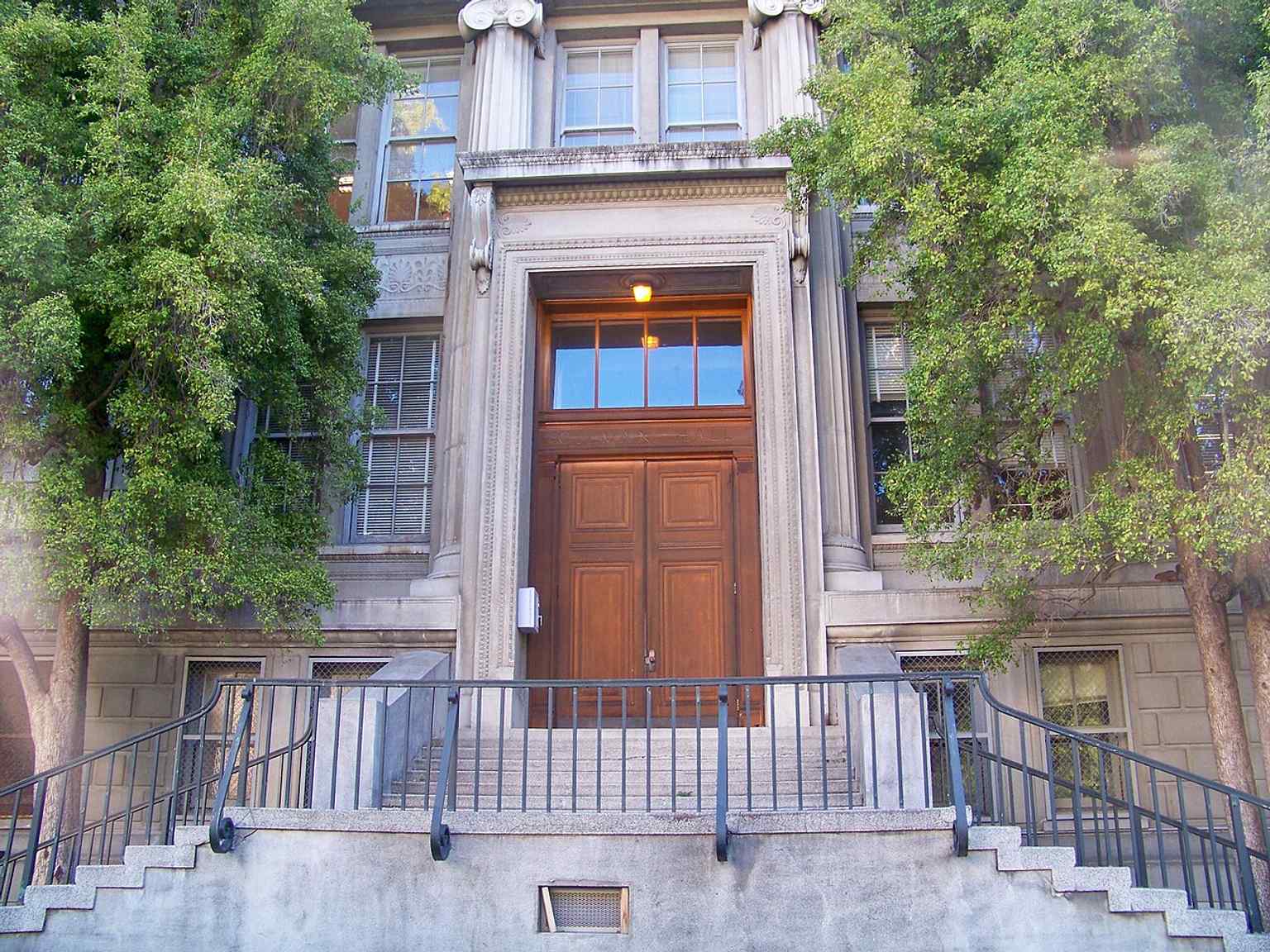
Gilman Hall’s Beaux-Arts front entrance at UC Berkeley, the building where Room 307 became famous for the 1941 plutonium discovery.Photo: Coro (talk), Wikimedia Commons, CC BY-SA 3.0. Cropped & resized. In the basement, Berkeley chemists installed a liquid hydrogen facility in nineteen twenty-one, reportedly one of the first in the United States. That let researchers study matter near absolute zero, meaning temperatures as close as possible to the coldest limit physics allows. William Giauque did prizewinning work from that foundation and later earned the Nobel Prize in Chemistry in nineteen forty-nine.
But Gilman Hall did not stay only a temple to elegant research. Plutonium’s identification in Room three oh seven happened here on the twenty-third of February, nineteen forty-one, when Glenn Seaborg and his coworkers confirmed a new element after a maddening sequence in which the tiny sample seemed to appear, disappear, and reappear. That ordinary lab room became a doorway into the atomic age.
Most tourists never realize that the top floor of this building turned into a fenced-off classified zone during the Second World War. The attic rooms, where chemistry students once trained, became restricted wartime space. Half the rooms had little balconies that served as outdoor fume hoods, and because the old hoods worked more like chimneys than machines, workers finally installed electric fans to pull dangerous gases away. Young Berkeley Ph.D.s like John Gofman, Robert Connick, and Leo Brewer carried out secret nuclear chemistry here under intense pressure, in the same building where they had only recently been students.
That is the hard knot at the center of Gilman Hall. It produced two Nobel Prizes in Chemistry, including Seaborg’s in nineteen fifty-one for transuranium elements, yet the same brilliance fed the Manhattan Project. Admiration belongs here... and so does unease.
Lewis’s own story ended inside this building in nineteen forty-six, when he died in his laboratory during a fluorescence experiment, a study of how substances glow under energy. So Gilman Hall became memorial, workplace, warning, and monument all at once.
If you look at the plaque in the app, notice how a whole moral earthquake gets pinned to one modest room number.
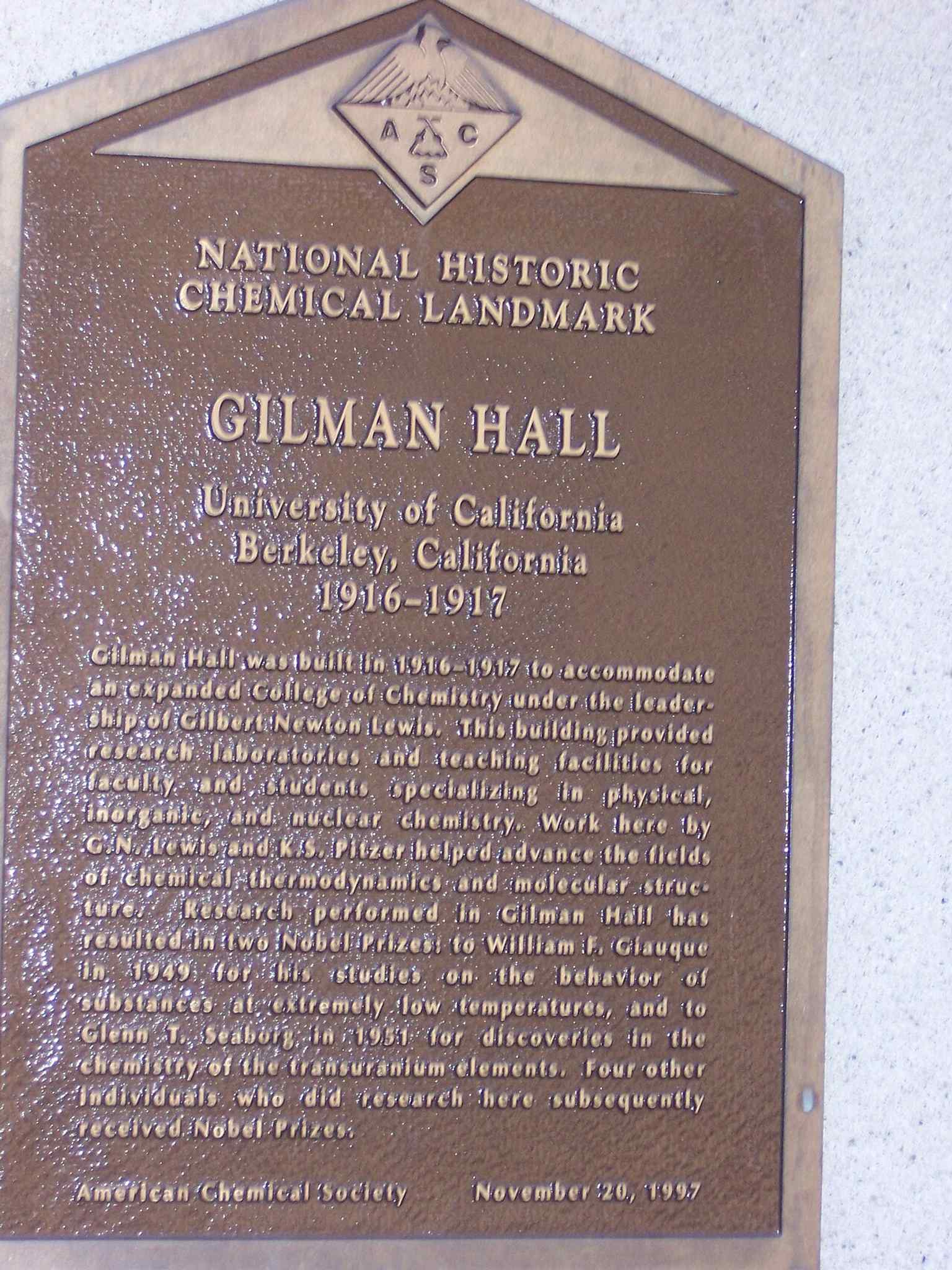
The historic plaque for Gilman Hall, marking Room 307 as the site tied to Berkeley’s plutonium breakthrough and Nobel Prize chemistry.Photo: Www78, Wikimedia Commons, CC BY-SA 3.0. Cropped & resized. And that is what lingers here: Room three oh seven... a badge of honor, and a warning. When you’re ready, we’ll head on in about three minutes to the Hearst Memorial Mining Building.
On your right, the Hearst Memorial Mining Building stands out in pale stone with a steep red-tiled roof, a tall central entry block, and heavy timber brackets held by carved…Read moreShow less
Open dedicated page →On your right, the Hearst Memorial Mining Building stands out in pale stone with a steep red-tiled roof, a tall central entry block, and heavy timber brackets held by carved granite figures.
This building began as a memorial, but it also became a test of how far Berkeley would go to keep its past alive. Phoebe Apperson Hearst gave the money in the early nineteen hundreds to honor her husband, George Hearst, a miner who had turned hard rock into a fortune. She wanted something grand, and architect John Galen Howard gave her Berkeley’s first building from his campus plan. If you glance at the plan on your screen, you can see how early this place sat in his larger vision for the university.
Howard did not work alone. Julia Morgan, still early in her career, helped draw the elevations and decorative details, and Samuel B. Christy, the mining dean, helped shape what a mining school should feel like. Howard thought a mining building should not look delicate. He said mining wrestles with the body and bone of the earth, so this place needed strength more than grace. That is why you see a bluff, muscular face here... tiled roof above, classical ornament, and those granite figures supporting the brackets like the building is flexing.
And yet the most astonishing chapter came much later.
After the Loma Prieta earthquake in nineteen eighty-nine, engineers found dangerous weaknesses in the old unreinforced masonry - brick and stone walls without internal steel strength. The university did not choose a light repair. It chose surgery. Workers lifted the whole building onto temporary supports - hundreds of wooden beams - while crews dug beneath it and built a seismic isolation system, a kind of protective platform that lets the structure slide during an earthquake instead of tearing itself apart. When the work finished, this landmark could move about twenty-eight inches sideways in any direction and still stand.
If that sounds absurd, it almost was. The project dragged through change orders and construction battles. But in January of two thousand two, Chancellor Robert Berdahl ceremonially released the last of the seven hundred support beams, and the rescue became public theater as well as engineering triumph.
So here is the question this building asks so quietly: when you save a landmark by lifting it, hollowing beneath it, and giving it a hidden modern skeleton... how much of the old place are you keeping, and how much are you remaking?
Maybe that is Berkeley’s habit. What starts as a mining memorial becomes a home for materials science - biomaterials, semiconductors, structural materials - new matter inside an old shell. If you want a face for the man behind the memorial, take a look at George Hearst on your screen.
Survival, sometimes, looks harsher than ruin. In about two minutes, we’ll continue to the Transportation Library, where another kind of knowledge found its own unlikely home.
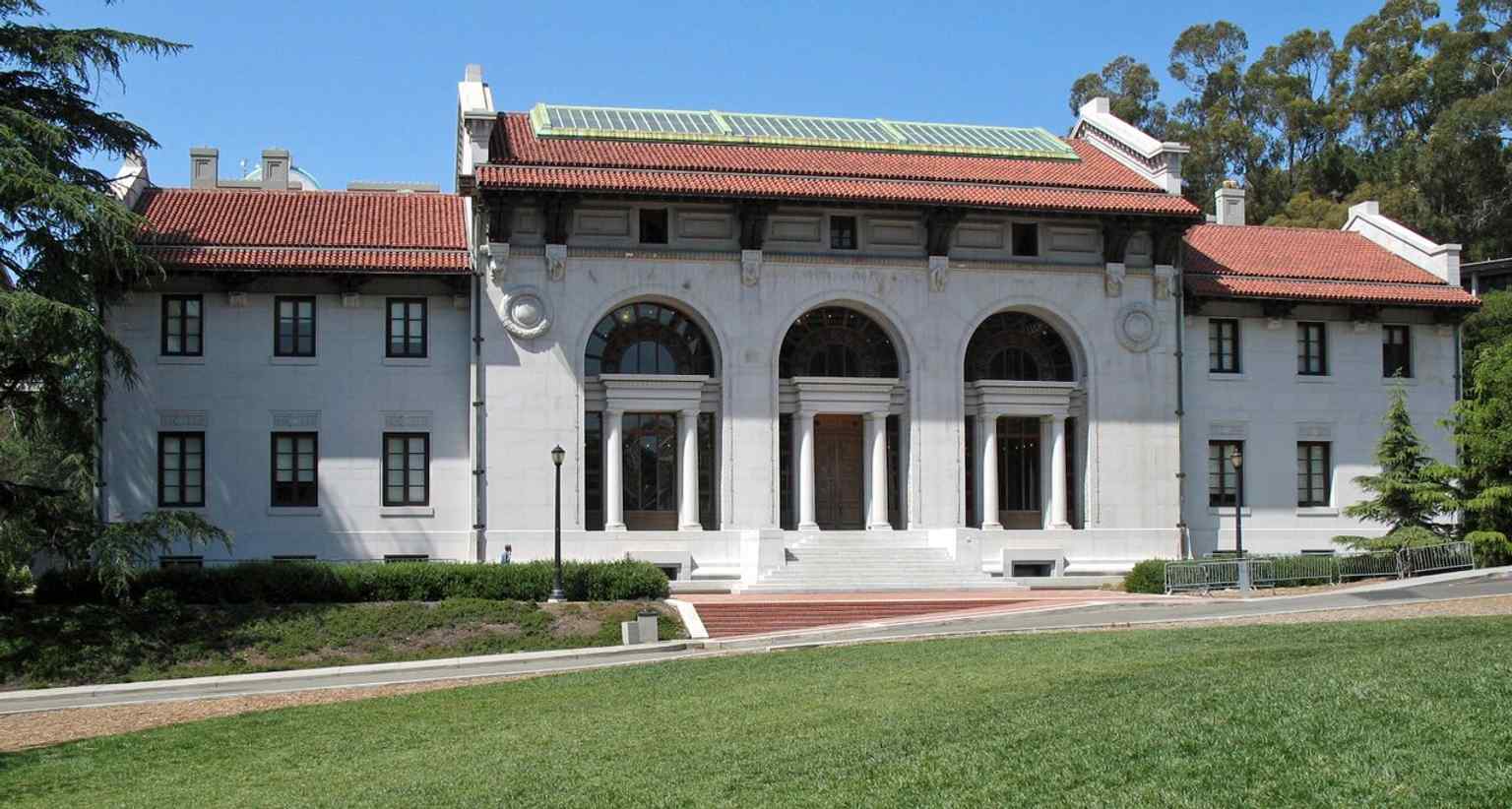
Seen from the south, this angle shows the building’s classic massing and the steep roofline that define Howard’s Beaux-Arts design.Photo: Sanfranman59, Wikimedia Commons, CC BY-SA 3.0. Cropped & resized. On your right is a broad, wood-shingled building with steep gables, stacked bay windows, and a recessed entry that still reads like an old hotel. Cloyne began in nineteen…Read moreShow less
Open dedicated page →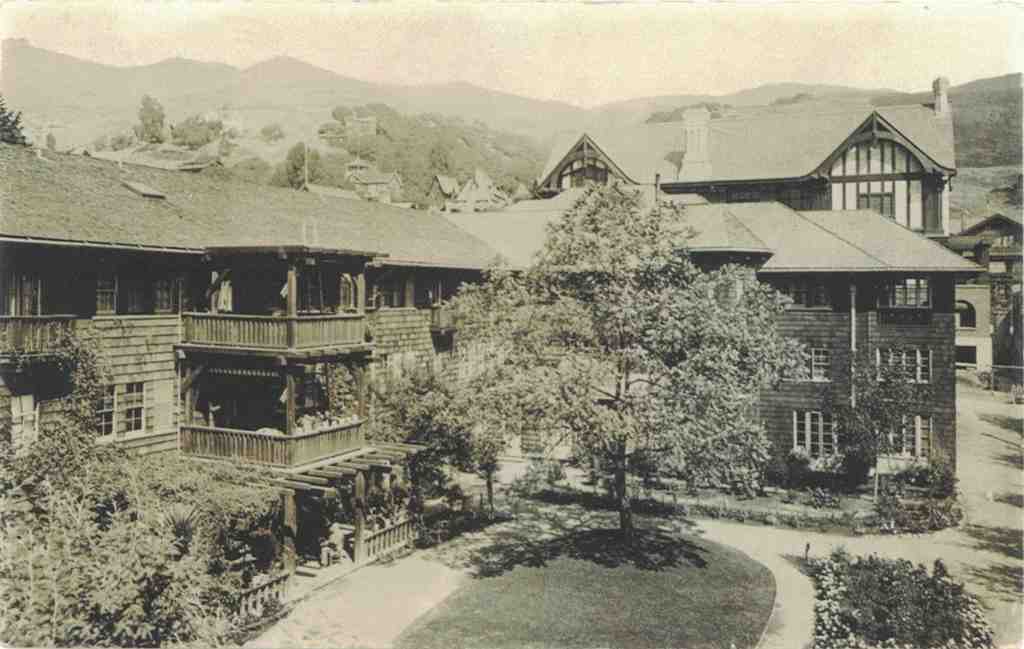
Cloyne Court HotelPhoto: Burl Willes editor, Wikimedia Commons, Public domain. Cropped & resized. On your right is a broad, wood-shingled building with steep gables, stacked bay windows, and a recessed entry that still reads like an old hotel.
Cloyne began in nineteen oh-four, when John Galen Howard - the architect who gave the university so much of its public face - designed a luxury residence for visiting scholars. It cost eighty thousand dollars, roughly three million today, and you can feel him trying out a Berkeley style here. Locals love this detail: Cloyne was Howard’s first large-scale shingled building in Berkeley, and the only Howard-designed residence listed individually on the National Register of Historic Places.
Its name reaches back to Cloyne in Ireland, where George Berkeley once served as bishop. But the daily life here soon became less formal than the name suggests. The original hotel held thirty-two suites, each with its own bath and telephone, and instead of long corridors, pairs of suites shared private stairways down to the public rooms. In nineteen eleven, a music room opened opposite the entrance for recitals and lectures.
If you want, take a quick look at the before-and-after image in the app.
What changed most was not the facade, but the people. Cloyne survived the Berkeley fire of nineteen twenty-three, which is remarkable when you remember it is made of redwood with wood-shake siding and roofs. Behind it, a protected courtyard once held poplars, cypress, willows, apple and peach trees, even avocado trees... a little enclosed world.
Then, in nineteen forty-six, the old hotel became part of the Berkeley Student Cooperative - a co-op, meaning the residents run much of it themselves. Berkeley’s identity was shaped not only in libraries and labs, but in places like this, where students cooked communal dinners, cleaned, gardened, and argued through house decisions together on Sundays. Housing became its own kind of education.
But Cloyne also reminds you that reinvention can come with pain. For some alumni, this place meant murals, bonfires, and early shows by bands like Green Day. Then in two thousand ten, resident John Bennett Gibson suffered a reported overdose here, and help came too late. His family sued, and the reckoning changed the house. In two thousand fourteen, Cloyne reopened as a substance-free academic house, with more study rooms, lectures, and a makerspace - a shared room for building and tinkering.
So this building keeps changing its answer to the same question: what is a home for? A scholar’s hotel, a co-op, a party house, a study house... Cloyne has been all of them. And on this campus, that happens more often than you’d think.
When you’re ready, head on to the Hearst Greek Theatre, about a seven-minute walk from here.
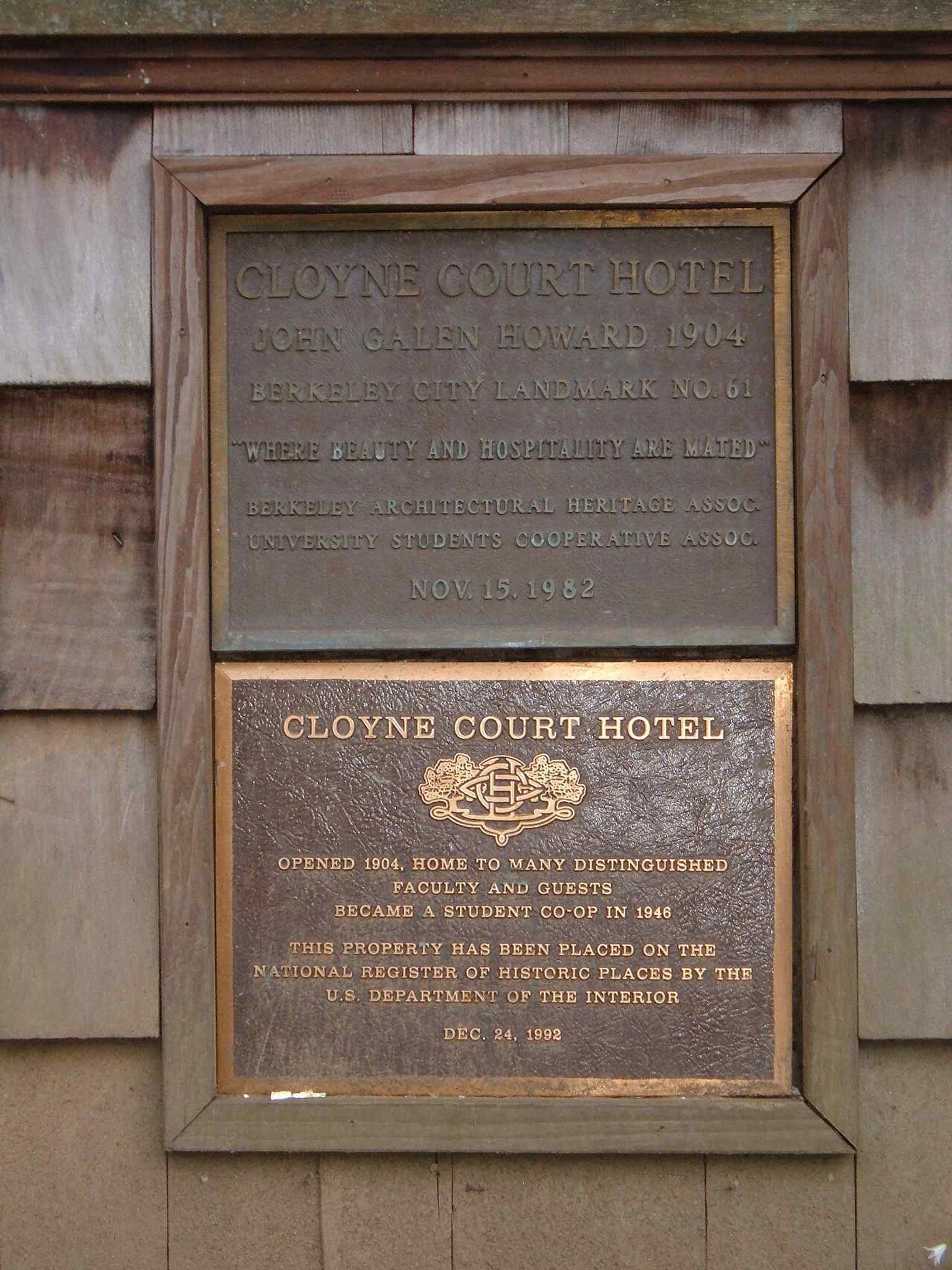
The landmark plaques for Cloyne Court Hotel, which was named a Berkeley landmark in 1982 and listed on the National Register in 1992.Photo: BrokenSphere, Wikimedia Commons, CC BY-SA 3.0. Cropped & resized. On your left, the Greek Theatre opens like a hillside deciding to become a stage. Before the stone, before the columns, before anyone called it monumental, this was simply a rough…Read moreShow less
Open dedicated page →On your left, the Greek Theatre opens like a hillside deciding to become a stage. Before the stone, before the columns, before anyone called it monumental, this was simply a rough bowl in the land... a place people loved to gather. Since eighteen ninety-four, students had already been coming here for the annual Senior Extravaganza, when the site was known as Ben Weed’s Amphitheater. Berkeley did not invent the tradition here. It inherited it, then gave it marble and ceremony.
That matters. So much on this campus began as an argument between use and design, between what people were already doing and what the university wanted to make official. President Benjamin Ide Wheeler saw this natural hollow and pushed hard to turn it into something lasting. William Randolph Hearst paid for it. John Galen Howard drew it as his first university building, a declaration of the campus he imagined. And Julia Morgan assisted on the design so closely that some historians later wondered whether she may have designed the Greek herself. Even here, authorship refuses to sit still.
Howard looked back to Epidaurus in ancient Greece, an open-air theater famous for its perfect bowl and remarkable acoustics. He first imagined something even grander than what you see: caryatids, which are sculpted female figures used as columns, a double colonnade, marble cladding, room for about ten thousand people. Fundraising pulled the dream back to earth. What rose in nineteen oh three was still splendid, but more honest too... Berkeley learning, even early on, that ideals usually arrive through compromise.
If you want, take a quick look at the before-and-after image in the app; the old bare hillside and the later tree-framed theater make that long transformation easy to feel.
The finished place kept the shape of the hill and let architecture catch up to a beloved habit. Nineteen rows of concrete benches sweep down in a semicircle. At the bottom sit twenty-eight carved stone chairs near the stage. Across the front, Doric columns - the plain, sturdy Greek kind - hold a classical façade that feels both formal and surprisingly open, as if the whole structure knows it still belongs to the landscape.
Look at the sketch on your screen if you’d like; Howard’s first drawing shows just how much bigger, and more ornate, he wanted this dream to be.
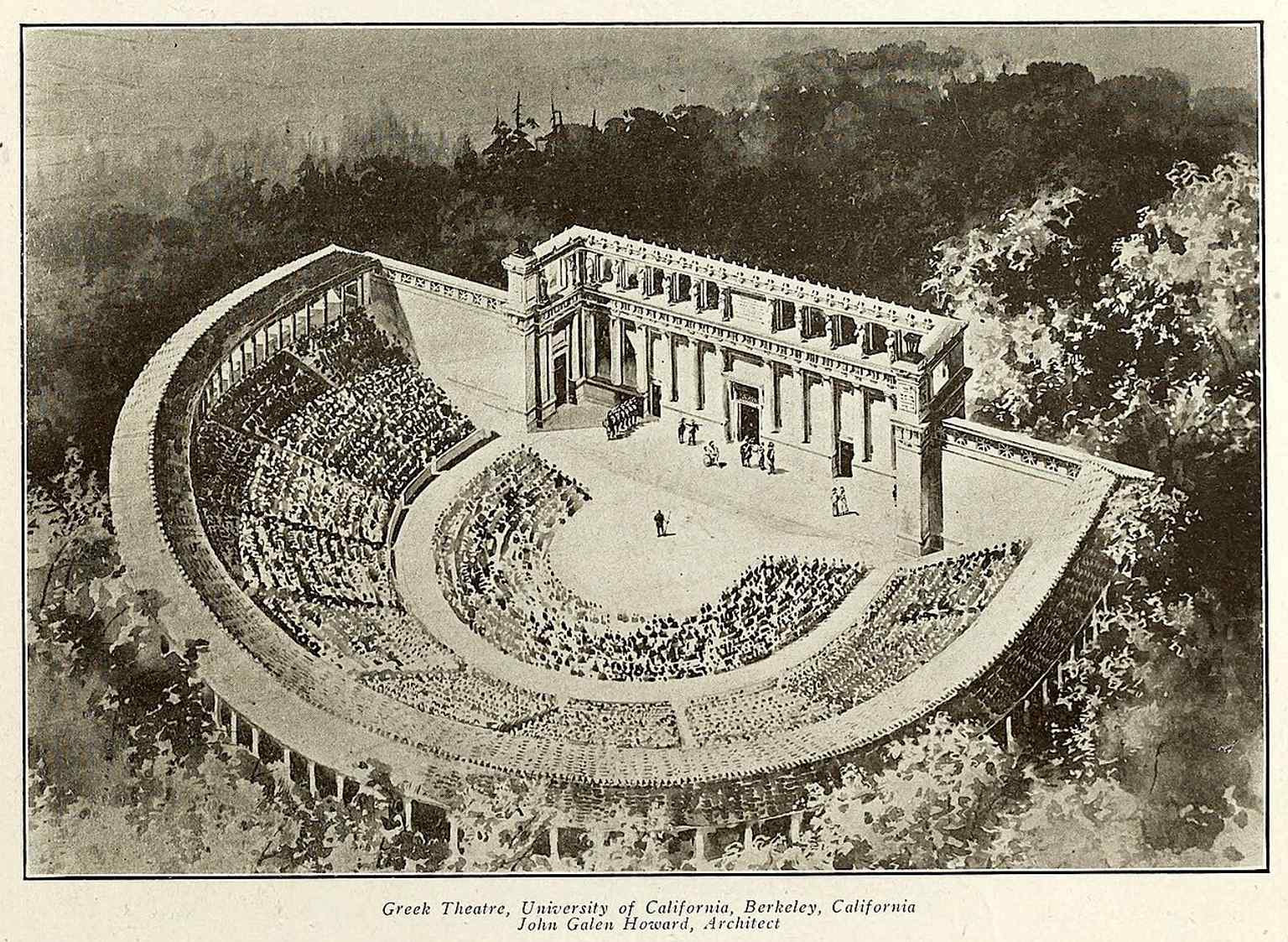
John Galen Howard’s original sketch reveals the grander early vision for the theatre, including the colonnade and formal garden that were later scaled back.Photo: John Galen Howard, Wikimedia Commons, Public domain. Cropped & resized. And then people filled it with their own meanings. Even before construction fully ended, President Theodore Roosevelt came in May of nineteen oh three to address graduates here. The formal opening followed that September with Aristophanes’ The Birds, performed by students. Sarah Bernhardt appeared as Phaedre soon after, proving this was not just a campus stage but an international one. Later came the Grateful Dead, twenty-nine times by nineteen eighty-nine. Mario Savio was dragged off this stage by police during the Free Speech Movement, and the crowd’s outrage helped force the university to loosen its grip on speech. In nineteen eighty-five, Bishop Desmond Tutu spoke here during the anti-apartheid protests, turning performance space into moral pressure.
Even the structure kept changing. A backstage basement arrived in nineteen fifty-seven. Then, in two thousand twelve, engineers hid four reinforced concrete columns inside the original fabric after discovering dangerous seismic weakness. Preservation here never meant freezing anything in place. It meant helping the old bowl keep receiving new voices.
That may be the real Berkeley gift: it knows how to turn a gathering into a spectacle without taking the gathering away. When you’re ready, Bowles Hall is about a four-minute walk from here.
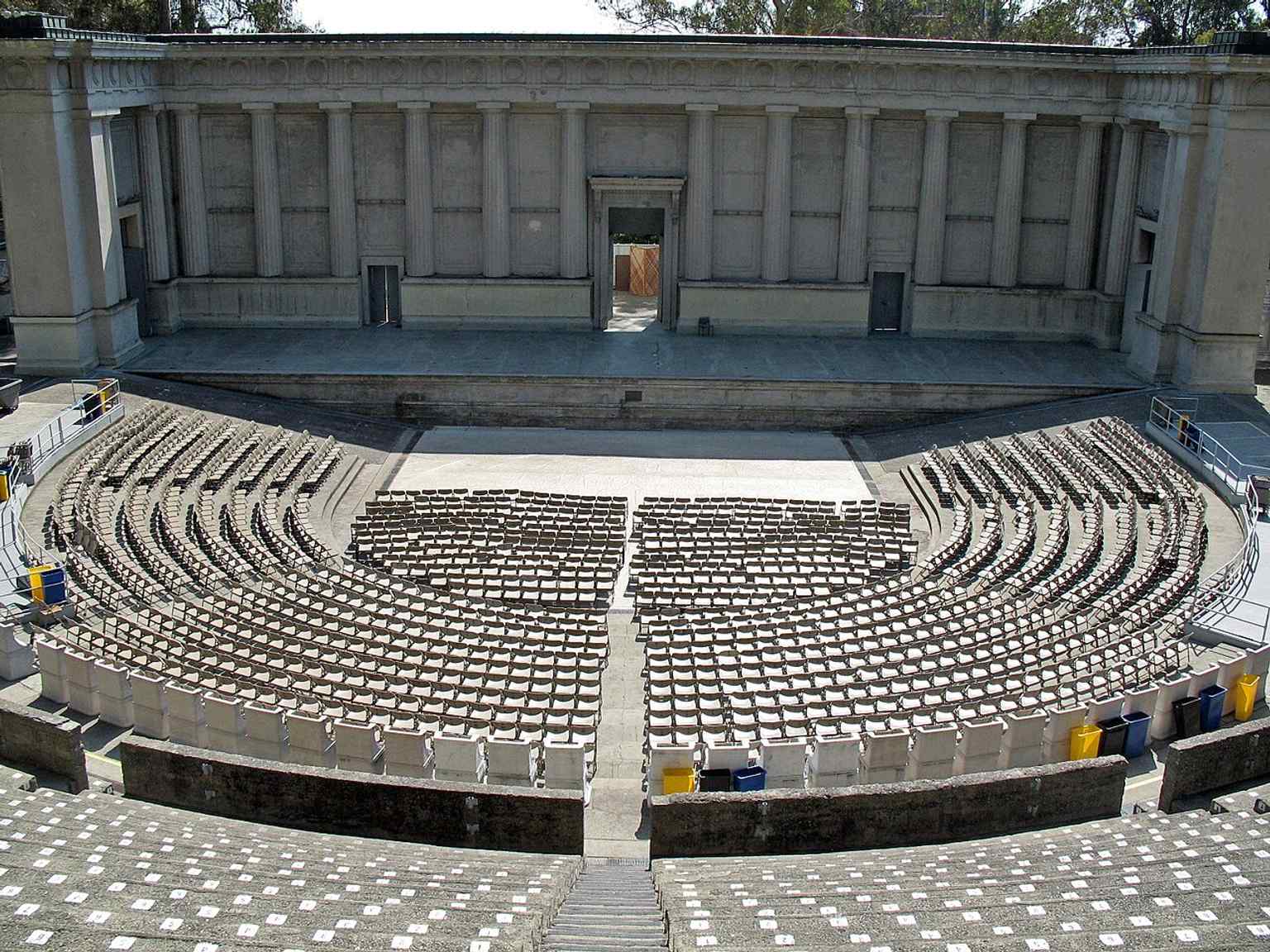
A clean modern view of the open-air Greek Theatre bowl, the 8,500-seat venue that rises from Berkeley’s hillside amphitheater.Photo: Sanfranman59, Wikimedia Commons, CC BY-SA 3.0. Cropped & resized. 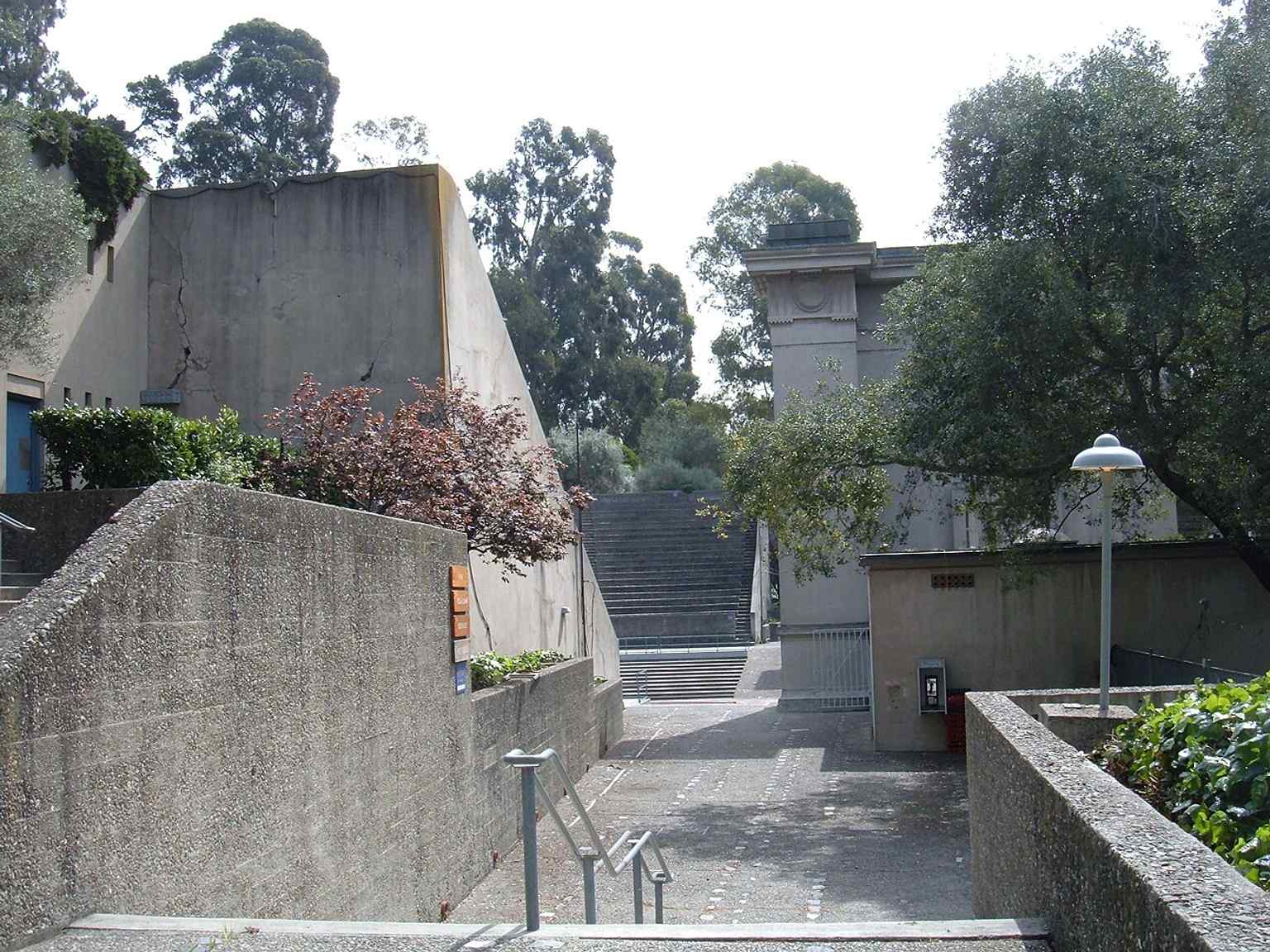
The west entrance and classical façade show the Doric-columned stage side of the theatre, built to echo an ancient Greek amphitheater.Photo: BrokenSphere, Wikimedia Commons, CC BY-SA 3.0. Cropped & resized. 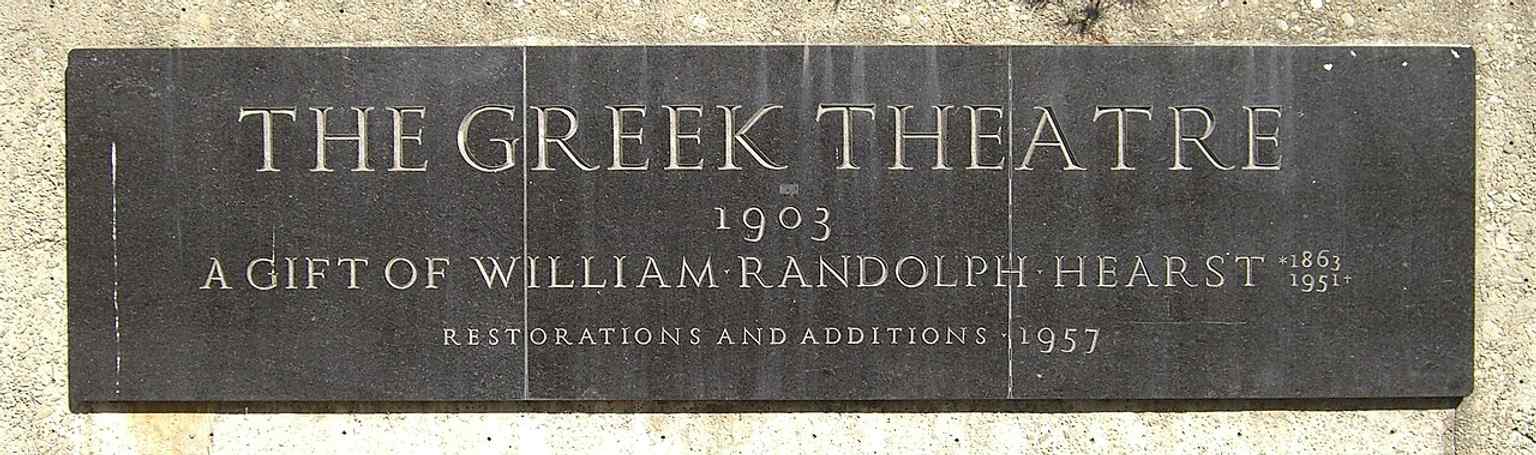
The entrance sign identifies the landmark by its familiar local name, the Greek Theatre, long associated with UC Berkeley events and concerts.Photo: Unknown, Wikimedia Commons, CC BY-SA 4.0. Cropped & resized. 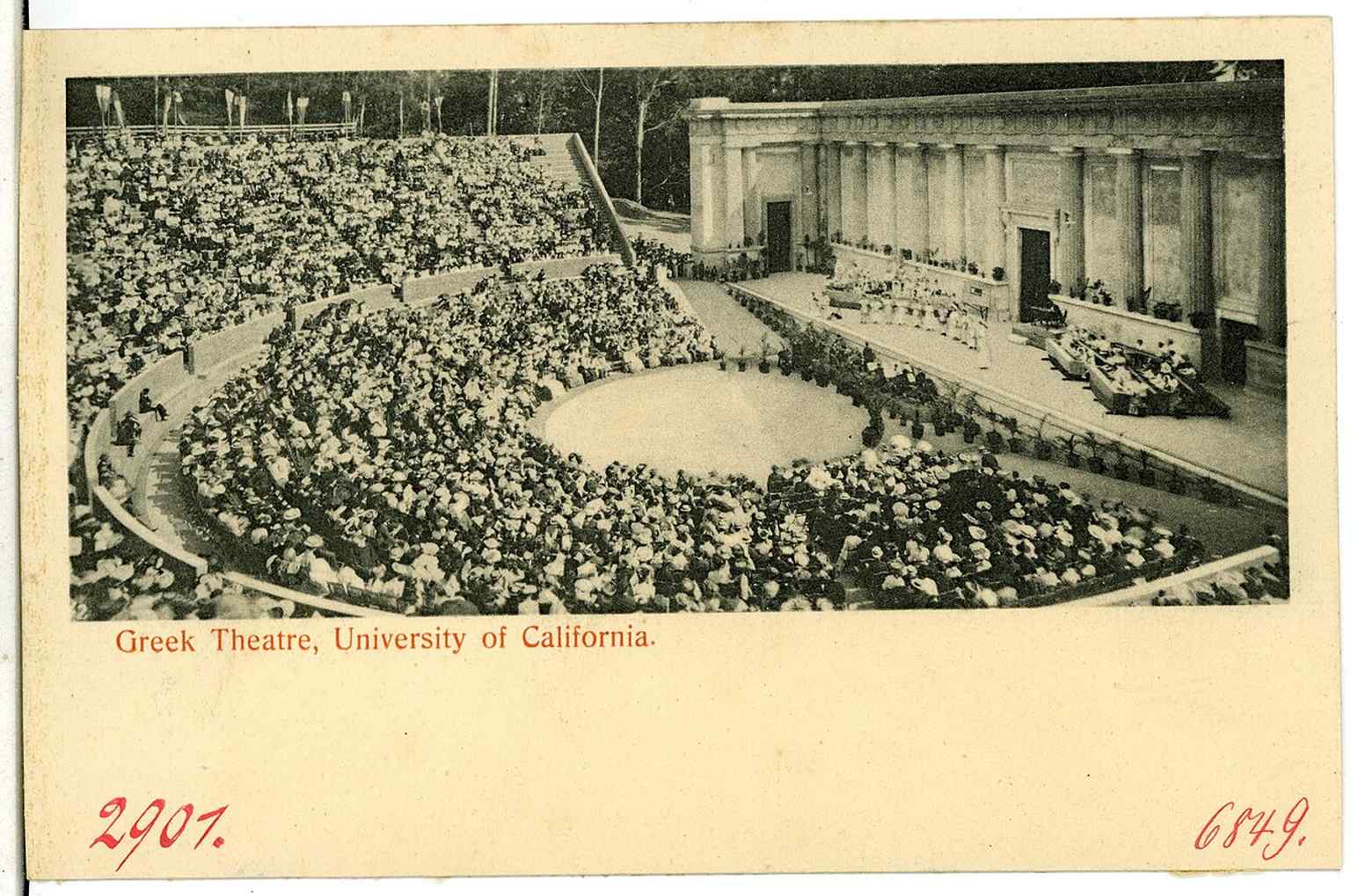
A 1905 postcard view captures the Greek Theatre soon after completion, just after it opened with student performances in 1903.Photo: Brück & Sohn Kunstverlag Meißen, Wikimedia Commons, CC0. Cropped & resized. 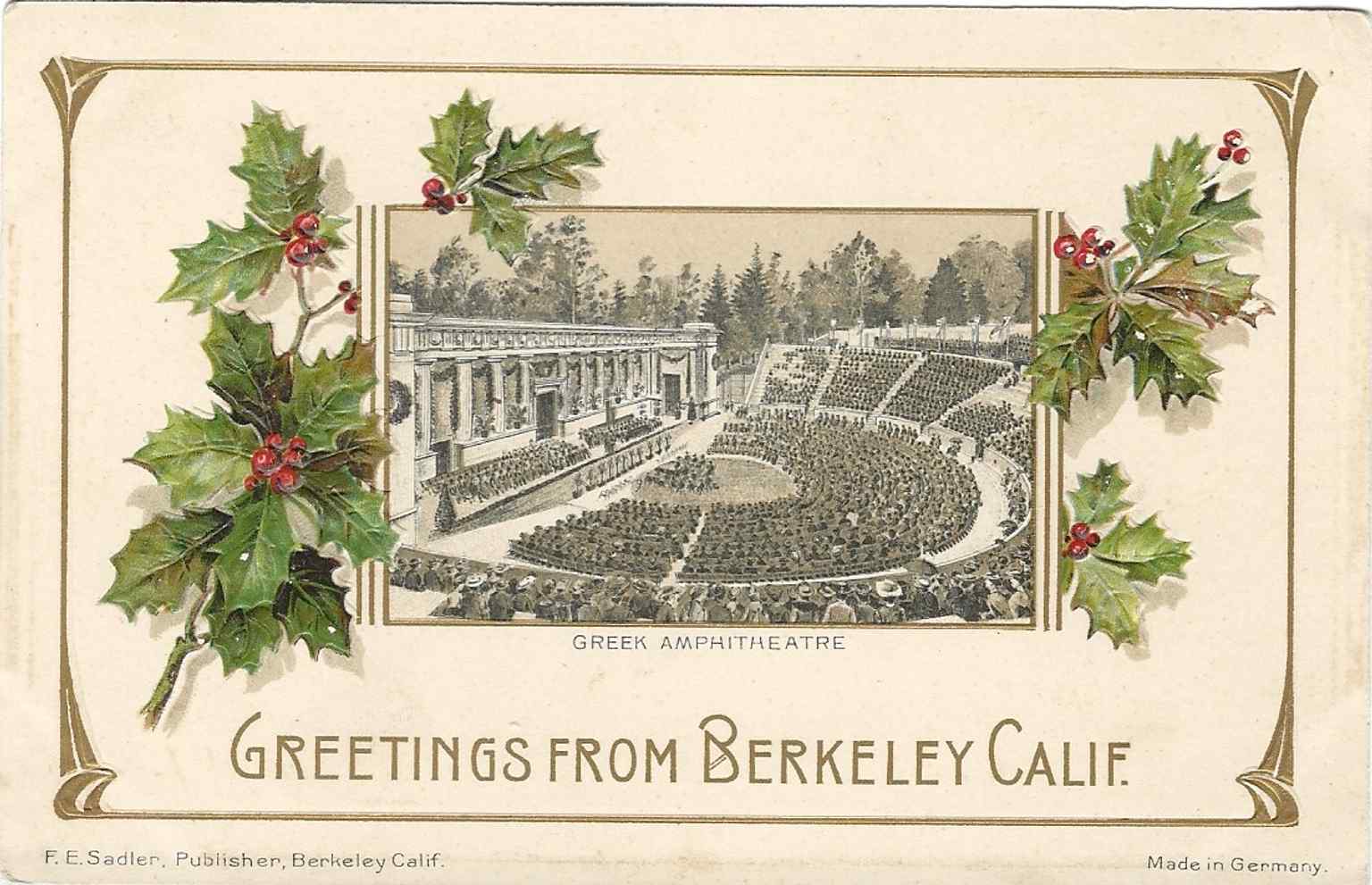
An early postcard labeled ‘Greek Amphitheatre’ shows how Berkeley promoted the venue in the first decades of the 20th century.Photo: M. Rieder, Wikimedia Commons, Public domain. Cropped & resized. 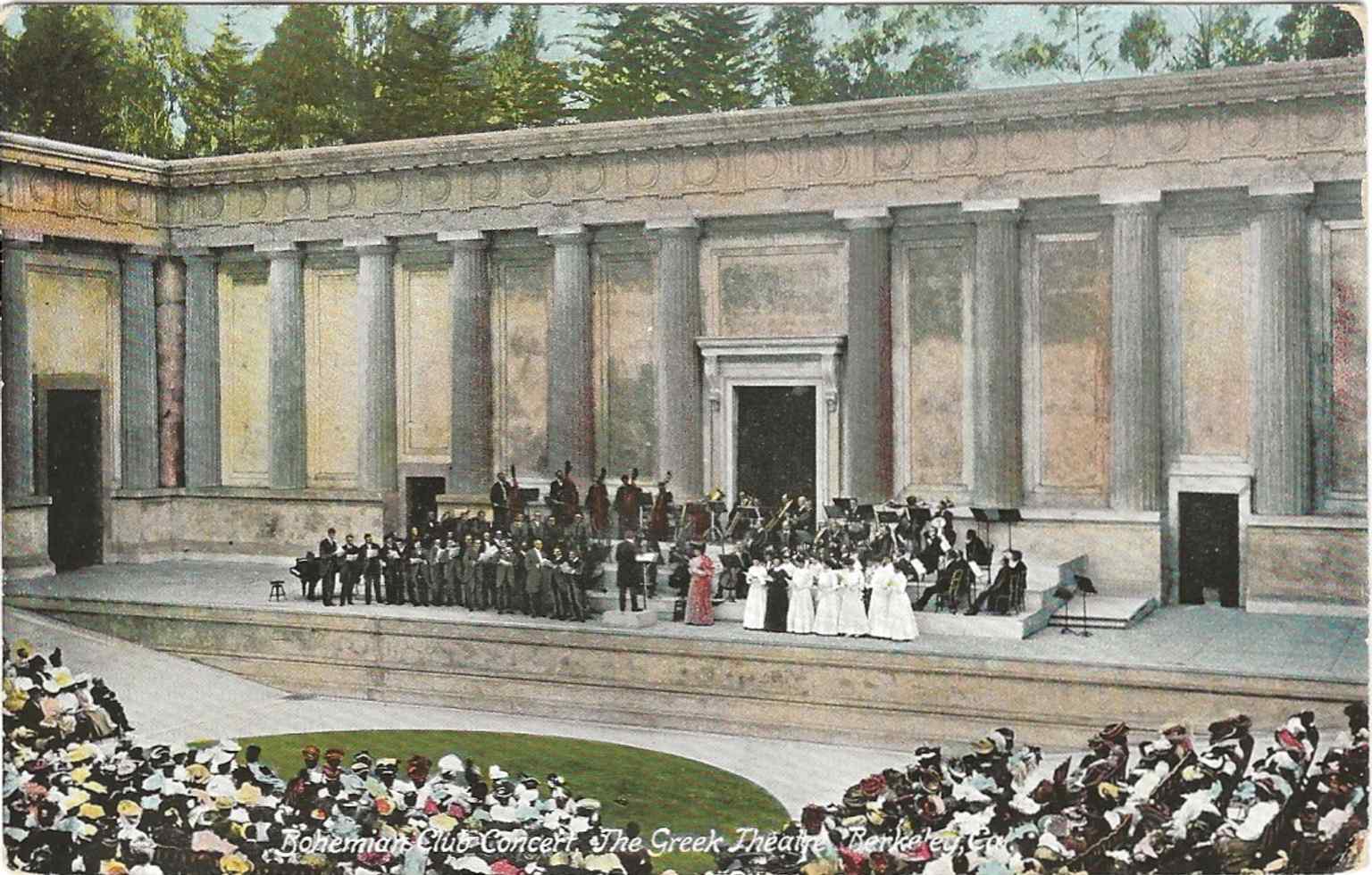
This ca. 1910 postcard of the Greek Theatre reflects its early reputation as a scenic campus amphitheater for concerts and gatherings.Photo: M. Rieder, Wikimedia Commons, Public domain. Cropped & resized. 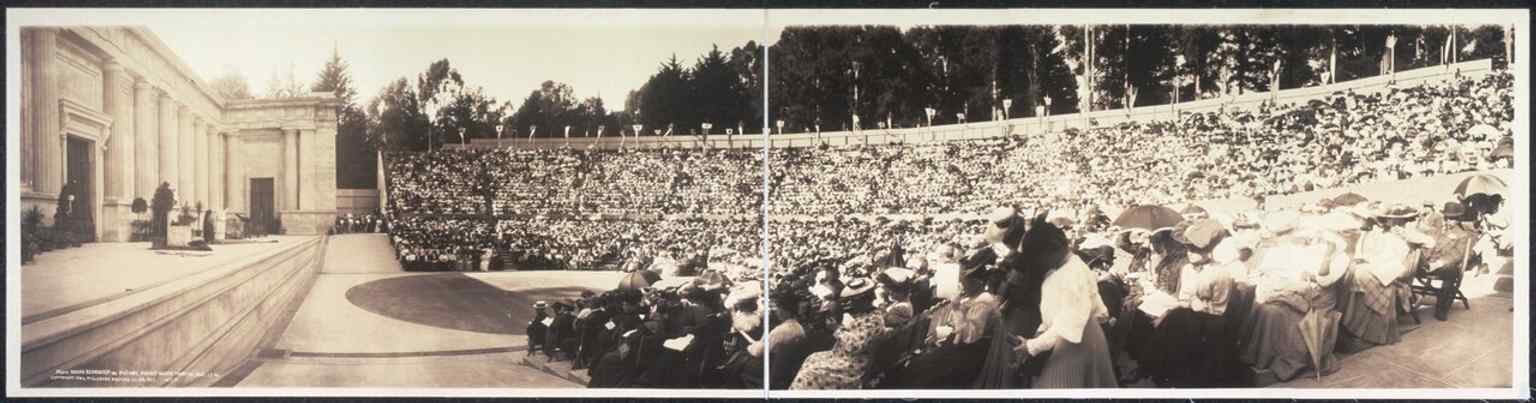
Sarah Bernhardt performing at the Greek Theatre in 1906 highlights the venue’s early role as a stage for internationally famous artists.Photo: Unknown, Wikimedia Commons, Public domain. Cropped & resized. 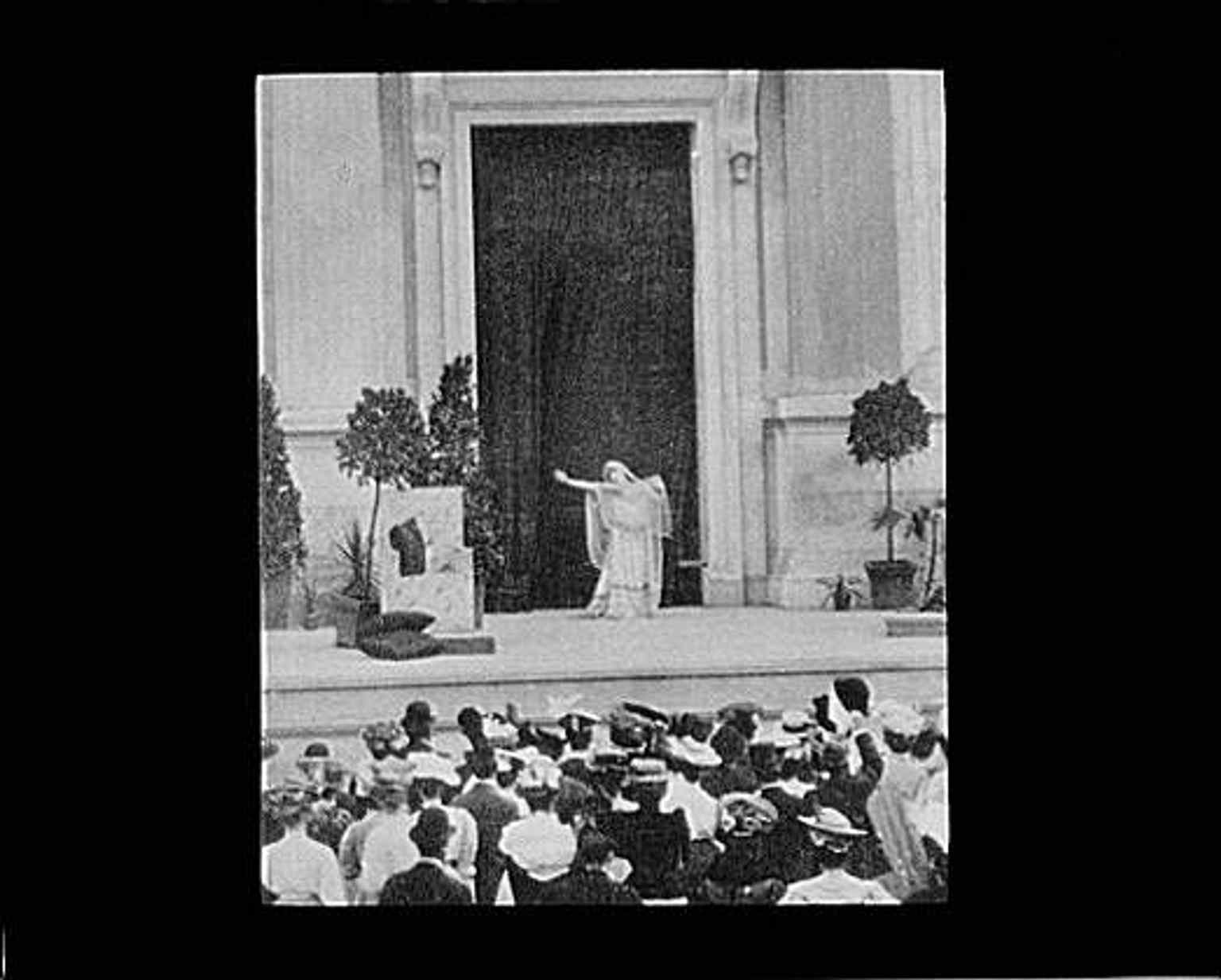
Another 1906 Bernhardt performance image, showing how quickly the theatre became a major cultural venue after opening.Photo: SiefkinDR, Wikimedia Commons, CC BY-SA 4.0. Cropped & resized. 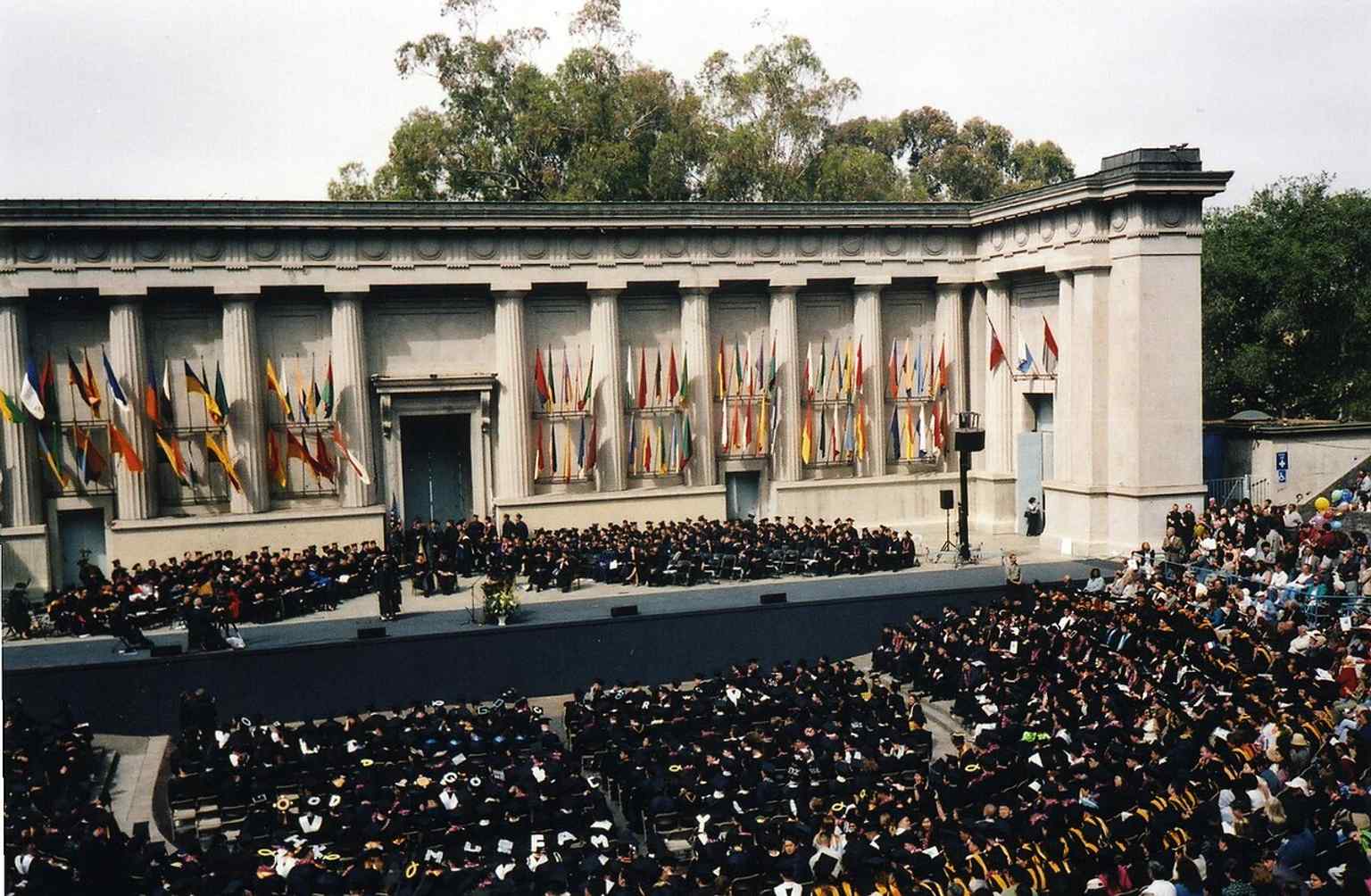
A graduation ceremony at the Greek Theatre, one of the long-running UC Berkeley traditions hosted in this open-air bowl.Photo: Andris at English Wikipedia, Wikimedia Commons, Public domain. Cropped & resized. 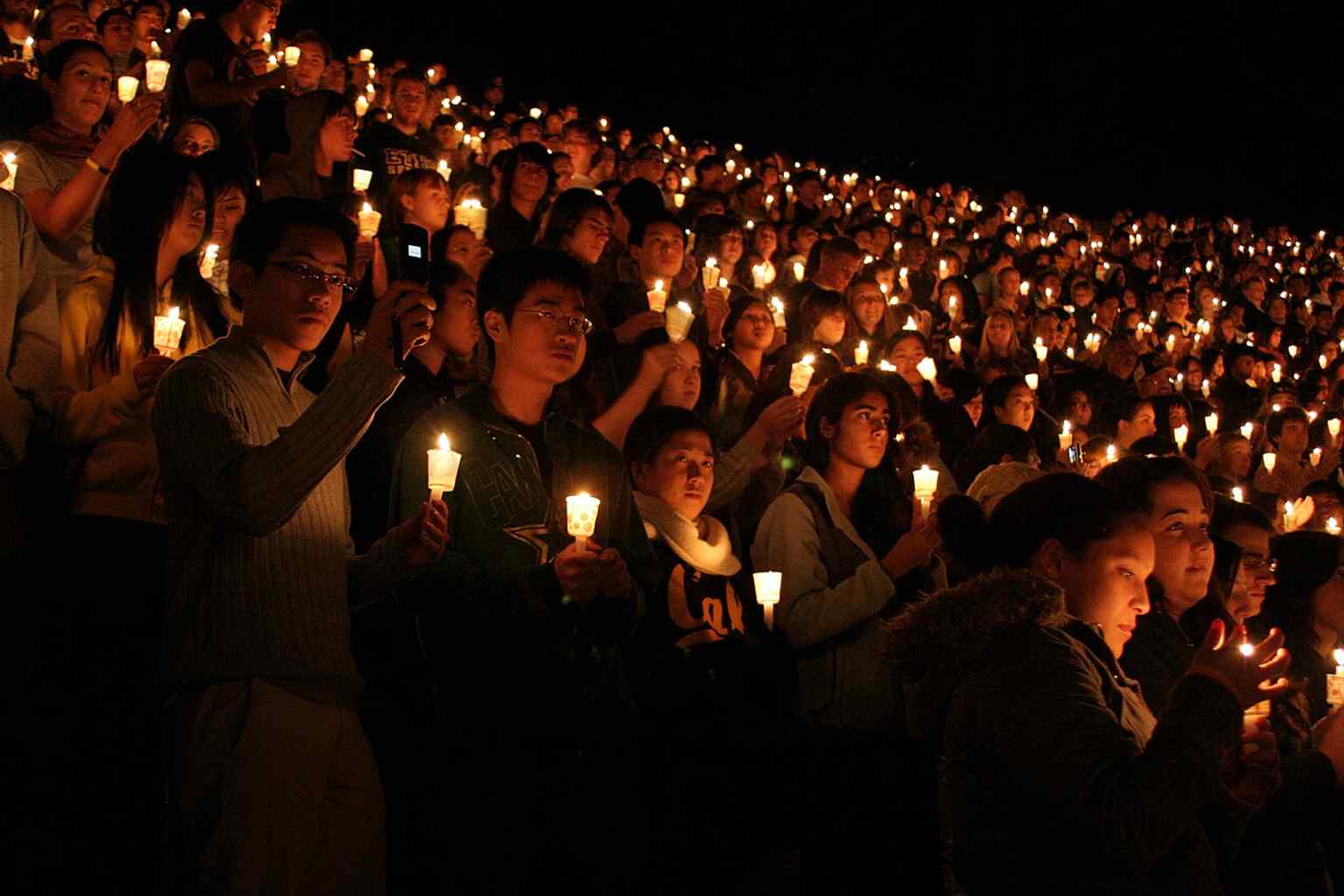
Students and alumni gathering for the Big Game bonfire recall the Greek Theatre’s role in major campus traditions and rally events.Photo: Monica's Dad, Wikimedia Commons, CC BY-SA 3.0. Cropped & resized. 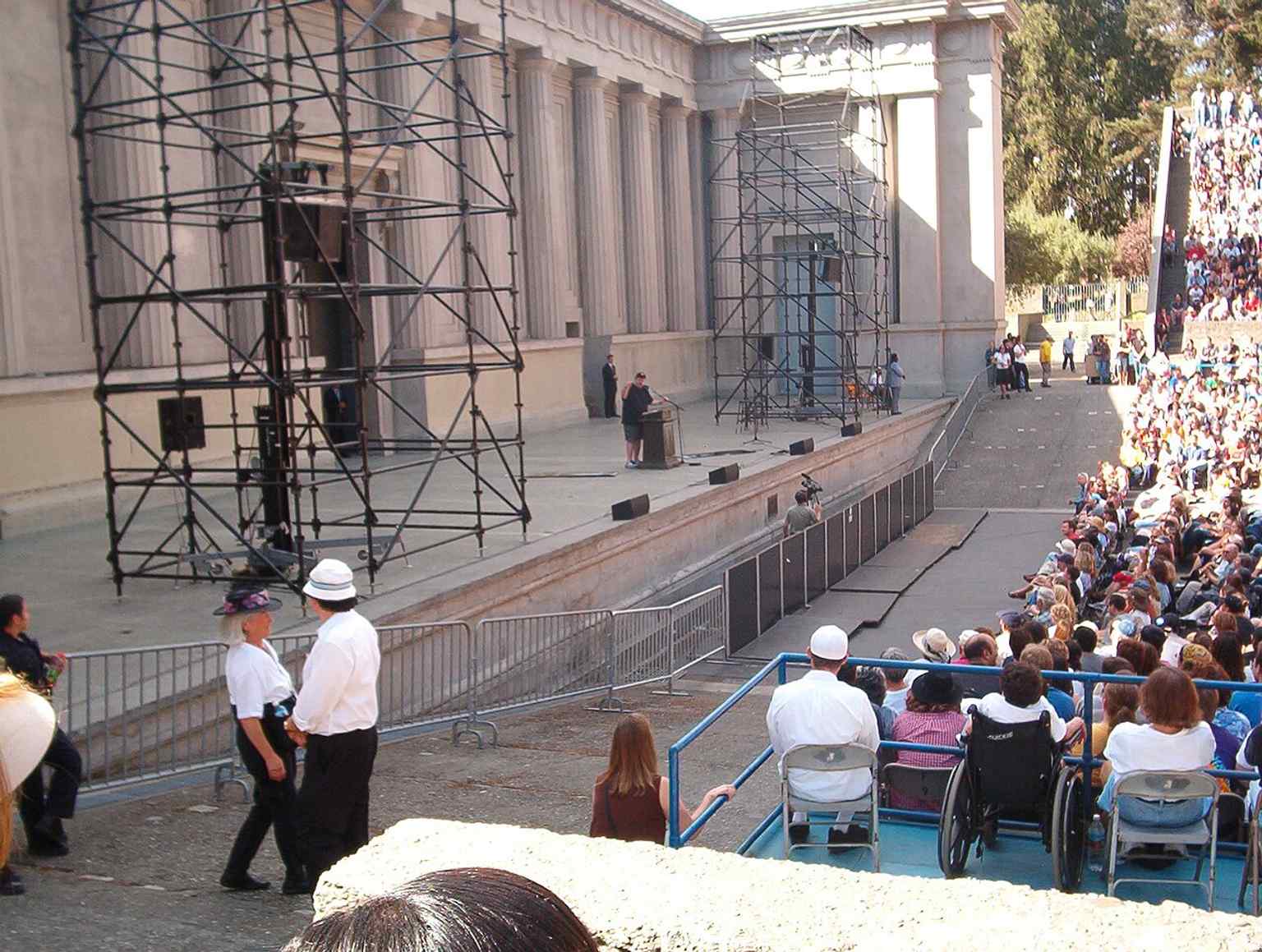
Michael Moore addressing a packed Greek Theatre shows the venue’s continued use for major public talks and campus gatherings.Photo: DirectorG at en.wikipedia, Wikimedia Commons, Public domain. Cropped & resized. On your right, Bowles Hall rises in pale stone, a long Collegiate Gothic block with a five-arch entry arcade and a crenelated tower that makes it look a little like a compact…Read moreShow less
Open dedicated page →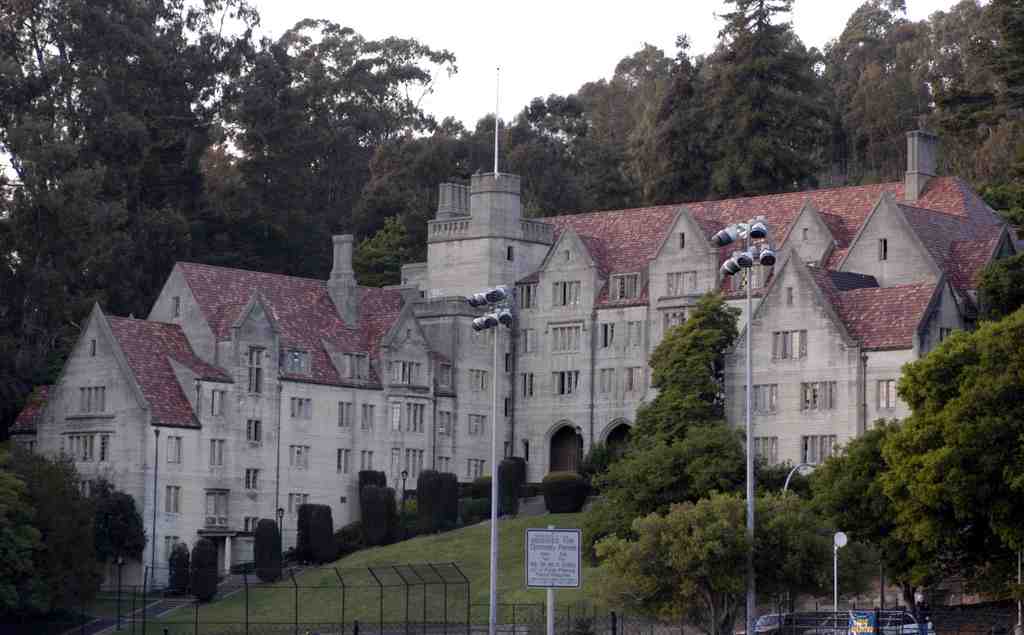
Bowles HallPhoto: Wikimedia Commons contributor, Wikimedia Commons, CC BY-SA 3.0. Cropped & resized. On your right, Bowles Hall rises in pale stone, a long Collegiate Gothic block with a five-arch entry arcade and a crenelated tower that makes it look a little like a compact castle.
Bowles has always carried two identities at once. University officials dedicated it in nineteen twenty-nine as Berkeley’s first residence hall and California’s first state-owned dormitory. But students quickly turned it into something more unruly: a tribe, a stage, a legend.
Mary McNear Bowles gave three hundred fifty thousand dollars for it in memory of her husband, Regent Phillip E. Bowles... about six million dollars in today’s money. Architect George W. Kelham gave that gift a grand shell, eight levels of suites and common rooms, all meant to gather people together. If you glance at the image on your screen, you can see how deliberately stately it looks, almost as if discipline should live here.
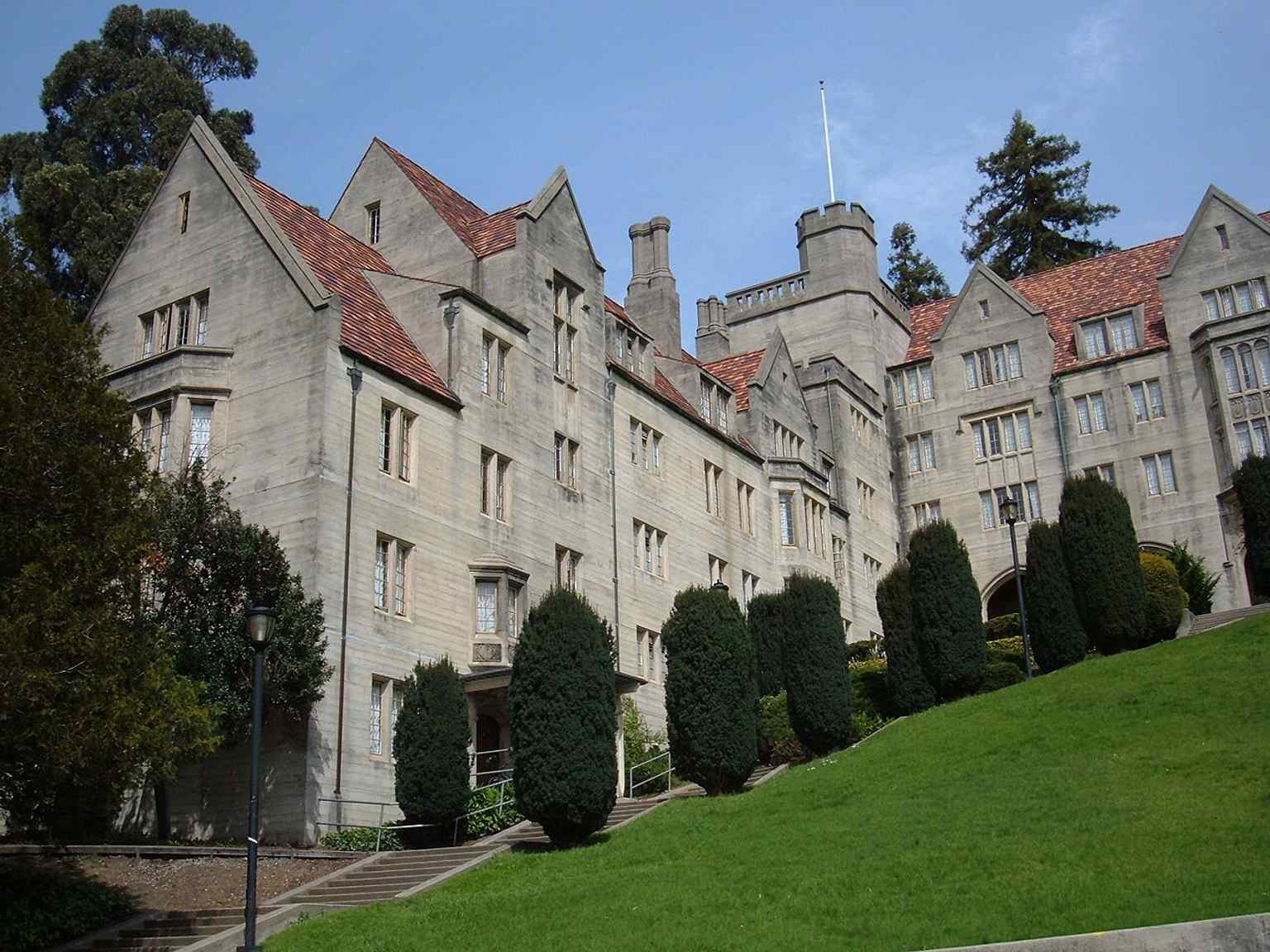
Bowles Hall’s pale stone Collegiate Gothic façade — the first residence hall on campus, dedicated in 1929.Photo: BrokenSphere, Wikimedia Commons, CC BY 3.0. Cropped & resized. But Bowles never settled for discipline alone. In the hall’s early decades, the Blue and Gold yearbook talked about beer-busts, picnics, exchange dinners, dances, and a costume spring dance famous across campus. This place was male-only for most of its life, and its four-man rooms and common spaces gave it a fraternity flavor even though it belonged to the university. The residents called themselves Bowlesmen, and they guarded their rituals like family heirlooms.
One of the best stories tells you everything. After football games, the Cal Band used to stop here and play “By” for Bowles. The tradition supposedly began when football players lived in the hall. Later, when the band tried to skip the stop, some Bowlesmen lay down in the road until the band gave in. That is Berkeley in miniature: official routine meeting student stubbornness... and student stubbornness winning.
There was mischief, too. Alumni remembered swiping the Bowles banner and hanging it upside down on Deutsch Hall, turning a prank into front-page news. And then there was the Halloween party, famous enough to be ranked among the country’s top college parties. That notoriety helped trigger a campus crackdown in two thousand five.
For a while, Bowles nearly slipped away. The university considered stripping out its old purpose, even replacing it. Then alumni fought back. Bob Sayles became the public face of the rescue, and generations of former residents joined him. Their campaign helped protect Bowles as a city landmark and a National Register site, and after a major restoration, it reopened in two thousand sixteen as a coed residential college, welcoming women for the first time.
So this building holds more than stone. It holds repeated gestures: songs, dinners, pranks, loyalties, arguments over what should survive and who gets to carry it forward. Around Berkeley, memory often lives not only in libraries, but in habits people refuse to stop performing.
From here, Thorsen House is about an eight-minute walk away.
If you’re checking access later, Bowles generally keeps weekday hours from ten in the morning to six in the evening and is closed on weekends.
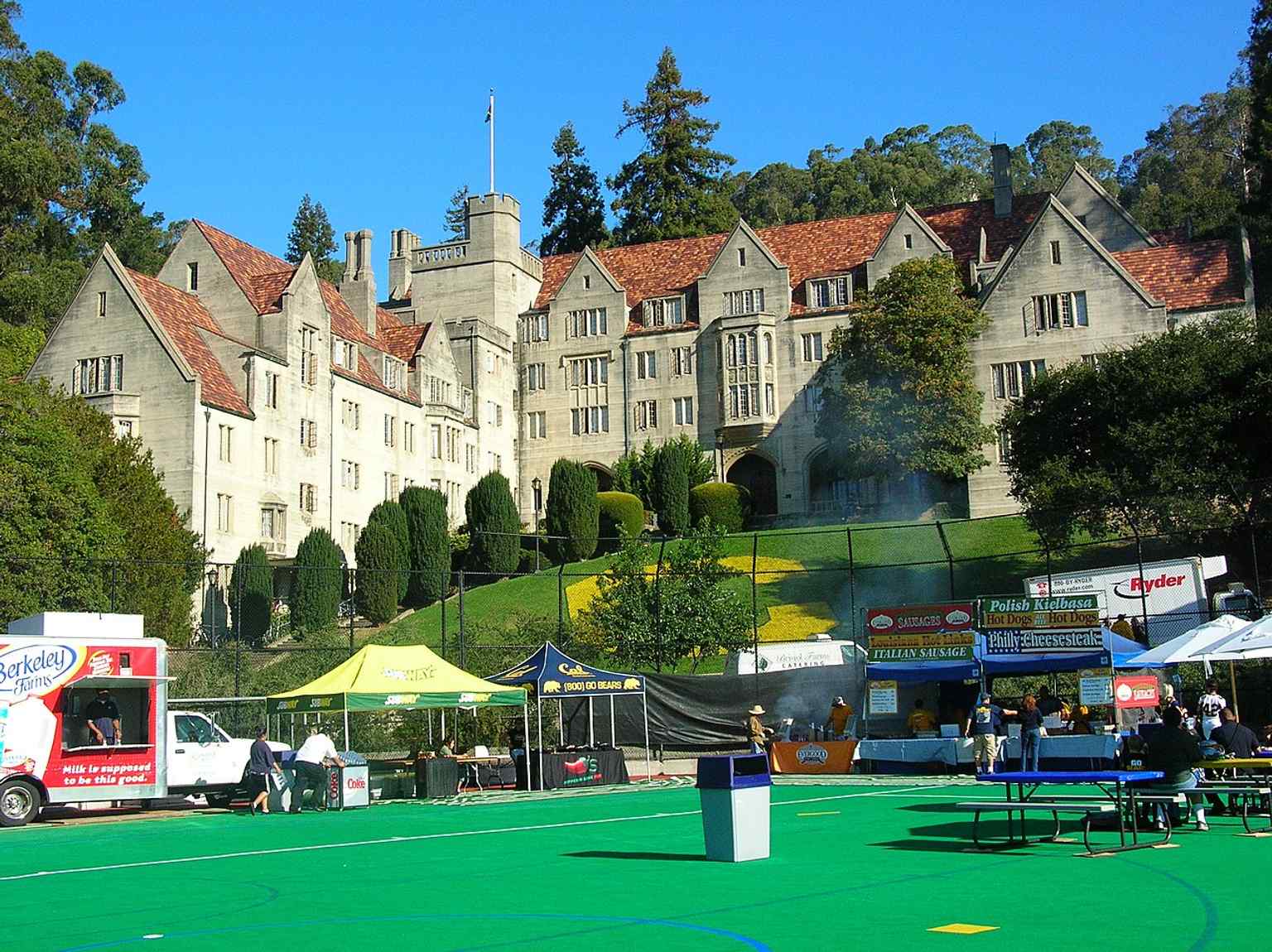
Bowles Hall viewed from Maxwell Family Field, showing its landmark tower and the campus setting beside Memorial Stadium.Photo: BrokenSphere, Wikimedia Commons, CC BY-SA 3.0. Cropped & resized. On your left, look for a broad wood-shingled house with deep sloping gables and a front entrance marked by leaded glass vines. Thorsen House feels almost secretive... not hidden…Read moreShow less
Open dedicated page →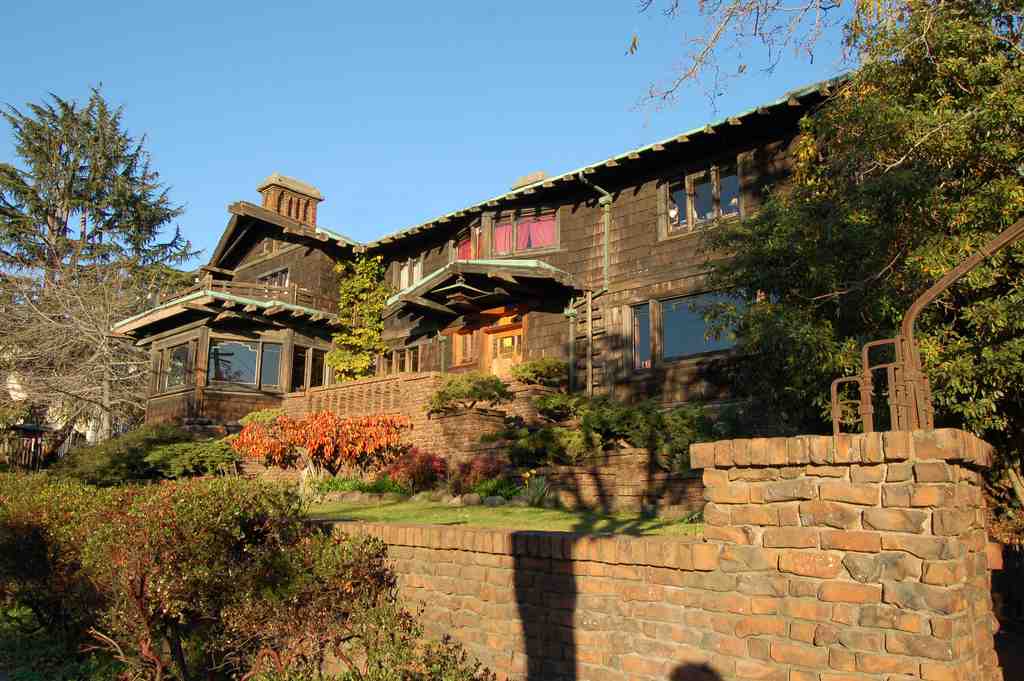
Thorsen HousePhoto: Beerguy721, Wikimedia Commons, CC BY-SA 3.0. Cropped & resized. On your left, look for a broad wood-shingled house with deep sloping gables and a front entrance marked by leaded glass vines.
Thorsen House feels almost secretive... not hidden exactly, but easy to pass without guessing how much care lives inside it. Charles and Henry Greene designed it in nineteen oh nine for William Randolph Thorsen and his wife, Caroline, and they gave Berkeley one of their so-called “ultimate bungalows” - a later nickname for the grandest houses they drew, even though a bungalow usually means something much smaller, lower, and simpler.
William Thorsen sold lumber. That matters here, because this house lets wood speak with real confidence. Inside, the entry hall glows with Burmese teak. The living and dining rooms carry Honduras mahogany, and the brothers Greene even specified tiny square ebony plugs to cover brass screws, turning hardware into ornament. If you glance at your screen, the front door detail shows that lovely leaded art glass grapevine, designed by Emil Lange. It is the kind of detail that makes a house feel handmade rather than manufactured.
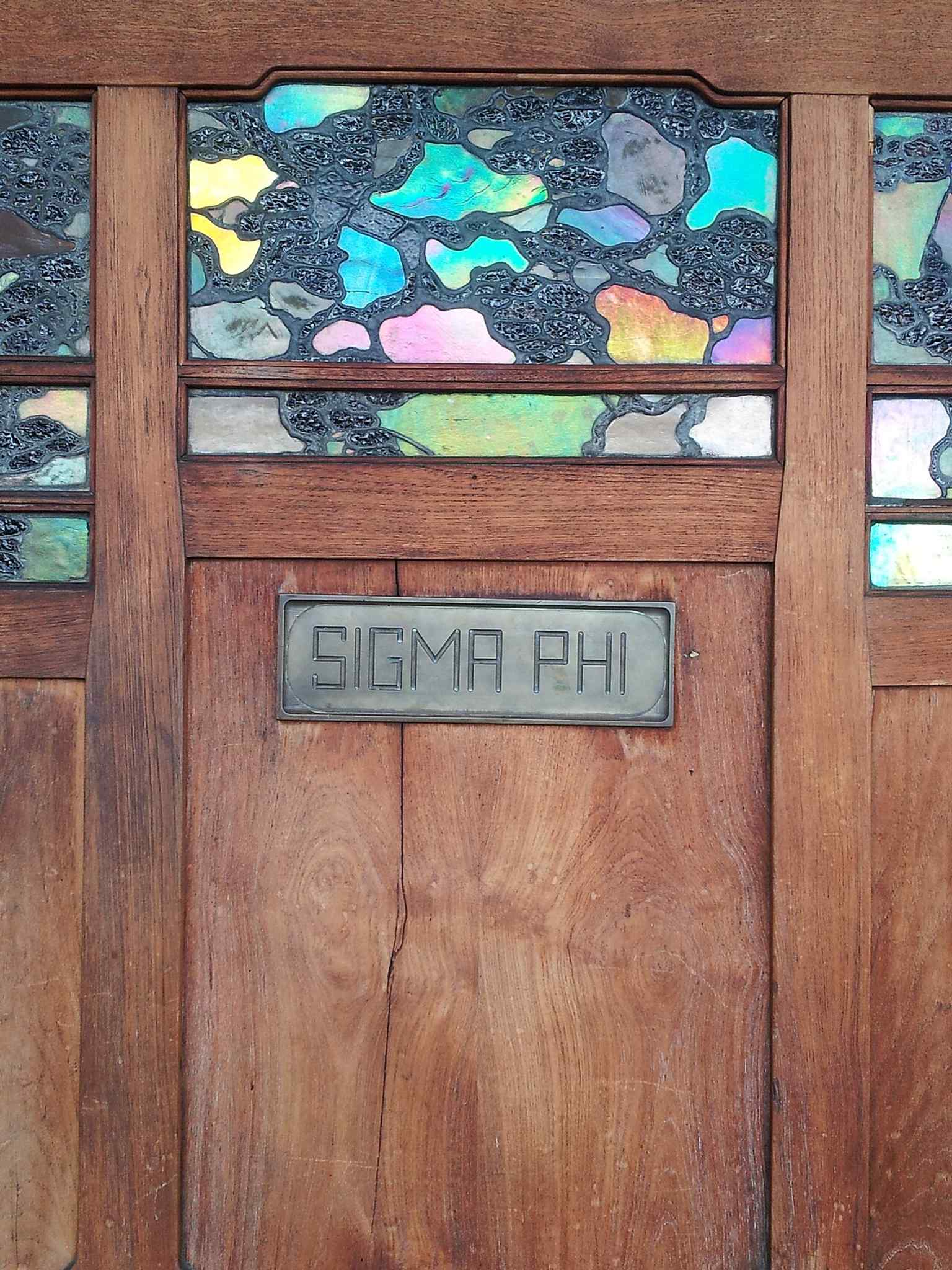
The front door entrance shows the house’s signature leaded art glass, including the vine motif tied to Greene & Greene’s refined wood-and-glass design.Photo: Eekiv, Wikimedia Commons, CC BY-SA 3.0. Cropped & resized. And yet this place did not freeze into a museum. In nineteen forty-two, after William and Caroline died, the California Alpha chapter of Sigma Phi Society bought the eleven-bedroom mansion for twenty-nine thousand dollars - about half a million in today’s money - and turned a private family home into a student-run residence. That change is the real Berkeley twist. A masterpiece became a living experiment in stewardship.
So the story here is not just about design. It is about chores... and loyalty. Members have treated upkeep as part of belonging. Saturday mornings go to cleaning and restoration. In twenty fourteen, people joining the house even got judged on whether they were willing to live in what one account called a “brittle” place and give three hours of work every week beside active members and alumni. Imagine that kind of devotion in a house this delicate.
People keep falling in love with it. Ted Bosley, who lived here as a student and later led the Gamble House, called Thorsen one of the Bay Area’s great architectural jewels. Architecture student Lauren Aguilar helped launch a restoration project after she came to a Monday night dinner and saw not just a landmark, but a home still asking for help. The need has never gone away: earthquakes, leaks, and aging redwood shakes keep pressing in.
That may be the most moving part of all. Berkeley guards treasures in archives, towers, and grand halls... but one of its richest collections is this house, still full of dinners, concerts, repairs, and knocks on the door. A place this handcrafted almost never remains socially alive.
When you’re ready, California Memorial Stadium is about a five-minute walk away, and if you hope to peek inside here another time, the house generally welcomes informal visits from nine to six most days, and from noon to six on Sundays.
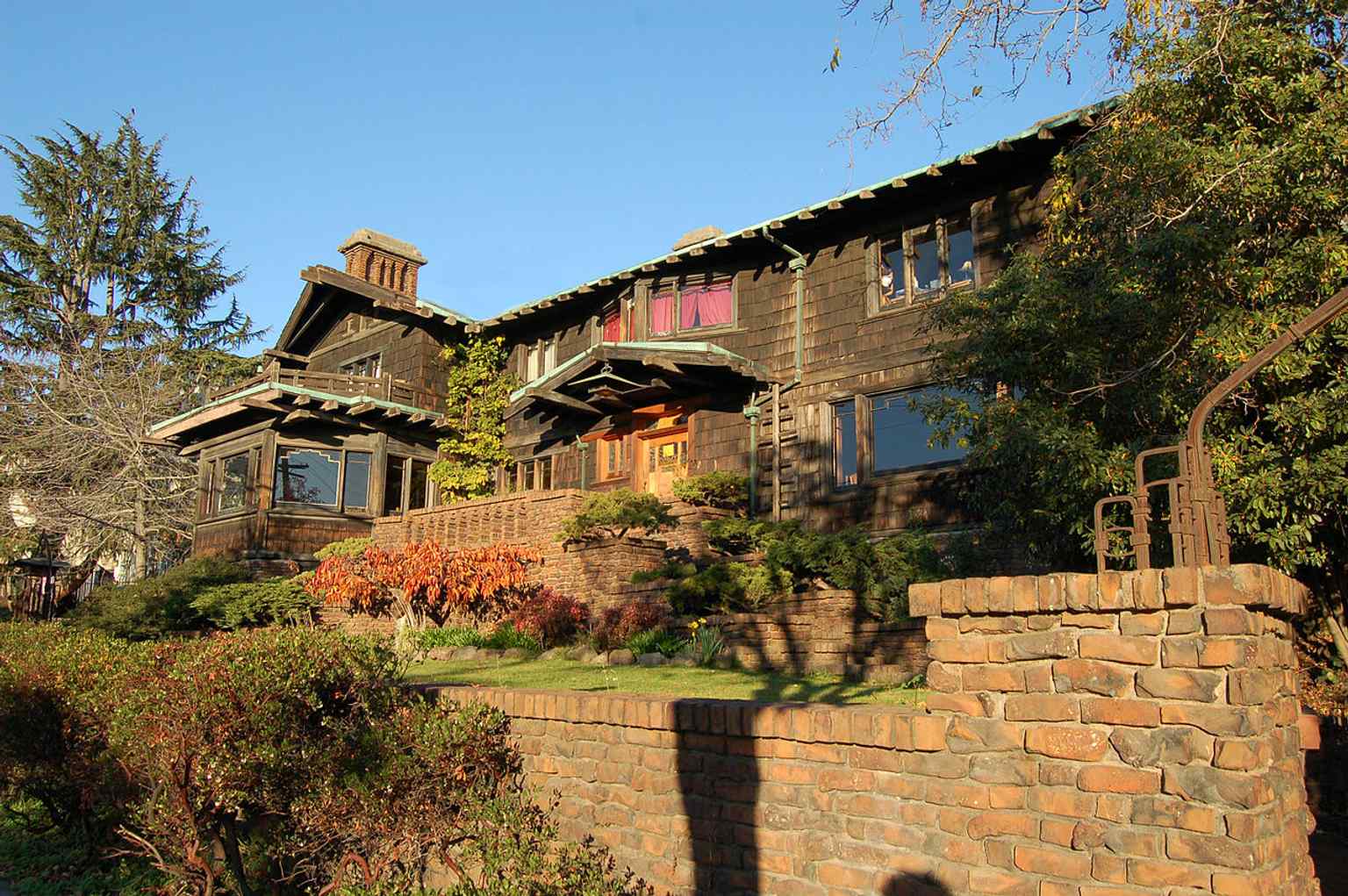
Full view of the Greene & Greene Thorsen House, a 1909 Craftsman landmark that later became home to Berkeley’s Sigma Phi chapter.Photo: Beerguy721 (talk), Wikimedia Commons, CC BY-SA 3.0. Cropped & resized. 
A close look at the Thorsen House doorway details, where the original handcrafted woodwork and stained glass reflect the home’s Arts and Crafts craftsmanship.Photo: Eekiv, Wikimedia Commons, CC BY-SA 3.0. Cropped & resized. Look for the long pale-concrete bowl with its sweeping oval rim and Roman-style arches, marked by a monumental west façade set against the hillside. California Memorial Stadium…Read moreShow less
Open dedicated page →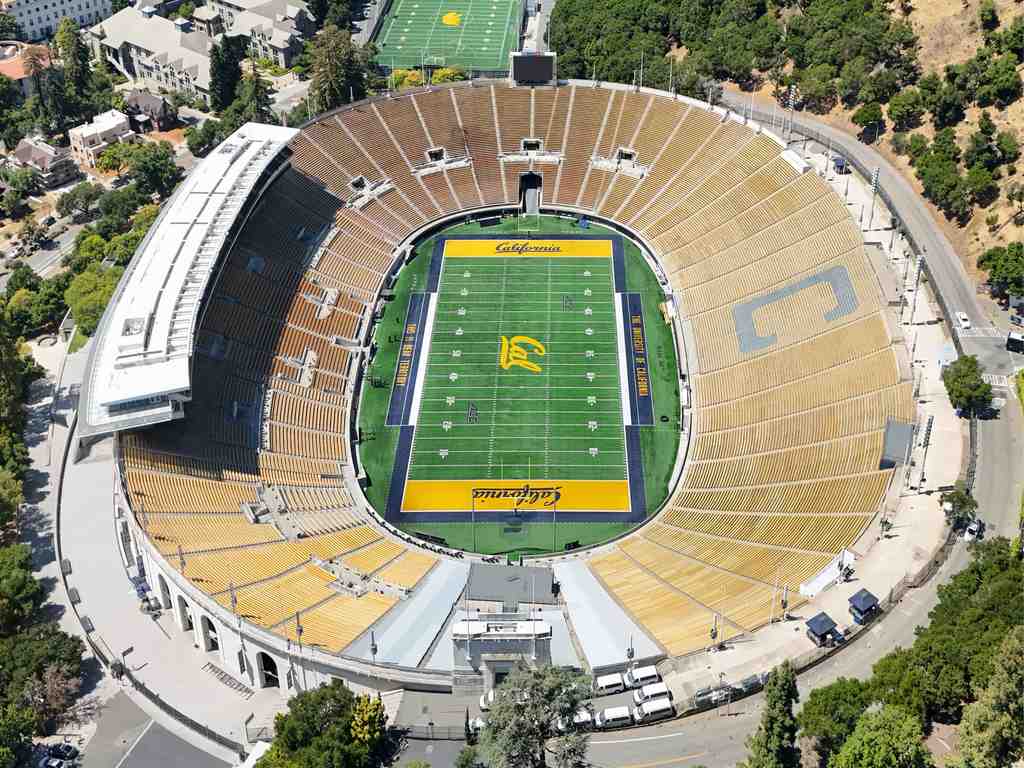
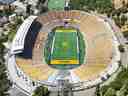
California Memorial StadiumPhoto: Quintin Soloviev, Wikimedia Commons, CC BY 4.0. Cropped & resized. Look for the long pale-concrete bowl with its sweeping oval rim and Roman-style arches, marked by a monumental west façade set against the hillside.
California Memorial Stadium carries a lot on its shoulders. It honors Californians who died in the First World War, but it also holds cheers, rivalries, protests, commencements, and the uneasy knowledge that the ground beneath it does not stay still.
From out here, the building can seem immovable... but John Galen Howard, the university’s chief architect, knew better. He actually warned against this site. The Hayward Fault runs directly under the playing field, nearly from goal post to goal post, and Howard also knew this canyon held birds, trees, and a living landscape people loved. Still, once the university chose Strawberry Canyon, he helped shape this place in the image of an ancient Roman arena, with formal arches and a grand public face.
People paid for it together. In nineteen twenty-two, supporters bought ten thousand seat subscriptions for one hundred dollars each, roughly eighteen hundred dollars today, and every one sold in less than ten days. That public effort raised the money for a memorial that opened in nineteen twenty-three, when coach Andy Smith’s California team beat Stanford in the first game here. Later, the stadium even gained a bench in Smith’s honor, as if Berkeley wanted to remember not only its dead, but also the people whose victories made this giant bowl feel necessary.
And yet necessity kept colliding with doubt. The stadium straddled a fault from the beginning, so builders split it into sections and left expansion joints, small built-in gaps, so the sides could move separately in an earthquake. By the late nineteen nineties, engineers judged the old structure a serious life hazard. That led to the huge renovation from two thousand ten to two thousand twelve: workers demolished and rebuilt the west side, lowered the field by four feet, and kept the historic outer wall. If you like, take a quick look at the before-and-after image in the app to see how dramatically that side changed.
Safety, though, did not end the argument. The project spilled into the oak grove beside the stadium, where tree-sitters stayed for twenty-one months trying to stop construction and defend the land around it. In two thousand and eight, U-C Police Chief Victoria Harrison finally spoke to the last protesters from a crane basket and coaxed them down. It was one of those moments that felt unmistakably Berkeley: even rebuilding a football stadium became a public struggle over what should survive.
Inside this bowl, generations gathered for far more than football. President John F. Kennedy spoke here to a crowd of eighty-eight thousand. Commencements filled the stands. The roar of nineteen eighty-two’s famous Big Game finish, The Play, still lingers in campus memory.
But the real story never stayed fully inside the gates. Even a stadium this large could not contain Berkeley’s appetite for watching from the edges. Crowds kept gathering beyond the eastern rim, outside the ticketed boundary, proving that the official venue was only part of the ritual.
Before you head on, take in the stadium’s scale... then lift your eyes toward the slope above it. Notice where the architecture ends, and where the spectators’ claim begins. Our next stop is uphill, about a five-minute walk away, on Tightwad Hill.
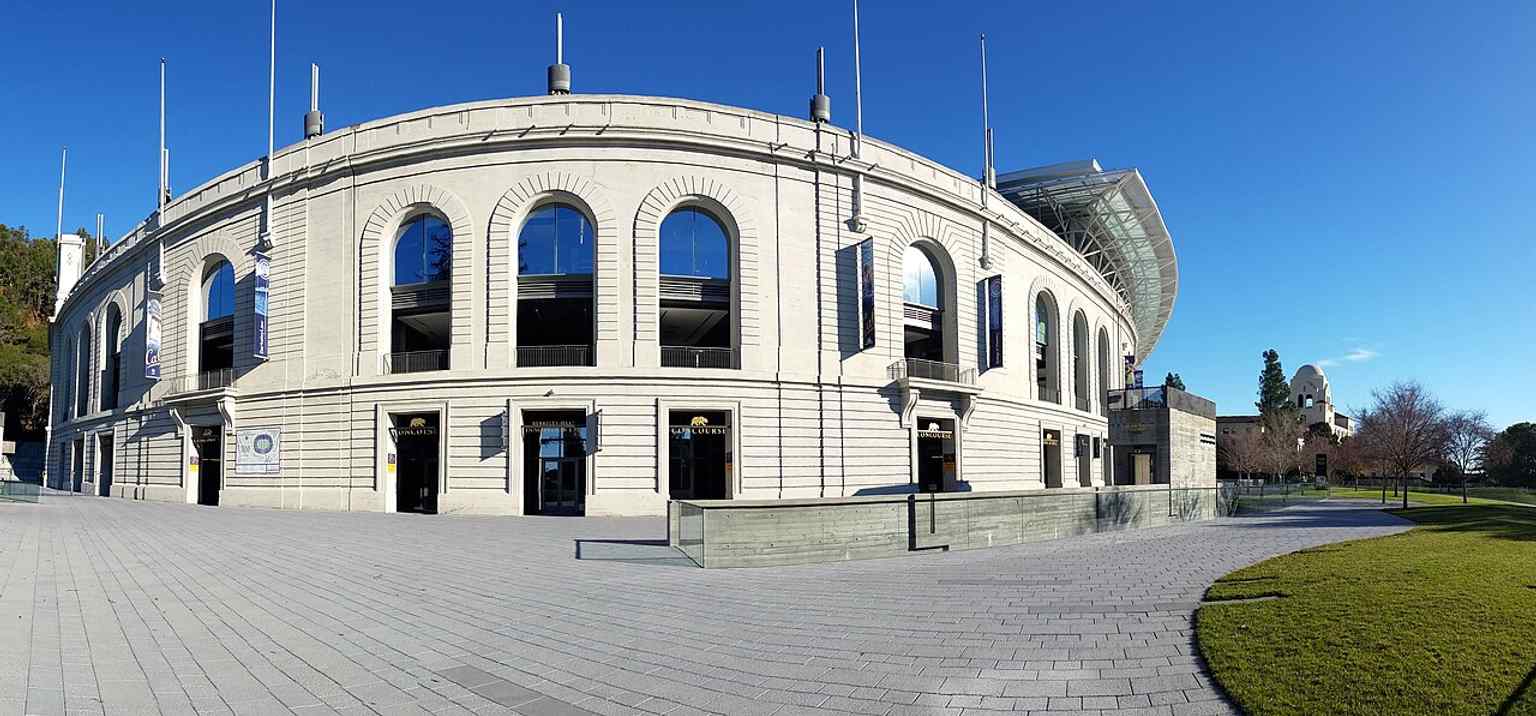
The rebuilt west side and Roman Coliseum-inspired façade capture the stadium’s neoclassical design, one of the features that made it a historic landmark.Photo: Rybkovich, Wikimedia Commons, CC BY-SA 4.0. Cropped & resized. 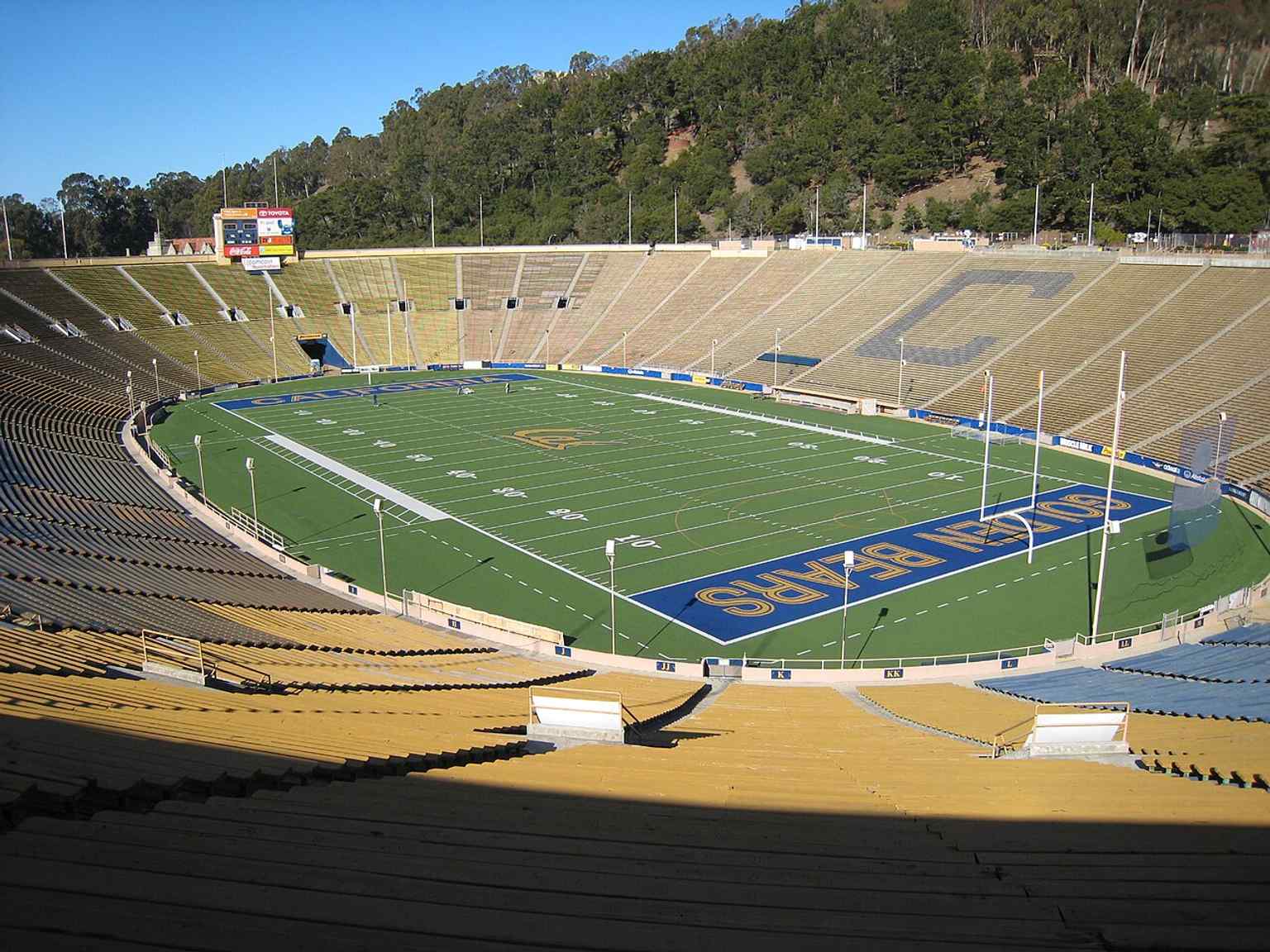
A straightforward exterior view of California Memorial Stadium before the renovation, useful for showing the classic bowl shape and canyon backdrop.Photo: Roman Fuchs, Wikimedia Commons, CC BY-SA 3.0. Cropped & resized. 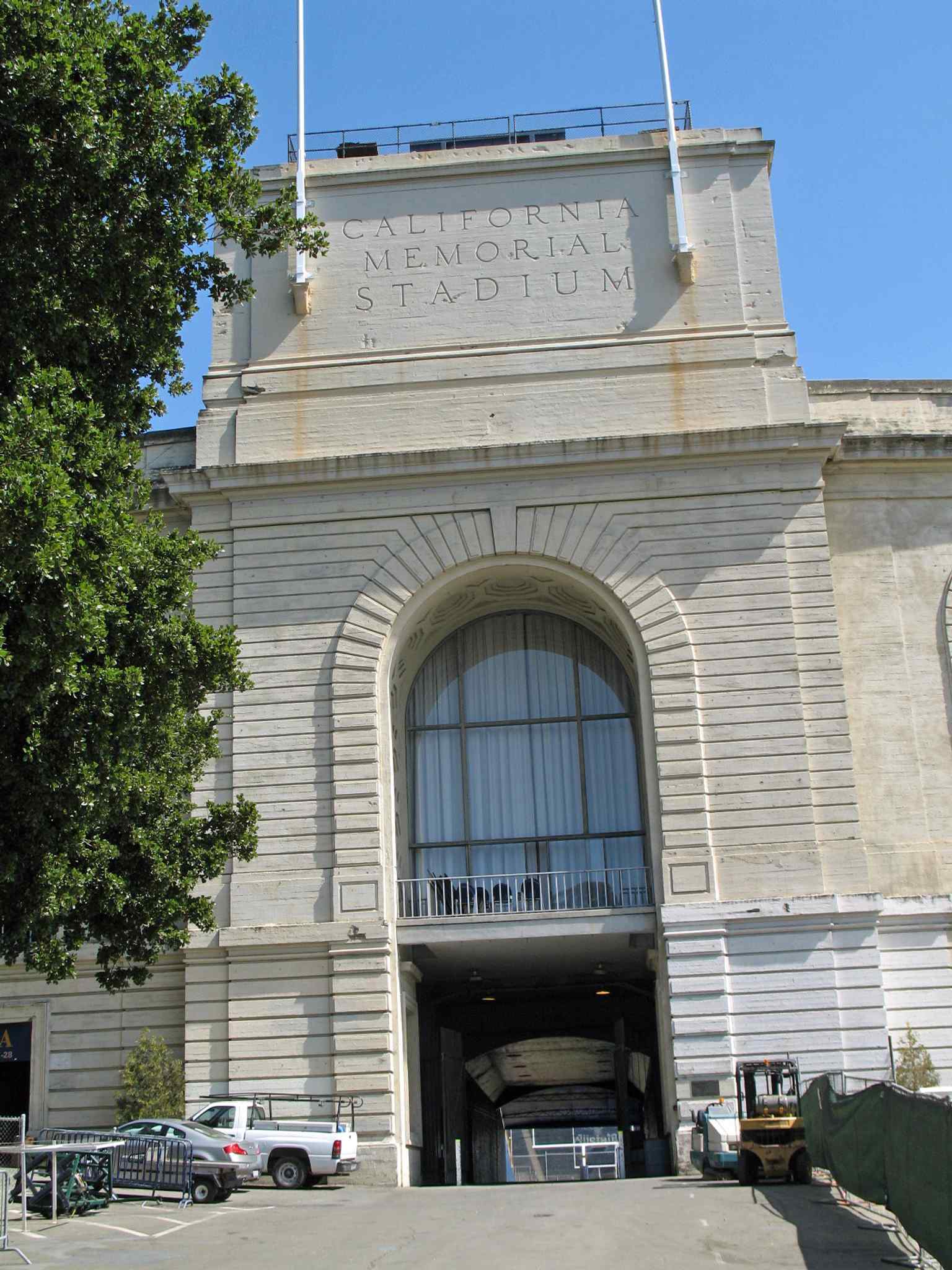
Taken from the northwest, this view highlights the stadium’s north entrance and its setting against the campus hillside.Photo: Sanfranman59, Wikimedia Commons, CC BY-SA 3.0. Cropped & resized. 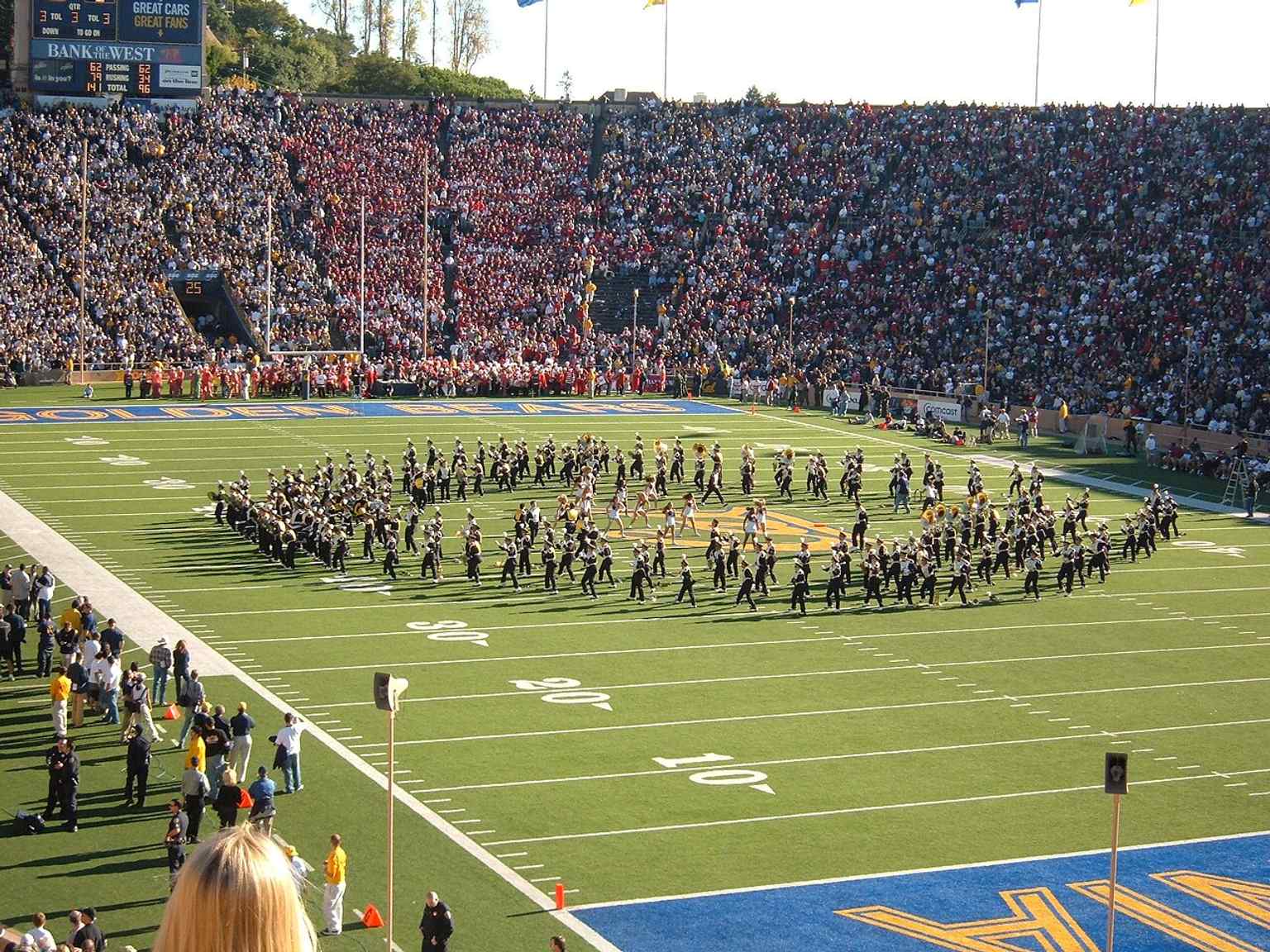
The Cal Band performing before the Big Game evokes the stadium’s role as the center of campus football pageantry and rivalry with Stanford.Photo: BrokenSphere, Wikimedia Commons, CC BY-SA 3.0. Cropped & resized. 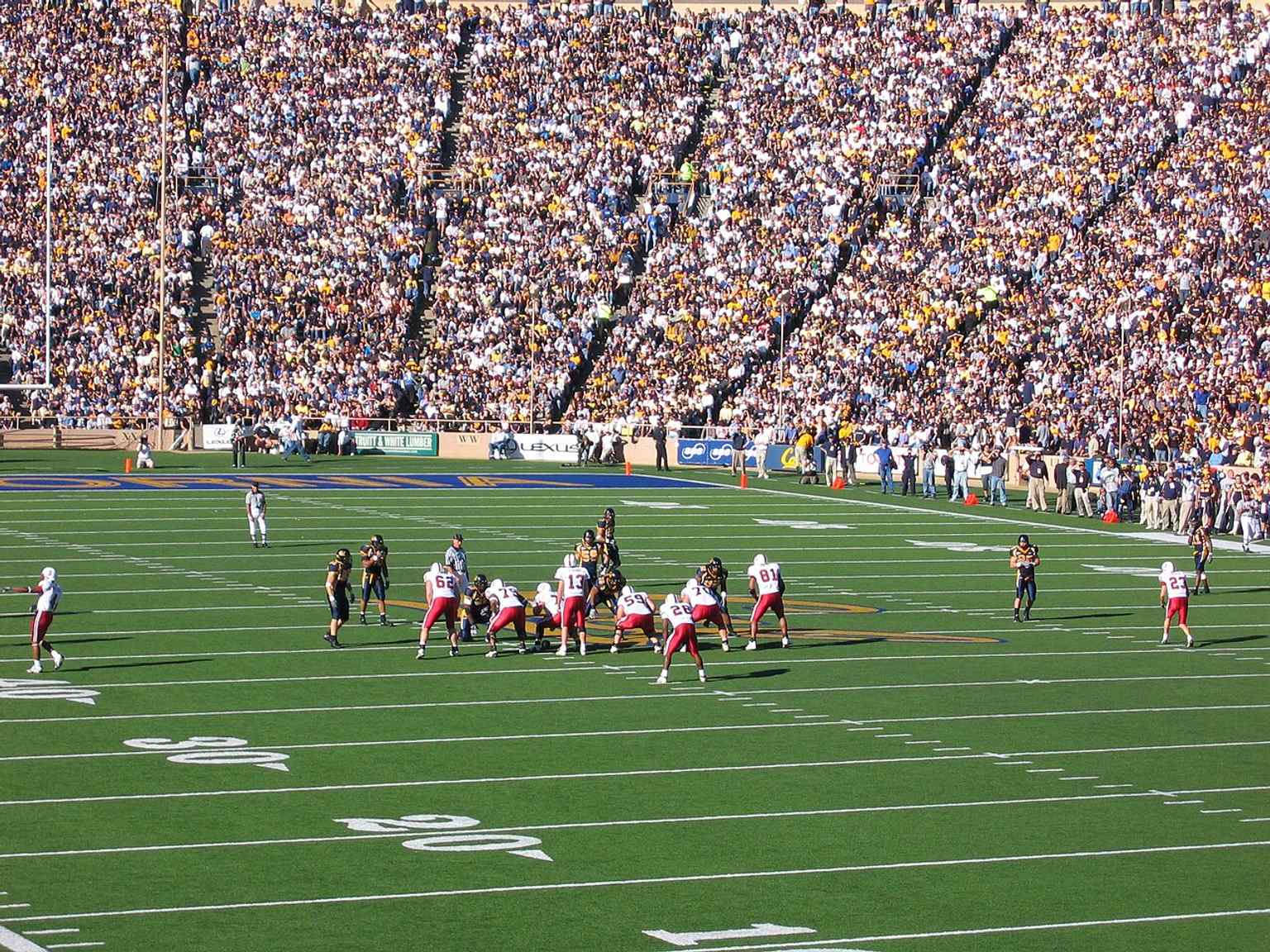
A Big Game action scene from 2004 connects the stadium to its most famous rivalry and the packed-game atmosphere it is known for.Photo: No machine-readable author provided. Poppy assumed (based on copyright claims)., Wikimedia Commons, CC BY-SA 3.0. Cropped & resized. 
This 1926 Big Game image shows Memorial Stadium in its early decades, soon after it opened as a memorial to Californians lost in World War I.Photo: Morton & Co., Wikimedia Commons, Public domain. Cropped & resized. 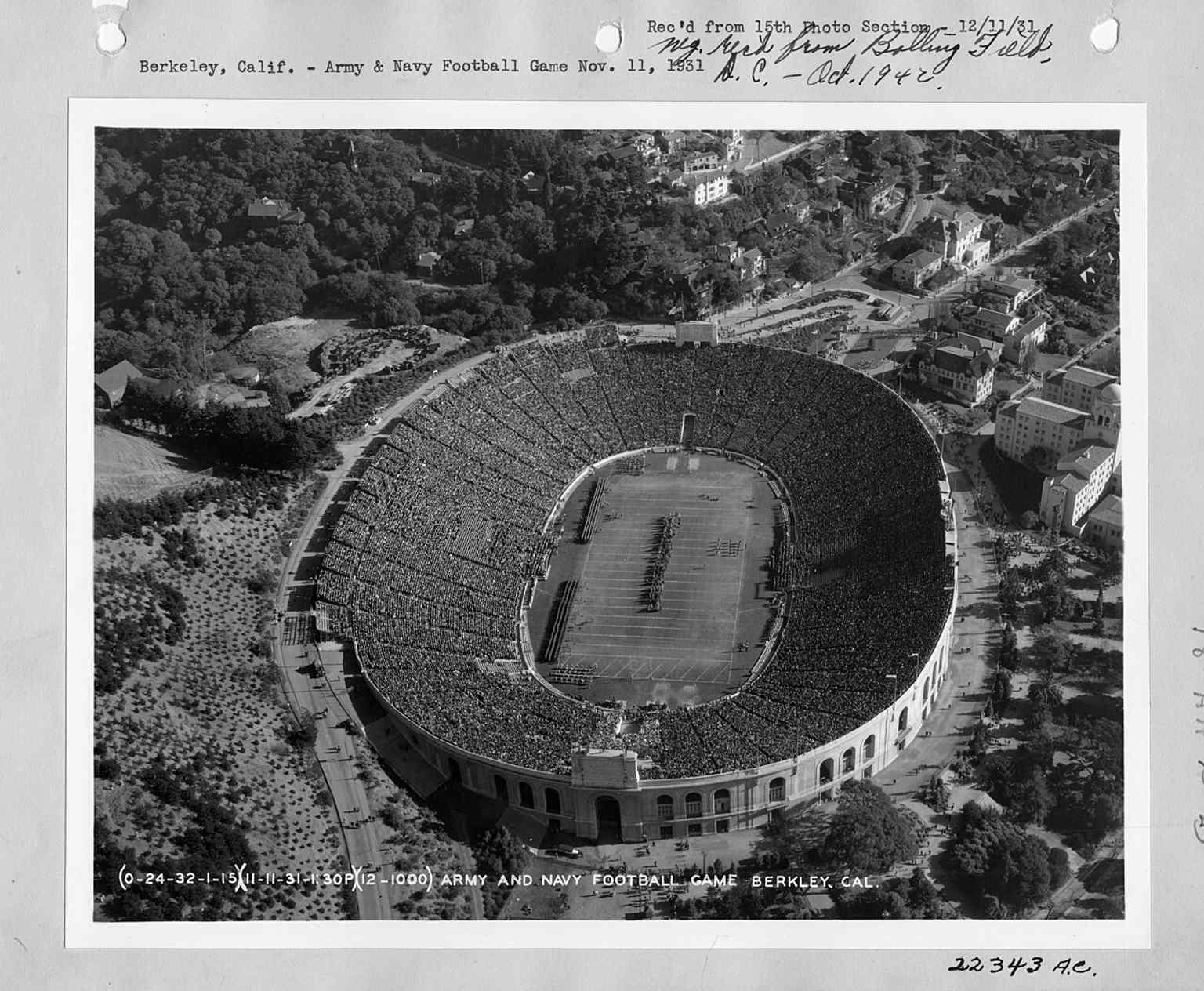
An archival view from 1931 gives a rare historic look at the stadium during its original era, before modern renovations changed the west side.Photo: Unknown authorUnknown author or not provided, Wikimedia Commons, Public domain. Cropped & resized. 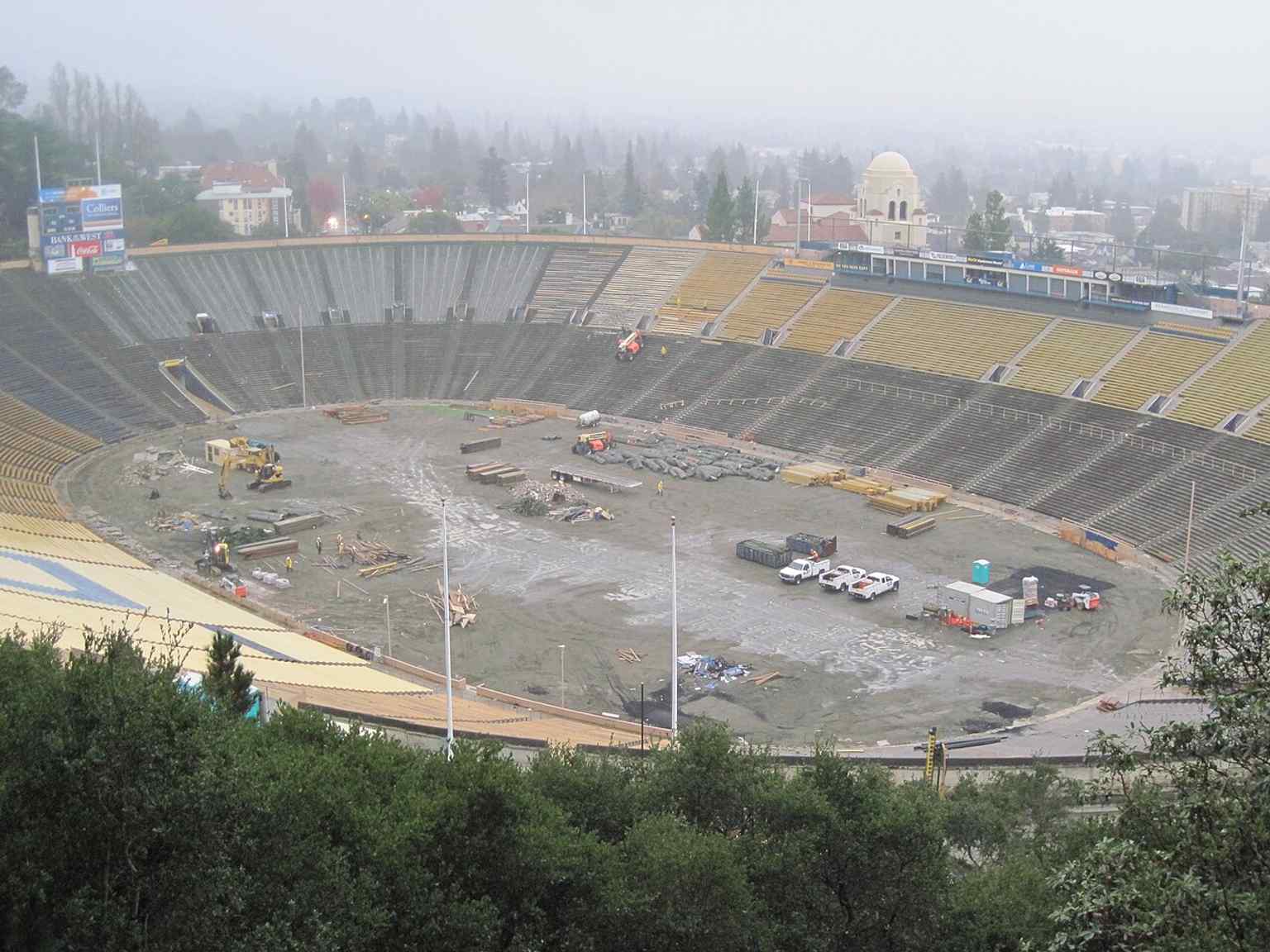
Construction in 2010 documents the major retrofit that lowered the field and rebuilt the west side to make the stadium seismically safer.Photo: Andrew Hogan, Wikimedia Commons, CC0. Cropped & resized. 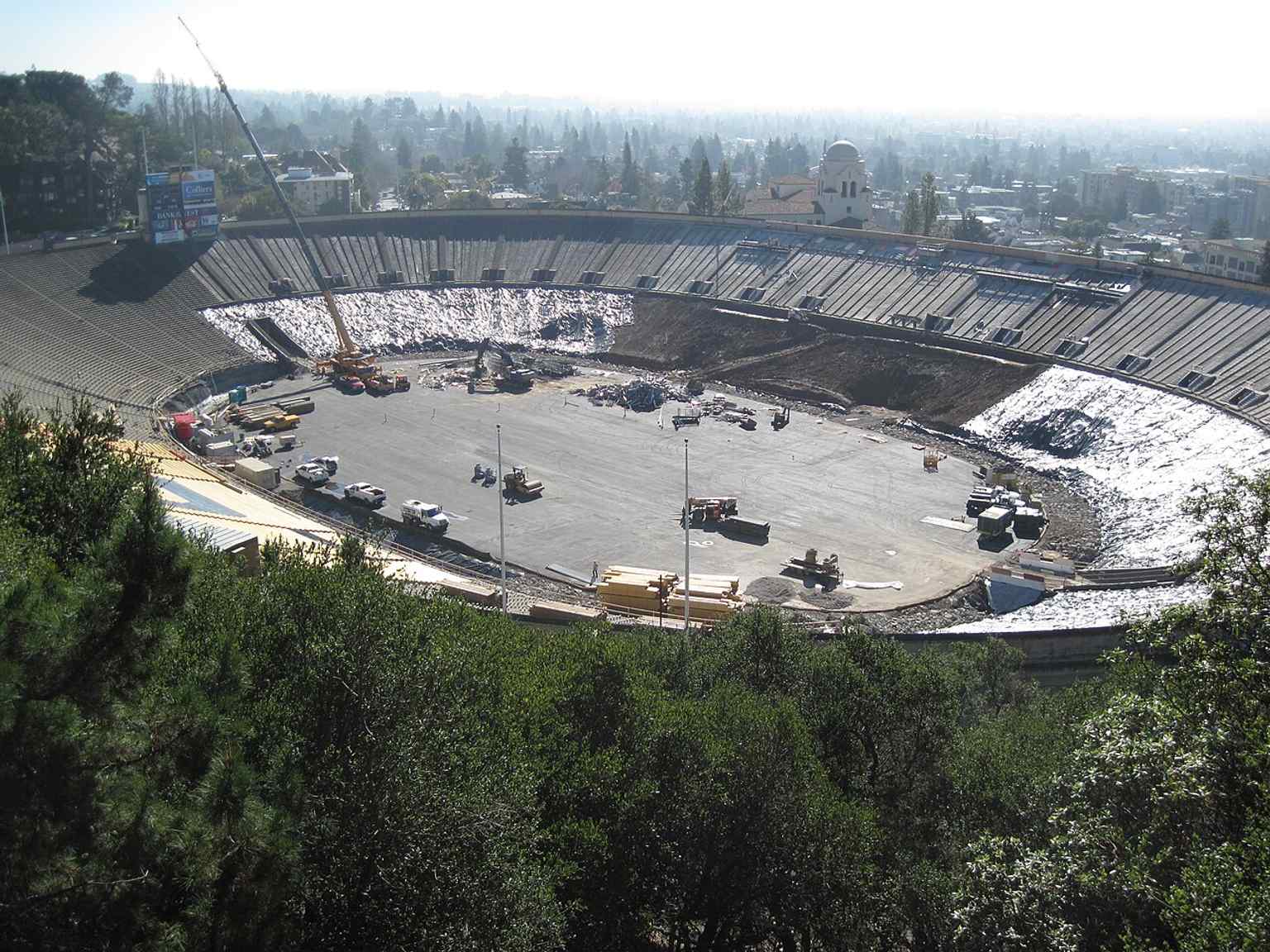
This 2011 construction image shows the long rebuild in progress while Cal played its home season away from Berkeley.Photo: Andrew Hogan, Wikimedia Commons, CC0. Cropped & resized. 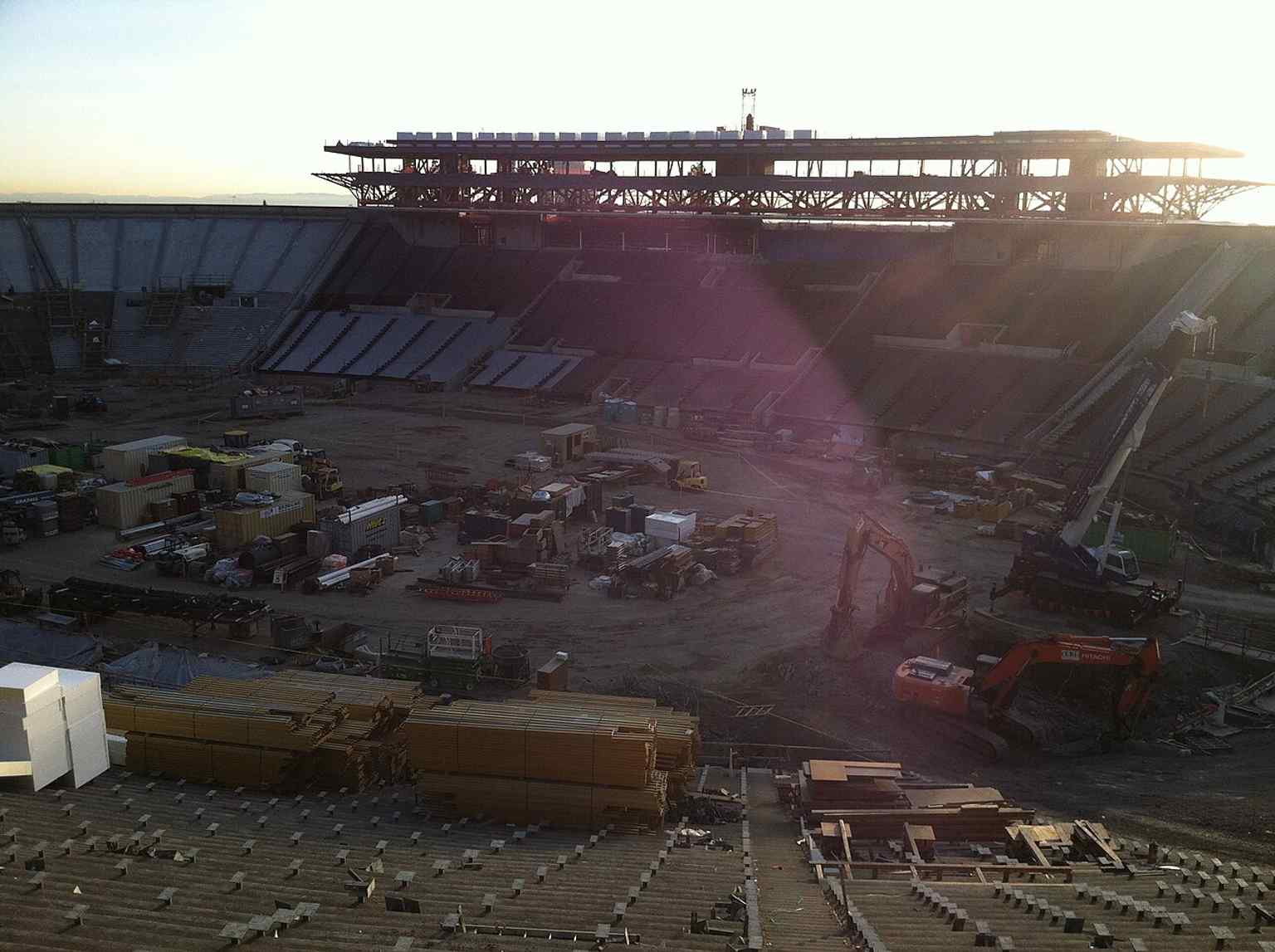
A late-2011 view from Vista Point shows the renovation nearing completion above Strawberry Canyon, just before the stadium reopened.Photo: CASportsFan, Wikimedia Commons, CC0. Cropped & resized. 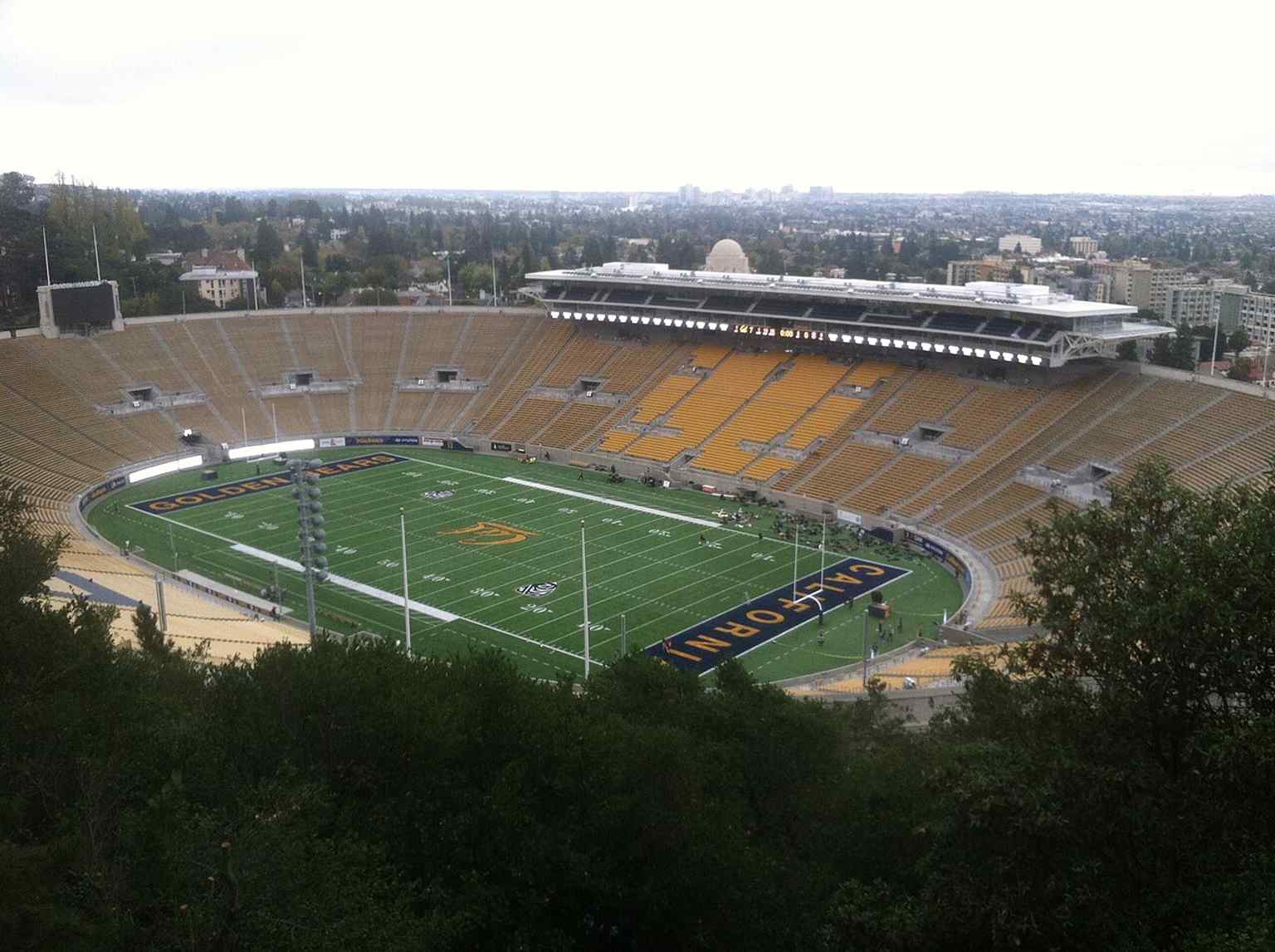
The post-renovation stadium in 2012 shows the modernized west side while preserving the historic exterior that defines Memorial Stadium.Photo: Andrew Hogan, Wikimedia Commons, CC BY-SA 3.0. Cropped & resized. Look for the steep earthen hillside rising above the stadium, shaped into rough terraces, with a concrete-and-stone platform for the California Victory Cannon near the edge.…Read moreShow less
Open dedicated page →Look for the steep earthen hillside rising above the stadium, shaped into rough terraces, with a concrete-and-stone platform for the California Victory Cannon near the edge.
This is Tightwad Hill... Berkeley’s most cheerful little act of defiance. Officially it’s part of Charter Hill, but nobody remembers it that way. People remember the joke in the name: if you climb up here, you can watch Cal football for free.
And people have. The hill itself only appeared in nineteen twenty-three, when workers piled up dirt from the excavation of lower Strawberry Canyon while building Memorial Stadium. On the twenty-fourth of November that year, the stadium sold out for its first Big Game, so students and fans scrambled up this brand-new slope and watched Cal beat Stanford nine to nothing. A tradition was born almost by accident.
Locals will tell you the instinct is even older. A later Chronicle columnist traced it back to the Big Game of nineteen hundred, when spectators climbed onto a nearby roof to see Cal and Stanford without paying. Berkeley has always had a talent for finding the unofficial balcony.
By the mid-two thousands, Tightwad Hill had its own tiny society: families, alumni, neighbors, regulars... and rules. U-S-C and U-C-L-A colors were not welcome, and Stanford red was said to be forbidden. Even the free section had standards.
Then came a fight over whether this view would survive. In two thousand and six, Cal alumnus Dan Sicular became the public face of Save Tightwad Hill. He carried a petition, argued that this slope belonged to the public imagination as much as the university, and pushed back when renovation plans threatened to block the sightlines. The group sued, and eventually the university agreed in principle to preserve the hill’s role in Cal football life.
When the stadium closed for its major rebuild in two thousand and eleven, the view turned strange: no field, no stands, just dirt, fences, and machinery. If you want, glance at the before-and-after image in the app to see how the reopened hill looked out on a completely remade stadium in two thousand and twelve.
And off to the side sits one of Berkeley’s great theatrical props: the Victory Cannon. Since the Pac-Eight banned cannons inside stadiums in nineteen seventy-two, Cal simply moved theirs out here and kept firing. Every touchdown, every run-out, every win... boom. They call it Oski’s Mighty Thunder. Once, in nineteen ninety-one, Cal scored twelve touchdowns against Pacific and the cannon crew actually ran out of ammunition.
What makes a place truly belong to the public... the structure with the ticket gate, or the hillside where people insist on gathering anyway?
That may be Berkeley’s sweetest answer. All through this campus, people argued over what should stay, what should change, and who gets a say. Here, the last word comes from the margins: a patch of earth, a stolen view, a cannon blast, and a crowd refusing to be left out. That’s how legends survive here... not only inside the gates, but wherever people find a way to join in.
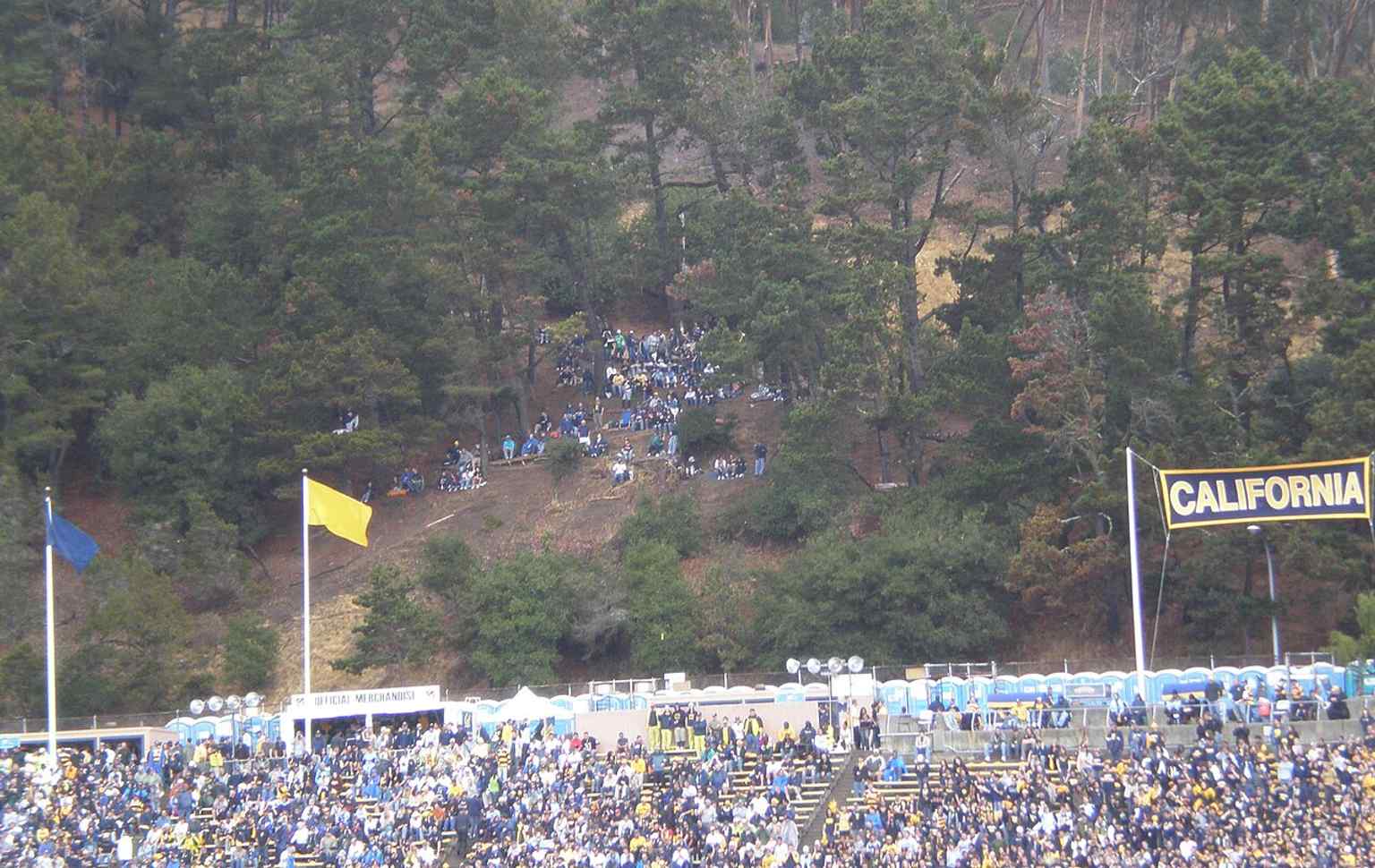
The hill from the stadium side, emphasizing how close this unofficial fan section sits to Memorial Stadium’s east rim.Photo: BrokenSphere, Wikimedia Commons, CC BY-SA 4.0. Cropped & resized.
Frequently asked questions
How do I start the tour?
After purchase, download the AudaTours app and enter your redemption code. The tour will be ready to start immediately - just tap play and follow the GPS-guided route.
Do I need internet during the tour?
No! Download the tour before you start and enjoy it fully offline. Only the chat feature requires internet. We recommend downloading on WiFi to save mobile data.
Is this a guided group tour?
No - this is a self-guided audio tour. You explore independently at your own pace, with audio narration playing through your phone. No tour guide, no group, no schedule.
How long does the tour take?
Most tours take 60–90 minutes to complete, but you control the pace entirely. Pause, skip stops, or take breaks whenever you want.
What if I can't finish the tour today?
No problem! Tours have lifetime access. Pause and resume whenever you like - tomorrow, next week, or next year. Your progress is saved.
What languages are available?
All tours are available in 50+ languages. Select your preferred language when redeeming your code. Note: language cannot be changed after tour generation.
Where do I access the tour after purchase?
Download the free AudaTours app from the App Store or Google Play. Enter your redemption code (sent via email) and the tour will appear in your library, ready to download and start.
If you don't enjoy the tour, we'll refund your purchase. Contact us at [email protected]
Checkout securely with 






.jpg)


.JPG)


.JPG)


%20entrance%20tall.jpg)

%20detail.jpg)


.JPG)


.jpg)
.jpg)
.jpg)

