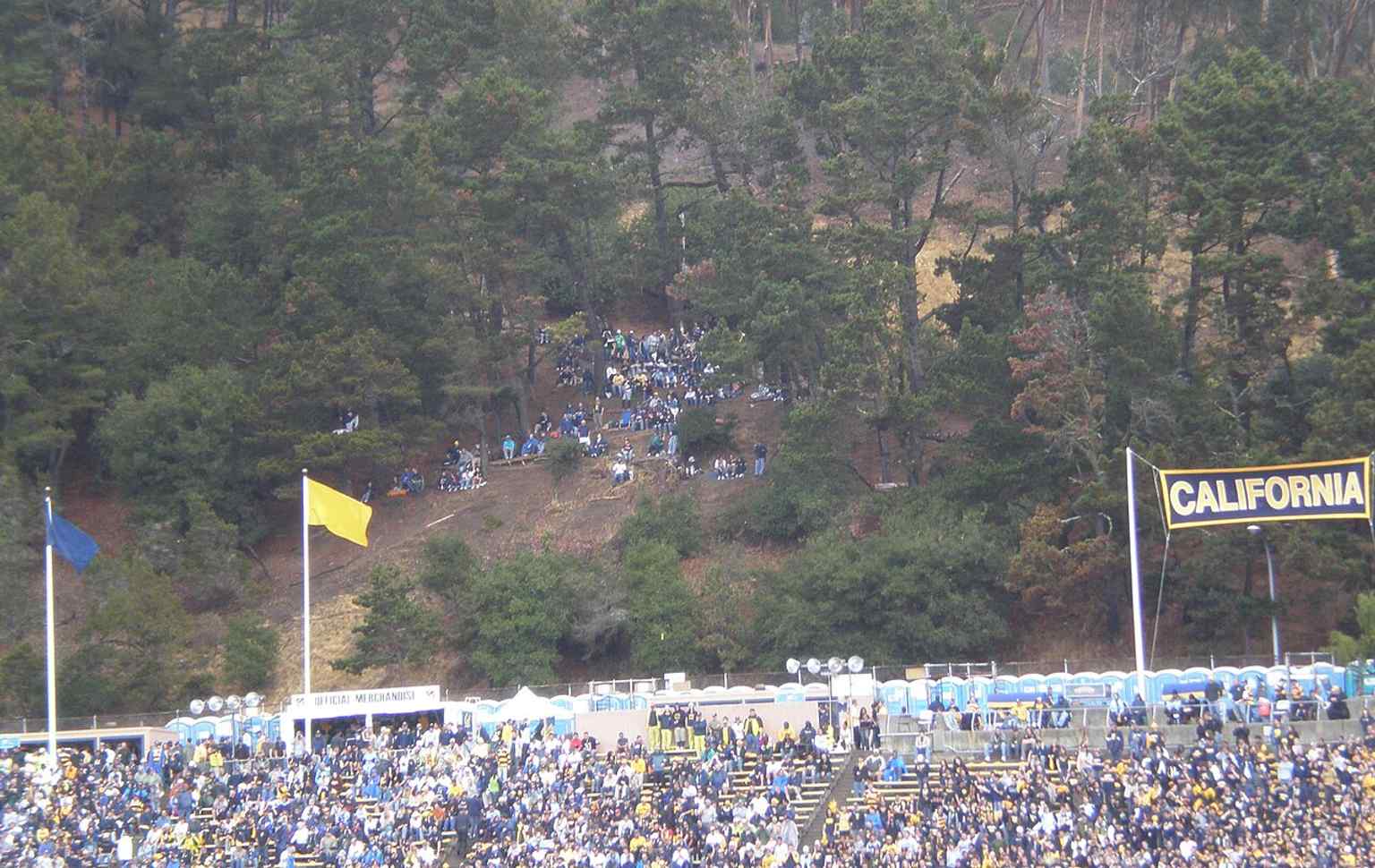
Look for the steep earthen hillside rising above the stadium, shaped into rough terraces, with a concrete-and-stone platform for the California Victory Cannon near the edge.
This is Tightwad Hill... Berkeley’s most cheerful little act of defiance. Officially it’s part of Charter Hill, but nobody remembers it that way. People remember the joke in the name: if you climb up here, you can watch Cal football for free.
And people have. The hill itself only appeared in nineteen twenty-three, when workers piled up dirt from the excavation of lower Strawberry Canyon while building Memorial Stadium. On the twenty-fourth of November that year, the stadium sold out for its first Big Game, so students and fans scrambled up this brand-new slope and watched Cal beat Stanford nine to nothing. A tradition was born almost by accident.
Locals will tell you the instinct is even older. A later Chronicle columnist traced it back to the Big Game of nineteen hundred, when spectators climbed onto a nearby roof to see Cal and Stanford without paying. Berkeley has always had a talent for finding the unofficial balcony.
By the mid-two thousands, Tightwad Hill had its own tiny society: families, alumni, neighbors, regulars... and rules. U-S-C and U-C-L-A colors were not welcome, and Stanford red was said to be forbidden. Even the free section had standards.
Then came a fight over whether this view would survive. In two thousand and six, Cal alumnus Dan Sicular became the public face of Save Tightwad Hill. He carried a petition, argued that this slope belonged to the public imagination as much as the university, and pushed back when renovation plans threatened to block the sightlines. The group sued, and eventually the university agreed in principle to preserve the hill’s role in Cal football life.
When the stadium closed for its major rebuild in two thousand and eleven, the view turned strange: no field, no stands, just dirt, fences, and machinery. If you want, glance at the before-and-after image in the app to see how the reopened hill looked out on a completely remade stadium in two thousand and twelve.
And off to the side sits one of Berkeley’s great theatrical props: the Victory Cannon. Since the Pac-Eight banned cannons inside stadiums in nineteen seventy-two, Cal simply moved theirs out here and kept firing. Every touchdown, every run-out, every win... boom. They call it Oski’s Mighty Thunder. Once, in nineteen ninety-one, Cal scored twelve touchdowns against Pacific and the cannon crew actually ran out of ammunition.
What makes a place truly belong to the public... the structure with the ticket gate, or the hillside where people insist on gathering anyway?
That may be Berkeley’s sweetest answer. All through this campus, people argued over what should stay, what should change, and who gets a say. Here, the last word comes from the margins: a patch of earth, a stolen view, a cannon blast, and a crowd refusing to be left out. That’s how legends survive here... not only inside the gates, but wherever people find a way to join in.