
St. Gallen Highlights Audio Tour: Medieval Treasures and Textile Heritage
Beneath the pristine facade of St. Gallen, medieval scripts whisper of power struggles that once shook the foundations of Europe. This city is not merely a backdrop of steeples but a battleground of intellect and defiance. Uncover these layers with a self guided audio tour designed to bypass the surface. Navigate hidden corners where history refuses to stay buried. Why did a local revolt almost vanish from the official archives? What dark secret remains etched into the walls of the Abbey District? How did a single piece of embroidery trigger a scandal that ruined a powerful merchant family? Traverse the cobblestones as past scandals rise to meet you. Experience a sensory journey through centuries of political tension and creative obsession. Transform your perspective on this quiet Swiss gem and leave behind the typical tourist path. Press play and expose the shadows hidden in plain sight.
Tour preview
About this tour
- scheduleDuration 80–100 minsGo at your own pace
- straighten2.7 km walking routeFollow the guided path
- location_onLocationSankt Gallen, Switzerland
- wifi_offWorks offlineDownload once, use anywhere
- all_inclusiveLifetime accessReplay anytime, forever
- location_onStarts at Karlstor (St. Gallen)
Stops on this tour
lock_open 3 free previews · 11 unlock with purchase
Look for a pale stone gate with a tall pointed arch, a steep gabled roof, and a large carved relief spread above the opening like a stone storybook. This is Karlstor, the only…Read moreShow less
Open dedicated page →Look for a pale stone gate with a tall pointed arch, a steep gabled roof, and a large carved relief spread above the opening like a stone storybook.
This is Karlstor, the only surviving city gate from St. Gallen’s medieval wall... and like many survivors, it earned that status by sitting right in the middle of trouble. People first called it the New Gate, or the Abbot’s Gate, because this opening served the prince-abbot and his entourage. It rose here in fifteen sixty-nine and fifteen seventy, after decades of arguments between the city and the abbey over power, access, and who got to act like the grown-up in the room.
By the fourteen hundreds, St. Gallen had gained imperial independence, which meant the city answered directly to the Holy Roman Emperor, not to a local lord. The abbey, meanwhile, had its own authority and ambitions. Then came the Reformation. In fifteen twenty-six, Joachim von Watt, better known as Vadian, pushed the city into the new Protestant faith, while the abbey stayed firmly Catholic. So now the same walls protected two neighbors who agreed on almost nothing. Awkward, yes... and politically explosive.
The prince-abbot hated having to pass through the city’s gates to reach his own territories. Earlier abbots had tried to secure a private exit and failed. Finally, in fifteen sixty-six, Swiss mediators brokered the Treaty of Wil. Abbot Otmar Kunz won the right to cut his own gate through the city wall, complete with a drawbridge and a zwinger, which is a narrow fortified passage meant to trap attackers between defenses. In practice, though, the grand plan shrank a bit. Instead of a drawbridge, builders laid a narrow causeway and a wooden bridge over the Steinach, which still ran openly here at the time. The zwinger seems never to have appeared at all. Even sixteenth-century projects had a way of losing features between the sketch and the final bill.
Now look up at that relief. If you check the close-up on your screen, you can catch details that are easy to miss from the ground. The stonecutter Baltus von Seilmannsweiler packed it with messages. At the top, Christ hangs on the cross with Mary and John beside him. Nearby sit the coats of arms of Pope Pius the Fourth and Emperor Maximilian the Second, a bold reminder of the abbey’s standing. In the middle, Saint Otmar appears with a wine barrel, and Saint Gallus stands with his bear, the animal from the city’s founding legend. And down at the bottom, tucked into the carving almost cheekily, there’s a tiny crouching man with hammer and chisel... probably the artist signing his work without bothering with a signature.
That relief nearly disappeared in the late seventeen hundreds, when revolution and anti-aristocratic fury inspired a second wave of image-breaking. A local historian, Georg Leonhard Hartmann, stopped a government commissioner from destroying it. For monument preservation, that was an unusually early save... a small miracle performed with paperwork and backbone.
Above the arch, those rows of narrow windows tell another chapter. By at least the seventeen hundreds, and officially by eighteen twelve, the rooms overhead served as prison cells. They still function as detention space today, which gives the gate a certain grim efficiency.
If you want a better sense of how the wall once stretched around it, the wider view in the app helps fill in the missing defensive world around this doorway. Karlstor itself is accessible to view at any hour.
For one gate, it carries an impressive load of faith, rivalry, vanity, and stonecraft.
Take one more look, and when you’re ready, we can continue to the next stop.
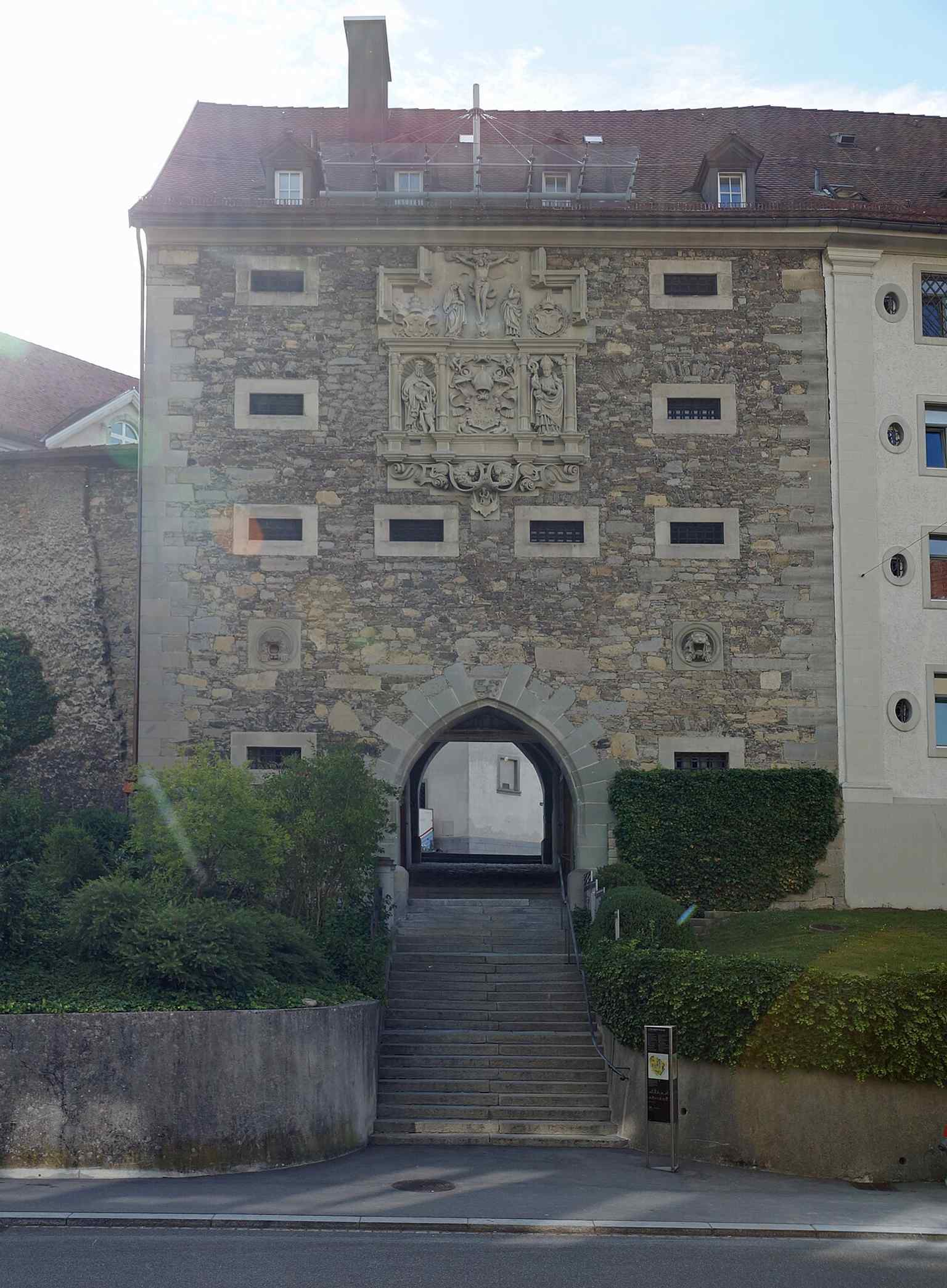
The outer face of Karlstor, the only surviving medieval city gate of St. Gallen and the one built in 1569–1570.Photo: albinfo, Wikimedia Commons, CC BY-SA 3.0. Cropped & resized. On your left, look for the pale stone Baroque church with its broad curved front, twin towers rising high above it, and the little onion-shaped lantern crowning the gable. This…Read moreShow less
Open dedicated page →On your left, look for the pale stone Baroque church with its broad curved front, twin towers rising high above it, and the little onion-shaped lantern crowning the gable.
This is the Collegiate Church of Saint Gallus and Otmar, later the cathedral of Saint Gallen... a building with the confidence of an empire and the backstory of a monk’s cell. The church you see now belongs mostly to the mid eighteenth century, but the story starts much earlier, around the grave of Gallus, the Irish missionary whose name the city still carries.
Around the year seven twenty, Abbot Otmar reorganized the little religious community here and turned it into a proper monastery. Stone buildings went up, including an early church with three aisles and a crypt, which is an underground sacred chamber. Archaeologists, digging here in the nineteen sixties, found carved sandstone pieces from that early world... two hundred and sixty-six of them. Some even carried holes from later reuse, where workers had hooked in lifting tongs after a fire in fourteen eighteen damaged the choir. Medieval thrift, in stone.
One of the great ideas born here was the Saint Gallen monastery plan, drawn in the Carolingian age, around the early ninth century. It is famous because it shows, for the first time in Europe, a separate building for a library and a writing workshop. Not bad for a monastery that began as a remote spiritual outpost. The monks clearly believed prayer and paperwork could live quite happily together.
By the seventeen hundreds, the old abbey church had become dangerously worn out, so the abbots decided on a full rebuild. Peter Thumb took charge of the main body between seventeen fifty-five and seventeen fifty-seven, using plans connected to Gabriel Loser and Johann Caspar Bagnato. Later, Johann Michael Beer oversaw the new choir, and by seventeen sixty-six the twin towers were finished. If you glance at the app’s wide exterior image, you can see how this church anchors the whole abbey district.
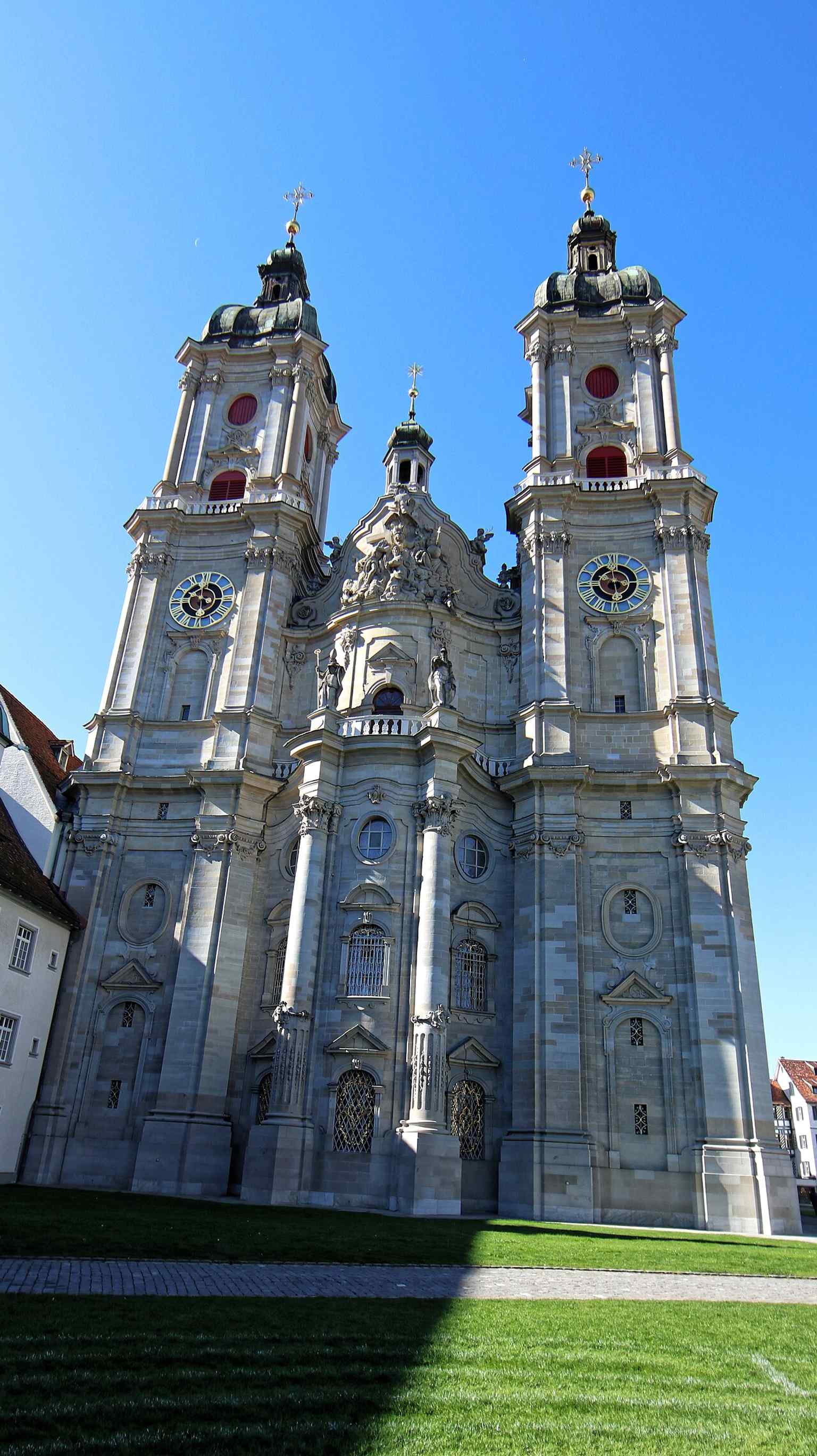
A wide view of the abbey church and monastery district — the 18th-century Baroque rebuild made St. Gallen part of a UNESCO World Heritage site in 1983.Photo: Burkhard Mücke, Wikimedia Commons, CC BY-SA 4.0. Cropped & resized. The result is one of the last great sacred buildings of the late Baroque, and it knows it. Those towers rise about sixty-eight meters, with clock faces, layered pilasters - shallow decorative columns - and a façade that pushes forward in the center like it is making a polite but firm point. This whole district entered the UNESCO, the United Nations Educational, Scientific and Cultural Organization, World Heritage list in nineteen eighty-three.
Inside, the church gets even more theatrical. On your screen, the interior view shows the nave, the main hall, opening into a rounded central space called a rotunda. Johann Christian Wentzinger shaped much of the decoration, and Joseph Wannenmacher filled the ceilings with frescoes. The design is brilliant, though the ambitious dome needed repairs almost immediately after completion. Even holy architecture, it turns out, is not immune to engineering optimism.
And since eighteen forty-seven, this former abbey church has served as the cathedral of the independent diocese of Saint Gallen, while still keeping the memory of Gallus and Otmar at its core.
If you want to go inside later, the church is generally open daily from seven in the morning to six in the evening.
This is the place where Saint Gallen turned a monastic beginning into a monument.
When you’re ready, we can head on to the Abbey Library.
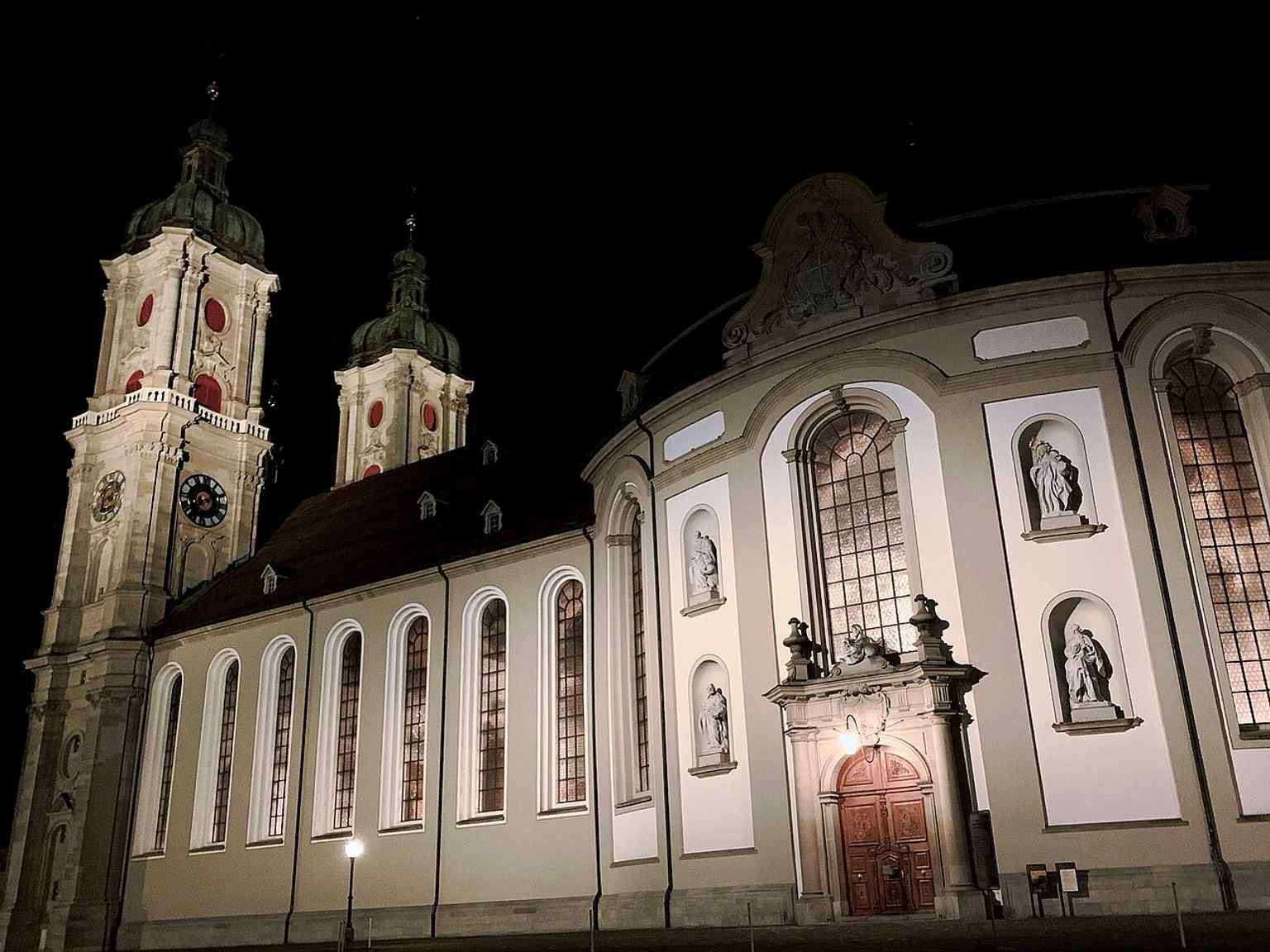
A night view of the cathedral highlights the monumental Baroque exterior after the 18th-century rebuild by Peter Thumb and Johann Christian Wentzinger.Photo: Ank Kumar, Wikimedia Commons, CC BY-SA 4.0. Cropped & resized. 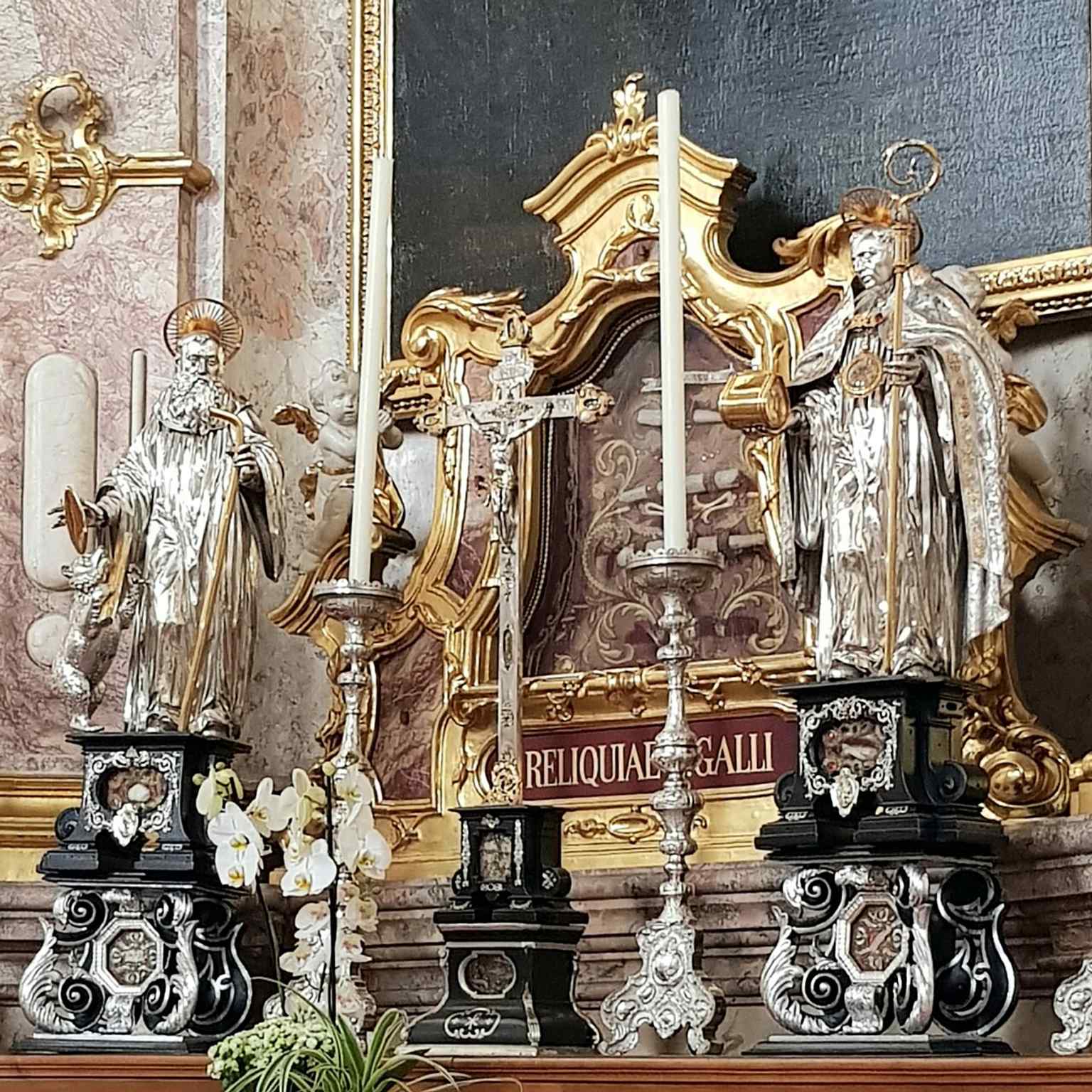
The silver statues of Saints Gallus and Otmar recall the church’s dedication to Gallus and Otmar, the founding figures of the monastery.Photo: DomenikaBo, Wikimedia Commons, CC BY-SA 4.0. Cropped & resized. 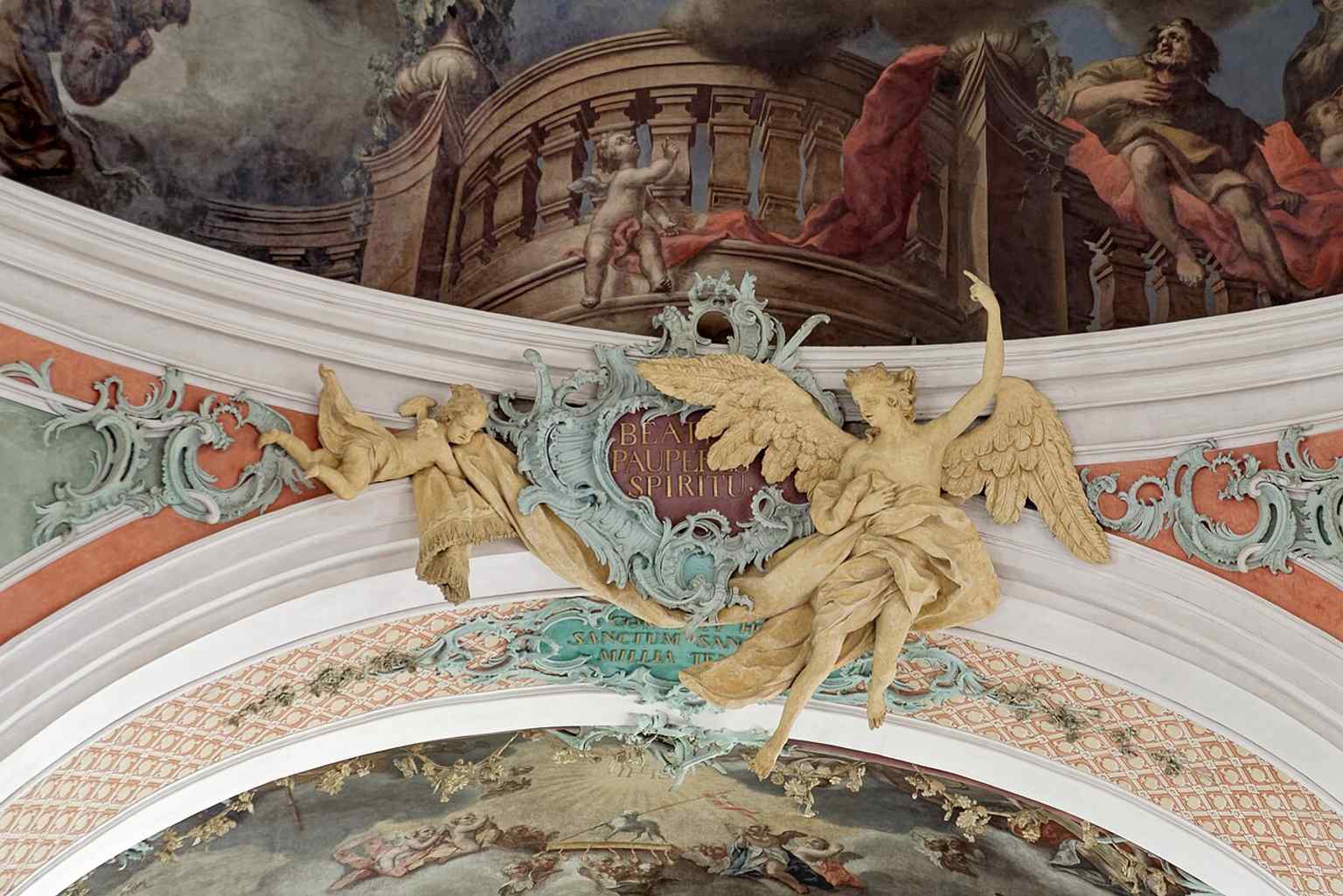
Baroque sculpture inside the church reflects the rich sculptural program that fills the interior with saints, ornament, and liturgical symbolism.Photo: Jakub Hałun, Wikimedia Commons, CC BY 4.0. Cropped & resized. On your left, look for a pale stone Baroque portal set into a gently curved facade, framed by columns and topped with the Greek inscription above the doorway. That inscription…Read moreShow less
Open dedicated page →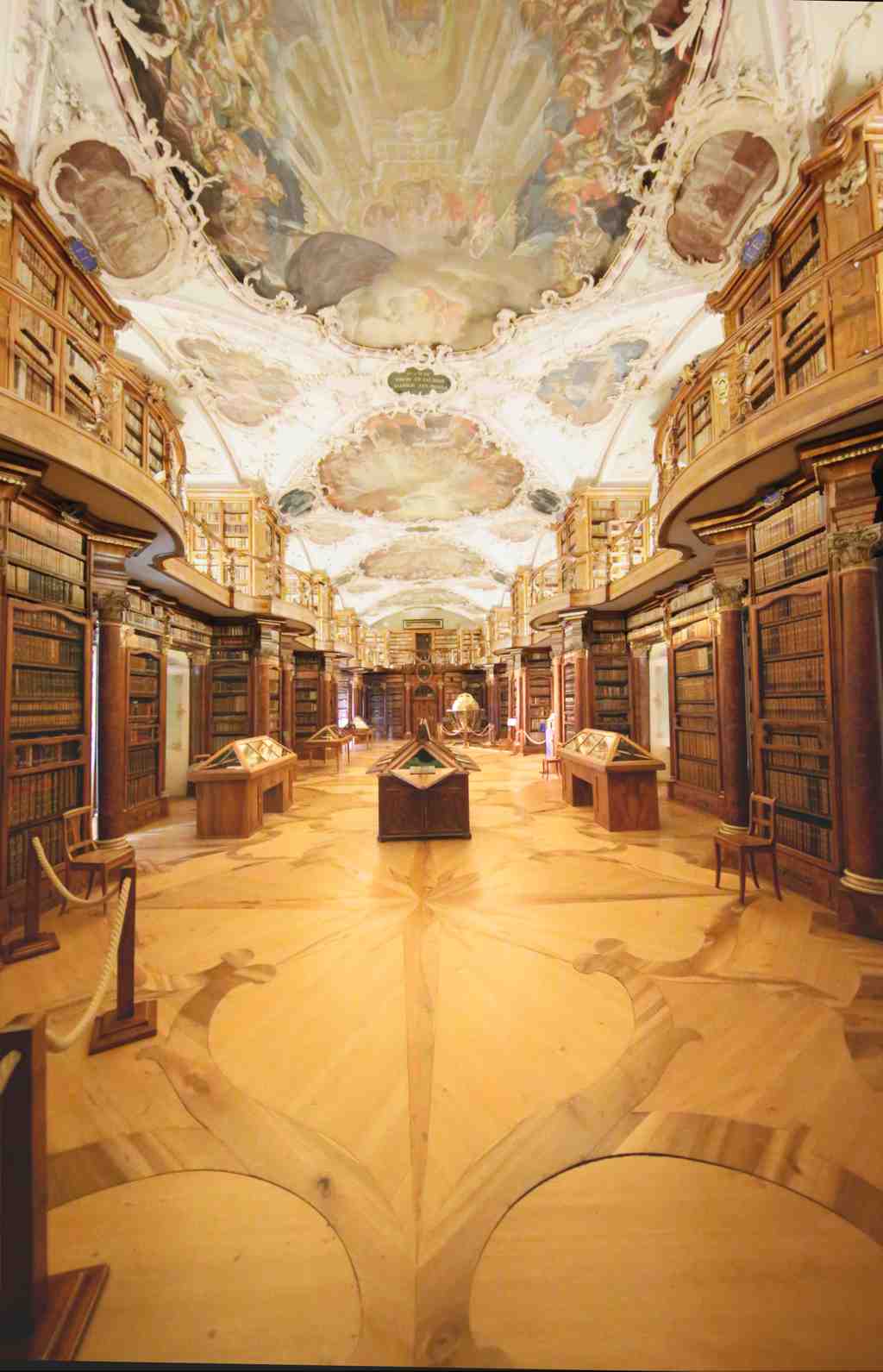
Abbey Library of St. GallenPhoto: User:Bobo11, Wikimedia Commons, CC BY-SA 4.0. Cropped & resized. On your left, look for a pale stone Baroque portal set into a gently curved facade, framed by columns and topped with the Greek inscription above the doorway.
That inscription reads Psyches Iatreion... “healing place of the soul,” or, more charmingly, a pharmacy for the spirit. Not a bad slogan for one of the world’s great historic libraries.
This place grew out of the little religious cell that the Irish monk Gallus founded here around the year six hundred twelve. Later, Abbot Otmar turned that settlement into a Benedictine abbey, and the monks began building a serious library. They copied books in a scriptorium - basically the monastery’s writing workshop - and, remarkably, the core of that collection stayed together. That almost never happened. St. Gallen still holds around two thousand one hundred manuscripts, plus a vast collection of early printed books and later volumes.
Its survival took real nerve. In nine hundred twenty-six, the recluse Wiborada warned the monks that Hungarian raiders were coming. They carried the manuscripts to safety on the island of Reichenau. Wiborada refused to leave her cell near St. Mangen. The attackers climbed in through her roof and killed her with axe blows. Because the books survived, she later became the first woman formally canonized by a pope, in ten forty-seven, and she is still the patron saint of libraries and book lovers. Tough company for anyone who returns a book late.
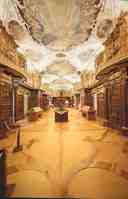
If you check the image on your screen, you can peek inside the famous hall. The room you see there, built between seventeen fifty-eight and seventeen sixty-seven, is often called the finest non-church Baroque room in Switzerland. It has a gallery running around the hall, rich woodwork made in the abbey workshop, and a delicate wooden floor inlaid with walnut stars. Visitors wear felt slippers inside, which may be the most civilized way anyone has ever been told, “Please don’t scuff the masterpiece.”
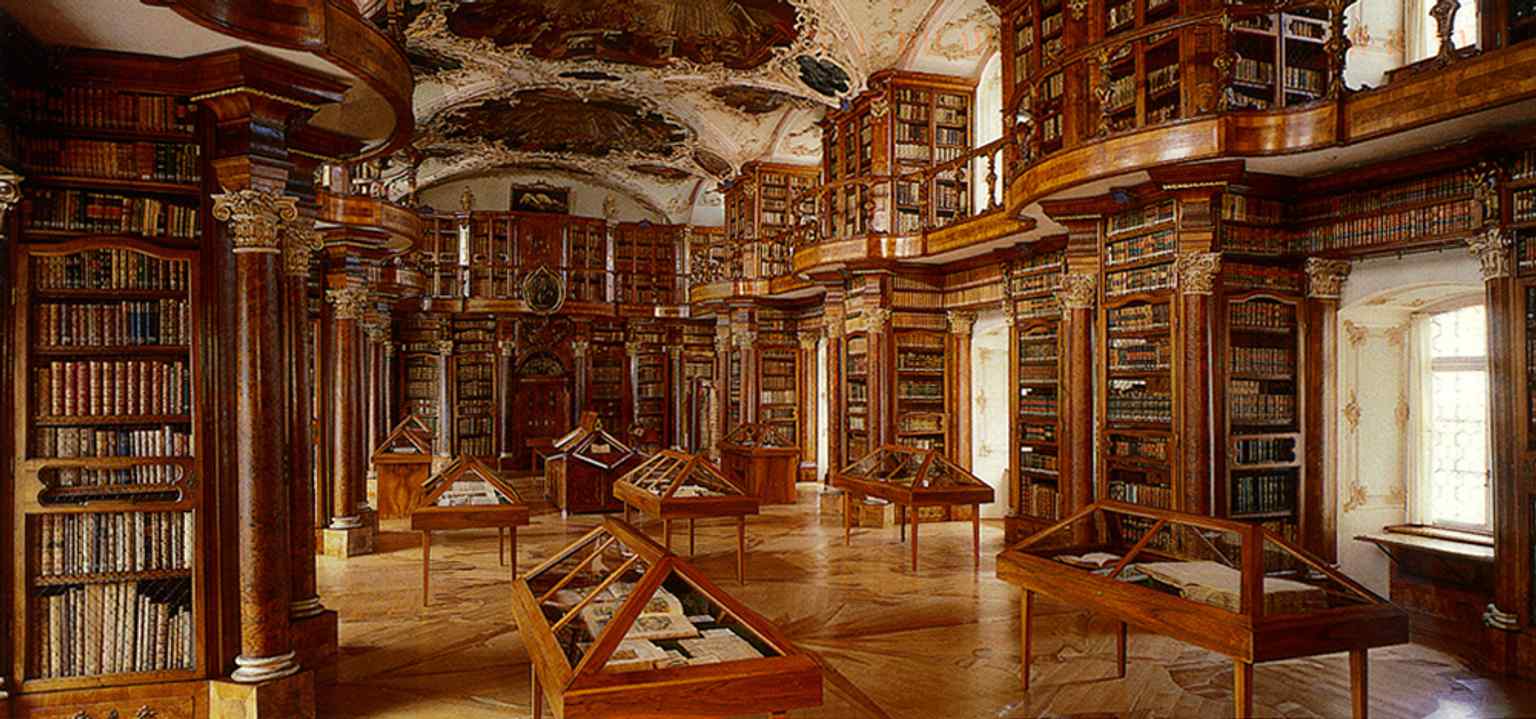
The iconic Baroque library hall, often described as one of the world’s most beautiful library interiors.Photo: Stiftsbibliothek St. Gallen, Wikimedia Commons, CC BY-SA 3.0. Cropped & resized. The library also had its share of theft and diplomacy. In seventeen twelve, Zurich and Bern troops carried off manuscripts and the great St. Gallen globe. The dispute dragged on for centuries until a settlement in two thousand six led to an exact replica for St. Gallen; you can see it in the app here.
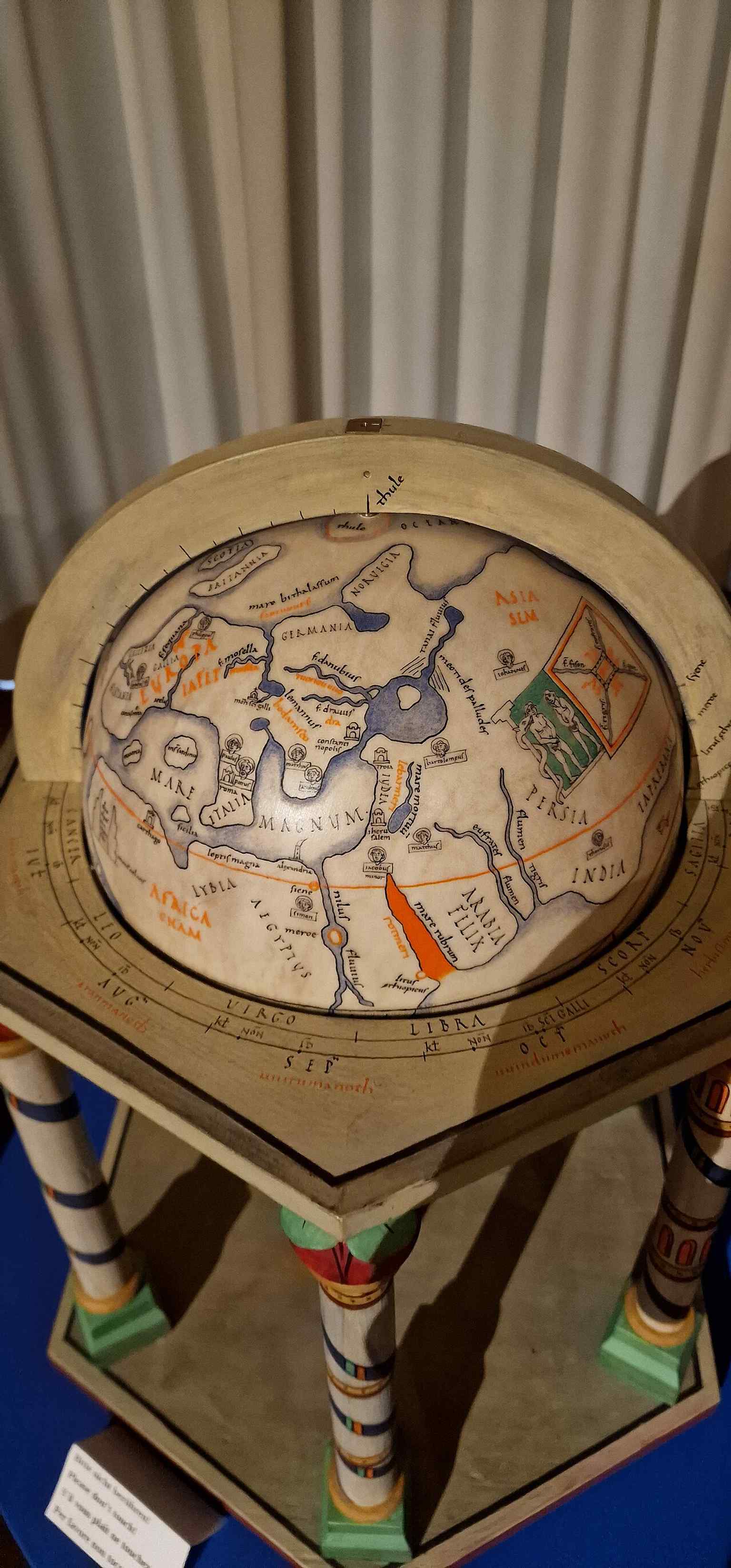
The reconstructed St. Galler Globus, linked to the famous 1712 looting and the later restitution compromise.Photo: Gre regiment, Wikimedia Commons, CC BY-SA 4.0. Cropped & resized. In twenty seventeen its documents joined the Memory of the World register. If you want to go inside later, the library is open daily from ten in the morning to five in the afternoon.
For a place devoted to quiet reading, this library has lived a surprisingly adventurous life.
Take a moment here, and when you’re ready, we can continue on to City Lounge.
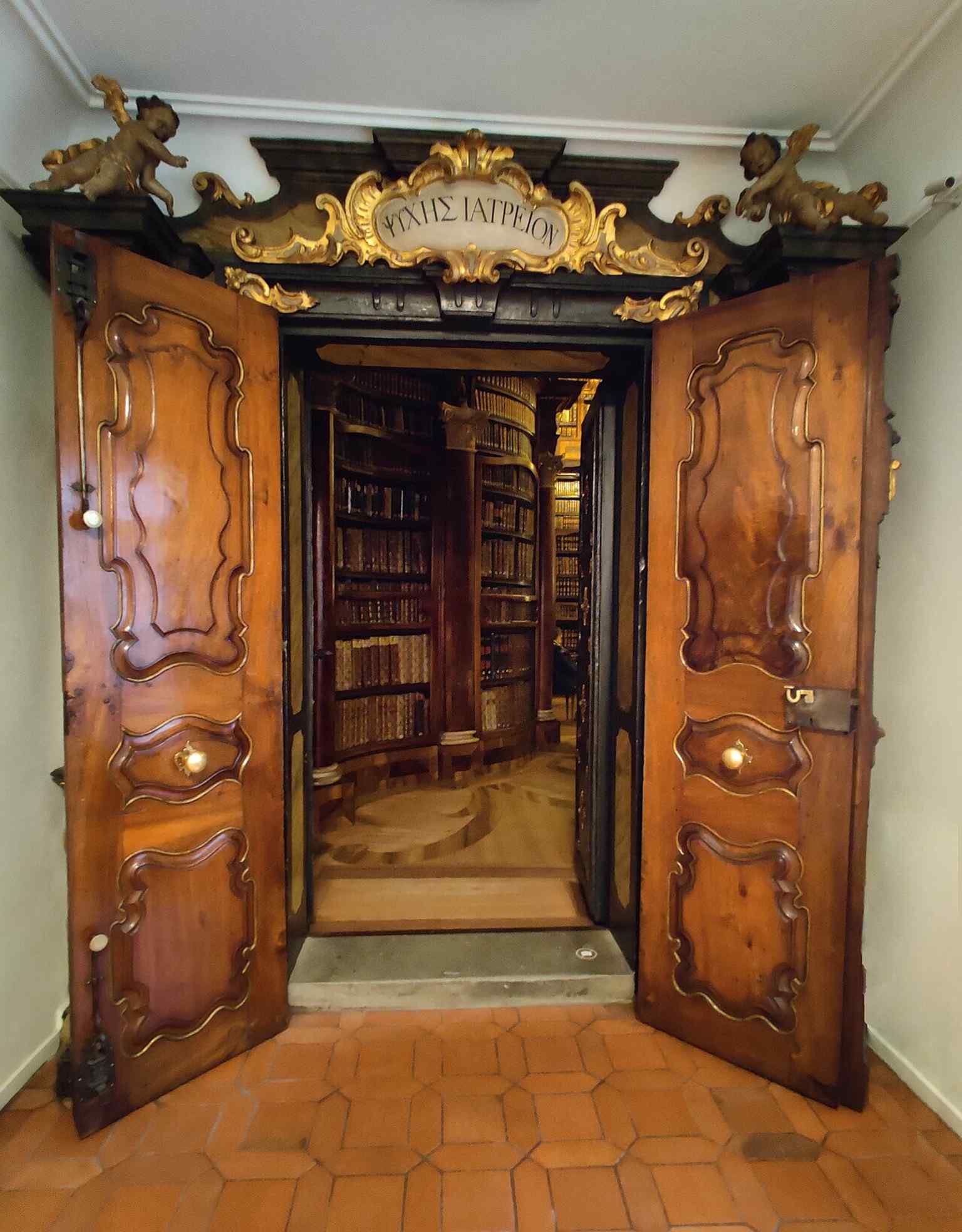
The library entrance with the Greek motto “Psyches Iatreion” — the famous “healing place of the soul” inscription above the portal.Photo: Gre regiment, Wikimedia Commons, CC BY-SA 4.0. Cropped & resized. 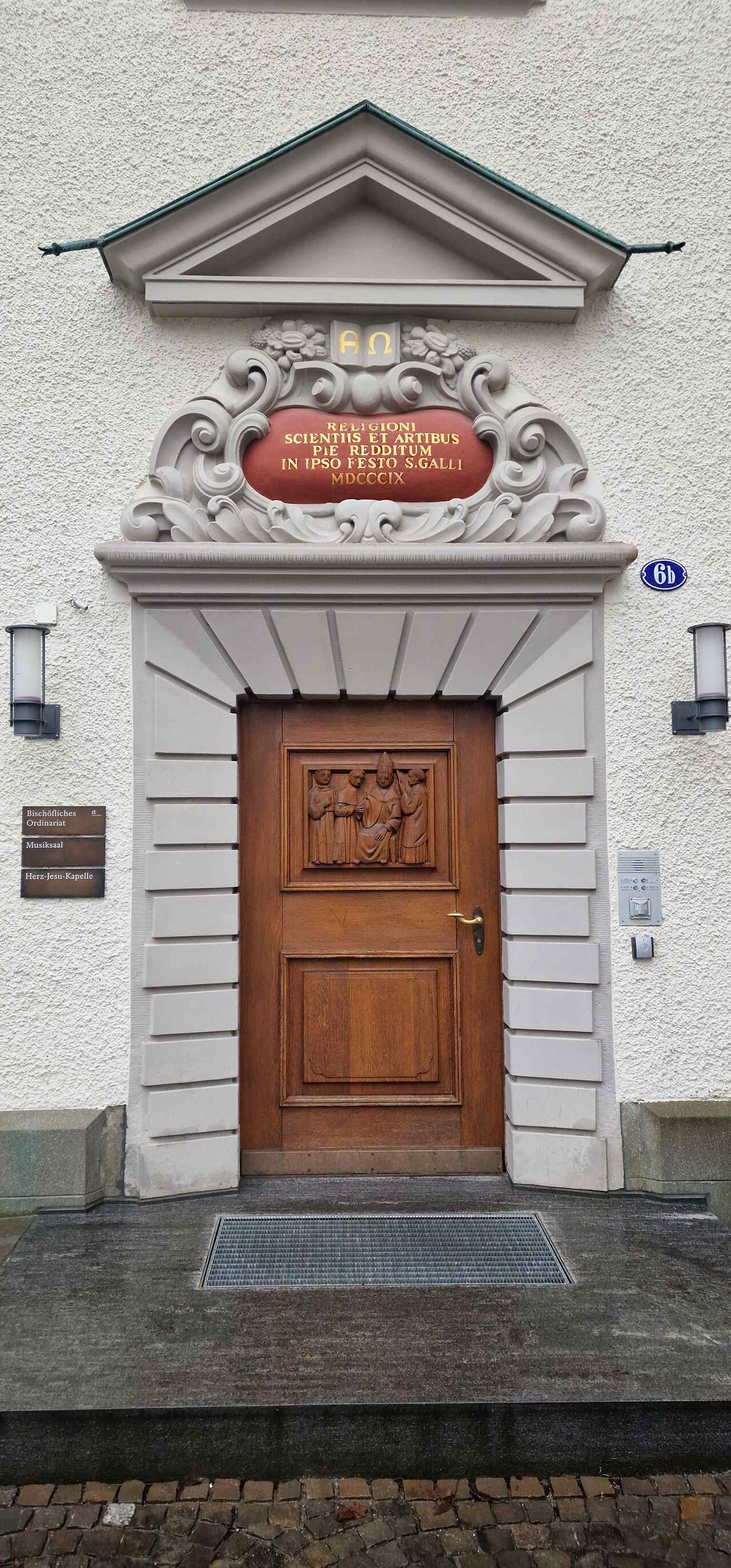
A clear view of the Abbey Library portal, tying the building to its baroque façade and historic entrance.Photo: Gre regiment, Wikimedia Commons, CC BY-SA 4.0. Cropped & resized. 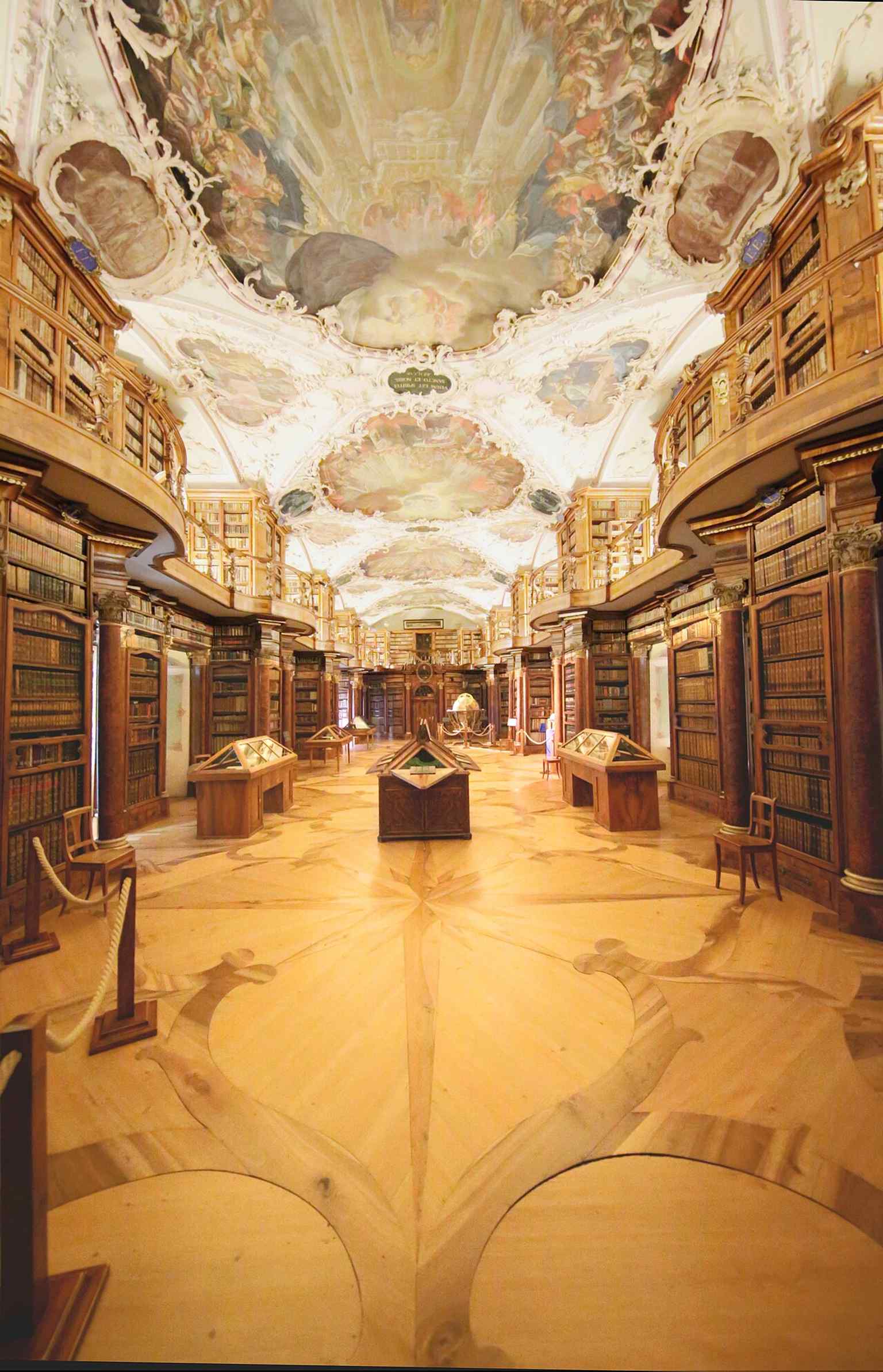
The grand reading hall without visitors, showing the elegant woodwork and the quiet museum atmosphere.Photo: User:Bobo11, Wikimedia Commons, CC BY-SA 4.0. Cropped & resized. 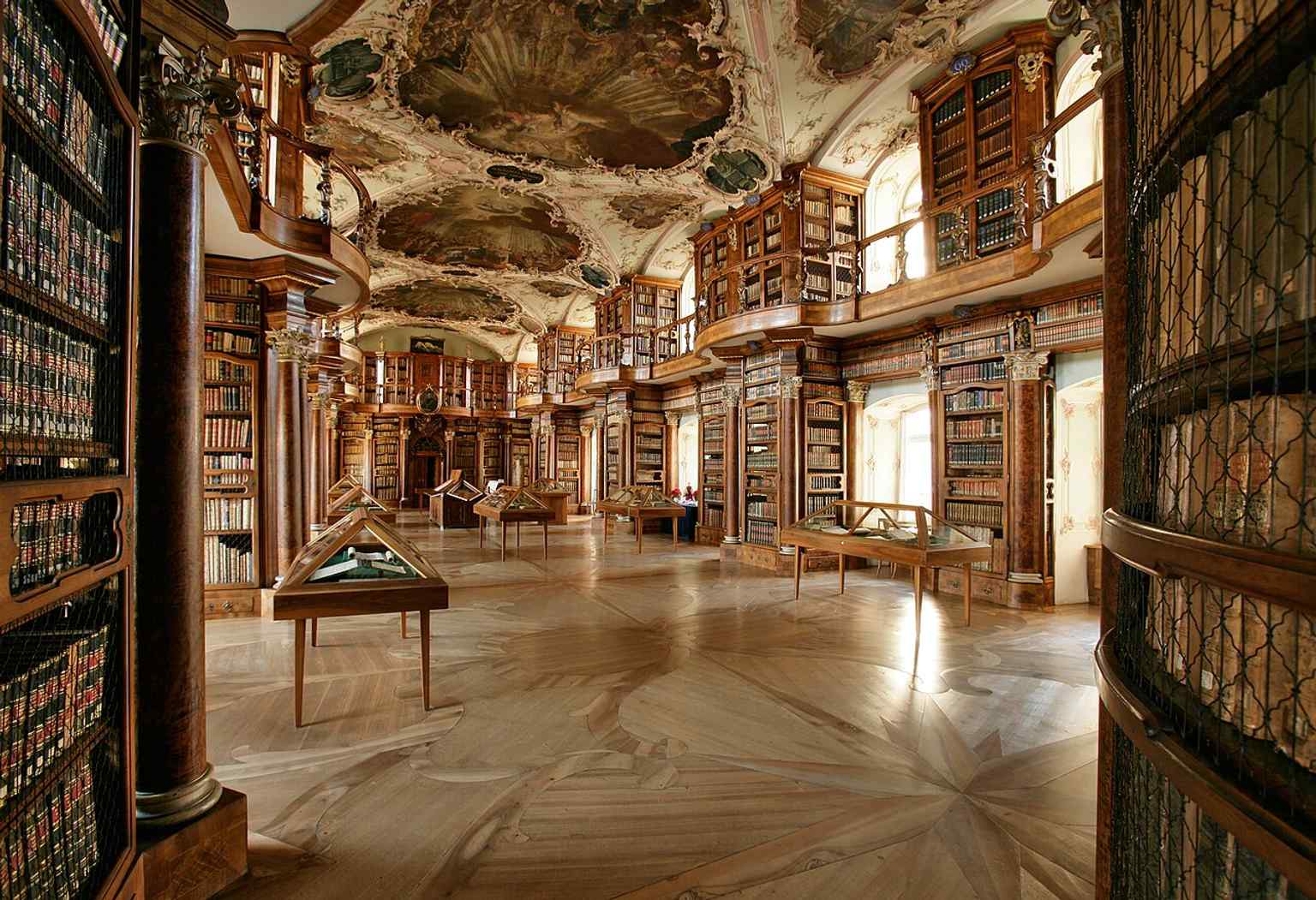
A wide interior view of the baroque hall, helpful for showing the room’s proportions and gallery level.Photo: Martin Thurnherr, Wikimedia Commons, CC BY-SA 4.0. Cropped & resized. 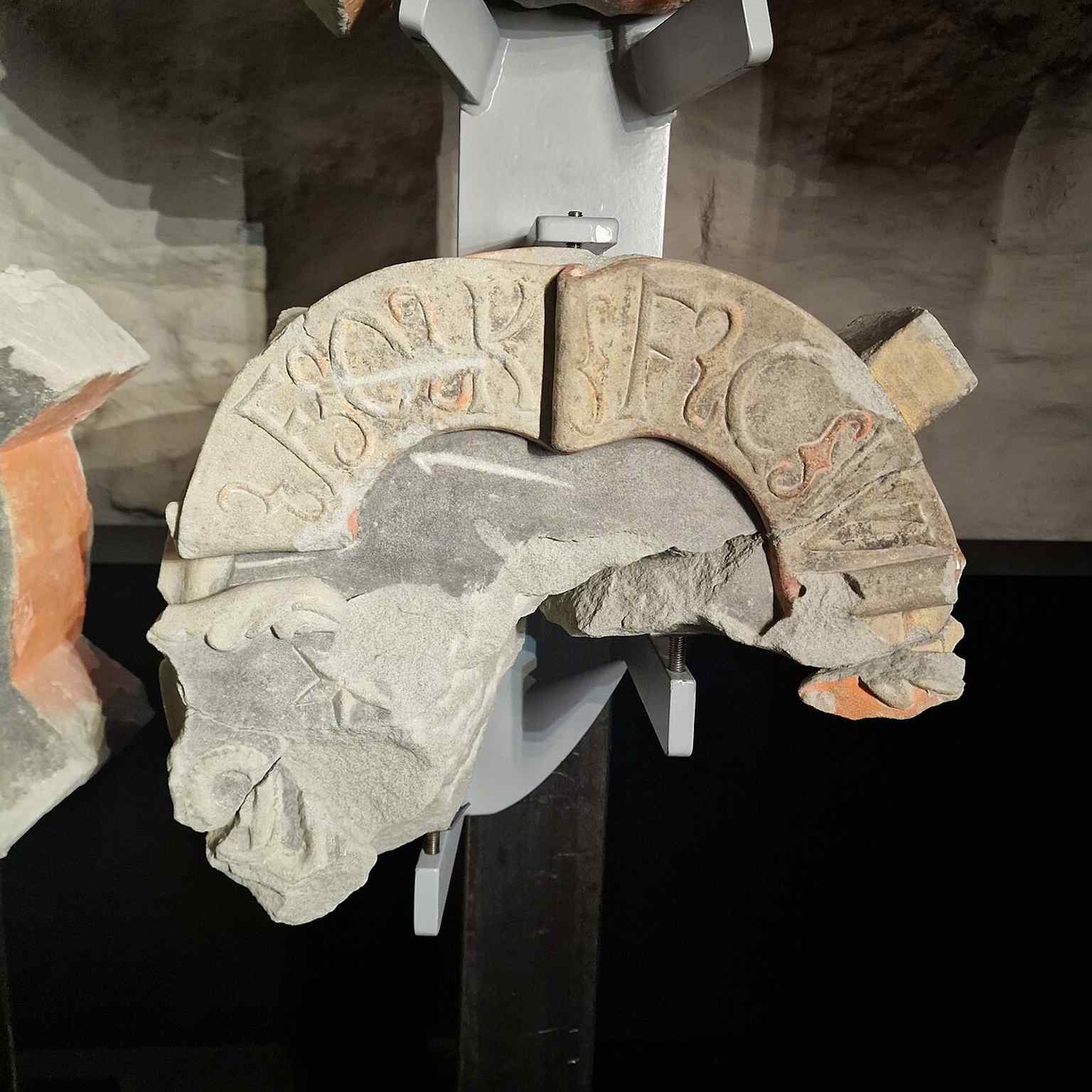
A close look at the coloured keystones with monks’ coats of arms, echoing the 16th-century predecessor library.Photo: Gre regiment, Wikimedia Commons, CC BY-SA 4.0. Cropped & resized. 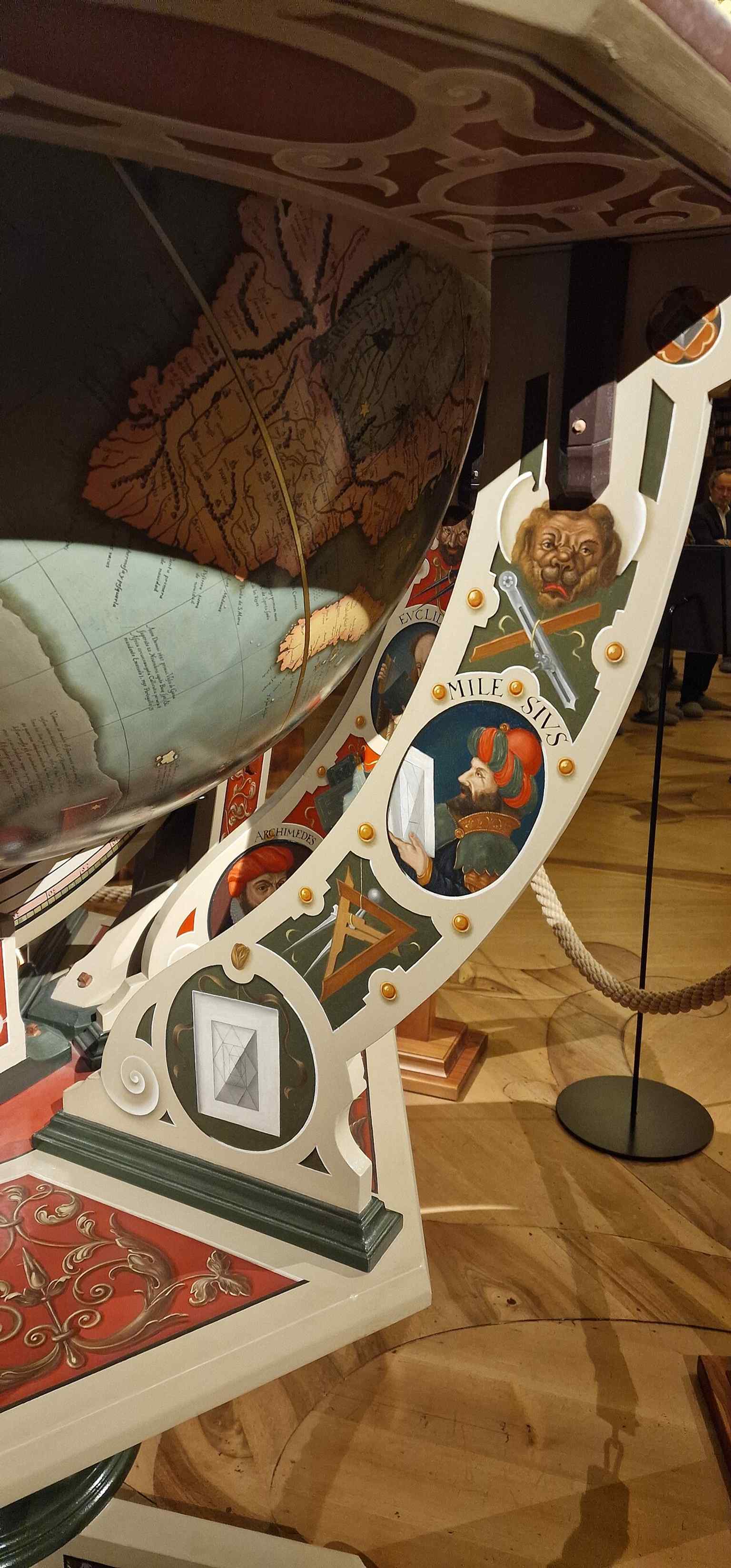
Another view of the replica globe, recalling the original 16th-century world and celestial globe now symbolically returned.Photo: Gre regiment, Wikimedia Commons, CC BY-SA 4.0. Cropped & resized. 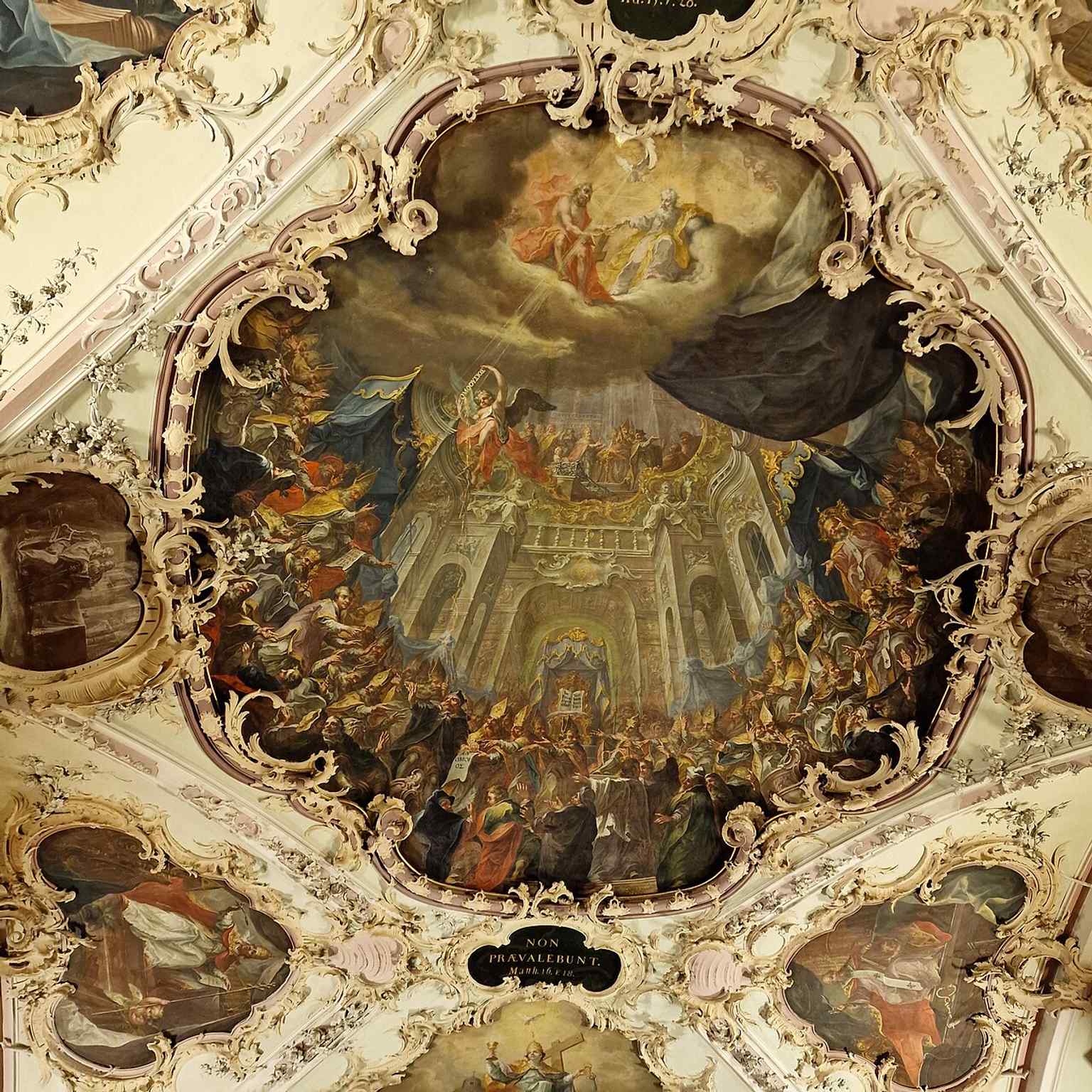
The First Council of Nicaea ceiling painting, part of the library’s iconographic program of the great ecumenical councils.Photo: Gre regiment, Wikimedia Commons, CC BY-SA 4.0. Cropped & resized. 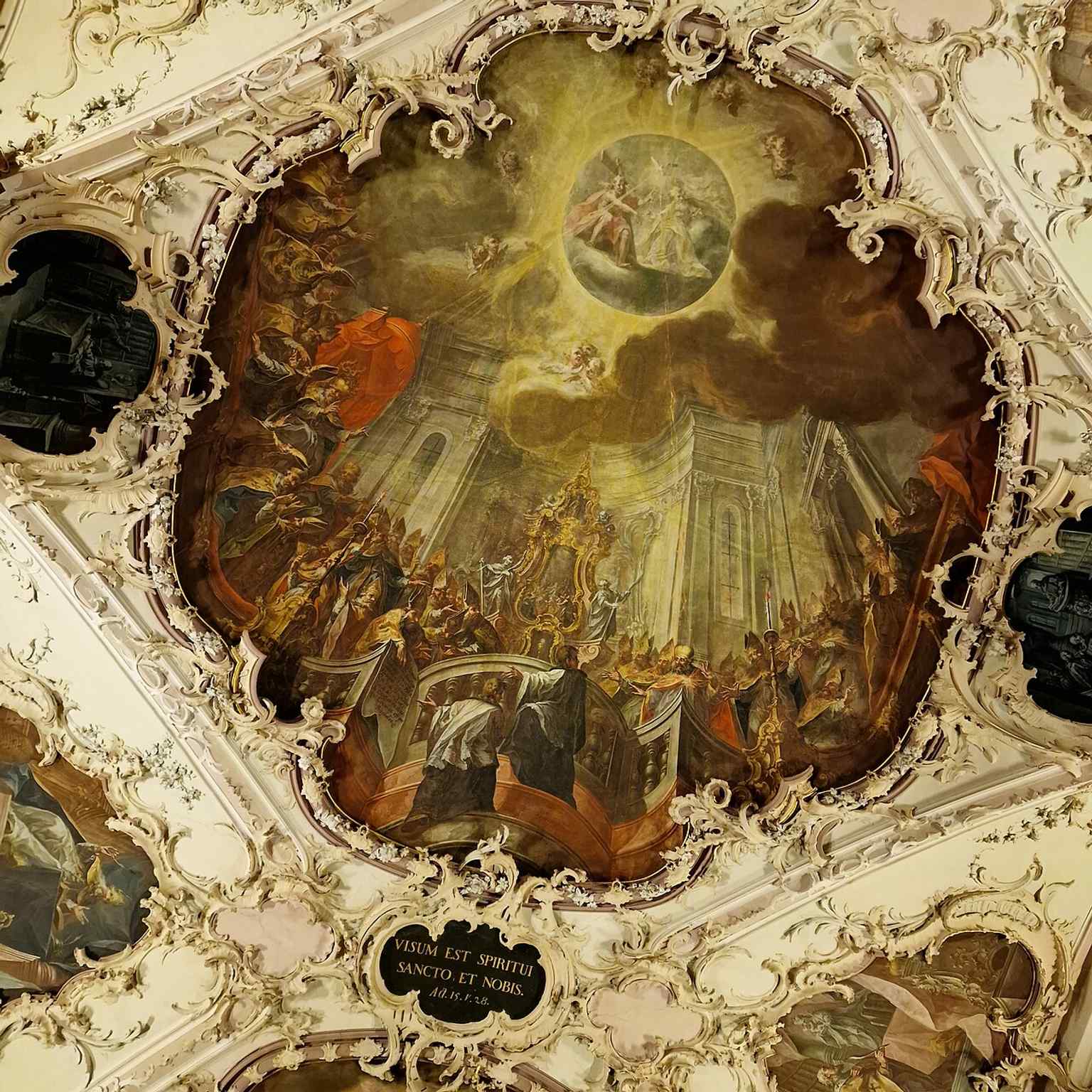
A ceiling scene of the Council of Constantinople, one of the four councils painted above the library hall.Photo: Gre regiment, Wikimedia Commons, CC BY-SA 4.0. Cropped & resized. 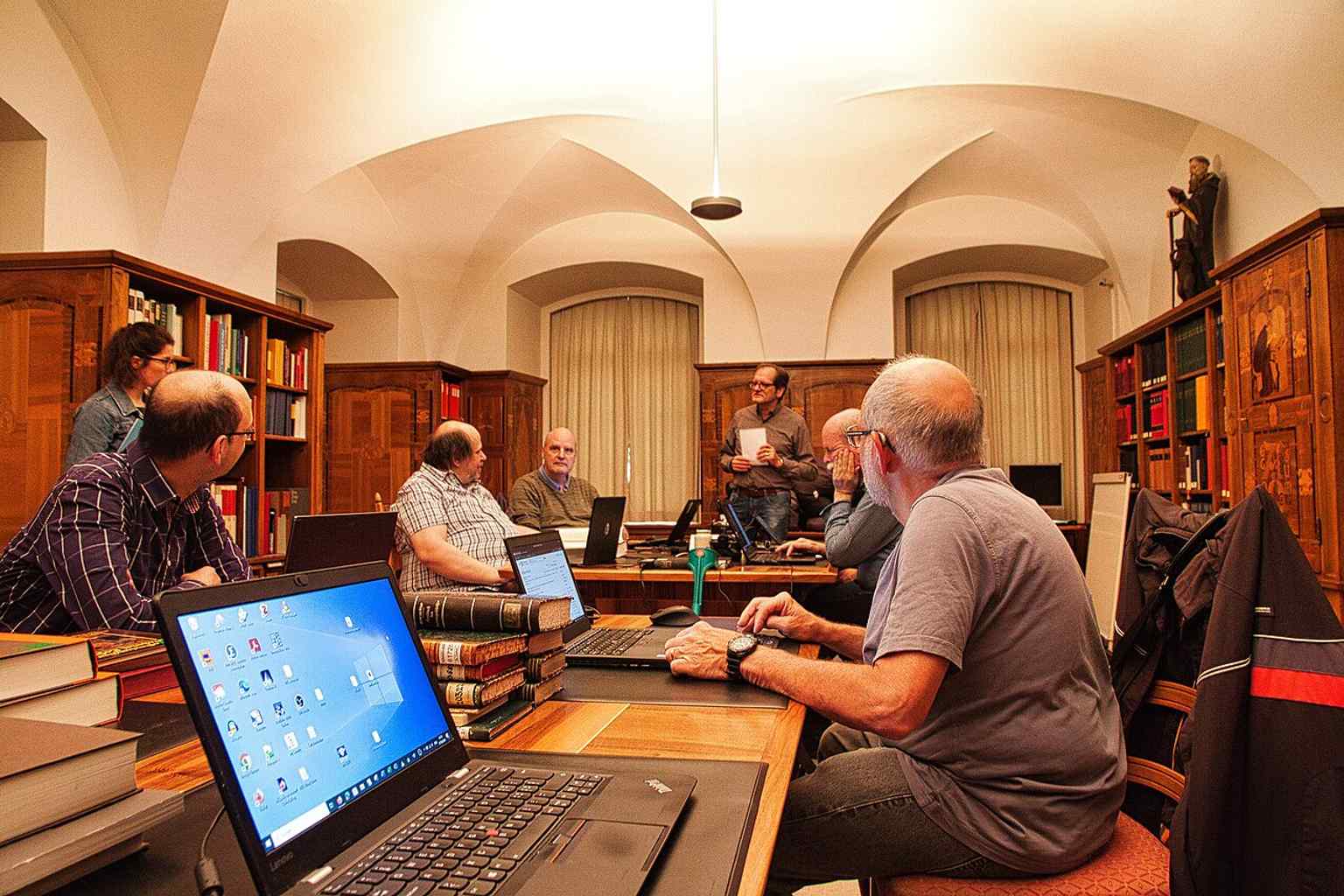
Visitors briefing in the reading room, showing the library still functioning as a living research space.Photo: Martin Thurnherr, Wikimedia Commons, CC BY-SA 4.0. Cropped & resized. 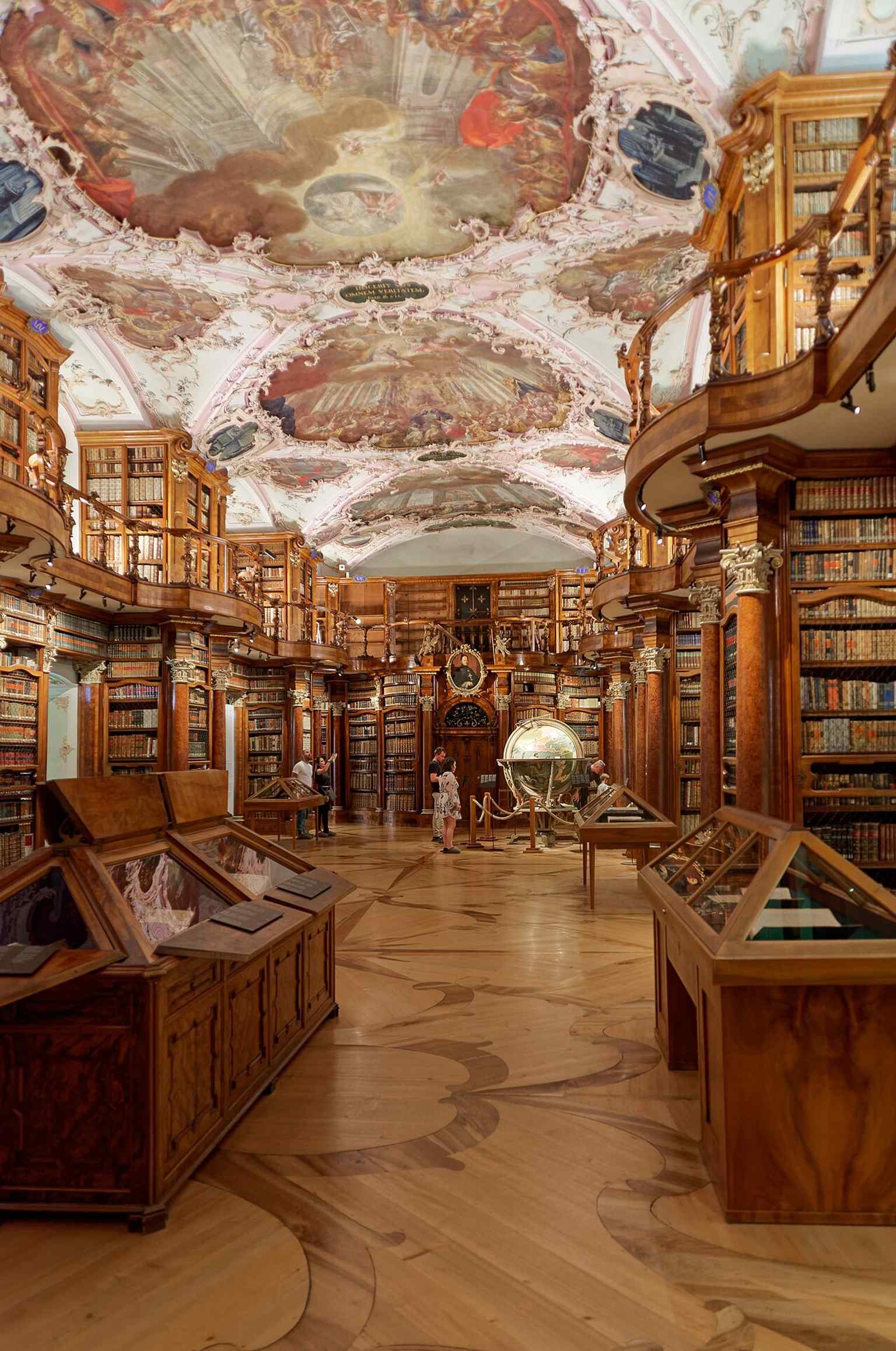
An outside view of the Stiftsbibliothek in the abbey district, where the library occupies the upper floors.Photo: Jakub Hałun, Wikimedia Commons, CC BY 4.0. Cropped & resized. 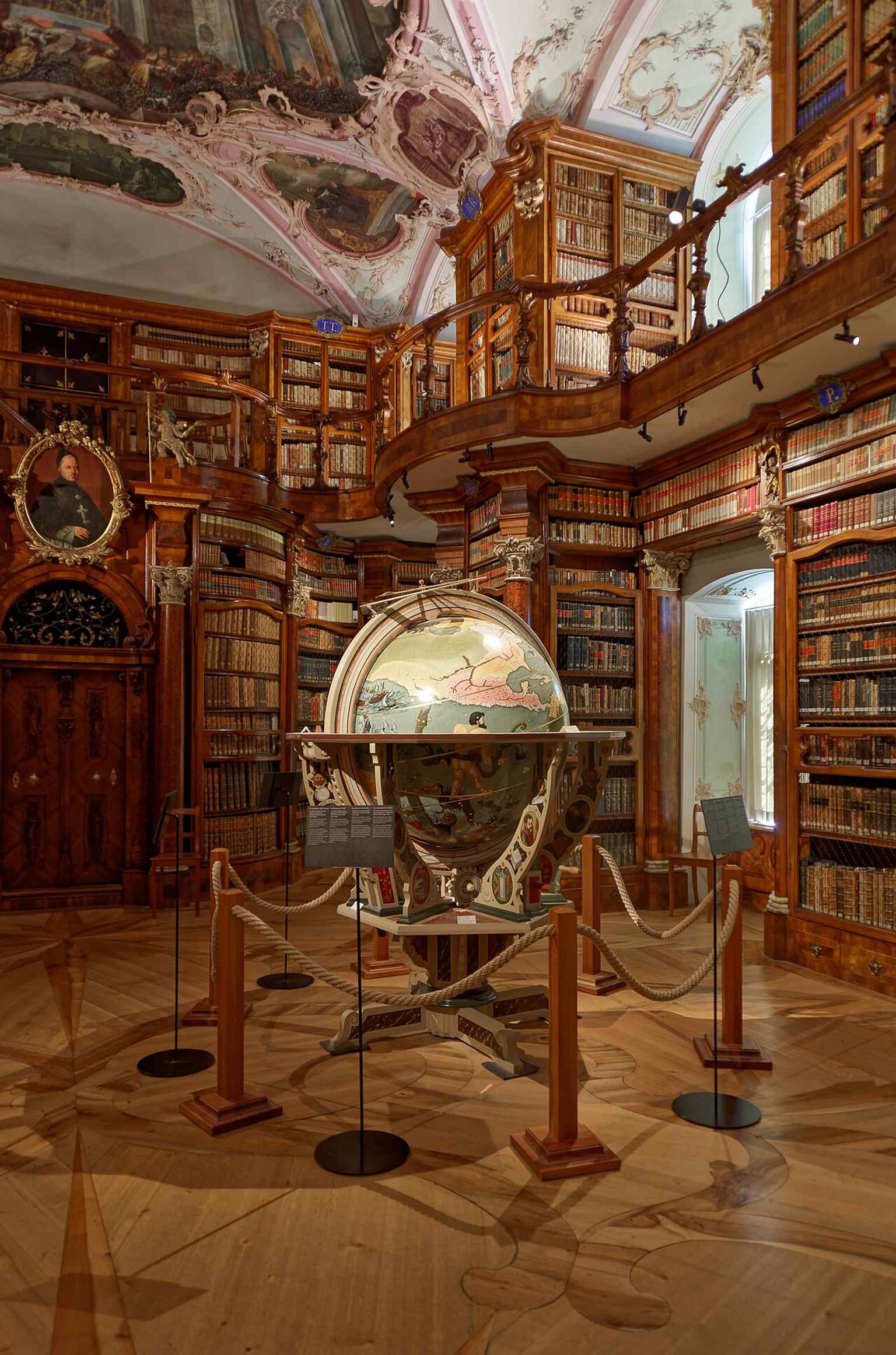
The hall with the replica St. Galler Globus, connecting the present museum display to the library’s long history.Photo: Jakub Hałun, Wikimedia Commons, CC BY 4.0. Cropped & resized. 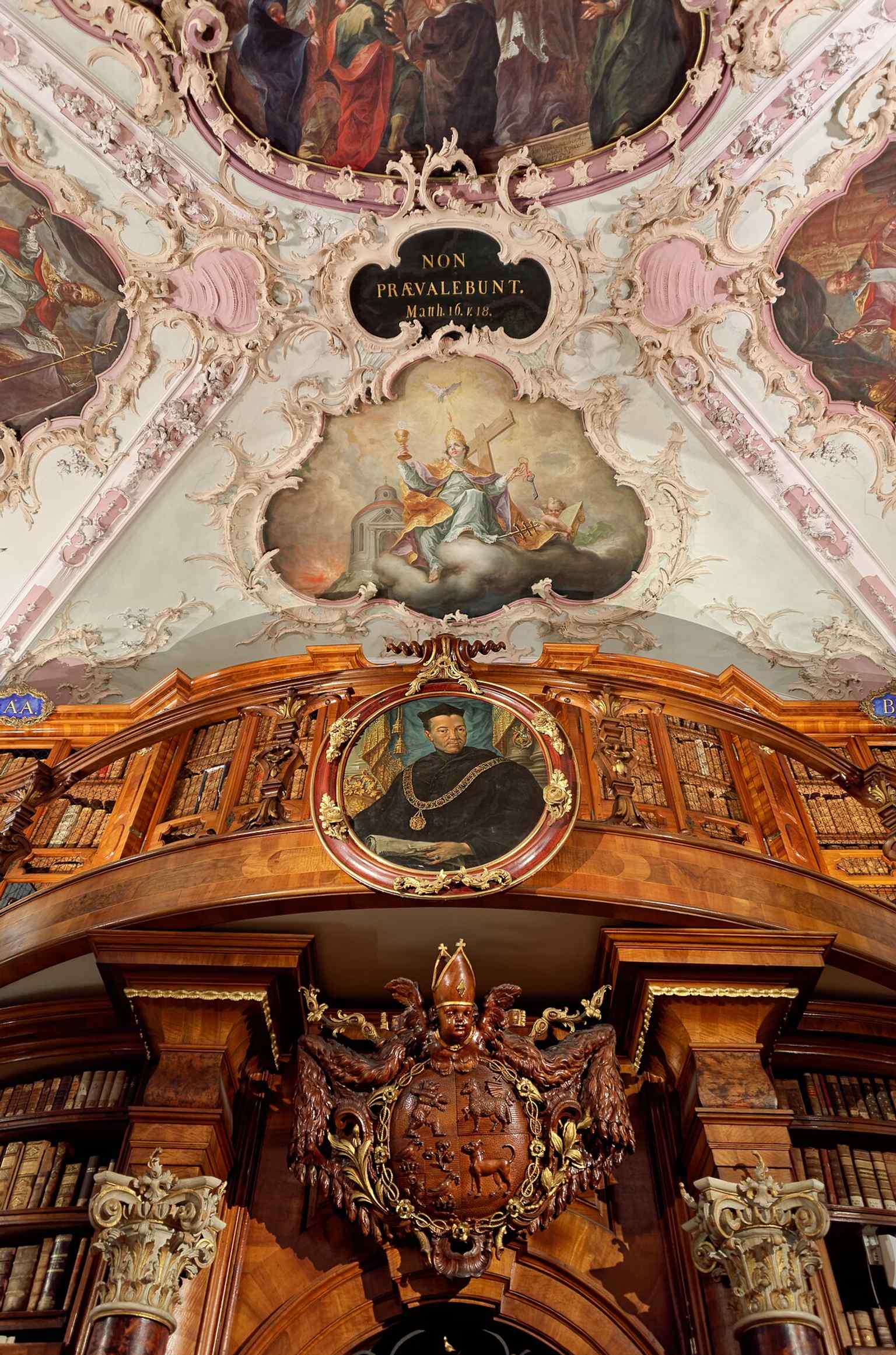
A contemporary view of the library hall, useful for showing how the baroque interior is preserved today.Photo: Jakub Hałun, Wikimedia Commons, CC BY 4.0. Cropped & resized.
Show 11 more stopsShow fewer stopsexpand_moreexpand_less
Look for a broad plaza coated in red rubber granulate, with rounded built-in seating and cloud-like light bubbles hanging above it. This is the Stadtlounge, better known as the…Read moreShow less
Open dedicated page →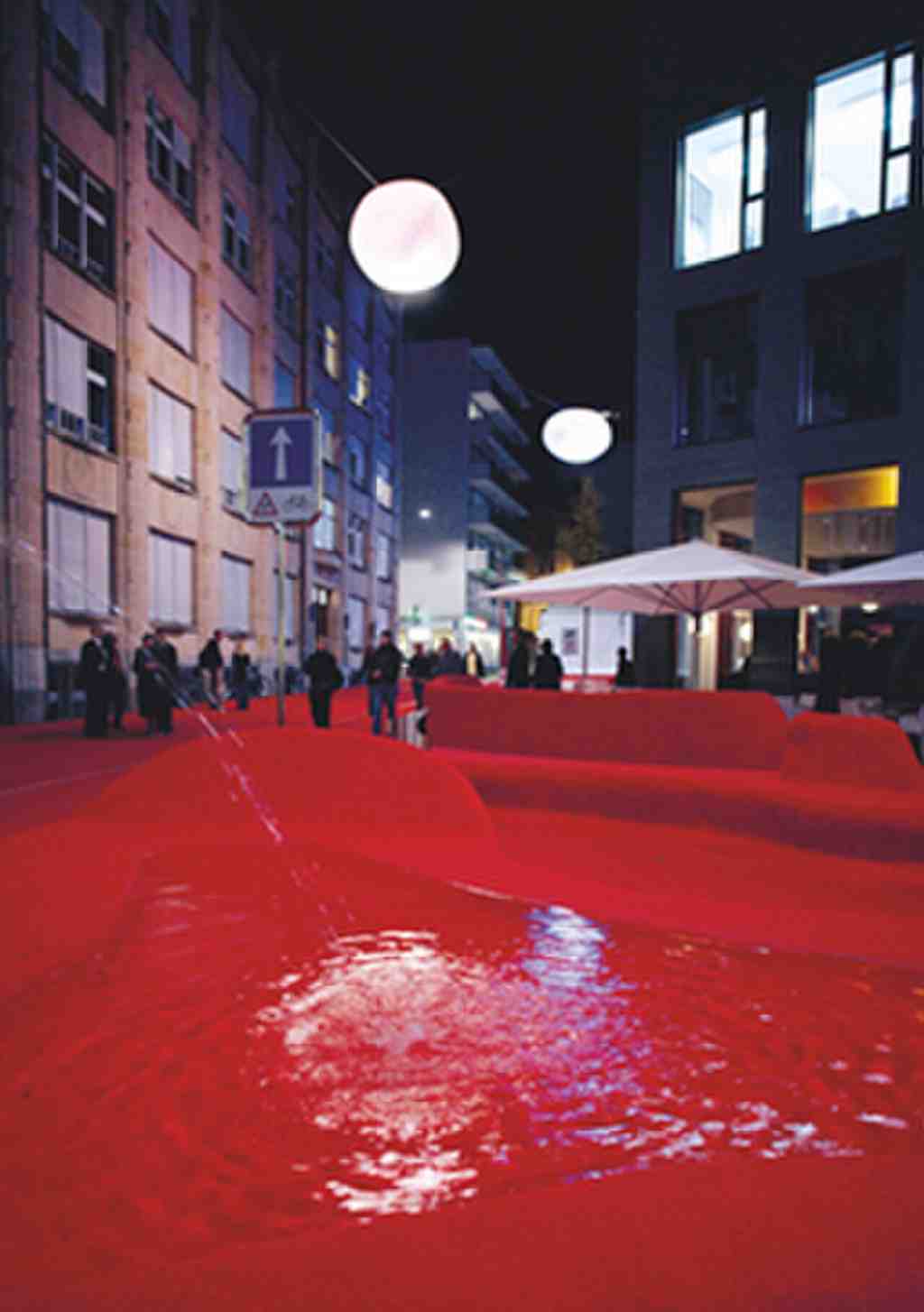
City LoungePhoto: Pipilotti Rist, Wikimedia Commons, CC BY-SA 4.0. Cropped & resized. Look for a broad plaza coated in red rubber granulate, with rounded built-in seating and cloud-like light bubbles hanging above it.
This is the Stadtlounge, better known as the Red Square... because St. Gallen decided a public plaza should feel less like a passageway and more like a living room that spilled into the city. In the spring of two thousand and five, Raiffeisen finished the last stage of its redevelopment here in the Bleicheli quarter. To give the new district an identity, the bank launched a design competition. Architect Carlos Martinez and artist Pipilotti Rist won it, and together they turned most of Raiffeisenplatz into this very red experiment.
Rist and Martinez imagined a public lounge dipped entirely in red, like a carpet unrolled across about four thousand six hundred square meters. The surface is a rubbery plastic granulate, tiny colored particles bound together, and it wraps not just the ground but benches, sculptures, and even a fountain. If you glance at your screen, image one shows how completely that red surface takes over the site.
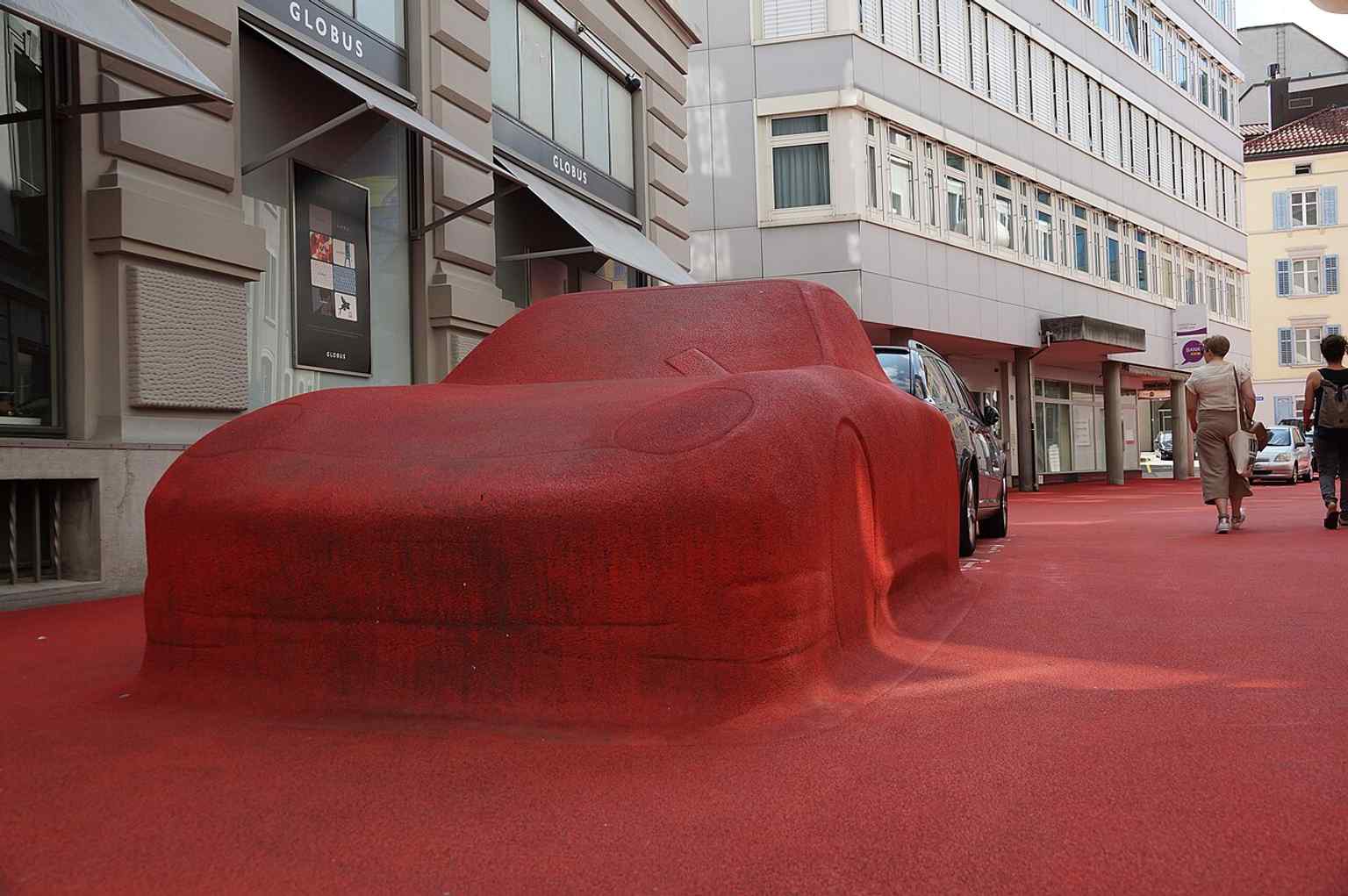
A broad view of the red-carpet-like City Lounge surface — the place is designed as a 4,600 m² public living room in St. Gallen.Photo: albinfo, Wikimedia Commons, CC BY-SA 3.0. Cropped & resized. The clever part is that the square is organized like a giant lounge: reception, cloakroom, foyer, café. A foyer, by the way, is simply an entrance hall. The zones slide into one another instead of ending in hard lines, so the whole place feels open, slightly surreal, and oddly domestic. On the app, image four makes that flow easier to read from above.
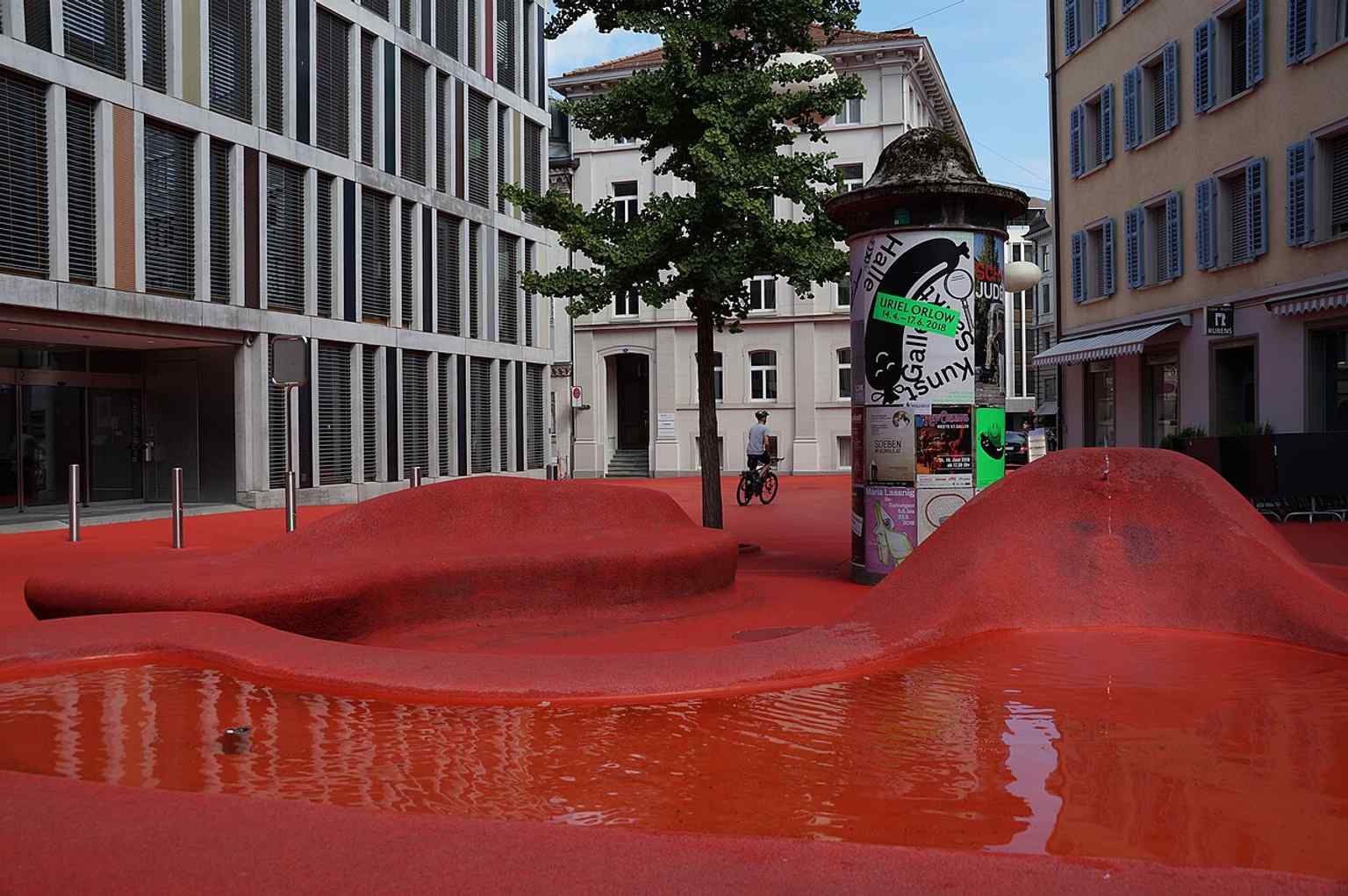
An open view of the public plaza shows how the different zones flow into one another like areas of a lounge.Photo: albinfo, Wikimedia Commons, CC BY-SA 3.0. Cropped & resized. For Rist, that mattered. She liked spaces where people could spend time together and move through art, not just stare at it. She had explored that idea earlier in a work called The Room, where she played with turning private space into something public. Here, the art becomes democratic... a place anyone can occupy. Not everyone loved the practical side, though: the coarse red surface faded, cracked, and dented, so the city eventually needed a maintenance plan and even a special cleaning vehicle. Still, the project went on to win design awards in two thousand and eight and again in two thousand and fourteen.
It is a rare square that tries to be both artwork and furniture, and somehow gets away with it.
The area stays active from around eleven in the morning until after midnight, with a moderate price level if you stop nearby.
Take one more look around, and when you're ready, we can continue toward the Textile Museum.
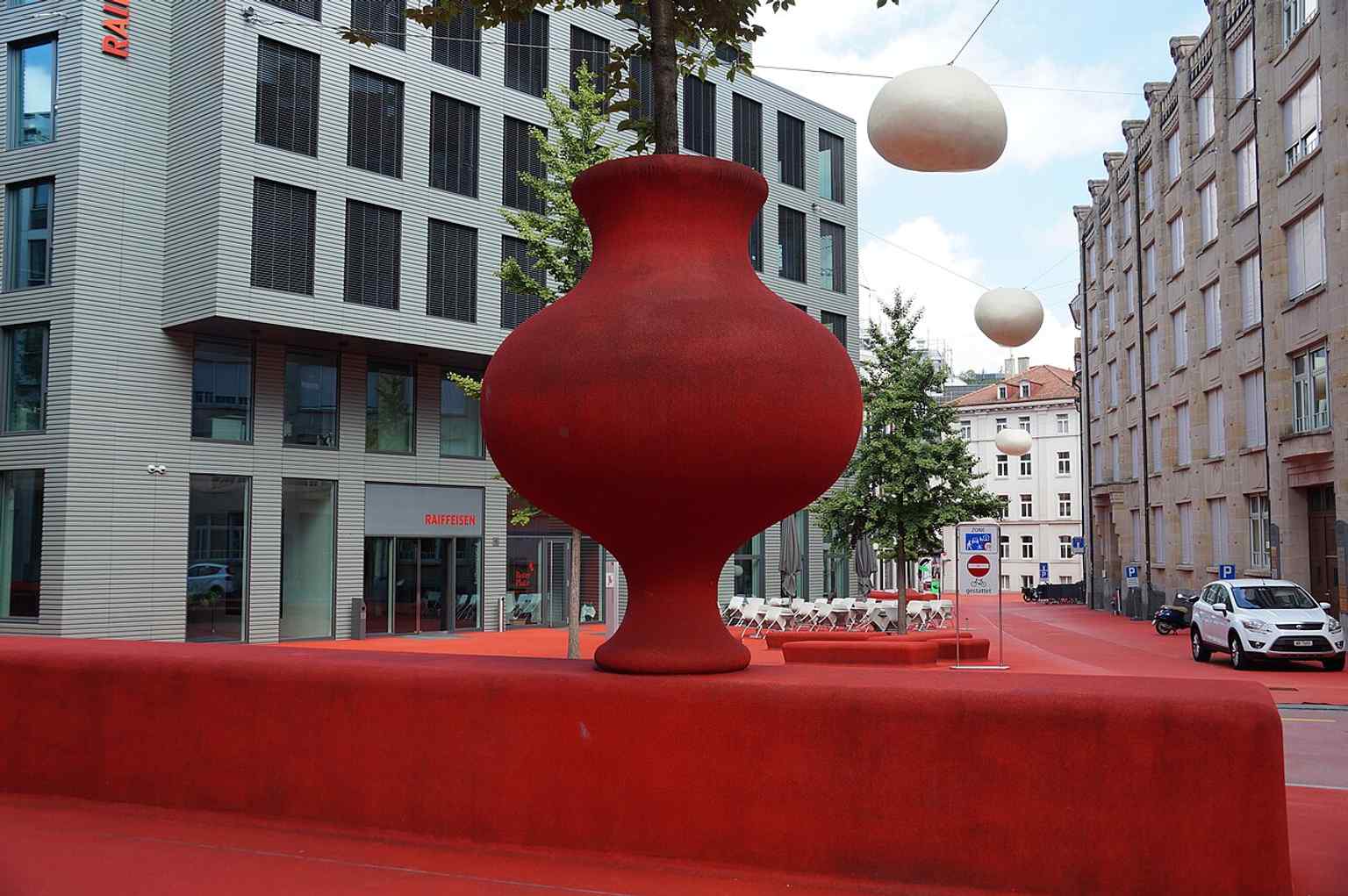
A closer look at the red flooring and built-in seating that gave the project its nickname, the “Red Square”.Photo: albinfo, Wikimedia Commons, CC BY-SA 3.0. Cropped & resized. 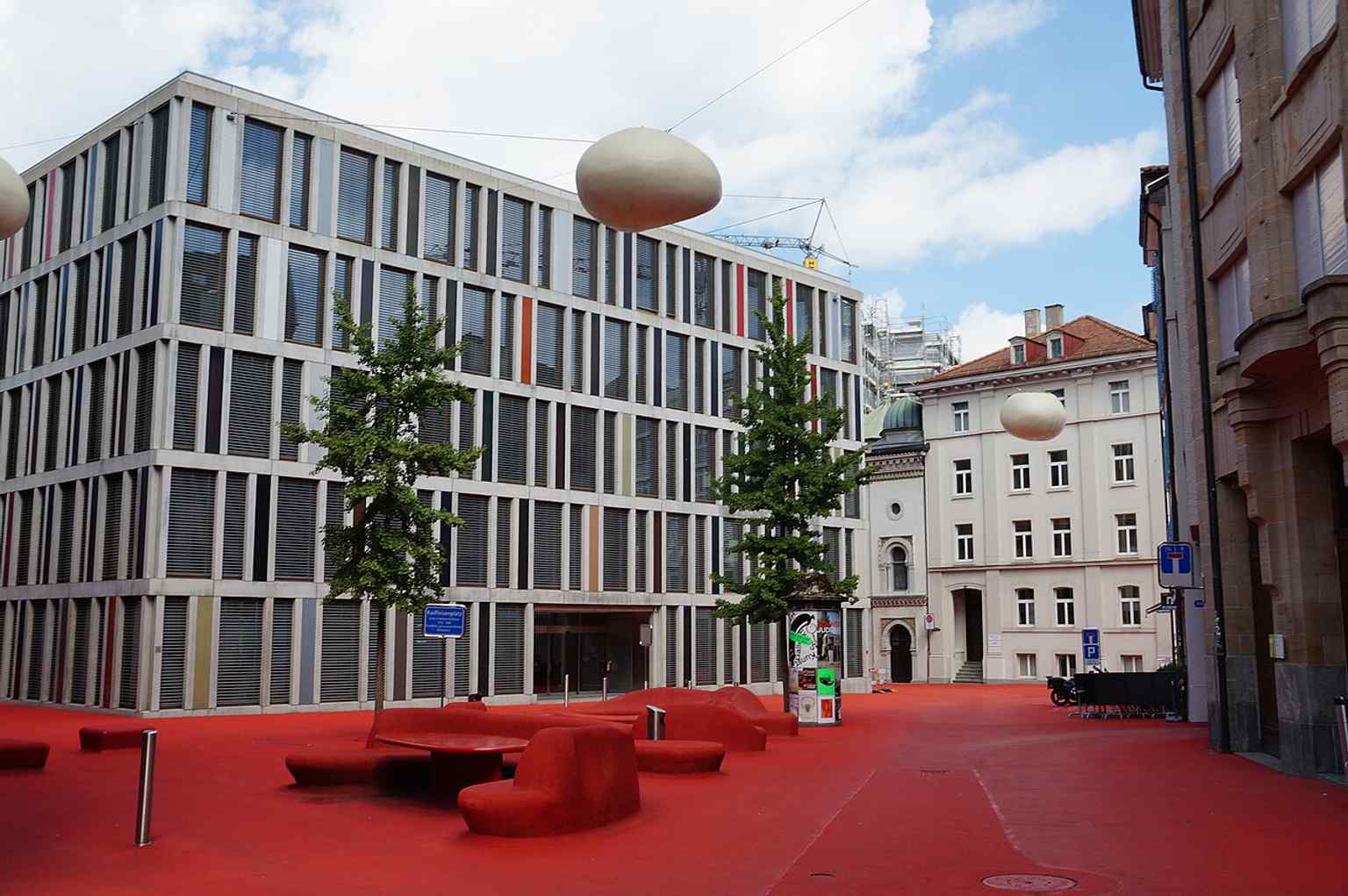
The City Lounge beside the Raiffeisen building highlights the project’s connection to the bank redevelopment finished in 2005.Photo: albinfo, Wikimedia Commons, CC BY-SA 3.0. Cropped & resized. 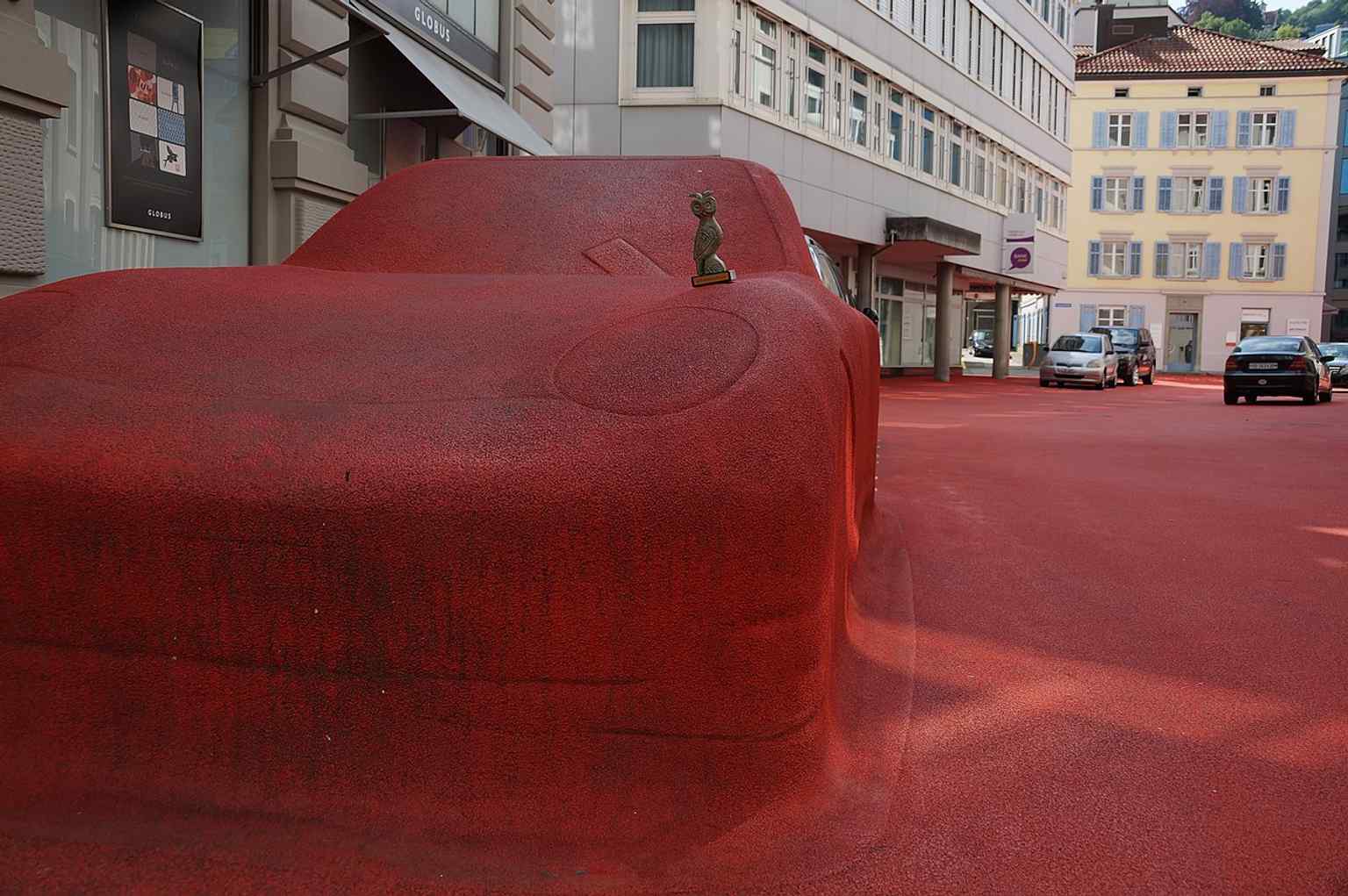
The Red Square hosting a public ceremony shows how the lounge functions as a stage for community life, not just as a passageway.Photo: albinfo, Wikimedia Commons, CC BY-SA 3.0. Cropped & resized. 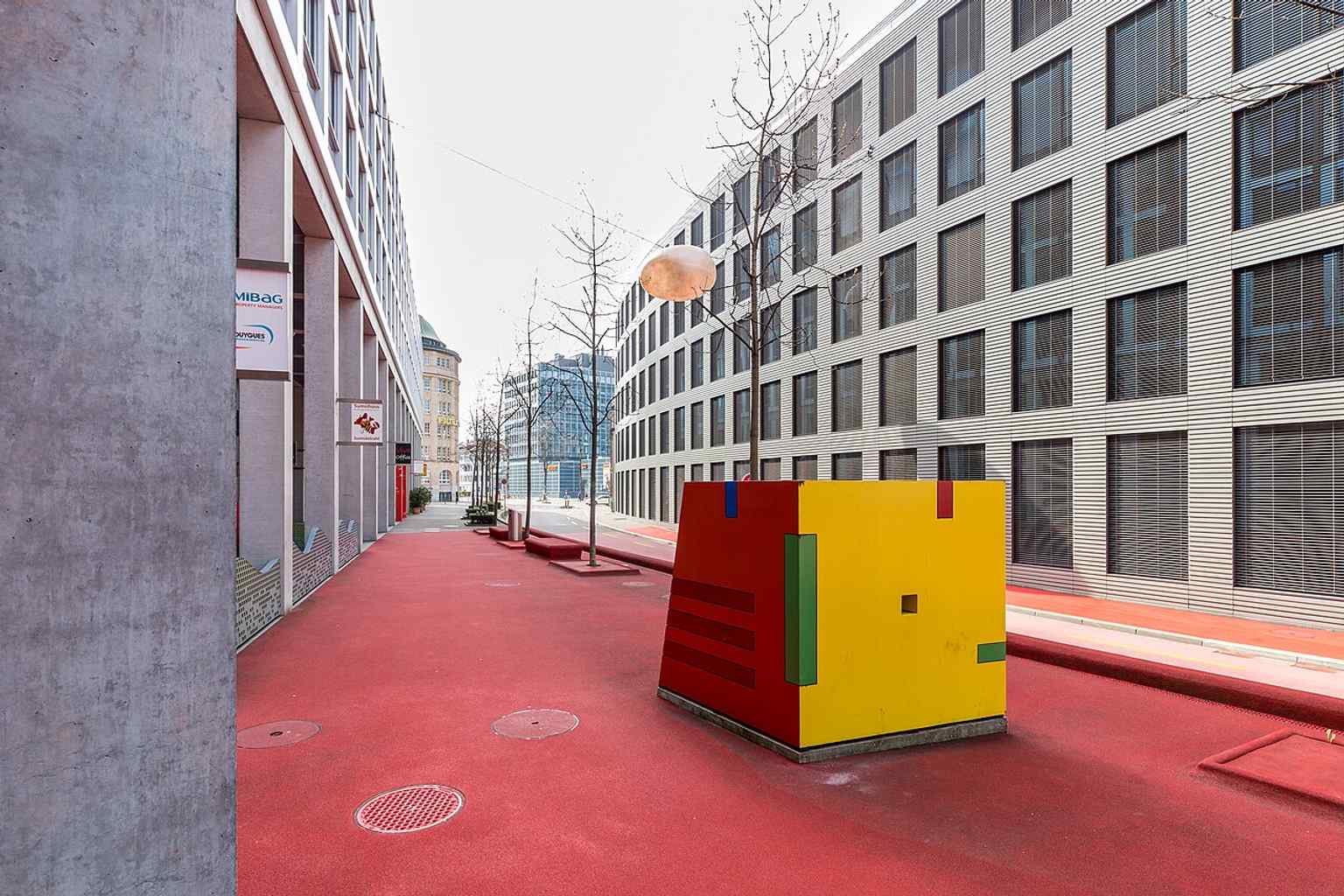
An earlier view of the Stadtlounge in St. Gallen, useful for showing how the installation looked shortly after completion.Photo: JoachimKohler-HB, Wikimedia Commons, CC BY-SA 4.0. Cropped & resized. On your left, look for a solid red-brick building with tall rectangular windows and a formal street-facing facade marked by the old Palazzo Rosso character. This museum tells…Read moreShow less
Open dedicated page →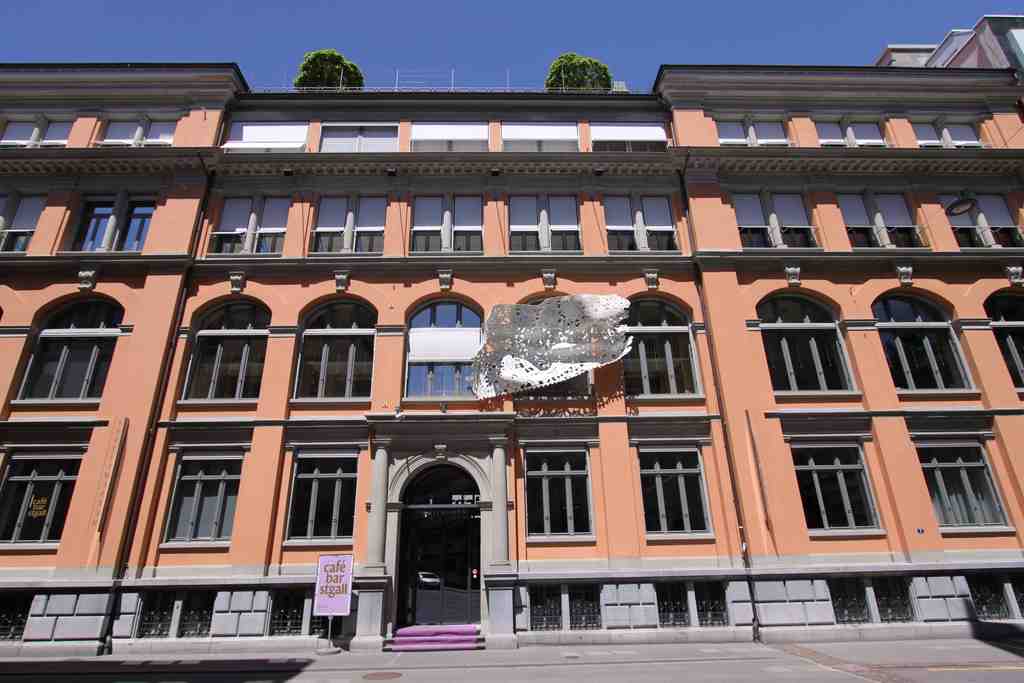
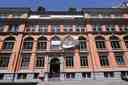
Textile Museum St. GallenPhoto: WWHenderson20, Wikimedia Commons, CC BY-SA 3.0. Cropped & resized. On your left, look for a solid red-brick building with tall rectangular windows and a formal street-facing facade marked by the old Palazzo Rosso character.
This museum tells the story of how St. Gallen turned thread into serious business... and then had the good sense to preserve the evidence. In eighteen sixty-three, the city’s commercial leaders, the Kaufmännische Direktorium, started collecting fabric samples from France after seeing how world exhibitions dazzled the public with new technology and design. They wanted local manufacturers to study, borrow, improve, and frankly compete.
That little teaching collection grew fast. In eighteen seventy-eight, the city founded the Industrie- und Gewerbemuseum, the Museum of Industry and Trade, and in eighteen eighty-six it opened here on the former Seidenhof site in this grand building. Along with the collections, the house took in the textile library, a drawing school, and by eighteen ninety, an embroidery school too. This was not a quiet shrine to old cloth. It was a working engine for an industry.
Over time, private collectors and company archives added more material: historical embroideries, handmade lace, fabrics and costumes from several centuries, and textiles from outside Europe. Some pieces once served as models for industrial production, which is a neat St. Gallen twist... beauty with a practical job description. Today the museum holds around fifty-six thousand objects.
And then there’s the library inside. Its sample books contain more than two million original designs from Swiss firms, especially machine embroidery from the late nineteenth and early twentieth centuries, when St. Gallen embroidery hit its commercial peak. Around nineteen sixty-two, someone even painted the red facade gray, which feels a bit like putting a dust cover on a silk dress. Since nineteen eighty-two, the place has proudly called itself the Textile Museum, and it still pairs permanent displays with sharp temporary exhibitions that connect cloth to art, society, and economics.
It’s a fine reminder that in St. Gallen, fabric never meant “just fabric,” and if you want to step inside later, the museum is open daily from ten AM to five PM.
Take one last look at the Palazzo Rosso, and when you’re ready, we can head on to Broderbrunnen.
Look for a bronze fountain rising from a round stone basin, topped by a draped nymph and dotted with playful figures on a dolphin, a turtle, and a goose. This is the…Read moreShow less
Open dedicated page →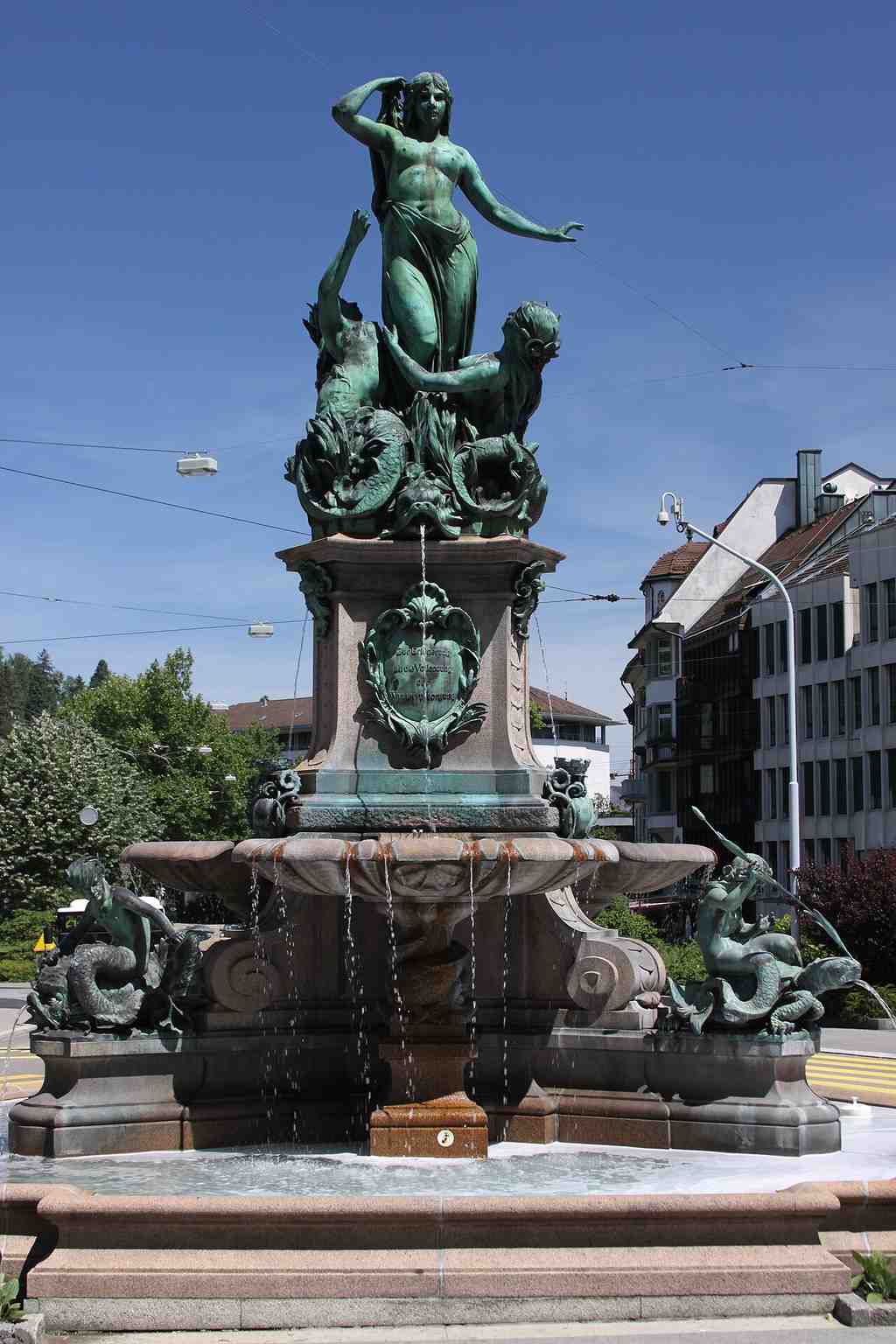
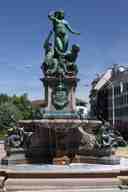
BroderbrunnenPhoto: WWHenderson20, Wikimedia Commons, CC BY-SA 3.0. Cropped & resized. Look for a bronze fountain rising from a round stone basin, topped by a draped nymph and dotted with playful figures on a dolphin, a turtle, and a goose.
This is the Broderbrunnen on Lindenplatz, and it marks a very practical triumph with gloriously impractical flair. On the first of May, eighteen ninety-five, Lake Constance water reached homes in St. Gallen for the first time. To celebrate, sculptor August Bösch created this fountain near the Multertor, funded by a bequest from cantonal judge Hans Broder. So yes... a monument to modern water supply that is almost useless for actually collecting water.
At the top stands a nymph in a very thin cloth, flanked by two reclining nymphs below. Tradition says Bösch brought in a nude model from Zurich, the police objected, and only his stubborn refusal to continue won him artistic freedom. If you check your screen, you can see how theatrical Bösch made the whole composition. The originals grew fragile, so restorers made bronze copies in two thousand, and the originals moved to the Historical Museum. This fountain keeps watch day and night.
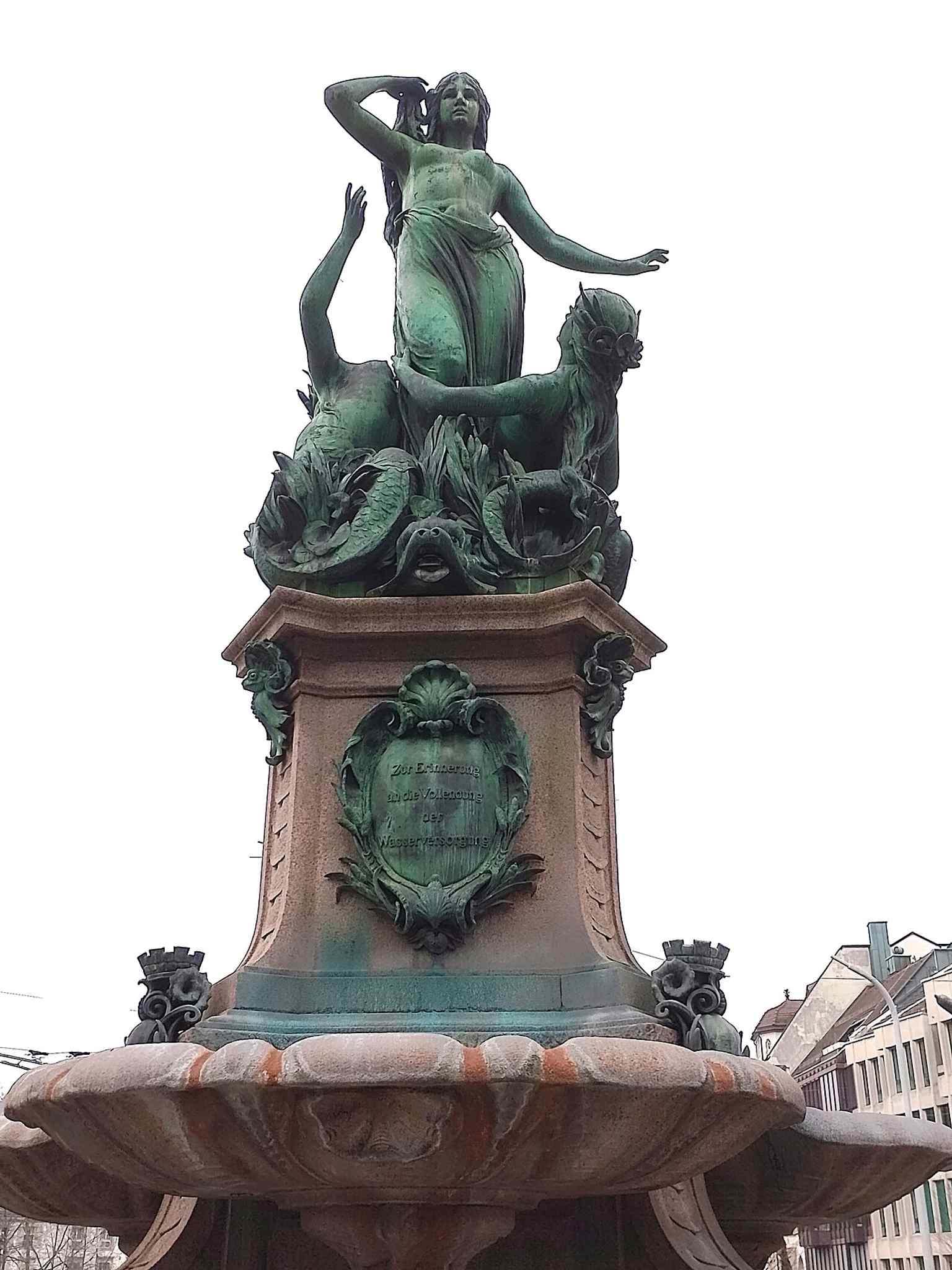
August Bösch’s Broderbrunnen design in bronze: a dramatic fountain sculpture created to commemorate St. Gallen’s new Bodensee water supply in 1895.Photo: EinDao, Wikimedia Commons, CC BY-SA 4.0. Cropped & resized. A city can reveal itself in the way it celebrates water.
Take a moment here, and when you’re ready, we can continue to the old town.
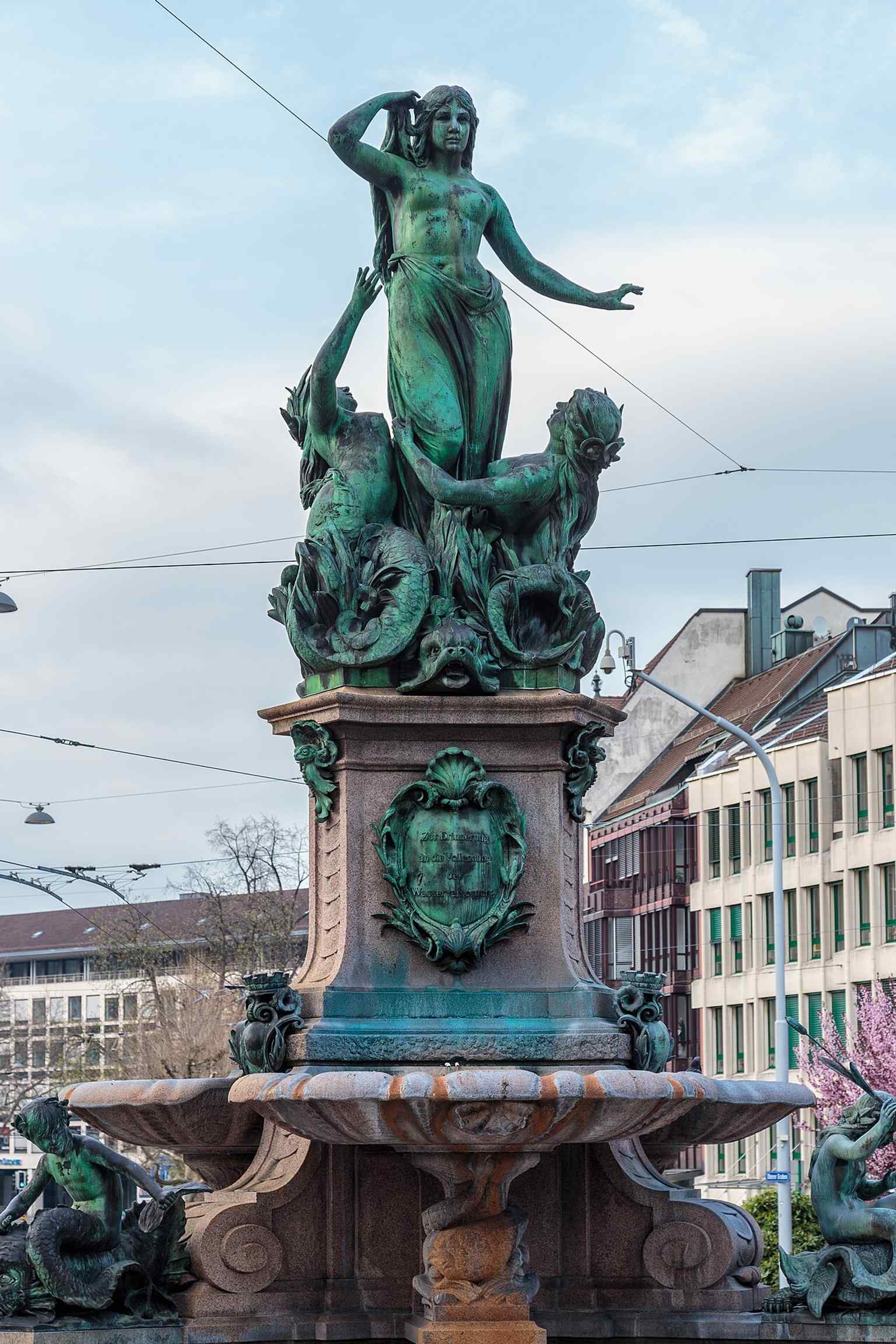
The Broderbrunnen at Lindenplatz in St. Gallen, shown as a public monument to the city’s waterworks — a fountain too decorative to serve as a real water intake.Photo: JoachimKohler-HB, Wikimedia Commons, CC BY-SA 4.0. Cropped & resized. Look for stone-paved lanes, tall plaster-fronted houses in tight rows, and the carved wooden oriel windows jutting out above the street like watchful little balconies. This is…Read moreShow less
Open dedicated page →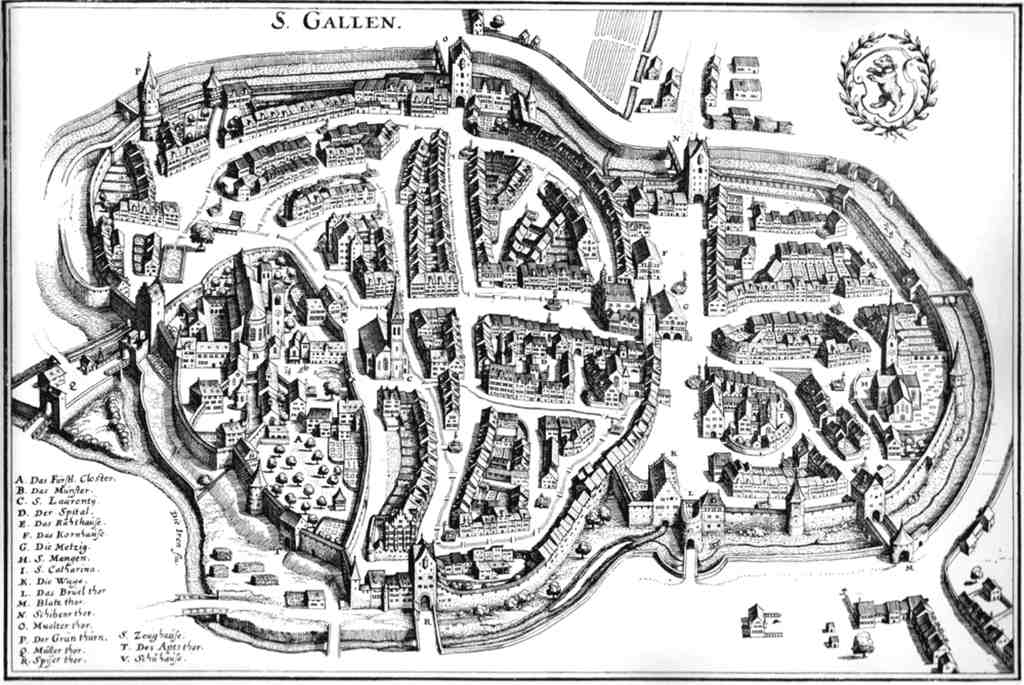
Old Town of St. GallenPhoto: sidonius, Wikimedia Commons, Public domain. Cropped & resized. Look for stone-paved lanes, tall plaster-fronted houses in tight rows, and the carved wooden oriel windows jutting out above the street like watchful little balconies.
This is the historic heart of St. Gallen, and Switzerland takes it very seriously: the whole old town counts as a cultural property of national significance. The protected ensemble stretches beyond these streets to include the Abbey of Saint Gall, the convent buildings and library, the former Dominican cloister, the Fine Arts Museum, the history museum, the Textile Museum, the cantonal library called Vadiana, the main station, the main post office, and even the bridges that stitch the city together. It sounds a bit bureaucratic... until you realize what that list really says: this place kept its layers. Monks studied here, merchants traded here, and textile wealth shaped the city without sanding off its memory. In nineteen ninety-two, St. Gallen earned the Wakker Prize, a Swiss honor for towns that preserve their built heritage with real care.
Many nearby sites open daily from nine thirty to five thirty.
That mix of everyday life and deep history is the old town’s quiet magic. When you’re ready, we can wander on to the next stop.
Standing here, you’re in a city that began with one monk and an unlikely patch of ground. Around the year six hundred twelve, Gallus, an Irish wandering monk, settled beside the…Read moreShow less
Open dedicated page →Standing here, you’re in a city that began with one monk and an unlikely patch of ground. Around the year six hundred twelve, Gallus, an Irish wandering monk, settled beside the upper Steinach and built a hermit’s cell. A little later, around seven hundred nineteen or seven hundred twenty, people founded the monastery that turned his lonely retreat into a lasting settlement. By the tenth century, it had grown into a town, and in eleven eighty St. Gallen became a Free Imperial City of the Holy Roman Empire. Not bad for what started as a spiritual off-grid experiment.
The city still carries Gallus in its name, which is why people call it the Gallusstadt. Even the spelling has a slightly Swiss flavor of precision: the city administration writes the name without a space after “Saint,” while formal spelling rules would rather see one there. Civilization, as you can tell, rests on standards.
What really shapes St. Gallen, though, is the land under your feet. The city sits around seven hundred meters above sea level, making it one of the higher cities in Switzerland. It stretches through a broad valley between the Rosenberg to the north and the Freudenberg to the south. If you glance at the image on your screen, you can see that landscape beautifully from above, with the city spilling across the slopes and Lake Constance in the distance. That steep terrain gave St. Gallen one of its best nicknames: the city of a thousand stairs.
There’s also more water here than meets the eye. The Steinach still runs through the city, but much of it now flows underground in a channel, hidden from view. Another stream, the Irabach, disappeared from maps after engineers buried it; before that, it flooded the station in nineteen oh four. And because much of the center sits on unstable peat with a lot of groundwater, builders supported major buildings, including the station and main post office, on oak piles. So yes, parts of St. Gallen stand on timber foundations... which is impressive, and just a little unsettling if you think about it too long.
St. Gallen’s power came first from religion, then from textiles. The abbey gave the city its start, but embroidery made it wealthy. St. Gallen lace and embroidery became famous far beyond Switzerland, and that trade drove its rise as an economic center. It also left the city vulnerable: textile crises brought real hardship, including famine in eighteen sixteen and a major decline after the nineteen thirties, when thirteen thousand residents left.
On your phone, the abbey complex in the UNESCO World Heritage site shows the seed from which the whole city grew. But modern St. Gallen is broader than its monastic heart. It’s the cultural and economic capital of eastern Switzerland, a railway hub, a gateway to Appenzell, home to the University of St. Gallen and the Federal Administrative Court, and still green around the edges, with nearly a third of its area used for agriculture.
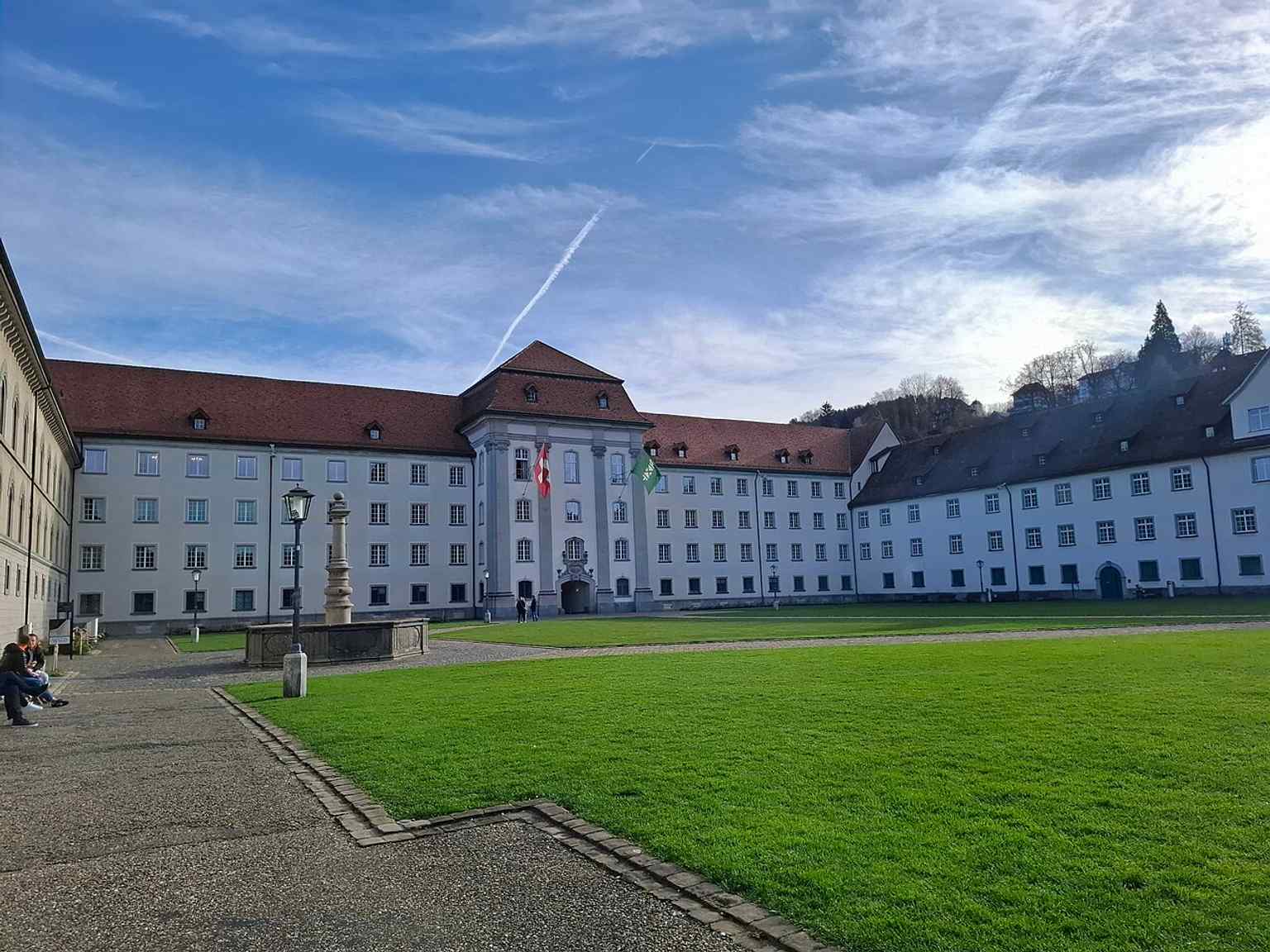
The abbey complex where St. Gall began in the 8th century — the UNESCO-listed heart of the city.Photo: Pablodbds, Wikimedia Commons, CC0. Cropped & resized. St. Gallen is a city of monks, merchants, hidden rivers, and stubborn reinvention.
Take a moment here, and when you’re ready, we can continue to St. Laurenzen.
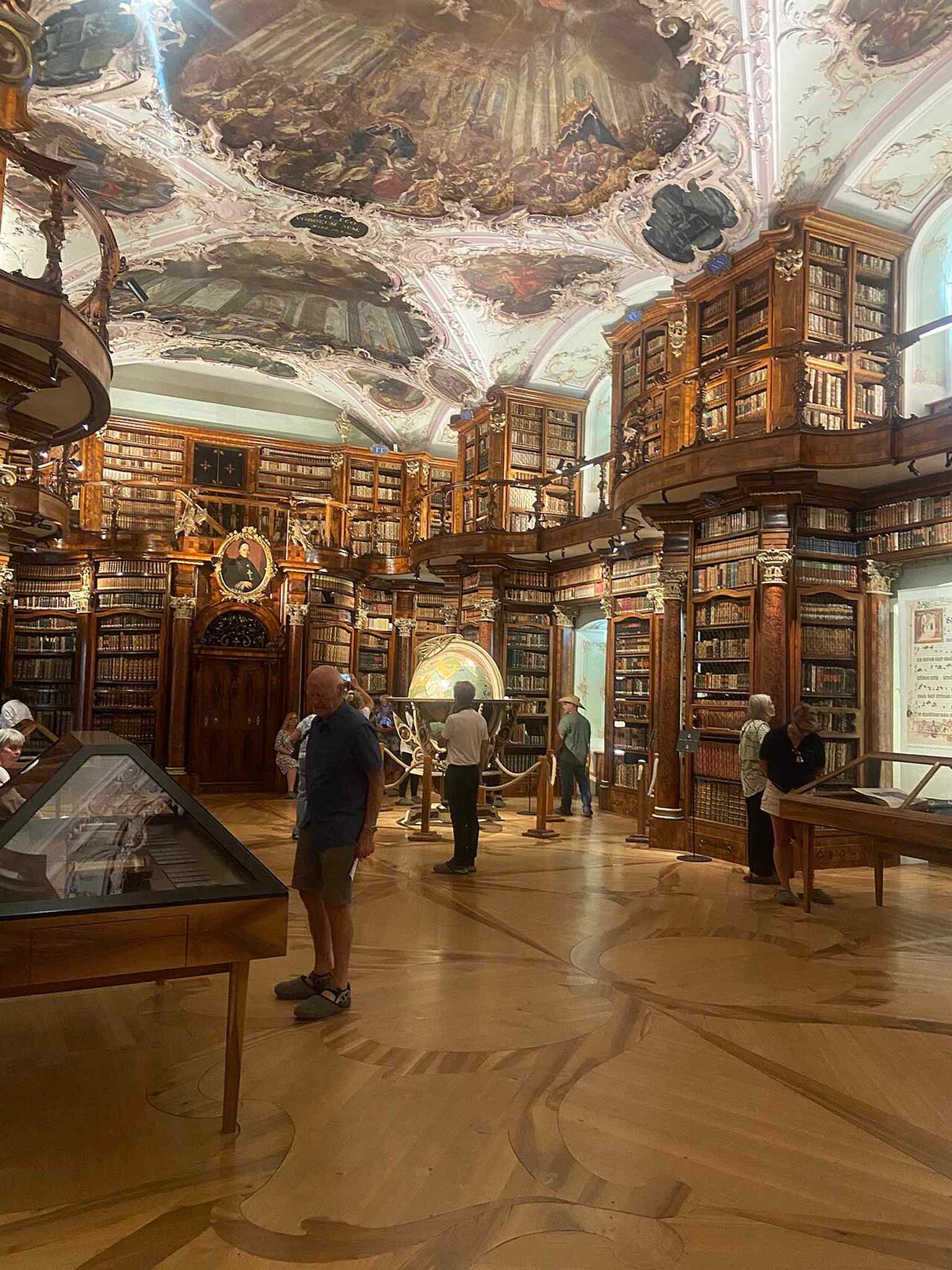
The Abbey Library’s baroque reading hall, home to one of Europe’s great monastic book collections.Photo: 4theliberty, Wikimedia Commons, CC0. Cropped & resized. 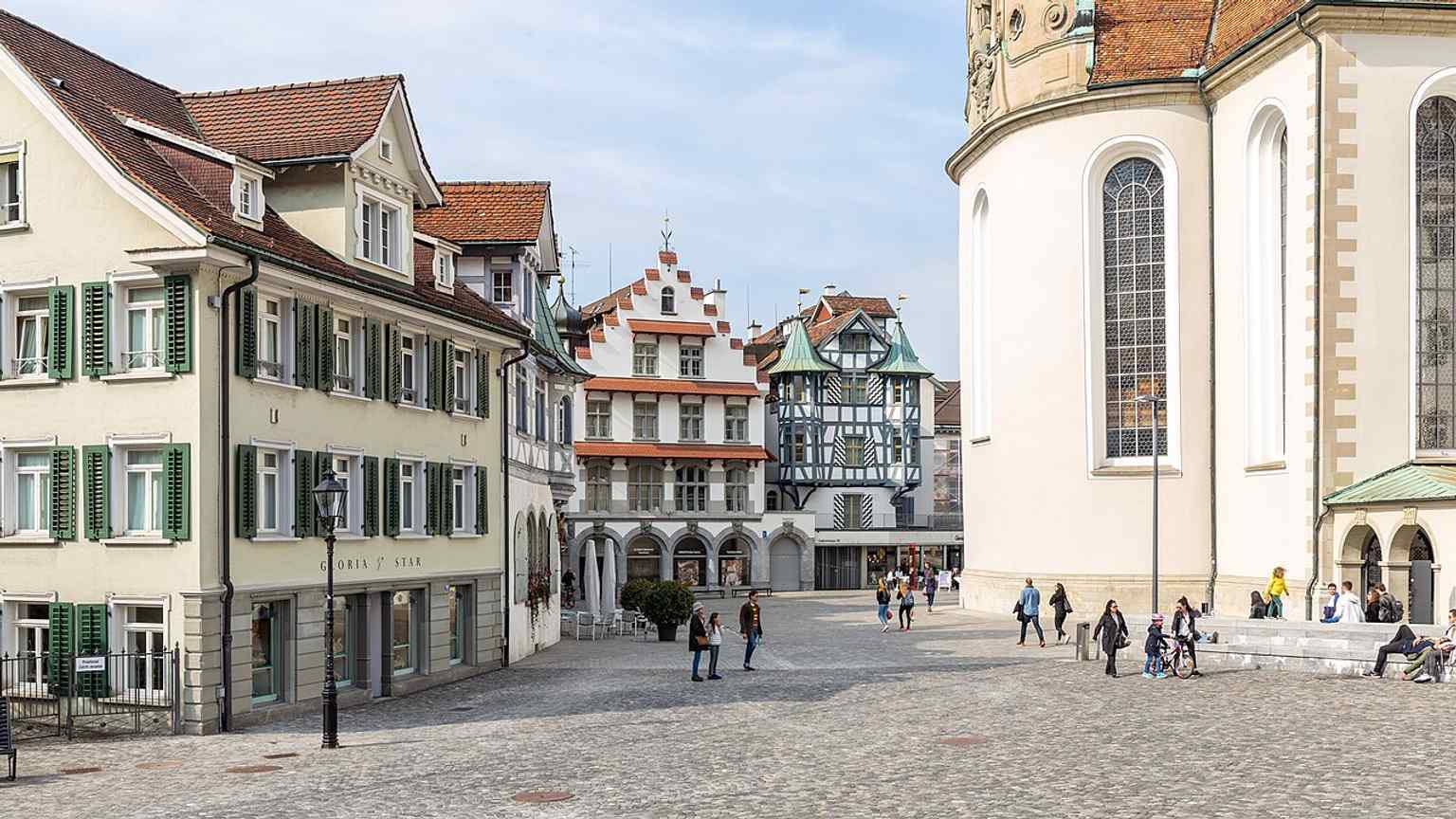
Gallusplatz in the old town, named after Saint Gall, the Irish monk linked to the city’s origins.Photo: JoachimKohler-HB, Wikimedia Commons, CC BY-SA 4.0. Cropped & resized. 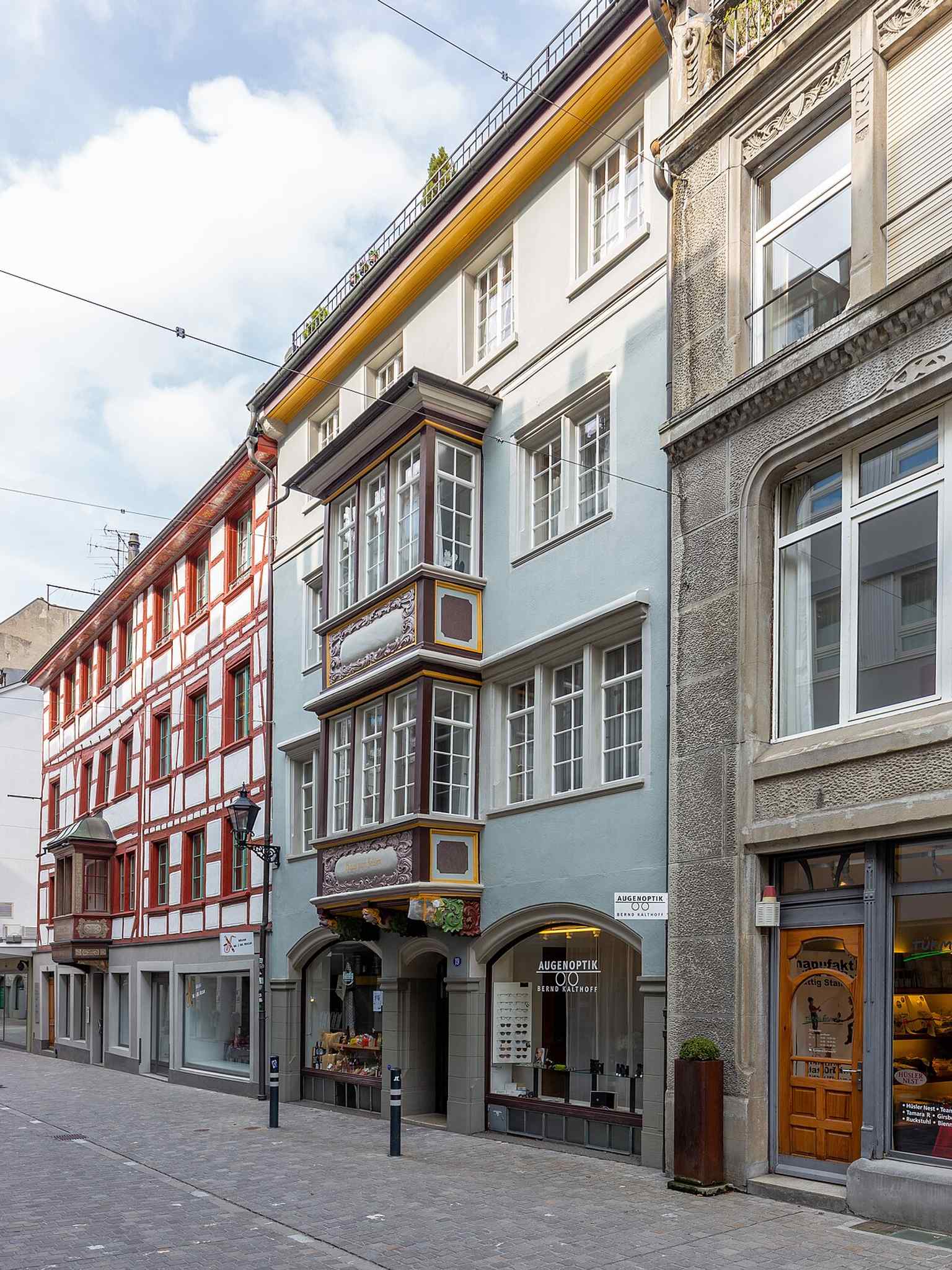
Historic townhouses with distinctive oriel windows on Webergasse, a reminder of the city’s preserved old town.Photo: JoachimKohler-HB, Wikimedia Commons, CC BY-SA 4.0. Cropped & resized. 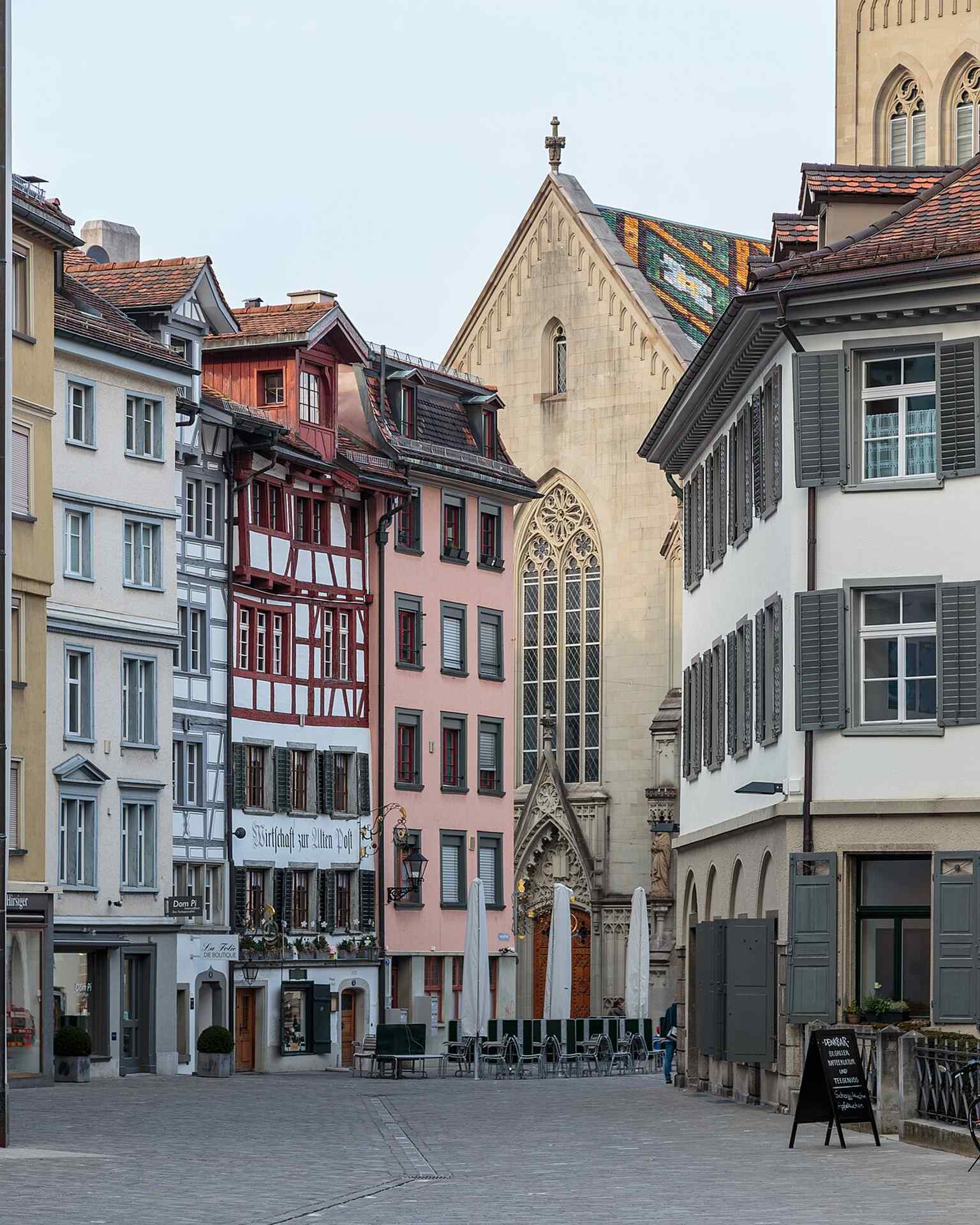
Gallusstrasse with St. Laurenzen Church in the background, reflecting the Reformation-era city center.Photo: JoachimKohler-HB, Wikimedia Commons, CC BY-SA 4.0. Cropped & resized. 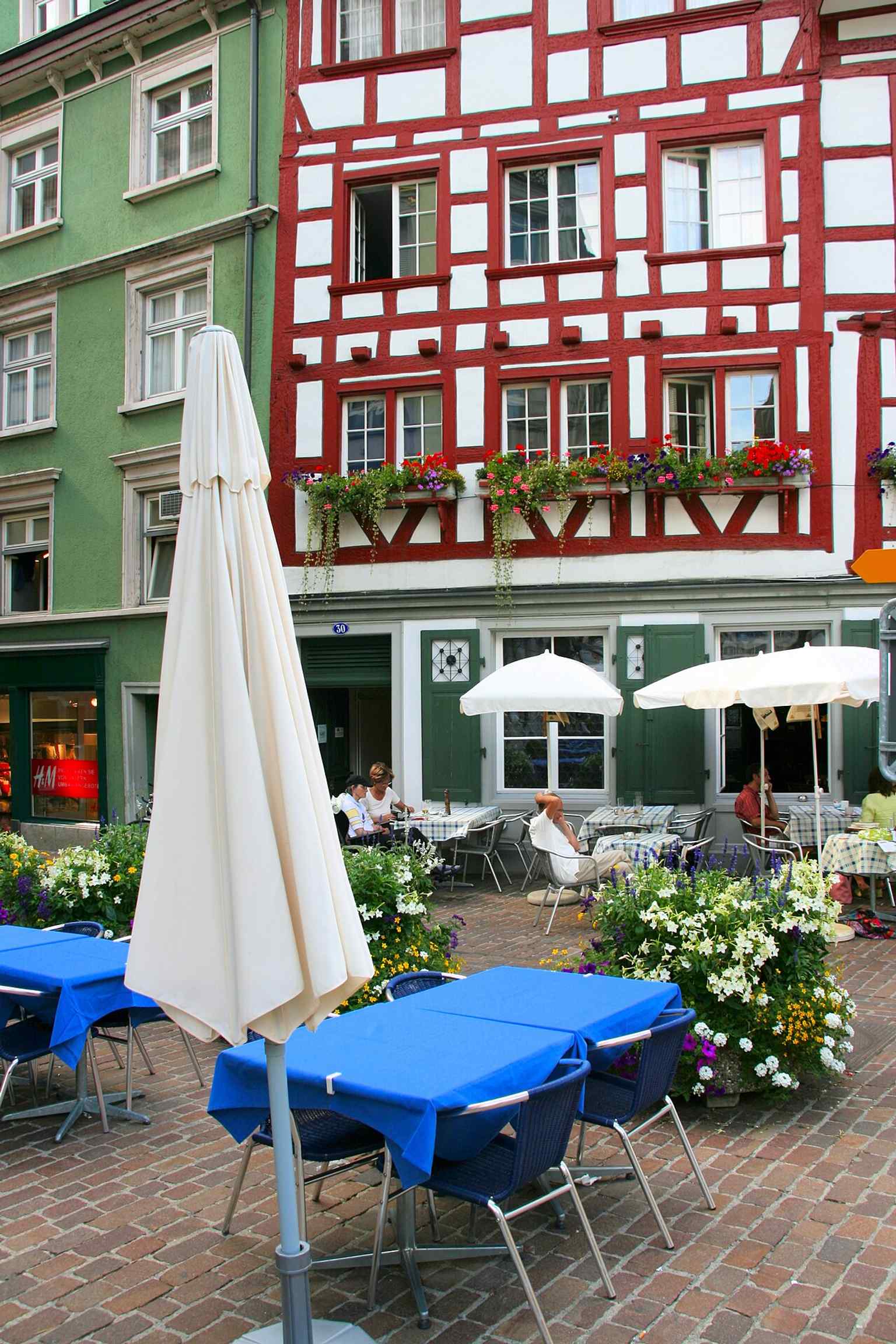
A street scene in St. Gallen’s old town, showing the compact historic core that grew from the abbey settlement.Photo: Marek Ślusarczyk (Tupungato) Photo portfolio, Wikimedia Commons, CC BY 3.0. Cropped & resized. 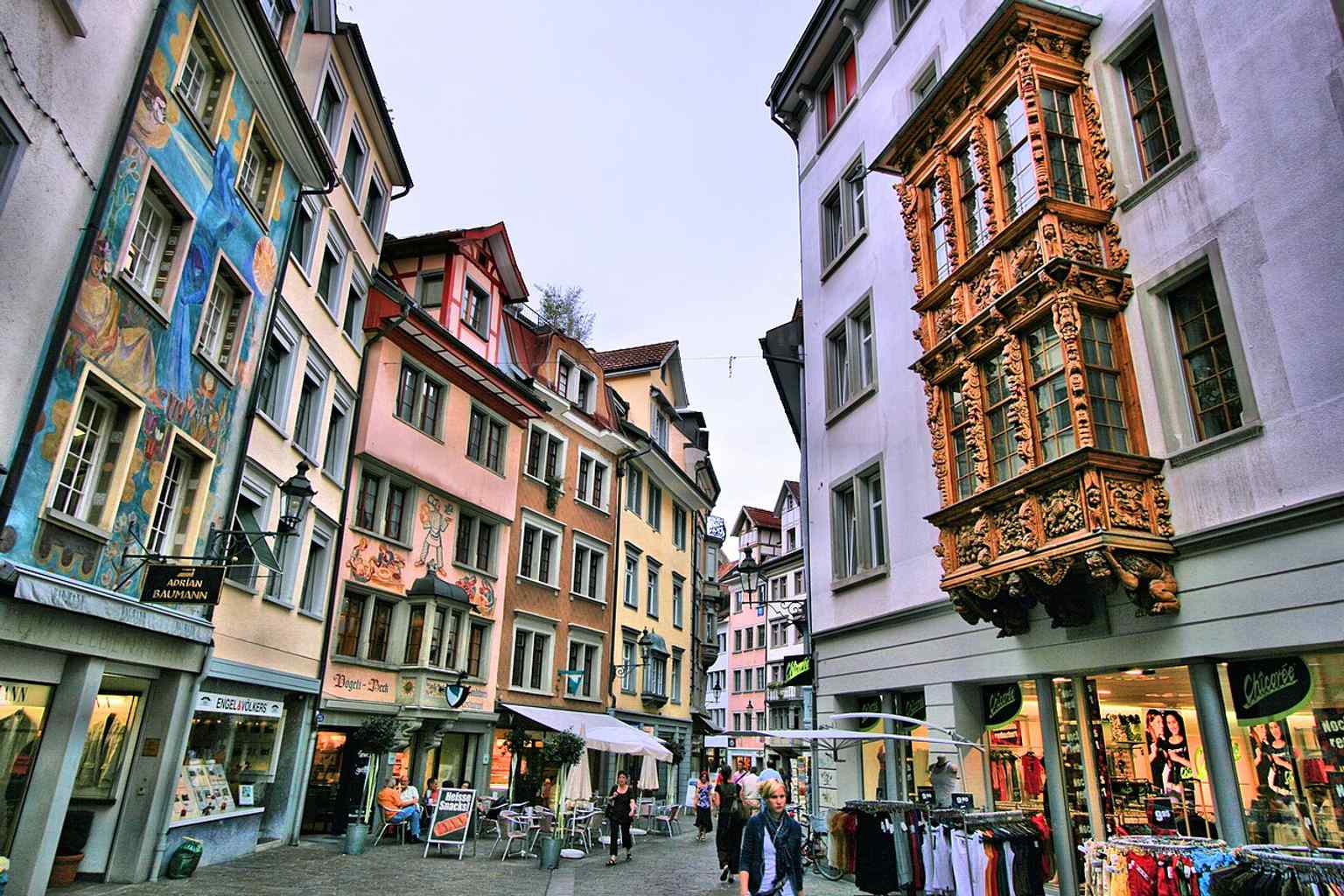
Another old-town view, useful for showing the dense streetscape and traditional architecture of the center.Photo: Marek Ślusarczyk (Tupungato) Photo portfolio, Wikimedia Commons, CC BY 3.0. Cropped & resized. 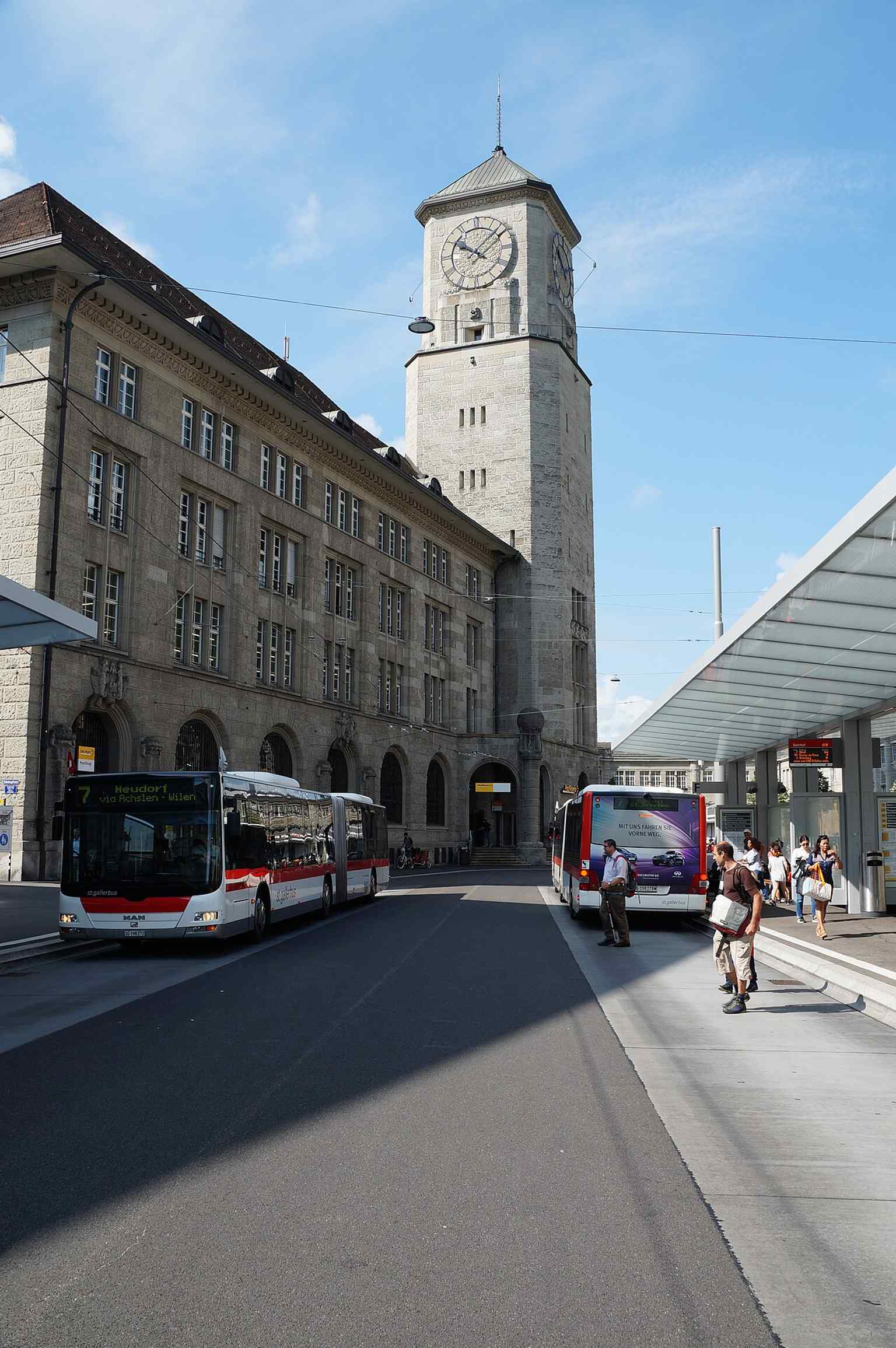
Bahnhofplatz, the city’s main transport hub and gateway to the wider Ostschweiz region.Photo: albinfo, Wikimedia Commons, CC BY-SA 3.0. Cropped & resized. 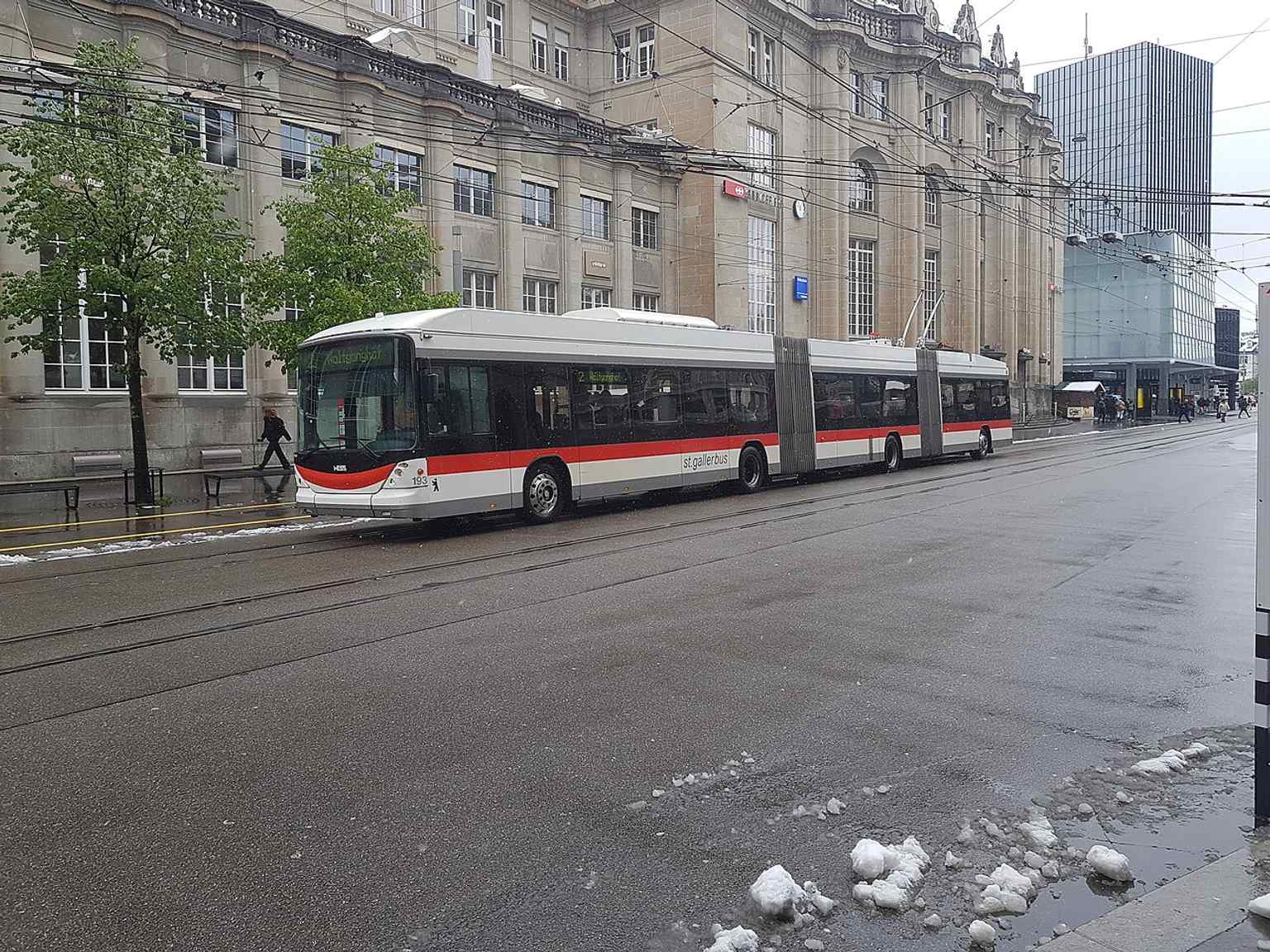
A modern VBSG trolleybus at Bahnhof St. Gallen — public transport remains central to everyday city life.Photo: Pilote2022, Wikimedia Commons, CC0. Cropped & resized. 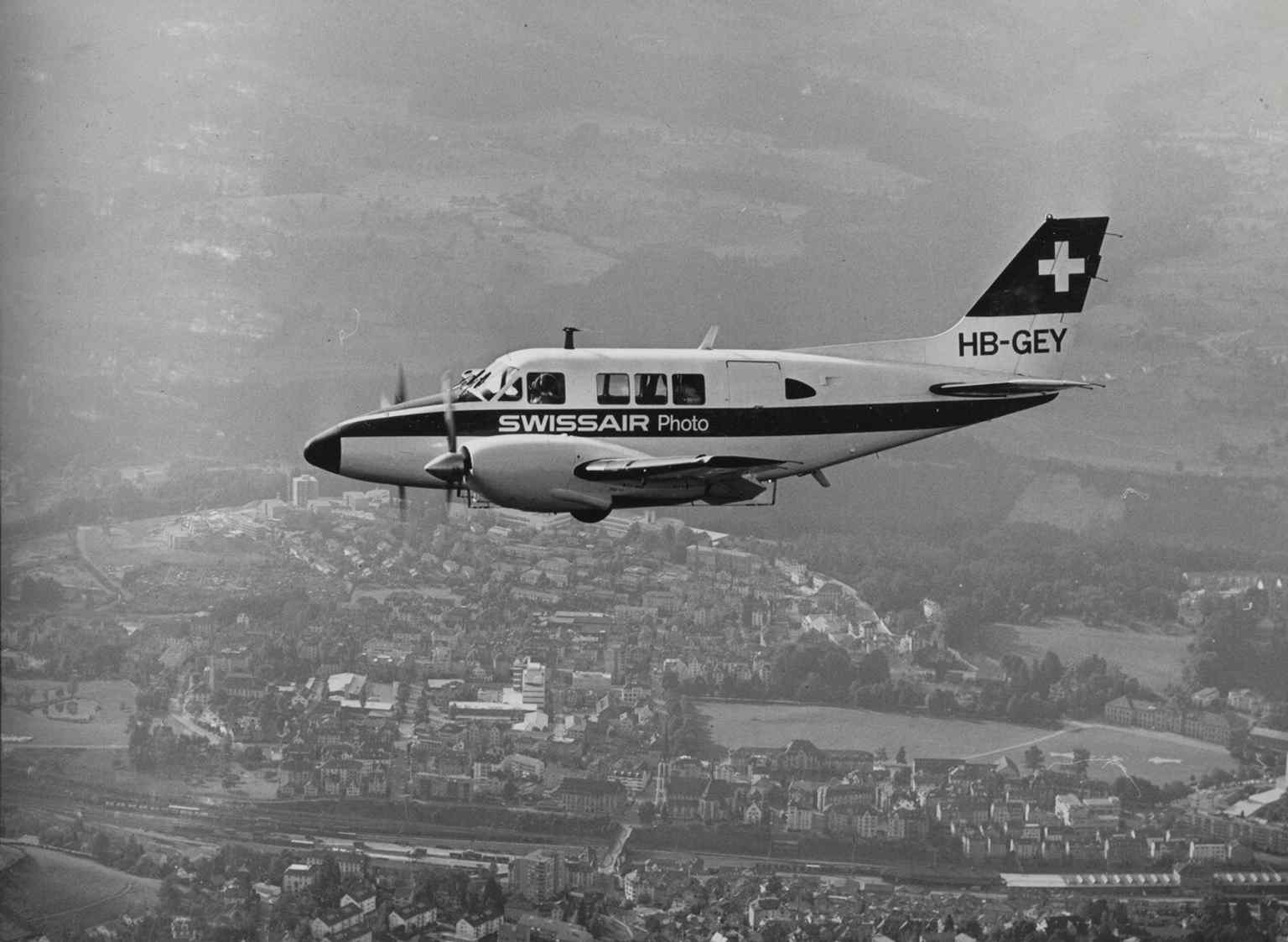
An aerial view over St. Gallen’s neighborhoods, revealing the valley setting and the city’s spread across the hills.Photo: Swissair, Wikimedia Commons, Public domain. Cropped & resized. On your right, St. Laurenzen is a pale stone church with a broad stepped façade, a tall spired tower, and pointed neo-Gothic openings cut high into the bell stage. It looks…Read moreShow less
Open dedicated page →On your right, St. Laurenzen is a pale stone church with a broad stepped façade, a tall spired tower, and pointed neo-Gothic openings cut high into the bell stage.
It looks medieval enough to fool you... but much of what you’re seeing came out of a nineteenth-century rebuild. By the early eighteen hundreds, the church had become impossible to ignore in all the wrong ways: tired, worn, and badly in need of repair. In eighteen forty-five, a young architect named Johann Georg Müller drew up an ambitious restoration. He fought off rival proposals that wanted to replace the church entirely, which feels a bit like saving a family heirloom while everyone else suggests buying flat-pack furniture.
Müller cared deeply about preserving the old building, but he died in eighteen forty-nine at just twenty-seven. Johann Christoph Kunkler then carried the project through between eighteen fifty-one and eighteen fifty-four. They removed the west front completely, kept parts of the older arcades and outer walls, and rebuilt the upper part of the tower in neo-Gothic style. That means a revival of medieval Gothic forms: pointed arches, vertical lines, and a general sense that stone ought to reach for heaven. The tower you see has a square lower shaft, then an octagonal upper stage, and finally that sharp spire. If you glance at the image on your screen, you can catch those rebuilt details clearly.
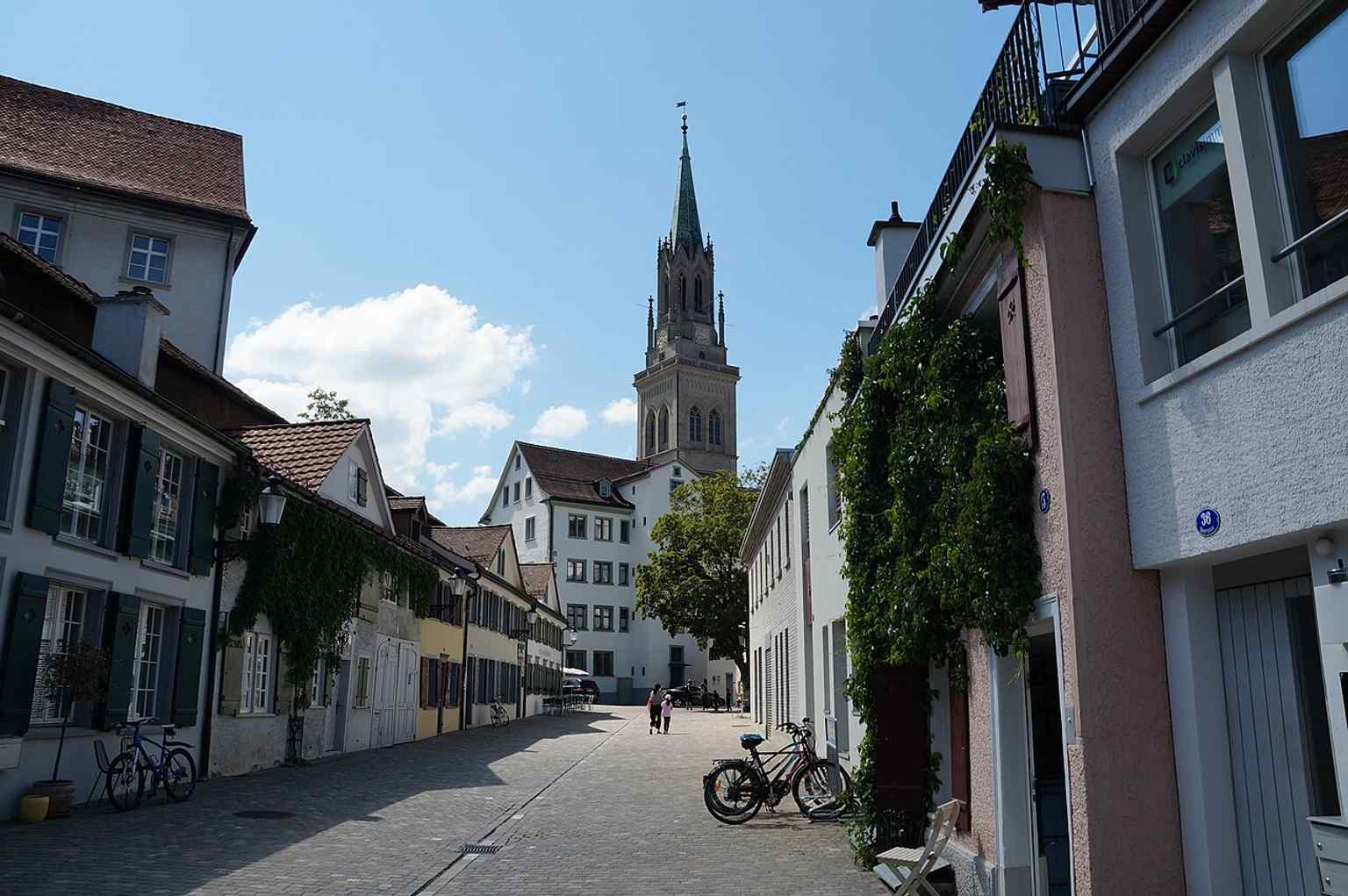
Another strong exterior angle showing the church’s tower and stepped façade details, including the rebuilt upper tower finished in a neo-Gothic style.Photo: albinfo, Wikimedia Commons, CC BY-SA 3.0. Cropped & resized. There’s a nice little historical irony here. St. Laurenzen is a Reformed Protestant church, yet it wears a Gothic style that had already gone out of fashion before the Reformation even began. So the building is Protestant by confession, medieval by costume, and nineteenth-century by major surgery.
Inside, the church is a basilica, meaning a tall central hall with lower side aisles. During the restoration from nineteen sixty-three to nineteen seventy-nine, specialists tried to recover an earlier building phase. That work led to something more startling. In nineteen seventy-six and seventy-seven, archaeologists dug beneath the floor and found traces of earlier churches, eleven graves, an ossuary - a bone box - and scattered remains from about one hundred and thirty individuals. About half were children, so scholars think this church rose over an older children’s cemetery. Some skull evidence even points toward late Roman or Celtic inhabitants, or their descendants. So beneath the sermons, hymns, and organ music, the ground had been keeping a very old memory.
And speaking of organ music: inside now sits a remarkable multi-part organ system. It grew from a nineteen seventy-nine Kuhn organ into a larger installation completed in twenty twenty-three and twenty twenty-four, with sections in different parts of the church and seventy-six registers, meaning seventy-six distinct families of sound. If you want a look inside, the interior image in the app gives you a good sense of that elevated space over the choir.
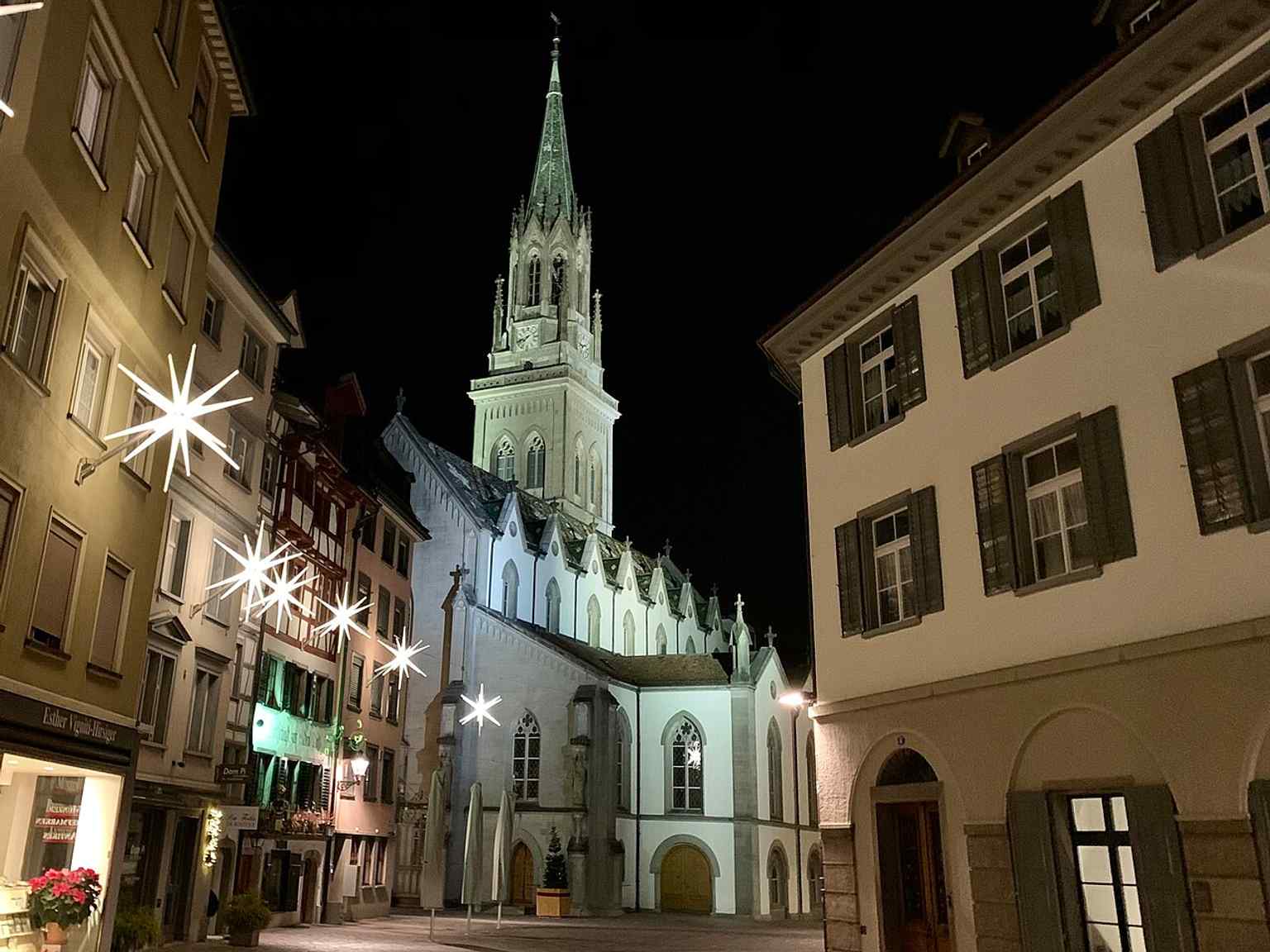
An interior view that helps explain the church’s basilica-like space, including the elevated nave and the organ area over the choir.Photo: Ank Kumar, Wikimedia Commons, CC BY-SA 4.0. Cropped & resized. St. Laurenzen is one of those churches that quietly stacks centuries on top of each other and somehow makes the whole thing feel coherent.
Take a moment here, and when you’re ready, we can continue to St. Mangen.
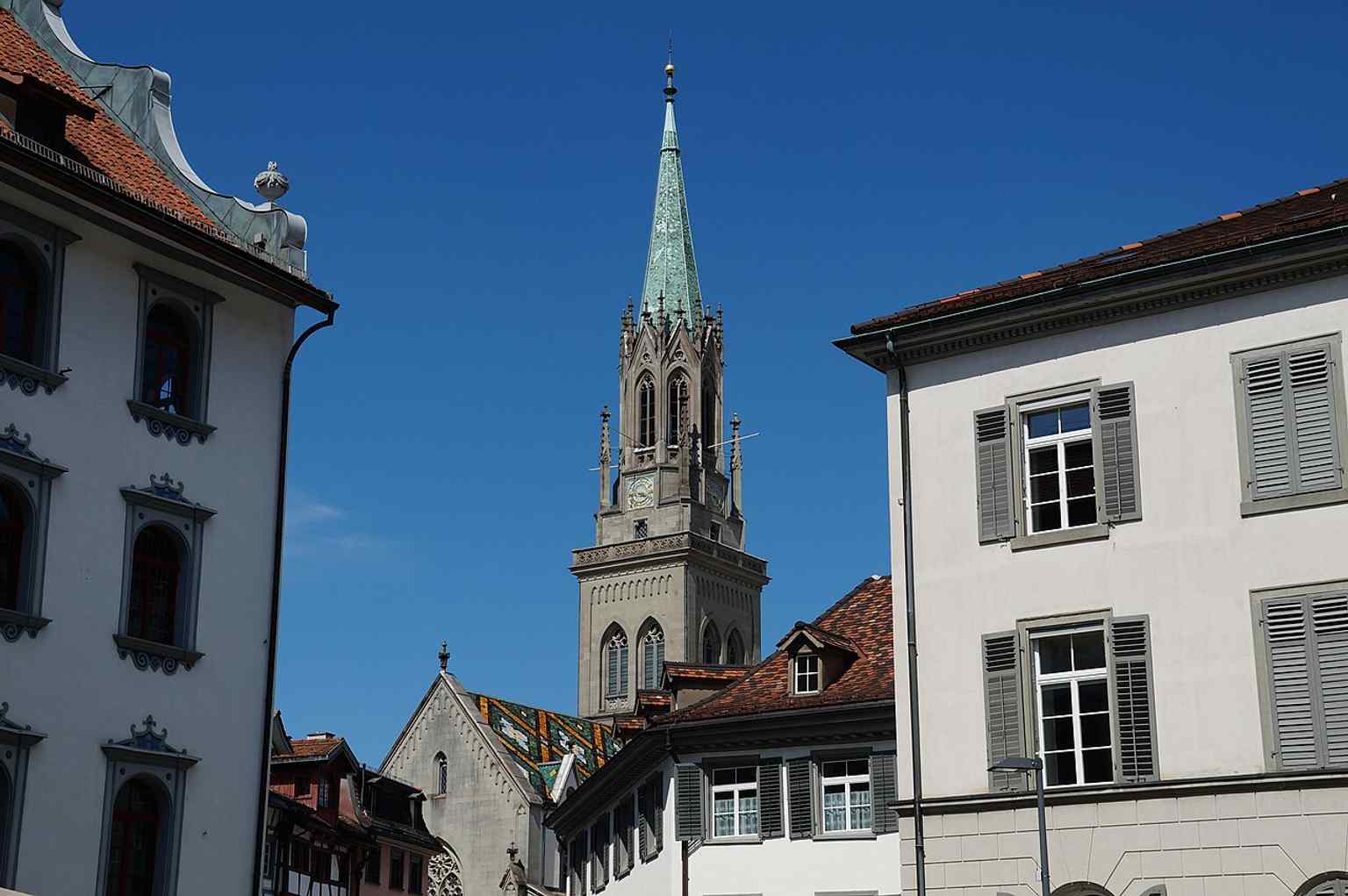
A clear front view of St. Laurenzen’s neo-Gothic façade, reflecting the 1850s reconstruction that largely followed Johann Georg Müller’s renovation plans.Photo: albinfo, Wikimedia Commons, CC BY-SA 3.0. Cropped & resized. 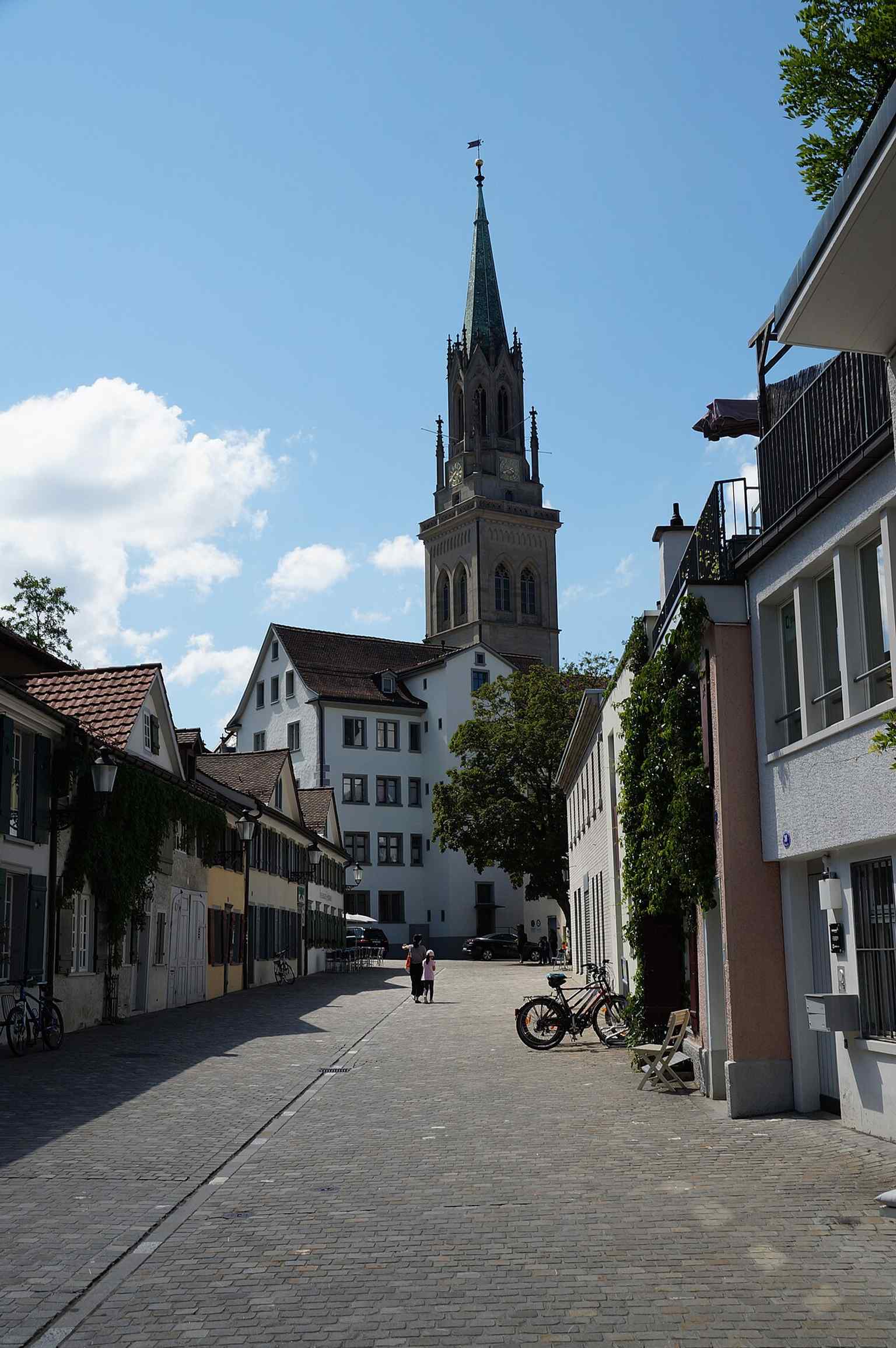
The church viewed from Zeughausgasse, giving a more street-level sense of how the rebuilt St. Laurenzen rises above the old city.Photo: albinfo, Wikimedia Commons, CC BY-SA 3.0. Cropped & resized. 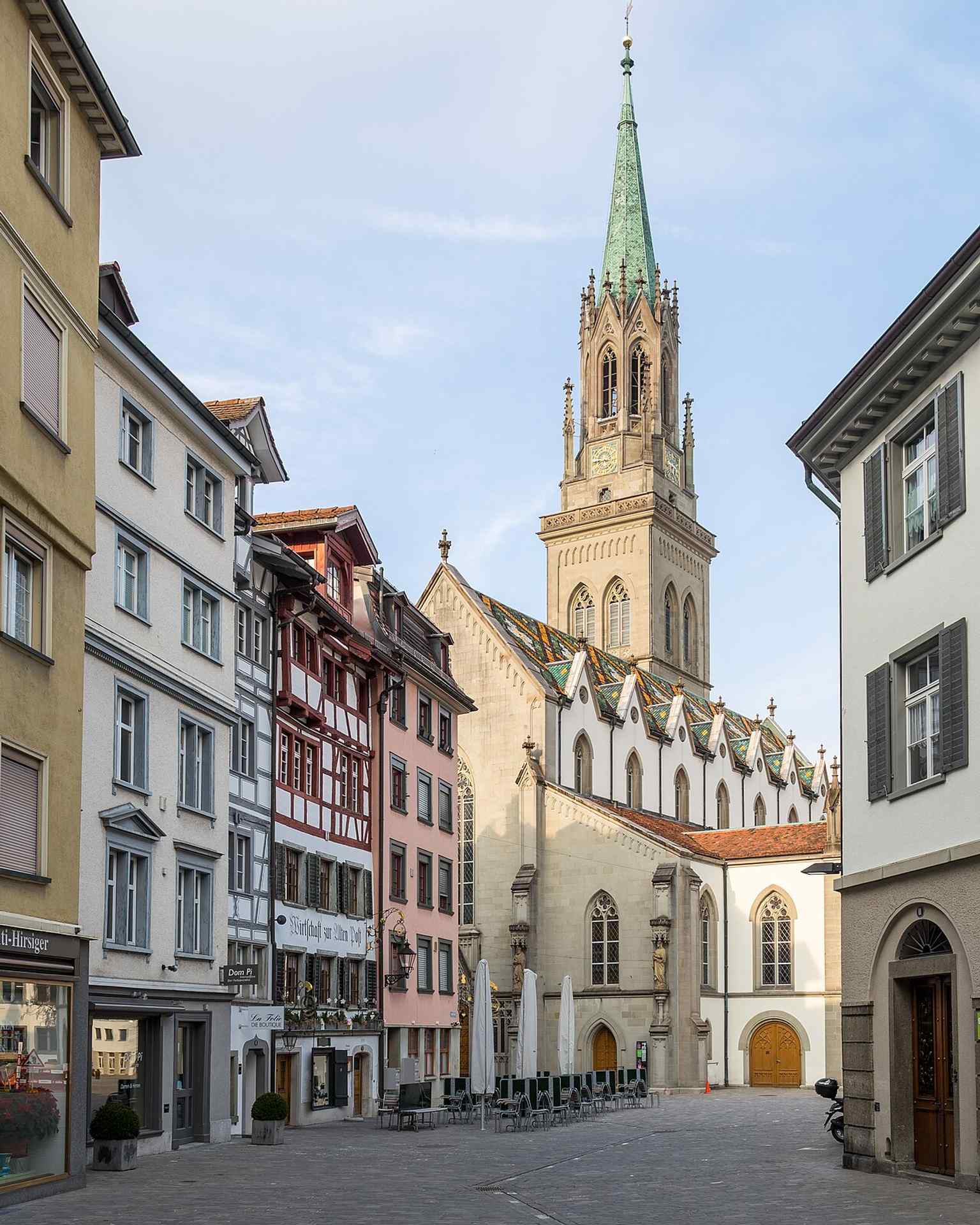
Seen from Gallusstrasse, this view emphasizes the church’s urban setting and the tower that was rebuilt after the mid-19th-century renovation.Photo: JoachimKohler-HB, Wikimedia Commons, CC BY-SA 4.0. Cropped & resized. 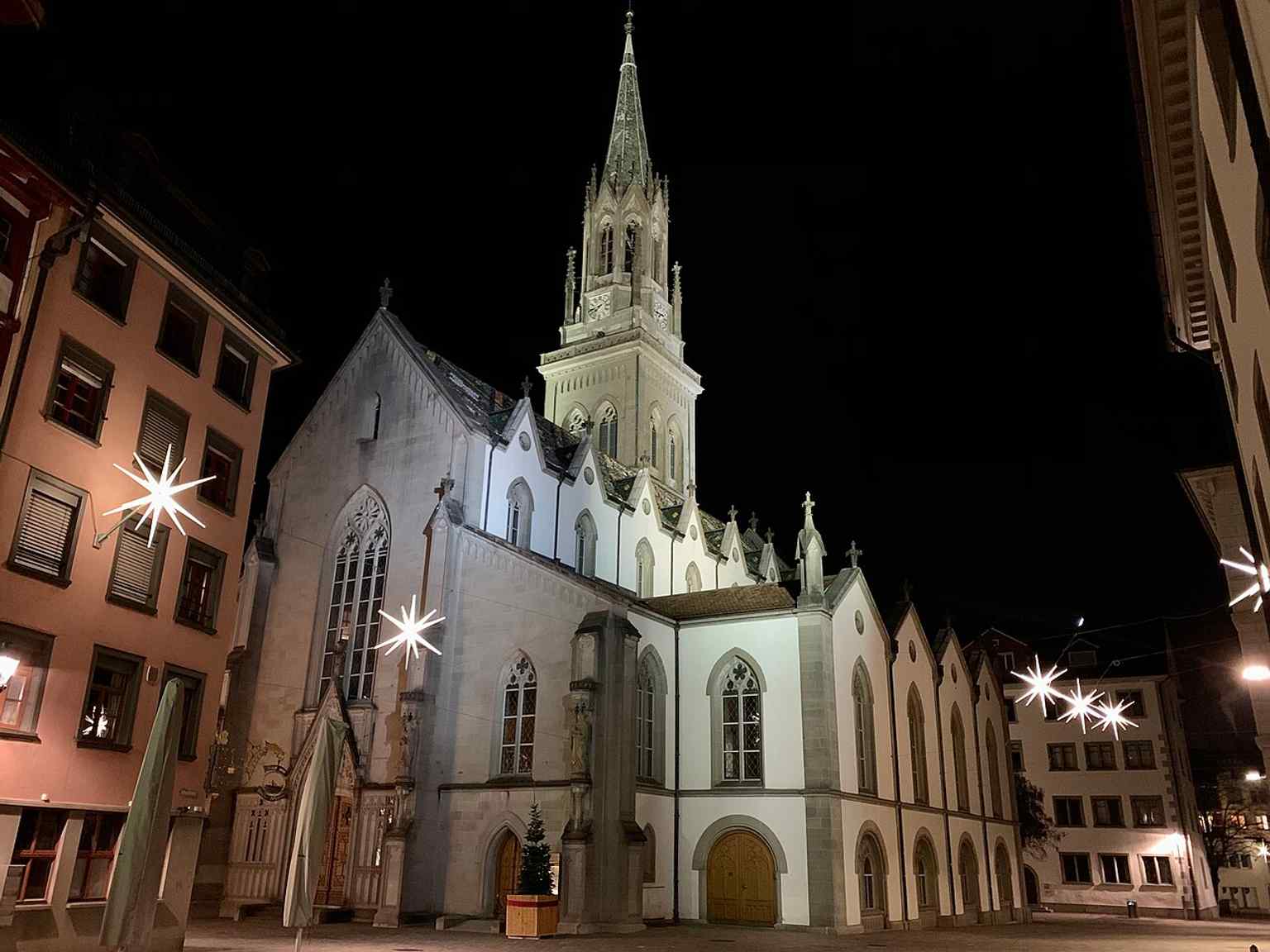
Another interior perspective, useful for showing the open, hall-like worship space that was adapted during the 1963–1979 restoration.Photo: Ank Kumar, Wikimedia Commons, CC BY-SA 4.0. Cropped & resized. 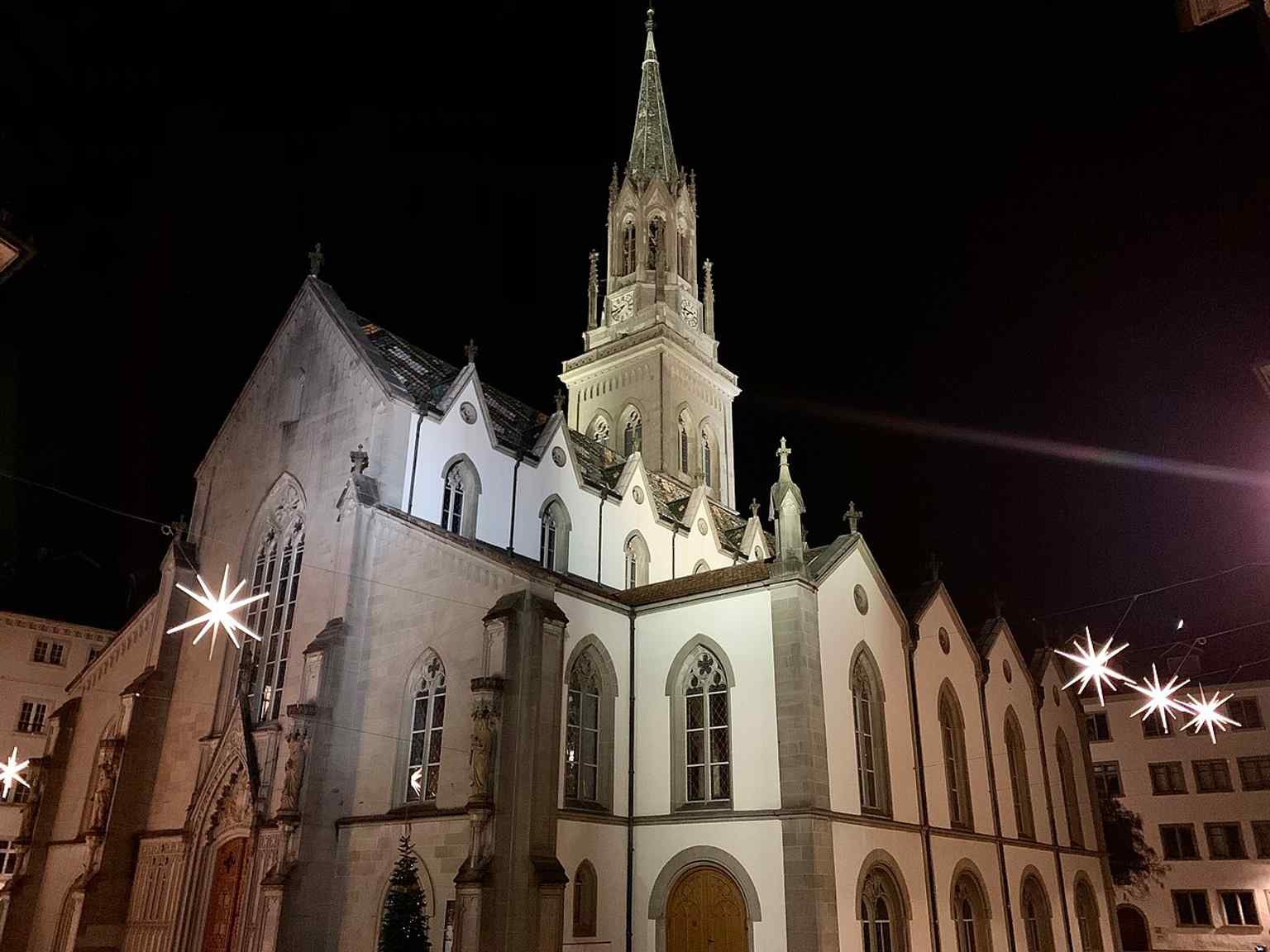
A further interior image that can support the story of the church’s later renovations and archaeological investigations beneath the floor.Photo: Ank Kumar, Wikimedia Commons, CC BY-SA 4.0. Cropped & resized. 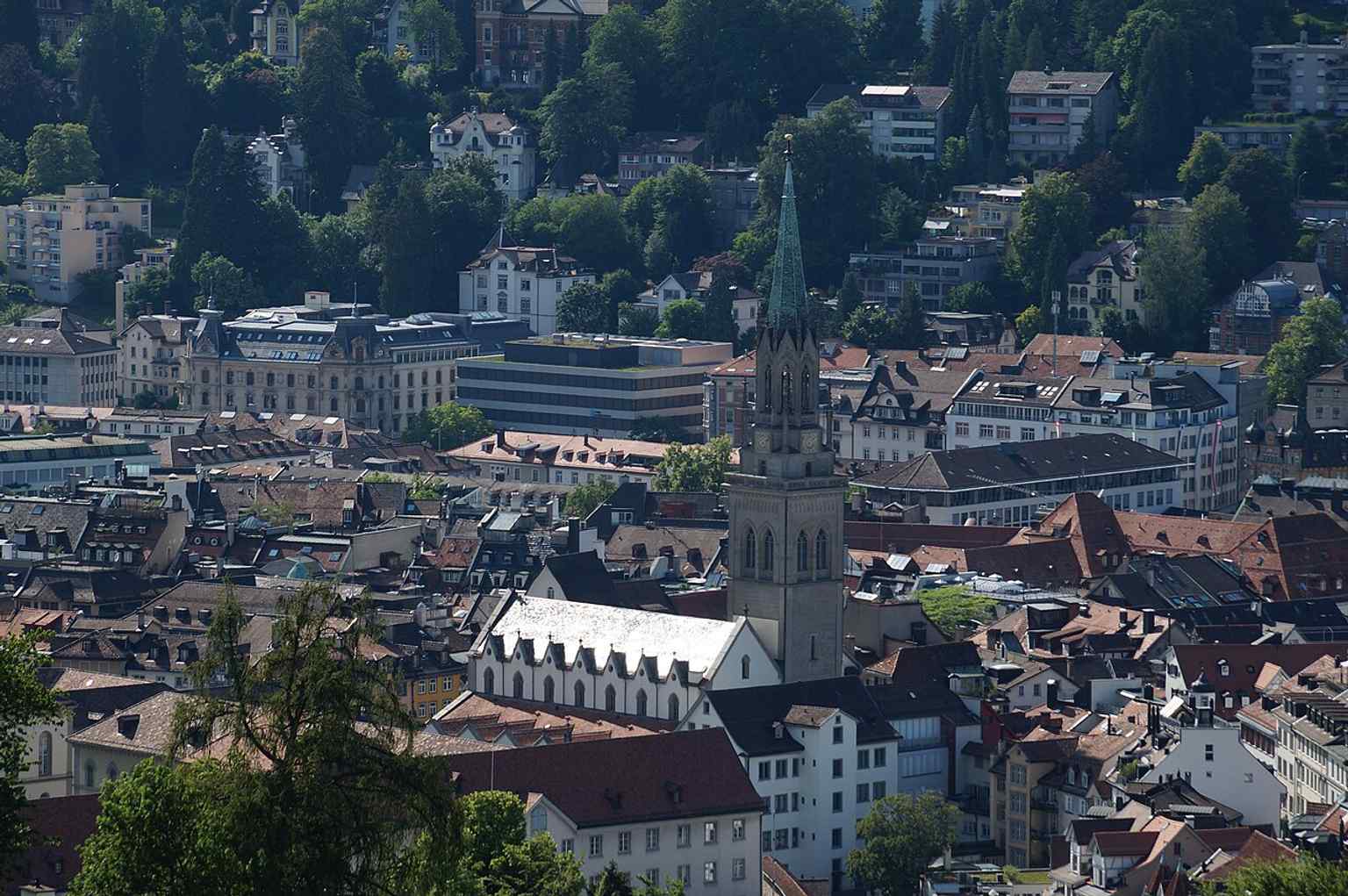
A distant elevated view from Drei Weieren, placing St. Laurenzen in the broader St. Gallen landscape and showing how prominent the tower is.Photo: albinfo, Wikimedia Commons, CC BY-SA 3.0. Cropped & resized. On your right, St. Mangen is a pale stone church with a long, simple body, a square tower, and a sharp pointed spire rising from the southwest corner. This is one of St.…Read moreShow less
Open dedicated page →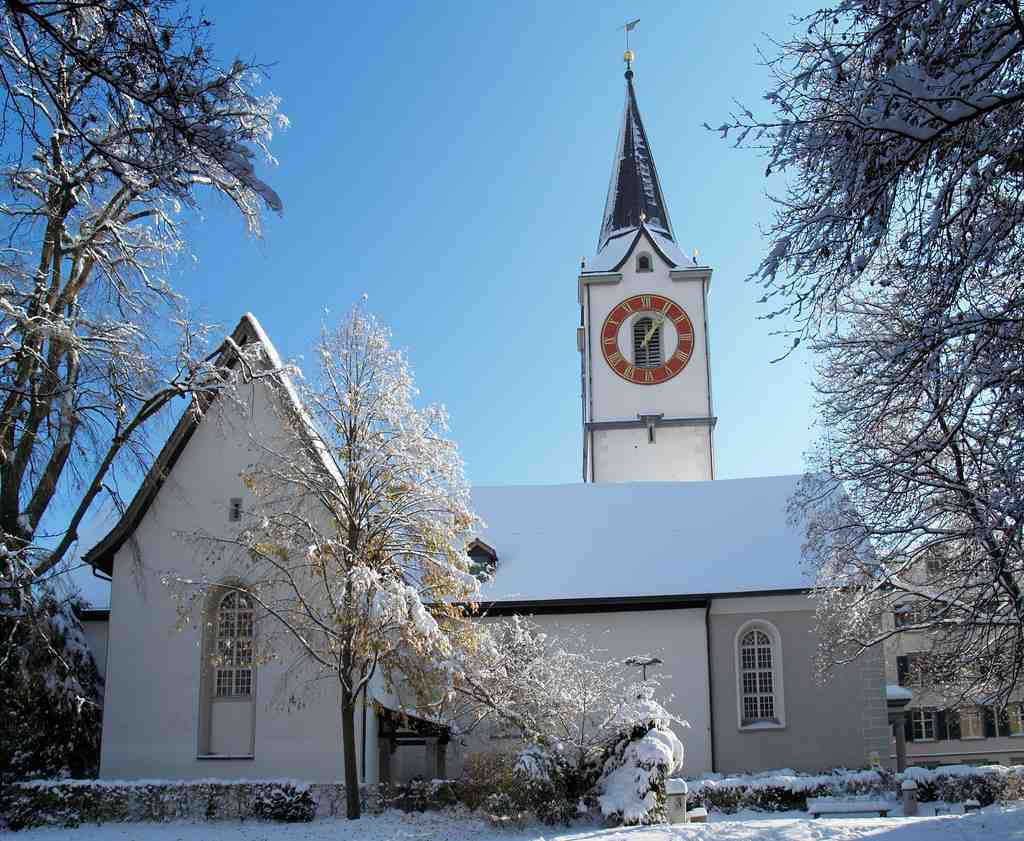
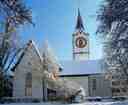
Church of St. MangenPhoto: Bobo11, Wikimedia Commons, CC BY-SA 3.0. Cropped & resized. On your right, St. Mangen is a pale stone church with a long, simple body, a square tower, and a sharp pointed spire rising from the southwest corner.
This is one of St. Gallen’s older survivors, with roots around the year eleven hundred. Its plan follows the shape of a Latin cross, meaning one long arm with shorter side arms, and it still sits on the same axis as the earlier church that stood here before. The tower came a bit later, between fifteen oh five and fifteen oh eight, attached to the southwest side in a way that still gives the building a slightly off-center character... as if perfect symmetry struck it as a little too easy.
St. Mangen also carries the memory of Wiborada. During the Reformation, the city ordered an iconoclasm, a campaign against religious images and shrines. On the twenty-seventh of February, fifteen twenty-eight, officials destroyed the graves of Wiborada and her pupil Rachildis, along with their relics. Wiborada’s bones disappeared from history after that. Her nearby chapel then changed jobs entirely: in fifteen sixty-seven, the city turned it into a library to receive books from Vadian’s bequest. After the earthquake of seventeen seventy-four, that chapel came down.
The church itself has had a dramatic relationship with the sky. At two in the afternoon on the sixth of June, seventeen thirty-one, lightning struck the tower and destroyed the roof and the bells. By the sixth of September, workers had rebuilt the spire and covered it in copper. Bell founders Peter and Johannes Melchior Ernst from Lindau cast four new bells, even reusing metal from the ruined ones. The largest cracked by seventeen thirty-three... because apparently surviving lightning was not enough excitement for one bell, so the founders recast the two biggest. That same year, H. Jakob Kessler installed a clockwork mechanism in the tower.
Later centuries kept revising the place. Builders lengthened the main body westward in sixteen fifty-seven. After the earthquake of seventeen seventy-four, they altered the window layout. In eighteen thirty-seven, architect Felix Wilhelm Kubly actually recommended demolishing the church and starting over. The city, wisely enough, settled for renovation instead. More repairs followed, and after severe mold forced a closure in two thousand eleven, St. Mangen reopened in two thousand fourteen with its interior and organ restored.
Today it belongs to the Evangelical Reformed congregation and often hosts concerts. Inside, a Felsberg organ from nineteen eighty-eight takes its cue from seventeenth-century instruments, with three hand keyboards and an old-style tuning that gives Bach just the right amount of bite.
If you want to look inside later, the church is generally open daily from nine in the morning to six in the evening.
St. Mangen feels quiet, weathered, and stubbornly alive.
Take a moment here, and when you’re ready, we can continue on toward the Waaghaus.
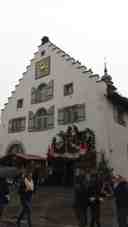
Look for the broad stone-and-plaster building with its open ground floor, stair-step gable, and big clock crowned by a small onion-domed roof turret. This is the Waaghaus, the…Read moreShow less
Open dedicated page →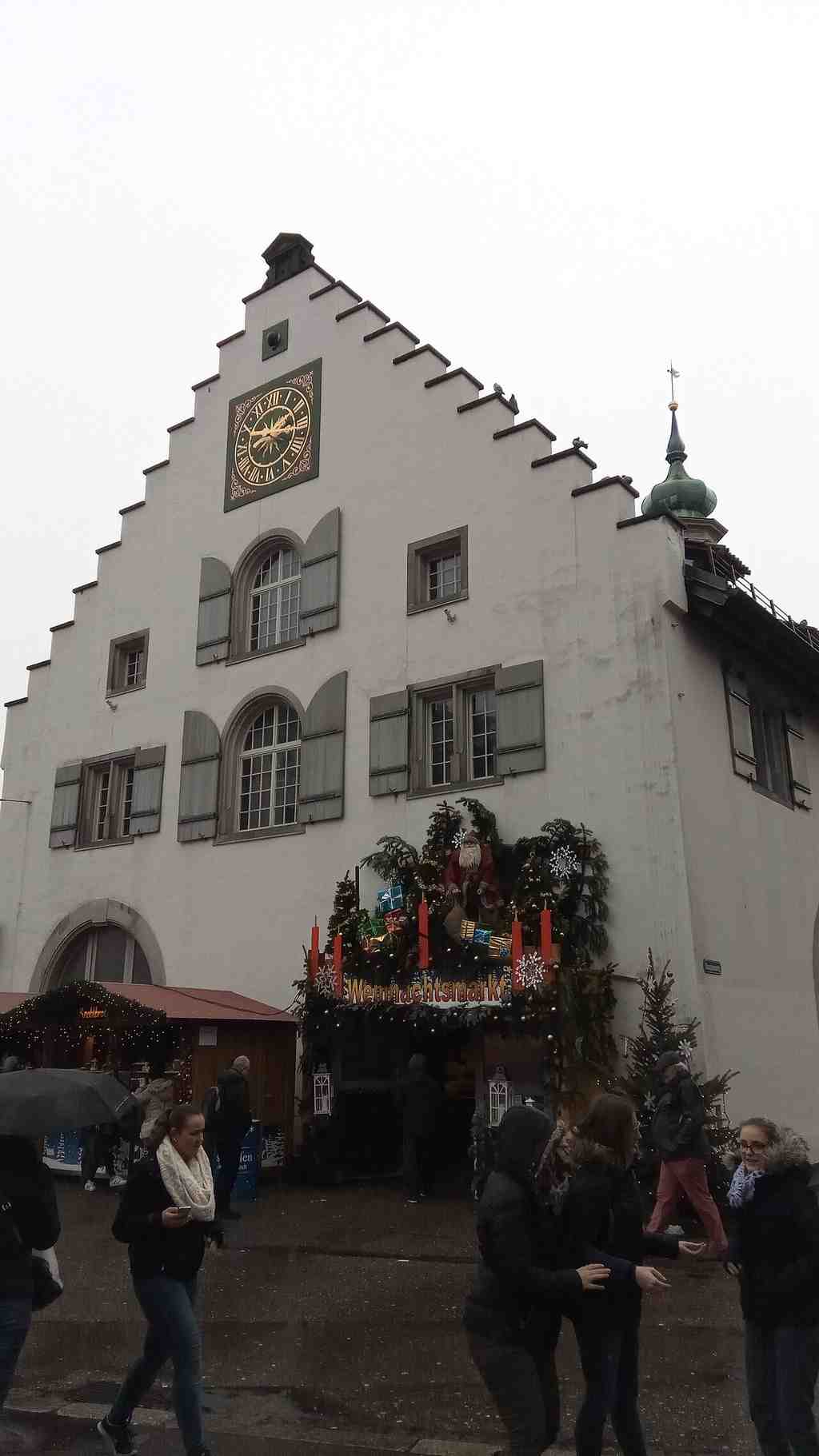
Waaghaus (St. Gallen)Photo: EtschPat, Wikimedia Commons, CC BY-SA 4.0. Cropped & resized. Look for the broad stone-and-plaster building with its open ground floor, stair-step gable, and big clock crowned by a small onion-domed roof turret.
This is the Waaghaus, the old weighing house of Saint Gallen, standing right where trade once squeezed through toward the Brühltor and the road to Rorschach. In fifteen eighty-one, the city council decided it needed a proper place to weigh carts, collect customs duties, and store goods... practical, not glamorous, but cities run on practical things. Builders raised this hall in fifteen eighty-four and fifteen eighty-five, and for a long time people simply called it the Waag, meaning the scales. Later, the nineteenth century preferred the grander name Kaufhaus, or trading house. Then that label faded too. Buildings, like people, go through phases.
The design still gives the game away. Those huge openings at street level let wagons roll straight in. The ground floor stays open on all sides, and the paving rises slightly toward the east, a subtle reminder that this place worked hard for a living. Above you, the two oversized middle windows once worked with a hoisting crane, so merchants could lift heavy linen bales and other cargo up to the upper floor. Saint Gallen never forgot that cloth paid a lot of bills.
By the nineteenth century, the railway and new customs warehouses near the station made this place less useful. For a while it even housed the police, and in eighteen seventy-six a post office moved in. Then came a very Swiss rescue: in nineteen fifty-eight, the citizens voted on whether to keep it. The result was close, six thousand four hundred forty-eight in favor, six thousand one hundred forty-seven against... democracy with excellent taste. Renovators gave the upper floor its current split: event rooms to the east, and the city parliament's council chamber to the west.
One more lovely detail: the clock and its moon-phase display, plus that onion-domed turret, came from the old town hall after its demolition in eighteen seventy-seven. So the Waaghaus is part market hall, part political stage, and part architectural salvage job.
You can stand outside and admire it at any hour, since the site is accessible around the clock.
It is a sturdy little summary of Saint Gallen: commerce, civic argument, and a refusal to throw away good craftsmanship. When you're ready, we can wander on toward the theater.
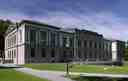
On your right is a pale stone museum, broad and symmetrical, with tall rectangular windows and a central stair rising to the entrance. This is the Kunstmuseum St. Gallen, though…Read moreShow less
Open dedicated page →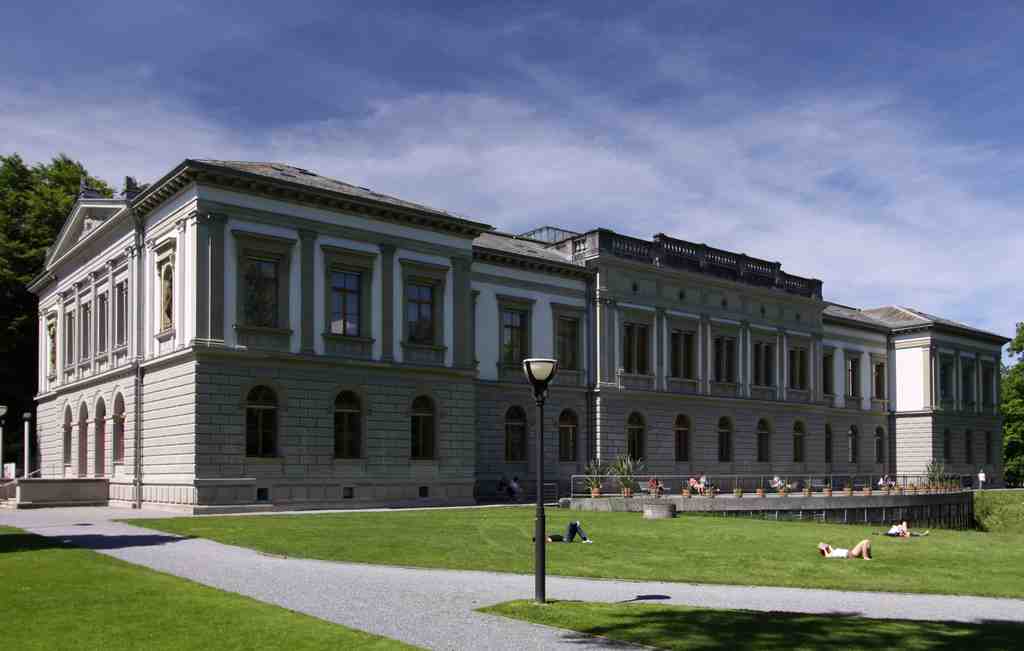
Kunstmuseum St. GallenPhoto: WWHenderson20, Wikimedia Commons, CC BY-SA 3.0. Cropped & resized. On your right is a pale stone museum, broad and symmetrical, with tall rectangular windows and a central stair rising to the entrance.
This is the Kunstmuseum St. Gallen, though the building itself has had a complicated career... which, for an old museum, is almost a hobby.
In nineteen twenty-one, St. Gallen and the East Swiss Geographical-Commercial Society moved their historical and ethnographic collections into a new building on Museumsstrasse. That shift freed the entire upper floor of the old museum for art, and this place slowly became the city’s main art home.
The collection began in a fairly human way: not with a grand master plan, but with works that happened to arrive. Early pieces mattered more for local history than for artistic fame. One notable exception came in eighteen sixteen, when Anton Graff gave the city his portrait of the engraver Adrian Zingg. Then collecting grew more intentional. In eighteen forty, the local art association bought François Diday’s Autumn Evening near Bouveret on Lake Geneva. In eighteen seventy-two, the Gonzenbach family donated a major print collection with names ranging from Albrecht Dürer to Rembrandt.
Friendships shaped the museum too. East Swiss painters with ties to Munich helped bring in Anselm Feuerbach’s Brawling Boys in eighteen seventy-eight, and Franz von Stuck followed in nineteen thirteen. Then came Ferdinand Hodler’s Song from Afar in nineteen oh-six, a sign that St. Gallen had started collecting living, modern Swiss art, not just respectable ancestors.
This building nearly disappeared from the story. It had to close in nineteen seventy because it was unsafe, and people even considered demolition. Instead, the city, the local citizens’ community, and the art association created a foundation in nineteen seventy-eight to support the museums, and after major renovation this old building reopened in nineteen eighty-seven. If you like, take a quick look at the before-and-after image in the app; it neatly shows how the museum and the square around it changed over more than a century and a half.
Inside, the range is surprisingly wide: Dutch Golden Age painting, Swiss masters like Hodler, French Impressionists including Pissarro and Monet, and modern voices from Paul Klee and Andy Warhol to Richard Serra, Nam June Paik, and Pipilotti Rist. A major leap came in nineteen twenty-six with the Sturzenegger collection, and later funds helped the museum acquire works like Pissarro in nineteen thirty-six and Monet in nineteen fifty. Space remains tight, so only part of the collection can be shown at once... a very civilized version of having too much treasure.
If you glance at the app image, you can also see the Gauklerbrunnen, Max Oertli’s fountain from nineteen sixty, standing in front like a slightly cheeky greeter.
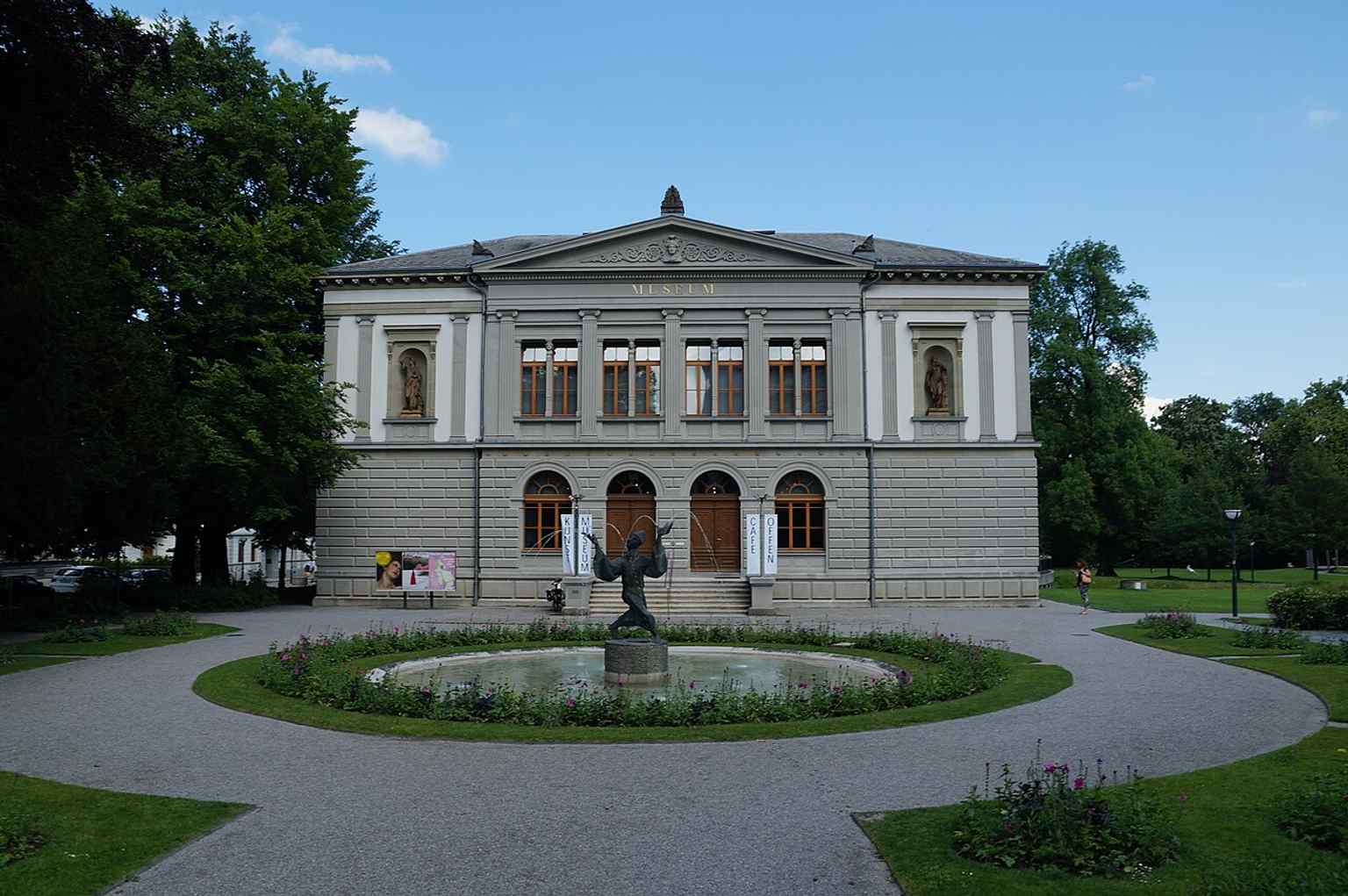
Kunstmuseum St. Gallen seen from the square with the Gauklerbrunnen in front — the fountain was added in 1960 and became part of the museum’s urban setting.Photo: albinfo, Wikimedia Commons, CC BY-SA 3.0. Cropped & resized. Since the Nature Museum moved out in two thousand sixteen, the Kunstmuseum has had the whole building to itself. If you plan to go in, it’s generally open Tuesday through Sunday from ten to five, with Thursday open until eight, and closed on Monday.
For a building that nearly vanished, it now holds an impressively stubborn slice of European art.
Take your time here, and when you’re ready, we can continue to the Museum of Culture.
Frequently asked questions
How do I start the tour?
After purchase, download the AudaTours app and enter your redemption code. The tour will be ready to start immediately - just tap play and follow the GPS-guided route.
Do I need internet during the tour?
No! Download the tour before you start and enjoy it fully offline. Only the chat feature requires internet. We recommend downloading on WiFi to save mobile data.
Is this a guided group tour?
No - this is a self-guided audio tour. You explore independently at your own pace, with audio narration playing through your phone. No tour guide, no group, no schedule.
How long does the tour take?
Most tours take 60–90 minutes to complete, but you control the pace entirely. Pause, skip stops, or take breaks whenever you want.
What if I can't finish the tour today?
No problem! Tours have lifetime access. Pause and resume whenever you like - tomorrow, next week, or next year. Your progress is saved.
What languages are available?
All tours are available in 50+ languages. Select your preferred language when redeeming your code. Note: language cannot be changed after tour generation.
Where do I access the tour after purchase?
Download the free AudaTours app from the App Store or Google Play. Enter your redemption code (sent via email) and the tour will appear in your library, ready to download and start.
If you don't enjoy the tour, we'll refund your purchase. Contact us at [email protected]
Checkout securely with 






%2001.jpg)


%20-%20Abbey%20library%20of%20St.%20Gallen.jpg)


.jpg)
.%20Broderbrunnen%201896%E2%80%931899%2C%20St.%20Gallen%20(2).jpg)
.jpg)
%20St.%20Gallen.jpg)

.jpg)
.jpg)
.jpg)


%2C%20St%20Gallen%2C%20Switzerland%20(%20Ank%20Kumar%20)%2001.jpg)


%2C%20St%20Gallen%2C%20Switzerland%20(%20Ank%20Kumar%20)%2002.jpg)
%2C%20St%20Gallen%2C%20Switzerland%20(%20Ank%20Kumar%20)%2003.jpg)

