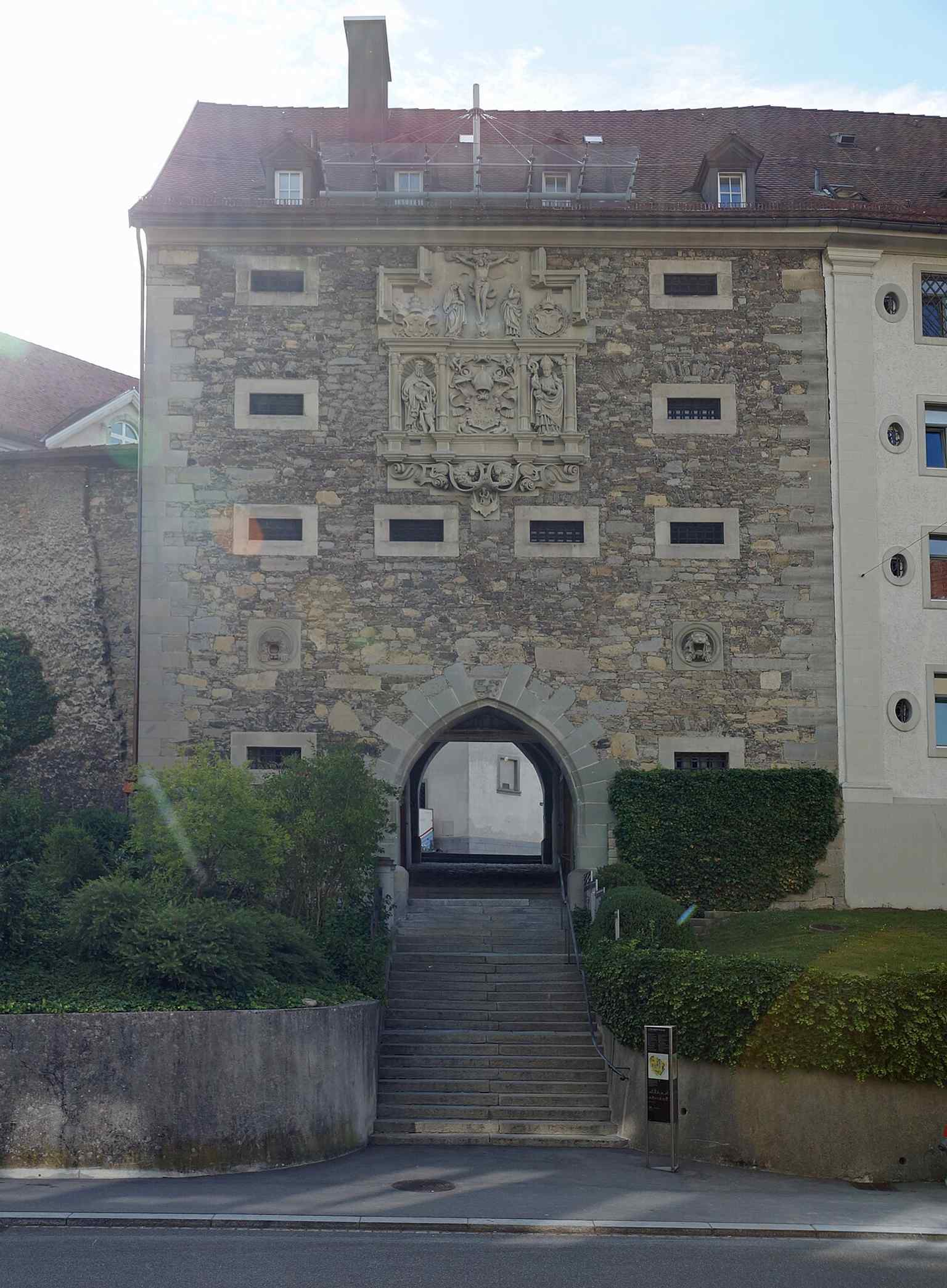
Look for a pale stone gate with a tall pointed arch, a steep gabled roof, and a large carved relief spread above the opening like a stone storybook.
This is Karlstor, the only surviving city gate from St. Gallen’s medieval wall... and like many survivors, it earned that status by sitting right in the middle of trouble. People first called it the New Gate, or the Abbot’s Gate, because this opening served the prince-abbot and his entourage. It rose here in fifteen sixty-nine and fifteen seventy, after decades of arguments between the city and the abbey over power, access, and who got to act like the grown-up in the room.
By the fourteen hundreds, St. Gallen had gained imperial independence, which meant the city answered directly to the Holy Roman Emperor, not to a local lord. The abbey, meanwhile, had its own authority and ambitions. Then came the Reformation. In fifteen twenty-six, Joachim von Watt, better known as Vadian, pushed the city into the new Protestant faith, while the abbey stayed firmly Catholic. So now the same walls protected two neighbors who agreed on almost nothing. Awkward, yes... and politically explosive.
The prince-abbot hated having to pass through the city’s gates to reach his own territories. Earlier abbots had tried to secure a private exit and failed. Finally, in fifteen sixty-six, Swiss mediators brokered the Treaty of Wil. Abbot Otmar Kunz won the right to cut his own gate through the city wall, complete with a drawbridge and a zwinger, which is a narrow fortified passage meant to trap attackers between defenses. In practice, though, the grand plan shrank a bit. Instead of a drawbridge, builders laid a narrow causeway and a wooden bridge over the Steinach, which still ran openly here at the time. The zwinger seems never to have appeared at all. Even sixteenth-century projects had a way of losing features between the sketch and the final bill.
Now look up at that relief. If you check the close-up on your screen, you can catch details that are easy to miss from the ground. The stonecutter Baltus von Seilmannsweiler packed it with messages. At the top, Christ hangs on the cross with Mary and John beside him. Nearby sit the coats of arms of Pope Pius the Fourth and Emperor Maximilian the Second, a bold reminder of the abbey’s standing. In the middle, Saint Otmar appears with a wine barrel, and Saint Gallus stands with his bear, the animal from the city’s founding legend. And down at the bottom, tucked into the carving almost cheekily, there’s a tiny crouching man with hammer and chisel... probably the artist signing his work without bothering with a signature.
That relief nearly disappeared in the late seventeen hundreds, when revolution and anti-aristocratic fury inspired a second wave of image-breaking. A local historian, Georg Leonhard Hartmann, stopped a government commissioner from destroying it. For monument preservation, that was an unusually early save... a small miracle performed with paperwork and backbone.
Above the arch, those rows of narrow windows tell another chapter. By at least the seventeen hundreds, and officially by eighteen twelve, the rooms overhead served as prison cells. They still function as detention space today, which gives the gate a certain grim efficiency.
If you want a better sense of how the wall once stretched around it, the wider view in the app helps fill in the missing defensive world around this doorway. Karlstor itself is accessible to view at any hour.
For one gate, it carries an impressive load of faith, rivalry, vanity, and stonecraft.
Take one more look, and when you’re ready, we can continue to the next stop.