
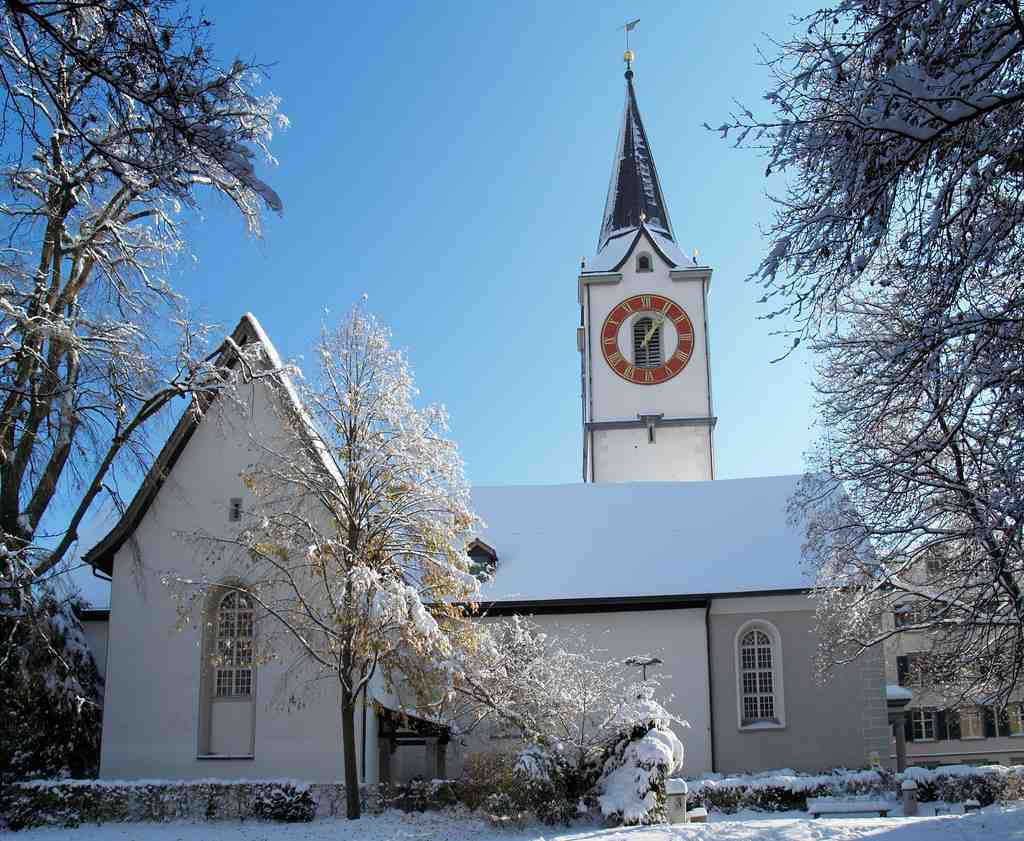
On your right, St. Mangen is a pale stone church with a long, simple body, a square tower, and a sharp pointed spire rising from the southwest corner.
This is one of St. Gallen’s older survivors, with roots around the year eleven hundred. Its plan follows the shape of a Latin cross, meaning one long arm with shorter side arms, and it still sits on the same axis as the earlier church that stood here before. The tower came a bit later, between fifteen oh five and fifteen oh eight, attached to the southwest side in a way that still gives the building a slightly off-center character... as if perfect symmetry struck it as a little too easy.
St. Mangen also carries the memory of Wiborada. During the Reformation, the city ordered an iconoclasm, a campaign against religious images and shrines. On the twenty-seventh of February, fifteen twenty-eight, officials destroyed the graves of Wiborada and her pupil Rachildis, along with their relics. Wiborada’s bones disappeared from history after that. Her nearby chapel then changed jobs entirely: in fifteen sixty-seven, the city turned it into a library to receive books from Vadian’s bequest. After the earthquake of seventeen seventy-four, that chapel came down.
The church itself has had a dramatic relationship with the sky. At two in the afternoon on the sixth of June, seventeen thirty-one, lightning struck the tower and destroyed the roof and the bells. By the sixth of September, workers had rebuilt the spire and covered it in copper. Bell founders Peter and Johannes Melchior Ernst from Lindau cast four new bells, even reusing metal from the ruined ones. The largest cracked by seventeen thirty-three... because apparently surviving lightning was not enough excitement for one bell, so the founders recast the two biggest. That same year, H. Jakob Kessler installed a clockwork mechanism in the tower.
Later centuries kept revising the place. Builders lengthened the main body westward in sixteen fifty-seven. After the earthquake of seventeen seventy-four, they altered the window layout. In eighteen thirty-seven, architect Felix Wilhelm Kubly actually recommended demolishing the church and starting over. The city, wisely enough, settled for renovation instead. More repairs followed, and after severe mold forced a closure in two thousand eleven, St. Mangen reopened in two thousand fourteen with its interior and organ restored.
Today it belongs to the Evangelical Reformed congregation and often hosts concerts. Inside, a Felsberg organ from nineteen eighty-eight takes its cue from seventeenth-century instruments, with three hand keyboards and an old-style tuning that gives Bach just the right amount of bite.
If you want to look inside later, the church is generally open daily from nine in the morning to six in the evening.
St. Mangen feels quiet, weathered, and stubbornly alive.
Take a moment here, and when you’re ready, we can continue on toward the Waaghaus.




