
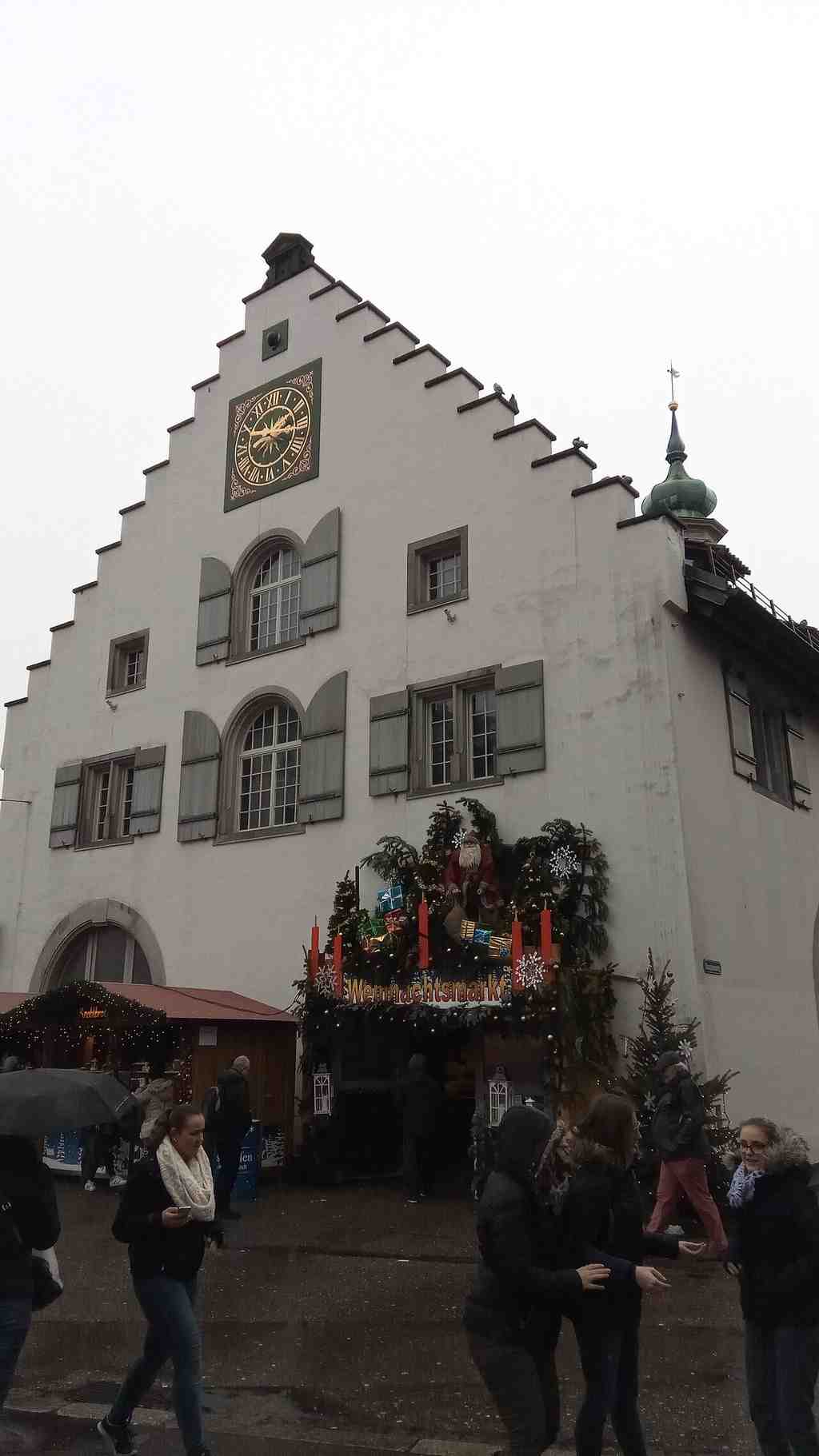
Look for the broad stone-and-plaster building with its open ground floor, stair-step gable, and big clock crowned by a small onion-domed roof turret.
This is the Waaghaus, the old weighing house of Saint Gallen, standing right where trade once squeezed through toward the Brühltor and the road to Rorschach. In fifteen eighty-one, the city council decided it needed a proper place to weigh carts, collect customs duties, and store goods... practical, not glamorous, but cities run on practical things. Builders raised this hall in fifteen eighty-four and fifteen eighty-five, and for a long time people simply called it the Waag, meaning the scales. Later, the nineteenth century preferred the grander name Kaufhaus, or trading house. Then that label faded too. Buildings, like people, go through phases.
The design still gives the game away. Those huge openings at street level let wagons roll straight in. The ground floor stays open on all sides, and the paving rises slightly toward the east, a subtle reminder that this place worked hard for a living. Above you, the two oversized middle windows once worked with a hoisting crane, so merchants could lift heavy linen bales and other cargo up to the upper floor. Saint Gallen never forgot that cloth paid a lot of bills.
By the nineteenth century, the railway and new customs warehouses near the station made this place less useful. For a while it even housed the police, and in eighteen seventy-six a post office moved in. Then came a very Swiss rescue: in nineteen fifty-eight, the citizens voted on whether to keep it. The result was close, six thousand four hundred forty-eight in favor, six thousand one hundred forty-seven against... democracy with excellent taste. Renovators gave the upper floor its current split: event rooms to the east, and the city parliament's council chamber to the west.
One more lovely detail: the clock and its moon-phase display, plus that onion-domed turret, came from the old town hall after its demolition in eighteen seventy-seven. So the Waaghaus is part market hall, part political stage, and part architectural salvage job.
You can stand outside and admire it at any hour, since the site is accessible around the clock.
It is a sturdy little summary of Saint Gallen: commerce, civic argument, and a refusal to throw away good craftsmanship. When you're ready, we can wander on toward the theater.




