
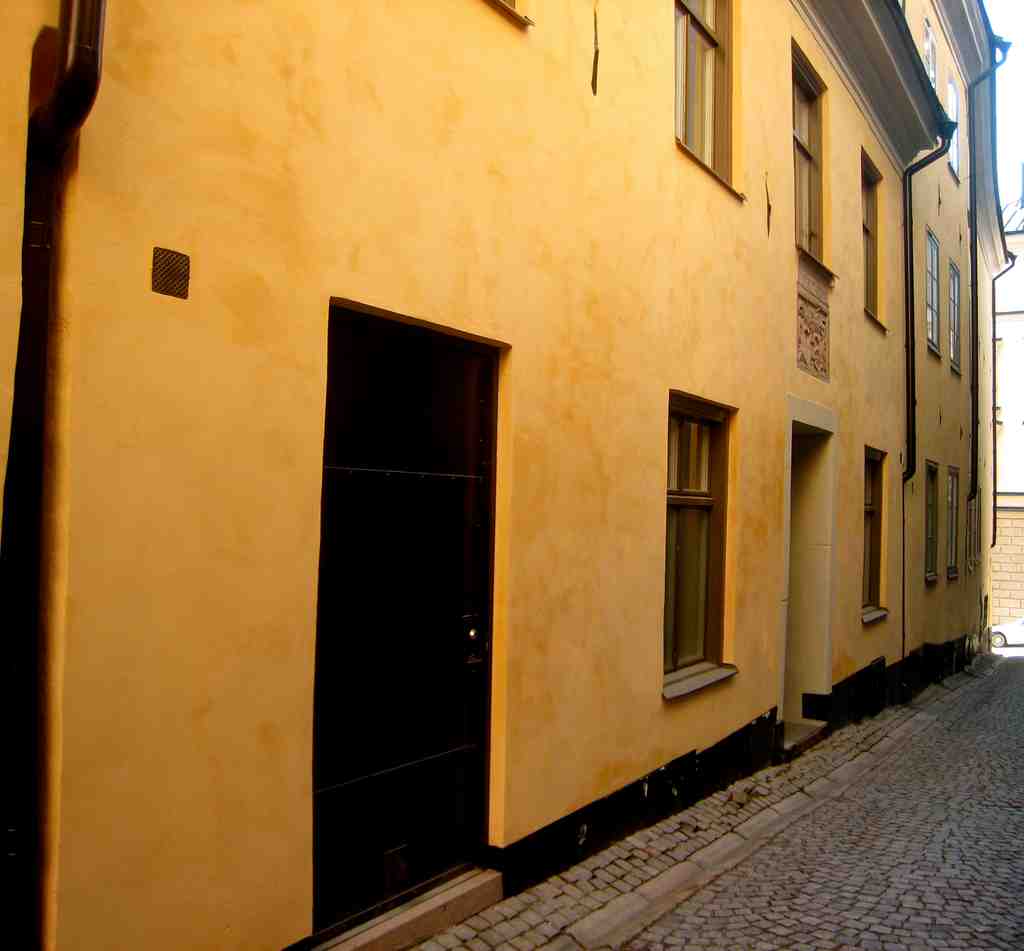
Look for the narrow plaster-fronted house with a steep gabled profile and a carved stone coat of arms set above the doorway.
At first glance, this does not look like one of Stockholm’s great survivors. But it is. Baggensgatan twenty-seven is likely one of the oldest surviving residential houses in the city... a place that quietly remembers medieval Stockholm not as a stage for kings, but as a place where people slept, prayed, traded, and kept going.
Most visitors pass the doorway and miss the age hiding in the wall. Look closely at the iron anchor plates fixed into the facade. They belong to a very early type, cast in one piece, older than the styles that became common after the mid fifteen hundreds. Locals notice those details. They tell you this house carries its centuries in its bones.
The story may begin in the thirteen thirties. King Magnus Eriksson likely ordered this house built in thirteen thirty-six for the Johanniters, a religious order also known as the Knights Hospitaller. He told them to keep a shelter here, something between a hostel and an inn, for pilgrims and traveling monks. That matters. It means medieval Stockholm was not only fortress, court, and punishment ground. It was also a city of arrivals... people with muddy boots, foreign accents, and religious purpose, looking for a bed behind these walls.
In the fourteen hundreds, Gertrud Hansdotter left the house to Vadstena Abbey. Then, in the late fifteen hundreds, another life began here. The Scottish nobleman Anders Keith, an officer in Swedish service and a favorite of King Johan the Third, held this address. His house stood between the twin merchant streets of the old town, with access from both Baggensgatan and Österlånggatan. Above the door, you can still see the stone shield with the arms of Keith and his wife, Elisabeth Birgersdotter Grip. The Latin inscription reads, “Auxilium nostrum a Domino” - our help comes from God. That shield originally faced Österlånggatan; workers moved it here in the eighteen sixties, which is why the house still wears its most personal memory toward this street.
Then the name changed everything. People began calling this place Papistekyrkan, “the Papist Church” - a Protestant nickname for a Catholic worship space. King Sigismund bought the house in the fifteen nineties and allowed Catholic services here. A priest named Andreas Olai led worship inside. In fifteen ninety-five, the conflict turned so sharp that the parish priest Erik Schepperus asked the city to lock the house because, as he put it, the papal priest was holding services here.
So this building is a witness twice over: first to medieval hospitality, then to the struggle over who had the right to worship in Stockholm at all. After that, it passed from nobles to masons, wine merchants, and traders. A fire in seventeen seventy damaged it, and the facade you see from Baggensgatan likely took its present character during the repairs.
That is the quiet power of this house. It proves that Gamla stan grew not only through crowns and decrees, but through migrants, merchants, clergy, and families layering their lives into the same walls. In a moment, we’ll carry that story into the community that helped shape this part of the city most visibly... at the German Church.




