
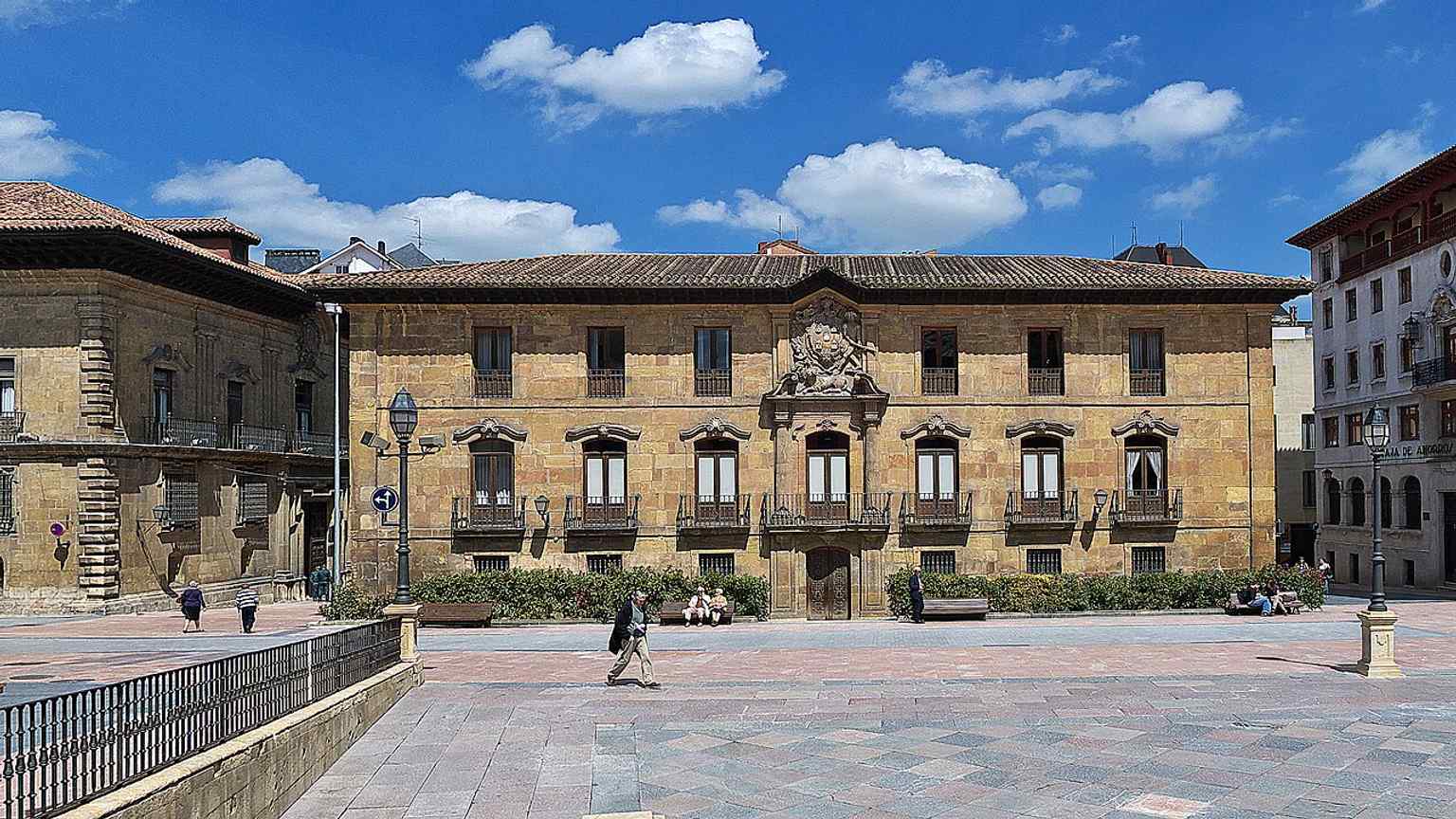
Look to your left for a broad ashlar-stone facade in three neat levels, centered on an ornate arched doorway and balcony, with a carved coat of arms rising above the cornice like a stone signature.
This palace teaches a useful Oviedo lesson: here, architecture is never just decoration. In the early modern city, Asturian noble lineages were not simply old families with long memories. They were rival power networks, and they wrote their status into the street in stone. The Mirandas, who ranked among the strongest houses in the principality, used this address near the cathedral the way a modern institution uses a headquarters... to announce influence, wealth, and who expected to be heard.
Diego de Miranda started that statement between sixteen twenty-seven and sixteen twenty-nine. Master builders including Juan de Naveda and Gonzalo Güemes Bracamonte likely helped shape it. The first version followed an early Asturian Baroque style, still very classical in spirit: a compact urban palace arranged around a large central courtyard, with two four-story towers flanking one side. Only one of those towers survives now. So even before you notice the details, the building already tells a story of loss and revision.
Now focus on the entrance. The doorway has a lowered arch, framed by pilasters, flat wall-columns, with recessed panels. Above it, the main balcony stands between Doric half-columns, and above those sits a broken pediment, a split triangular crown, supporting the shield. This is stone speaking the language of authority.
But here comes the turn. The facade in front of you is not Diego de Miranda's original face. In the late eighteenth century, Antonio Heredia Velarde, mayor of Oviedo, pushed a major redesign. He hired the Asturian architect Manuel Reguera González... and then the relationship collapsed. Another architect finished the job around seventeen seventy-four. So the elegant front you see came out of conflict, not smooth agreement. That's Oviedo in a nutshell: people keep remaking the city, and not always politely.
If you glance at the image on your screen, you can read that central composition more clearly and see how the whole facade channels your eye upward to the shield. That shield belongs to the Heredia family. It shows Hercules wrestling the Nemean lion, with a mask below and the date seventeen seventy-four inscribed like a small stone boast. Noble families did not exactly go in for understatement.
Later, the palace changed uniforms again: in the nineteenth century it became a casino, then in nineteen thirty-one the Audiencia Territorial, a regional high court. Today it still serves public authority, which is a fine irony for a house born as private power. Official monument protection finally arrived in two thousand.
From these family emblems, we now turn toward an older source of authority altogether: the royal Oviedo of its earliest kings. San Tirso el Real is about a one-minute walk from here, and this exterior can be viewed at any hour.





