
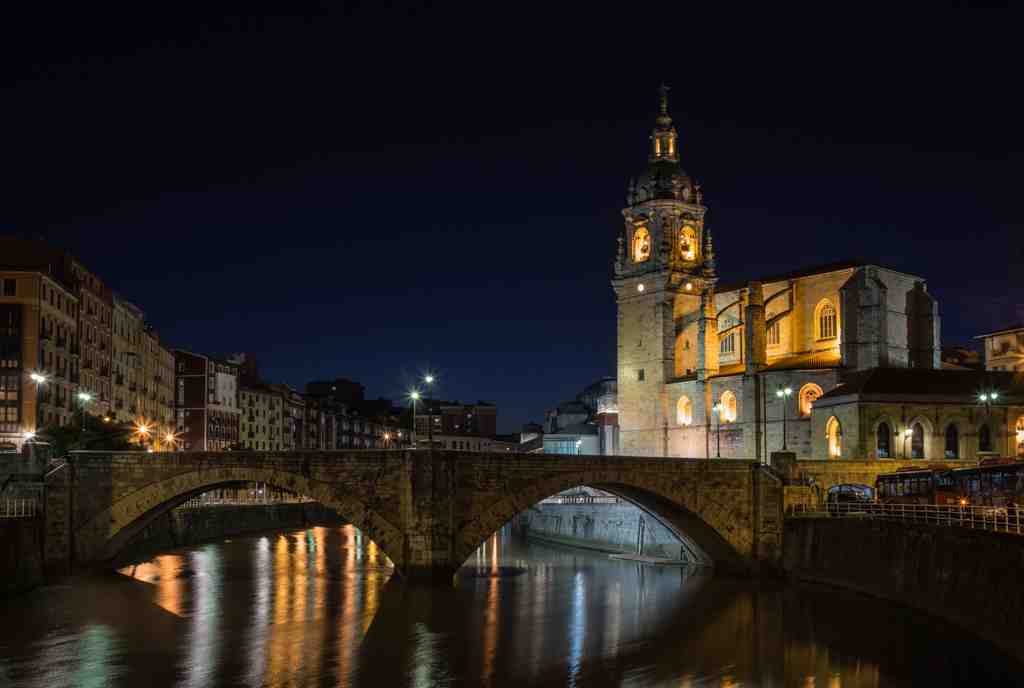
On your right is a pale stone church with a compact Gothic shape, a richly carved doorway, and a bell tower topped by a dome and lantern.
This is San Antón, and in Bilbao it means more than just “church.” Put this building together with the bridge beside it, and you have the city’s coat of arms. Its outline also made its way onto the Athletic Club emblem, which is about as Bilbao as strong coffee and a serious opinion about football. So this place sits right where faith, trade, and civic pride all shake hands.
The setting matters. San Antón stands at the edge of the old commercial quarter, right beside the estuary. The river helped Bilbao grow rich, and it also gave the church plenty of trouble. Flood after flood hit this site, including the devastating one in nineteen eighty-three, which wrecked furniture, doors, and railings inside. The same water that carried goods and ambition also came back now and then like an unpaid bill.
Its story goes deeper than the walls you see. In two thousand and two, archaeologists found remains from the twelfth and thirteenth centuries here, older than Bilbao’s official founding in thirteen hundred. They also uncovered a fourteenth-century wall, two burial grounds, and the foundations of an earlier church consecrated in fourteen thirty-three. So San Antón is less one building than a stack of chapters: warehouse, fortification, cemetery, shrine, and city symbol.
If you glance at your screen, the interior image shows the rib vaults - the stone ribs crossing the ceiling - that still carry the Gothic character through all the later repairs. This is Biscay Gothic: not the giant, glass-heavy style you find in northern France, but a smaller, sturdier local version that fits the region’s history.
The church grew with Bilbao. Builders enlarged it in fourteen seventy-eight as the congregation expanded. Then in fifteen forty-eight they gave it a Renaissance front, with carved heads around the entrance and neat Corinthian columns. Later, in seventeen seventy-four, Gabriel de Capelastegui began the present bell tower, following a design by Juan de Iturburu. That tower did not just hold bells. It crowned the church like a public signature, and the figure at the top represented Faith. Even that finishing touch came from a nearby workshop on Ascao Street, tying the skyline to local metalworkers.
San Antón also survived some rough handling from people, not just rivers. During the Carlist war, forces used the church for military logistics. Fire and bombing damaged it. By eighteen eighty-one, the building had become dangerously worn down, and Sabino Goikoetxea led a restoration that saved it but also changed many original features. Helpful, yes... uncomplicated, not exactly.
Take a look at the old historical view on your phone, and you can see how long this silhouette has served as a marker for the city. That may be the real heart of San Antón. Bilbao keeps rebuilding itself, but it likes to leave a recognizable outline in the frame.
From here, the story turns practical again. In about one minute, Riverside Market picks up exactly where this church leaves off: river trade, daily commerce, and the very tasty business of keeping a city fed.




