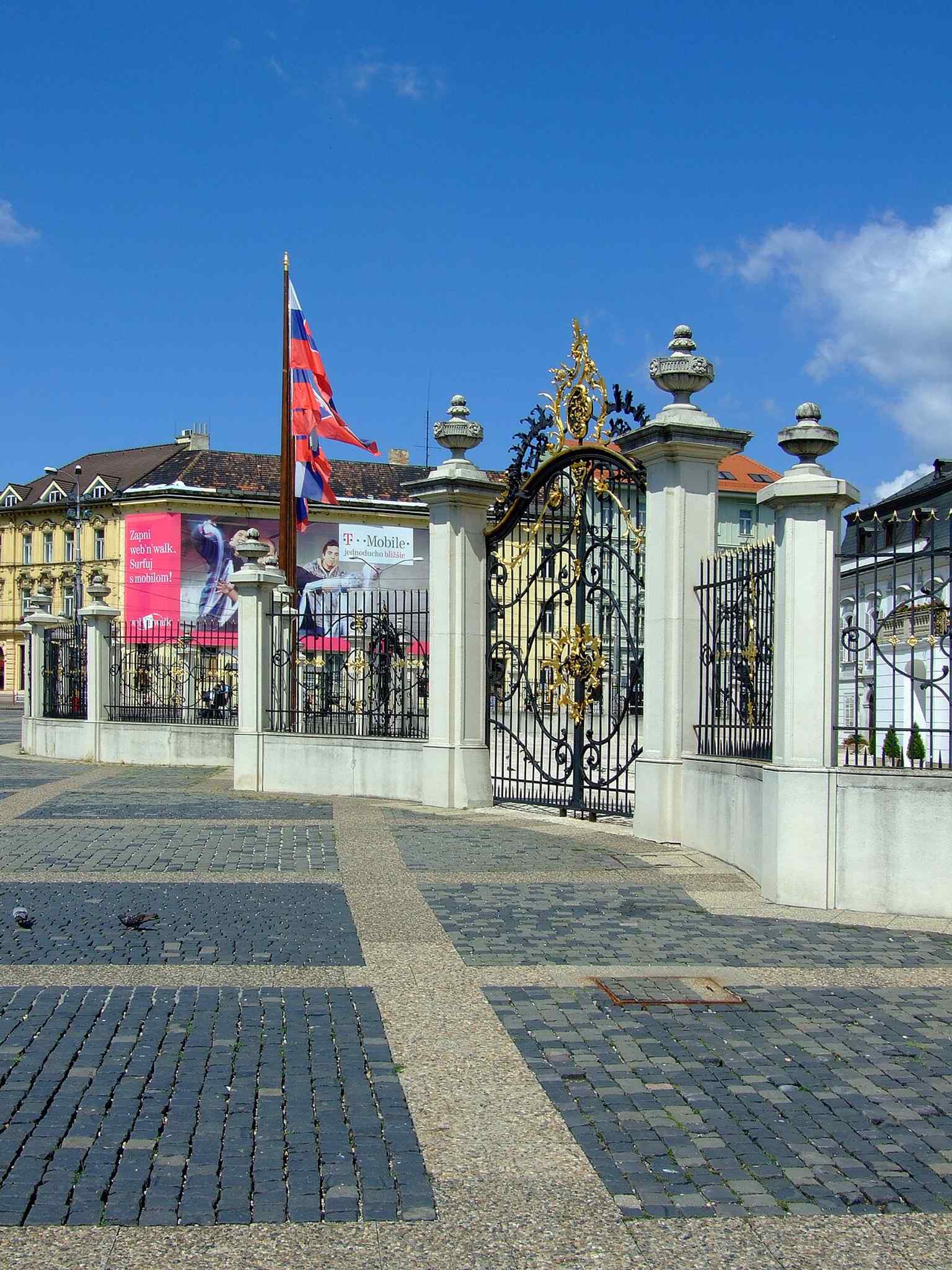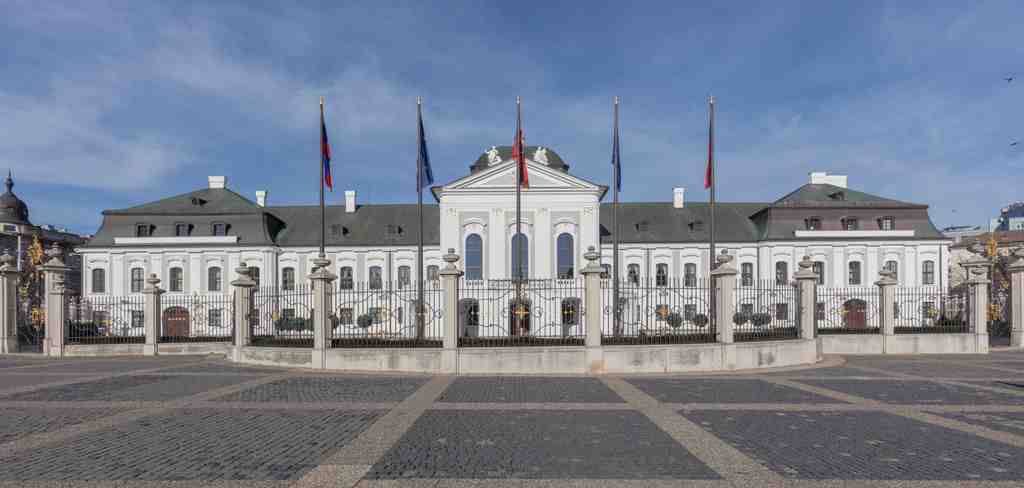
On your right, look for the pale cream Rococo palace with a rounded central block, two sweeping side wings, and an ornate wrought-iron gate marking the presidential entrance.
Take in that façade for a moment... it behaves like a court host. The center bows forward, the wings stretch outward, and the whole composition says, very politely, “important people this way.” Antal Grassalkovich wanted exactly that effect when he hired architect Andreas Mayerhoffer to finish this summer palace in seventeen sixty. Grassalkovich was no minor noble with expensive hobbies. He served as president of the Royal Hungarian Chamber, something close to a finance minister, and because Pressburg, today’s Bratislava, stood as the capital of the Kingdom of Hungary, he needed a residence that could perform rank as clearly as any title.
This is Rococo, a lighter, more playful late Baroque style, and it worked like elegant stage design. Here, politics dressed itself in stucco, symmetry, and ceremony. Courtly music and Enlightenment prestige met under this roof too: the palace became one of Pressburg’s great musical addresses, where art and power boosted each other like old friends with excellent tailoring. Joseph Haydn conducted here, and tradition ties him to a concert in the room now used for receptions. Grassalkovich kept his own orchestra, and Prince Esterházy even “loaned” Haydn across aristocratic lines. Not a bad borrowed employee.
Maria Theresa herself stayed here in seventeen seventy-five, and that matters because this was not just a rich man’s house. It was part salon, part political theater, part royal extension. Balls unfolded here, marriages were celebrated here, and the Great Hall still preserves so much of its eighteenth-century look that the room is presented as something the empress would recognize. If you glance at the image of the Green Salon on your screen, you’ll get a feel for how these interiors still turn conversation into ceremony.
Now here’s the sharper edge of the story. If you heard a brand-new Haydn piece in a room like this, would it feel like culture shared... or like a velvet rope set to music?
Because this palace did not glide untouched from powdered wigs to modern diplomacy. After the old empire faded, the building stood empty, then served the military. During the nineteen thirty-nine to nineteen forty-five period, architect Emil Belluš adapted it for Jozef Tiso, the president of the First Slovak Republic. Later the Communist state repurposed it again, and in nineteen fifty it became the Klement Gottwald House of Pioneers and Youth, nicknamed “Pinkáč.” Children came here for drama, ballet, ballroom dance, music, modeling, folk groups... and in the process they caused heavy damage to the palace. That’s the twist, isn’t it? A house built for elite display became a children’s activity center, then nearly a ruin through overuse rather than neglect.
You can check the before-and-after image in the app to see how that aristocratic residence turned into the guarded forecourt of a modern presidency.
After the Velvet Revolution, restoration finally began in earnest, overseen by Slovakia’s first First Lady, Emília Kováčová. On the thirtieth of September, nineteen ninety-six, President Michal Kováč received the keys here, and the palace began its latest act. Inside, even the small rituals matter: an antique Vienna clock from around seventeen eighty still gets wound by hand each day. Power likes its symbols... and this city rarely throws old ones away when it can teach them a new script.
Behind the palace, the former gardens now serve the public again as a park, another reminder that spaces of privilege in Bratislava keep slipping, slowly, into civic life. And if Reduta brought music into a more public hall, this palace reminds you where some of that cultural prestige first learned to wear formal clothes.
From here, we leave the polished salon and head back toward the city’s old skin. In about seven minutes, Michael’s Gate will show us how entry, status, and ceremony once narrowed into a single controlled passage.