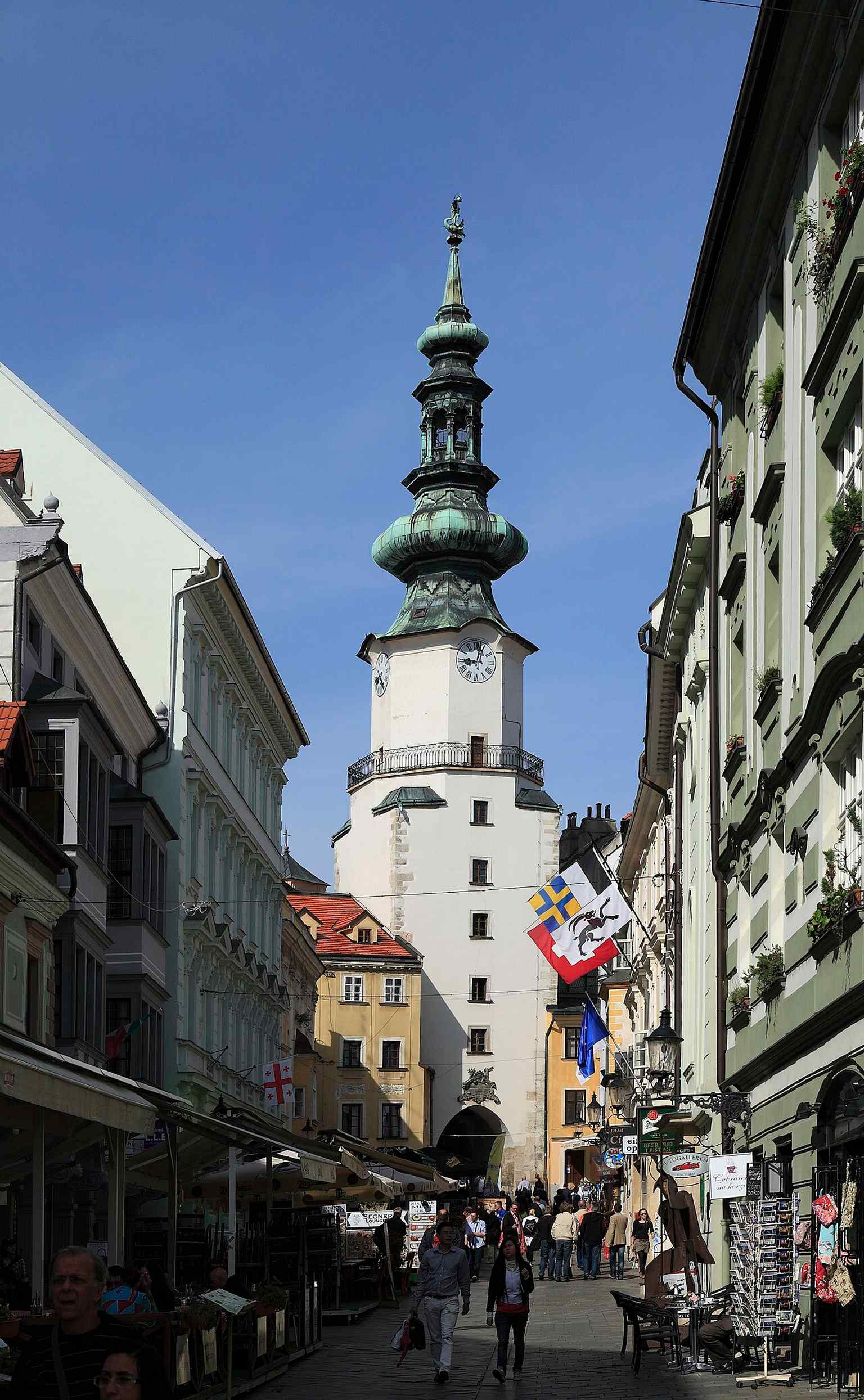
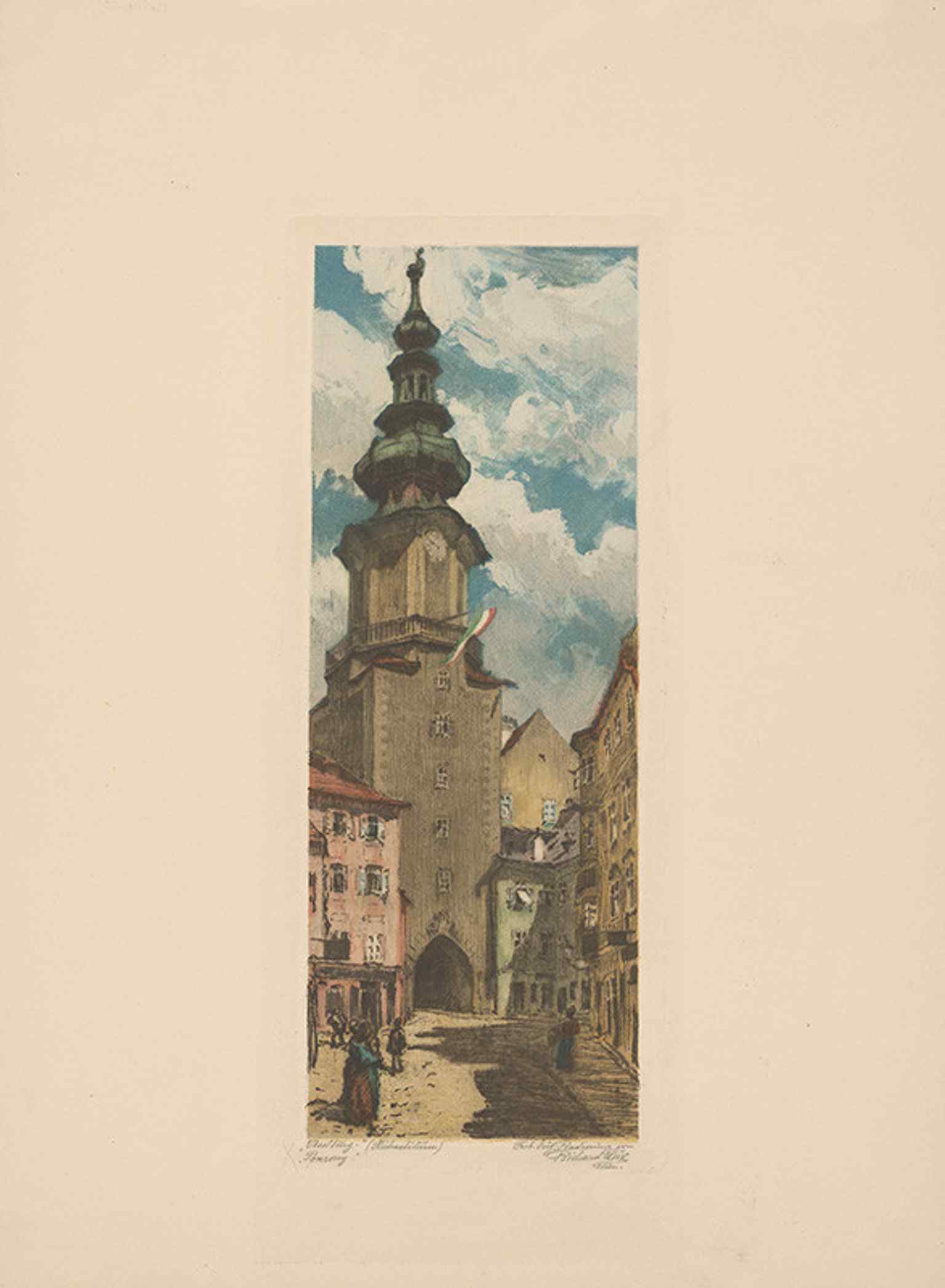
Ahead of you rises a pale stone tower with a tall arched passage, a rounded green copper roof, and the figure of Saint Michael standing on top with his dragon.
Michael's Gate is the last witness of Bratislava's walled city. Nearly everything that once worked with it - the rings of walls, the moat, the defensive outworks - has disappeared, so this one survivor carries the memory of a whole lost system on its shoulders.
The first gate here dates to the late thirteenth century, and a written record mentions it in fourteen eleven. Back then, entering town was no casual stroll. Travelers approached the north side of the city, crossed a drawbridge over a moat, passed a barbican - that is, an outer defensive gatehouse - and then faced a portcullis, the heavy iron grille that could drop straight down, plus a stout wooden door for good measure. Medieval Bratislava believed in clear boundaries. Very clear.
If you check the image in the app, you can see how this gate once belonged to a much larger defensive puzzle, not a lonely monument standing by itself.
What you see now mostly comes from change, not purity. Builders first raised the gate around the year thirteen hundred, but they kept reworking it. The tower suffered major damage in the sixteenth century, and between seventeen fifty-three and seventeen fifty-eight city leaders rebuilt it into the Baroque form you see now. That was when they placed Saint Michael on top, turning a fortress into something a little more theatrical, a little more civic. Bratislava does that well: it keeps the bones and changes the outfit.
And this gate mattered in ceremony, not just security. During the coronations of nineteen Hungarian kings, from fifteen sixty-three to eighteen thirty, the new ruler processed through the city after the crowning at Saint Martin's Cathedral. Here at Michael's Gate, the ritual sharpened. The procession moved out through the gate, crossed the stone bridge over the moat, and stopped outside the walls, where the king swore his oath into the archbishop's hands. So this arch was not just an entrance. It was a threshold between power claimed inside the city and power promised in public.
Look up to the statue. Its recent restoration tells another fine Bratislava story. Architectural historian Patrik Baxa examined Saint Michael and found traces of gold, which suggested the sculpture had originally gleamed all over. During the restoration from two thousand twenty-one to two thousand twenty-three, conservators followed his clue and regilded the figure with twenty-eight grams of twenty-three point five carat gold. They also repaired the whole tower, reversed some nineteen-fifties efforts to make it look more severely medieval, and even recast one bell that World War Two gunfire had damaged. Old gates, like old cities, are never just one age.
If you open the app image of the museum interior, you'll see that the tower now tells its own story layer by layer, rather than simply showing off weapons.
Before you head on, lift your eyes to the archangel, then to the dark opening below, and picture this as a checkpoint instead of a postcard... who got welcomed through, and who heard the gate shut behind them?
When you're ready, continue into the streets beyond toward Pálffy Palace, where noble houses take over from city walls.