
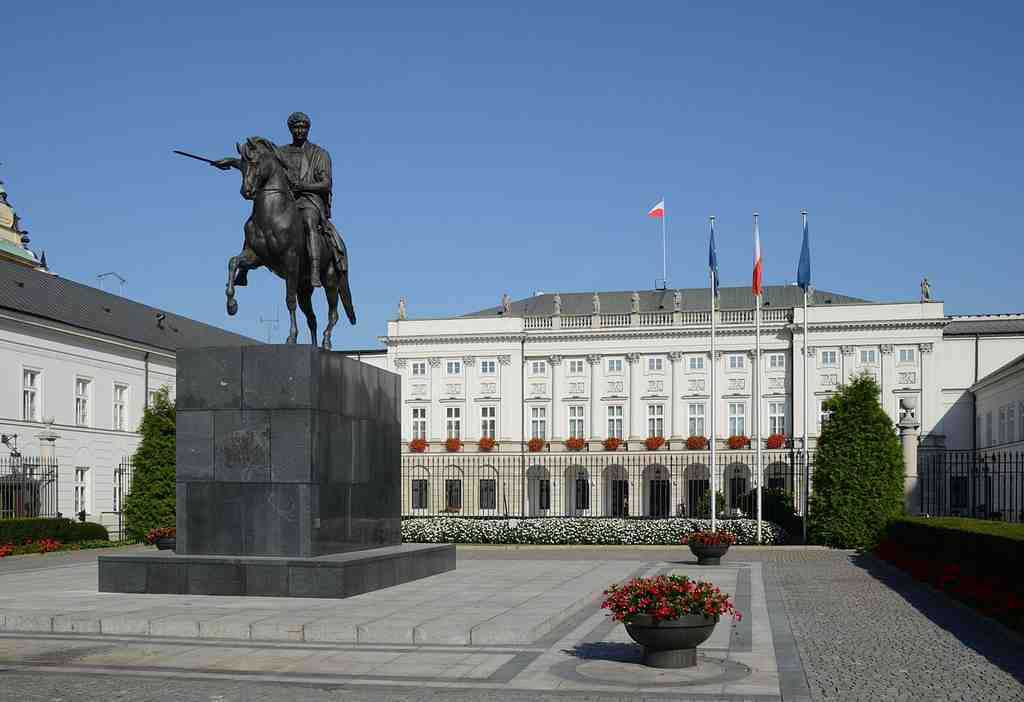
On your right stands a long pale stone palace with a broad classical façade, a central row of Corinthian half-columns, and four reclining stone lions guarding the forecourt.
This is the seat of the state on Krakowskie Przedmieście, one of the streets where Warsaw packs government, ceremony, and memory shoulder to shoulder. For centuries, power kept changing uniforms here, but it kept returning to this same address.
The palace began in the seventeenth century, when Stanisław Koniecpolski started a baroque residence here for his Warsaw base. Most people read this building from the street and never guess its first great luxury lay behind it: one of Warsaw’s earliest Italian-style gardens dropped in terraces all the way toward the Vistula, back when the river ran much closer to the escarpment. So this neat official front once belonged to a much more theatrical private world.
Then came the Radziwiłł family, who turned the place into a stage for public life: balls, assemblies, and even theater. In seventeen seventy-eight, one of the first Polish operas premiered here. In eighteen eighteen, eight-year-old Fryderyk Chopin gave his first public performance in the palace. Not bad for a building that later became a government office... talk about a career change.
The real visual shift came when the government of the Kingdom of Poland bought the palace in eighteen eighteen and hired Chrystian Piotr Aigner to remake it in a classical style. He lowered the roofline, stretched the side wings to the street, and gave the center that formal Corinthian order you see now. The lions out front date from that transformation too, carved by Camillo Landini, and they still lounge there like they own the mortgage.
But here is the turn in the story. On the twenty-ninth of November, eighteen thirty, General Maurycy Hauke was shot in front of this palace after he refused to join the uprising. He was no distant bureaucrat. He had served the old Polish Commonwealth and lived through the Napoleonic age. His death fixed this place in Warsaw’s memory not just as a seat of authority, but as a place where loyalty, rebellion, and tragedy collided in public.
After an eighteen fifty-two fire gutted the main block, the palace rose again with the same exterior form. Then, in eighteen seventy, Russian rule planted a statue of Ivan Paskevich in the forecourt, where an imperial message could stare straight down the route. If you like, check the before-and-after image; it shows how that monument once crowded the front and how much more open the palace feels now.
In the twentieth century, the building kept changing roles without leaving the stage. It housed Poland’s prime minister and cabinet between the wars. During the German occupation, the invaders turned it into the Deutsches Haus, a luxury hotel and casino for the occupier’s elite. They even set a bronze head of Adolf Hitler inside.
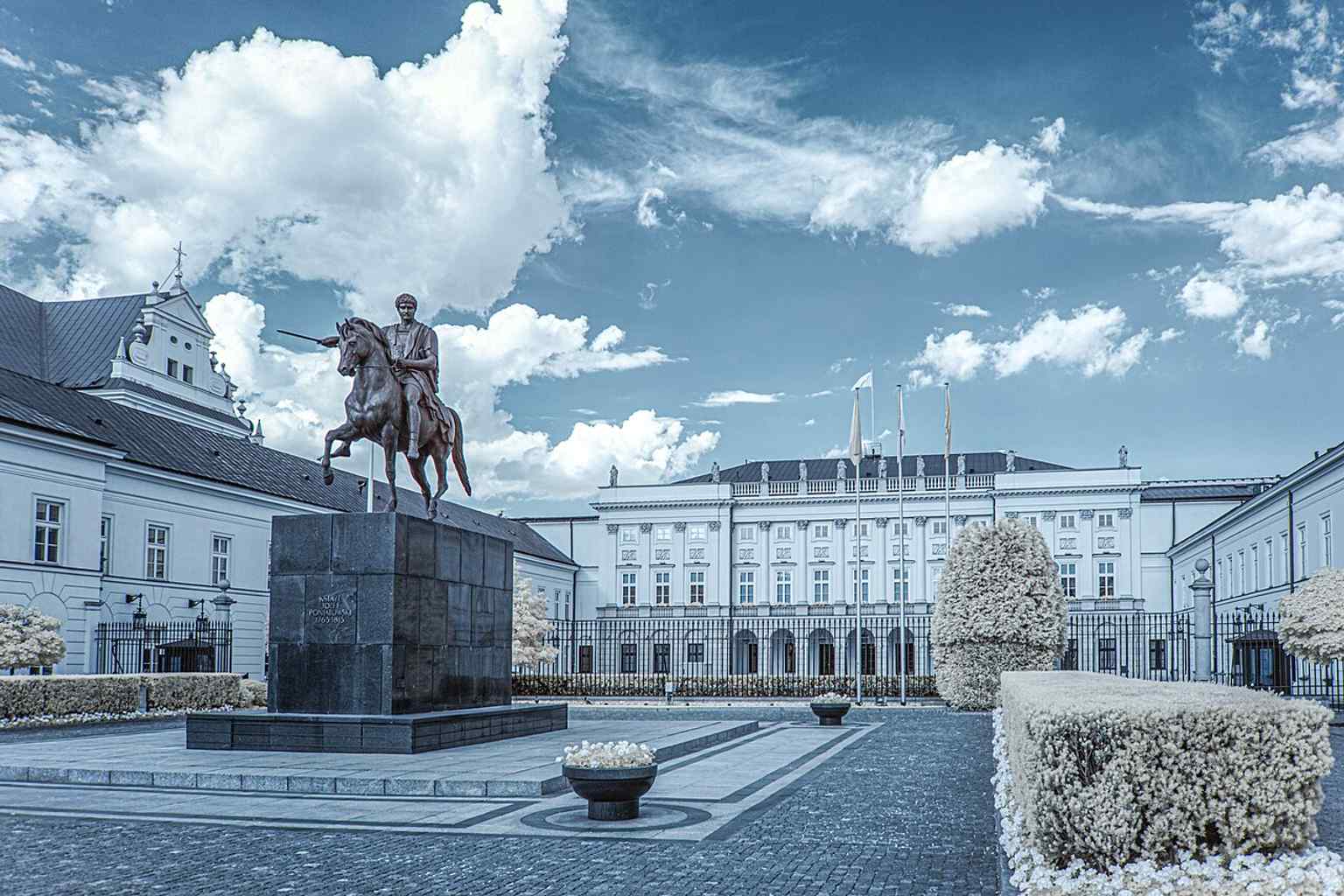
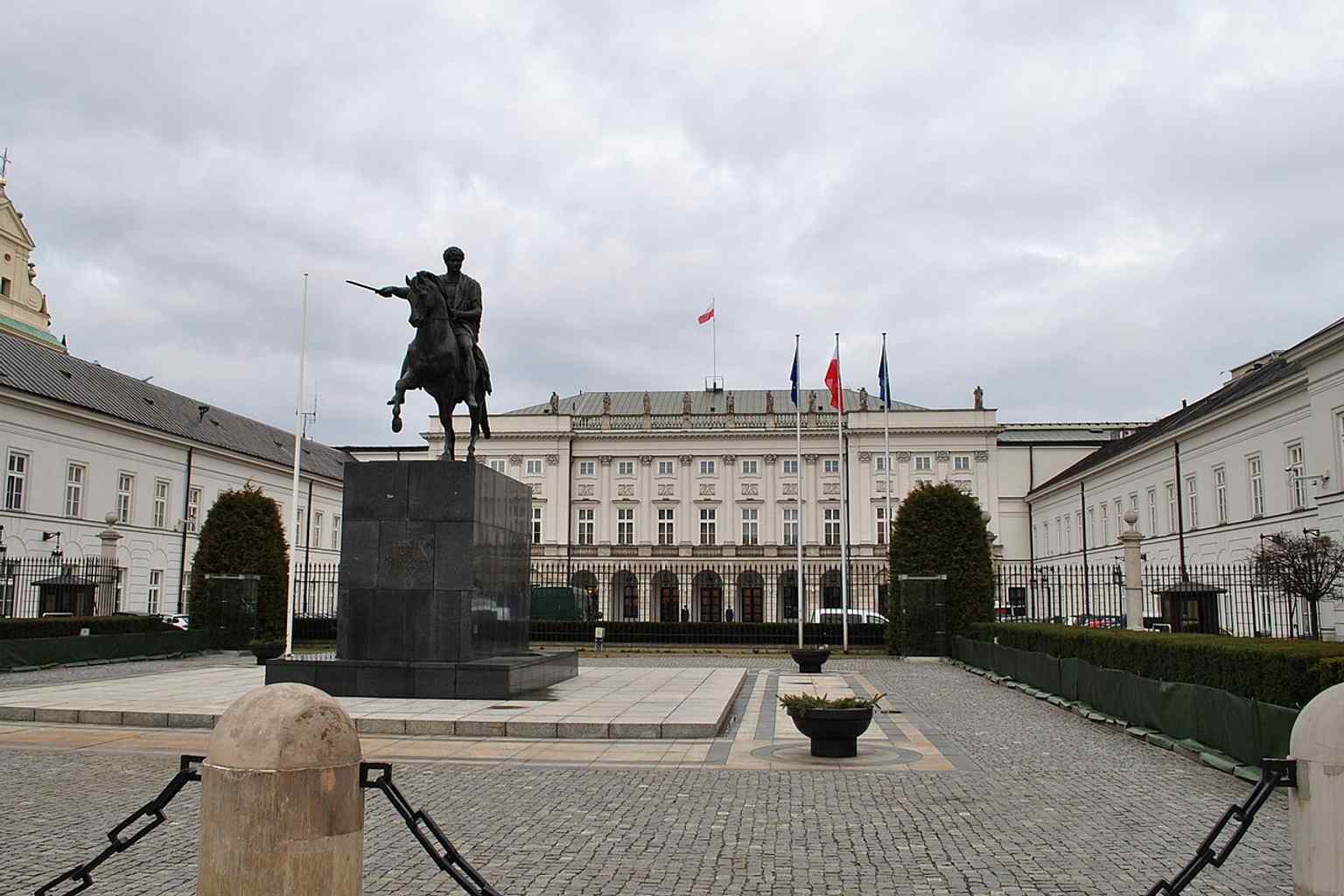
After the war, the palace survived when so much of Warsaw did not. Later, leaders signed the Warsaw Pact here, and in nineteen eighty-nine the Round Table talks helped negotiate the end of communist rule. Since nineteen ninety-four, it has served as the official seat of the President of Poland, where major state ceremonies and treaty signings have passed through its doors.
So this palace is not one story. It is a relay race of authority: magnates, governors, occupiers, cabinets, presidents. Ahead, in about seven minutes, St. Anne’s Church will remind you that on this street in Warsaw, political power never stands far from the sacred.






.jpg)

