
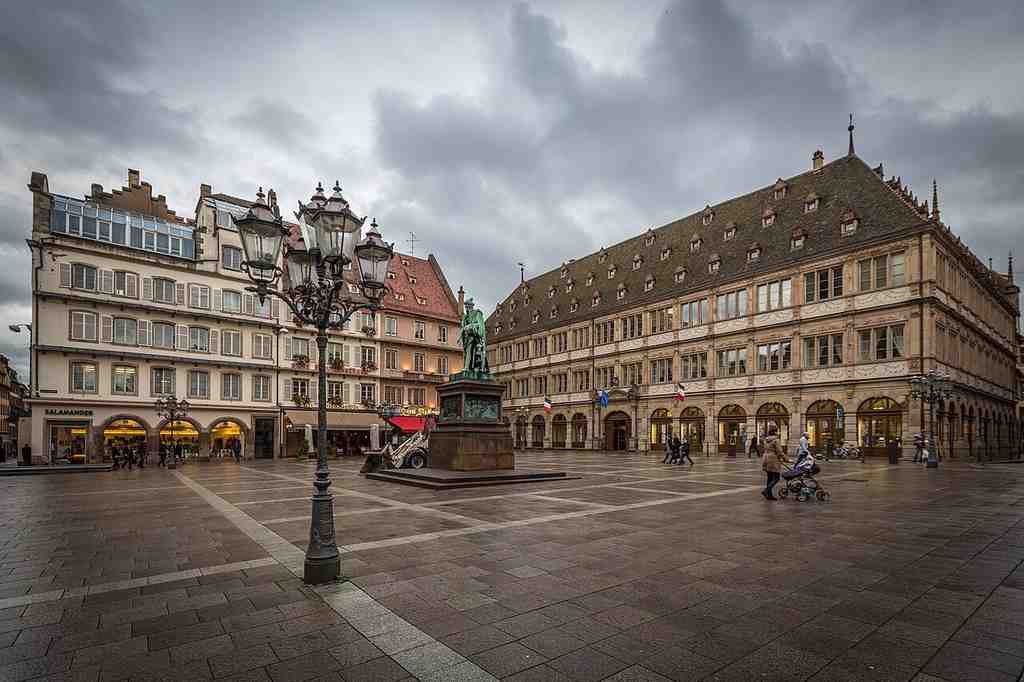
On your left, Gutenberg Square opens as a broad stone plaza framed by the long pale facade of the Neue Bau, with a dark bronze figure in the center holding a parchment high.
This square has changed its role so many times, it could give lessons in career reinvention. Around the twelfth century, people knew it as Martinsplatz, a market space tied to merchants and already close to Strasbourg’s political heart. In the fifteen twenties, city leaders tried to reclaim the church of Saint Martin so they could enlarge the town hall. The plan failed... then in fifteen twenty-nine they demolished the church, and that cleared the opening that helped shape the square you see now.
Then came another sharp turn. In seventeen eighty-one, Strasbourg tore down the Pfalz, the old town hall, and the building beside you, the Neue Bau, took over as the new city hall. That grand administrative moment did not last long. Revolutionaries ransacked it, and in seventeen ninety-five private owners bought it. Today, fittingly enough, it belongs to the Chamber of Commerce and Industry. Trade, government, and public life keep swapping seats at the same table here.
Now look at the statue for a beat. Johannes Gutenberg holds a parchment that reads, “And there was light.” Not subtle, is it? But Strasbourg meant every word. Gutenberg, born in Mainz, spent years here between fourteen thirty-four and fourteen forty-four, working inside a city wired for exchange: merchants, officials, scholars, churchmen. Whether or not he fully invented printing in Strasbourg, he carried out crucial early experiments here, including work connected to the Bible. In other words, this was a city ready to turn ideas into something portable.
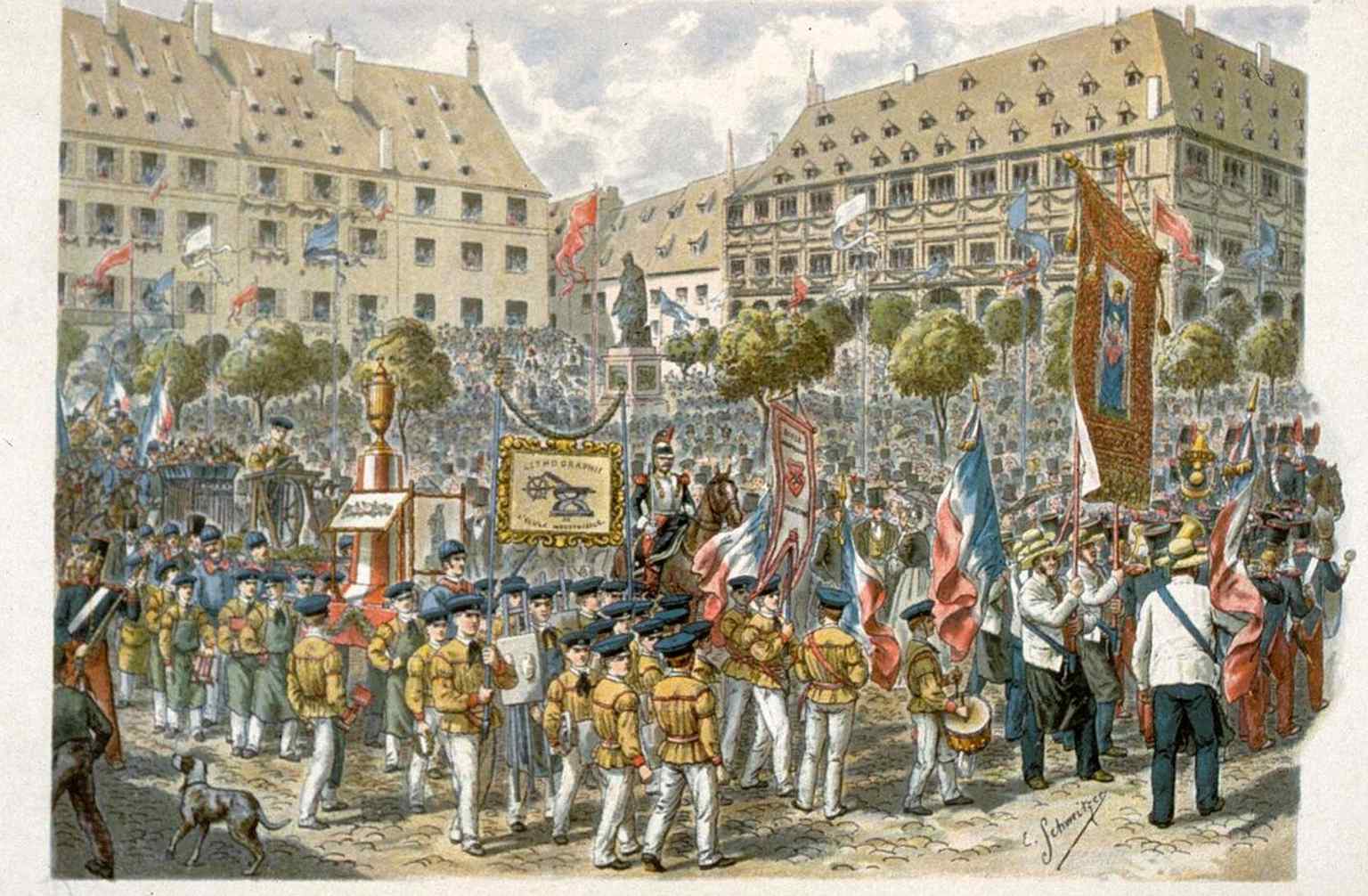
The bronze monument itself arrived in eighteen forty, when sculptor David d’Angers created it for the four hundredth anniversary of printing’s rise. If you check the image on your screen, the celebration looks like a civic parade for a machine that changed the human brain. And notice the pedestal: four bronze plaques show printing spreading across different continents. This is not just a local hero statue. It is Strasbourg saying, very calmly, “We helped flip the switch.”
Even the shopfront history here carries weight. At numbers one and two stood the ancestor of the famous Schwowelade hardware store. Paul Siebler-Ferry, from the nearby Black Forest, helped build it into the Quincaillerie Centrale. In August nineteen forty-four, bombing hit the building, fire followed, and Arno Siebler-Ferry died there. So yes, even ordinary commerce in this square got caught in Europe’s larger storms.
From here, the next stop offers a quieter answer to what Alsatian culture means beyond public monuments and civic muscle. The Alsatian Museum is about a five-minute walk away, and it brings the story down to the scale of lived rooms, tools, and daily ritual.






.jpg)