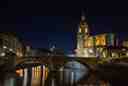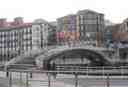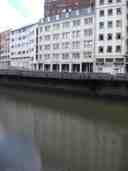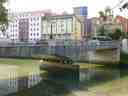
In front of you, stretching gracefully over the river, is the Bridge of La Ribera-a pale-colored pedestrian bridge with a wide parabolic arch, white railings, and a staircase at each end, perfectly set against the colorful facades of the old town.
Alright, take a deep breath of that river air and look up at the curved bridge ahead, because you’re about to cross one of Bilbao’s most storied routes-a spot where generations have walked, worried, cheered, and, if we’re honest, probably argued about the best pintxos. But this isn’t just any bridge, oh no! The Bridge of La Ribera, also known for centuries as the San Francisco Bridge, is maybe the most accident-prone celebrity in town.
Let’s turn the clocks back-way, way back. Picture it: the late Middle Ages. Just nearby, the grand Convento de San Francisco stood, bustling with friars, and even showing off the imperial crest of Carlos V from the 1500s. The area was so famous for this monastery, even the street and the bridge you’re on took its name. That’s a lot of billing for one holy spot! Over the years, that old convent was abandoned, reoccupied, and finally demolished in the 1800s, but its ghost still lingers under nearby plazas, and recent excavations even dug up ancient church stones, silent and weathered.
Now, about the bridge itself... few have had such a dramatic life. In 1506, the Franciscans, keen on an easy shortcut to the city (lazy or clever-you decide!), tried to build their own bridge, but Bilbao’s powerful leaders stood in the way. Despite getting approval from a royal court in Valladolid, all they managed to complete was one lonesome abutment on the right side, which was soon swept away by the river’s fury.
Fast forward to 1735: at last, a sturdy stone bridge! Or so they thought. Two years later, on a November morning, a flood crashed through Bilbao, and the proud bridge collapsed with a rumbling splash. Witnesses said it was like watching a pair of great stone arms sink beneath the waves. But Bilbao’s folks have never been quitters-by the late 1700s, they tried again with a wooden bridge using robust oak and bits of limestone, constructed with all the care of a Basque grandmother’s stew. Still, in 1813, French troops burned it down for firewood during their retreat. Talk about adding insult to injury!
Did Bilbao give up? Absolutely not! Through the 1800s, the bridge was reborn again and again-sometimes with chains, sometimes with iron cables, sometimes with stone, and sometimes just as a floating bridge of boats. In 1827, a chain suspension bridge went up. But that too soon gave way to a version with wire cables, and later an iron arch built by a mayor who thought "pasadera" sounded more authentically Spanish than the French-sounding "pasarela." If nothing else, Bilbao’s bridges are as stubborn as the people!
By the time of the Carlist Wars in the late 1800s, bridge after bridge was attacked or destroyed. In 1874, bombardment severed the cable of a suspension bridge, leaving only Saint Anton’s bridge intact for the city to use. Eventually, Pablo de Alzola, a former mayor, designed a new iron bridge, which opened in 1881. Zig-zagging between innovation and disaster, it’s a wonder anyone dared cross at all! There were talks, and even a catchy tune was sung about the bridge that once dangled over the river. But don't be fooled-while some believed the song was about Portugalete’s famous transporter bridge, it was actually for the San Francisco Bridge that once held center stage here.
Today’s Bridge of La Ribera dates from 1938, built in the tough times just after older bridges were blown up in the Spanish Civil War. Architect Fernando Arzadun gifted the city this elegant arch, connecting San Francisco and Casco Viejo in a way that’s lasted-though if you look up close, you might see some clunky pipes and lines strapped on for modern needs. Not so glamorous, but hey, even celebrities age!
As you cross, listen for your footsteps echoing against metal and stone-imagine past centuries of river floods, galloping hooves on the streets, shouts of builders and friars, and the great sigh of Bilbao each time the river calmed after a storm. The soul of the city flows under this bridge, restless and resilient, always ready for the next rebuild.
Fascinated by the current bridge, origin or the historical background? Let's chat about it