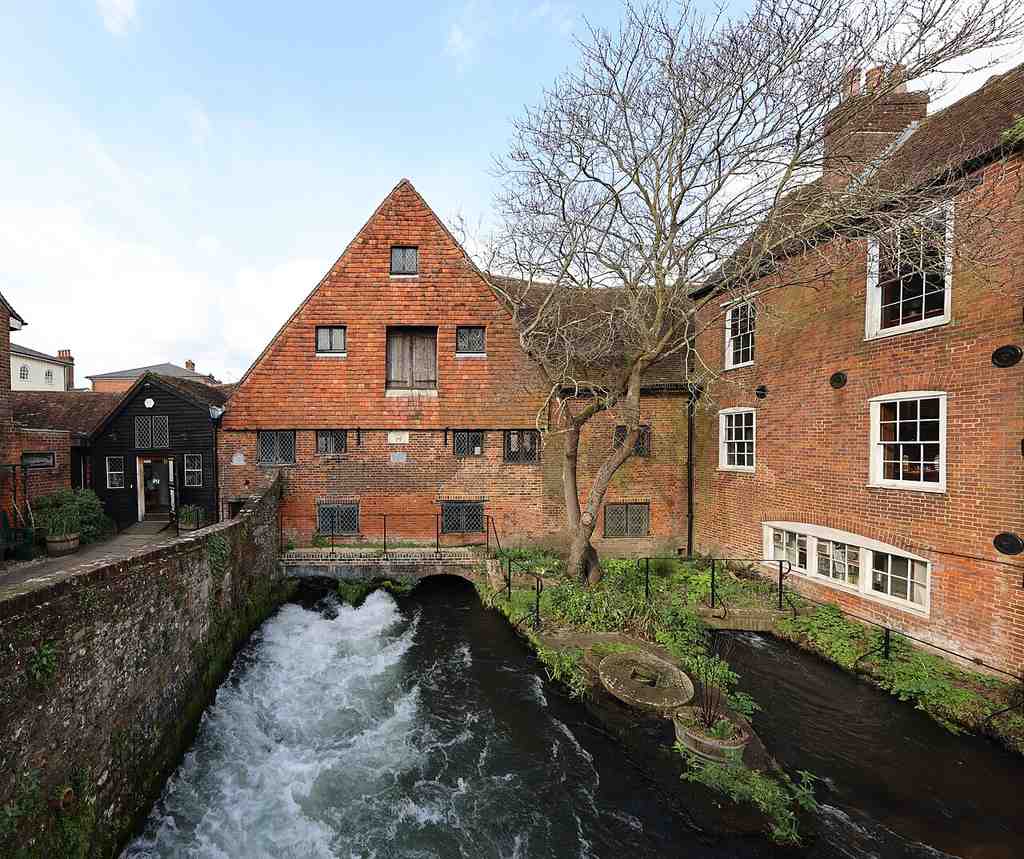
Winchester's spires and royal halls belong to bishops and kings. The city between them belongs to a different cast entirely: the Norman mason who built the cathedral in 1079 on waterlogged peat; the deep-sea diver William Walker who spent five years underground in complete darkness replacing those rotten foundations with concrete, brick by underwater brick; the manciple John Bedell who provisioned Winchester College for nearly forty years; the tanner James Cooke who rebuilt the Saxon mill on the Itchen in 1743; the butter-sellers and cheese-sellers who traded from the Buttercross steps; the coaching-inn landlord who turned 270 years of trade into a bric-a-brac shrine; and the unnamed abbey workers whose bones were scattered by prison convicts in 1788. Heritage Open Days 2026 theme is Everyday Histories — the unsung people missing from the picture. This tour gives them their day.
National Trust - Winchester City MillBuilding in Winchester, Hampshire, England, UK
location_on
2
lock
The Itchen Navigation
location_on
3
lock
Wolvesey Castle (Old Bishop's Palace)The ruins of the 12th-century bishops' palace built primarily by Henry of Blois (Bishop 1129-1171), brother of King Stephen and grandson of William the Conqueror. At his death in 1171 Wolvesey was the most expensive non-royal building project in Norman England. A workforce of hundreds — stone-cutters, masons, carpenters, plasterers, metalworkers — built and maintained the palace continuously from the 1120s. Mary I and Philip II of Spain held their wedding reception here in 1554.
location_on
4
lock
Winchester CollegeFounded in 1382 by William of Wykeham, Bishop of Winchester and Lord Chancellor — himself the son of a Hampshire peasant farmer, who rose to become Chancellor to two kings. The college was built to house and educate 70 poor scholars, 16 choristers, 10 fellows, a warden and a domestic staff. Manciple John Bedell provisioned the college kitchen from 1459 to 1498 — 39 years of daily catering for seventy mouths. The college has operated continuously on its original site ever since.
location_on
5
lock
8 College StA Grade II* listed late-18th-century house in College Street where Jane Austen lodged with her sister Cassandra from 24 May to 18 July 1817 — her last eight weeks of life. She came to Winchester to seek treatment from surgeon Giles King Lyford; she died here on 18 July, aged 41. She was working on Sanditon in this house and wrote a light comic poem about St Swithun's Day on 15 July. The blue plaque above the door was placed by her admirers, not her family.
location_on
6
lock
The Wykeham Arms, WinchesterA Grade II listed coaching inn at 75 Kingsgate Street, established in 1755, tucked between Winchester College and the Cathedral Close. Lord Nelson is said to have stopped here on his way to Portsmouth. By the mid-20th century it had become the Fleur de Lys bar. Its late landlord Graeme Jameson, widely regarded as the perfect landlord, filled the pub with so much bric-a-brac that his collection still covers the walls today.