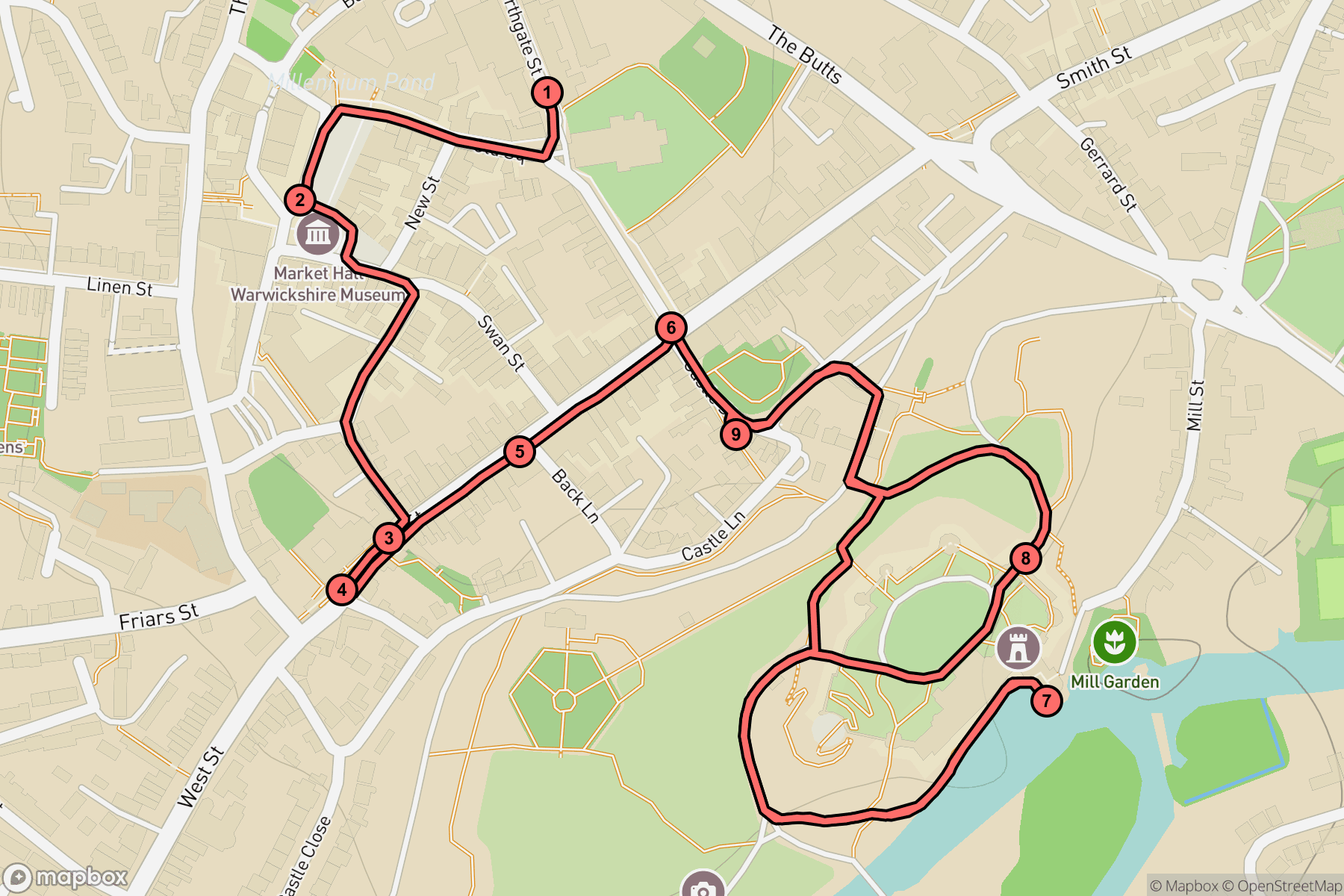
Warwick belongs to the earls on its postcards. The streets beneath the castle walls belong to a different story — the armourers and mill-tenants who kept the castle running, the six named craftsmen whose contracts survive from the making of Richard Beauchamp's tomb, the five named workers who rebuilt St Mary's nave after the 1694 fire destroyed a quarter of the town, the veterans and their wives who have kept the same morning prayers since 1571, the wool-trading mercer Thomas Oken who made his fortune and gave it all away, the mason Francis Smith who was born in the ashes of one town and spent his life building the next. This is Heritage Open Days' 'Everyday Histories' — the working names Warwick nearly forgot.
St Mary’s ChurchThe medieval collegiate church whose chancel and Beauchamp Chapel survived the 1694 fire; whose nave was destroyed and rebuilt in 1697-1704 by Sir William Wilson (a sculptor who had never designed a church before) and mason Francis Smith; and whose Beauchamp Chapel contains the tomb of Richard Beauchamp (died 1439) — built by six named craftsmen whose contracts survive.
location_on
2
lock
Market PlaceThe medieval market heart of Warwick, where the Sheep Market, Wheat Market, Women's Market and Shoemakers' Row divided the working day by commodity. The Booth Hall — built by Thomas de Beauchamp (died 1369) — charged traders rent for stalls until it became the manorial bailiff's residence in 1505. The Market Hall (1670) stands on stone pillars at the south end.
location_on
3
lock
The Lord LeycesterMedieval guild buildings at the West Gate converted in 1571 by Robert Dudley, Earl of Leicester, into an almshouse for aged and injured soldiers and their wives. More than 400 Brethren have lived here since. The same prayers Dudley dictated are read every weekday morning at 9:30. In 2017, Heidi Meyer became the first female Master in the hospital's 450-year history.
location_on
4
lock
West GateThe medieval town gate and the chapel built over it — in continuous daily use since 1126. Roger de Newburgh, 2nd Earl of Warwick, built the original chapel in 1126; Thomas Beauchamp rebuilt it in 1386 and gave it to the Guild of St George; Robert Dudley absorbed it into Lord Leycester's Hospital in 1571. The Brethren still hold morning prayers here every weekday at 9:30.
location_on
5
lock
High Street, Warwick — Fire Rebuilding Act streetlineThe point on High Street where the 1694 fire began — from a blacksmith's stray spark in the thatch — and where the Warwick Fire Rebuilding Act 1694 imposed new street widths and uniform building designs. The aligned Georgian facades either side of High Street are the direct product of the Act: two 10-foot storeys with cellars and garrets, no timber-frame jetted facades.
location_on
6
lock
The Court HouseBuilt 1725-28 by Francis Smith of Warwick — the mason who had led the town's rebuilding after the 1694 fire, who served on the Town Corporation from the 1720s and oversaw maintenance until his death in 1738. The building replaced a medieval tavern and immediately became Warwick's social hub: balls, assemblies and public meetings. Named craftsmen: Thomas Paris and Benjamin King made the ironwork; Thomas Stayner carved the Statue of Justice.