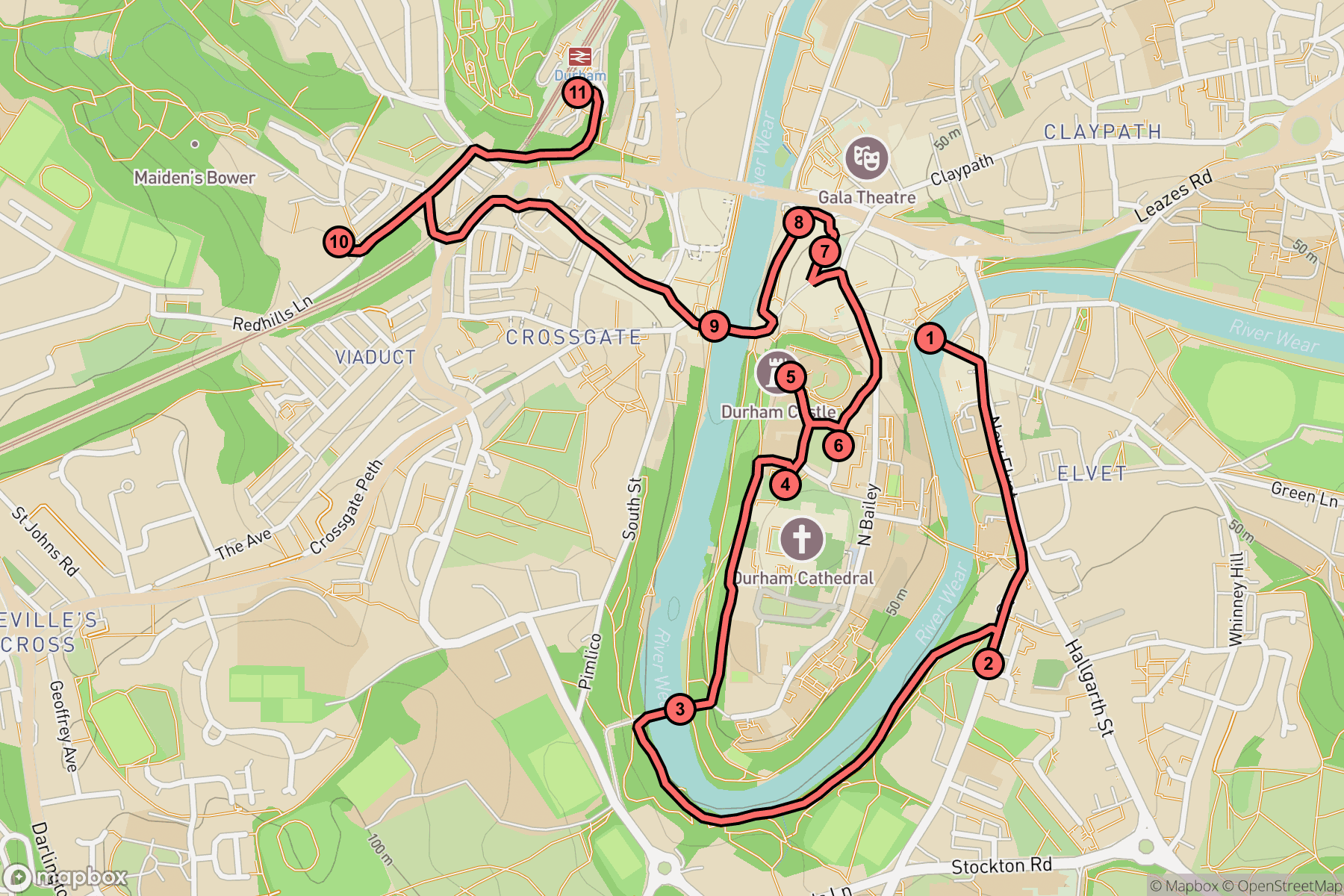
Durham's skyline belongs to the cathedral and the castle. The rest of the city belongs to a different story — the Norman masons who signed their stones with a chisel mark, the boy choristers educated in exchange for their voices, the Bishop's kitchen staff who fed five hundred in a hall built around hierarchy, the medieval bridge-builders who raised Framwellgate and Elvet for the pilgrims and the traders, the market stallholders who gathered under Bishop Pudsey's charter, the 150,000 Durham miners who pooled their wages to build their own parliament on Redhills Lane, and the secretary William Crawford who made the Durham Miners' Association the largest miners' union in Britain. These are the people whose labour made the peninsula possible — and whose names rarely appear on any plaque.
Elvet BridgeGrade I listed bridge in Durham, England
location_on
2
lock
St Oswald's Church, DurhamChurch in Durham, England, UK
location_on
3
lock
Prebends BridgeThe three-arched stone bridge across the River Wear designed by George Nicholson and built 1772–1778. Funded by and named for the Prebendaries of Durham Cathedral, the bridge provided a private road for the Dean and Chapter giving access to the south. It is one of the most photographed viewpoints of the Cathedral.
location_on
4
lock
Durham CathedralThe late-Romanesque chapel at the western end of Durham Cathedral, built for Bishop Hugh de Puiset (Bishop Pudsey) in the 1170s. The master of works is named as Christian in historical records. The chapel was built at the west end because two earlier attempts to build a Lady Chapel at the east end both failed — the walls cracked repeatedly, which contemporaries interpreted as a sign that St Cuthbert's relics would not tolerate women near them.
location_on
5
lock
Durham CastleThe Norman castle begun c.1072, seat of the Prince Bishops of Durham until 1836 when it became the first college of Durham University. The kitchen — built for Bishop Richard Fox (Bishop of Durham 1494–1501) in 1499 — has been in continuous use since. Its three large fireplaces and the wooden screen bearing Fox's motto are still visible.
location_on
6
lock
Palace GreenThe open green between the Cathedral and the Castle, originally the site of Durham's first market place before Bishop Flambard cleared it in the 12th century. The library buildings on the east side of the Green were used as the university's first teaching and residential space from 1833. The first students — 19 scholars and 18 students — came into residence at Archdeacon's Inn on Palace Green in 1833.