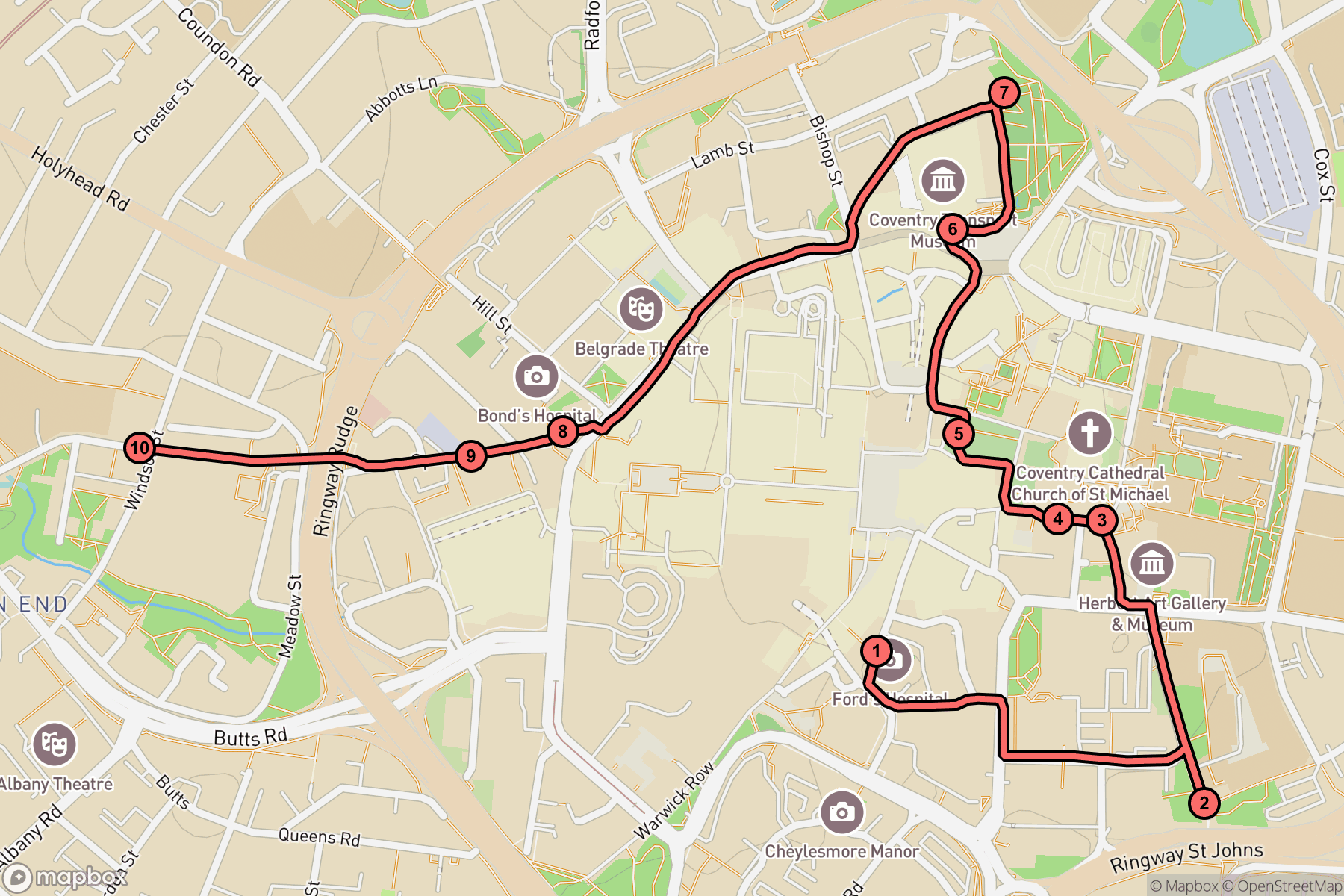
Ford's HospitalA Grade I listed half-timbered almshouse on Greyfriars Lane, founded by the merchant William Ford in the early sixteenth century to provide accommodation for six elderly poor people. After Ford's death, subsequent endowments extended it to provide shelter for couples. One of the finest examples of timber-framed domestic architecture surviving in England. Thomas Bond, a draper and Mayor of Coventry since 1497, founded his own almshouse nearby in 1506 — leaving money in his will for ten poor men and a woman attendant, who were required to attend church three times daily and pray for the founder and the Trinity Guild. Two named merchant-philanthropists, two sets of unnamed residents: the six and the ten elderly poor whose working lives built the cloth wealth that funded their shelter.
Whitefriars GateThe surviving gatehouse and eastern claustral range of the Carmelite friary founded in 1342 and dissolved on 1 October 1538. The dissolution surrender document was signed by fourteen named friars — one of the most complete records of named religious working life to survive in Coventry. The claustral range has been described as one of the finest surviving medieval friary remains in Northern Europe. Now used by the Herbert Art Gallery and Museum.
Coventry CathedralThe shell of the medieval Cathedral of St Michael, gutted by Luftwaffe incendiary bombs on the night of 14 November 1940. The tower and exterior walls survive; inside, the altar area preserves the charred cross made by cathedral stonemason Jock Forbes from two fallen roof beams. Provost Richard Howard had the words 'Father Forgive' inscribed on the sanctuary wall — the permanent inscription attributed to Canon Joseph Poole in 1958. The Cross of Nails became the symbol of Coventry's international reconciliation movement. Alongside the ruins stands the new Cathedral of St Michael, designed by Sir Basil Spence and built by John Laing & Son, consecrated in May 1962. On the exterior east wall hangs Jacob Epstein's bronze 'St Michael's Victory over the Devil' — Epstein's last major work, unveiled after his death by his widow Kathleen.
St Mary's GuildhallBuilt between 1340 and 1342 on the site of a twelfth-century castle, St Mary's Guildhall was the meeting place of the Guild of St Mary and the Guild of Holy Trinity — the merchant associations that included the leading traders of medieval Coventry. The guilds performed the Corpus Christi mystery plays, ran the cloth and wool trade, and funded the building of almshouses. The hall contains one of the oldest tapestries in Britain, woven somewhere between 1505 and 1515, depicting Henry VI and the court — but no record survives of who commissioned or made it.
Holy Trinity CoventryOne of the largest medieval parish churches in England, with a soaring early sixteenth-century spire. The interior contains the 'Coventry Doom' — a large-scale painting of the Last Judgement created in the 1430s above the tower arch. Covered in whitewash during the Reformation, discovered in 1831 and fully conserved and revealed in 2004. The painter is unknown. John Thornton of Coventry, whose International Gothic workshop style is associated with the city's medieval artistic tradition, may have been known to craftsmen who worked here — though no document links him to this specific building.
Coventry Transport MuseumHome to the world's largest collection of British road transport, the Coventry Transport Museum stands as a proxy for the bicycle and motor industry that defined the city's working life from the 1870s onwards. Harry Lawson incorporated the Daimler Motor Company on 14 January 1896 — Britain's first series-production car manufacturer. By June 1897 the company had 223 workers producing three cars per week; by 1910, 4,116 workers. The Triumph motorcycle factory on Priory Street, 3,000 workers strong, was obliterated in the Blitz of 14 November 1940.