
Syracuse Audio Tour: Echoes of Innovation and Historic Downtown Legends
Under the shadow of Syracuse’s grandest spires and bustling arenas, secrets echo through stone and glass—waiting for a listener brave enough to follow where history stirs. This immersive self-guided audio tour opens hidden chapters of the city, revealing stories and corners most visitors never notice. Feel the pulse of Syracuse’s past and present as you wander between icons old and new. Why did Columbus Circle ignite civic battles that shaped city politics for generations? What whispers from Clinton Square’s silent statues hint at unsolved mysteries? Did an outrageous moment in sports at Upstate Medical University Arena truly change local legend forever? Move through a city ablaze with drama and unexpected beauty, where every block holds a revelation and the past brushes past your shoulder. Discover Syracuse the way only a true insider can—through movement, sound, and secrets. Ready to step beyond the obvious and let the real Syracuse reveal itself? Your journey starts now.
Tour preview
About this tour
- scheduleDuration 80–100 minsGo at your own pace
- straighten3.8 km walking routeFollow the guided path
- location_onLocationSalina, United States
- wifi_offWorks offlineDownload once, use anywhere
- all_inclusiveLifetime accessReplay anytime, forever
- location_onStarts at Columbus Circle, Syracuse
Stops on this tour
lock_open 3 free previews · 7 unlock with purchase
In front of you is a wide circular stone fountain with a tall granite pedestal rising from its center, topped by a dark bronze figure. This is Columbus Circle, but that name…Read moreShow less
Open dedicated page →In front of you is a wide circular stone fountain with a tall granite pedestal rising from its center, topped by a dark bronze figure.
This is Columbus Circle, but that name arrived late. Before that, Syracuse called this place Library Circle, then St. Mary’s Circle, and at one point Courthouse Square. A city leaves clues in its names. Each one tells you what people wanted this space to mean... books, faith, law, then a monument at the very center of public life.
That shifting identity began in the ground around you. This started as a quiet residential district, close to churches and homes. In the early twentieth century, Syracuse recast it. The public library arrived. The Onondaga County Courthouse rose nearby. Government offices and commercial buildings followed. Without moving an inch, this circle changed costume, from neighborhood room to civic stage. If you want to see that change in one glance, check the before-and-after image in the app.
One of the people who pushed hardest for the monument was Torquato De Felice, a Syracuse University fine arts professor. Back in nineteen oh nine, he argued that Syracuse should honor Christopher Columbus here. For many local Italian Americans, this was not only about Columbus. It was about belonging. They spent roughly twenty-five years raising money, organizing, and insisting that their story deserved a place in stone and bronze, at a time when Italian immigrants still faced prejudice and anti-Catholic suspicion.
Look around the rim of the circle, then back to the center. Notice how the space asks you to admire the fountain and monument first, while the great public buildings stand watch around it. What does that arrangement say about what Syracuse wanted people to remember?
The monument you see now, designed by architect Dwight James Baum and dedicated in nineteen thirty-four, stands at the center of the fountain and rises about forty feet high. Baum even chose the inscription, turning the monument into a deliberate statement about discovery, identity, and who gets honored in the heart of a city.
And here is the detail locals love because it unsettles the whole picture a little: in nineteen ten, this circle held a grove of blue gum eucalyptus trees.
Imagine that for a moment. Not the formal plaza you see now, but an oddly planted circle, still trying out what it wanted to be.
That uncertainty never really disappeared. Annual tree lightings happened here from nineteen thirteen to nineteen thirty-three before moving to Clinton Square. Columbus Day memorials followed the dedication. Protesters later gathered here too, especially from the early nineteen nineties on, saying the statue honored a history of Indigenous pain. Supporters answered that it marked immigrant endurance and recognition. In twenty twenty, the city announced plans to remove the statue and remake the circle as Heritage Park. As of twenty twenty-five, the statue still remains.
So this first stop gives us Syracuse in miniature: a fountain, a monument, several names, and a ring of institutions all trying to say what belongs at the center. From here, the story widens into the streets that earned the city its confidence. When you are ready, head about five minutes to the South Salina Street Downtown Historic District. And since this circle is open all day, you can always return for another look.
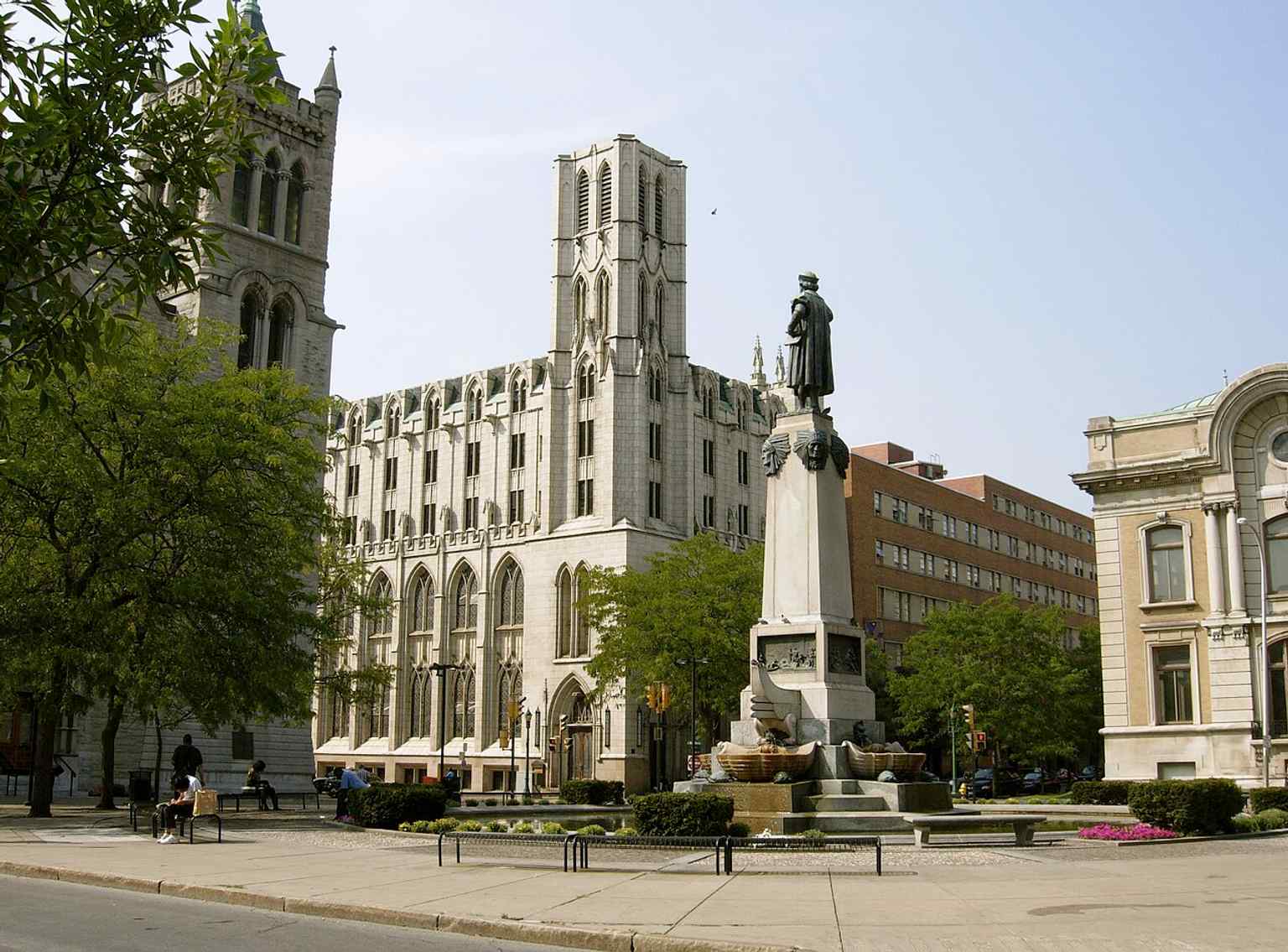
A broad view of Columbus Circle, where the fountain and monument anchor downtown Syracuse’s civic core.Photo: Crazyale, Wikimedia Commons, Public domain. Cropped & resized. 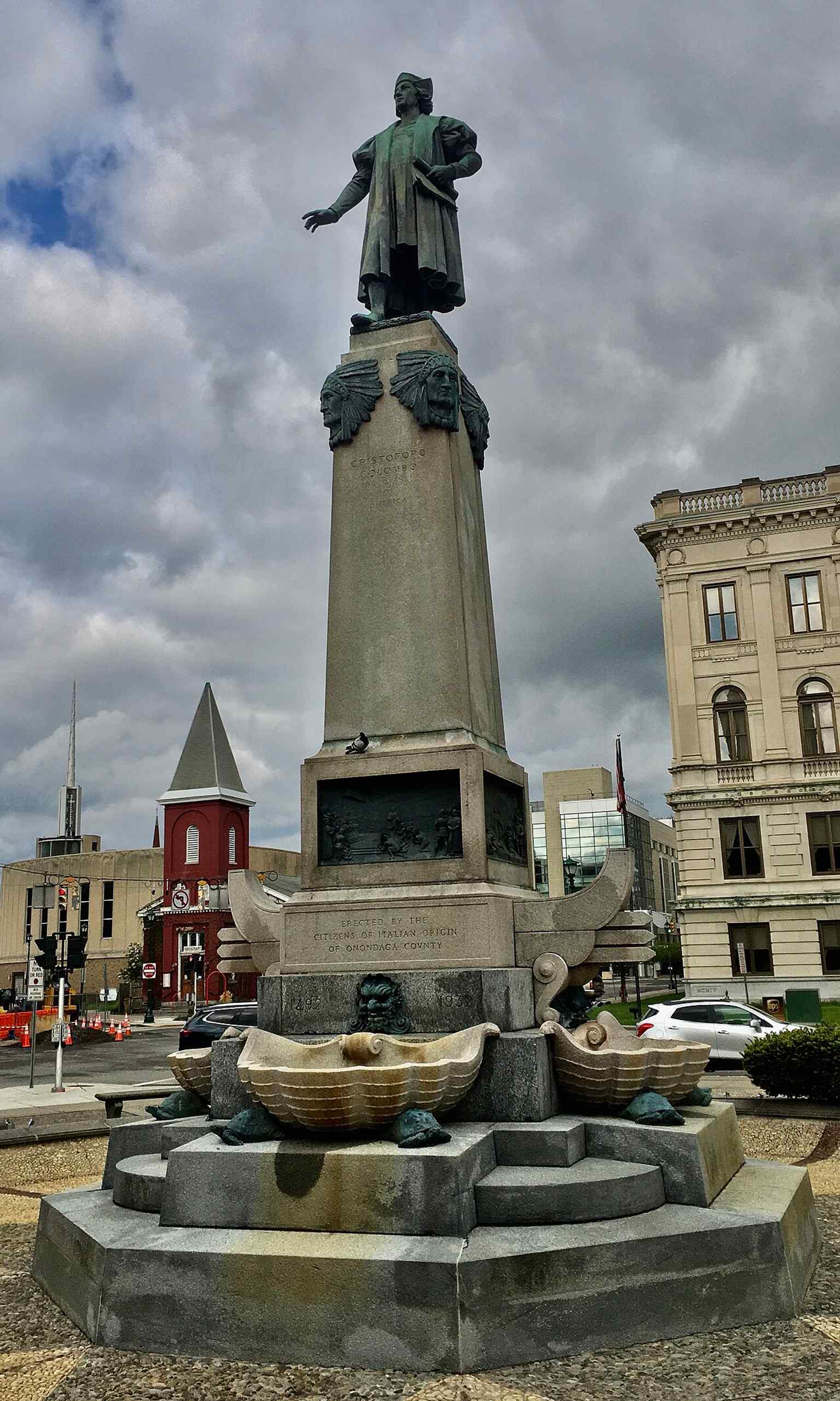
A close look at the Columbus Monument, designed by Dwight James Baum and dedicated in 1934 as a symbol of Italian American pride.Photo: Andre Carrotflower, Wikimedia Commons, CC BY-SA 4.0. Cropped & resized. 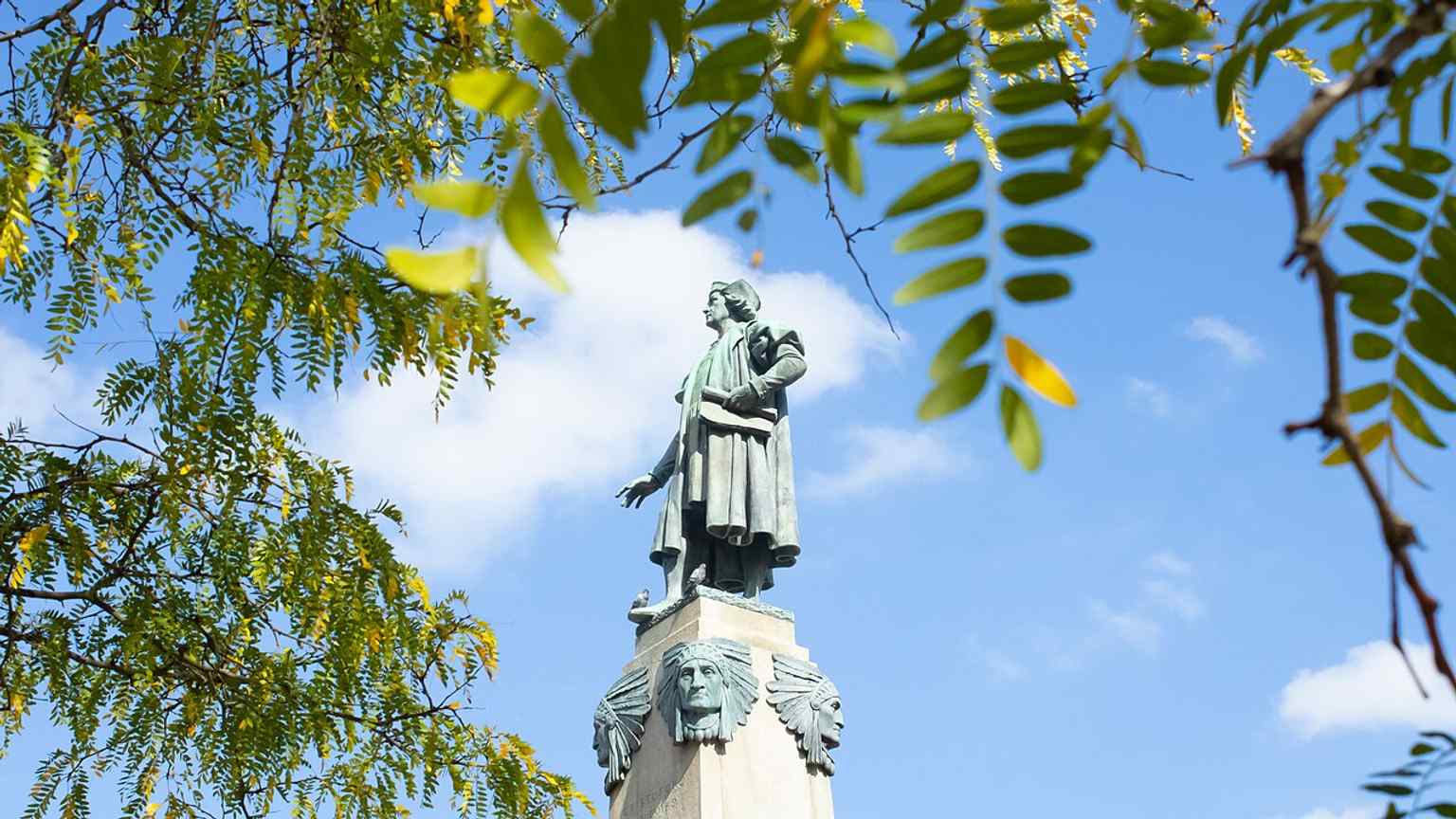
The monument in the center of the circle, a focal point for both Columbus Day ceremonies and long-running protests.Photo: LoganTheHammer, Wikimedia Commons, CC BY-SA 4.0. Cropped & resized. 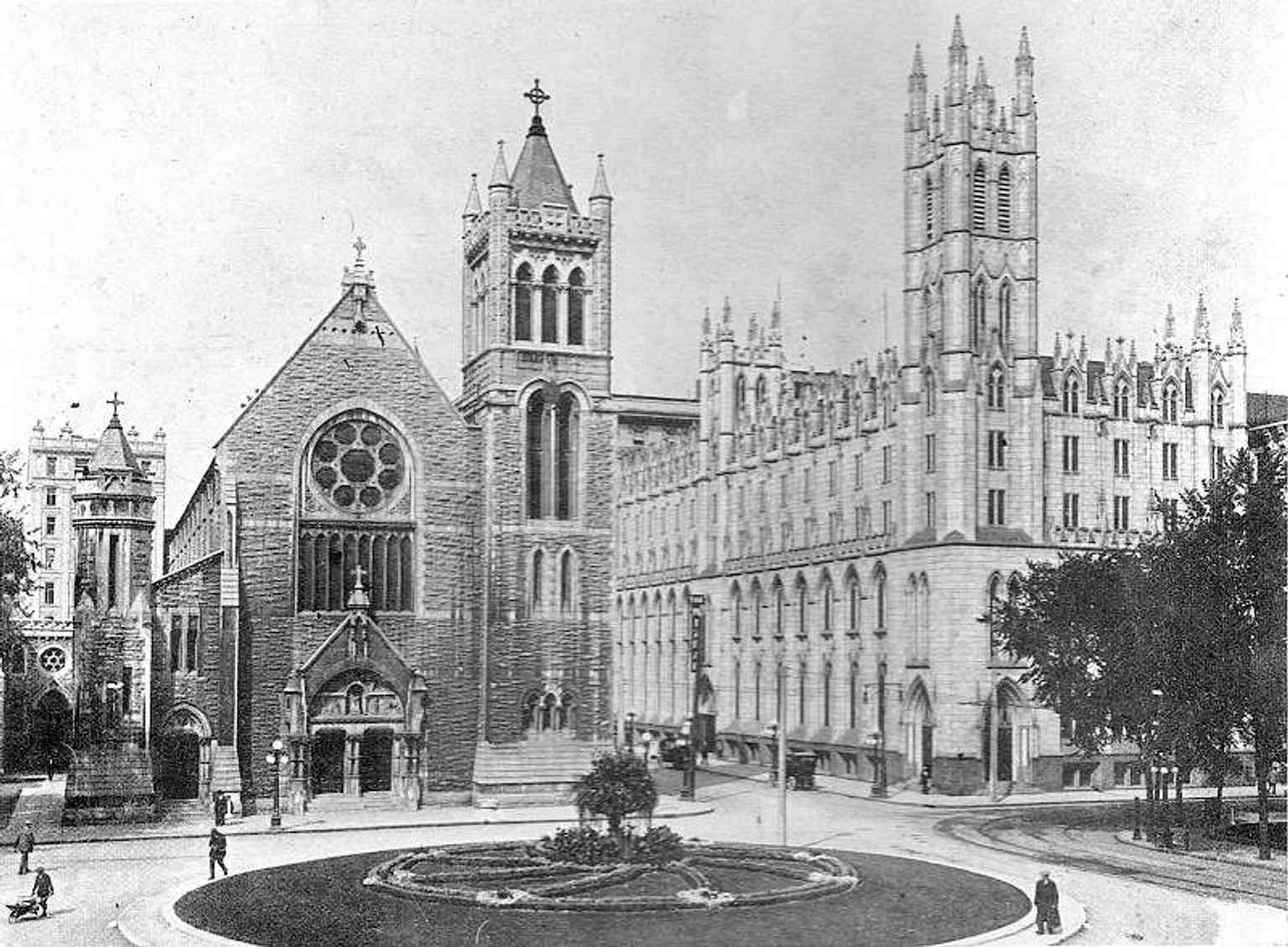
Columbus Circle around 1900, before the monument was added, when the area was still known by earlier names.Photo: Unknown authorUnknown author, Wikimedia Commons, Public domain. Cropped & resized. 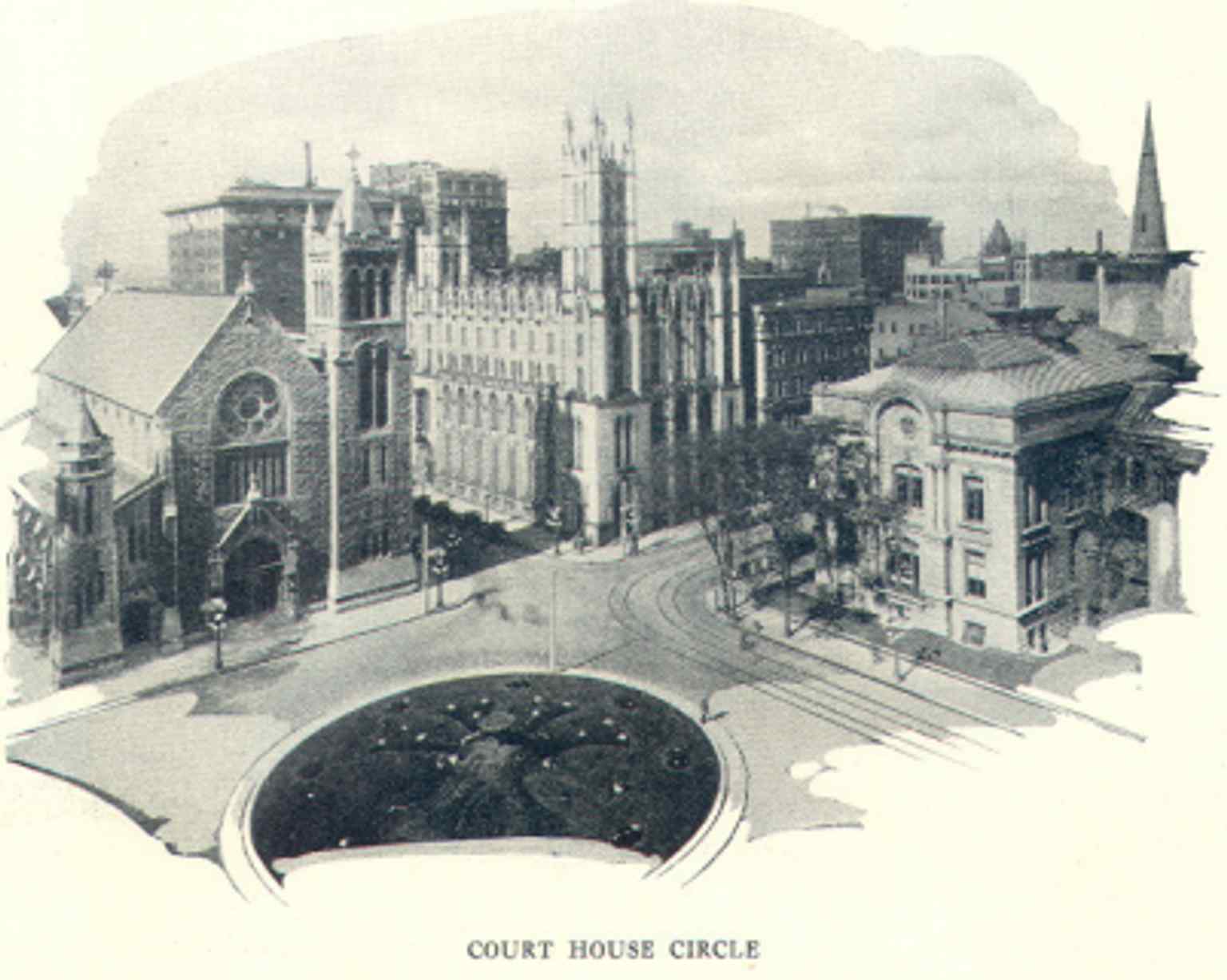
Columbus Circle in the 1920s, showing the plaza before the Columbus Monument’s 1934 dedication.Photo: Unknown authorUnknown author, Wikimedia Commons, Public domain. Cropped & resized. 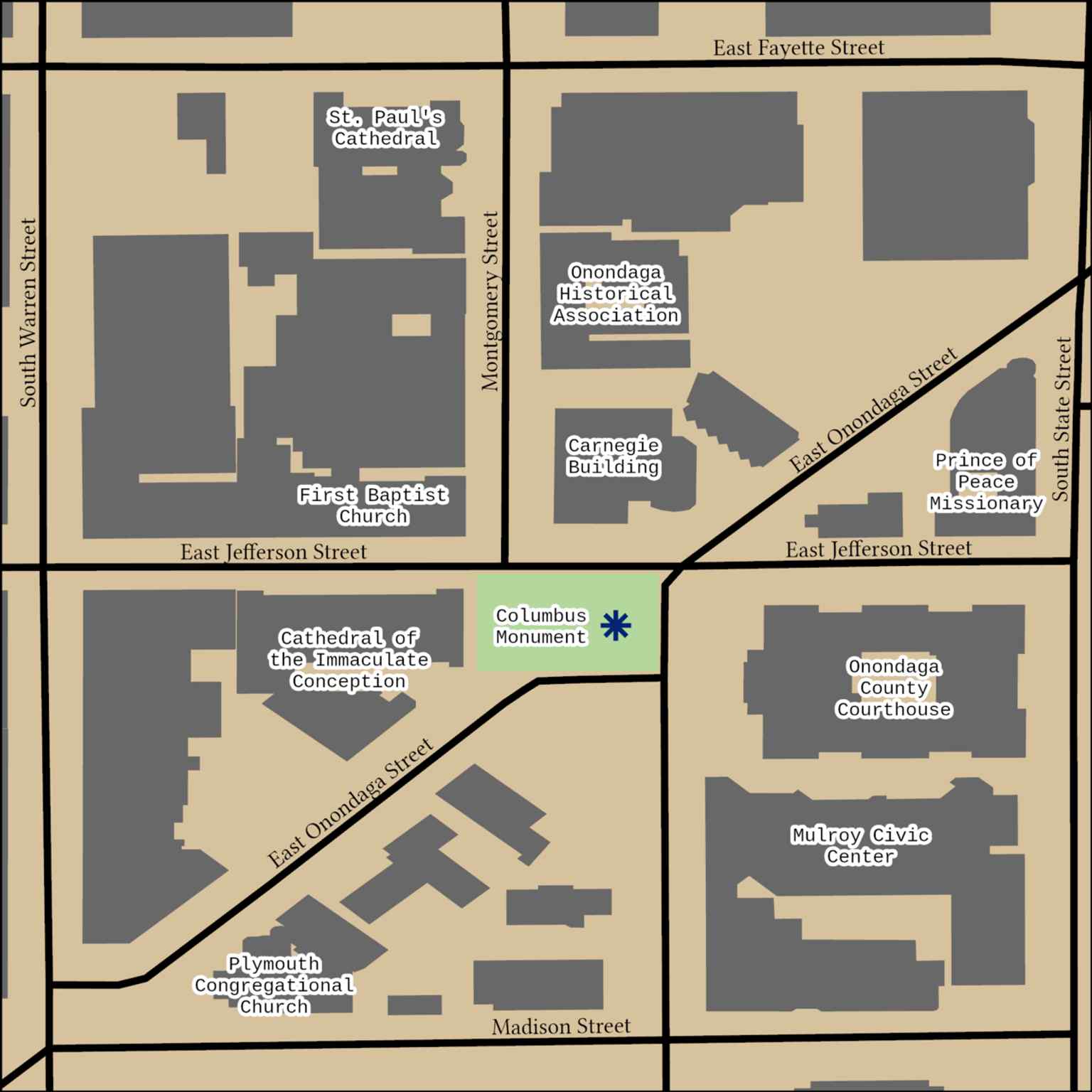
A simple map of Columbus Circle that helps orient the cathedral, courthouse, and civic buildings around the plaza.Photo: Tom Fish · geo.fish · Fish Eye, Wikimedia Commons, CC BY-SA 4.0. Cropped & resized. On your left, look for a stretch of brick and stone commercial blocks, rising four to seven stories, with deep metal cornices along the rooflines and the tall arched window of the…Read moreShow less
Open dedicated page →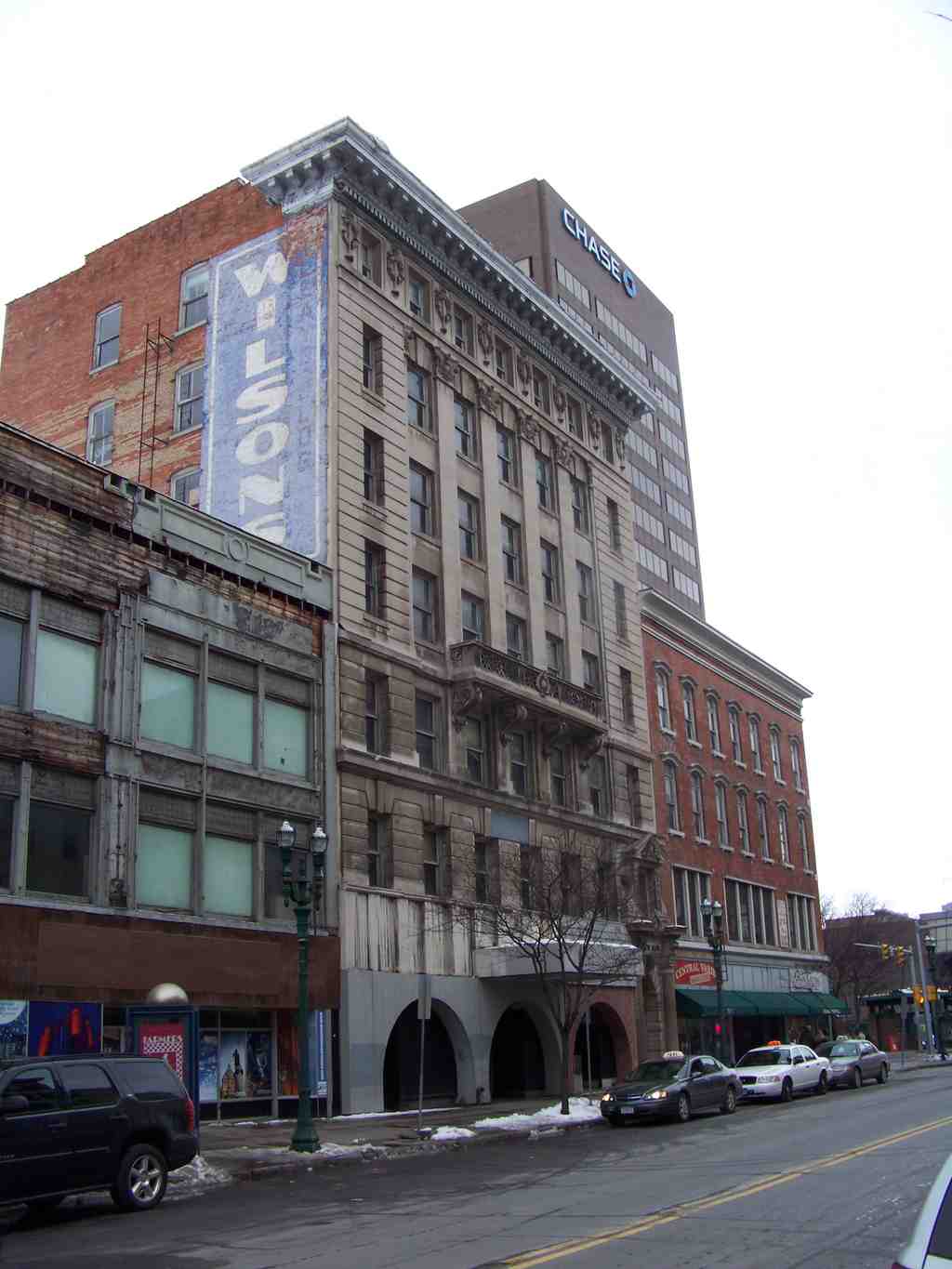
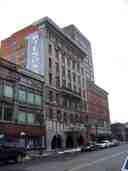
South Salina Street Downtown Historic DistrictPhoto: Lvklock, Wikimedia Commons, CC BY-SA 3.0. Cropped & resized. On your left, look for a stretch of brick and stone commercial blocks, rising four to seven stories, with deep metal cornices along the rooflines and the tall arched window of the old Loew’s State Theater standing out among them.
This is the South Salina commercial core... the place where downtown Syracuse once did its buying, selling, dining, and dreaming. Today, it is less a shopping street than a record in masonry, a kind of architectural fossil showing where the city’s business heart beat from the mid-nineteenth century into the mid-twentieth.
You can read confidence here in the details. A cornice, by the way, is that projecting band at the top of a building, like a formal hat brim. A parapet is the raised edge above the roofline. Those flourishes mattered. Merchants wanted customers to feel solidity, style, and ambition before they even stepped inside.
This district gathered work by downtown’s signature architects: Horatio Nelson White, Archimedes Russell, Charles E. Colton, Joseph Lyman Silsbee, Charles D. Wilsey, and Thomas W. Lamb. They gave commercial Syracuse its visual language... Gothic drama, Italian Renaissance grace, Beaux Arts polish, and the theatrical flourish of the movie palace. If you glance at your screen, the White Memorial Building shows that confidence beautifully, with its ornate materials and bold silhouette.
One of the most human stories here lives at three twenty-one South Salina, the Park-Brannock Building. In the eighteen fifties, it began as another commercial block. Later, the Park-Brannock Shoe Store operated there, and that is where the Brannock Device, the foot-measuring tool still used in shoe stores, was first invented and manufactured. Such a humble object... and yet it ties this whole grand streetscape to ordinary bodies, ordinary errands, ordinary lives.
By the twenty-first century, shopping had shifted away, especially toward Armory Square. So Syracuse stopped trying to make South Salina the city’s main retail strip again. Instead, preservationists pushed for rehabilitation and adaptive reuse, which simply means repairing old buildings and giving them new jobs. That effort helped the district win a place on the National Register of Historic Places on the sixteenth of October, two thousand nine. In two thousand fourteen, the protected boundaries expanded onto Warren Street, Jefferson Street, and farther down South Salina itself. That widening mattered. It meant the city had decided this was not just one handsome block, but a whole historic street fabric worth keeping.
At three twenty-one, that choice became a real fight. Senator Chuck Schumer helped push for preservation recognition, which unlocked federal Historic Tax Credits and supported its rescue. The credits came through, the facade returned, and later the building gained new life as Whitney Lofts. Not the old commerce reborn... something gentler, but still alive.
And then there is Loew’s State, now the Landmark Theatre, rescued from decline and reopened for live performance. You can see its grand presence on your phone here.
Walk west to Armory Square next. The city’s commercial energy did not disappear... it drifted, frayed, and then found another shape. If you want to linger, the district is generally active from eight thirty in the morning to five on weekdays, and from eleven to seven on weekends.
Look for sturdy red-brick warehouse blocks with tall rectangular windows and old loading-door openings, gathered around the fortress-like armory with its brick walls and pale…Read moreShow less
Open dedicated page →Look for sturdy red-brick warehouse blocks with tall rectangular windows and old loading-door openings, gathered around the fortress-like armory with its brick walls and pale limestone trim.
Armory Square feels like a neighborhood that had to earn its second life. Standing here, you’re in a part of downtown that began as a hardworking commercial and industrial district on Syracuse’s west side. By the turn of the twentieth century, these streets did far more than store goods. More than twenty hotels served railroad travelers here, and the Jefferson Street Armory was not just one building but three, quartering cavalry and infantry. This was a place of freight, uniforms, boarding rooms, and movement.
One of the people who helped shape that earlier world was Jacob Crouse, working with his brother Charles. In eighteen eighty-seven, they put up the Crouse Building, a substantial commercial block that later housed Penfeld and Wilcox Bedding. Around nineteen twenty-seven, labor unions moved in and renamed it the Syracuse Labor Temple. A building can change jobs like a person does... and still carry its old bones.
Then came the fire. In the early hours of the third of November, nineteen forty-eight, around three-thirty in the morning, flames tore through the old Crouse Building. Firefighters said they could see the blaze halfway across the street when they arrived. One person died, two were injured, and the fire kept burning until about seven. In a district like this, survival was never guaranteed.
If you glance at the image on your screen, you can see the kind of warehouse streetscape that made the comeback possible: solid brick, practical windows, buildings sturdy enough to be imagined again instead of erased.
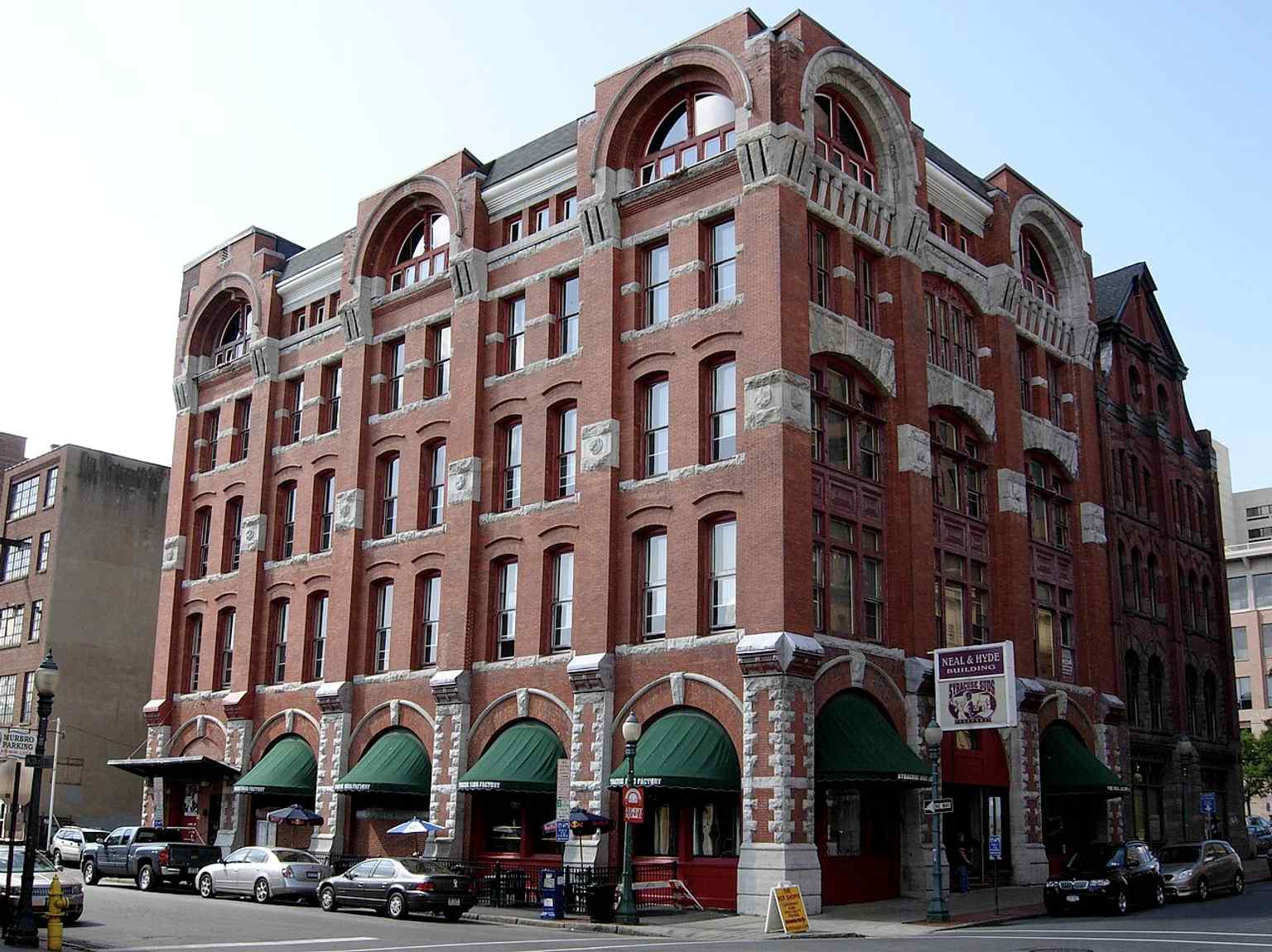
Walton and South Clinton Street show Armory Square’s mix of preserved brick warehouses and retail buildings that helped fuel its 1990s comeback.Photo: Crazyale, Wikimedia Commons, Public domain. Cropped & resized. And for a while, erasure seemed more likely than renewal. After the Second World War, people and businesses drifted outward to the suburbs, and downtown thinned out. Armory Square languished. Empty storefronts multiplied. Yet in nineteen eighty-four, the Armory Square Historic District won a place on the National Register of Historic Places, with forty-six industrial and commercial buildings included. That listing mattered. It helped spark real restoration. Developers Robert Doucette and George Curry restored the old Labor Temple under federal preservation standards, and their work won an award the following year.
The comeback did not arrive polished. One early nightlife spot, the Packing House Cafe, sat beside a packing house and chicken rendering plant, which tells you exactly how rough-edged this revival could be. People took chances here. Restaurateur Karyn Korteling later admitted she hesitated to open in Armory Square because so many storefronts still stood empty. Then the momentum changed. Students came. Shops came. Coffeehouses, restaurants, offices, music, tattoos, and late-night energy moved into buildings once meant for freight and factory work.
You can also pull up the Shot Clock Monument on your phone. Its twenty-four-second clock honors the rule first used in Syracuse in nineteen fifty-four, one more reminder that this neighborhood keeps finding new ways to matter.
So here’s the question I want to leave with you: when a district loses the work it was built for, what saves it most... the bricks, the location, or the people willing to tell a new story inside old walls?
Armory Square endures because it learned how to be useful more than once. When you’re ready, head toward Clinton Square, about a seven-minute walk from here.
Show 7 more stopsShow fewer stopsexpand_moreexpand_less
On your right, Clinton Square opens as a broad paved plaza marked by a tall granite monument with corner columns and a globe held by four eagles, beside a wide low fountain. This…Read moreShow less
Open dedicated page →On your right, Clinton Square opens as a broad paved plaza marked by a tall granite monument with corner columns and a globe held by four eagles, beside a wide low fountain.
This is where Syracuse first learned to gather. Long before it looked ceremonial, roads from north and south met here in a rough crossroads, and Henry Bogardus kept an inn on the muddy edge of town. People first called it Bogardus’ Corners, then Cossits’ Corners after Sterling Cossit took over the tavern... and when the Erie Canal opened in eighteen twenty-five, this crossroads became the city’s front door.
The canal changed everything. Boats slid through here, the Oswego Canal joined nearby, and Joshua Forman renamed the square for DeWitt Clinton, the governor who pushed the canal dream forward. By eighteen thirty-seven, this was an official marketplace, the city’s busy center. Farmers sold produce here, Lafayette was welcomed here, and brewer John Greenway once laid out a New Year’s feast for around twenty thousand people, with three oxen, thousands of loaves, and plum pudding stretched along a hundred-foot table.
But this center kept getting rewritten. Fire struck the surrounding blocks again and again - in eighteen thirty-four, eighteen fifty-six, eighteen eighty-one, eighteen ninety-six, and nineteen forty-three. Hotels, business blocks, and landmarks vanished, and each time downtown stitched itself back together with new facades and new ambitions.
Take a slow look around for a moment... the fountain, the monument, the marker to the Jerry Rescue, the old bank buildings. How many different ideas of civic importance can one square carry at once?
Memory stands tall here. The Soldiers and Sailors Monument, dedicated in nineteen eleven, rises about seventy-five feet high: a granite shaft, Roman Ionic columns at the corners, and that remarkable globe lifted by four eagles. It honors Onondaga County’s Civil War dead. Nearby, another monument remembers William “Jerry” Henry, a fugitive slave arrested under the Fugitive Slave Act in eighteen fifty-one. In this square, crowds rallied for his freedom, and men including Jermain Wesley Loguen and Samuel Joseph May helped turn protest into rescue. That is why this place belongs not only to commerce, but to conscience.
What many visitors never realize is that some of this grandeur stands on absence. The Erie Canal once ran right through here; when the city closed and filled it in after nineteen seventeen, the ground beneath downtown memory literally changed. If you glance at the before-and-after image in the app, you can watch the canal disappear and the plaza take over.
And one of the square’s sharpest absences waits just ahead: a theater that once stood here before fire took it in eighteen eighty-one. We’re heading there next, because in this city, gathering was never only about buying and selling... it always wanted a stage.
Like any true civic heart, Clinton Square stays open all day, every day.
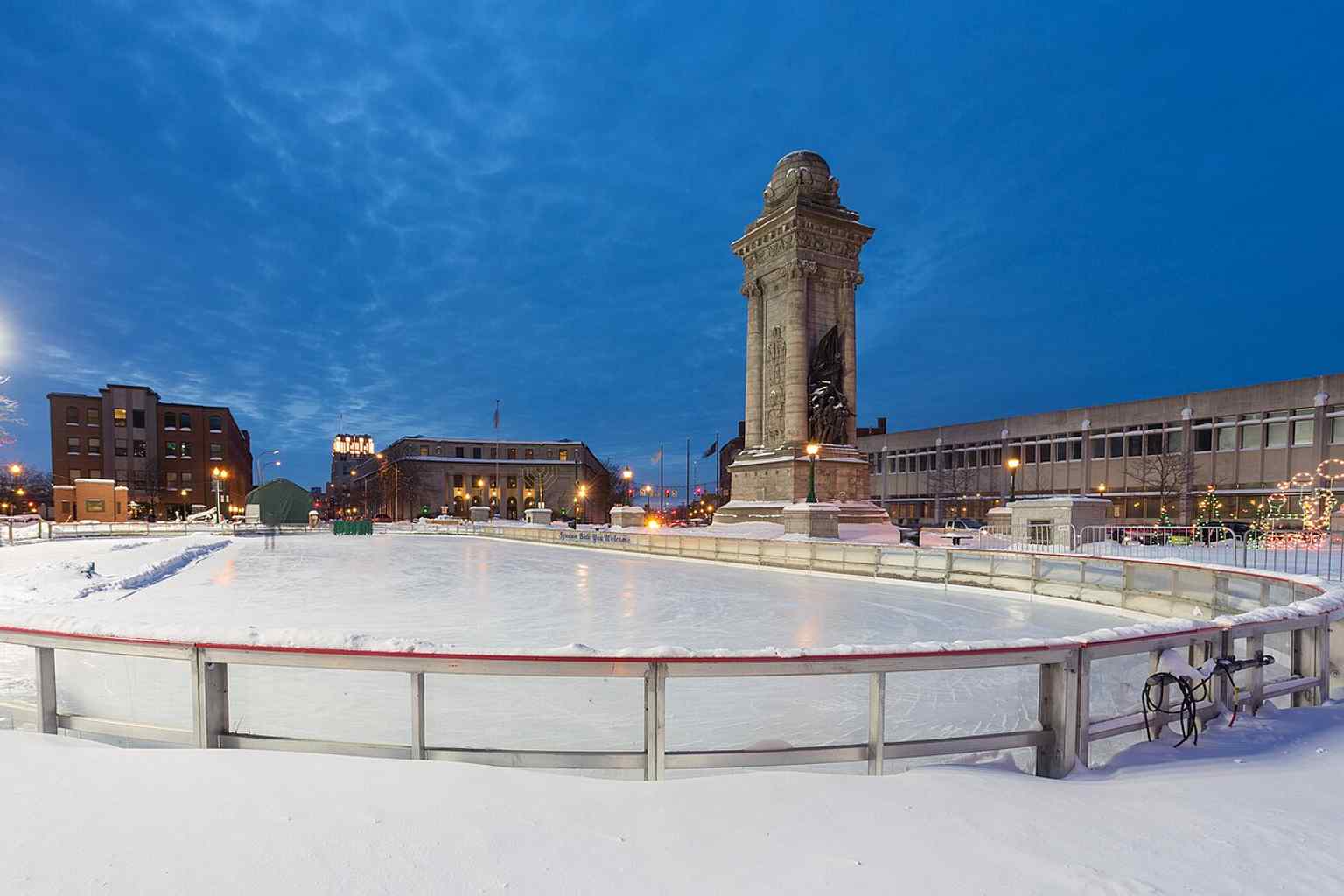
Clinton Square’s winter ice rink, a tradition since the 1990s and now a signature seasonal use of the downtown park.Photo: Kenneth C. Zirkel, Wikimedia Commons, CC BY-SA 4.0. Cropped & resized. 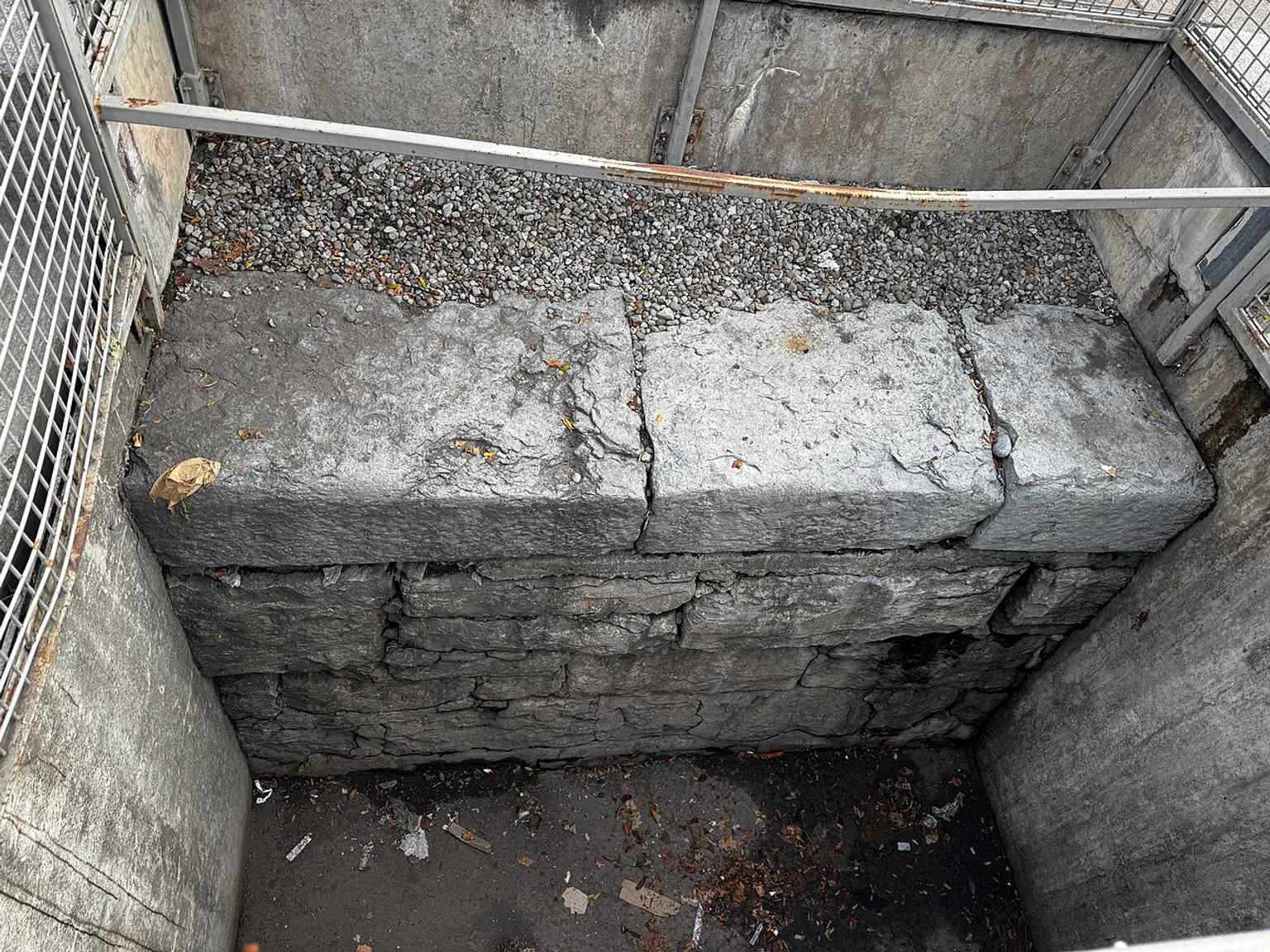
The Erie Canal stones in Clinton Square recall the waterway that once ran through the square before it was filled in and replaced by Erie Boulevard.Photo: Eddie891, Wikimedia Commons, CC BY 4.0. Cropped & resized. On your right, picture the old Wieting as a broad masonry theater block with a flat roof, tall rows of arched upper windows, and a prominent street-front entrance facing Salina…Read moreShow less
Open dedicated page →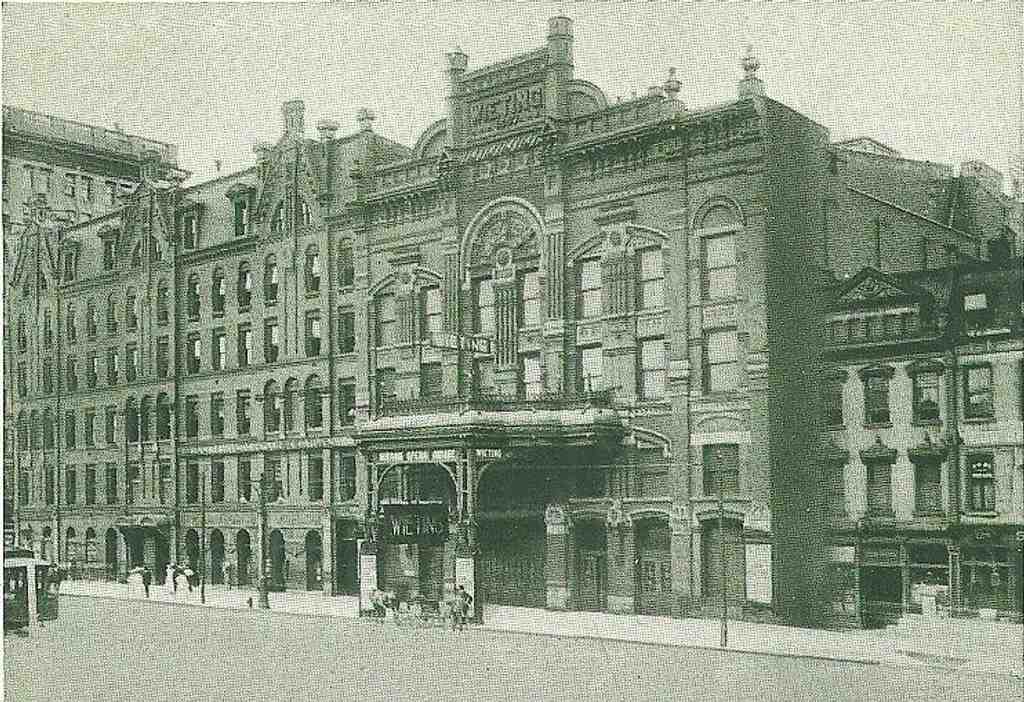
Wieting Opera HousePhoto: Unknown author, Wikimedia Commons, Public domain. Cropped & resized. On your right, picture the old Wieting as a broad masonry theater block with a flat roof, tall rows of arched upper windows, and a prominent street-front entrance facing Salina Street.
This address carried a bold idea. John Wieting made money in the lecture business, and instead of keeping that fortune to himself, he turned it into a public hall because he believed Syracuse deserved a room as large as its hopes. He opened Wieting Hall here in eighteen fifty-two. Four years later, fire tore through it so completely that only one wall stayed standing. Firefighters struggled to stop it because their water froze. Most people would have stepped back after that. Wieting answered by rebuilding in about one hundred days.
That speed mattered. It told the city, and everyone beyond it, that Syracuse would not wait quietly for culture to happen somewhere else.
Inside, this hall became a place where Syracuse argued, listened, applauded, and announced itself. Frederick Douglass spoke here in eighteen sixty-one under police and military protection after handbills urged residents to drive him from the city. John Wieting refused to cancel him. Charles Dickens later stood on this stage and read from A Christmas Carol and The Pickwick Papers for about two hours. Susan B. Anthony appeared here. So did Ralph Waldo Emerson, Henry Ward Beecher, and famous actors who drew packed houses. The auditorium officially seated one thousand and seventeen people, but managers sometimes squeezed in nearly two thousand with extra stools. You can almost feel the rustle of coats and the impatient shifting before the curtain rose.
In eighteen seventy, Wieting renovated the hall and gave it a grander name: the Wieting Opera House. The first night did not even open with grand opera, but with a dance piece called The Lancers. I love that detail. It shows a city reaching upward, trying on the confidence of a major cultural capital before anyone could say it fully belonged there.
And then, slowly, it did. By the late nineteenth century, the Wieting ranked among the premiere theaters in the East. Downtown became a stage for spectacle and prestige, a place where touring companies tested productions before Broadway. The Wieting belonged to the Theatrical Syndicate, a network that controlled many touring shows, which gave it first claim on many major productions in the region. In nineteen ten, Naughty Marietta tried itself out here before heading to New York. Syracuse was not only receiving the performance world... it was helping shape what the larger world would soon see.
If you glance at the ruins image in the app, the wreckage after the eighteen eighty-one fire feels almost impossible to imagine. Yet Syracuse answered again. The rebuilt theater reopened with incandescent lighting, the first in the city. After another fire in eighteen ninety-six, Mary Elizabeth Wieting, John’s widow, personally pushed for a new design that would be as fireproof as possible. The new interior glowed in gold and rose, with Italian mosaic floors, silk and velvet drapes, and bronze doors. You can catch a hint of that richness in the interior view on your screen.
By nineteen thirty, the opera house closed, and a parking garage replaced it. Still, stand here a moment and imagine the crowd pouring in for Sarah Bernhardt, Lillian Russell, Gilbert and Sullivan, and later even films. Next, we’ll walk about two minutes to the State Tower Building, where downtown’s ambition climbs upward instead of stepping onto a stage. For practical planning, the app lists weekday hours of ten in the morning to four in the afternoon, with weekends closed.
On your left, look for a tall Art Deco tower of limestone, terra-cotta, and brick, rising in wedding-cake setbacks with a narrow upper shaft that makes it easy to spot against the…Read moreShow less
Open dedicated page →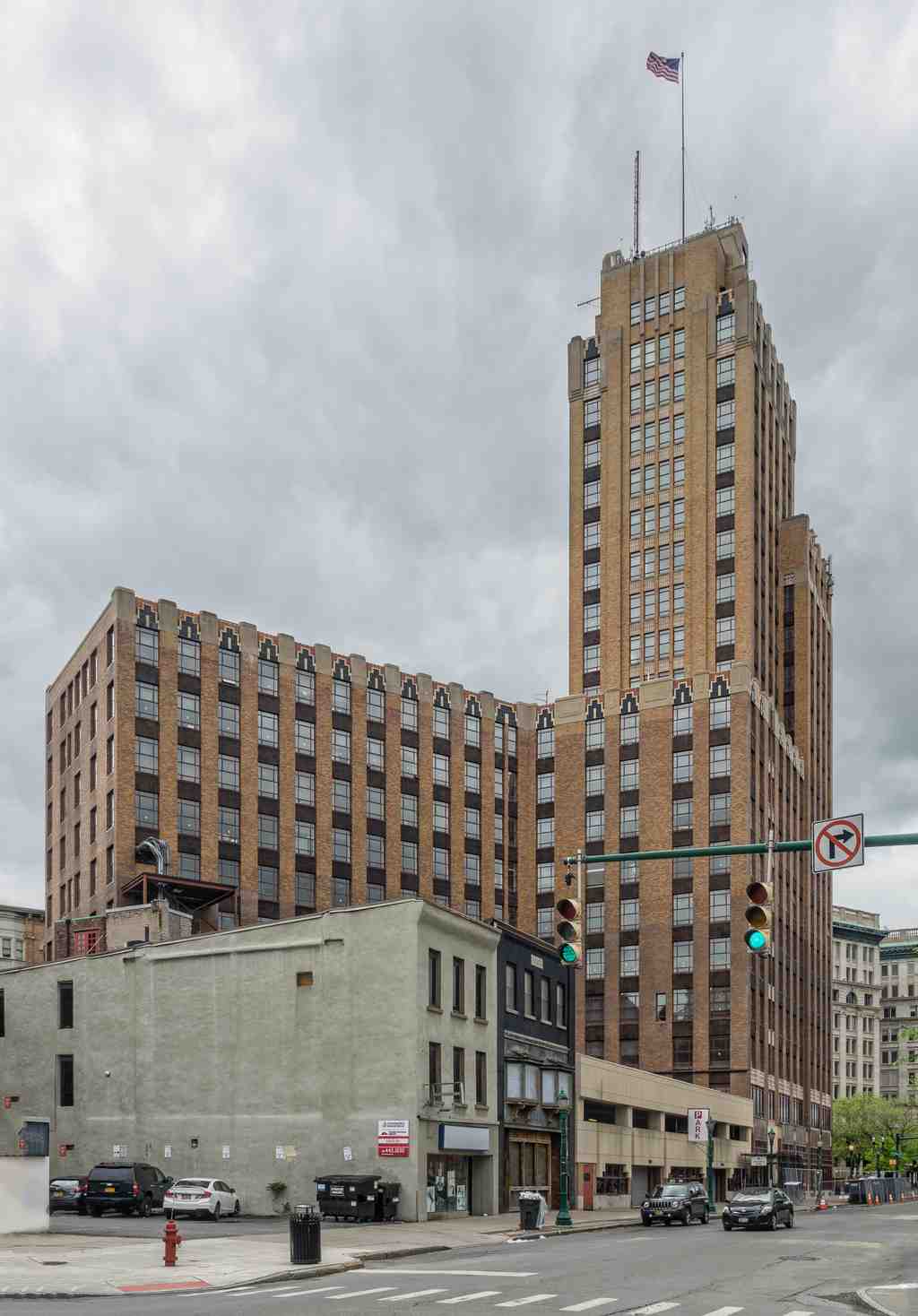
State Tower BuildingPhoto: Kenneth C. Zirkel, Wikimedia Commons, CC BY-SA 4.0. Cropped & resized. On your left, look for a tall Art Deco tower of limestone, terra-cotta, and brick, rising in wedding-cake setbacks with a narrow upper shaft that makes it easy to spot against the Syracuse skyline.
This is the State Tower Building... the moment Syracuse decided that modern ambition could be measured in height. When it opened in nineteen twenty-eight, people called it the city’s first skyscraper, and nearly a century later it still holds the crown as Syracuse’s tallest landmark, climbing about three hundred twelve feet over downtown.
That feels dramatic now, but the surprise is what stood here before. This ground once belonged to the Bastable block and then the Bastable Theatre, a place of spectacle, comedy, and crowded evenings. Frederick Bastable rebuilt there after an earlier fire, and by eighteen ninety-seven Sam S. Shubert was running the theater profitably, filling it with popular shows. Then, in nineteen twenty-three, fire tore through again and destroyed the theater completely.
And here is the quiet little twist locals love to remember: after all that applause, this site was seriously considered for another theater. Stephen Bastable even had to make a public break with that dream. In July of nineteen twenty-three, he committed the land to a modern office building instead. Syracuse chose desks over footlights... contracts over curtain calls... and turned public excitement into a skyline statement.
If you glance at the image on your screen, you can see how proudly the tower presents that choice. Thompson and Churchill, the architects, gave it that stepped profile, where the upper floors pull back in layers. Those setbacks were practical, but they also made the building feel taller, almost as if it were stretching itself upward. And there’s a detail many people miss from the sidewalk: the brick color grows lighter as it rises. That gradient coaxes your eye upward and makes the whole tower seem even more vertical.
The engineering was a story of grit all by itself. Crews started in nineteen twenty-seven and dug what newspapers called one of the deepest foundations in downtown Syracuse. Pumps ran constantly to fight seepage. Three hundred workers took turns in two shifts just to keep the excavation dry enough to build. Before the tower even opened, about eighty percent of it had already been leased. The city wasn’t just dreaming big... it had tenants waiting.
A vintage image in the app shows how proudly Syracuse advertised this new identity. For years, the exterior glowed at night, turning the tower into a civic beacon. Later, it survived a gas explosion in nineteen sixty-two, weathered years of vacancy, and then changed again in the twenty-tens, when developers kept the lower floors for offices and turned the upper stories into apartments. So even now, this building keeps revising what downtown can be.
Architectural historian Evamaria Hardin called it Syracuse’s counterpart to the Empire State Building. That sounds grand, but standing here, I think what matters most is simpler: this tower made loss visible as renewal. A burned theater left a gap, and the city answered with height.
From here, our story narrows from the skyline to a single home. In about nine minutes, we’ll reach the Hamilton White House, where older Syracuse still waits at a much more human scale.
On your left, look for the white-painted house with a temple-shaped front gable, tall rectangular windows, and a small cupola perched on the roof. This house asks Syracuse to…Read moreShow less
Open dedicated page →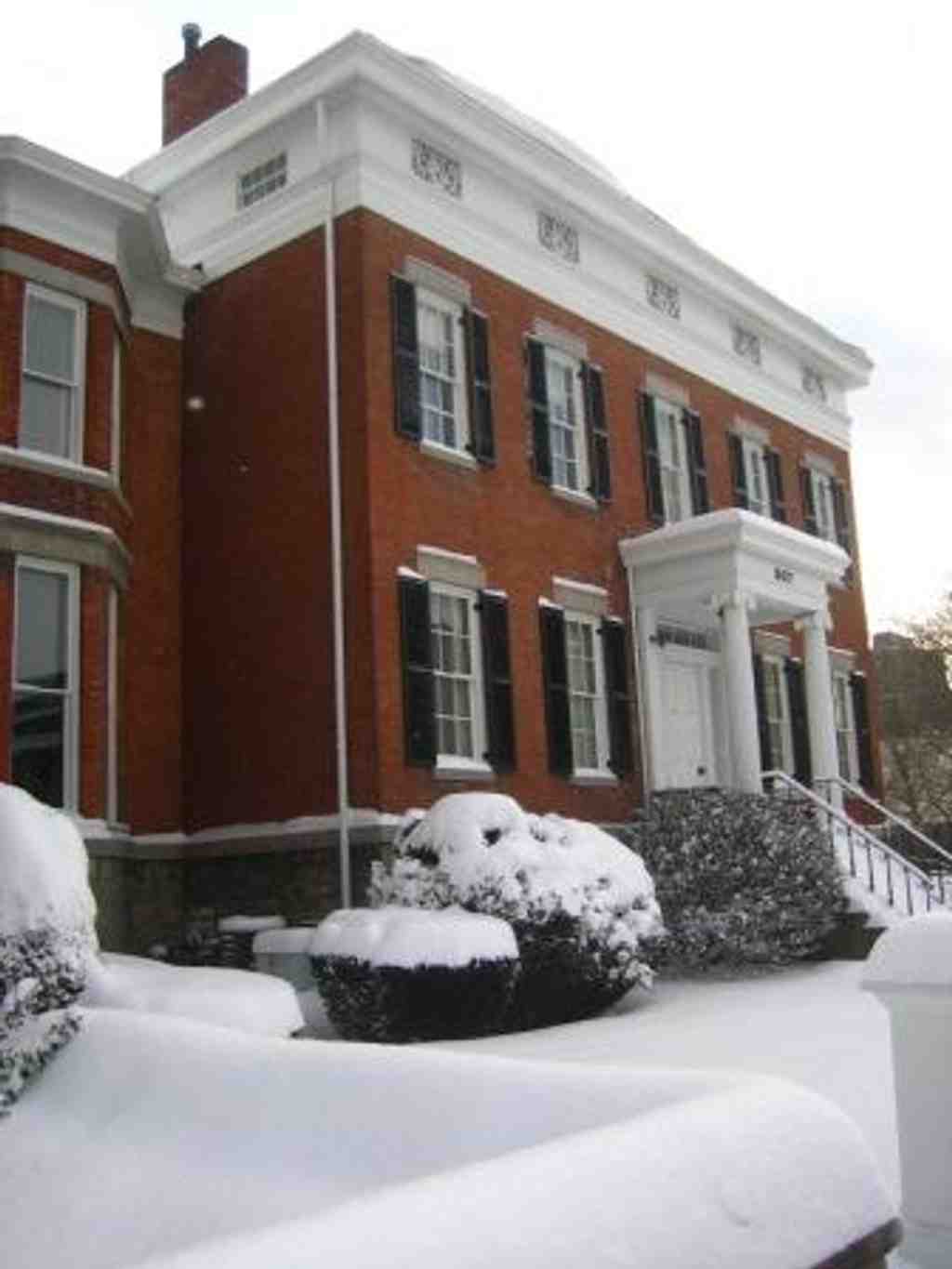
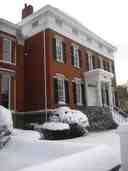
Hamilton White HousePhoto: Doncram, Wikimedia Commons, CC BY-SA 3.0. Cropped & resized. On your left, look for the white-painted house with a temple-shaped front gable, tall rectangular windows, and a small cupola perched on the roof.
This house asks Syracuse to lower its voice a little. After towers and commercial blocks, here is something older, more personal... a Greek Revival home, meaning it borrowed the calm symmetry and temple-like forms that nineteenth-century Americans associated with dignity and civic virtue. Hamilton White raised it around eighteen forty to eighteen forty-two, though some later surveys say eighteen forty-five. That uncertainty matters. Even important houses can slip a little at the edges of memory, their first years blurred by missing papers and later guesswork.
Hamilton White himself gives this place its heartbeat. He was a lawyer, banker, businessman, investor in salt, railroads, and canal ventures, and one of those men whose name kept appearing wherever Syracuse was growing. But this house was not only a badge of status. People remembered it as a place of gracious hospitality beside Fayette Park, a domestic center in a district that has otherwise lost so many of its early homes. In fact, this is one of the few major National Register-listed residences near downtown still standing with much of its historic exterior intact.
If you glance at your screen, you can meet Hamilton White face to face in an old portrait. Behind that formal image stood a family deeply woven into the city’s private networks of power and care. White and his relatives supported churches, orphan care, schools, and civic causes. More quietly, and more bravely than polite society liked to advertise, they were associated with Black institutions, Underground Railroad efforts, and speakers such as Frederick Douglass in Syracuse in the eighteen fifties. So this elegant house held more than dinner conversations and business plans. It also sheltered convictions that mattered when the stakes were human freedom.
The house shaped the next generation too. Hamilton Salisbury White, born here in eighteen fifty-three, turned childhood fascination into a new kind of public service. Local stories say that as a little boy he raced from the stables behind the house in a pony cart just to watch volunteer firefighters at work. Imagine that small burst of wheels and curiosity. As a man, he transformed that obsession into one of Syracuse’s great experiments: a paid, trained fire company, mechanical and electric alarms, improved turnout gear, and a fierce belief that getting to a fire fast could save lives. What we now call response time became part of his science of firefighting. He later died in eighteen ninety-nine after battling a downtown chemical fire.
If you look at the image of his memorial across the park, you can feel how the city answered that loss with remembrance. Yet the deeper surprise is here, in wood and plaster and family routine. Syracuse did not build its public ambitions from plazas and office towers alone. It built them from households like this one, where money, faith, reform, and ambition gathered around a table and then spilled outward into the city.
Later, the house changed again: club rooms for a time, then business offices, another quiet reinvention rather than a grand rebirth. From this private threshold, we’ll head next toward a place where gathering becomes public again, the Upstate Medical University Arena, about an eight-minute walk from here. The offices here generally keep long hours, usually from seven in the morning to eleven at night, with a later start on Sunday.
Look for the broad brick-and-stone arena with its low curved concrete roof and formal central entrance, a sturdy mid-century monument that feels more civic hall than ordinary…Read moreShow less
Open dedicated page →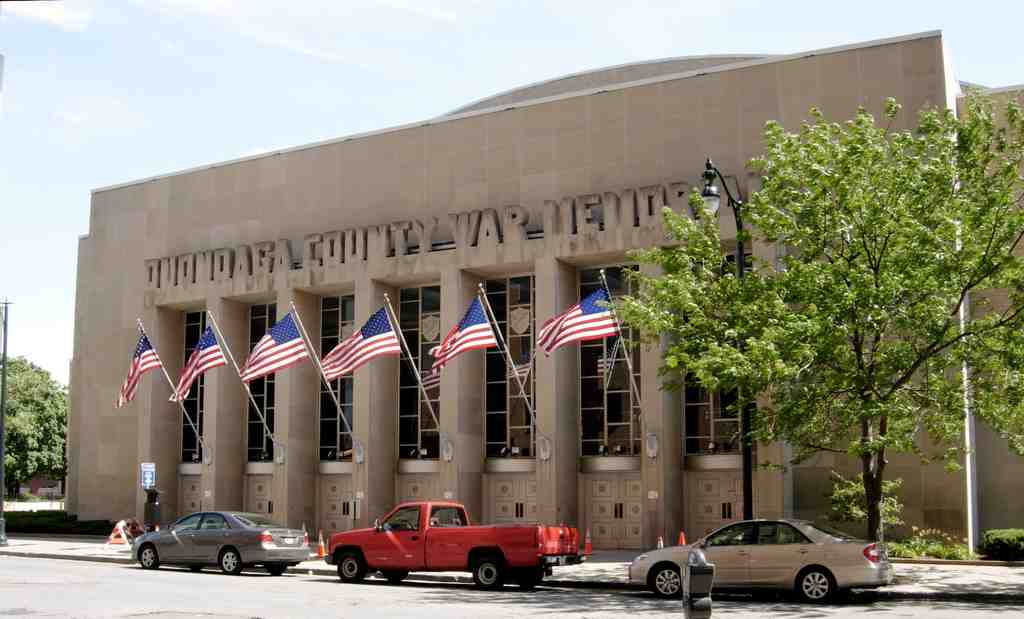
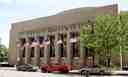
Upstate Medical University ArenaPhoto: Crazyale, Wikimedia Commons, Public domain. Cropped & resized. Look for the broad brick-and-stone arena with its low curved concrete roof and formal central entrance, a sturdy mid-century monument that feels more civic hall than ordinary stadium.
This place began as a promise of memory. In nineteen forty-nine, Gold Star Mothers, women whose children had died in military service, helped launch the project that became the Onondaga County War Memorial. So before Syracuse cheered here, it remembered here. Architects Edgarton and Edgarton gave that grief a public shape between nineteen forty-nine and nineteen fifty-one: a memorial for veterans from several wars, wrapped inside an arena bold enough to use a thin-shell concrete roof, a wide single-span structure that covered a huge space without a forest of interior supports.
And yet memory in a city rarely stands still. This building also answered a practical wound. After the nineteen forty-seven fire at Archbold Gymnasium, Syracuse University men’s basketball needed a home. When this arena opened in nineteen fifty-one, it brought the program back downtown and turned remembrance into daily civic life.
If you glance at the before-and-after image in the app, you can see how the Montgomery Street entrance stayed recognizable even as the streetscape around it changed.
That double identity never really left. Inside, the Syracuse Nationals won the nineteen fifty-four to nineteen fifty-five N-B-A championship in a seventh game thriller, ninety-two to ninety-one. Years later, this floor also became part of a quieter history: Earl Lloyd and Jim Tucker, Black players in the early N-B-A, helped make this arena part of the league’s slow breaking of the color line. So this memorial held more than names from wars; it also held the difficult work of widening who belonged in American public life.
And what happens when a memorial must also survive as a working arena... does commerce weaken the meaning, or keep the meaning alive by keeping the doors open?
Syracuse wrestled with that question out loud. Renovations came in nineteen ninety-four and again in two thousand eighteen. In two thousand seventeen, county officials argued bluntly over money, naming rights, bathrooms, lighting, accessibility, veterans exhibits, even a new club space. Then came the two thousand nineteen sponsorship with Upstate Medical University: a new name, health programming, and support for a veterans foundation through the Syracuse Crunch. The name changed, but the old tension stayed visible. What do we preserve here: the words, the purpose, or the gathering itself?
That may be this building’s real legacy. Like the opera house and the towers we’ve met downtown, it keeps reinventing public spectacle: parades became games, ceremonies, concerts, testing clinics, and community rituals. Syracuse does not freeze memory in place. It puts memory to work.
From here, the Everson Museum of Art is about a four-minute walk, where that same stubborn act of making culture after loss takes a very different shape. If you want to check posted information, the arena offices generally keep weekday hours from ten in the morning to five in the afternoon and stay closed on weekends.
Front view of the War Memorial’s downtown Syracuse entrance, the civic landmark that opened in 1951 after years of planning and veterans’ fundraising.Photo: Crazyale, Wikimedia Commons, Public domain. Cropped & resized. 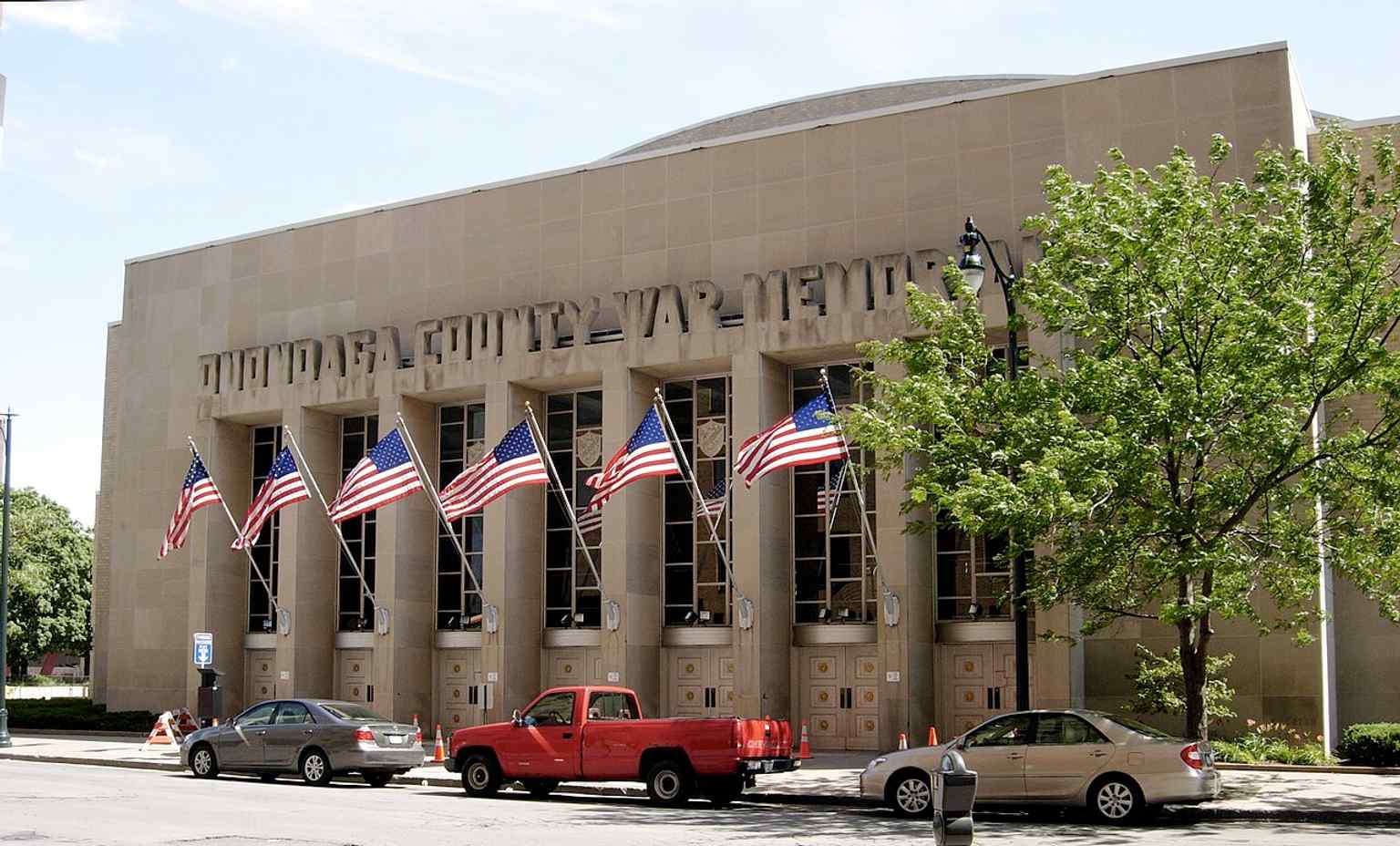
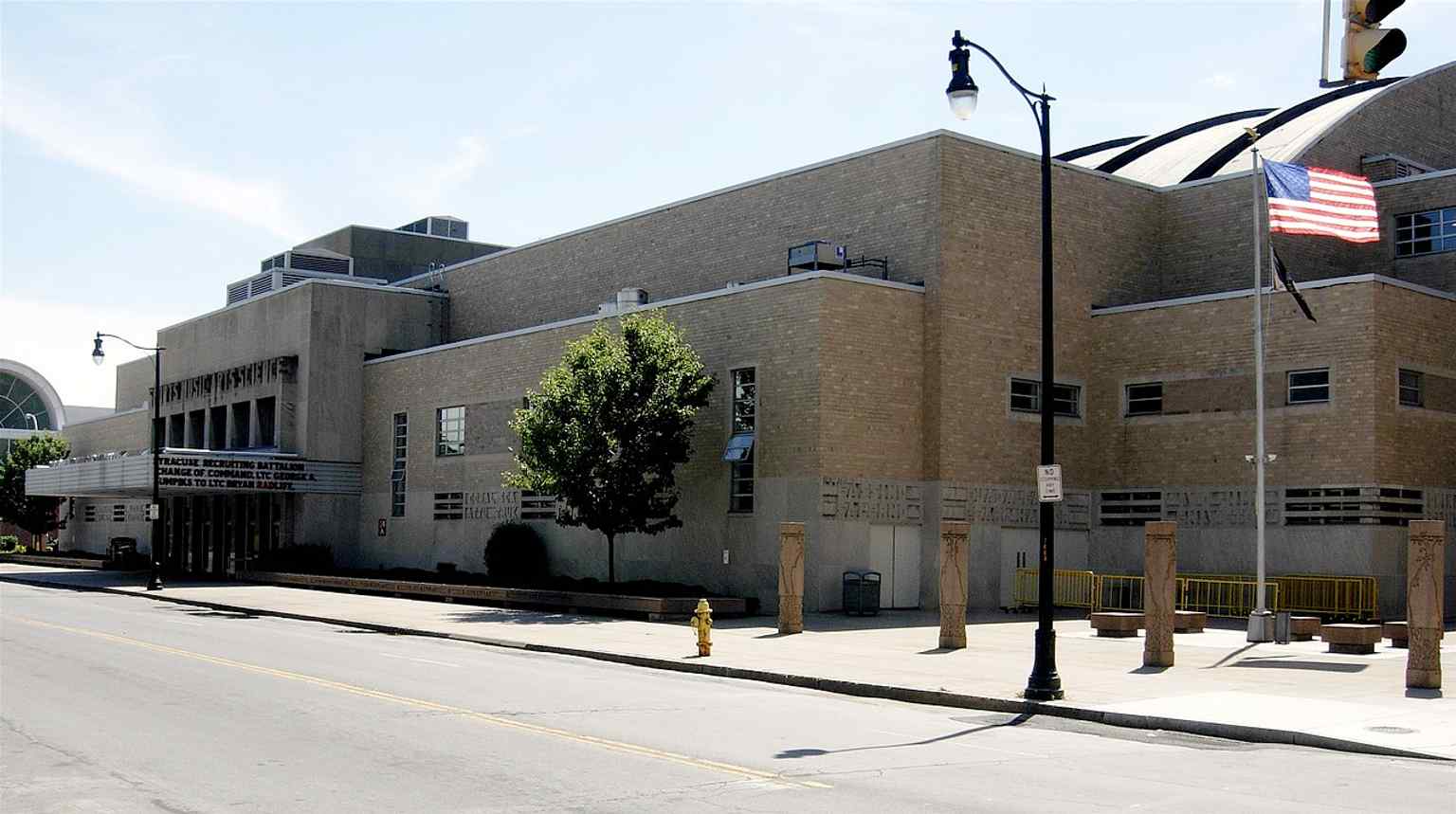
A side entrance showing the arena’s sturdy mid-century façade, part of the historic complex later listed on the National Register of Historic Places.Photo: Crazyale, Wikimedia Commons, Public domain. Cropped & resized. 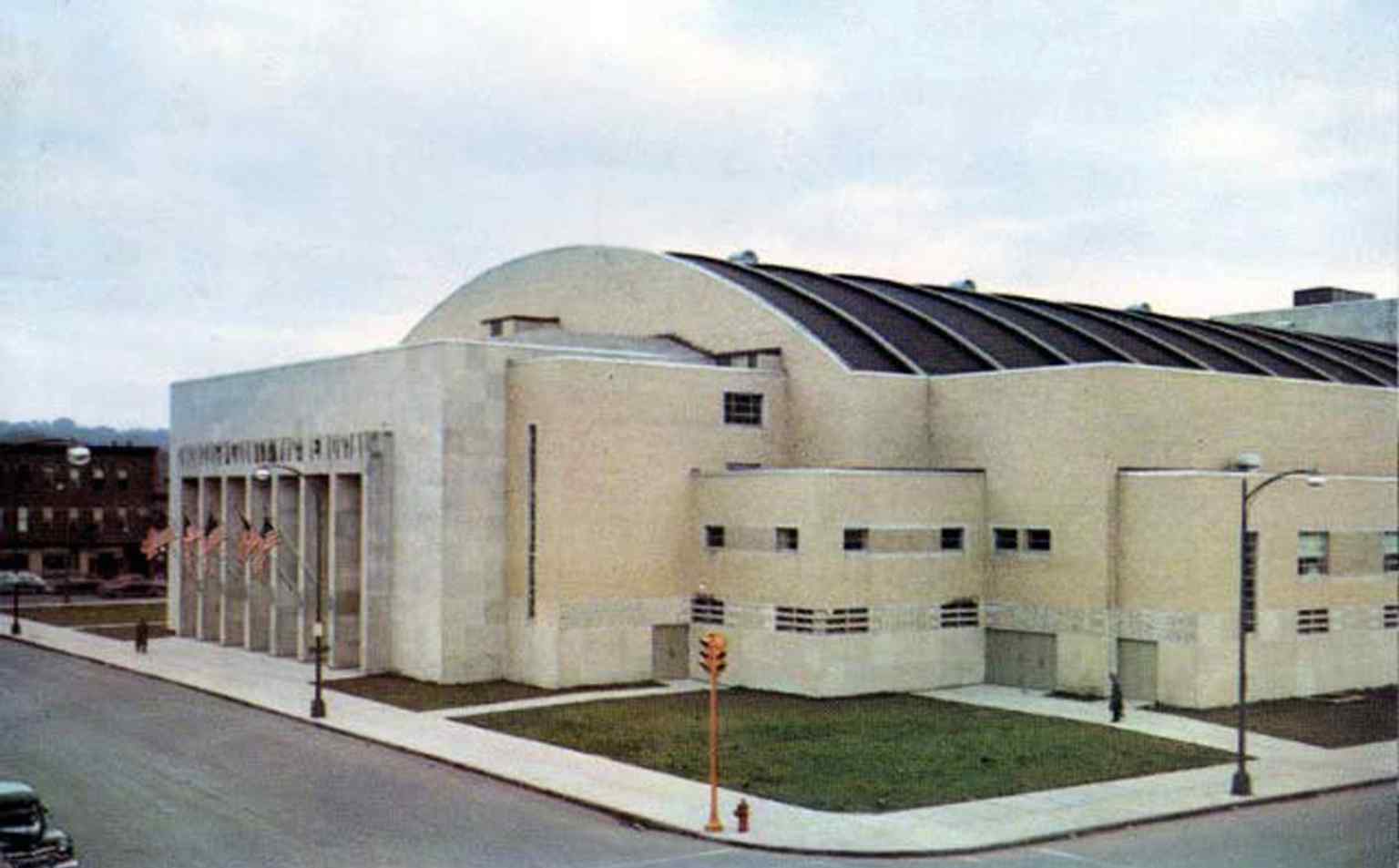
A 1954 postcard of Memorial Hall Entrance, capturing the building soon after it replaced the lost Archbold Gymnasium basketball home downtown.Photo: Marks & Fuller, Inc., Rochester, N.Y., Wikimedia Commons, Public domain. Cropped & resized. 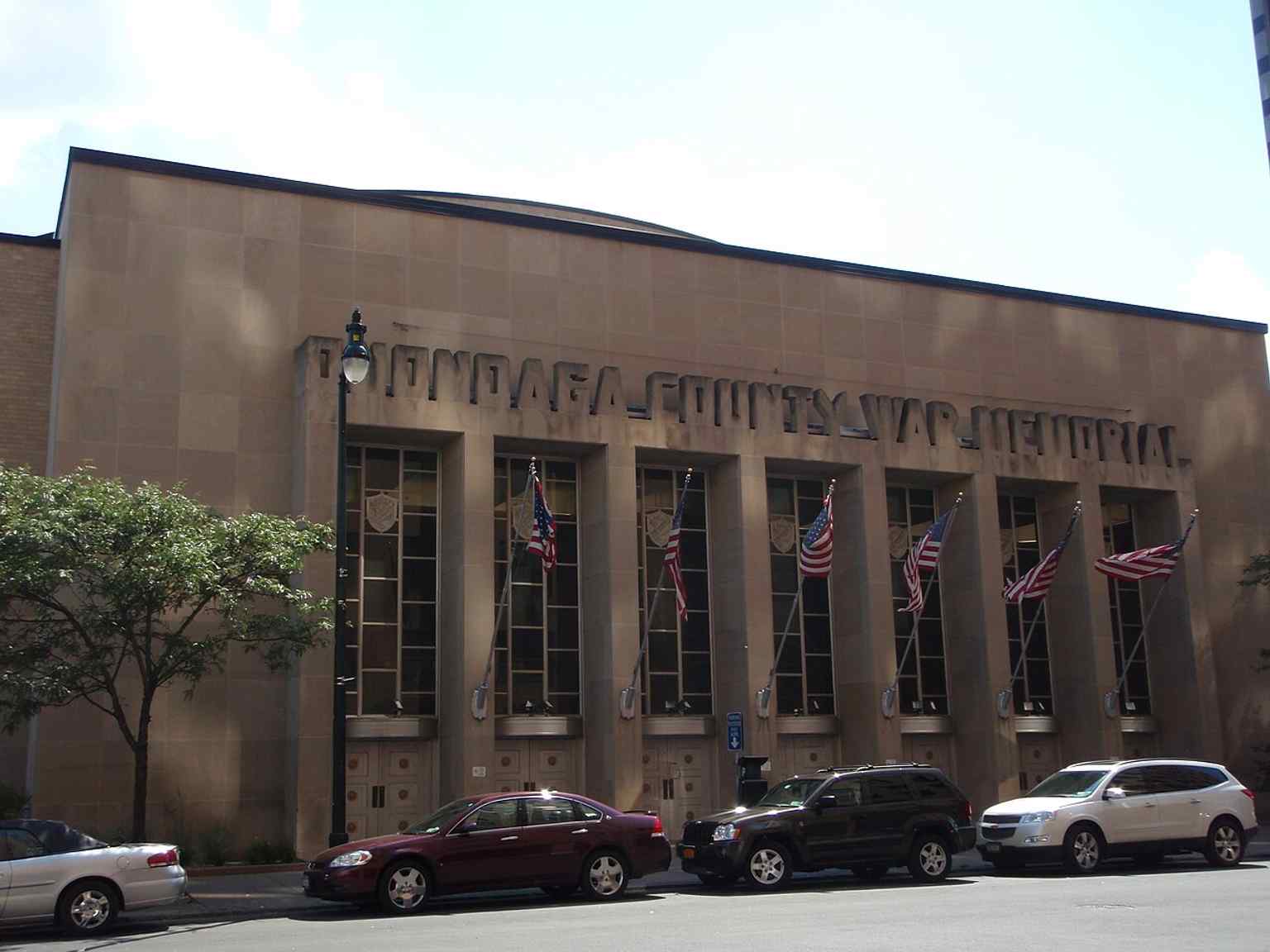
The arena in a clear modern exterior view, useful for showing how the old War Memorial still anchors the Oncenter complex today.Photo: Zchen46, Wikimedia Commons, CC BY-SA 3.0. Cropped & resized. 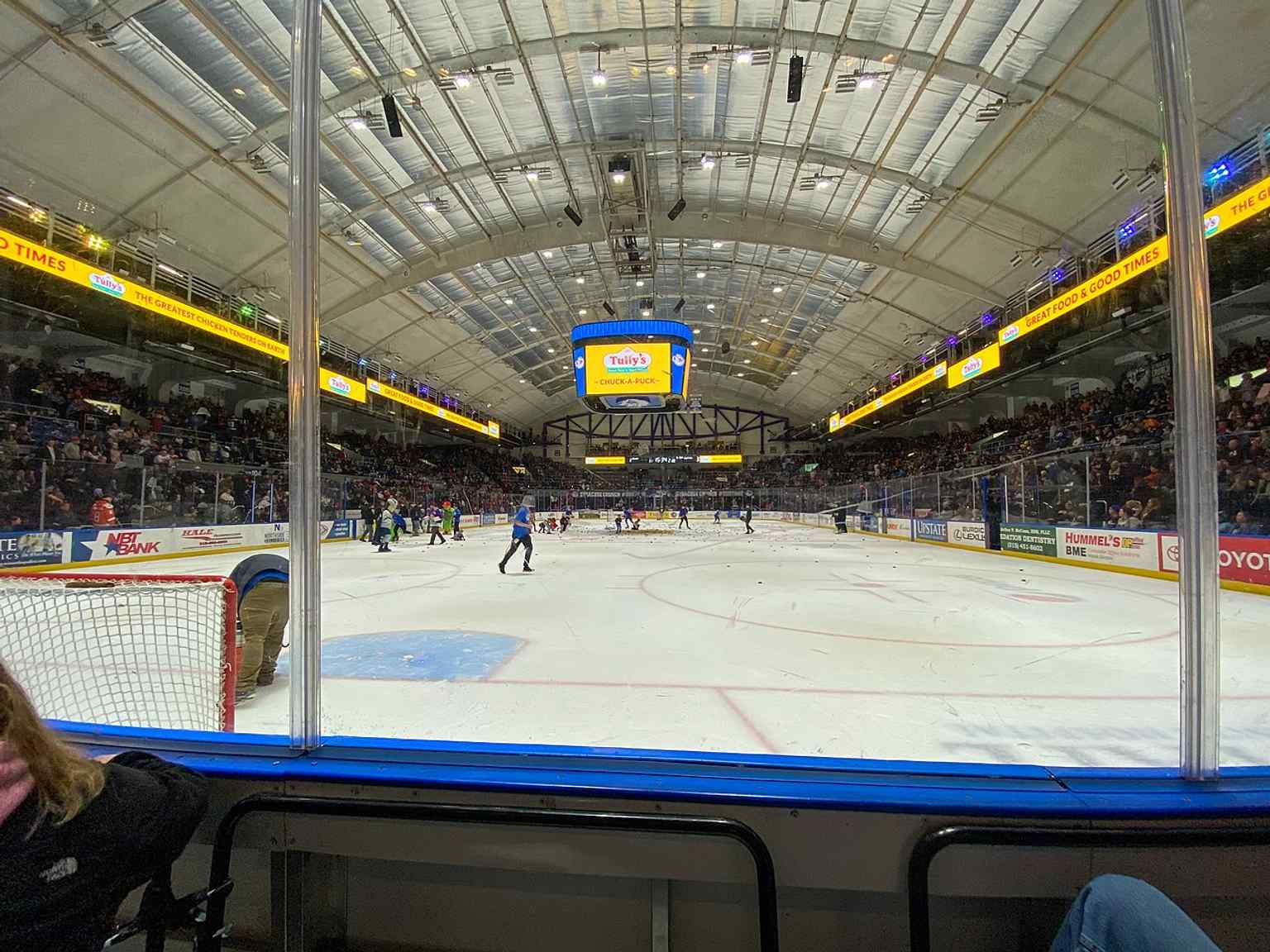
A 2023 Crunch game inside the renovated arena, illustrating the building’s ongoing role as a working sports venue.Photo: Andrew nyr, Wikimedia Commons, CC BY-SA 4.0. Cropped & resized. 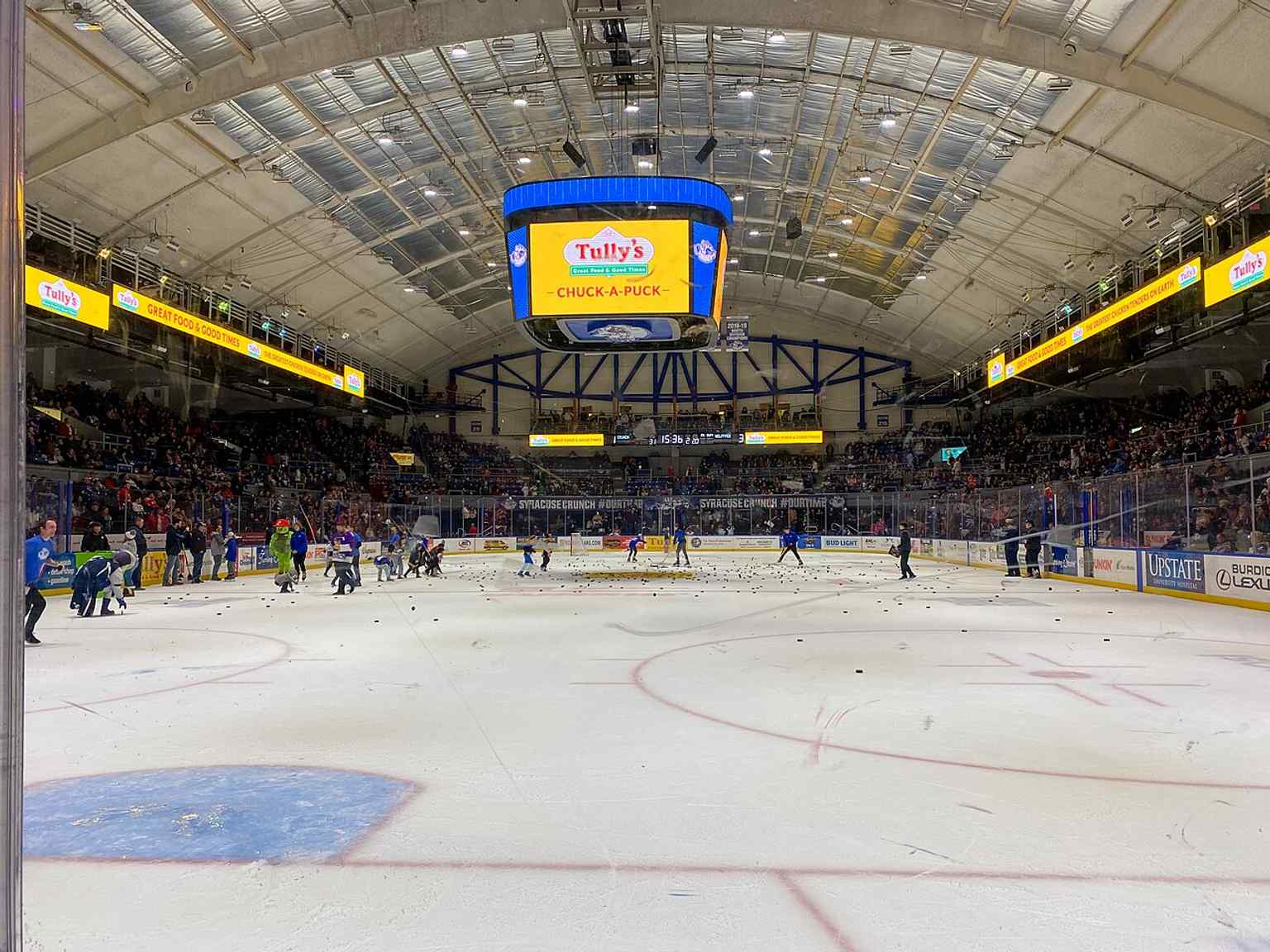
Crowd-and-ice view from a 2023 game, useful for showing the seating bowl and the arena’s current game-day experience.Photo: Andrew nyr, Wikimedia Commons, CC BY-SA 4.0. Cropped & resized. Look for the pale concrete museum formed from stacked square volumes, with deep cantilevered edges and a broad geometric plaza that makes the whole building feel like a…Read moreShow less
Open dedicated page →
Everson Museum of ArtPhoto: Crazyale, Wikimedia Commons, Public domain. Cropped & resized. Look for the pale concrete museum formed from stacked square volumes, with deep cantilevered edges and a broad geometric plaza that makes the whole building feel like a sculpture.
The Everson feels certain of itself now... but Syracuse’s art museum began in a much more wandering way. On the evening of the twenty-second of January, eighteen ninety-seven, art historian George Fisk Comfort gathered people at May Memorial Church for the museum’s inaugural meeting. Comfort was the kind of institution-builder who changed the shape of a city’s ambitions; he also helped found the Metropolitan Museum of Art and served as the first dean of Syracuse University’s College of Fine Arts. He and his fellow organizers were saying, very plainly, that art here deserved a public life.
Most visitors never hear that before this museum had a home of its own, it lived wherever Syracuse could tuck it in, including the Onondaga Savings Bank and the Syracuse Public Library. That small local detail says a lot. Long before the city could make art look permanent, it protected it any way it could.
In nineteen eleven, the museum committed itself to collecting only American art. Then Anna Wetherill Olmsted gave Syracuse another lasting identity. In nineteen thirty-two, she started the Ceramic Nationals as a tribute to potter Adelaide Alsop Robineau. The first exhibition looked almost homemade, displayed on draped crates borrowed from a local coffin company... and still, artists immediately urged Olmsted to open it to the whole country. She did. Within a few years, Syracuse had become one of the most important places in America for studio pottery.
Robineau’s presence still feels close here. Her Scarab Vase, carved over more than one thousand hours, became one of the museum’s signature treasures. If you glance at the image in the app, the interior view gives you a sense of the calm, open space created to honor objects like that.
The city’s larger declaration came because Helen Everson gave Syracuse one million dollars in nineteen forty-one, a huge sum at the time, to build an art museum. When this building opened in nineteen sixty-eight, I. M. Pei did not design a simple container. He shaped a work of art in concrete, with four bold square forms thrusting outward. The exterior photo on your screen catches that sculptural confidence well.
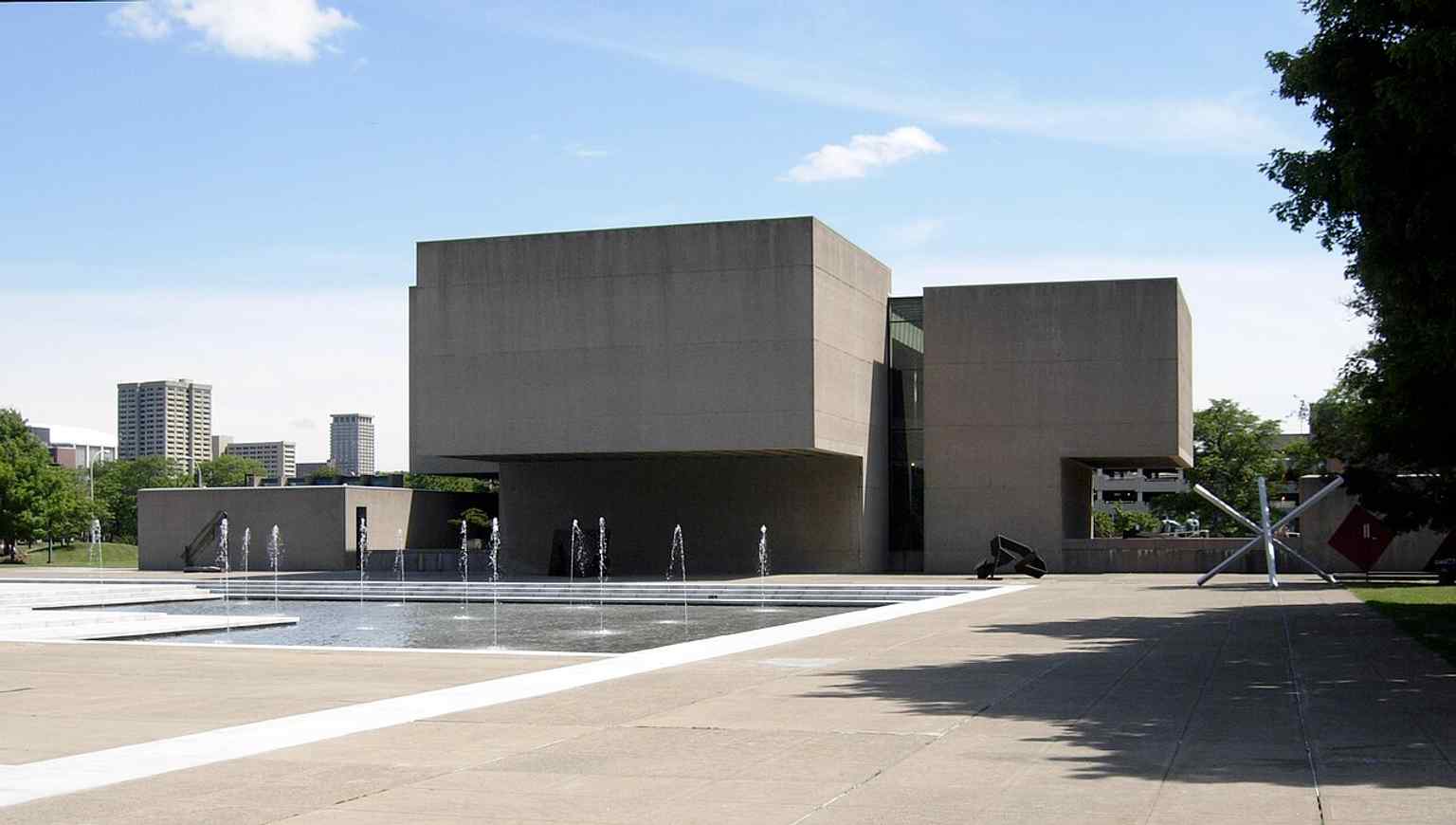
The rear of the Everson Museum shows I. M. Pei’s sculptural modernist form, built as a landmark-worthy work of art in itself.Photo: Crazyale, Wikimedia Commons, Public domain. Cropped & resized. There is a harder truth in the ground beneath it. The Everson stands on land reshaped by the displacement of many Black residents from Syracuse’s Fifteenth Ward during urban renewal in the nineteen sixties. So this place keeps memory in a complicated way: through paintings, ceramics, video, and also through the city’s choices about what to preserve, what to celebrate, and what it once erased.
That may be the most lasting thing here. Syracuse gave art a permanent civic address, and then kept widening the definition of what belonged inside it. The facade itself still becomes a screen through public art collaborations, which makes our final stop feel like a natural next step. Light Work is about an eleven-minute walk from here. If you want to come back inside later, the museum is closed Monday and Tuesday, then open Wednesday through Sunday, with later hours on Thursday.
On your left, look for a broad modern building of pale concrete and glass, laid out in long horizontal bands, with the Robert B. Menschel Media Center marking the entrance. Light…Read moreShow less
Open dedicated page →
Light WorkPhoto: Light Work, Wikimedia Commons, Public domain. Cropped & resized. On your left, look for a broad modern building of pale concrete and glass, laid out in long horizontal bands, with the Robert B. Menschel Media Center marking the entrance.
Light Work lives inside this Syracuse University building, and that matters, because this place is not just about hanging finished pictures on a wall. It is art as living civic infrastructure: a working support system for artists, neighbors, students, and anyone trying to make an image mean something.
Its beginning was beautifully practical. In nineteen seventy-three, Phil Block and Tom Bryan were still running Community Darkrooms when they incorporated Light Work. There was no grand ceremonial launch. They carved the first gallery right out of the corridor outside the darkrooms, held a Les Krims workshop that April, and by October they had won a five thousand dollar grant from the New York State Council on the Arts, roughly thirty-five thousand dollars in today’s money. You can feel the spirit of that start even now... less ribbon-cutting, more sleeves rolled up.
If you glance at the image in the app, you can see the larger home that now shelters those ambitions: labs, galleries, and archives gathered under one roof.
Inside, the work continues in very tangible ways. There are black-and-white darkrooms, digital printing and scanning stations, private studios, a lighting studio, a library, and workshops that teach everything from the foundations of photography to the professional nuts and bolts of surviving as an artist. That is why Light Work matters so much. It does not only preserve culture. It produces it.
The residency program, which began in nineteen seventy-six, brings a dozen or more artists here each year with a stipend, a furnished apartment, staff support, and time to make new work. More than five hundred artists from sixteen countries have come through, among them Cindy Sherman, Nancy Floyd, and Pao Houa Her. In two thousand eighteen, the acceptance rate was just one point three percent. That tells you how coveted this small Syracuse institution has become.
One artist carried its impact into the world in a deeply personal way. Carrie Mae Weems first wrote to Jeffrey Hoone in nineteen eighty-six, introducing herself and offering a lecture. Two years later she arrived as an artist in residence. She later said Contact Sheet, Light Work’s advertisement-free photography publication, sent her work to hundreds of photographers, collectors, and institutions, opening doors to lectures, exhibitions, and books. And Light Work changed her life in another way too: she met Hoone here, and later married him. A career and a marriage, both shaped inside a place devoted to helping images travel.
Hoone himself joined in nineteen eighty, led Light Work from nineteen eighty-two, and after his retirement in two thousand twenty-one, Syracuse University honored him with the Jeffrey J. Hoone Gallery and an endowment in two thousand twenty-three. Leadership passed on, but the current stays alive.
Light Work also reaches beyond its walls. It collaborates with the Everson Museum, the Community Folk Art Center, En Foco, Autograph A-B-P, and the Urban Video Project, or U-V-P, whose giant projections turn public space into a shared screen. Here, memory is not only archived after the fact; it is made in real time.
And that feels like the right final image for Syracuse. A city can save its landmarks, yes... but its deepest renewal happens when it also sustains the people still making new meaning. Downtown Syracuse is still making the stories future visitors will inherit.
If you want to return, Light Work is generally open Monday through Friday from ten to five, and closed on Saturday and Sunday.


Frequently asked questions
How do I start the tour?
After purchase, download the AudaTours app and enter your redemption code. The tour will be ready to start immediately - just tap play and follow the GPS-guided route.
Do I need internet during the tour?
No! Download the tour before you start and enjoy it fully offline. Only the chat feature requires internet. We recommend downloading on WiFi to save mobile data.
Is this a guided group tour?
No - this is a self-guided audio tour. You explore independently at your own pace, with audio narration playing through your phone. No tour guide, no group, no schedule.
How long does the tour take?
Most tours take 60–90 minutes to complete, but you control the pace entirely. Pause, skip stops, or take breaks whenever you want.
What if I can't finish the tour today?
No problem! Tours have lifetime access. Pause and resume whenever you like - tomorrow, next week, or next year. Your progress is saved.
What languages are available?
All tours are available in 50+ languages. Select your preferred language when redeeming your code. Note: language cannot be changed after tour generation.
Where do I access the tour after purchase?
Download the free AudaTours app from the App Store or Google Play. Enter your redemption code (sent via email) and the tour will appear in your library, ready to download and start.
If you don't enjoy the tour, we'll refund your purchase. Contact us at [email protected]
Checkout securely with 






%20c.%201926.png)


