
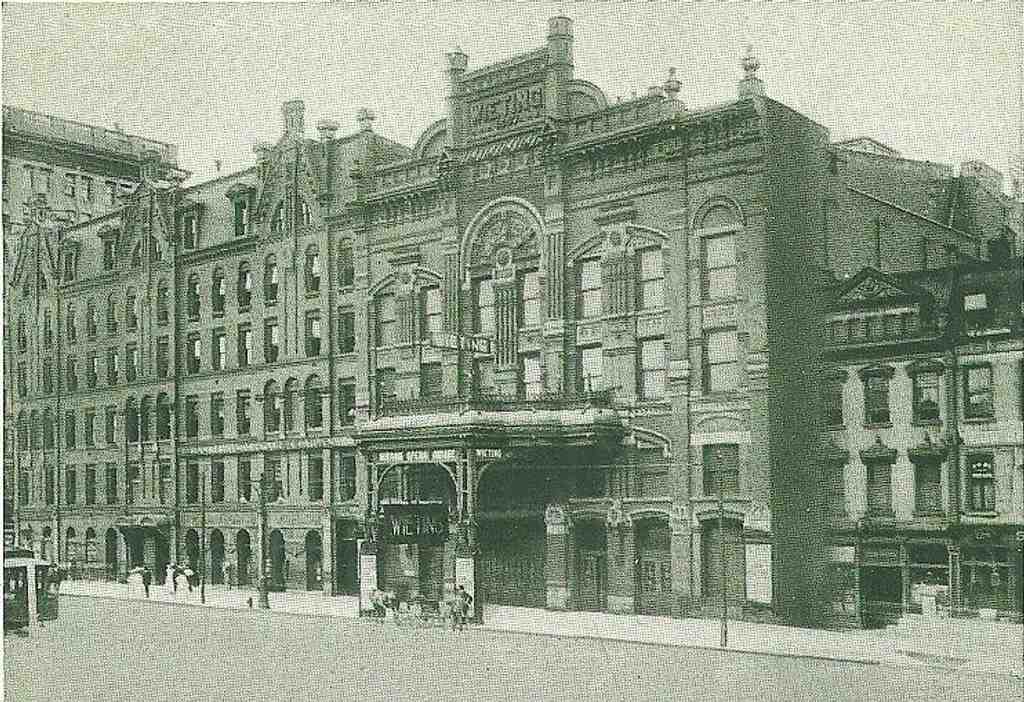
On your right, picture the old Wieting as a broad masonry theater block with a flat roof, tall rows of arched upper windows, and a prominent street-front entrance facing Salina Street.
This address carried a bold idea. John Wieting made money in the lecture business, and instead of keeping that fortune to himself, he turned it into a public hall because he believed Syracuse deserved a room as large as its hopes. He opened Wieting Hall here in eighteen fifty-two. Four years later, fire tore through it so completely that only one wall stayed standing. Firefighters struggled to stop it because their water froze. Most people would have stepped back after that. Wieting answered by rebuilding in about one hundred days.
That speed mattered. It told the city, and everyone beyond it, that Syracuse would not wait quietly for culture to happen somewhere else.
Inside, this hall became a place where Syracuse argued, listened, applauded, and announced itself. Frederick Douglass spoke here in eighteen sixty-one under police and military protection after handbills urged residents to drive him from the city. John Wieting refused to cancel him. Charles Dickens later stood on this stage and read from A Christmas Carol and The Pickwick Papers for about two hours. Susan B. Anthony appeared here. So did Ralph Waldo Emerson, Henry Ward Beecher, and famous actors who drew packed houses. The auditorium officially seated one thousand and seventeen people, but managers sometimes squeezed in nearly two thousand with extra stools. You can almost feel the rustle of coats and the impatient shifting before the curtain rose.
In eighteen seventy, Wieting renovated the hall and gave it a grander name: the Wieting Opera House. The first night did not even open with grand opera, but with a dance piece called The Lancers. I love that detail. It shows a city reaching upward, trying on the confidence of a major cultural capital before anyone could say it fully belonged there.
And then, slowly, it did. By the late nineteenth century, the Wieting ranked among the premiere theaters in the East. Downtown became a stage for spectacle and prestige, a place where touring companies tested productions before Broadway. The Wieting belonged to the Theatrical Syndicate, a network that controlled many touring shows, which gave it first claim on many major productions in the region. In nineteen ten, Naughty Marietta tried itself out here before heading to New York. Syracuse was not only receiving the performance world... it was helping shape what the larger world would soon see.
If you glance at the ruins image in the app, the wreckage after the eighteen eighty-one fire feels almost impossible to imagine. Yet Syracuse answered again. The rebuilt theater reopened with incandescent lighting, the first in the city. After another fire in eighteen ninety-six, Mary Elizabeth Wieting, John’s widow, personally pushed for a new design that would be as fireproof as possible. The new interior glowed in gold and rose, with Italian mosaic floors, silk and velvet drapes, and bronze doors. You can catch a hint of that richness in the interior view on your screen.
By nineteen thirty, the opera house closed, and a parking garage replaced it. Still, stand here a moment and imagine the crowd pouring in for Sarah Bernhardt, Lillian Russell, Gilbert and Sullivan, and later even films. Next, we’ll walk about two minutes to the State Tower Building, where downtown’s ambition climbs upward instead of stepping onto a stage. For practical planning, the app lists weekday hours of ten in the morning to four in the afternoon, with weekends closed.




