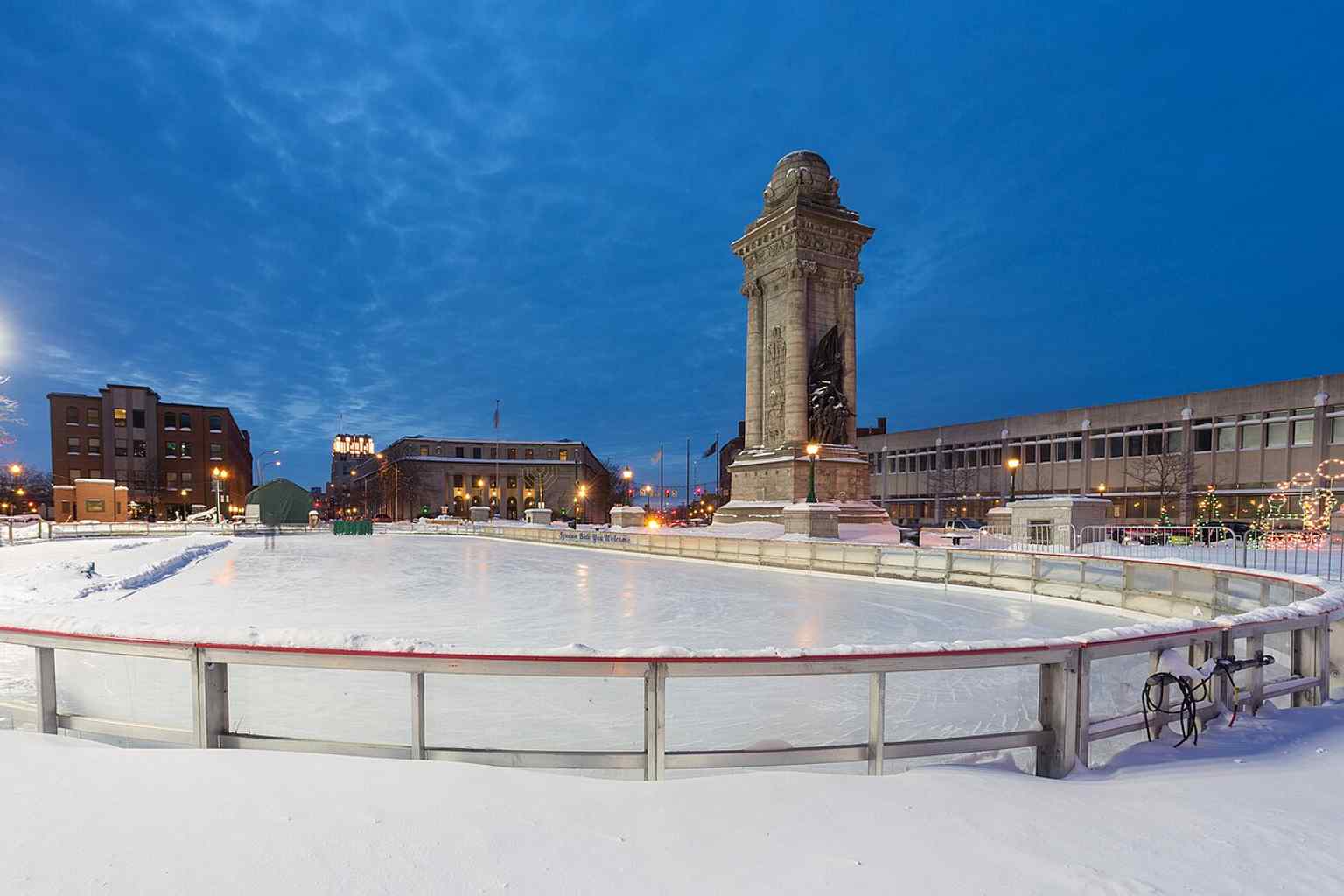
On your right, Clinton Square opens as a broad paved plaza marked by a tall granite monument with corner columns and a globe held by four eagles, beside a wide low fountain.
This is where Syracuse first learned to gather. Long before it looked ceremonial, roads from north and south met here in a rough crossroads, and Henry Bogardus kept an inn on the muddy edge of town. People first called it Bogardus’ Corners, then Cossits’ Corners after Sterling Cossit took over the tavern... and when the Erie Canal opened in eighteen twenty-five, this crossroads became the city’s front door.
The canal changed everything. Boats slid through here, the Oswego Canal joined nearby, and Joshua Forman renamed the square for DeWitt Clinton, the governor who pushed the canal dream forward. By eighteen thirty-seven, this was an official marketplace, the city’s busy center. Farmers sold produce here, Lafayette was welcomed here, and brewer John Greenway once laid out a New Year’s feast for around twenty thousand people, with three oxen, thousands of loaves, and plum pudding stretched along a hundred-foot table.
But this center kept getting rewritten. Fire struck the surrounding blocks again and again - in eighteen thirty-four, eighteen fifty-six, eighteen eighty-one, eighteen ninety-six, and nineteen forty-three. Hotels, business blocks, and landmarks vanished, and each time downtown stitched itself back together with new facades and new ambitions.
Take a slow look around for a moment... the fountain, the monument, the marker to the Jerry Rescue, the old bank buildings. How many different ideas of civic importance can one square carry at once?
Memory stands tall here. The Soldiers and Sailors Monument, dedicated in nineteen eleven, rises about seventy-five feet high: a granite shaft, Roman Ionic columns at the corners, and that remarkable globe lifted by four eagles. It honors Onondaga County’s Civil War dead. Nearby, another monument remembers William “Jerry” Henry, a fugitive slave arrested under the Fugitive Slave Act in eighteen fifty-one. In this square, crowds rallied for his freedom, and men including Jermain Wesley Loguen and Samuel Joseph May helped turn protest into rescue. That is why this place belongs not only to commerce, but to conscience.
What many visitors never realize is that some of this grandeur stands on absence. The Erie Canal once ran right through here; when the city closed and filled it in after nineteen seventeen, the ground beneath downtown memory literally changed. If you glance at the before-and-after image in the app, you can watch the canal disappear and the plaza take over.
And one of the square’s sharpest absences waits just ahead: a theater that once stood here before fire took it in eighteen eighty-one. We’re heading there next, because in this city, gathering was never only about buying and selling... it always wanted a stage.
Like any true civic heart, Clinton Square stays open all day, every day.