
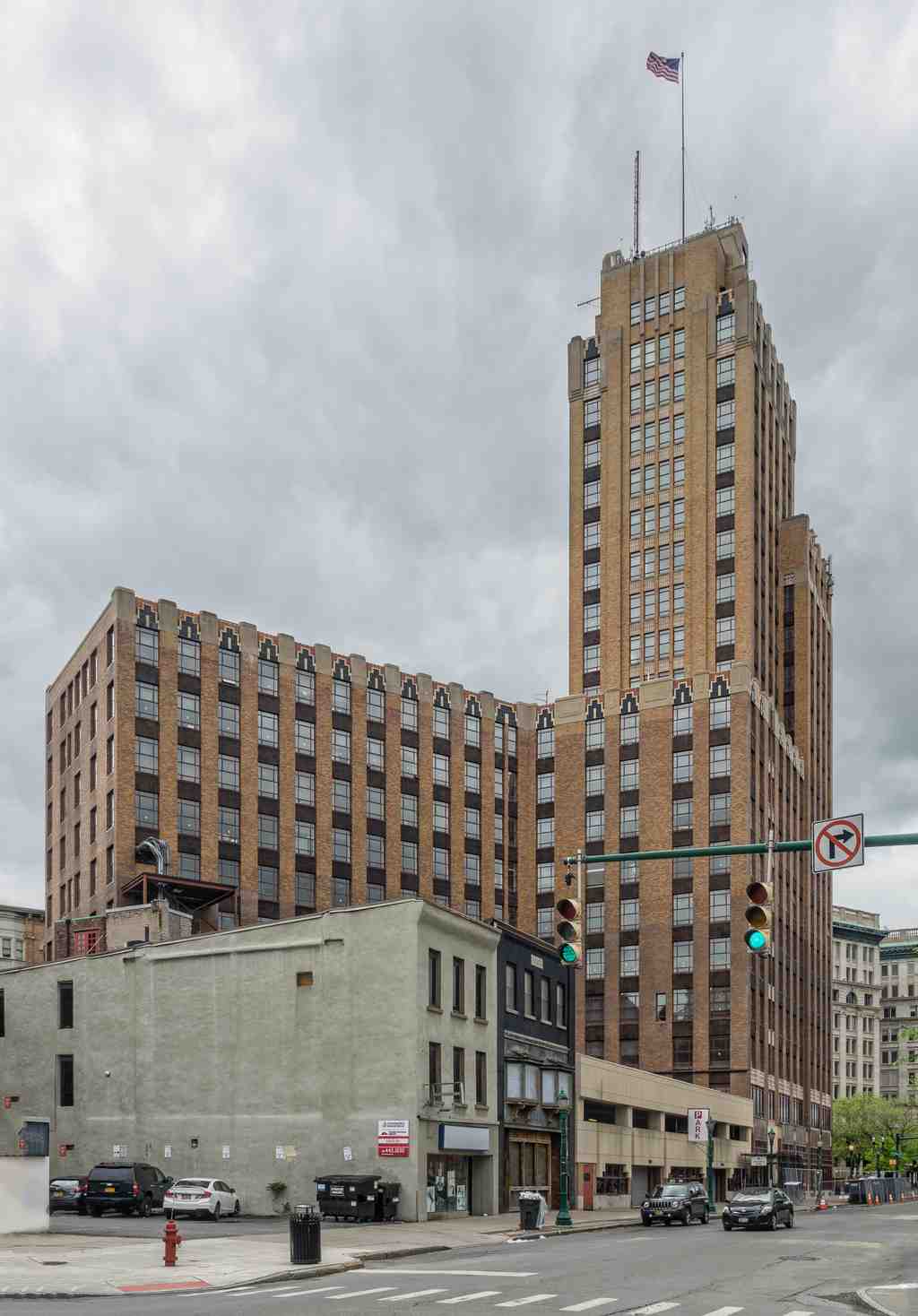
On your left, look for a tall Art Deco tower of limestone, terra-cotta, and brick, rising in wedding-cake setbacks with a narrow upper shaft that makes it easy to spot against the Syracuse skyline.
This is the State Tower Building... the moment Syracuse decided that modern ambition could be measured in height. When it opened in nineteen twenty-eight, people called it the city’s first skyscraper, and nearly a century later it still holds the crown as Syracuse’s tallest landmark, climbing about three hundred twelve feet over downtown.
That feels dramatic now, but the surprise is what stood here before. This ground once belonged to the Bastable block and then the Bastable Theatre, a place of spectacle, comedy, and crowded evenings. Frederick Bastable rebuilt there after an earlier fire, and by eighteen ninety-seven Sam S. Shubert was running the theater profitably, filling it with popular shows. Then, in nineteen twenty-three, fire tore through again and destroyed the theater completely.
And here is the quiet little twist locals love to remember: after all that applause, this site was seriously considered for another theater. Stephen Bastable even had to make a public break with that dream. In July of nineteen twenty-three, he committed the land to a modern office building instead. Syracuse chose desks over footlights... contracts over curtain calls... and turned public excitement into a skyline statement.
If you glance at the image on your screen, you can see how proudly the tower presents that choice. Thompson and Churchill, the architects, gave it that stepped profile, where the upper floors pull back in layers. Those setbacks were practical, but they also made the building feel taller, almost as if it were stretching itself upward. And there’s a detail many people miss from the sidewalk: the brick color grows lighter as it rises. That gradient coaxes your eye upward and makes the whole tower seem even more vertical.
The engineering was a story of grit all by itself. Crews started in nineteen twenty-seven and dug what newspapers called one of the deepest foundations in downtown Syracuse. Pumps ran constantly to fight seepage. Three hundred workers took turns in two shifts just to keep the excavation dry enough to build. Before the tower even opened, about eighty percent of it had already been leased. The city wasn’t just dreaming big... it had tenants waiting.
A vintage image in the app shows how proudly Syracuse advertised this new identity. For years, the exterior glowed at night, turning the tower into a civic beacon. Later, it survived a gas explosion in nineteen sixty-two, weathered years of vacancy, and then changed again in the twenty-tens, when developers kept the lower floors for offices and turned the upper stories into apartments. So even now, this building keeps revising what downtown can be.
Architectural historian Evamaria Hardin called it Syracuse’s counterpart to the Empire State Building. That sounds grand, but standing here, I think what matters most is simpler: this tower made loss visible as renewal. A burned theater left a gap, and the city answered with height.
From here, our story narrows from the skyline to a single home. In about nine minutes, we’ll reach the Hamilton White House, where older Syracuse still waits at a much more human scale.




