

Kalispell Audio Tour: Echoes of Elegance and Main Street Memories
Beneath the rugged peaks of Kalispell, stories of ambition, scandal, and mystery pulse just beyond the picturesque storefronts. This self-guided audio tour unlocks the hidden layers of Northwest Montana’s heart, leading you through historic streets where every building has secrets that most visitors never hear. Why did a silent showdown at the Northwest Montana History Museum shake the city’s future? What’s the true story behind the mysterious murals inside the Hockaday Museum? And who vanished after a midnight stop at the Continental Oil Company Filling Station? Move through shaded avenues and vibrant galleries, tracing the drama of political feuds, whispered conspiracies, and forgotten triumphs that shaped Kalispell’s soul. At every step, discover the city in striking detail and feel the weight of history shift beneath your feet. The trails of Kalispell’s untold stories await. Are you ready to dig deeper than the surface?
Tour preview
About this tour
- scheduleDuration 80–100 minsGo at your own pace
- straighten3.2 km walking routeFollow the guided path
- location_onLocationKalispell, United States
- wifi_offWorks offlineDownload once, use anywhere
- all_inclusiveLifetime accessReplay anytime, forever
- location_onStarts at Charles E. Conrad Mansion
Stops on this tour
lock_open 3 free previews · 10 unlock with purchase
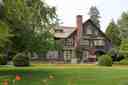
Ahead of you rises a broad, wood-shingled mansion with steep gables, tall chimneys, and a deep porch that makes it feel part farmhouse, part little Norman manor. This is the…Read moreShow less
Open dedicated page →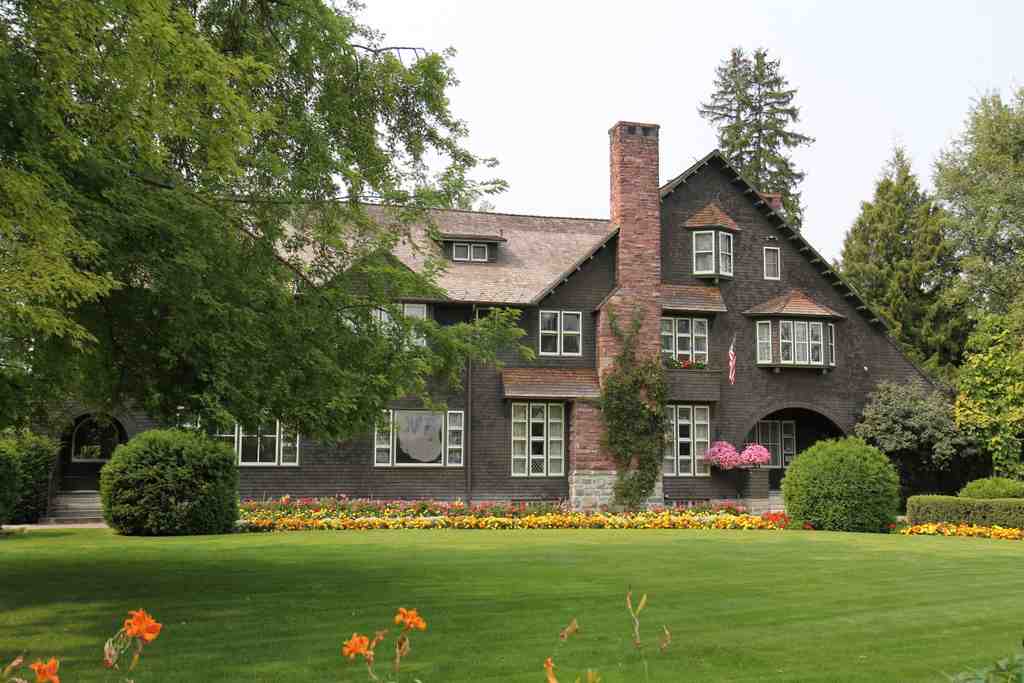
Charles E. Conrad MansionPhoto: Royalbroil, Wikimedia Commons, CC BY-SA 3.0. Cropped & resized. Ahead of you rises a broad, wood-shingled mansion with steep gables, tall chimneys, and a deep porch that makes it feel part farmhouse, part little Norman manor.
This is the Charles E. Conrad Mansion, and it introduces Kalispell with a flourish. Charles E. Conrad, shipping magnate and early town pioneer, chose noted Spokane architect Kirtland Cutter to design it, and work began in eighteen ninety-two before finishing in November of eighteen ninety-five. The style borrows from rural Normandy in France, not a stone castle tradition, but a grand revival of the farmhouse idea, translated into a house meant to impress.
Yet the personality of this place came from two people, not one. Charles brought money and ambition; Lettie Conrad brought education, musical taste, and the steadier art of making a new estate run while raising their three children in a town still finding its shape. This was no sealed-up trophy house. The Conrads loved guests, and the more people they welcomed, the happier they seemed to be, turning private status into a kind of performance of generosity.
Pause a moment and study the layered exterior. Does it strike you as homely, noble, or delightfully uncertain between the two? If you glance at the image on your screen, you can see that same mingling of comfort and grandeur even more clearly.
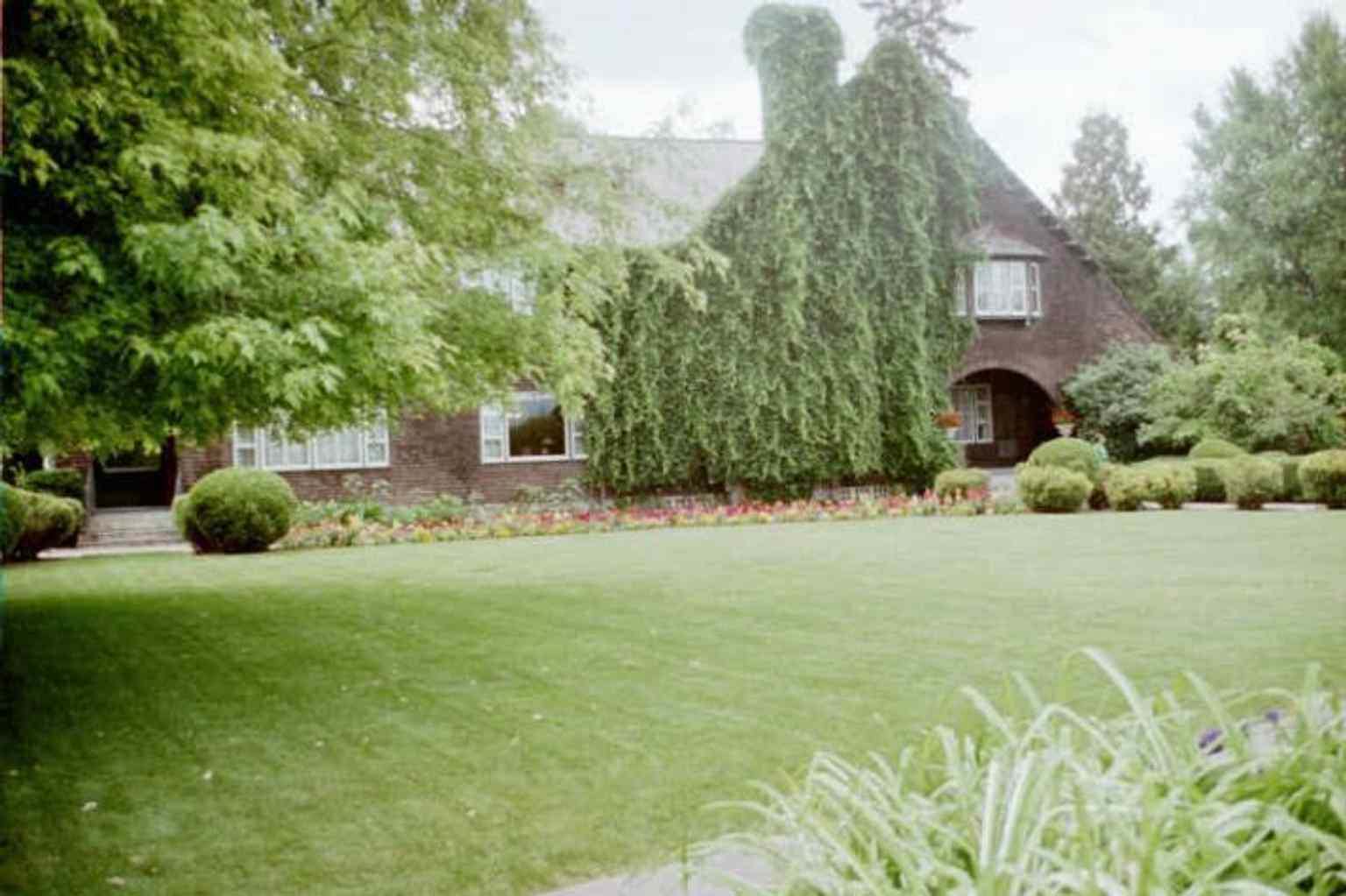
The Conrad Mansion’s shingle-style Victorian exterior, the 1892–1895 home of shipping magnate Charles E. Conrad in Kalispell.Photo: Chris Light (talk), Wikimedia Commons, CC BY-SA 3.0. Cropped & resized. Most visitors admire the splendour and miss the absence. In the late nineteen nineties, a visitor named Ken Miers noticed buffalo-horn rifle hooks still fixed in the Gun Room, but no original firearms hanging from them. That small gap opened a detective story. In twenty fourteen, Ken and Mary Miers traced a Charles Conrad rifle to the Montana Historical Society in Helena; the family guns had left decades earlier through Samuel E. Johns and his son Douglas Johns. In twenty fifteen, the collection returned, and volunteer Dan Conner installed the glass case that finally gave the room its story back.
The mansion survives because Alicia Conrad Campbell donated the house and its contents to the city in nineteen seventy-four, and because volunteers still guide, clean, garden, and mend what prosperity first built. Next, we continue to the Hockaday Museum, about an eight-minute walk away. If you plan to return inside, the museum is open daily from ten in the morning until six in the evening.
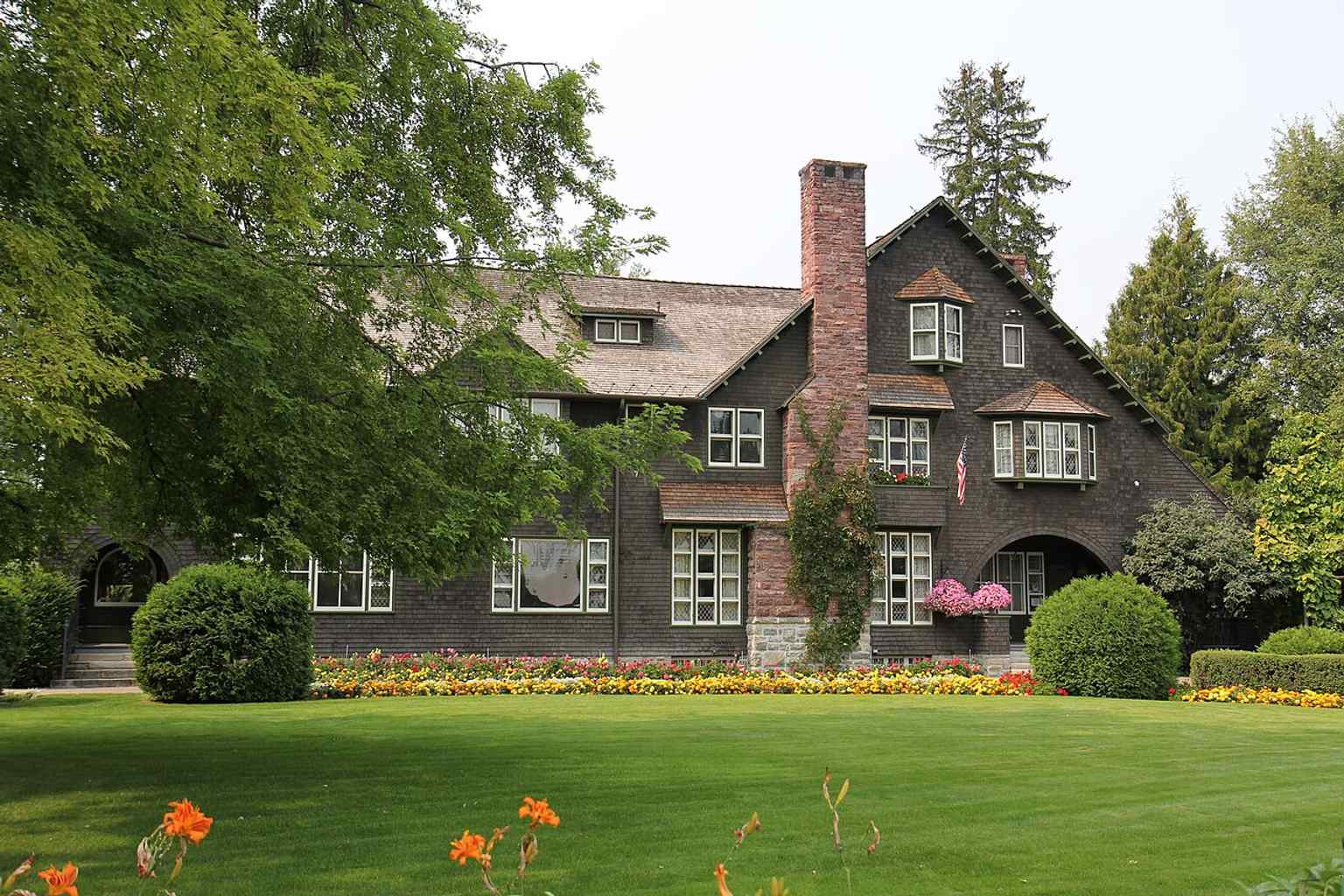
A clear daylight view of the mansion itself, now a museum thanks to Alicia Conrad Campbell’s 1974 donation to the city.Photo: Royalbroil, Wikimedia Commons, CC BY-SA 3.0. Cropped & resized. On your left is a sleek, pale stone storefront with rounded Moderne lines, bands of metal trim, and a distinctive crest crowned by sea horses above the façade. This smart little…Read moreShow less
Open dedicated page →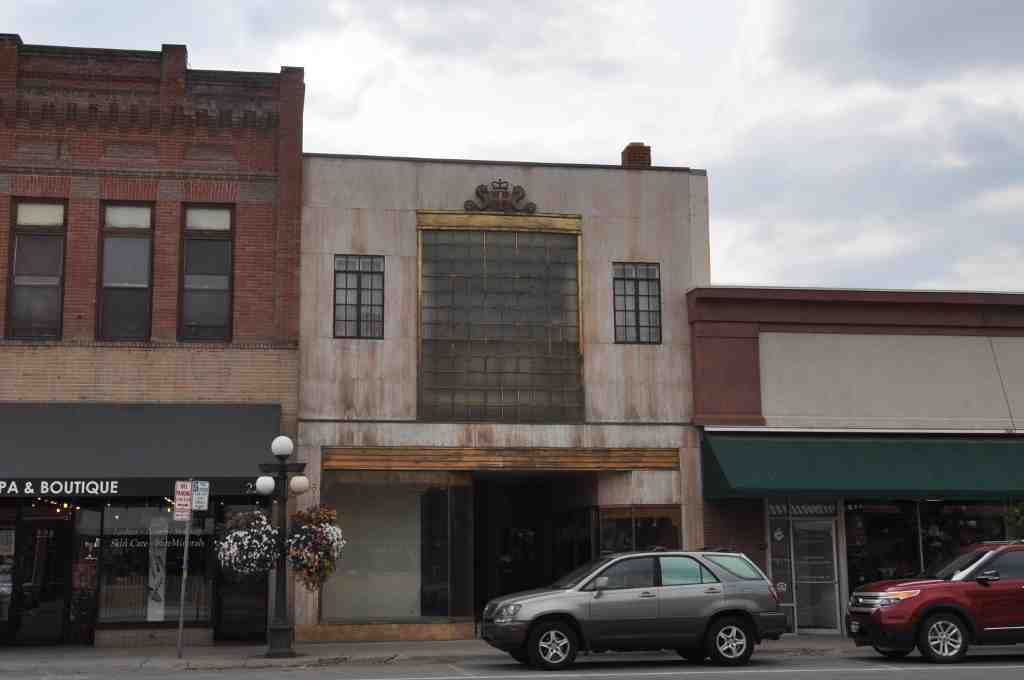
Anderson Style ShopPhoto: Magicpiano, Wikimedia Commons, CC BY-SA 4.0. Cropped & resized. On your left is a sleek, pale stone storefront with rounded Moderne lines, bands of metal trim, and a distinctive crest crowned by sea horses above the façade.
This smart little building carries more motion in its story than its polished front first suggests. Before this version appeared in nineteen forty-one, the lot held an older two-storey building hauled here from Demersville, the town Kalispell outgrew. When the railroad bypassed Demersville in eighteen ninety-one, merchants did not simply surrender; they rolled entire buildings on logs into the new town, dragging trade, hope, and habit with them.
One of those migrants landed here. It served, in turn, as a grocery, the Pacific Union Tea Company, and then a ladies’ furnishings shop before Carl Anderson took it over around nineteen twenty-eight. Carl is the human key to this address. He did not confine himself to frocks and fittings. He and his father, Marius Anderson, a Danish immigrant, also moved through Kalispell’s theatre world, with ties to the Orpheum and Liberty. Carl often hired managers to run the shop while he worked a wider circuit of business and civic life. During the Second World War, he even chaired the county preparedness and advisory commission.
So when Carl tore down the old wood-frame shop and spent seventeen thousand five hundred dollars, roughly three hundred and eighty thousand dollars today, he was making more than a retail upgrade. He asked local architect Fred Brinkman for a Moderne design, a streamlined modern style, with travertine stone, copper-alloy bands, glass block, and that flamboyant heraldic crest. The first floor and basement served the shop; two apartments above turned the property into an income-producing little machine. If you look at the photo in the app, you can see how confidently that new façade announces itself on Main Street. The plaque on your screen marks its National Register listing in nineteen ninety-four, honouring that distinctive commercial front.
This one lot tells you how downtown Kalispell formed: buildings shifted, families improvised, and money chased the railroad’s new map. In about two minutes, we’ll carry that story into the Main Street Historic District. If you plan to return, the building is generally open weekdays from seven in the morning until five in the afternoon.
Show 10 more stopsShow fewer stopsexpand_moreexpand_less
Look for a run of brick commercial fronts with flat parapets, tall rectangular upper windows, and old storefront bays stretching along Main Street in one continuous historic…Read moreShow less
Open dedicated page →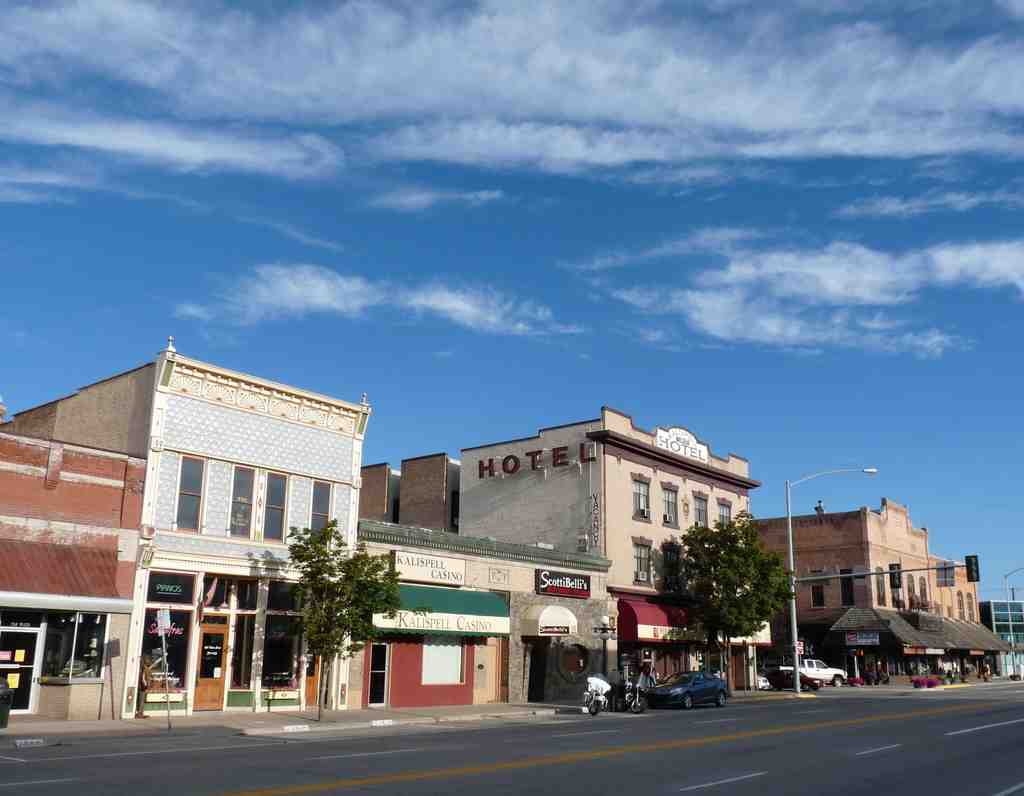
Kalispell Main Street Historic DistrictPhoto: Jeff the quiet, Wikimedia Commons, CC0. Cropped & resized. Look for a run of brick commercial fronts with flat parapets, tall rectangular upper windows, and old storefront bays stretching along Main Street in one continuous historic wall.
This is the heart of Kalispell’s first great wager. In the early eighteen nineties, the Great Northern Railroad chose this place, and in eighteen ninety-three Kalispell became county seat. Those two decisions lit the fuse. Trade, offices, hotels, saloons, and ambition rushed here so quickly that even Demersville, the town Kalispell outgrew, fed the new center with people, energy, and salvaged structures.
One block tells the tale neatly. A stone foundation for the Missoula Mercantile, later the Kalispell Mercantile, already stood in eighteen ninety-two, but the Panic of eighteen ninety-three froze the project. By eighteen ninety-five, county court and offices had moved into the unfinished building’s second floor; then the mercantile took over, and by eighteen ninety-seven it employed twenty men and shipped goods across a three-hundred-mile territory by train.
Pause a moment and let your gaze travel across the facades. Notice how one block can hold boomtown confidence, later alterations, and careful rescue all at once.
August Heller added his own gamble here between eighteen ninety-eight and nineteen oh one, opening yet another saloon in a town that already had plenty. And the Kalispell Hotel sold itself in nineteen twelve as modern luxury: running water, wake-up calls, lockable doors. If you glance at the streetscape image in the app, you can see how the hotel, the Brewery Saloon, and the old McIntosh Opera House once formed a single commercial stage. The opera house survives because it kept changing use rather than being discarded.
That instinct to adapt saved downtown again when shoppers drifted north and toward the mall; in two thousand ten, the district expanded and claimed its history more boldly. Hold on to that thought. In about two minutes, we’ll reach a building that nearly slipped away altogether: the Northwest Montana History Museum.
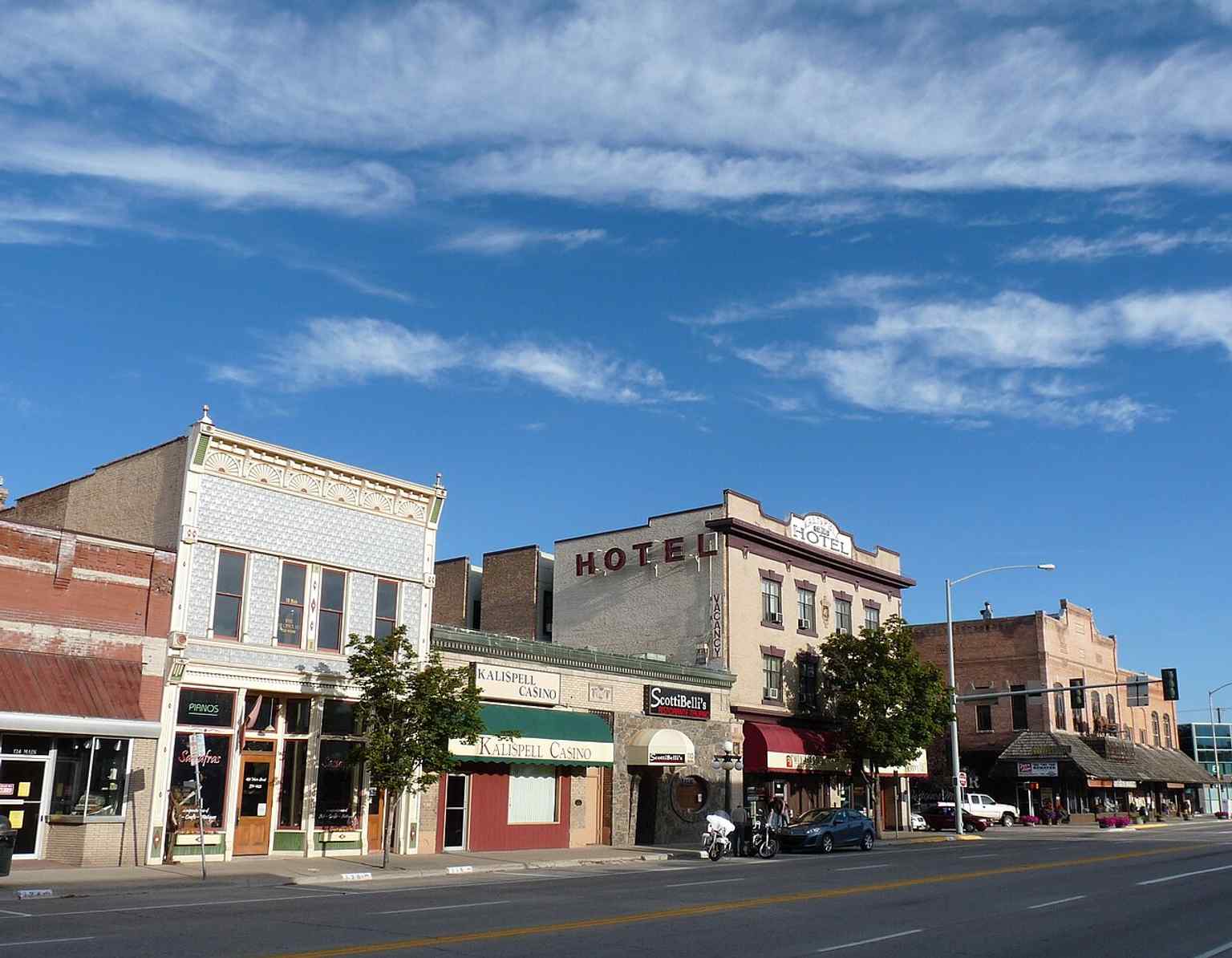
A streetscape of Main Street showing the Brewery Saloon, Kalispell Grand Hotel, and McIntosh Opera House — three buildings that helped define the district’s late-1890s boomtown era.Photo: Jeff the quiet, Wikimedia Commons, CC0. Cropped & resized. 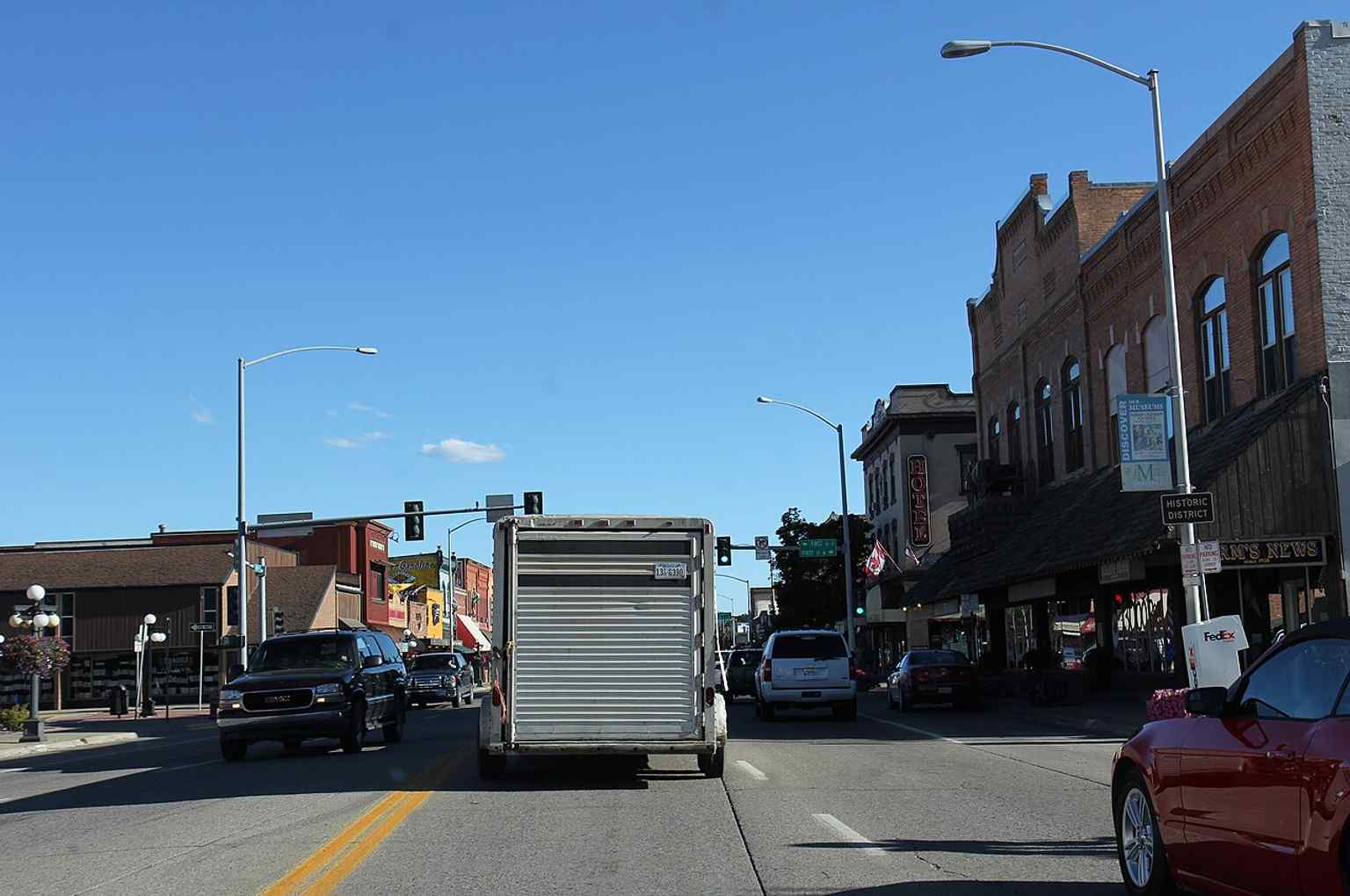
The district sign on Main Street marks the historic core that was expanded and renamed in 2010, reflecting renewed preservation efforts downtown.Photo: Royalbroil, Wikimedia Commons, CC BY-SA 3.0. Cropped & resized. Look for a low rectangular brick building with broad plate-glass storefront windows and a plain parapet, its wide face hinting at a showroom built for weight rather than…Read moreShow less
Open dedicated page →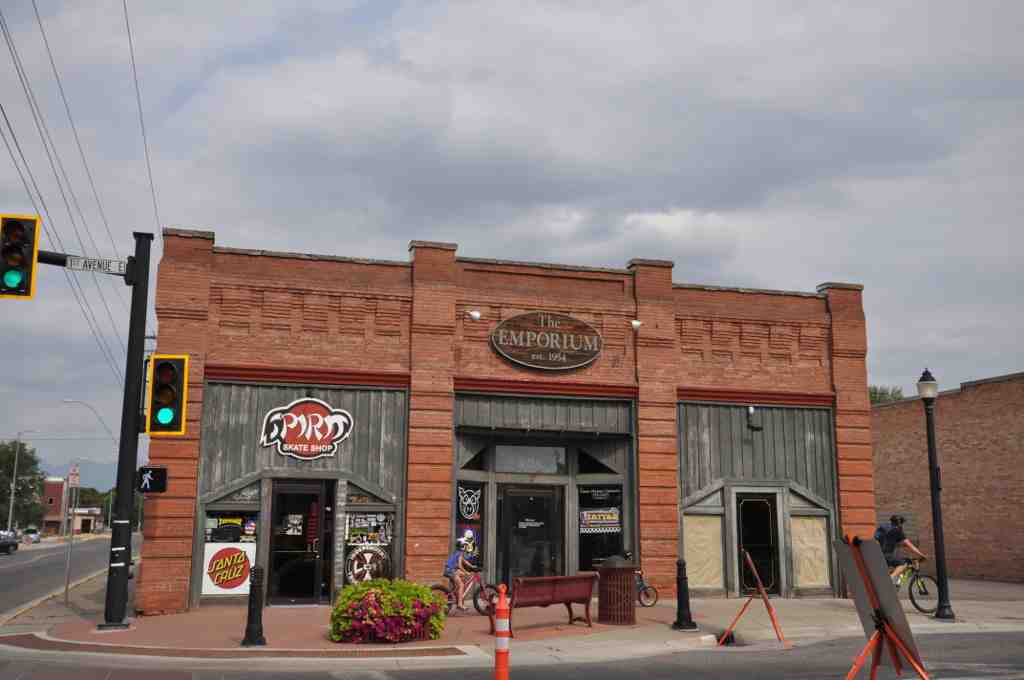
Kalispell Monumental CompanyPhoto: Magicpiano, Wikimedia Commons, CC BY-SA 4.0. Cropped & resized. Look for a low rectangular brick building with broad plate-glass storefront windows and a plain parapet, its wide face hinting at a showroom built for weight rather than display.
This place held a rather unusual trade. In nineteen ten, the Kalispell Monumental Company bought two lots here beside the railroad right-of-way and asked architect Joseph Gibson to draw something more ambitious than a shop. He planned an industrial showroom: proof that Kalispell grew not only through polished Main Street fronts, but through freight, distribution, and careful rail-side planning. Stone is stubborn stuff. Marble and granite do not drift in by wagon with any grace.
The company came from Spokane, as a branch of Sammis Monumental Company, selling tombstones and memorials. That purpose gives the building a quiet gravity. Inside, practical engineering carried a strange poetry: a track ran through the centre for a traveling crane, meaning an overhead machine that could move massive stone blocks from place to place. Plate-glass windows along the front and west side flooded the showroom with light, so customers could study surfaces brought from Barre, Scotland, Sweden, Vermont, Georgia, Italy, Colorado, and beyond.
But even solid businesses begin with delays. The pressed brick for the east and north walls arrived late in late December of nineteen ten, and no local substitute could be found. When the building neared completion, company president Fred H. Sammis came from Spokane to inspect it, and local manager C. M. Secor proudly showed him the steam-heated works. By January of nineteen eleven, six carloads of supplies had arrived. By February, the firm was already furnishing marble bases and trim for the Buffalo Block on Main Street before fully moving in that March. The whole venture cost twelve thousand dollars, roughly four hundred thousand dollars in present terms.
If you glance at the image in the app, you can still read that broad, workmanlike confidence in the facade. Yet the business failed by nineteen fourteen; Kalispell may simply have been too small for a company that billed itself as one of the largest monument firms in the country. The building adapted instead, serving a laundry, then a motor sales showroom, where cars arrived by rail and were driven over from the depot. That shift from rail-served stone to the architecture of motoring leads us neatly to the Continental Oil Company Filling Station, about a minute away. If you want to return later, this site is generally open weekdays from nine to five and closed on weekends.
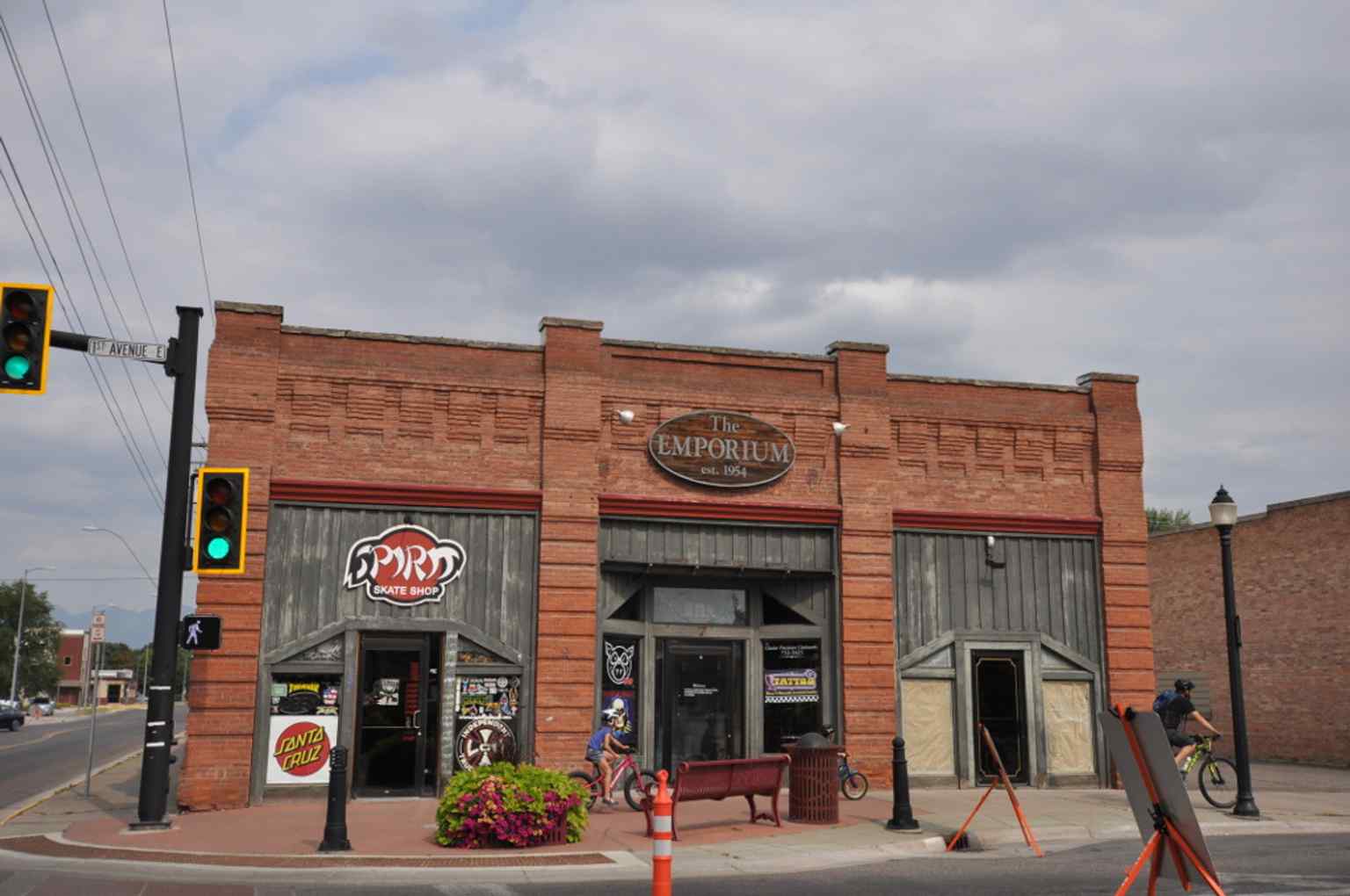
The former Kalispell Monumental Company storefront still stands on First Avenue East, where rail access helped the monument business handle heavy stone shipments.Photo: Magicpiano, Wikimedia Commons, CC BY-SA 4.0. Cropped & resized. On your left stands a weathered wooden shop with a tall flat false front, a low roof tucked behind it, and faint painted ghost signs still clinging to the facade. Boyd’s Shop…Read moreShow less
Open dedicated page →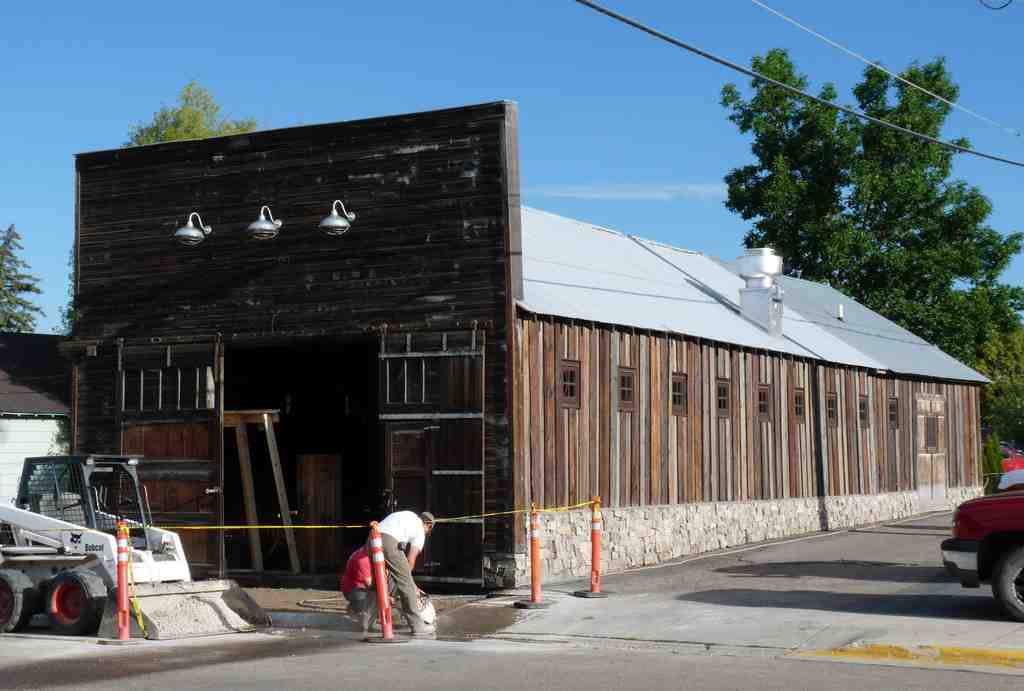
Boyd's ShopPhoto: Jeff the quiet, Wikimedia Commons, CC0. Cropped & resized. On your left stands a weathered wooden shop with a tall flat false front, a low roof tucked behind it, and faint painted ghost signs still clinging to the facade.
Boyd’s Shop took shape between nineteen ten and nineteen fifteen, just as Kalispell was changing its habits. That false front - the tall, flat street face meant to make a small one-story shop look bigger and prouder - belonged to the old commercial West. Inside, the work began with blacksmithing and later shifted to welding. In nineteen oh nine, Kalispell had seven blacksmiths and only two automobile repair businesses; by nineteen fifteen, the balance had nearly flipped. The ghost signs tell that story beautifully: horseshoeing on one hand, welding and repair on the other. If you glance at the image in the app, you can see how stubbornly this little building still holds its ground. The people here were ordinary, which is precisely why they matter. Mort Fuller and Harry Jones worked here by nineteen fifteen. Fuller died the following year at just thirty-three. Jones died in Billings in nineteen thirty-four, another reminder of how precarious life could be. Later Paris Logan Boyd, who had carried family burdens since boyhood, kept the shop alive, and his son Glen carried it on.
And here is the part most visitors miss: this stood on part of Kalispell’s forgotten Chinatown. In the eighteen nineties, this lot held a steam laundry, a Chinese laundry, and dwellings. Fire, demolition, and time erased that layer before this shop appeared. Even the nineteen ninety-four historic plaque honours what survived more than what vanished. As you continue to Fisher House, about a four-minute walk away, remember that sometimes the most important thing a building tells us is what stood here before it. If it is open, the shop usually keeps late-morning to early-evening hours and closes on Sundays.
On your left, look for a wooden house with a steep gable, crisp vertical siding, and delicate decorative trim tucked under the roofline. This is the Fisher House, and its quiet…Read moreShow less
Open dedicated page →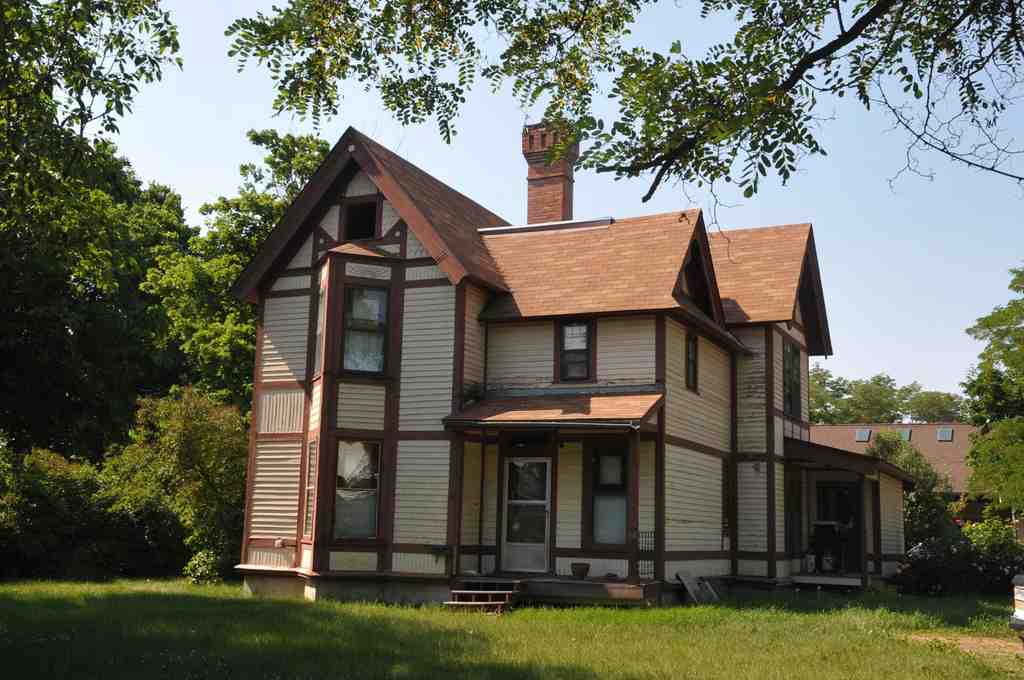
Fisher HousePhoto: JERRYE AND ROY KLOTZ MD, Wikimedia Commons, CC BY-SA 3.0. Cropped & resized. On your left, look for a wooden house with a steep gable, crisp vertical siding, and delicate decorative trim tucked under the roofline.
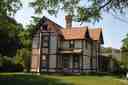
This is the Fisher House, and its quiet surprise is this: a private family home helped shape both the soul of Kalispell and the ground it stood on. Reverend George McVey Fisher did not arrive as a grand town founder. He came as a Presbyterian minister and missionary. By eighteen eighty-six, he was the only Presbyterian minister in northwestern Montana, and he preached the first sermon in what became Flathead County in the Ashley schoolhouse. A year later, he, Mary Swaney Fisher, and their children moved into a log cabin near Ashley and served roughly seven hundred to eight hundred settlers who had never had regular religious services.
Then necessity altered the story. Church authorities objected to ministers farming and withheld aid, so Fisher leaned on the family homestead. In eighteen ninety-one, he proved up on the land and sold much of it to the Kalispell Townsite Company. In other words, the minister did not simply bless the town’s beginnings; he helped finance and physically enable them. This house rose in the summer of eighteen ninety-two, just as that new town was taking shape.
If you glance at the image in the app, you can see the Stick and Eastlake style here, a Victorian look that celebrates wood trim and visible ornament rather than hiding it. Mary Swaney Fisher deserves her own spotlight. Born in Pennsylvania and trained in piano and voice in Pittsburgh, she carried music into frontier worship, playing a portable organ in scattered churches and bringing an early piano into the Flathead Valley, a square Chickering that remained here into the nineteen eighties. The house filled with six children, wedding guests, synod visitors, and even west-side neighbours arriving for Fourth of July fireworks. Later, Mary Heller and James Heller kept it in the family, and a city rehabilitation project in nineteen seventy-nine repaired windows, reinforced walls, and quietly saved the place again.
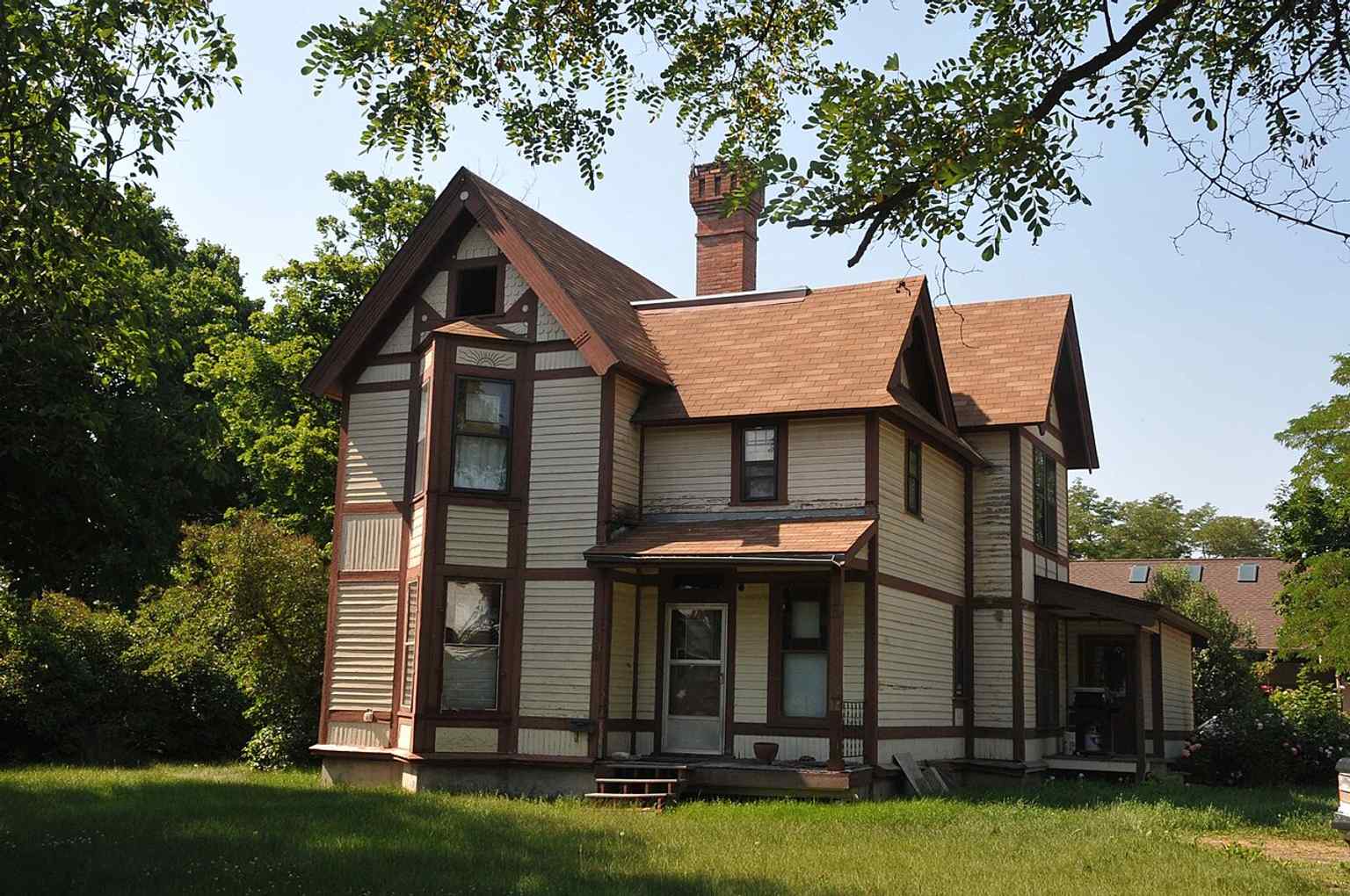
The Fisher House in Kalispell, built in 1892 for Presbyterian minister George McVey Fisher, shows the Stick/Eastlake home that became the family center of the Flathead Valley.Photo: JERRYE AND ROY KLOTZ MD, Wikimedia Commons, CC BY-SA 3.0. Cropped & resized. Next, we move toward the Scandinavian Methodist Church, where faith leaves the parlour and takes architectural form in a congregation’s own sacred space. If you hope to return, the house generally opens from nine to five most days and closes on Sunday.
On your left is a simple one-story clapboard church, marked by pointed Gothic window heads and patterned diamond-and-fishscale shingles tucked into the gable ends. This modest…Read moreShow less
Open dedicated page →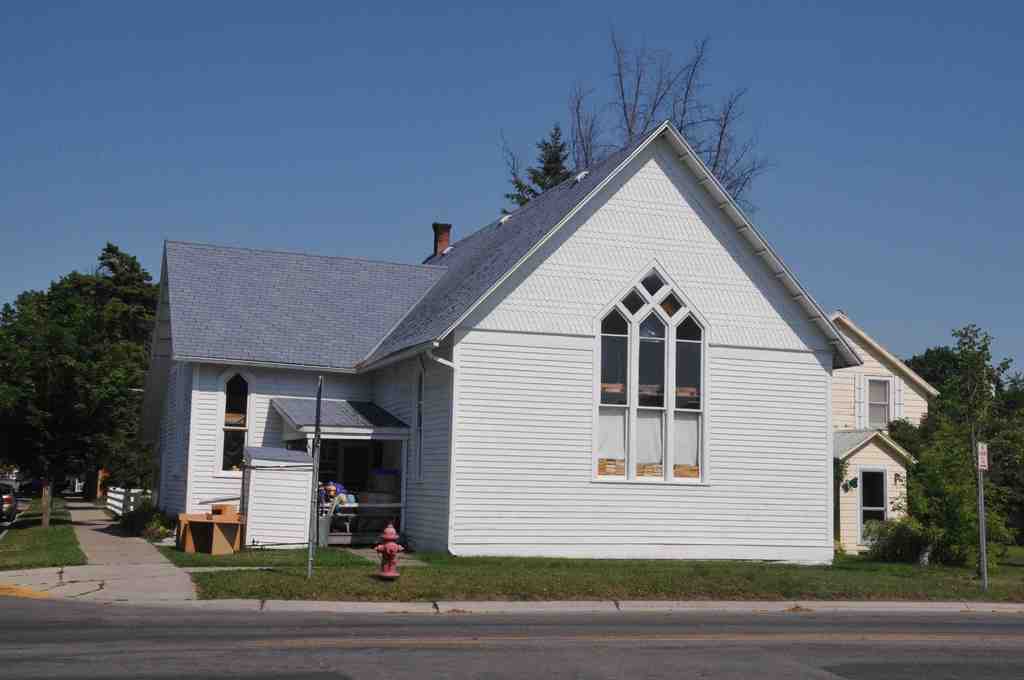
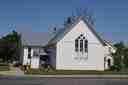
Scandinavian Methodist ChurchPhoto: JERRYE AND ROY KLOTZ MD, Wikimedia Commons, CC BY-SA 3.0. Cropped & resized. On your left is a simple one-story clapboard church, marked by pointed Gothic window heads and patterned diamond-and-fishscale shingles tucked into the gable ends.
This modest building carries one of Kalispell’s most intimate truths: people here often began before conditions were perfect. In the spring of eighteen ninety-five, Norwegian-Danish Methodists formed the town’s second Methodist congregation. The Kalispell Townsite Company gave them the lot, but the first building fund held only three hundred and fifty dollars, roughly thirteen thousand today. So the Scandinavian Methodist congregation-builders did not wait for wealth. They worshipped, planned, and built at once.
Robert Nordtome, a farmer and skilled carpenter, became the lead builder and informal architect. Lars Johnson, who had recently contracted Central School, also lent his hands. Much of the labour happened in spare hours, after ordinary work was done. More touching still, the congregation held regular services and Sunday school here before construction had even finished. Faith came first; completion followed later.
Let your eyes rest on those upward-pointing details, the Late Gothic Revival shapes borrowed from older European churches, and imagine members stepping inside while sawdust still lingered and walls were still being finished.
If Reverend George McVey Fisher helped spread Kalispell’s earliest religious network, this church gave that network a distinctly Scandinavian voice. It was one of only four churches in Montana built by the Norwegian-Danish Conference, and it kept worship services in the congregation’s original Scandinavian languages longer than the others, until nineteen thirty-nine. When the conference merged that year, the congregation became Westside Methodist Church and shifted to English, neatly tracing the town’s passage from immigrant enclave to settled community.
This building even served as temporary classrooms while West Side School rose nearby. Later, after the Methodists left in nineteen fifty-seven, the Salvation Army turned it into a thrift shop. Since nineteen eighty-nine, it has continued in that practical, generous afterlife. If you peek at the image in the app, you can see that plain endurance for yourself. When you’re ready, we’ll continue to the Bader-Jaquette and Westwang Houses and Rental Property, about two minutes away, where work, home, and ambition meet under one roof.
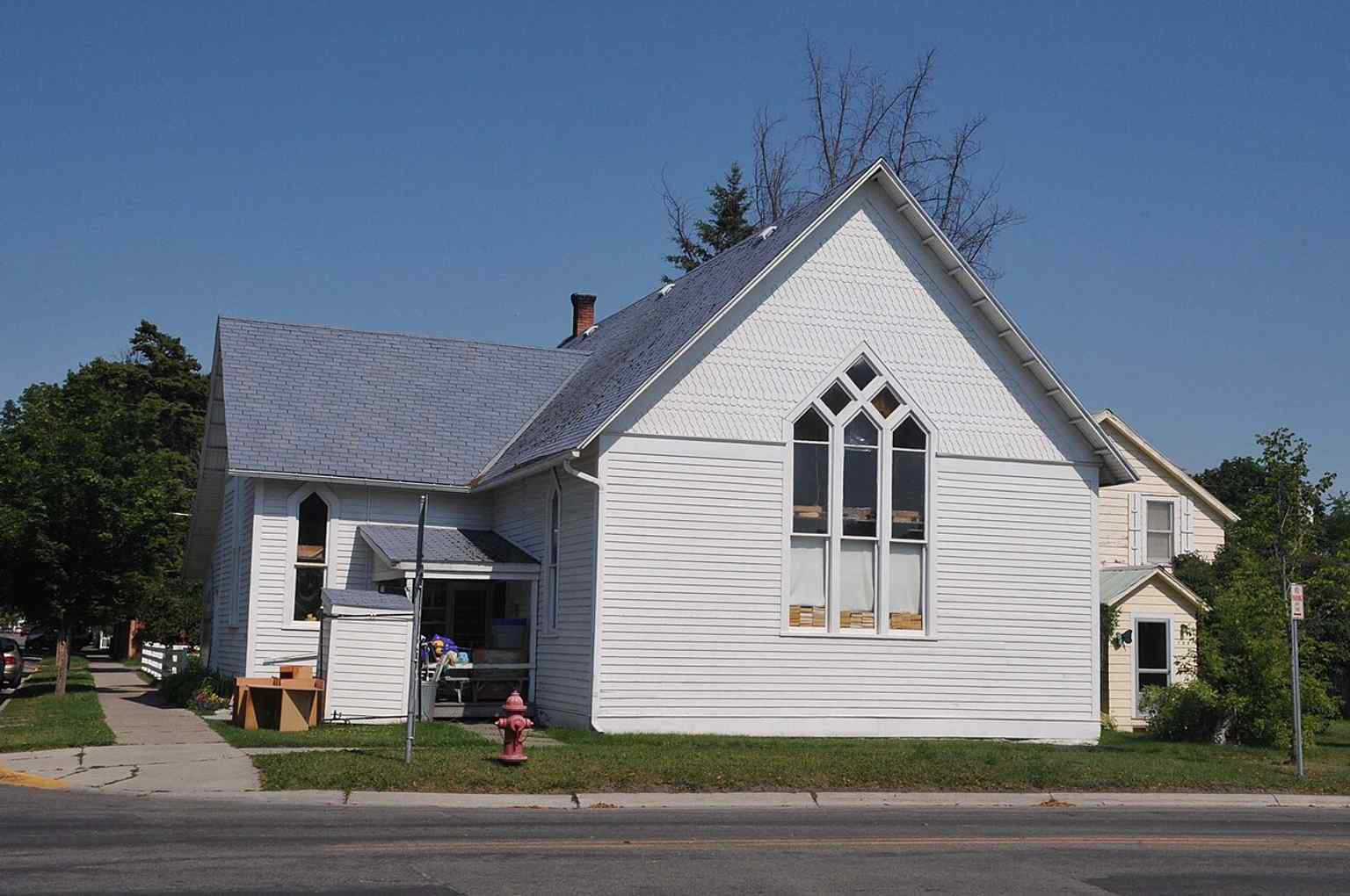
The former Scandinavian Methodist Church in Kalispell, later reused as a thrift store, showing the simple wood-frame building that began life serving the Scandinavian congregation in 1895.Photo: JERRYE AND ROY KLOTZ MD, Wikimedia Commons, CC BY-SA 3.0. Cropped & resized. On your left, look for the wood-clad, two-story house with a hipped roof, projecting bay windows, and a recessed upper porch tucked beneath the front gable. This little cluster…Read moreShow less
Open dedicated page →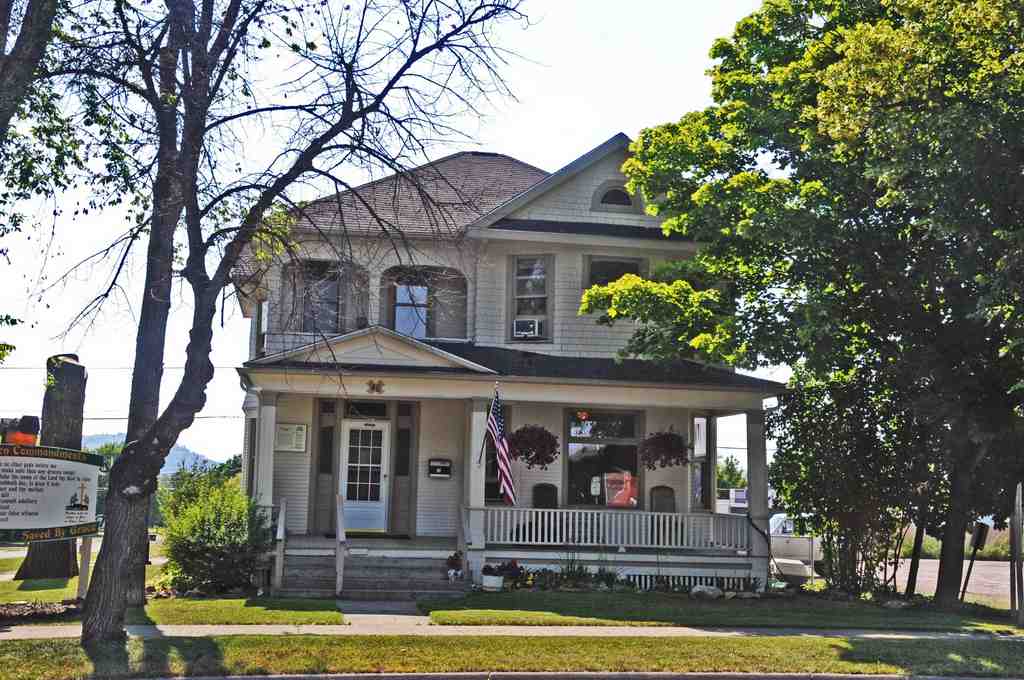
Bader-Jaquette and Westwang Houses and Rental PropertyPhoto: JERRYE AND ROY KLOTZ MD, Wikimedia Commons, CC BY-SA 3.0. Cropped & resized. On your left, look for the wood-clad, two-story house with a hipped roof, projecting bay windows, and a recessed upper porch tucked beneath the front gable.
This little cluster tells a very Kalispell story: a home, a rental business, and a commercial foothold, all turning on one corner. Elmer Bader, builder-investor, arrived from Wisconsin in eighteen ninety-one and quickly understood that in a young town, you could live in your enterprise and let your enterprise shape where you lived. In eighteen ninety-five he bought these corner lots for one thousand dollars, roughly thirty-seven thousand dollars today, and first raised two modest houses here.
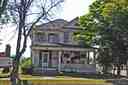
Then he enlarged the ambition. In eighteen ninety-nine Bader opened his own lumberyard on the northeast corner, selling windows, doors, mouldings, lath, shingles, and building paper. By nineteen oh-three, he used the trade to create the larger house before you: Queen Anne in style, meaning a late-Victorian taste for lively shapes and variety. Notice the full porch, the cutaway bays, the mixed siding, and the stained and leaded glass that gave ordinary daylight a little ceremony. If you glance at the image on your screen, you can see that confident silhouette clearly. After Bader moved to Eureka in nineteen oh-five, Walter Jaquette bought both this house and its companion property. Jaquette farmed about two hundred and forty acres near Spring Creek, invested in real estate, and married Luella Belle Patton after a Kalispell family arranged the match; she came west to marry a man she had never even known. He rented these houses out for decades and only moved into this one after retiring in nineteen thirty-four.
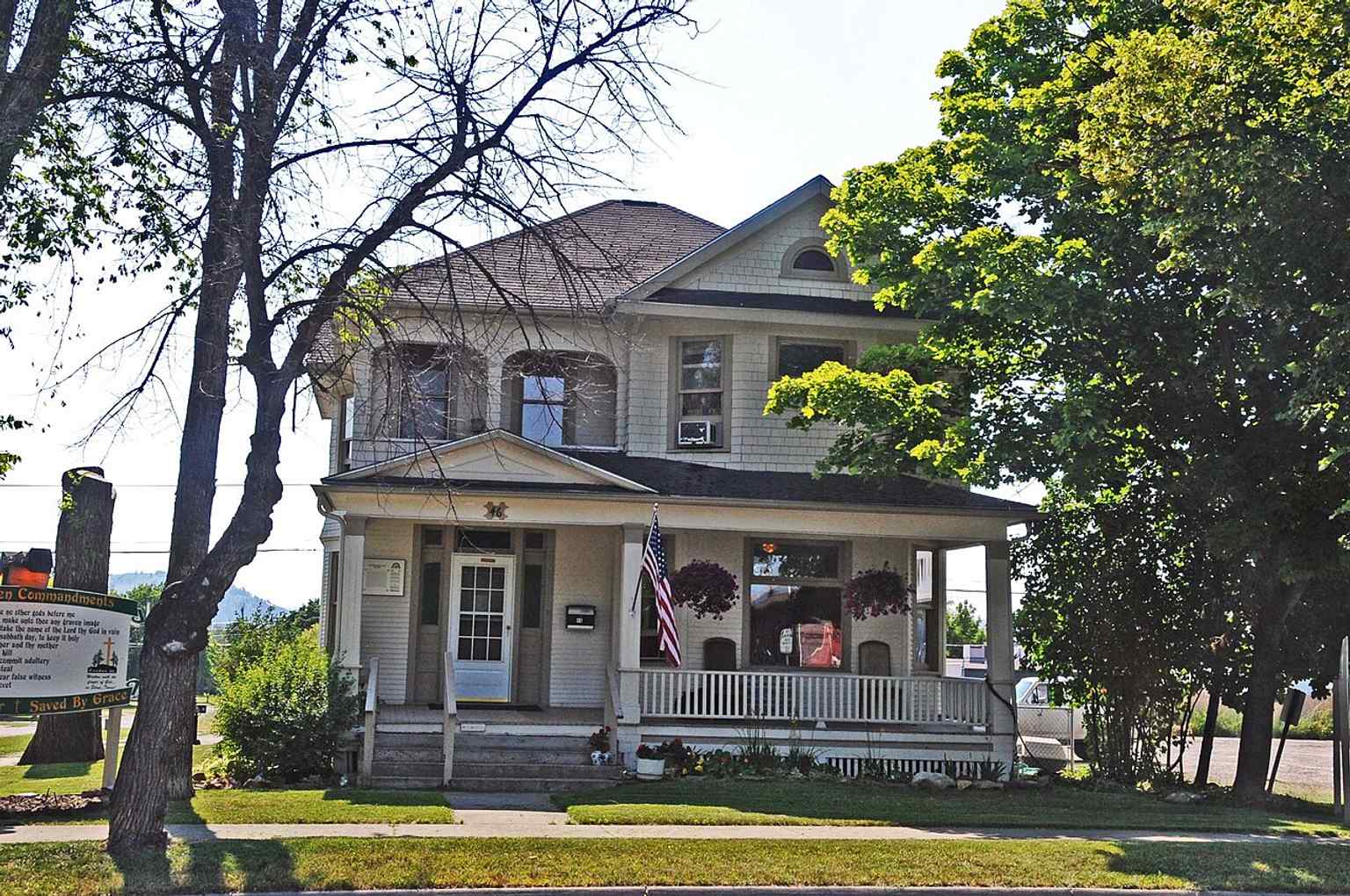
The main Queen Anne house on 5th Avenue West, built by carpenter Elmer Bader in 1903 as part of his home-building and rental business.Photo: JERRYE AND ROY KLOTZ MD, Wikimedia Commons, CC BY-SA 3.0. Cropped & resized. That, really, is the point of this address. Even its later compromises matter: a nineteen ninety-two remodel insulated beveled-glass windows and changed some original fabric, but it also kept the place in use. The plaque shown in the app marks its nineteen ninety-four recognition as a three-building ensemble, bound together by ownership, tenants, and adaptation. Kalispell’s neighbourhoods were shaped by investors who were also neighbours. Cross on to the Alexander and Busey Houses, about a two-minute walk, and you’ll see Bader’s world extending again. For practical purposes, the listed visiting hours are weekdays from nine in the morning to five in the afternoon, with weekends closed.
Look to your right for a modest wood-frame house with a steep front-facing gable, a small porch, and a National Register marker that hints this lone survivor once had a…Read moreShow less
Open dedicated page →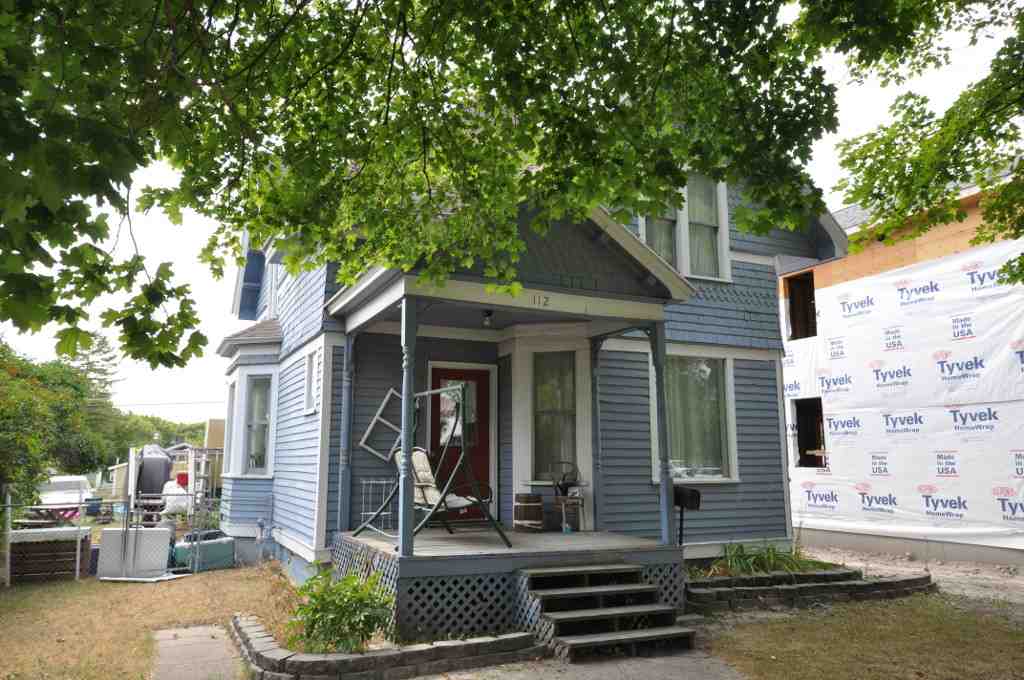
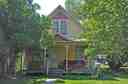
Alexander and Busey HousesPhoto: Magicpiano, Wikimedia Commons, CC BY-SA 4.0. Cropped & resized. Look to your right for a modest wood-frame house with a steep front-facing gable, a small porch, and a National Register marker that hints this lone survivor once had a twin.
These were the Alexander and Busey Houses, raised around nineteen oh three by Elmer Bader, the carpenter and lumber dealer who understood that a town could be shaped one repeatable house at a time. He used the same design for both rentals and lived across the street himself, as if keeping a discreet eye on the investment. If you glance at the photo in the app, you can see that broken pairing for yourself: the surviving Alexander House beside the site where the Busey House once stood.
Then the pattern filled with particular lives. Bader sold the houses in nineteen oh five to Isaac Busey, a Great Northern Railway pumper, a worker who kept the railroad water system running for steam engines. His family moved into number one hundred six, but Isaac died only two years later. His widow Mattie stayed on, along with daughter Nellie and Nellie’s husband, Dr. Adelbert Howe, who later helped bring the Young Men’s Christian Association, Kalispell General Hospital, and Central Christian Church into being.
Next door, number one hundred twelve held another surprise: John Gus Thompson, a pitcher for the Pittsburgh Pirates in the first World Series, lived here in nineteen ten. A year later, John and Melinda Alexander bought the house, and Melinda became known locally as a writer and speaker with a soft spot for the underdog.
That is the lovely deception of repeated architecture: matching forms, utterly different lives. In about nine minutes, at Snyder House, we arrive at one last place where change and remembrance keep their delicate truce.
On your right, look for a wood-frame house with a cross-gabled roof, clapboard siding, and a broad front porch marked by turned posts and delicate scrollwork. This is the Snyder…Read moreShow less
Open dedicated page →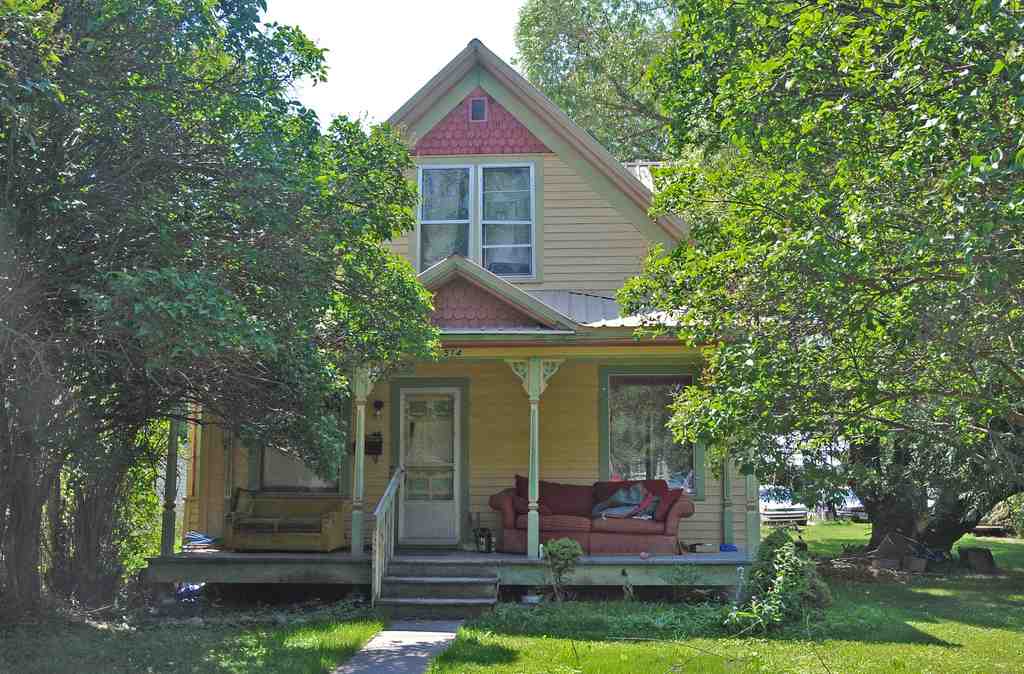
Snyder HousePhoto: JERRYE AND ROY KLOTZ MD, Wikimedia Commons, CC BY-SA 3.0. Cropped & resized. On your right, look for a wood-frame house with a cross-gabled roof, clapboard siding, and a broad front porch marked by turned posts and delicate scrollwork.
This is the Snyder House, though Kalispell has also called it the Howard House and the Welty House, which tells you something at once: this place has never belonged to a single neat story. Earlier, at the Conrad mansion, we met the mystery of the missing guns; here, the missing piece is simpler and somehow lovelier. We are not even entirely certain whether the house Joseph C. Snyder built is precisely the one before you.
Snyder was a stonemason, and he had already entered civic life by eighteen ninety-four, when the town nominated him for constable on the Populist ticket. The records place him on this block between eighteen ninety-nine and nineteen oh-three, but here is the detail locals treasure: in just a few years, he seems to have lived in three different dwellings on the same stretch of Eighth Avenue West, at five fourteen, five eighteen, and five twenty-eight. So the house keeps its secret. In December of nineteen hundred, the Kalispell Bee reported that Snyder built a frame residence costing one thousand eight hundred dollars, roughly sixty-five thousand dollars in today’s money, but no one can prove that notice referred to this exact address.
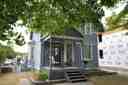
If you glance at the image on your screen, you can see the blend that makes the house so distinctive. Its overall shape belongs to Colonial Revival, a style that looked back to earlier American forms, but the decorative shingle work, stained-glass transoms, bay window, and those porch details still flirt with the more playful Queen Anne fashion of the late nineteenth century.
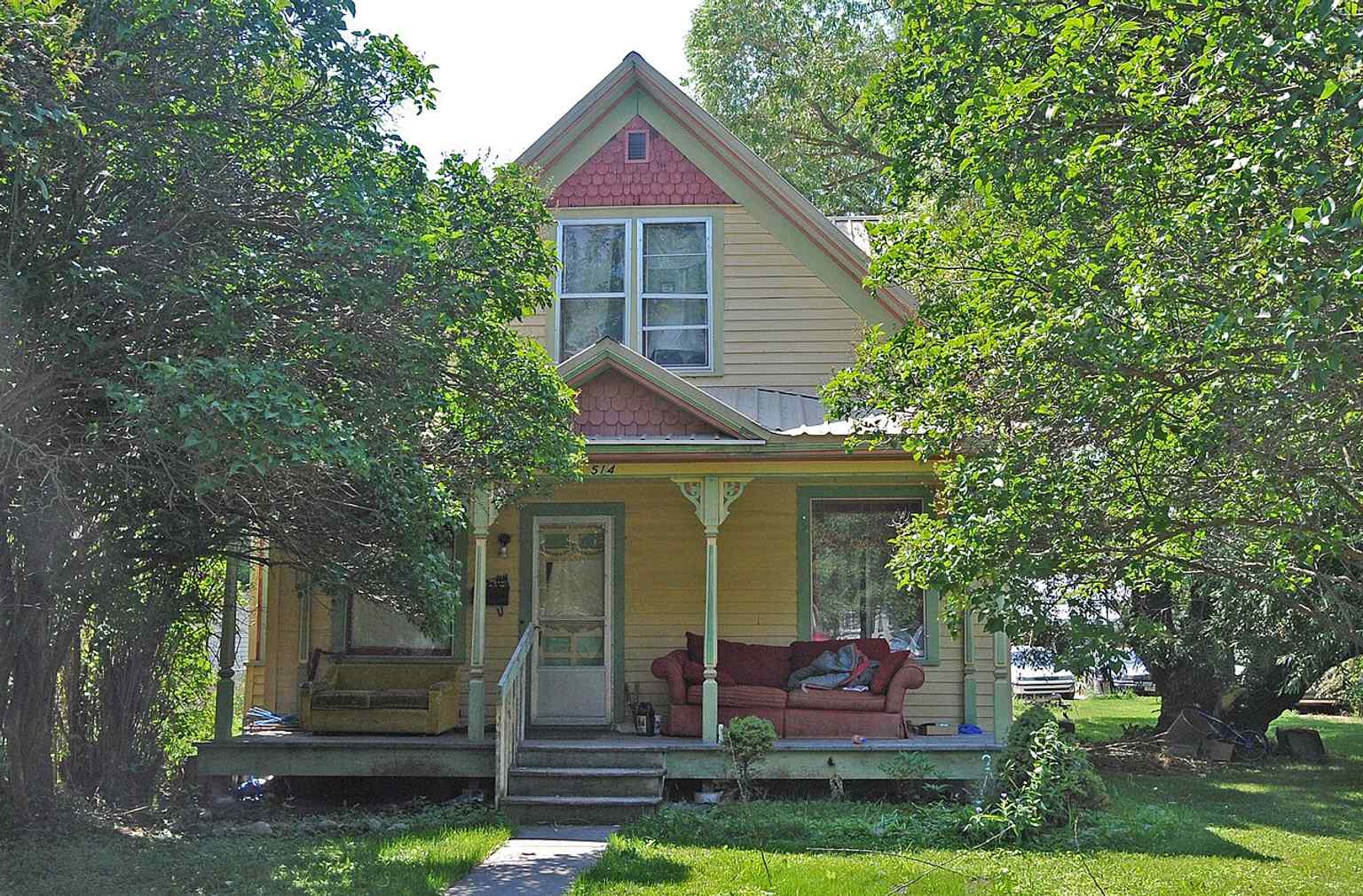
The Snyder House in Kalispell, also known as the Howard House and Welty House, is a transitional Colonial Revival home built around 1900.Photo: JERRYE AND ROY KLOTZ MD, Wikimedia Commons, CC BY-SA 3.0. Cropped & resized. James Conlon, the department store owner who first held the property, never lived here. By nineteen ten, three families rented rooms inside. Janitors, drivers, millers, loggers, odd-job men: ordinary lives kept the place alive until Lloyd and Gladys Welty bought it in nineteen forty-eight, and their family gave it the long continuity the earlier decades never could.
That, I think, is Kalispell’s real grace. Not flawless memory, but faithful attention: a town choosing to keep houses even when the facts blur, trusting that beauty survives in what buildings still remember.
Frequently asked questions
How do I start the tour?
After purchase, download the AudaTours app and enter your redemption code. The tour will be ready to start immediately - just tap play and follow the GPS-guided route.
Do I need internet during the tour?
No! Download the tour before you start and enjoy it fully offline. Only the chat feature requires internet. We recommend downloading on WiFi to save mobile data.
Is this a guided group tour?
No - this is a self-guided audio tour. You explore independently at your own pace, with audio narration playing through your phone. No tour guide, no group, no schedule.
How long does the tour take?
Most tours take 60–90 minutes to complete, but you control the pace entirely. Pause, skip stops, or take breaks whenever you want.
What if I can't finish the tour today?
No problem! Tours have lifetime access. Pause and resume whenever you like - tomorrow, next week, or next year. Your progress is saved.
What languages are available?
All tours are available in 50+ languages. Select your preferred language when redeeming your code. Note: language cannot be changed after tour generation.
Where do I access the tour after purchase?
Download the free AudaTours app from the App Store or Google Play. Enter your redemption code (sent via email) and the tour will appear in your library, ready to download and start.
If you don't enjoy the tour, we'll refund your purchase. Contact us at [email protected]
Checkout securely with 






