
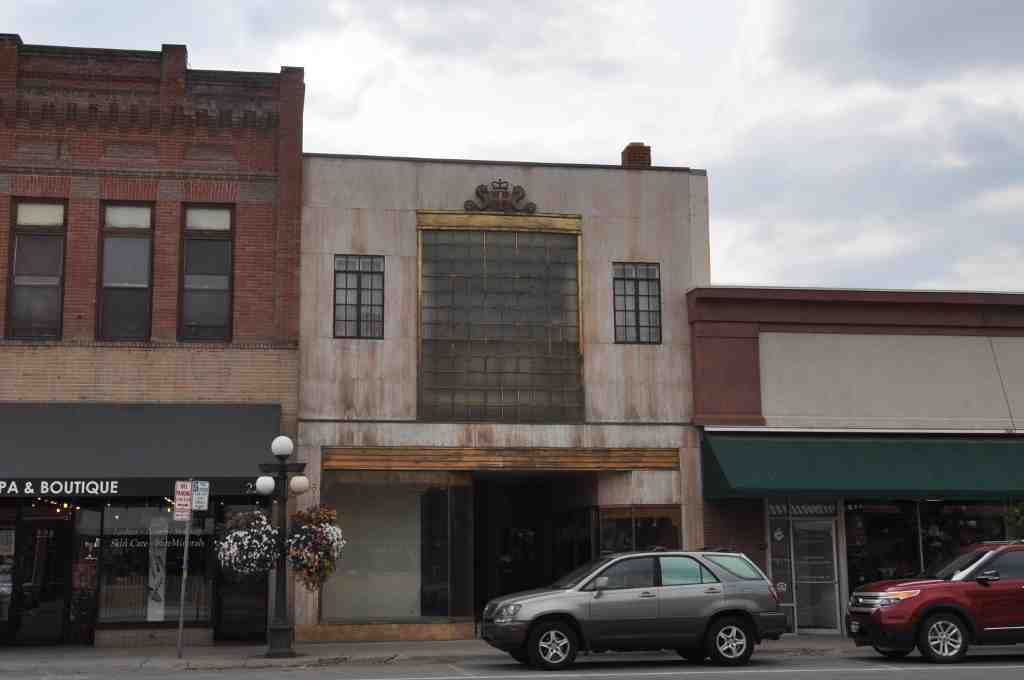
On your left is a sleek, pale stone storefront with rounded Moderne lines, bands of metal trim, and a distinctive crest crowned by sea horses above the façade.
This smart little building carries more motion in its story than its polished front first suggests. Before this version appeared in nineteen forty-one, the lot held an older two-storey building hauled here from Demersville, the town Kalispell outgrew. When the railroad bypassed Demersville in eighteen ninety-one, merchants did not simply surrender; they rolled entire buildings on logs into the new town, dragging trade, hope, and habit with them.
One of those migrants landed here. It served, in turn, as a grocery, the Pacific Union Tea Company, and then a ladies’ furnishings shop before Carl Anderson took it over around nineteen twenty-eight. Carl is the human key to this address. He did not confine himself to frocks and fittings. He and his father, Marius Anderson, a Danish immigrant, also moved through Kalispell’s theatre world, with ties to the Orpheum and Liberty. Carl often hired managers to run the shop while he worked a wider circuit of business and civic life. During the Second World War, he even chaired the county preparedness and advisory commission.
So when Carl tore down the old wood-frame shop and spent seventeen thousand five hundred dollars, roughly three hundred and eighty thousand dollars today, he was making more than a retail upgrade. He asked local architect Fred Brinkman for a Moderne design, a streamlined modern style, with travertine stone, copper-alloy bands, glass block, and that flamboyant heraldic crest. The first floor and basement served the shop; two apartments above turned the property into an income-producing little machine. If you look at the photo in the app, you can see how confidently that new façade announces itself on Main Street. The plaque on your screen marks its National Register listing in nineteen ninety-four, honouring that distinctive commercial front.
This one lot tells you how downtown Kalispell formed: buildings shifted, families improvised, and money chased the railroad’s new map. In about two minutes, we’ll carry that story into the Main Street Historic District. If you plan to return, the building is generally open weekdays from seven in the morning until five in the afternoon.




