
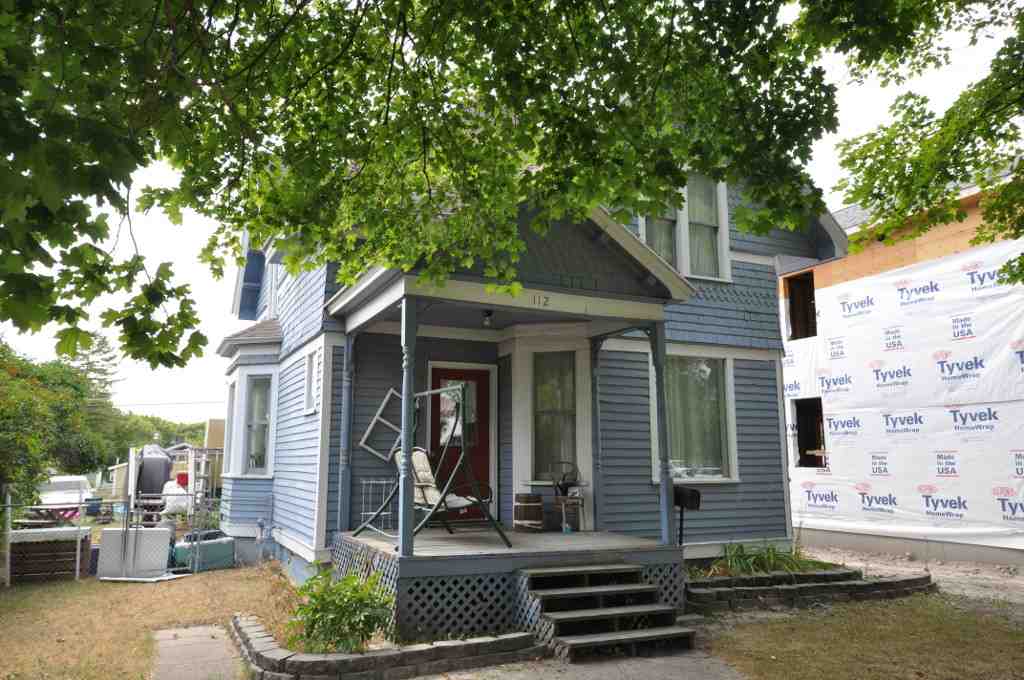
Look to your right for a modest wood-frame house with a steep front-facing gable, a small porch, and a National Register marker that hints this lone survivor once had a twin.
These were the Alexander and Busey Houses, raised around nineteen oh three by Elmer Bader, the carpenter and lumber dealer who understood that a town could be shaped one repeatable house at a time. He used the same design for both rentals and lived across the street himself, as if keeping a discreet eye on the investment. If you glance at the photo in the app, you can see that broken pairing for yourself: the surviving Alexander House beside the site where the Busey House once stood.
Then the pattern filled with particular lives. Bader sold the houses in nineteen oh five to Isaac Busey, a Great Northern Railway pumper, a worker who kept the railroad water system running for steam engines. His family moved into number one hundred six, but Isaac died only two years later. His widow Mattie stayed on, along with daughter Nellie and Nellie’s husband, Dr. Adelbert Howe, who later helped bring the Young Men’s Christian Association, Kalispell General Hospital, and Central Christian Church into being.
Next door, number one hundred twelve held another surprise: John Gus Thompson, a pitcher for the Pittsburgh Pirates in the first World Series, lived here in nineteen ten. A year later, John and Melinda Alexander bought the house, and Melinda became known locally as a writer and speaker with a soft spot for the underdog.
That is the lovely deception of repeated architecture: matching forms, utterly different lives. In about nine minutes, at Snyder House, we arrive at one last place where change and remembrance keep their delicate truce.




