
Oxford Audio Tour: An Enchanted Stroll Through Oxford’s Timeless Treasures
In Oxford, ancient stones once whispered secrets to rebellious scholars and condemned kings alike. Shadows linger where power and scandal have changed the city’s fate forever. This self-guided audio tour is your invitation to explore Oxford’s hidden corners and forgotten legends at your own pace. Uncover tales behind iconic landmarks like Oxford Castle, Campion Hall, and University College that most visitors walk past unknowingly. Which infamous figure plotted a deadly uprising inside the castle walls? Why does a single locked room at Campion Hall still stir up whispers of forbidden research? Who was mysteriously erased from University College’s history—leaving only a vanished portrait as evidence? Trace steps through alleys of intrigue and grandeur. Experience Oxford as a stage for drama, rebellion, secret societies, and extraordinary ambition. The city will transform as each story unfolds beneath your feet. Hear the echoes. Your journey into Oxford’s best-kept secrets begins now.
Tour preview
About this tour
- scheduleDuration 80–100 minsGo at your own pace
- straighten2.7 km walking routeFollow the guided path
- location_onLocationOxford, United Kingdom
- wifi_offWorks offlineDownload once, use anywhere
- all_inclusiveLifetime accessReplay anytime, forever
- location_onStarts at Oxford Castle
Stops on this tour
lock_open 3 free previews · 12 unlock with purchase
Ahead of you, Oxford Castle appears as a pale stone mound beside a tall rectangular tower, with sturdy prison blocks folded around the older medieval core. This place has had an…Read moreShow less
Open dedicated page →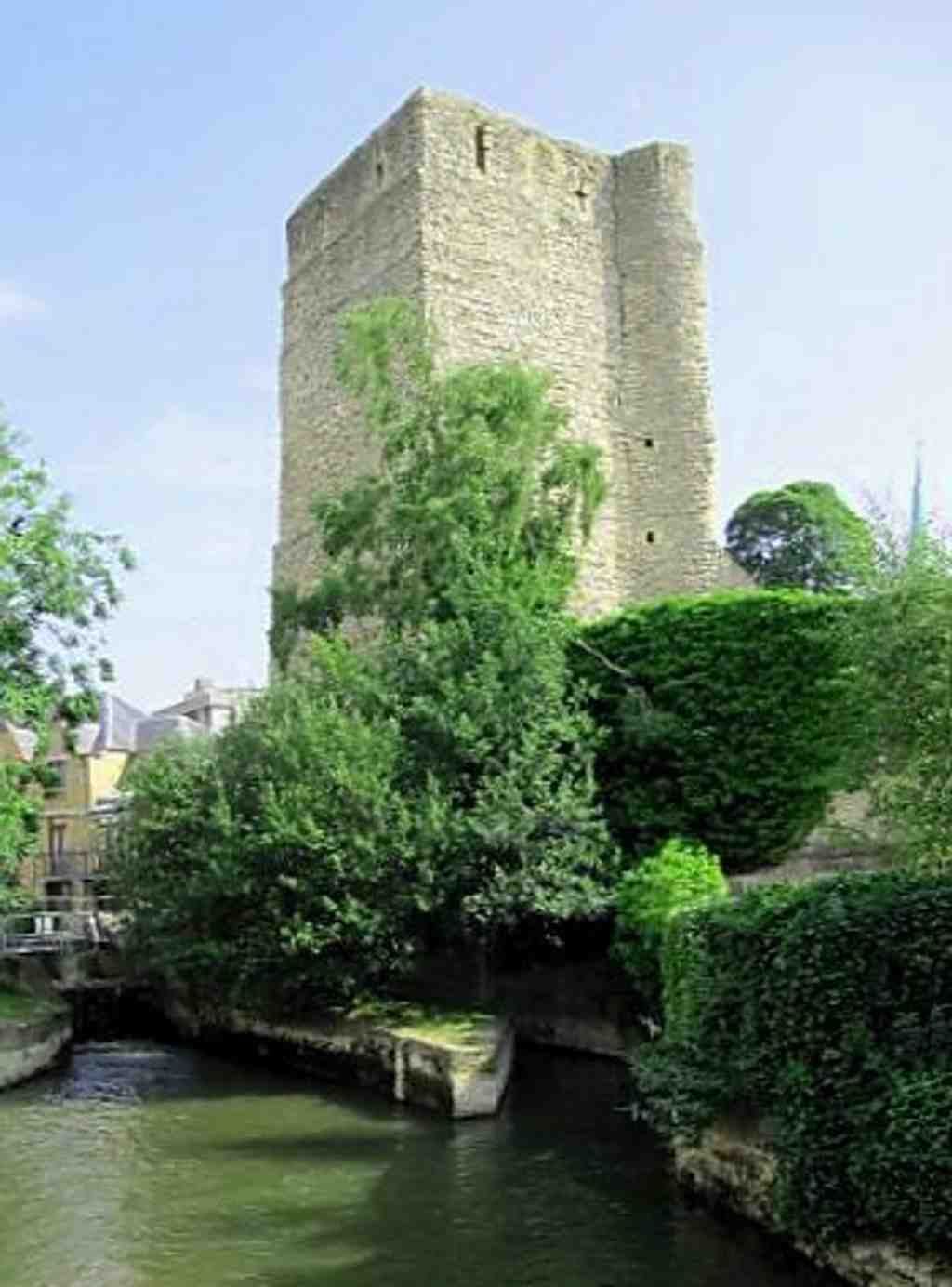
Oxford CastlePhoto: APK, Wikimedia Commons, CC BY 4.0. Cropped & resized. Ahead of you, Oxford Castle appears as a pale stone mound beside a tall rectangular tower, with sturdy prison blocks folded around the older medieval core.
This place has had an identity crisis for almost a thousand years... fortress, royal stronghold, county jail, execution site, courthouse, prison, hotel. Very efficient, really.
The story starts just after the Norman Conquest. Between ten seventy-one and ten seventy-three, Robert d'Oyly, one of William the Conqueror's men, set up a castle here to dominate a town that had already been stormed and damaged. He chose this western edge of Oxford carefully. A nearby branch of the Thames, now called Castle Mill Stream, gave him natural protection, and he diverted water to form a moat. If you glance at the image on your screen, you can see how the moat, barbican, keep and west gate once fitted together like a very unfriendly machine.
The earliest castle was probably a motte and bailey. That means a steep earth mound, the motte, paired with an enclosed yard, the bailey. The mound here rose to about sixty feet, and later builders replaced the timber defenses with stone. But the real old-timer is St George's Tower. Historians now think it predates the castle entirely and began life around the year ten twenty as a Saxon watchtower guarding Oxford's west gate. So yes, one of the castle's most famous pieces may actually be older than the castle itself. History does enjoy a technicality.
This fortress earned its reputation in the civil war called the Anarchy. In the year eleven forty-two, Empress Matilda took refuge here while King Stephen besieged the castle for months. According to the famous version of the story, she escaped at night dressed in white, slipping past Stephen's men across the frozen ground and stream. Local legend insists she never entirely left; people have claimed to see a woman in white waiting on the stairs.
By the late Middle Ages, the castle's military role faded and Oxford turned it into something grimmer: a center of county government and a prison. In fifteen seventy-seven, a notorious court session here ended in the "Black Assize," when judges, jurors and officials died after a sudden outbreak. People blamed a bookseller's curse, naturally. Modern historians blame typhus, then called gaol fever, spread from filthy prison conditions. Less dramatic than a curse... but more convincing.
Then came one of the strangest survival stories in English history. In sixteen fifty, Anne Green was hanged here for allegedly killing her newborn child. After half an hour on the gallows, doctors opened her coffin and discovered she was still breathing. They revived her, she recovered, and authorities pardoned her. That is an astonishing second chance, even by Oxford standards.
From seventeen eighty-five, officials rebuilt the prison under William Blackburn, and Daniel Harris later completed it. The prison expanded through the Victorian period, held adults and children alike, and eventually became H-M Prison Oxford. If you check the aerial image, you can trace how the mound, St George's Tower, Debtors' Tower and prison wings all sit together in one layered site. The prison closed in nineteen ninety-six, and the cells now serve a gentler purpose than they once did.
Oxford began here as a statement of power, and it still wears every century on its walls.
If you want to go inside later, the site usually opens daily from ten AM to five thirty PM.
When you're ready, continue on to St Ebbe's Church.
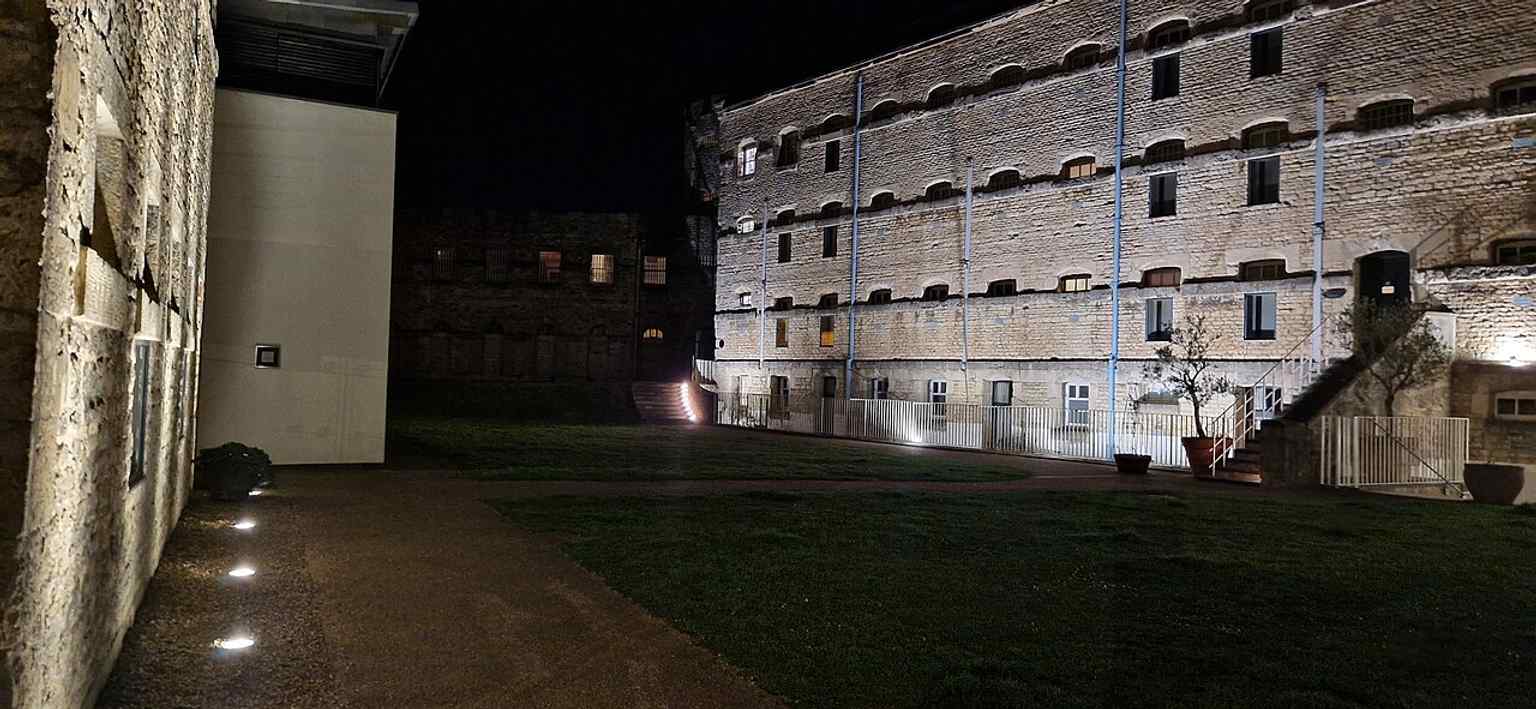
At night, the former prison blocks and House of Correction make the castle’s later penal history especially clear.Photo: Chris j wood, Wikimedia Commons, CC BY-SA 4.0. Cropped & resized. On your right stands a pale stone church with a broad rectangular form, a squat tower, and a restored Norman doorway with rounded arches that hints at a much older past. St…Read moreShow less
Open dedicated page →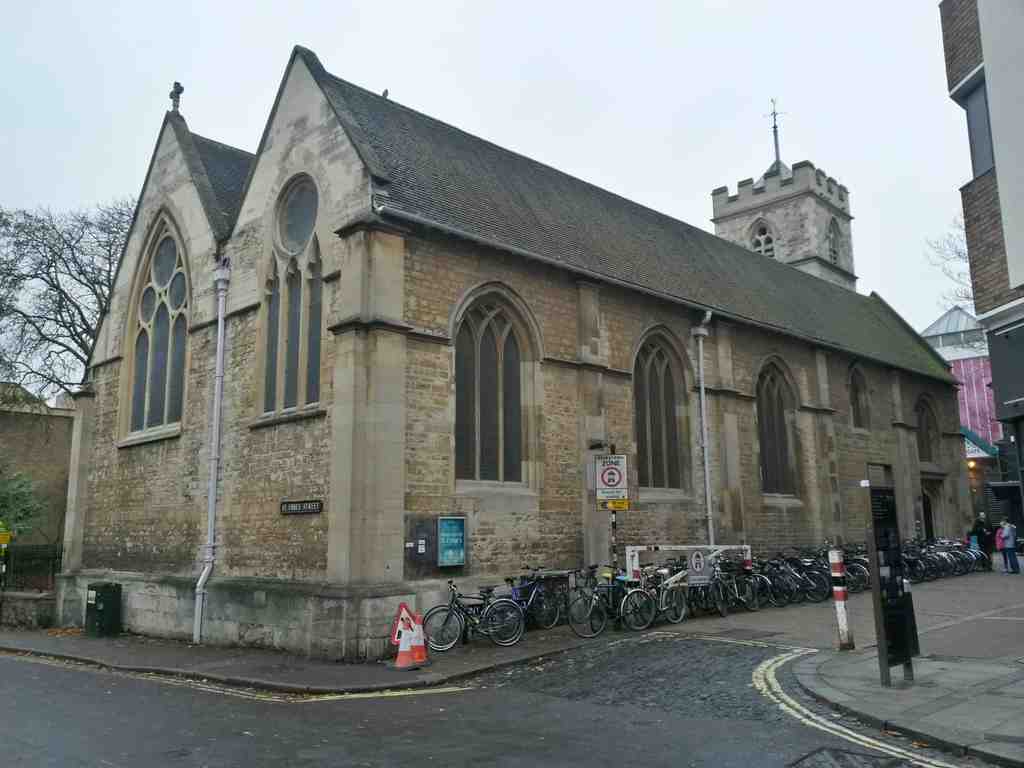
St Ebbe's Church, OxfordPhoto: BethNaught, Wikimedia Commons, CC BY-SA 4.0. Cropped & resized. On your right stands a pale stone church with a broad rectangular form, a squat tower, and a restored Norman doorway with rounded arches that hints at a much older past.
St Ebbe's looks fairly restrained, almost polite... but its story runs deep. People worshipped on this site before ten oh five, and even then records called it the ancient St Ebbe's. It takes its name from Saint Ebbe, a seventh-century abbess - that is, the head of a community of nuns - usually identified as Ebbe of Coldingham in Northumbria. Though, in classic Oxford fashion, there is also an argument that this Ebbe may have been a different local saint entirely. Even the patron saint comes with footnotes.
The name enters the record when Aethelmaer the Stout granted the church to Eynsham Abbey around ten oh five. That alone tells you this place mattered early. The building in front of you, though, is much newer. People rebuilt it between eighteen fourteen and eighteen sixteen, then restored it again in the eighteen sixties, again in nineteen oh four, and again in twenty seventeen under the architect Quinlan Terry. So what you see is really Oxford in layers: old devotion, Georgian rebuilding, Victorian repair, modern polishing.
One piece reaches much further back. If you check the image on your screen, you can see the restored twelfth-century Norman doorway at the west end, with its thick rounded arch and sturdy medieval carving. It is a survivor from an earlier church, quietly outlasting centuries of rebuilding, which is more than most of us can say. Another view in the app helps you take in the whole exterior as it stands today, neat and self-contained in the middle of the city.
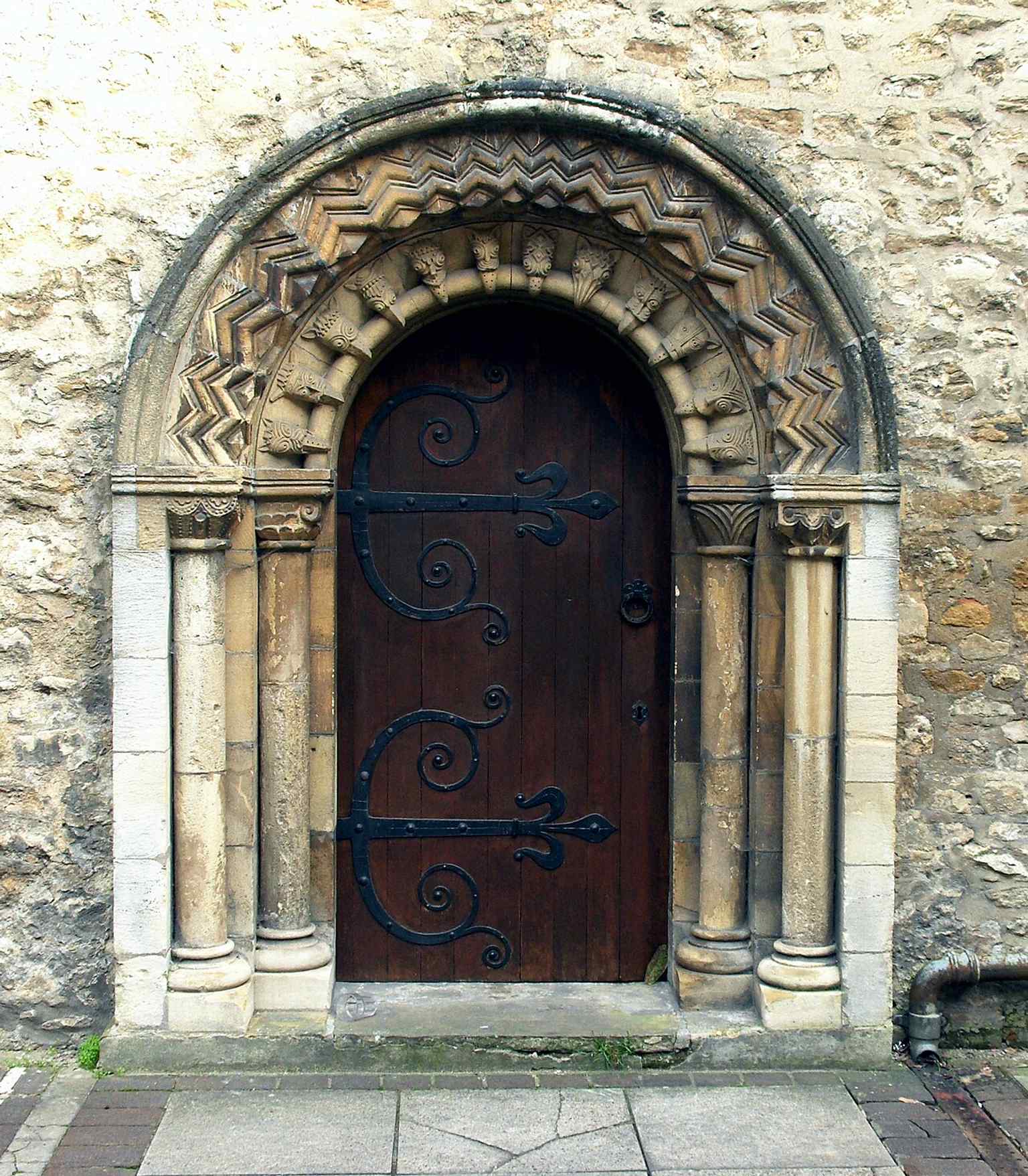
The restored 12th-century Norman west doorway — a rare surviving medieval feature on a church otherwise rebuilt in the 1814–16 period.Photo: Stemonitis, Wikimedia Commons, CC BY-SA 3.0. Cropped & resized. St Ebbe's has not stood still spiritually either. It belongs to the conservative evangelical tradition in the Church of England, and it takes part in the Anglican Reform movement. Today the congregation draws people from many nations, including plenty of Oxford students, and Vaughan Roberts has served here as rector since nineteen ninety-eight, alongside his work as an author and conference speaker. The church is active through the week and on Sundays, though its position has also shaped debate: it has formally rejected the ordination of women and female leadership, and it receives oversight from the Bishop of Ebbsfleet.
The neighborhood around it changed dramatically when part of the old parish - the church's local district - disappeared for the Westgate redevelopment in the nineteen seventies. Even so, St Ebbe's kept adapting, absorbing the parish of Holy Trinity in nineteen fifty-seven and St Peter-le-Bailey in nineteen sixty-one.
If you want to return later, it is generally open Monday to Friday from nine thirty to five, closed Saturday, and open Sunday from nine thirty to noon and again from three thirty to eight thirty.
St Ebbe's proves that a church can be rebuilt, reduced, argued over, and still remain very much alive.
When you're ready, continue on toward Campion Hall, where Oxford's religious world shifts tone again.
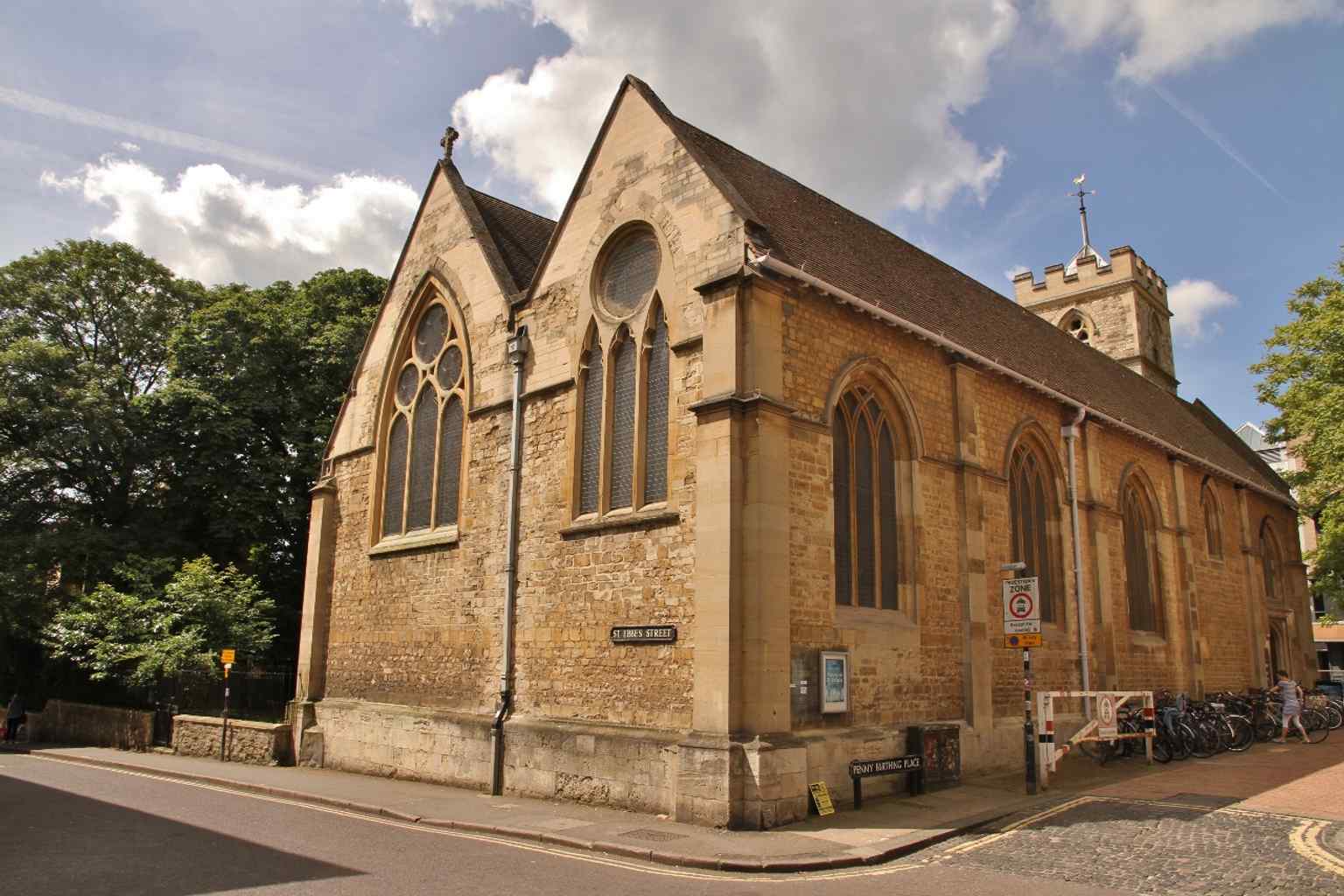
A northeast view of St Ebbe’s Church in central Oxford, showing the parish church as it appears today after later restorations.Photo: Motacilla, Wikimedia Commons, CC BY-SA 4.0. Cropped & resized.
Show 12 more stopsShow fewer stopsexpand_moreexpand_less
Ahead of you is a pale stone square tower over a broad arched gateway, crowned by an octagonal lantern and a curved ogee dome - that S-shaped dome is Tom Tower’s signature. This…Read moreShow less
Open dedicated page →Ahead of you is a pale stone square tower over a broad arched gateway, crowned by an octagonal lantern and a curved ogee dome - that S-shaped dome is Tom Tower’s signature.
This is the main entrance to Christ Church, and Tom Tower finishes a job that sat unfinished for more than a century and a half. Cardinal Wolsey started the gatehouse, then fell from power in fifteen twenty-nine, and the structure stood roofless after that... a very grand shrug in stone. In sixteen eighty-one and sixteen eighty-two, Christopher Wren stepped in. Yes, that Christopher Wren, usually associated with classical architecture. But here he argued the tower “ought to be Gothick” so it would match the older work of the college’s founder, Henry the Eighth. Oxford does enjoy continuity, even when it takes a hundred and fifty years to get around to it.
Look at the tower’s shape: a solid square base, then the lantern - the smaller windowed stage above - and then that faceted ogee dome. If you check your screen, image two shows that stacked silhouette especially clearly. Wren never actually came to supervise the building himself; the stonemason Christopher Kempster of Burford carried it out. Even so, the result became strangely influential. Later architects borrowed its dome for work at Hampton Court, and imitations turned up as far away as Harvard and Auckland. Not bad for a tower built to complete someone else’s unfinished business.
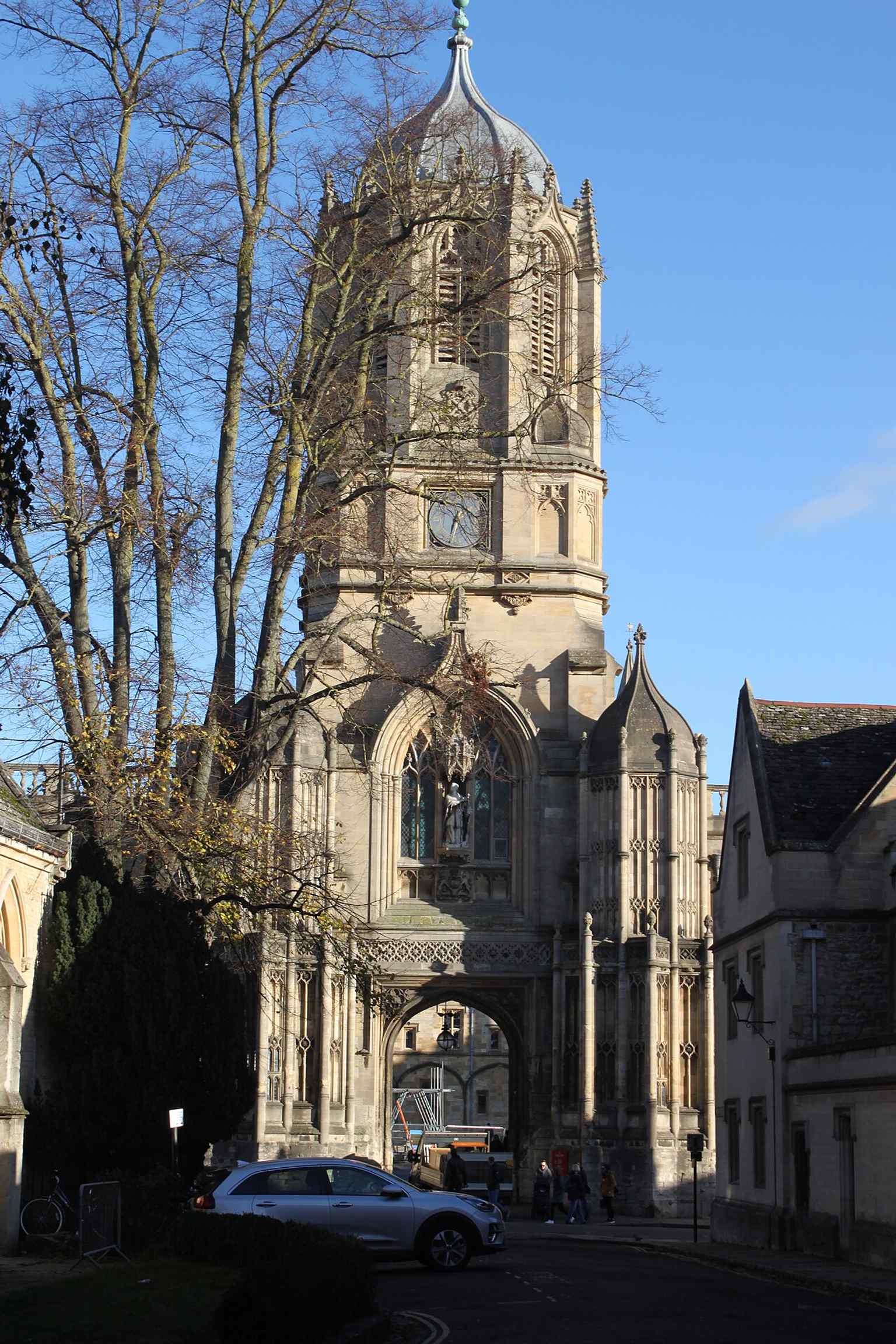
A clear view from Pembroke Square showing Tom Tower’s distinctive square shaft and octagonal lantern above Tom Gate.Photo: Medarduss, Wikimedia Commons, CC BY-SA 4.0. Cropped & resized. Its name comes from the bell inside: Great Tom, the loudest bell in Oxford. It weighs six and a quarter tons and began life at twelfth-century Osney Abbey, before officials moved it after the dissolution of the monasteries. The bell misbehaved for generations, wearing out clappers and surviving multiple failed recastings. Richard Keene of Woodstock tried three times in the late sixteen seventies and only made it heavier. Finally, in sixteen eighty, Christopher Hodson of London recast it successfully, and they hung it here in the new tower.
Great Tom still sounds one hundred and one times each night - one hundred for Christ Church’s original scholars, plus one added in sixteen sixty-three. It rings at nine oh five by modern time, which matches nine o’clock in old Oxford local time, when the city ran five minutes behind Greenwich. Once, that peal told Oxford colleges to shut their gates. If you want to picture the threshold it guards, image eight on your phone looks through Tom Gate into Tom Quad.
The clock also got a serious Victorian brain transplant in eighteen eighty-nine, when J. B. Joyce and Company installed new works using Lord Grimthorpe’s gravity escapement - the mechanism that releases the clockwork in tidy, controlled steps.
If you plan to go in, Christ Church generally opens from ten thirty A-M to four thirty P-M on most days and closes on Tuesdays. Tom Tower is Oxford in one frame: authority, ceremony, and a bell with a personality disorder. When you’re ready, continue on to Christ Church itself, just beyond this famous gate.
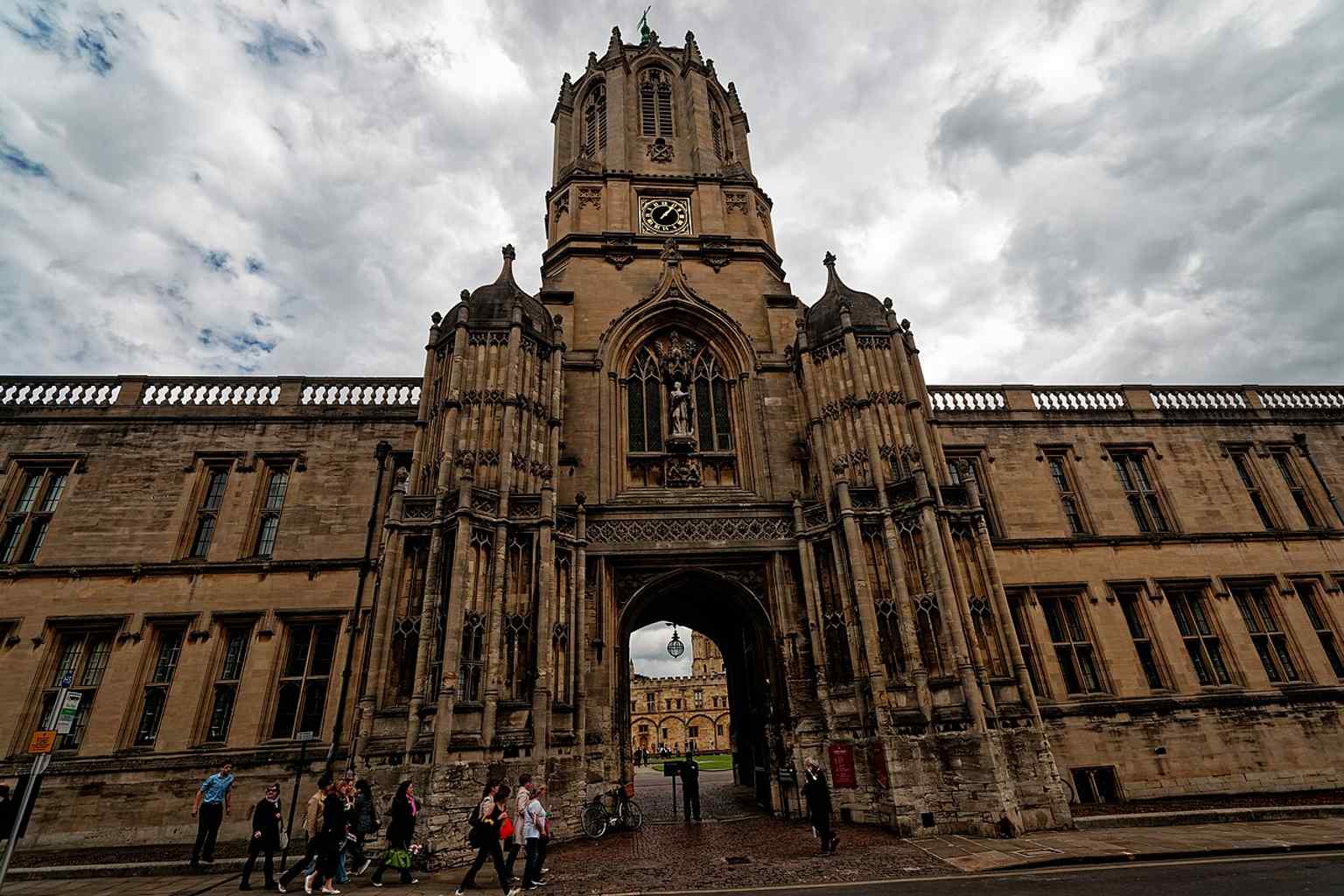
A wider eastward view of Tom Quad with Tom Tower anchoring the composition beside the college’s Tudor fabric.Photo: Txllxt TxllxT, Wikimedia Commons, CC BY-SA 4.0. Cropped & resized. 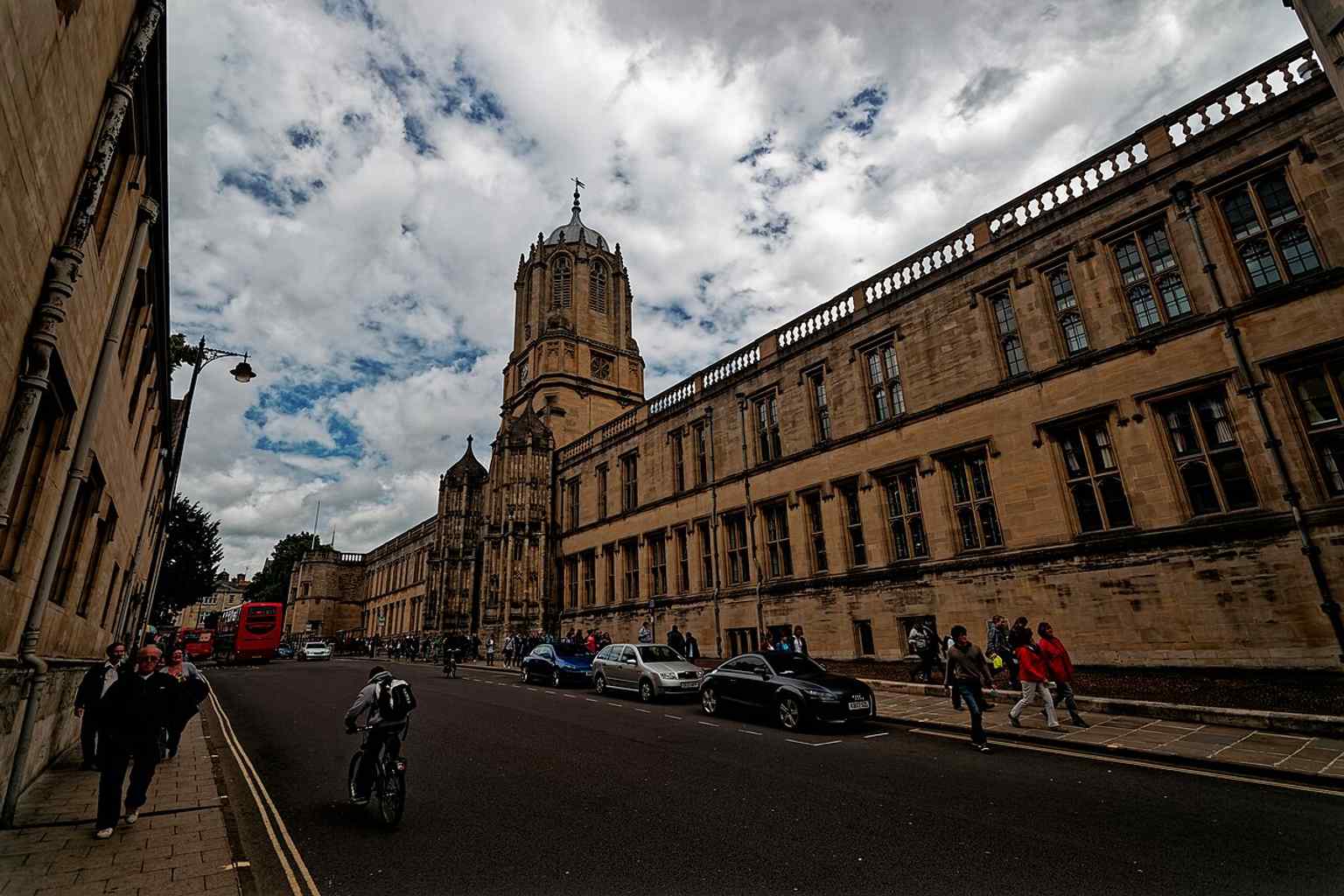
Tom Tower and the Great Quadrangle together, a strong image for Wren’s Gothic-style addition to Wolsey’s unfinished gatehouse.Photo: Txllxt TxllxT, Wikimedia Commons, CC BY-SA 4.0. Cropped & resized. 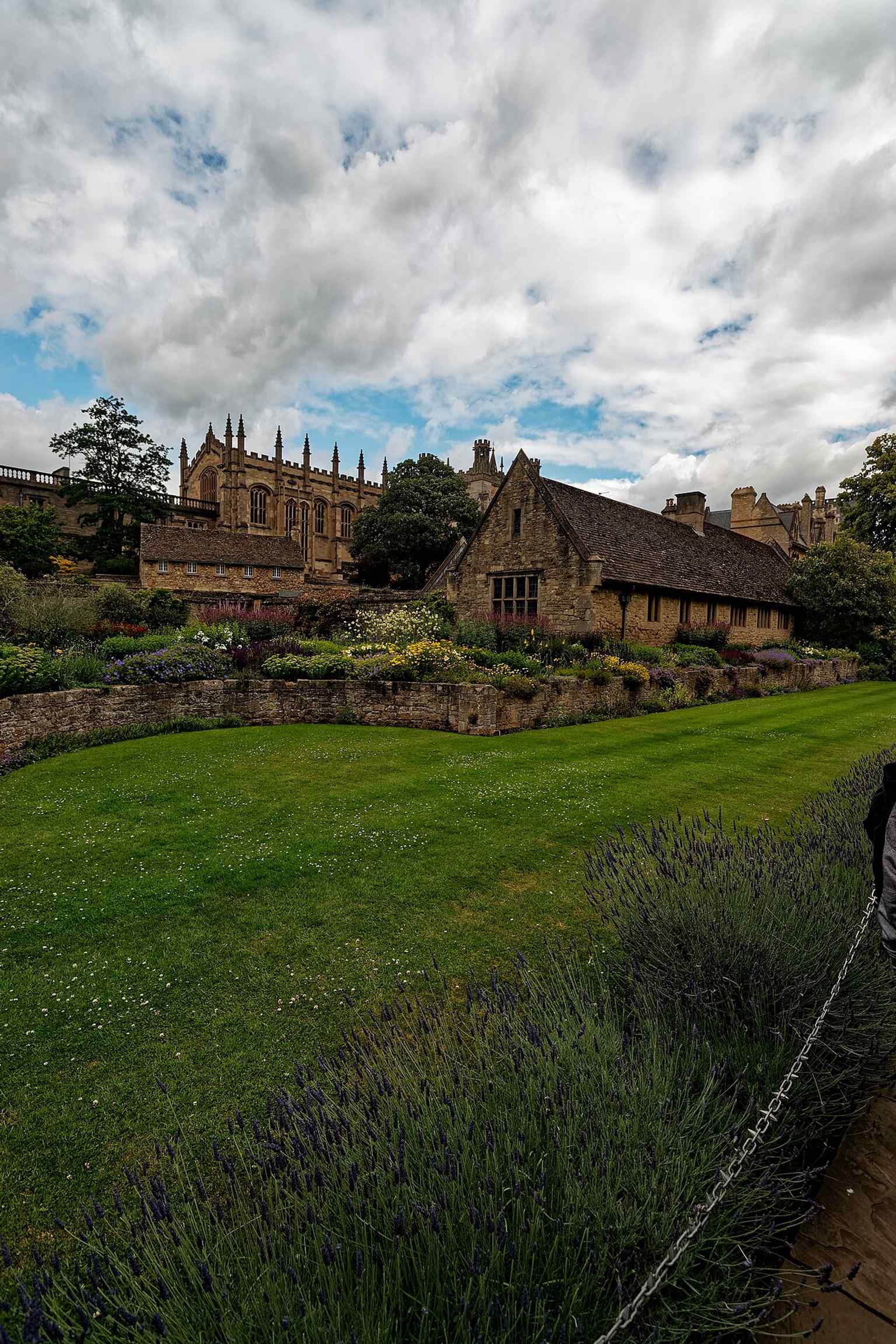
From Broad Walk, Tom Tower stands beyond the Christ Church War Memorial Garden, showing how the tower overlooks the college precinct.Photo: Txllxt TxllxT, Wikimedia Commons, CC BY-SA 4.0. Cropped & resized. 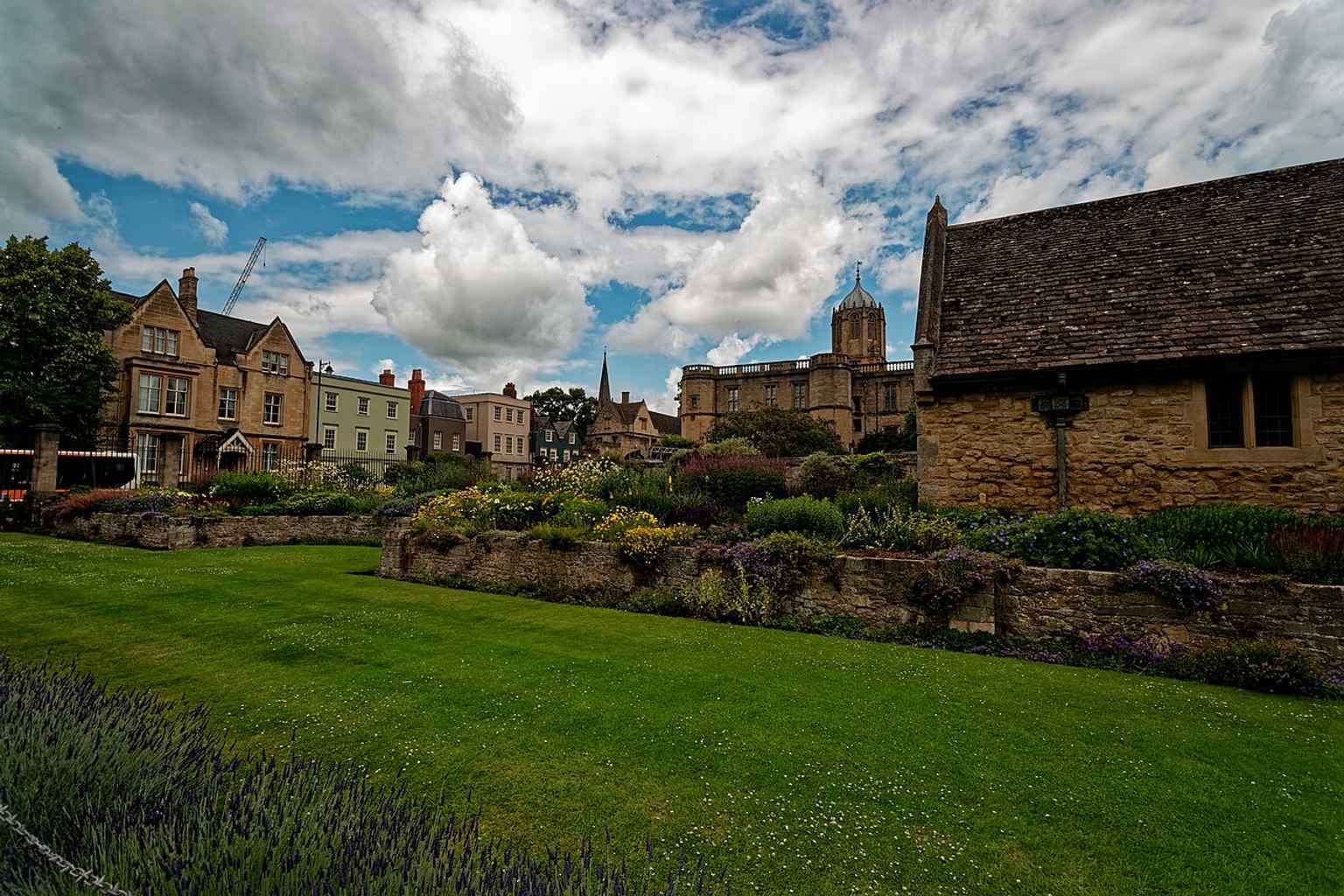
Another Broad Walk perspective on Tom Tower, useful for showing its setting within Christ Church’s grounds and historic architecture.Photo: Txllxt TxllxT, Wikimedia Commons, CC BY-SA 4.0. Cropped & resized. Christ Church is a broad stretch of honey-colored stone with tall Gothic windows and, above the entrance, the square-topped landmark of Tom Tower. What you’re looking at is one…Read moreShow less
Open dedicated page →Christ Church is a broad stretch of honey-colored stone with tall Gothic windows and, above the entrance, the square-topped landmark of Tom Tower.
What you’re looking at is one of Oxford’s stranger masterpieces: a college, a cathedral, and a royal statement piece all folded into one. Christ Church is the only Oxford college that also serves as a cathedral - in other words, the official church seat of a bishop. Oxford does love an exception to the rule.
The story starts in fifteen twenty-five, when Cardinal Thomas Wolsey chose this site for a grand new college on the land of St Frideswide’s Priory. He planned on a lavish scale, then lost the king’s favor in fifteen twenty-nine, and the whole scheme stalled half-finished. Henry the Eighth stepped in, refounded it more than once, and in fifteen forty-six turned it into Christ Church, tying together university life and the new Church of England in one neat Tudor package.
That scale still shows. The grounds cover about one hundred and seventy-five acres, including the Meadow, and inside sits Tom Quad, the largest quadrangle in Oxford - a quadrangle just meaning a four-sided courtyard enclosed by buildings. If you check the before-and-after image, you can see how the skyline from the Meadow stayed strikingly familiar while the riverside setting grew fuller around it.
Christ Church has never been short on drama. During the English Civil War, King Charles the First used the Deanery here as his palace, and the Great Hall became his parliament chamber. A parliamentarian cannon even fired a nine-pound shot that struck the north wall in sixteen forty-five. If you want a look inside, the image of the Great Hall on your screen is worth a glance.
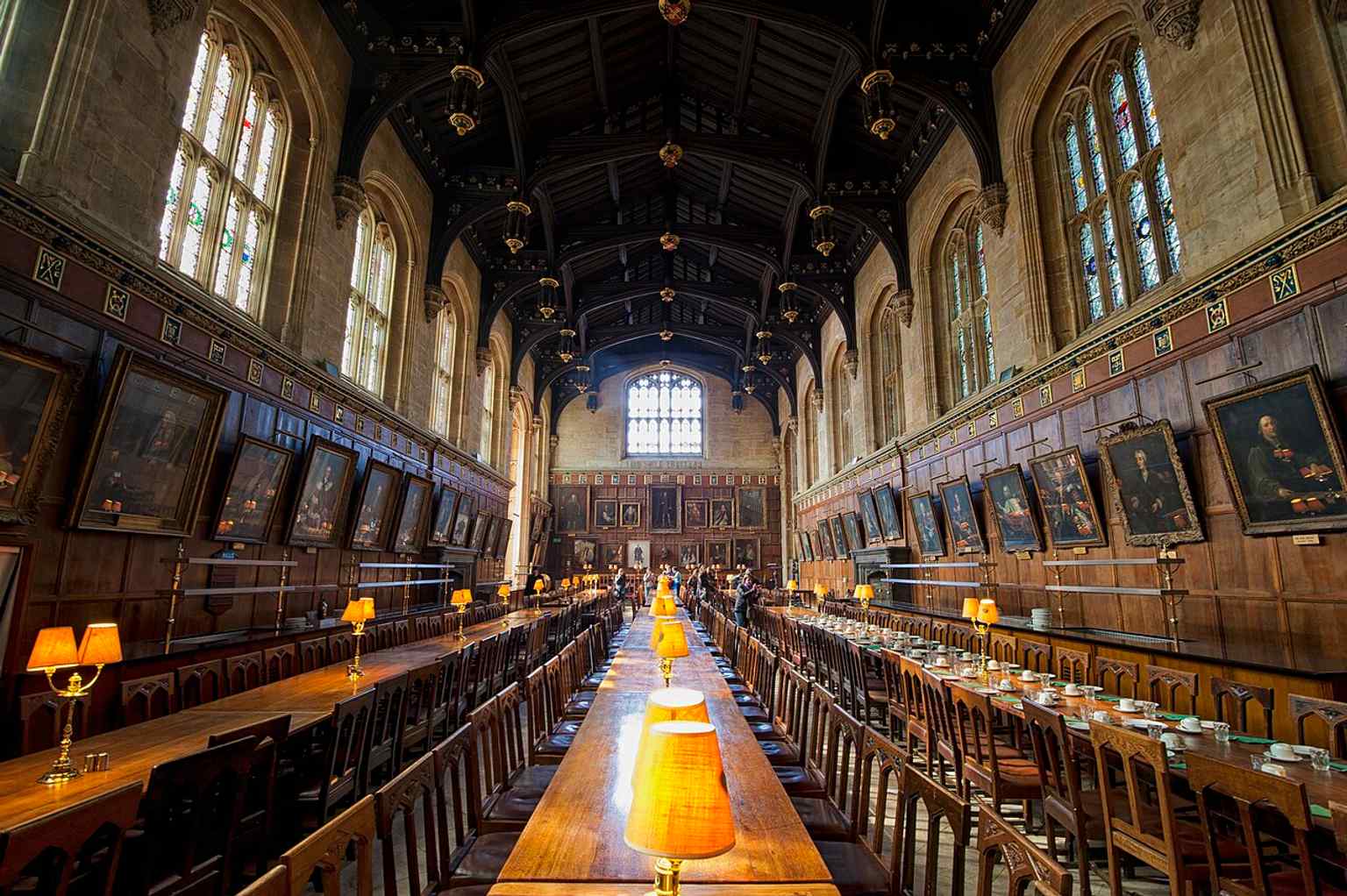
The Great Hall at Christ Church — the medieval dining hall that once served as King Charles I’s parliament chamber.Photo: chensiyuan, Wikimedia Commons, CC BY-SA 4.0. Cropped & resized. The place also leaks into popular culture. Parts of it helped shape the visual world of Harry Potter and The Golden Compass, and long before that, Lewis Carroll - whose real name was Charles Dodgson - taught mathematics here. He spun the first Alice story for the dean’s daughter, Alice Liddell, during a boat trip nearby. Oxford, naturally, turned even children’s fiction into a matter of scholarly intrigue.
And then there’s Albert Einstein. In the early nineteen thirties, fleeing Nazi Germany, he came here as a research fellow with rooms overlooking Tom Quad - the very rooms once used by Lewis Carroll. Christ Church paid him four hundred pounds a year, roughly thirty thousand pounds today. He appreciated the refuge, but not the rituals. He hated the formal dinner jacket, refused to wear socks, and grumbled in his diary, “Not even a carthorse could endure so much.” Fair enough. More generously, when he left for the United States in nineteen thirty-three, he suggested his salary should help other German-Jewish refugee scholars escape Europe and find posts here.
For centuries Christ Church admitted only men; women first enrolled in nineteen eighty. Today it has hundreds of students, a famous choir, a major art collection, and a tourist count that runs into the hundreds of thousands each year. Grand, devout, political, literary, and a little absurd... that’s Christ Church in one sentence.
Christ Church feels like Oxford concentrating very hard on being Oxford. When you’re ready, head on toward the Museum of Oxford for the city’s story at street level.
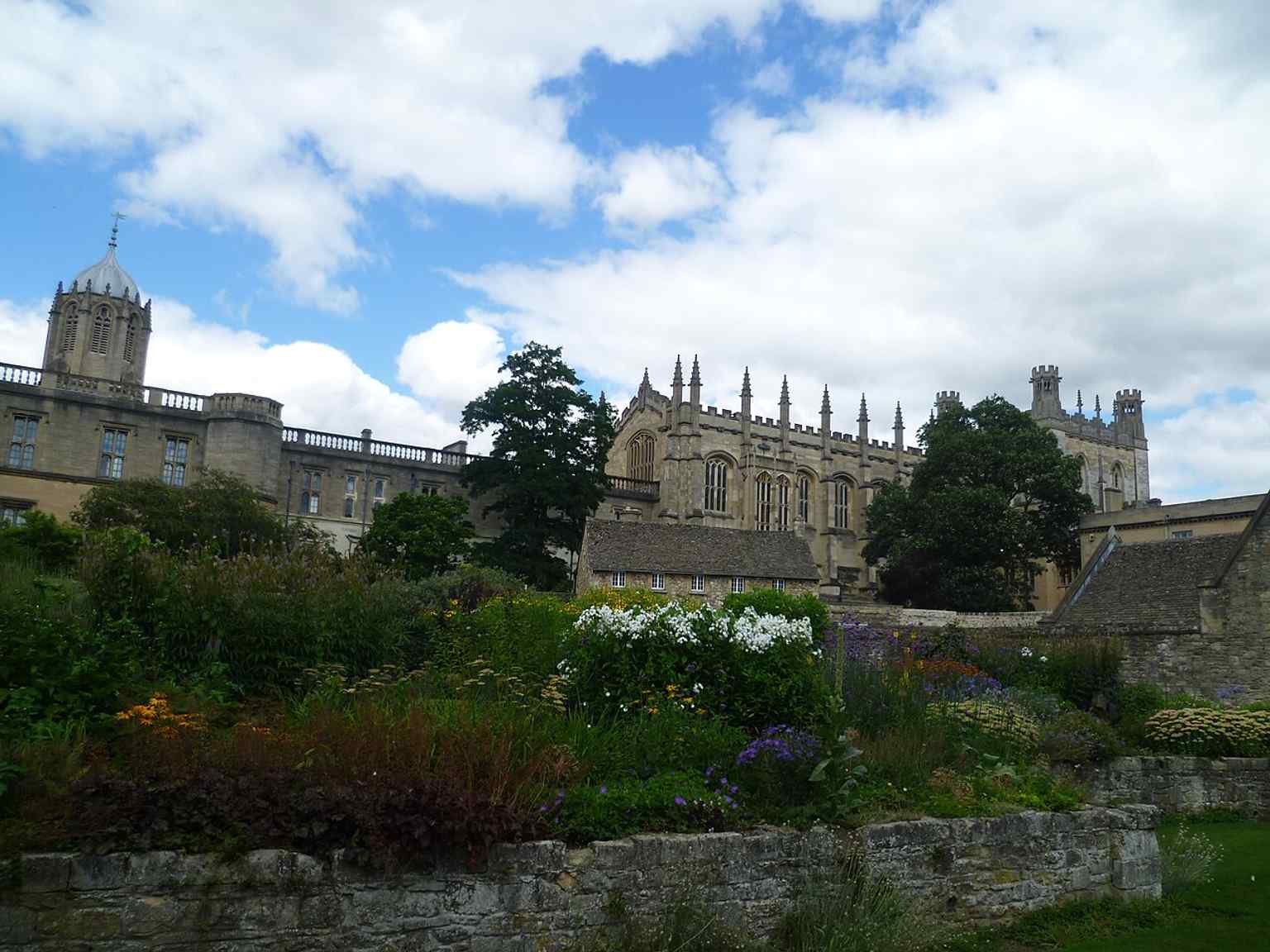
Christ Church’s gardens and listed grounds — part of the 175 acres that include the meadow, quadrangles, and historic parkland.Photo: Lolalatorre, Wikimedia Commons, CC BY-SA 3.0. Cropped & resized. 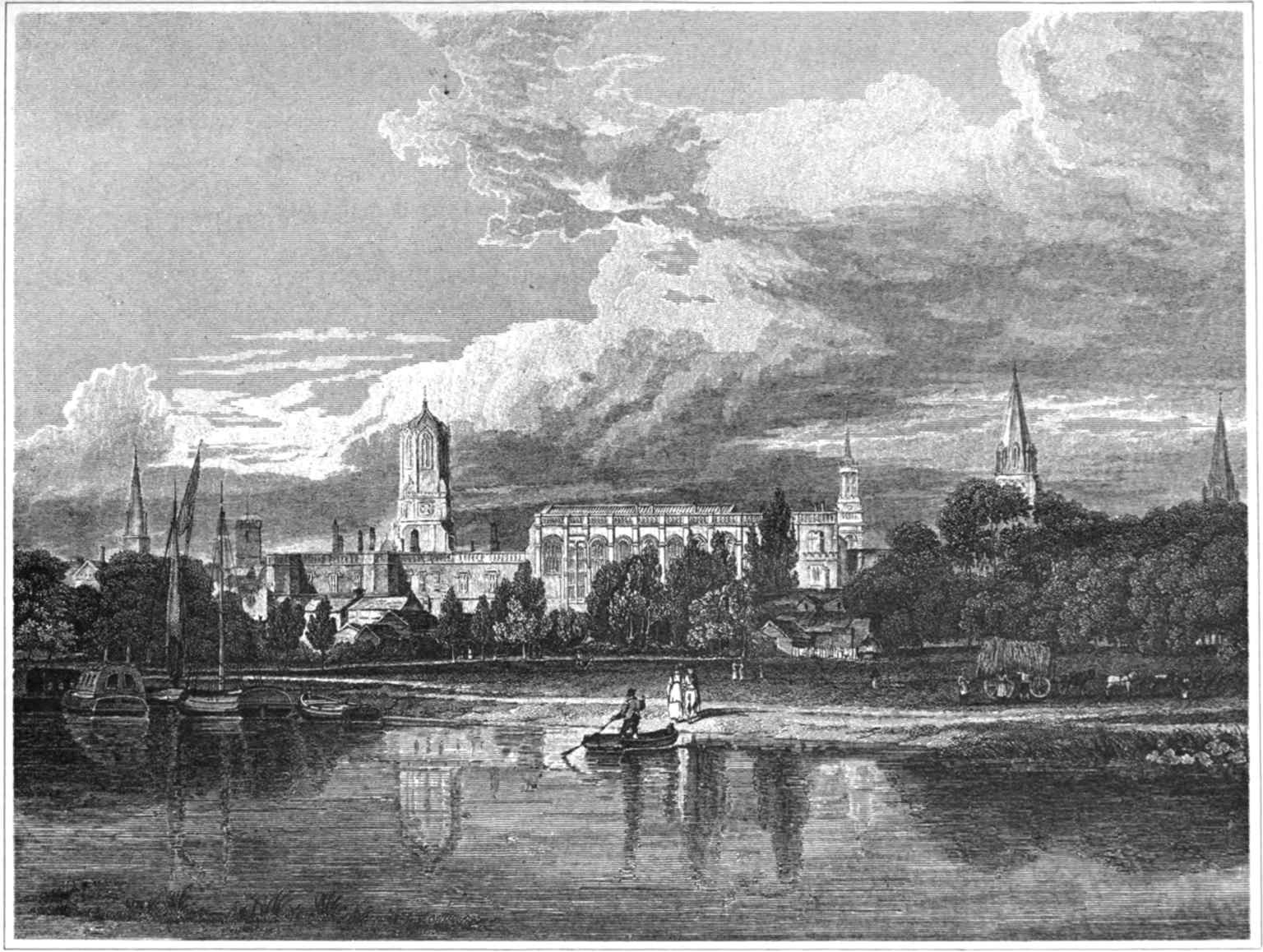
An 1893 view from the Meadows — a reminder that Christ Church has long drawn artists and visitors to its riverside setting.Photo: Author Joseph Foster Artist J. M. W. Turner, R.A. Engraving by Skelton, Wikimedia Commons, Public domain. Cropped & resized. 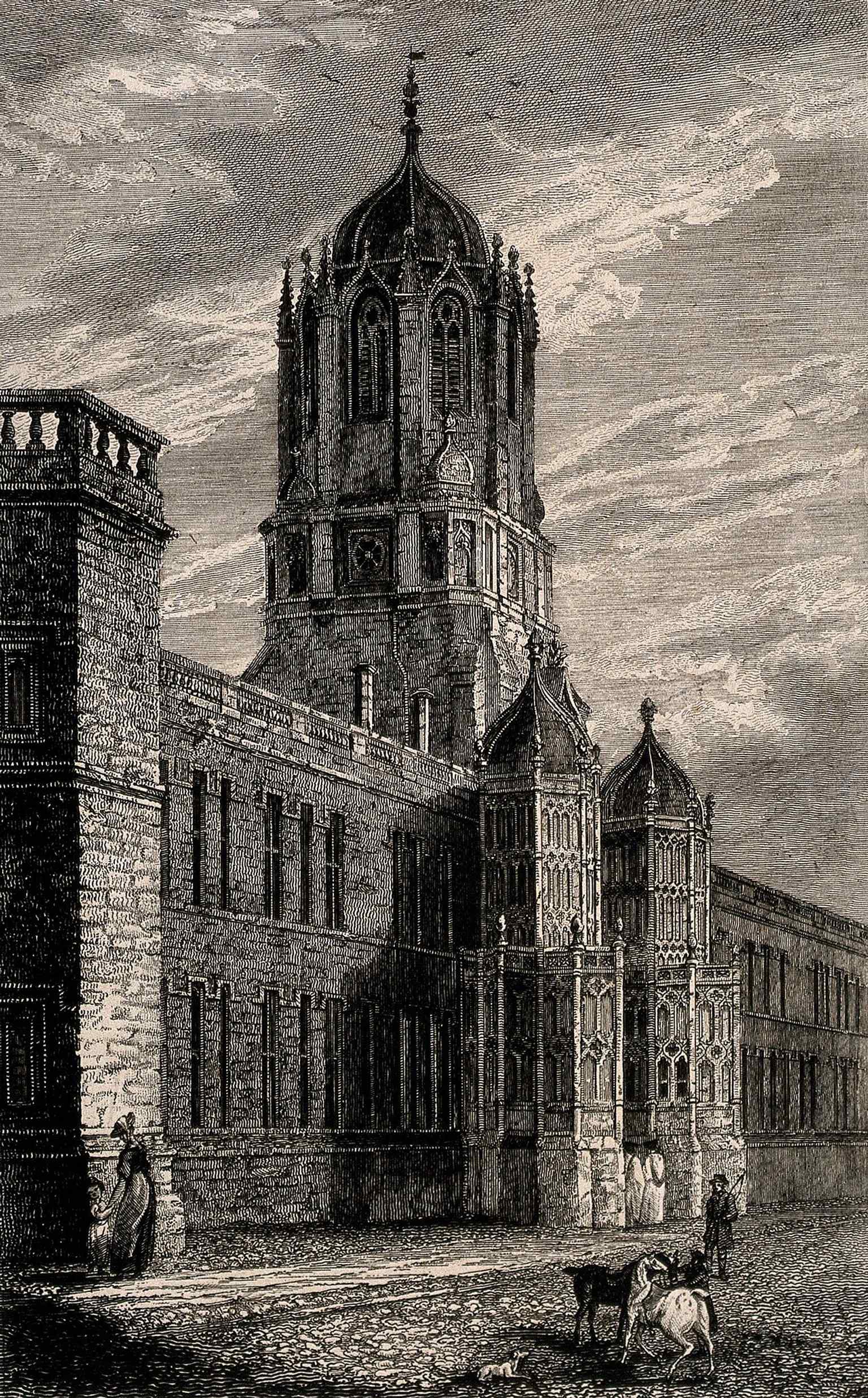
An 1825 etching of Tom Gate — showing Christ Church’s iconic entrance as it appeared in early 19th-century Oxford.Photo: J. Whessell, Wikimedia Commons, CC0. Cropped & resized. On your right stands a broad honey-colored stone frontage with tall arched windows and a carved central balcony, the grand face of Oxford Town Hall. Inside this civic…Read moreShow less
Open dedicated page →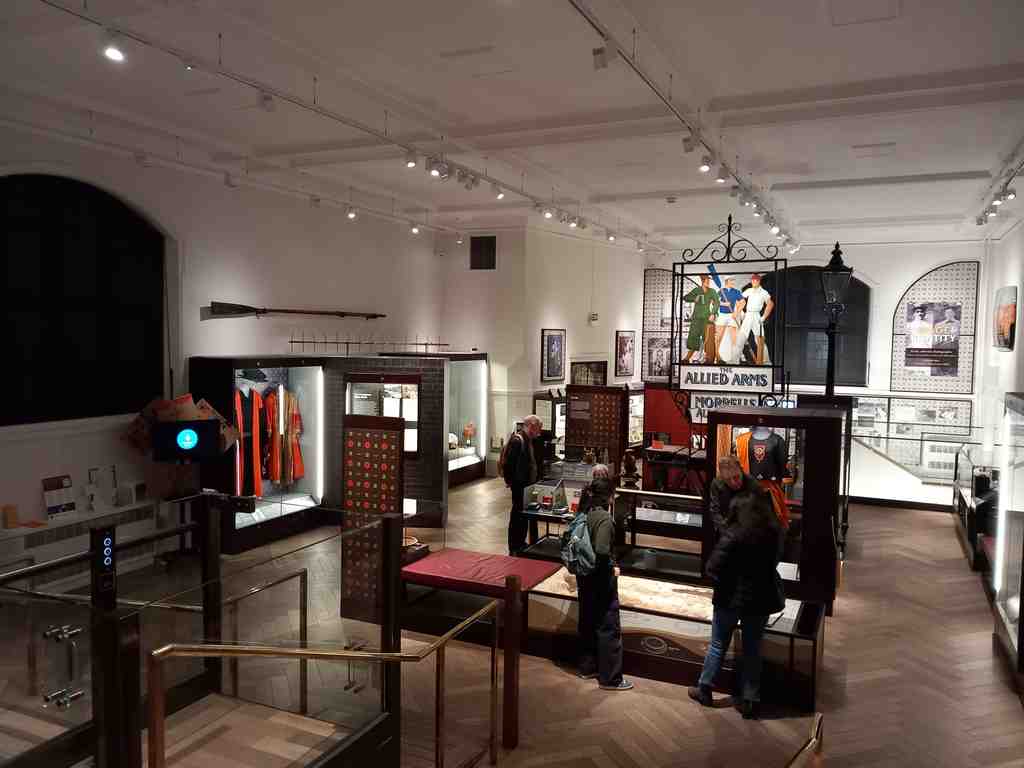
Museum of OxfordPhoto: The History Wizard of Cambridge, Wikimedia Commons, CC0. Cropped & resized. On your right stands a broad honey-colored stone frontage with tall arched windows and a carved central balcony, the grand face of Oxford Town Hall.
Inside this civic heavyweight sits the Museum of Oxford... and that matters, because Oxford is not only colleges, gowns, and people arguing politely in Latin. This museum tells the story of the city and its residents, from prehistoric Oxford to the present, and it has done that here since nineteen seventy-five, when it took over the old Oxford Public Library rooms.
What makes it good is its range. One minute you are face to face with Oliver Cromwell’s death mask. The next, you are looking at artefacts from Oxford’s medieval Jewish quarter, the city crest given by Elizabeth the First, a chunk of the Cutteslowe Wall that once divided communities by class, or Cold War gadgets designed to measure nuclear fallout... which is an awfully tense thing to display in a museum gift-shop world. There are also Rolling Stones concert tickets, a copy of Pink, Oxford’s first L-G-B-T newspaper, personal belongings from Lewis Carroll and Alice Liddell, and even a tin of Frank Cooper’s marmalade that joined Robert Falcon Scott’s doomed South Pole expedition.
In two thousand and five, a grant helped the museum collect Oxfordshire memories of the Second World War, preserving local voices instead of letting them drift away. Then came a rough patch. In two thousand and nine, the city council considered closing the museum because it cost about two hundred thousand pounds a year to run. Local campaigners pushed back, and volunteers helped keep it alive. That feels fitting for a museum about a city’s people... the people saved it.
You can see the refurbished main gallery on screen. Between two thousand and eighteen and two thousand and twenty-one, architects at Purcell led a major overhaul that tripled the museum’s space and expanded the displays from two hundred and eighty-six exhibits to around seven hundred and fifty. The museum reopened with a broader sense of who Oxford belongs to, including stronger displays on Black British history and queer history, plus a Windrush exhibition celebrating Caribbean life in Oxford since the nineteen fifties. The image of a volunteer guiding visitors through historic maps is apt, because more than one hundred volunteers now help power the place.
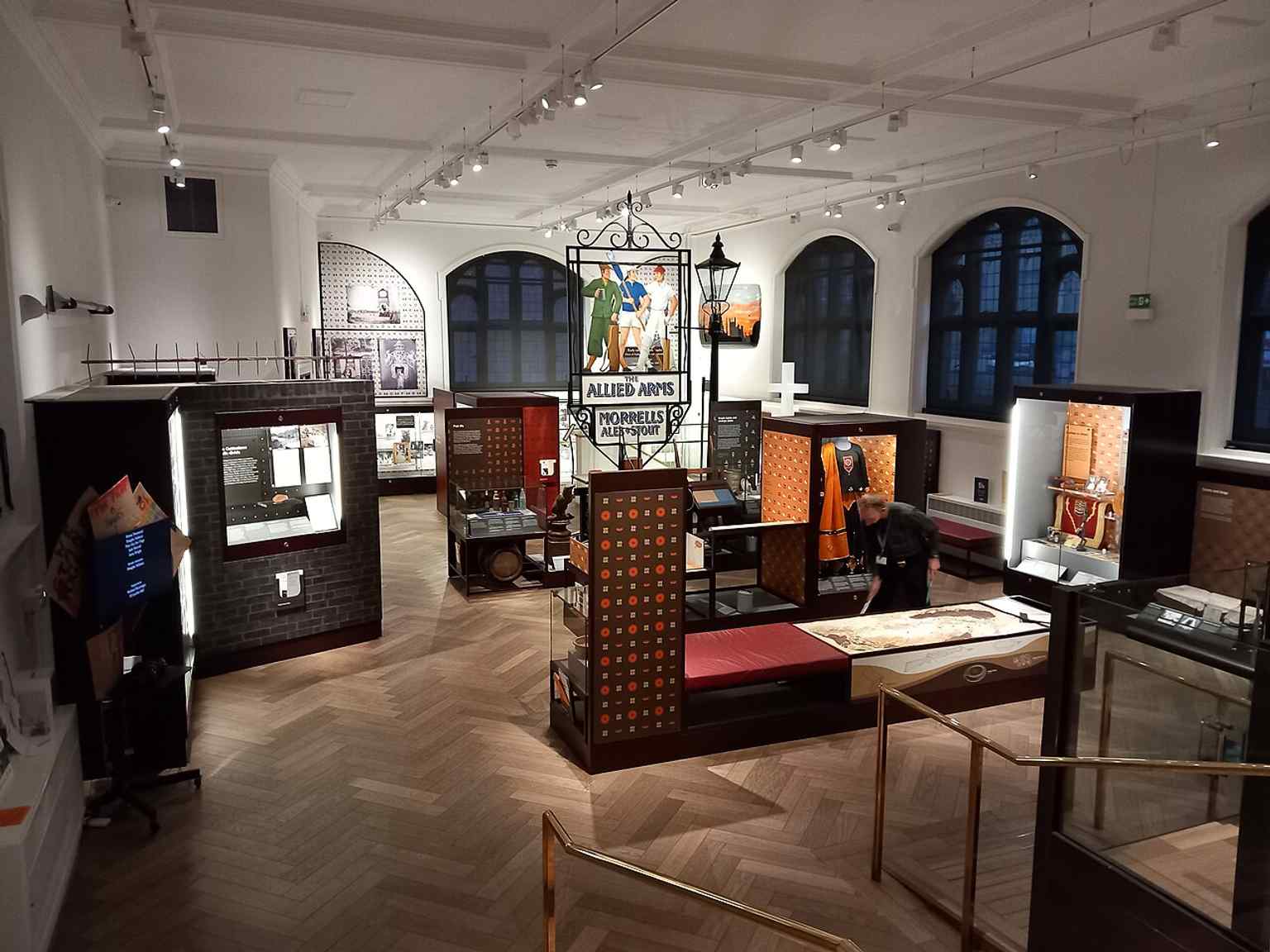
The refurbished main gallery, part of the museum’s 2021 expansion that tripled its display space.Photo: The History Wizard of Cambridge, Wikimedia Commons, CC0. Cropped & resized. It also works as a meeting space, a classroom, and occasionally a stage. In two thousand and twenty-three, it hosted Little Edens, a play about the Florence Park rent strikes of nineteen thirty-four... proof that local history does not have to sit quietly in a case.
If you want to go in later, it usually opens Monday to Saturday from ten in the morning to five in the afternoon, and stays closed on Sunday.
This is Oxford telling its own story, in its own voice. When you’re ready, continue on toward Cornmarket Street.
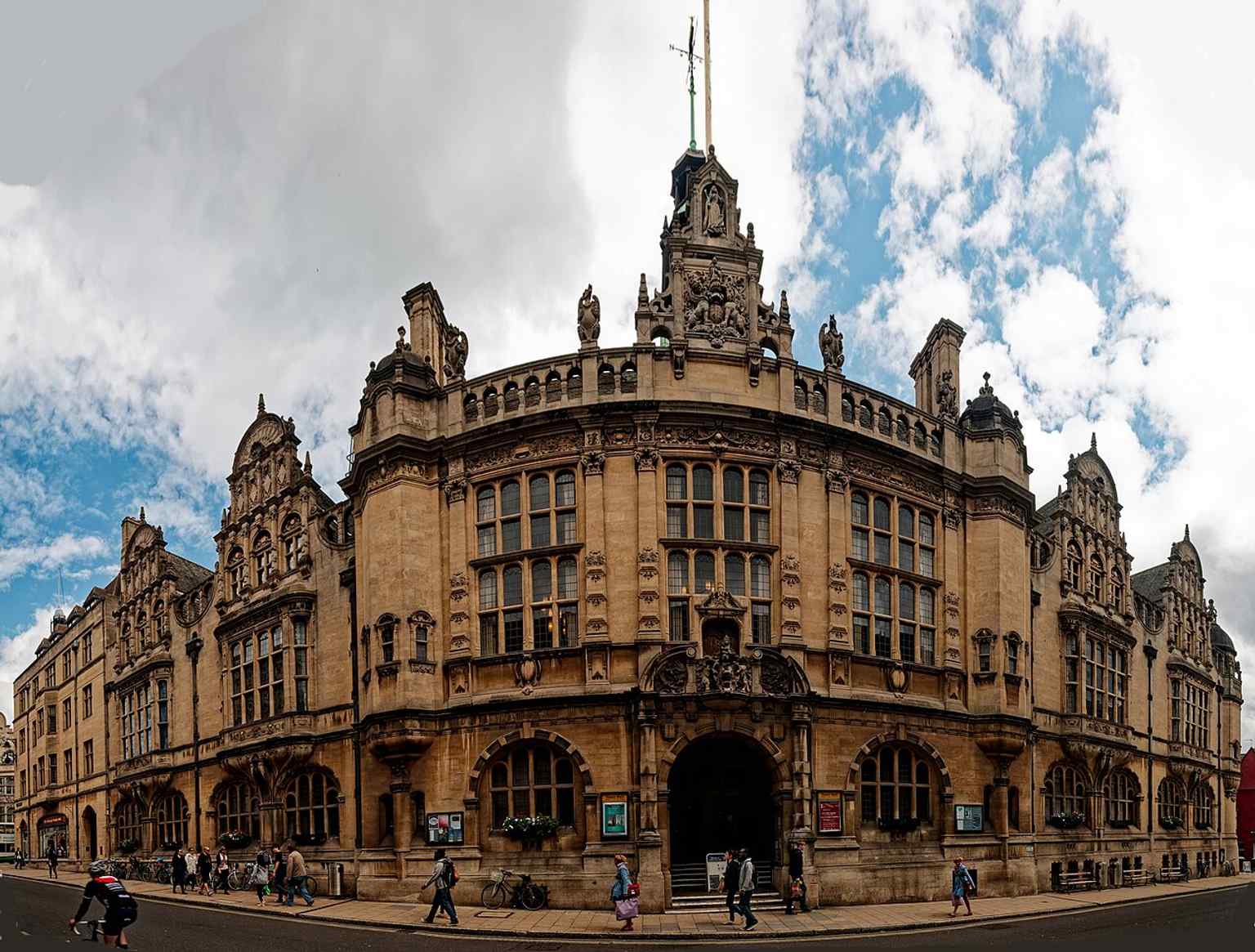
Oxford Town Hall on St Aldate’s — the historic building that houses the Museum of Oxford in the city centre.Photo: Txllxt TxllxT, Wikimedia Commons, CC BY-SA 4.0. Cropped & resized. 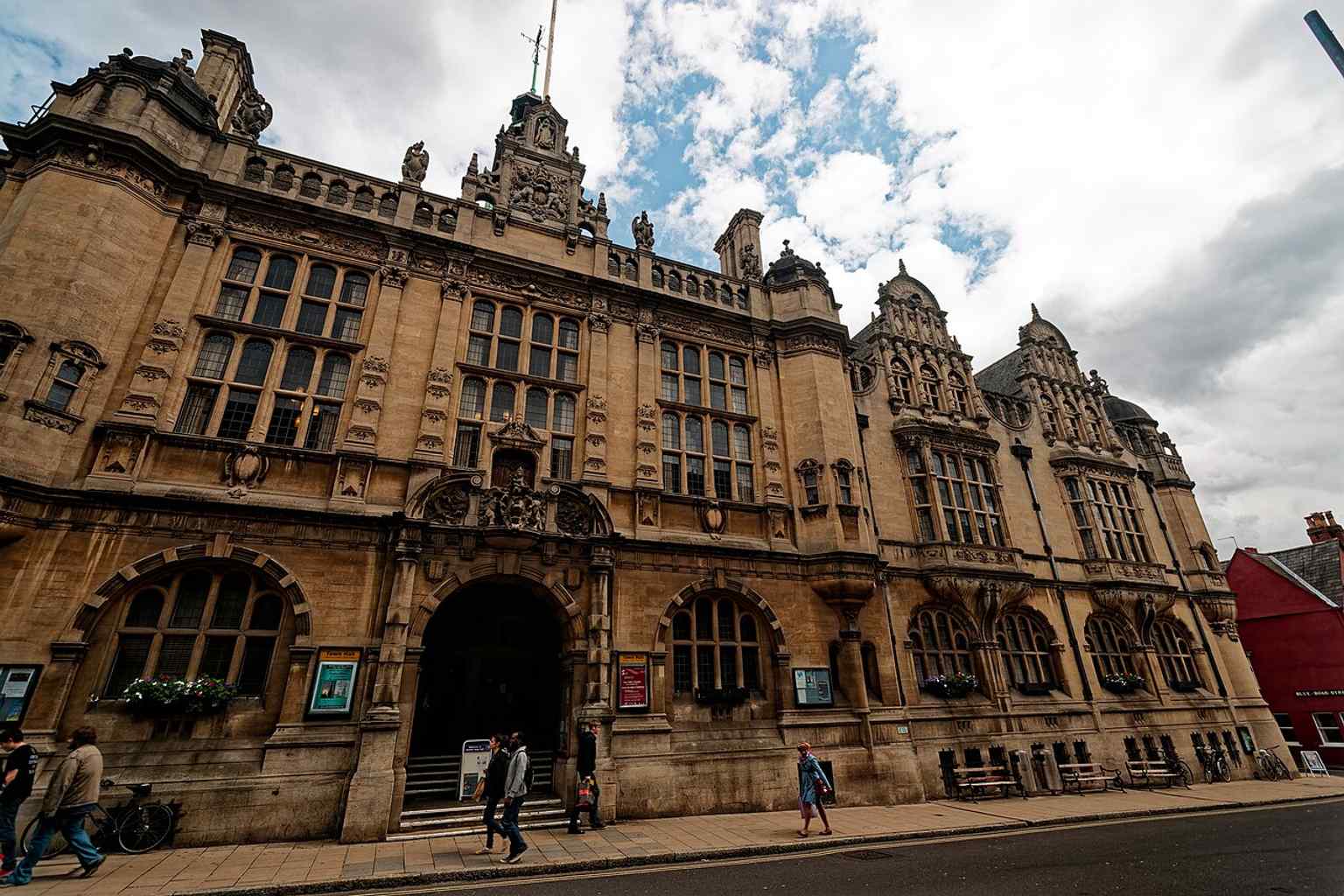
A wider view of Oxford Town Hall, showing the landmark building that now contains the Museum of Oxford.Photo: Txllxt TxllxT, Wikimedia Commons, CC BY-SA 4.0. Cropped & resized. 
A volunteer guiding visitors through historic maps, reflecting the museum’s reliance on more than 100 volunteers.Photo: The History Wizard of Cambridge, Wikimedia Commons, CC0. Cropped & resized. 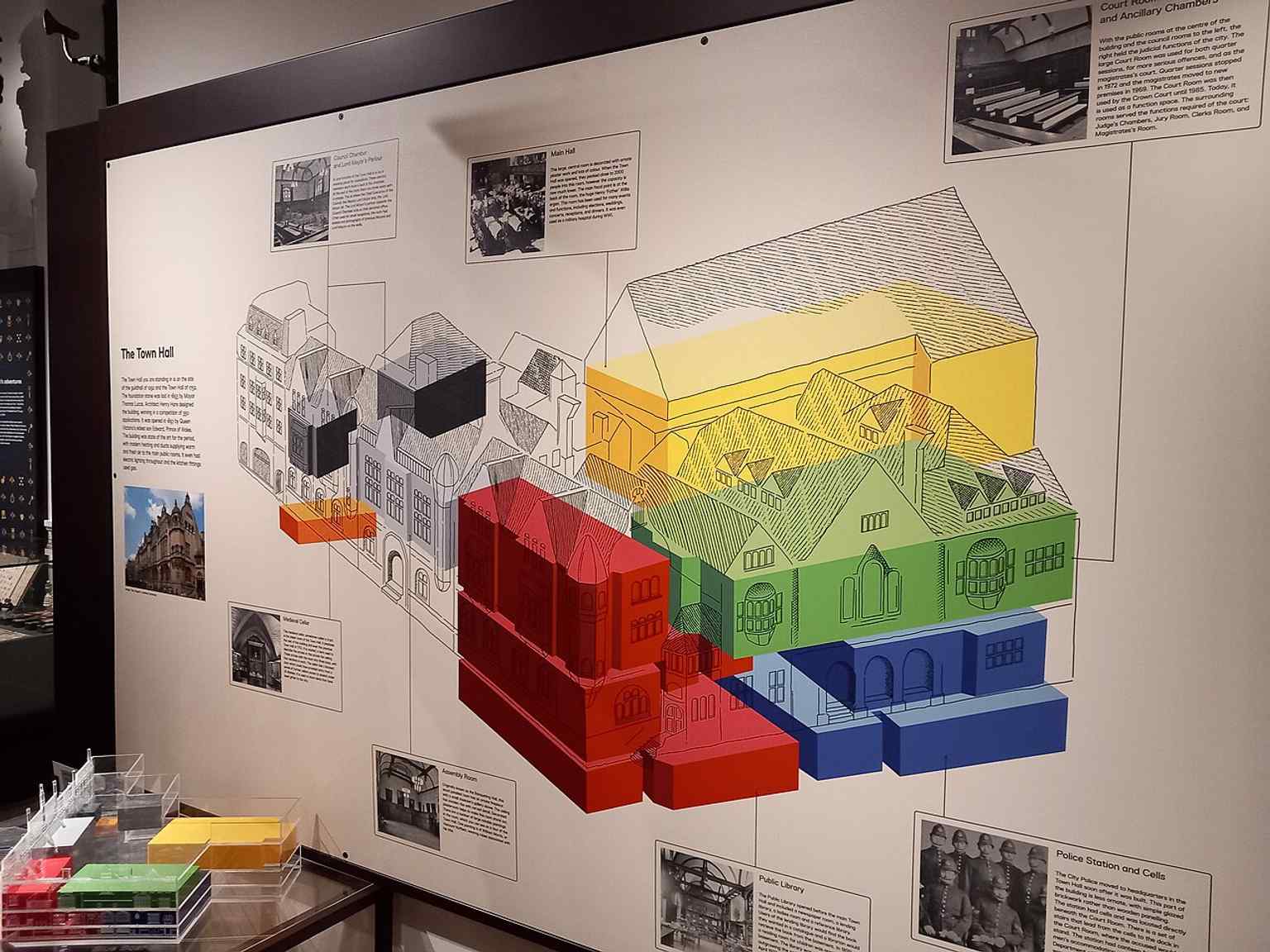
A map showing the museum’s ground floor and basement rooms inside Oxford Town Hall.Photo: The History Wizard of Cambridge, Wikimedia Commons, CC0. Cropped & resized. 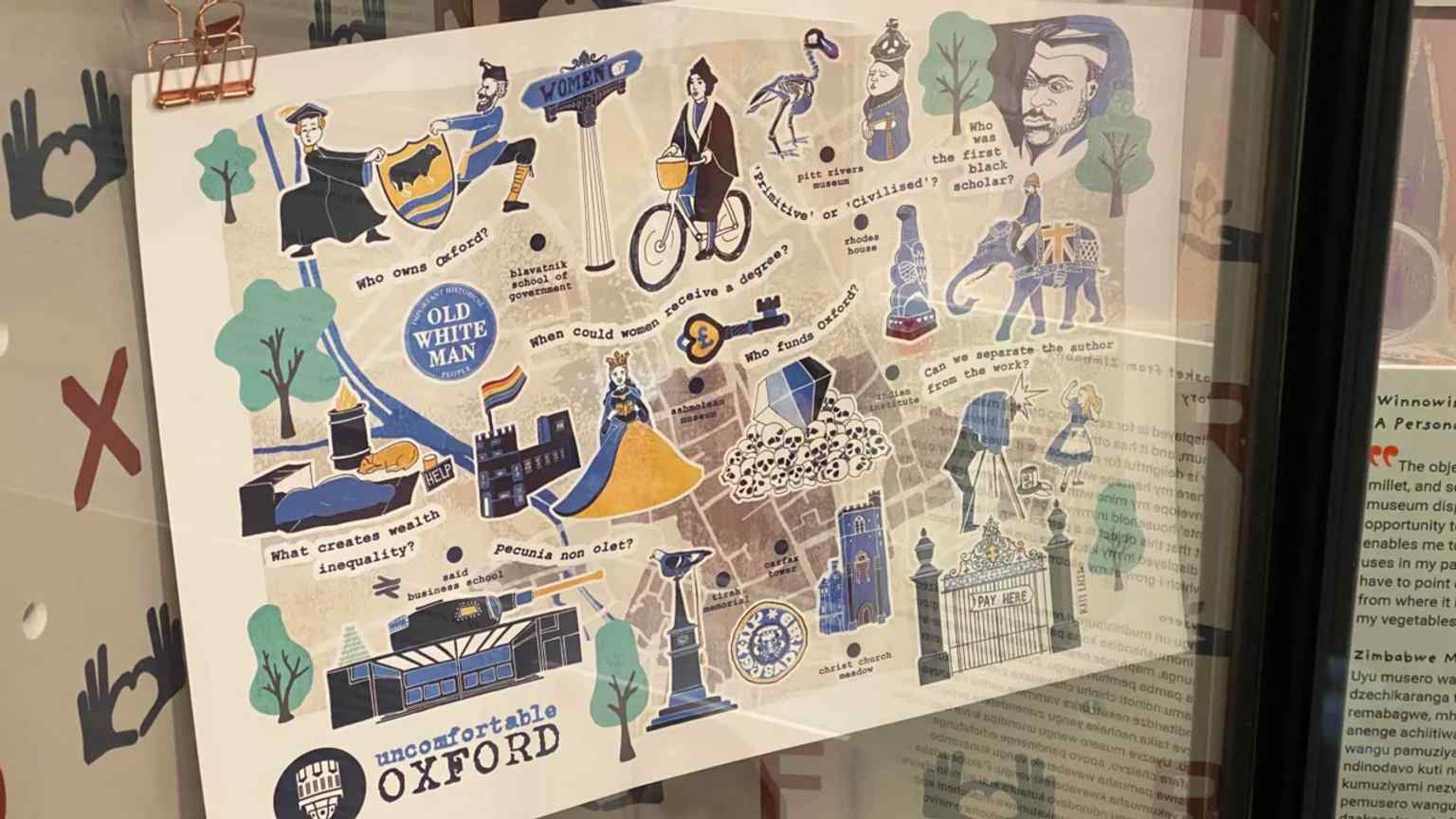
Anniversary display cases showing how the museum continues to expand its Oxford history collections.Photo: Cornmarket-26-28, Wikimedia Commons, CC0. Cropped & resized. Cornmarket is a long, straight pedestrian street paved in pale stone, lined with brick-and-stone shopfronts, and marked at its northern end by the Saxon tower of Saint Michael at…Read moreShow less
Open dedicated page →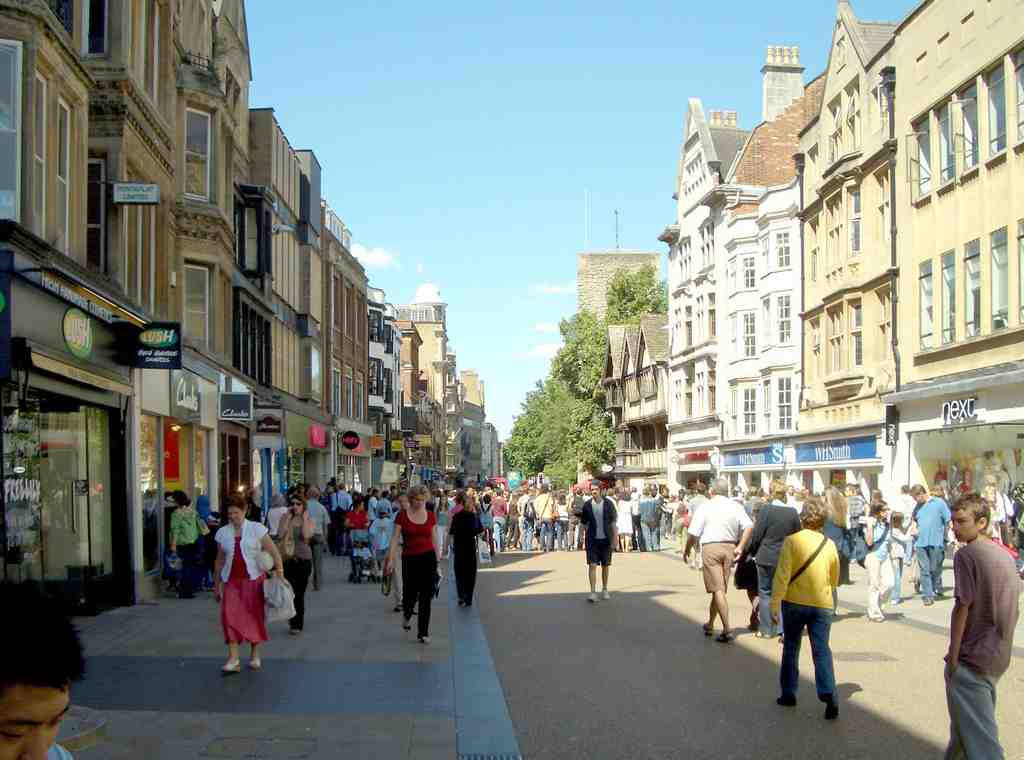
Cornmarket StreetPhoto: APK, Wikimedia Commons, CC BY 4.0. Cropped & resized. Cornmarket is a long, straight pedestrian street paved in pale stone, lined with brick-and-stone shopfronts, and marked at its northern end by the Saxon tower of Saint Michael at the North Gate.
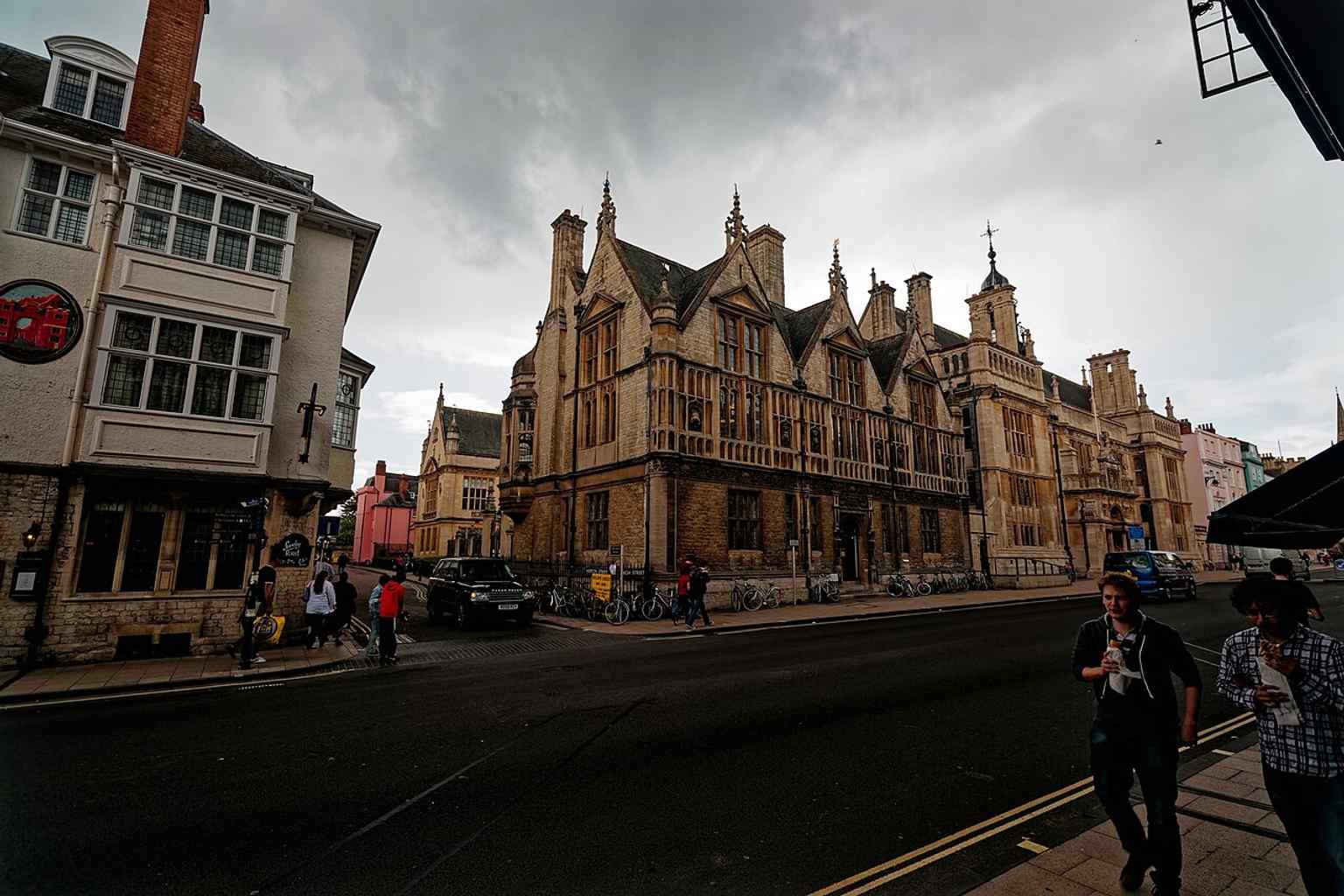
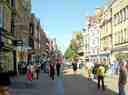
This is Oxford’s main shopping street, known simply as The Corn, running north to south between Magdalen Street and Carfax Tower. It looks ordinary enough for a place where people buy socks and sandwiches... but Oxford rarely leaves anything pleasantly simple for long.
In two thousand and two, a radio poll voted Cornmarket the second worst street in Britain. The reason was not some grand moral collapse. It was paving. In two thousand and one, workers laid granite setts - small rectangular paving stones - across much of the street. They cracked, the contractor went bust, and the city had to repave the whole thing again in two thousand and three, adding benches while wrestling with budget trouble. Urban drama, Oxford style.
If you glance at your screen, there’s a useful older view from Carfax that shows Cornmarket before those later fixes. And near Ship Street, another image picks out one of the real survivors here: the New Inn at twenty-six to twenty-eight Cornmarket. That timber-framed building dates to about thirteen eighty-six, though only half of it survives now. Jesus College owns it, and specialists restored it in nineteen eighty-three.
Cornmarket also carries a trail of vanished businesses. Boswells opened here in seventeen thirty-eight and grew into Oxford’s biggest department store before closing in twenty twenty. Photographer Henry Taunt started at number thirty-three in eighteen sixty-nine before moving to Broad Street. Zac’s sold waterproof clothing from the eighteen eighties until nineteen eighty-three... which feels very sensible in England.
On the west side, Woolworths bought the old Clarendon Hotel in nineteen thirty-nine and eventually demolished it in the nineteen fifties, despite warnings from planner Thomas Sharp. Worse, builders destroyed part of its twelfth-century vaulted cellar - an underground room with a curved stone ceiling - to fit a column for Clarendon House.
Cornmarket turns Oxford into a running argument between old stone and new money. When you’re ready, head east through Golden Cross toward the Covered Market.
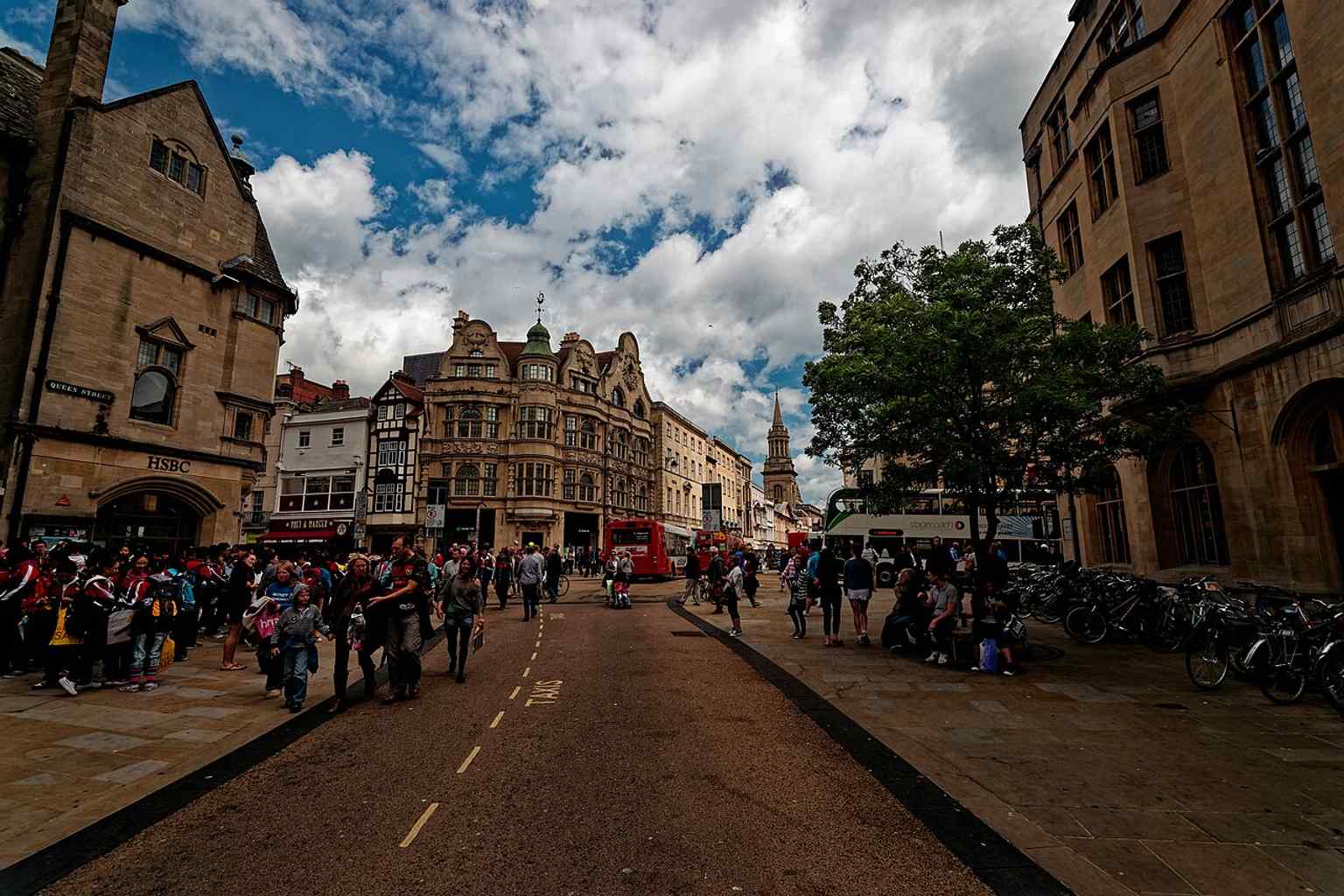
Looking west from Cornmarket toward Carfax and Queen Street, where the street meets Oxford’s main pedestrian shopping area.Photo: Txllxt TxllxT, Wikimedia Commons, CC BY-SA 4.0. Cropped & resized. 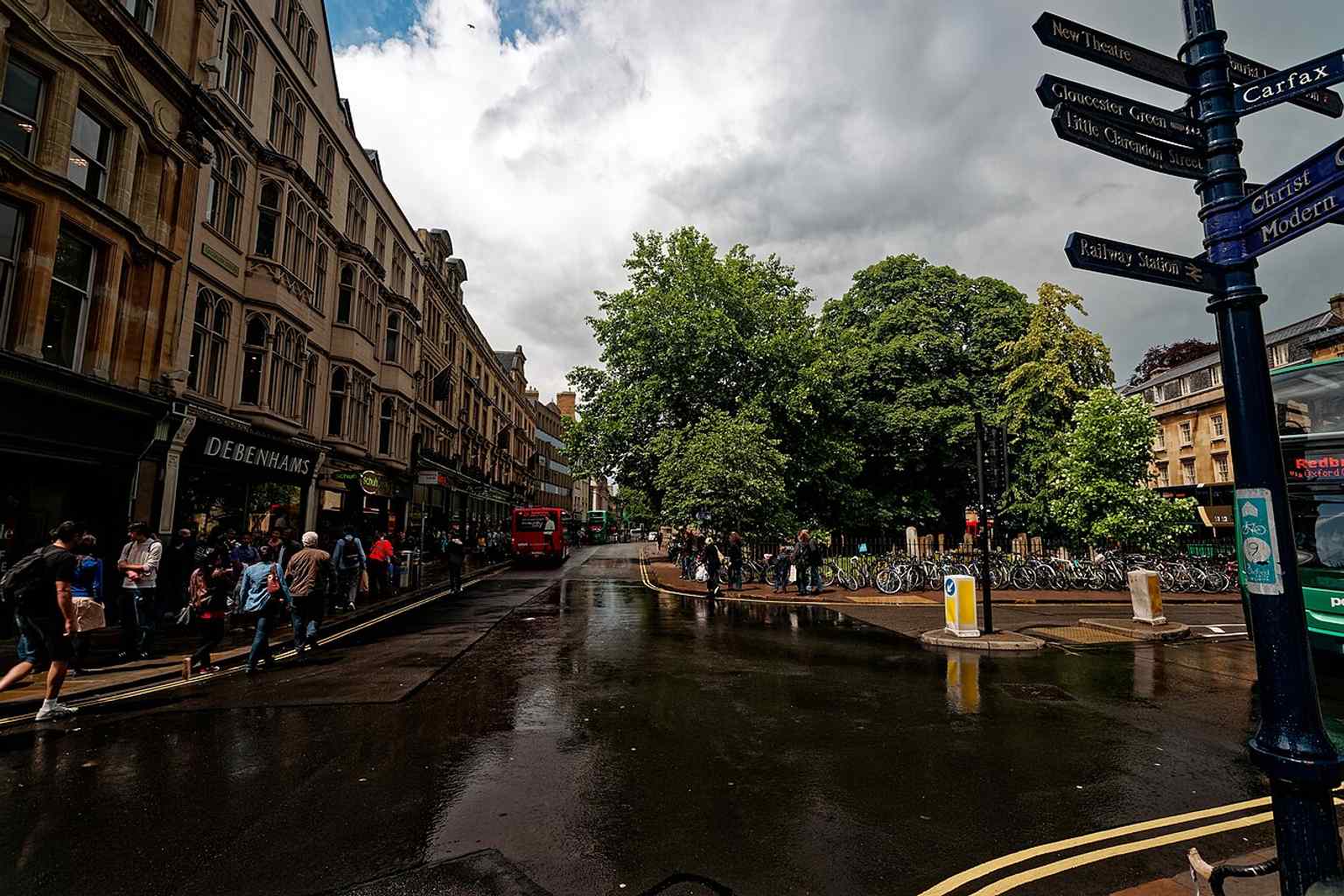
A clear view along Cornmarket Street, the north–south shopping street that links Magdalen Street with Carfax Tower.Photo: Txllxt TxllxT, Wikimedia Commons, CC BY-SA 4.0. Cropped & resized. 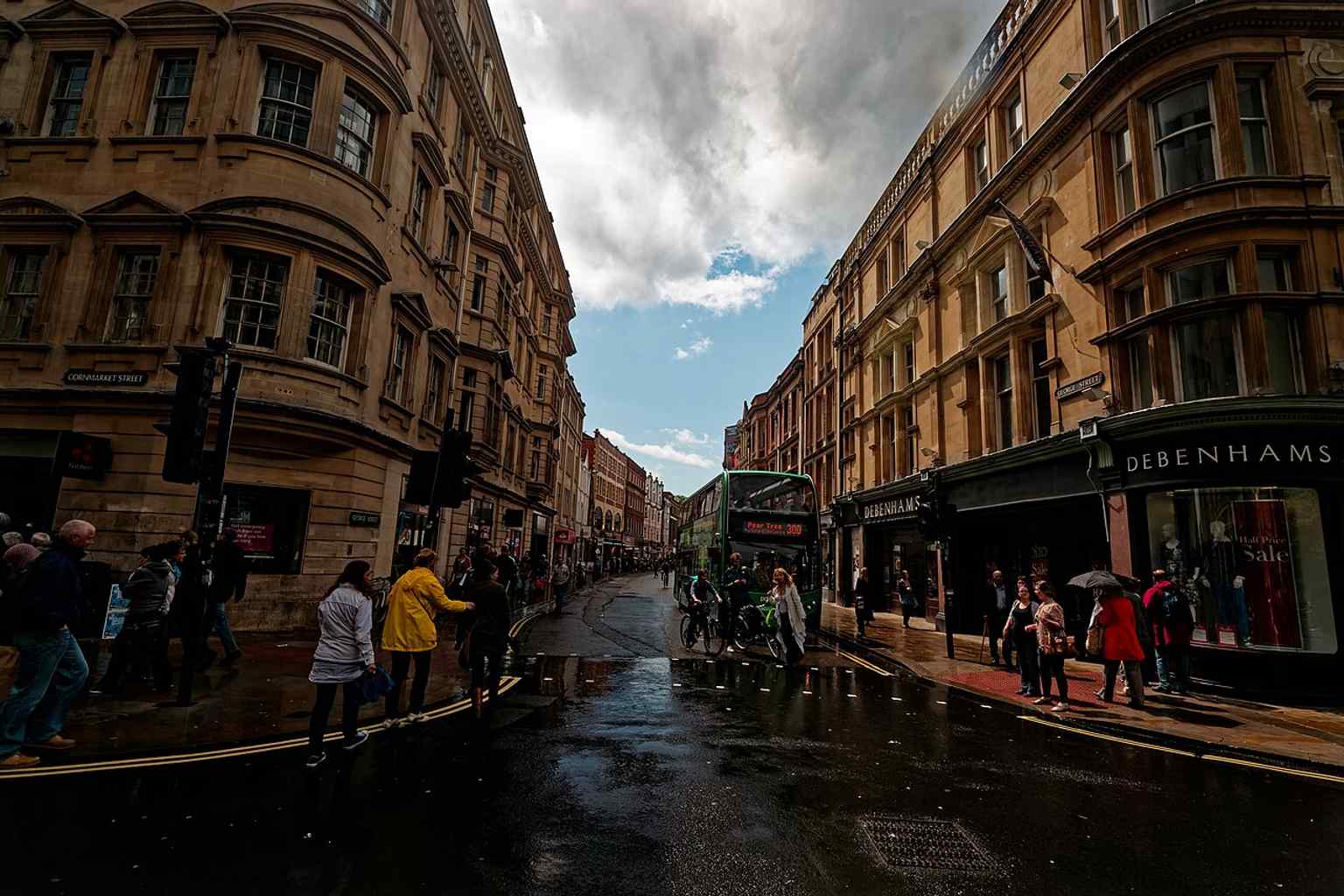
The Cornmarket junction with George Street, showing how this pedestrian precinct connects to the city centre streets around it.Photo: Txllxt TxllxT, Wikimedia Commons, CC BY-SA 4.0. Cropped & resized. 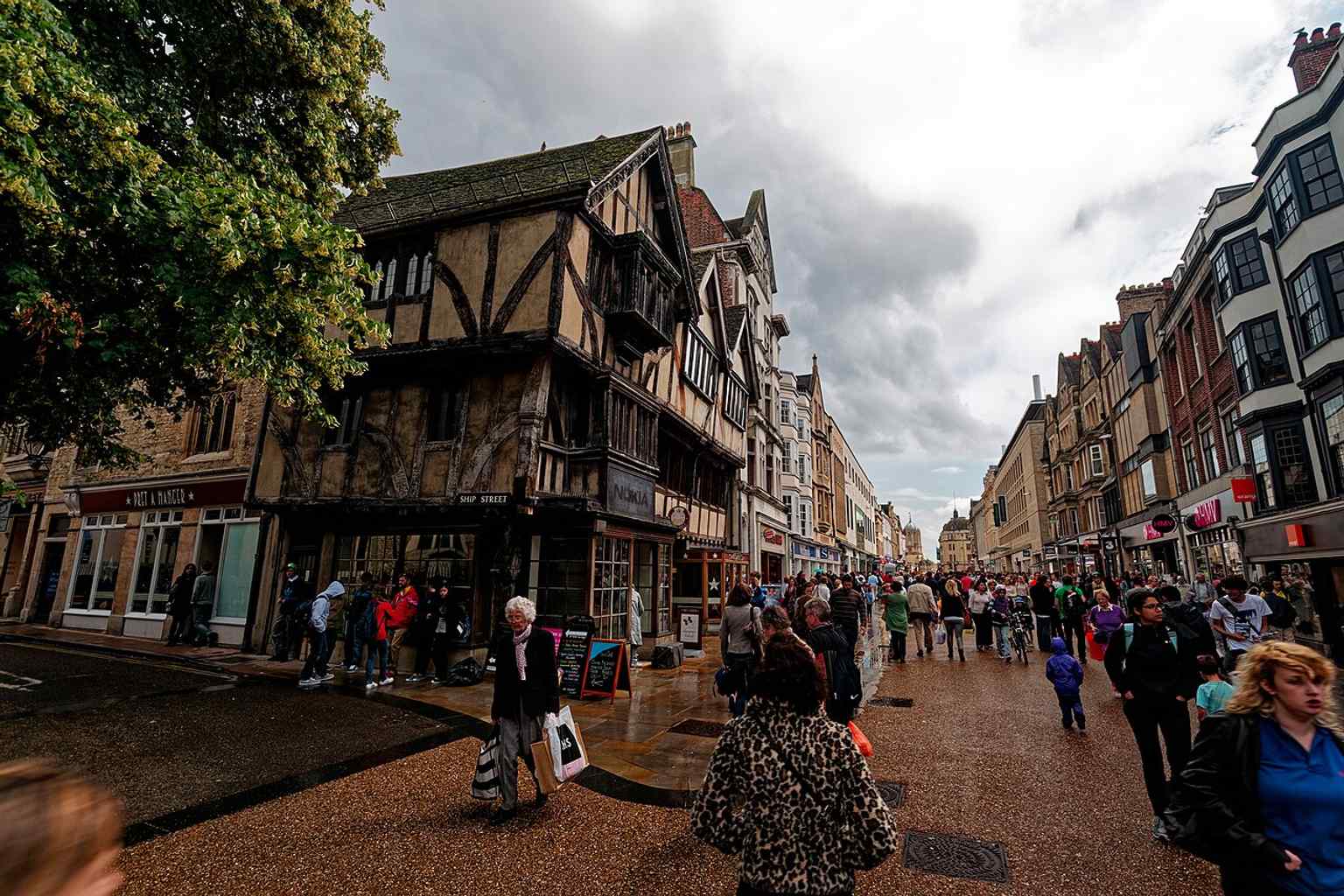
Cornmarket by Ship Street, near the 14th-century timber-framed New Inn at 26–28 Cornmarket on the corner.Photo: Txllxt TxllxT, Wikimedia Commons, CC BY-SA 4.0. Cropped & resized. 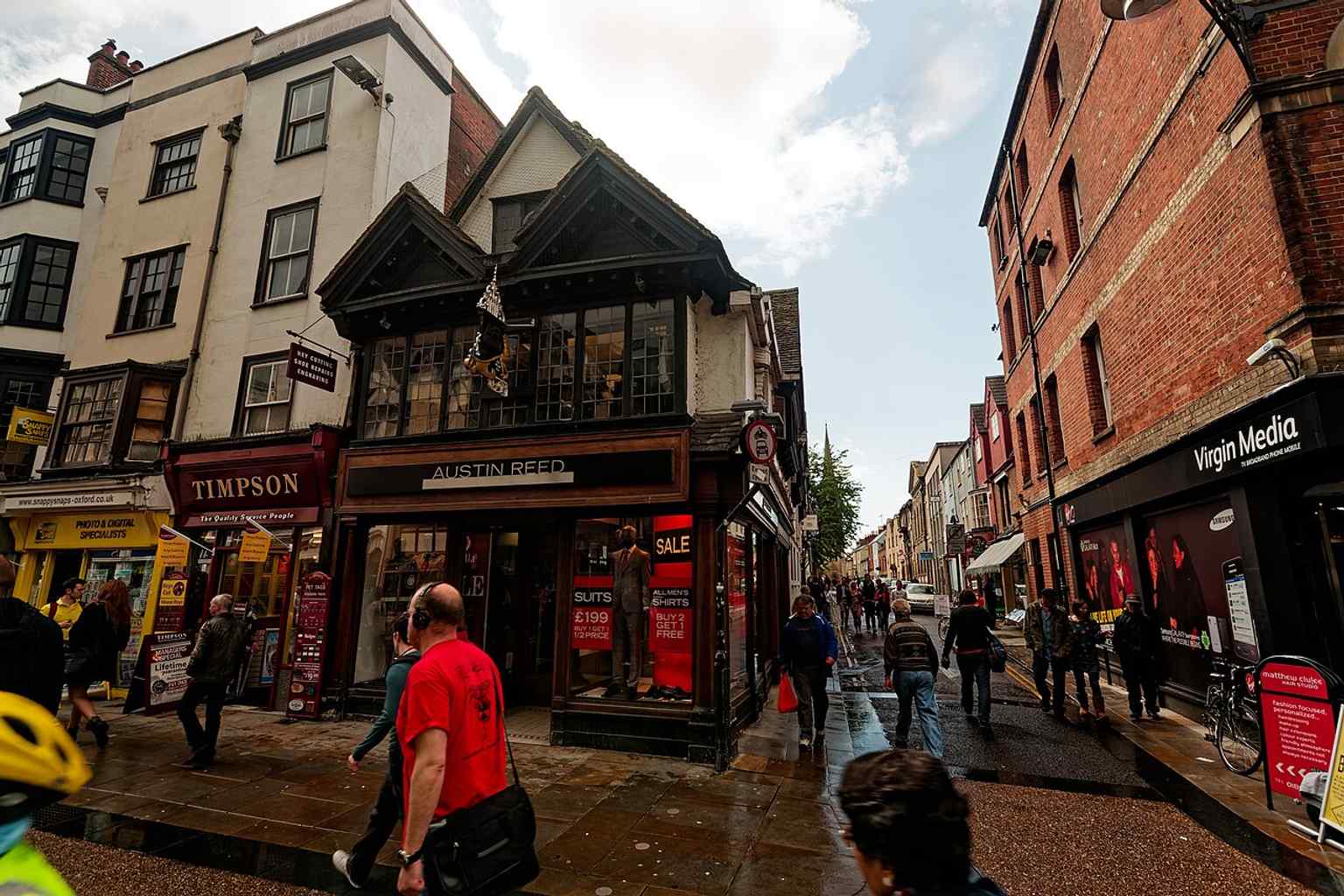
Looking into St Michael’s Street beside Cornmarket, close to St Michael at the North Gate, Oxford’s oldest building.Photo: Txllxt TxllxT, Wikimedia Commons, CC BY-SA 4.0. Cropped & resized. 
A modern shopfront on Cornmarket Street, showing the street’s continuing role as Oxford’s busy retail precinct.Photo: DanielMichaelPerry, Wikimedia Commons, CC0. Cropped & resized. Ahead of you is a long pale-stone frontage with rounded arch entrances, plain upper windows, and the Covered Market name set above one of Oxford’s oldest indoor trading halls.…Read moreShow less
Open dedicated page →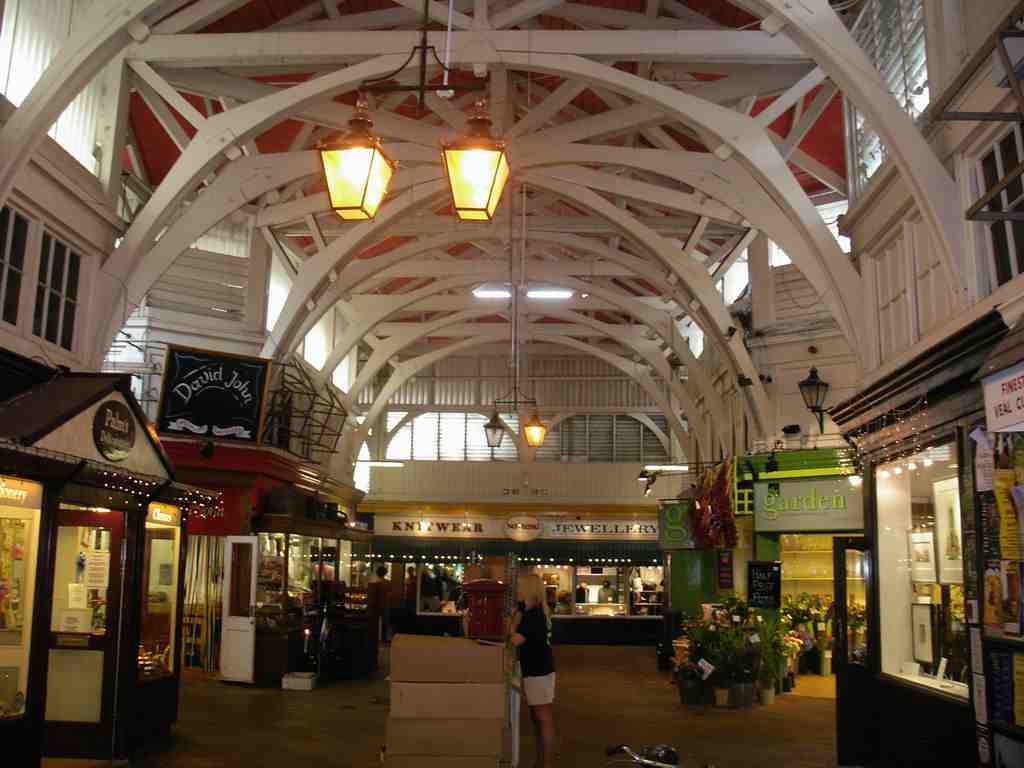
Covered Market, OxfordPhoto: User:M stone, Wikimedia Commons, CC BY-SA 3.0. Cropped & resized. Ahead of you is a long pale-stone frontage with rounded arch entrances, plain upper windows, and the Covered Market name set above one of Oxford’s oldest indoor trading halls.
The city opened this market on the first of November, seventeen seventy-four, because people had grown tired of what records called the “untidy, messy and unsavoury” stalls clogging the main streets. Oxford solved the problem in a very Oxford way... organize it, committee it, and put a roof over it. In seventeen seventy-two, a new market committee, split evenly between town and university, approved nine hundred and sixteen pounds and ten shillings for twenty butchers’ shops - well over a hundred thousand pounds in today’s money. John Gwynn, the architect who also designed Magdalen Bridge, drew up the plans and designed this High Street front with its four entrances.
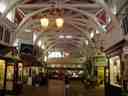
After seventeen seventy-three, meat could only be sold inside the market, and that first row of butchers quickly grew into stalls for garden produce, pig meat, dairy, and fish. The butcher’s stall image gives you a neat link to those original rows of shops. Another photo shows the interior arcade, the covered passage that replaced the old street-market muddle.
It still works as a real market today: around half the traders sell food, including butchers, greengrocers, bakeries, sandwich shops, and even Oxford sausage. Oxford City Council invested one point six million pounds in repairs and improvements in twenty seventeen, the same year King Charles the Third - then Prince Charles - and Camilla visited.
This place turned civic tidiness into a lasting Oxford institution. If you want to look inside later, it’s generally open from eight to five-thirty, later on Thursday through Saturday and from ten on Sunday; when you’re ready, continue toward the Sheldonian Theatre.
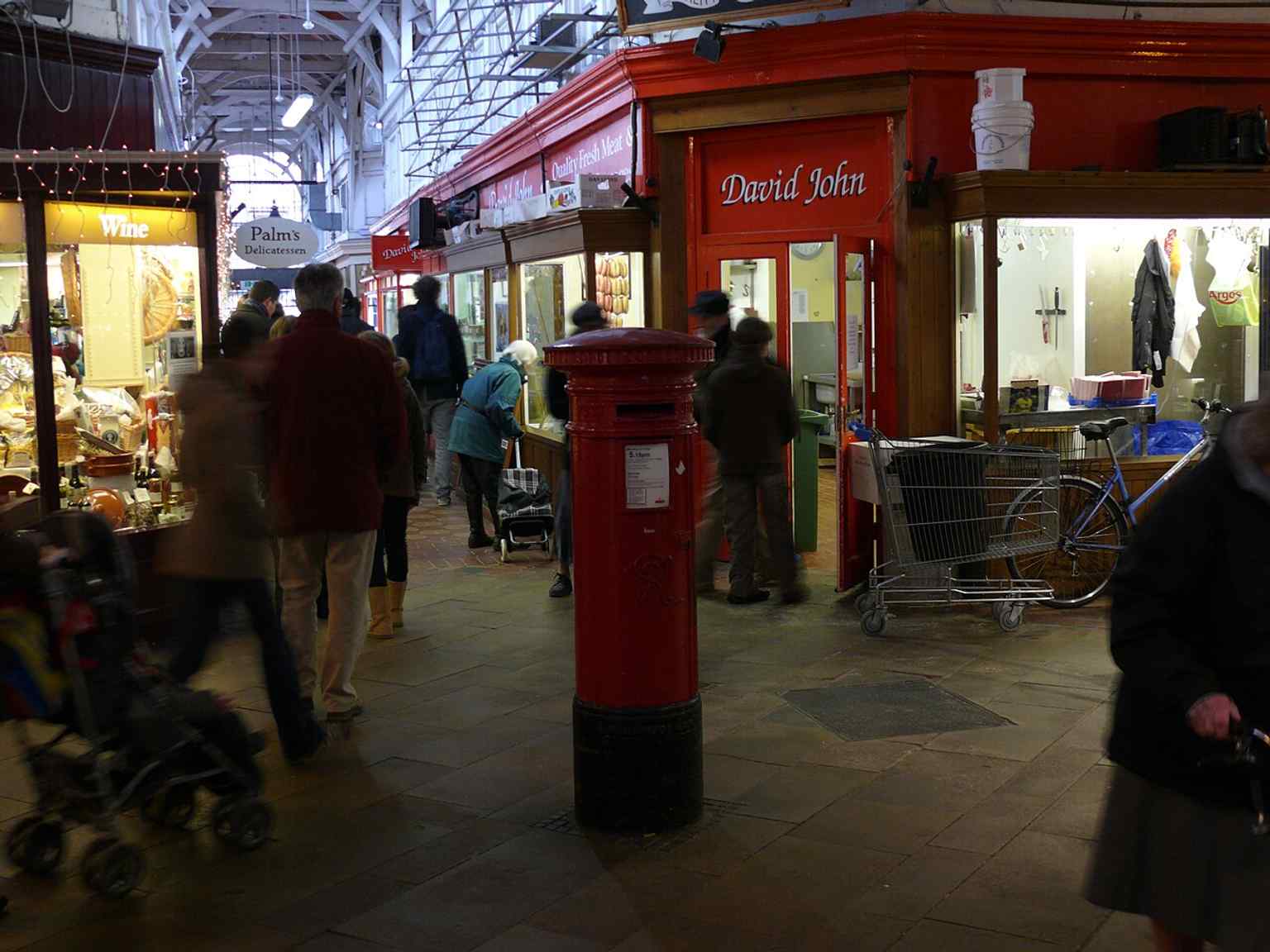
A clear view of the Covered Market’s listed façade, the historic building that has anchored Oxford’s market since 1774.Photo: Andrew Gray, Wikimedia Commons, CC BY-SA 3.0. Cropped & resized. 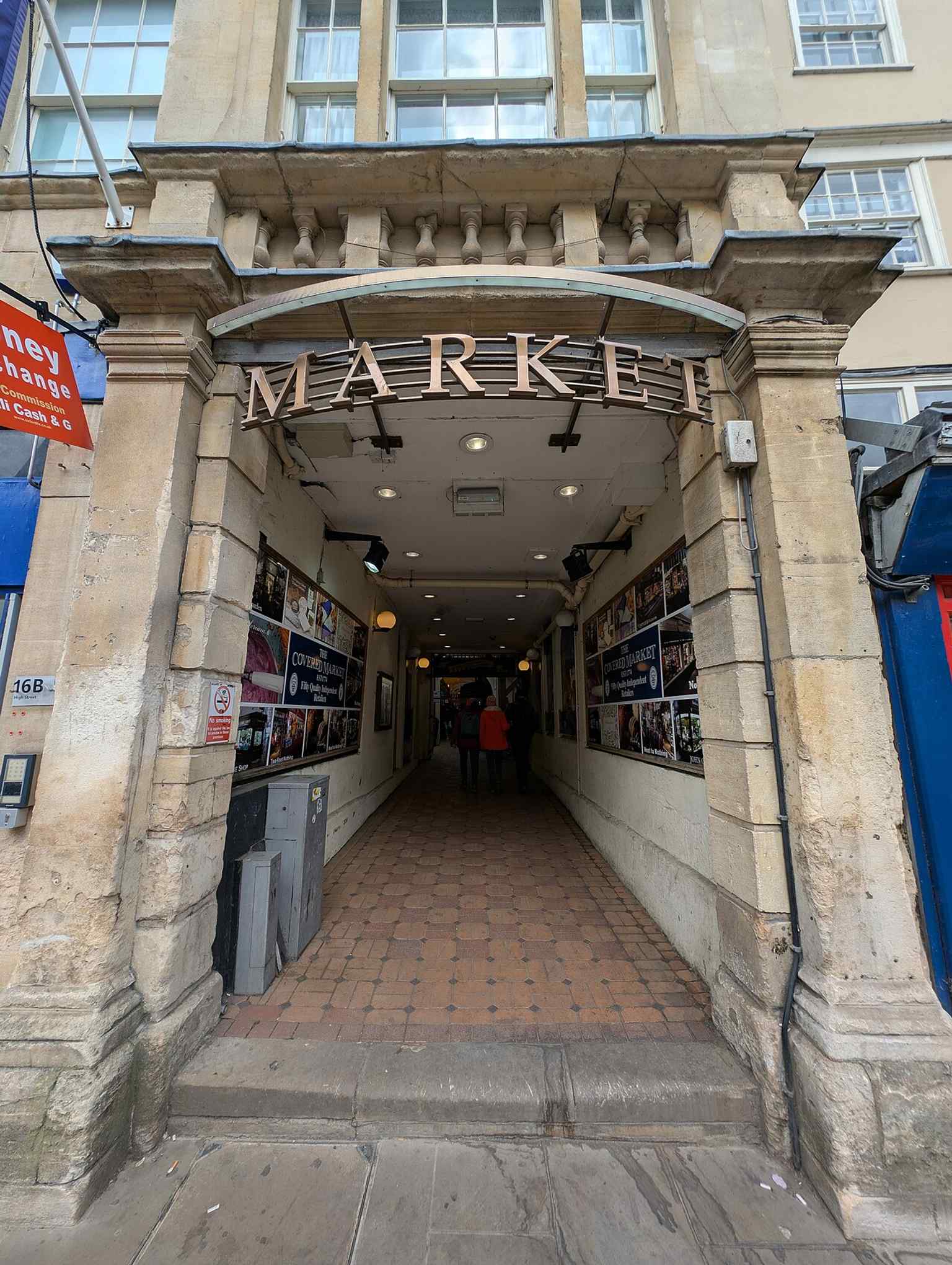
One of the market entrances, matching the source’s detail that visitors can enter from multiple High Street and Market Street access points.Photo: Andy Li, Wikimedia Commons, CC0. Cropped & resized. 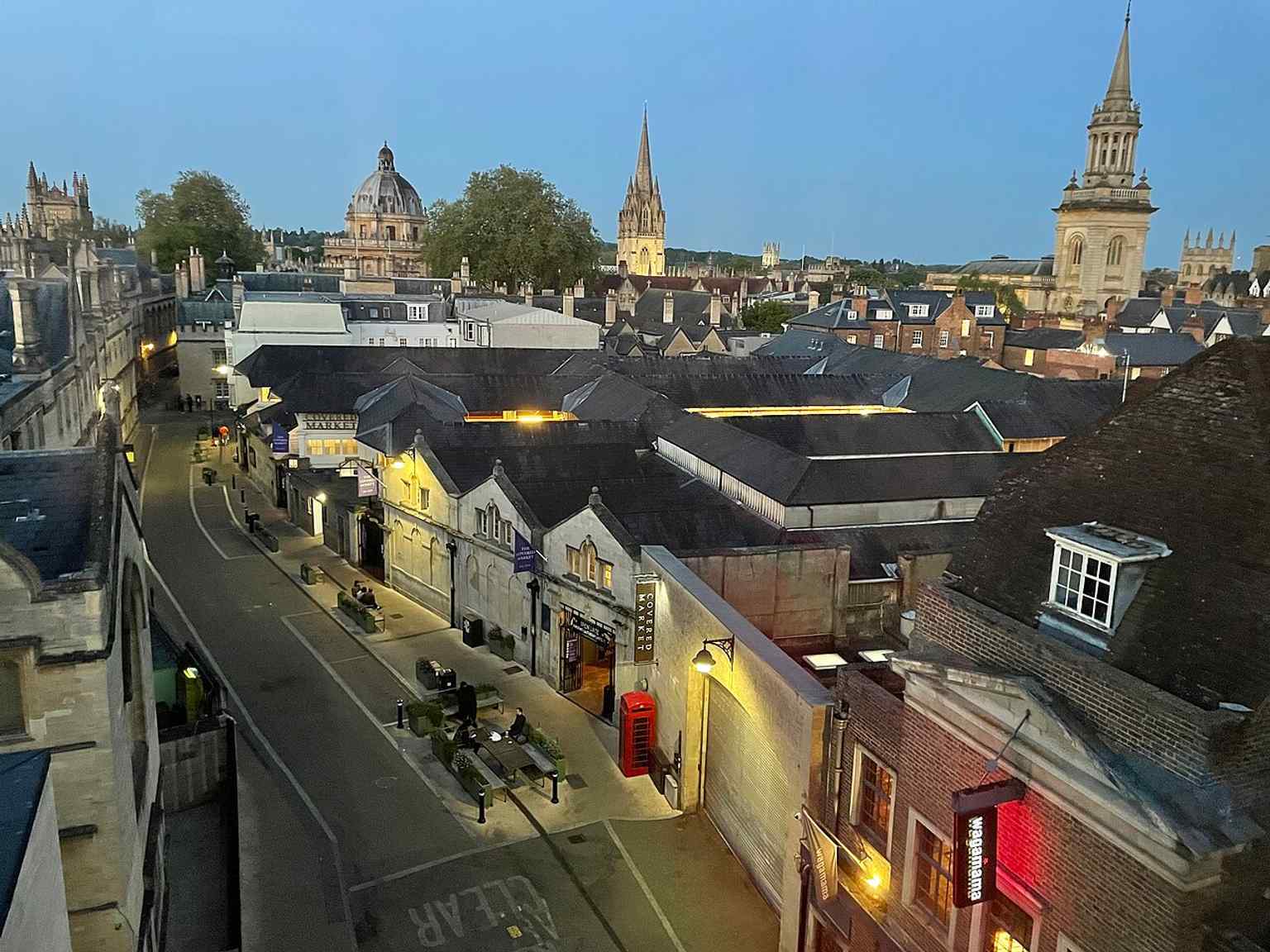
An overhead view of Market Street beside the Covered Market, helping place the market in Oxford’s street grid.Photo: Addedentry, Wikimedia Commons, CC0. Cropped & resized. 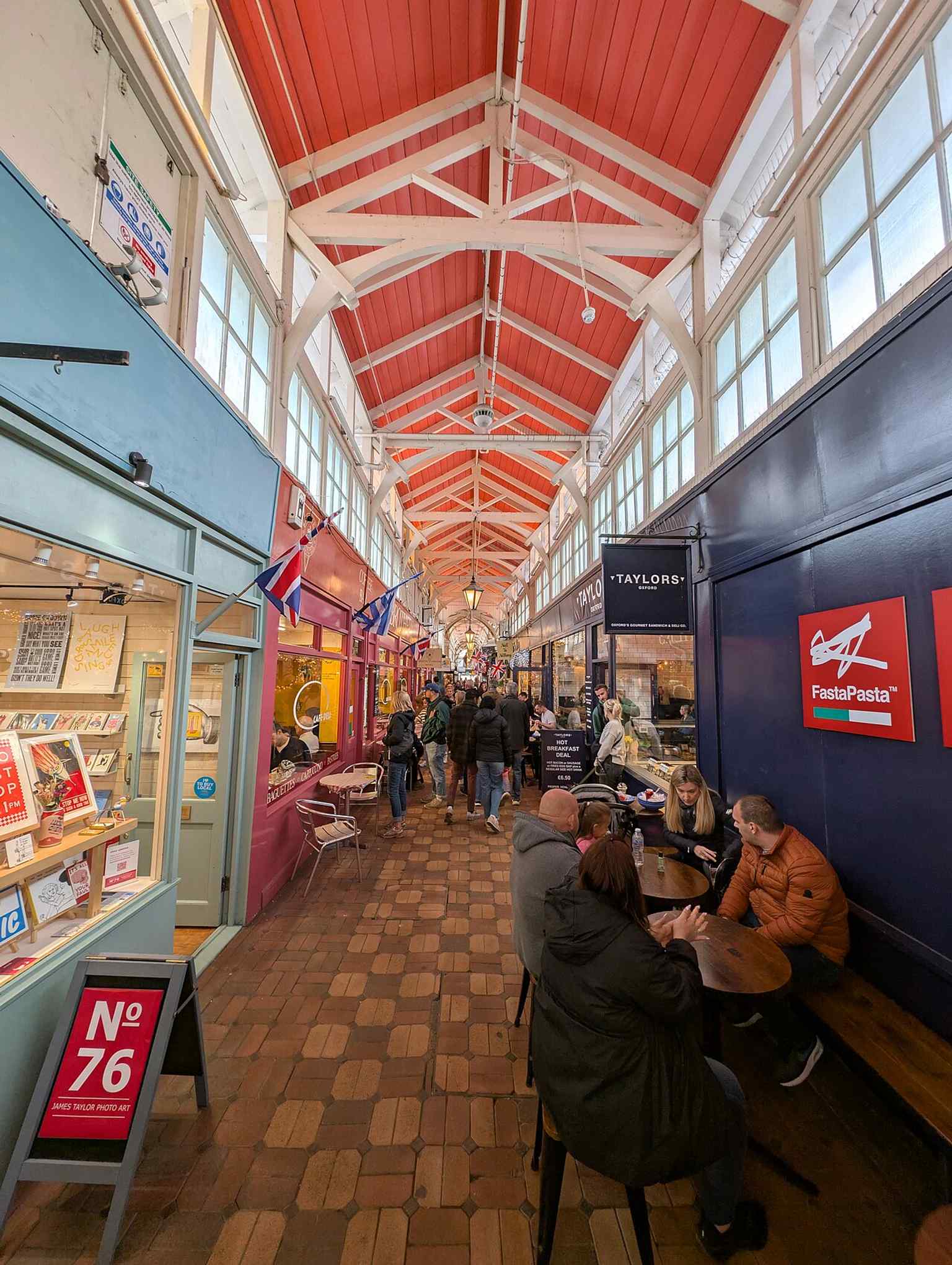
A modern full-building view of the Covered Market, showing the long covered structure still in active use today.Photo: Andy Li, Wikimedia Commons, CC0. Cropped & resized. 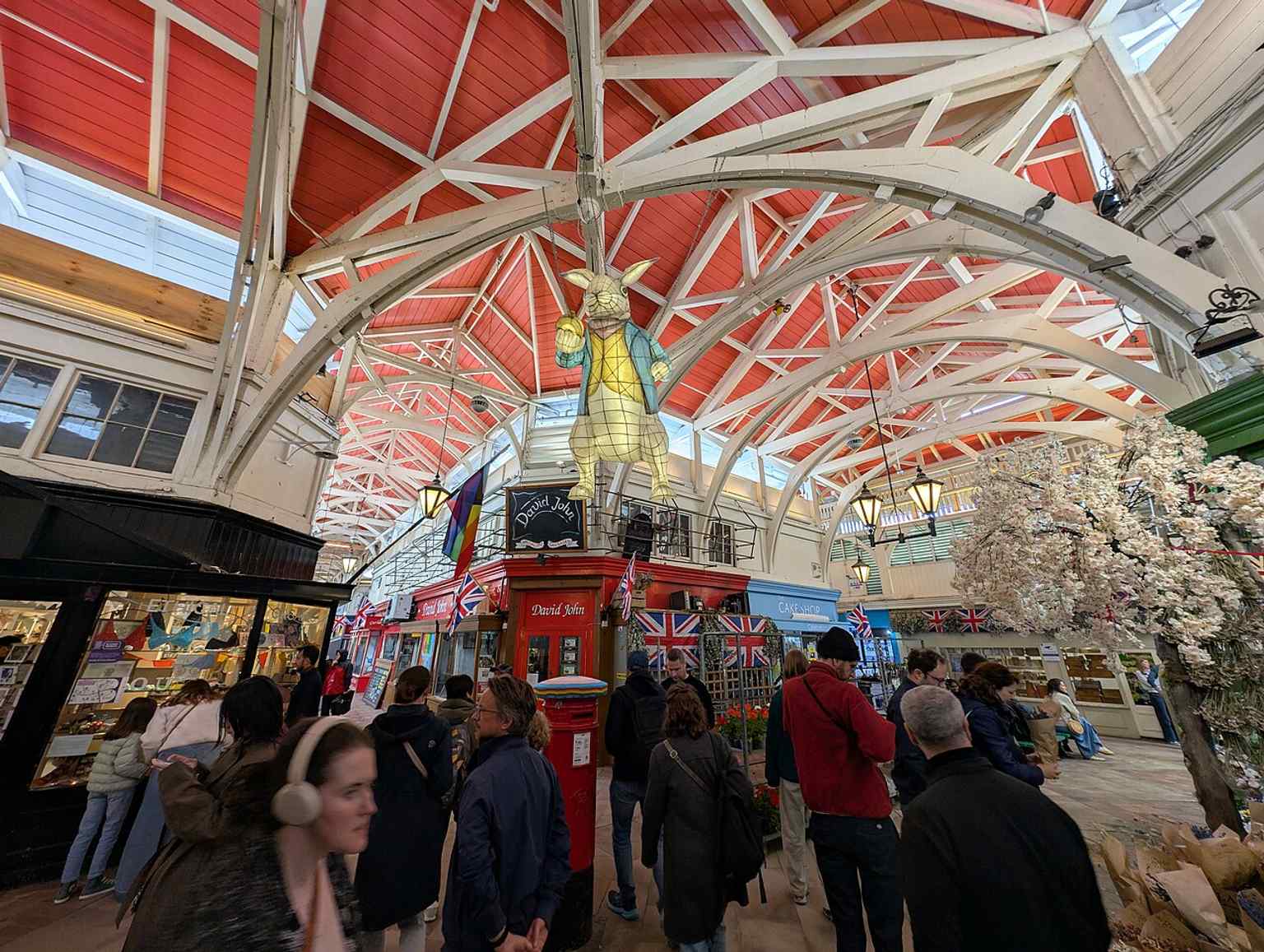
The White Rabbit lantern adds a playful Oxford touch, fitting the market’s newer gift and themed shops.Photo: Andy Li, Wikimedia Commons, CC0. Cropped & resized. On your left, look for a broad honey-colored stone hall with a curved front, tall rectangular windows, and an eight-sided cupola rising from the middle of the roof. This is the…Read moreShow less
Open dedicated page →On your left, look for a broad honey-colored stone hall with a curved front, tall rectangular windows, and an eight-sided cupola rising from the middle of the roof.
This is the Sheldonian Theatre, and despite the name, it spent most of its life doing almost everything except drama. Christopher Wren designed it between sixteen sixty-four and sixteen sixty-nine, and this was only his second major work. Gilbert Sheldon, the Archbishop of Canterbury and Oxford’s chancellor, backed the project so heavily that the building took his name... and, frankly, his wallet. He first gave one thousand pounds, then ended up covering almost the full cost of fourteen thousand four hundred and seventy pounds, worth several million today.
Why bother? Because Oxford needed a proper home for degree ceremonies. Those had been happening in the University Church of Saint Mary the Virgin, and the university authorities had decided that mixing worship with noisy academic celebration was a bit too much Apollo in God’s front room. Scholars, as it turns out, do not always behave like saints.
Wren gave Oxford something startlingly different from its Gothic colleges. If you study the stonework on your screen, you can see that crisp Classical style quite clearly. He borrowed the basic idea from the ancient Roman Theatre of Marcellus, using a D-shaped plan - curved at one end, straight at the other.
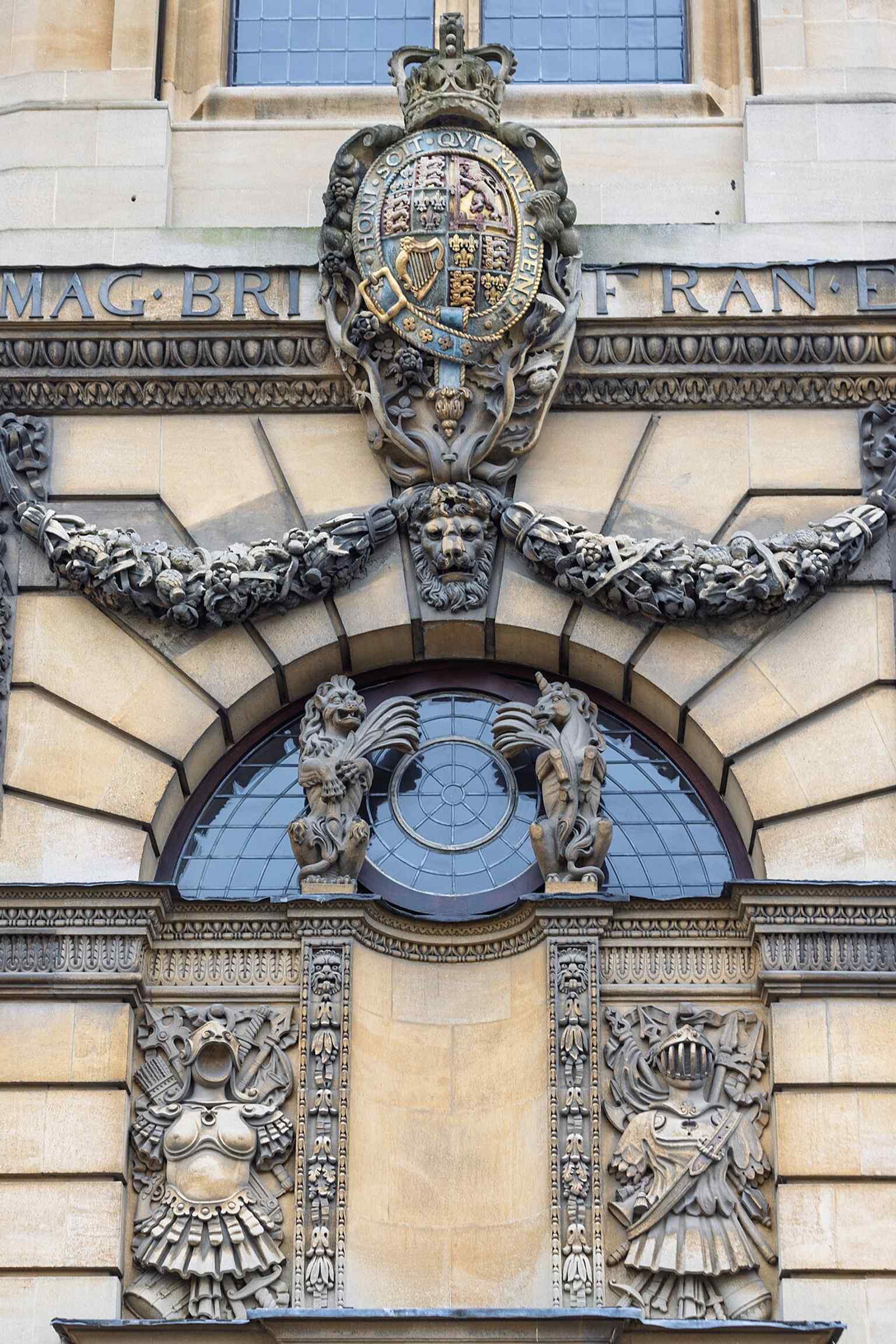
A close look at the Sheldonian’s stonework and façade detail, showing the refined Classical design that broke from Oxford’s Gothic past.Photo: The wub, Wikimedia Commons, CC BY-SA 4.0. Cropped & resized. The real headache was the roof. The span stretched more than seventy feet, and no timber in England could neatly cross it. Wren refused the obvious medieval solution and turned instead to a structural system worked out by Oxford mathematician John Wallis: a grid of shorter timbers, locked together with iron bolts and plates. It was so strong that the University Press later stored books above it. When surveyors inspected the roof in seventeen twenty, they expected trouble and found the opposite: slight sagging from the weight, yes, but a structure they thought could last another one or two centuries. Understatement ages very well in Oxford.
Inside, the theatre still seats about seven hundred and remains one of the university’s great ceremonial rooms. Have a look at the interior image in the app. This is where students matriculate - that is, formally join the university - and where many return for graduation. It also hosts lectures and concerts. Handel conducted his oratorio Athalia here in seventeen thirty-three. Yet actual staged drama did not arrive until two thousand and fifteen, which is such a perfectly fussy Oxford detail that it barely needs improving.
Above the audience, Robert Streater painted a ceiling where Truth descends on the Arts and Sciences and drives out Ignorance. Ambitious, yes, but universities do enjoy a grand mission statement.
If you want to visit the cupola, the theatre usually opens daily from ten in the morning to four thirty in the afternoon.
The Sheldonian is Oxford showing off, but with real brains behind the performance.
When you’re ready, carry on toward the Bridge of Sighs.
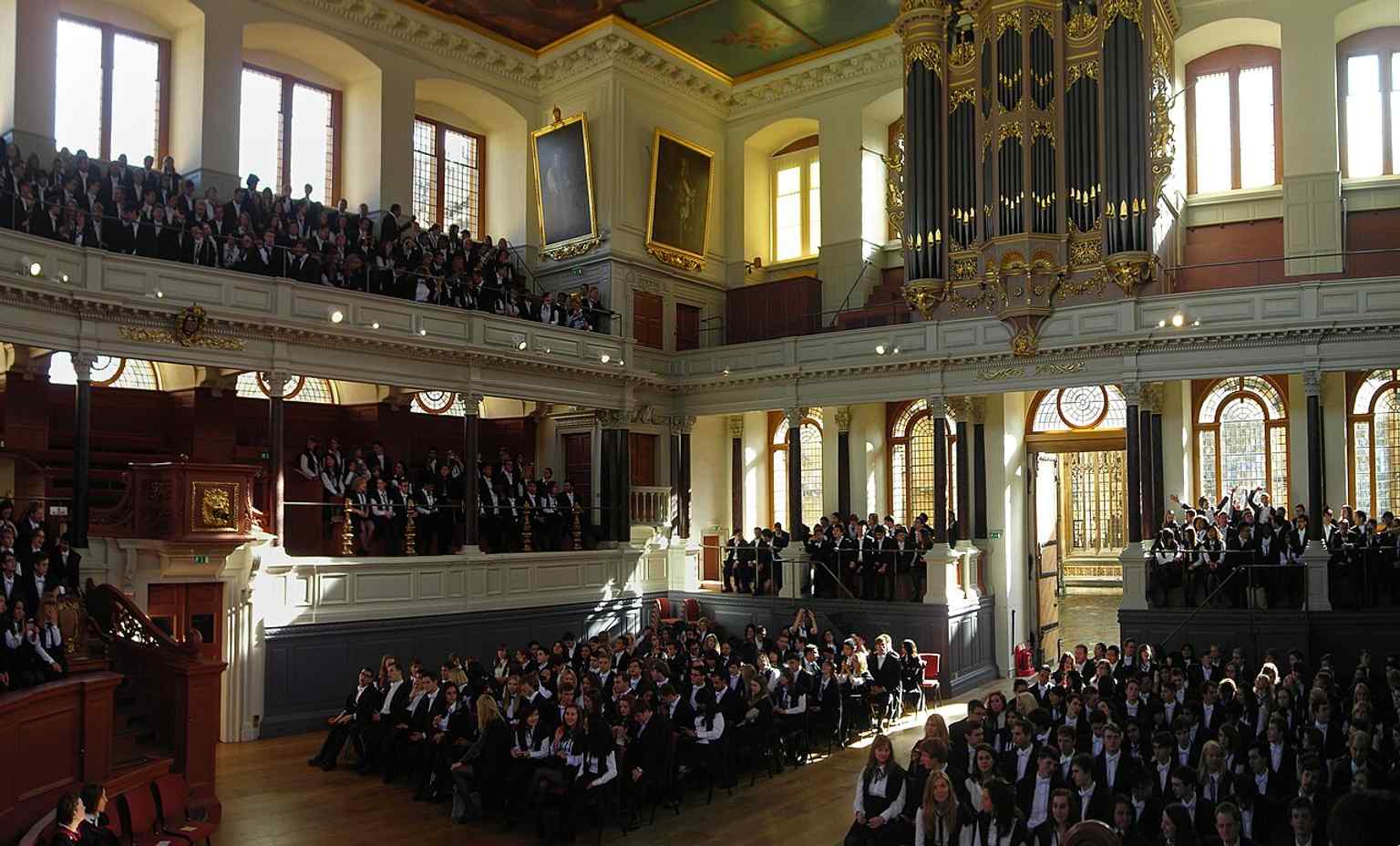
Students gathered for matriculation inside the theatre — one of the building’s most important ceremonial uses.Photo: Decan, Wikimedia Commons, CC BY-SA 3.0. Cropped & resized. Look for the pale stone bridge overhead: an enclosed, curved skyway with rows of windows and a carved coat of arms set into its face. Its proper name is Hertford Bridge, and it…Read moreShow less
Open dedicated page →Look for the pale stone bridge overhead: an enclosed, curved skyway with rows of windows and a carved coat of arms set into its face.
Its proper name is Hertford Bridge, and it links Hertford College’s old and new quads - meaning its college courtyards - across New College Lane. Oxford borrowed the nickname “Bridge of Sighs” from Venice, though that is rather optimistic branding. A favorite legend claims college officials closed the bridge because Hertford students were the heaviest in Oxford and needed extra exercise on the stairs. Nice story, completely false... and backwards, too, because skipping the bridge actually means fewer stairs, not more. Sir Thomas Jackson designed much of the architecture here, and the bridge opened in nineteen fourteen, despite New College objecting to it. If you glance at your screen, you can see how it stitches the two college sides together. The south side holds offices, the north mostly student rooms, and the bridge remains open to college members. It’s even Grade two listed, meaning the law protects it as historically important.
Oxford does love turning a practical shortcut into a local legend. When you’re ready, continue on to the Bodleian Library.
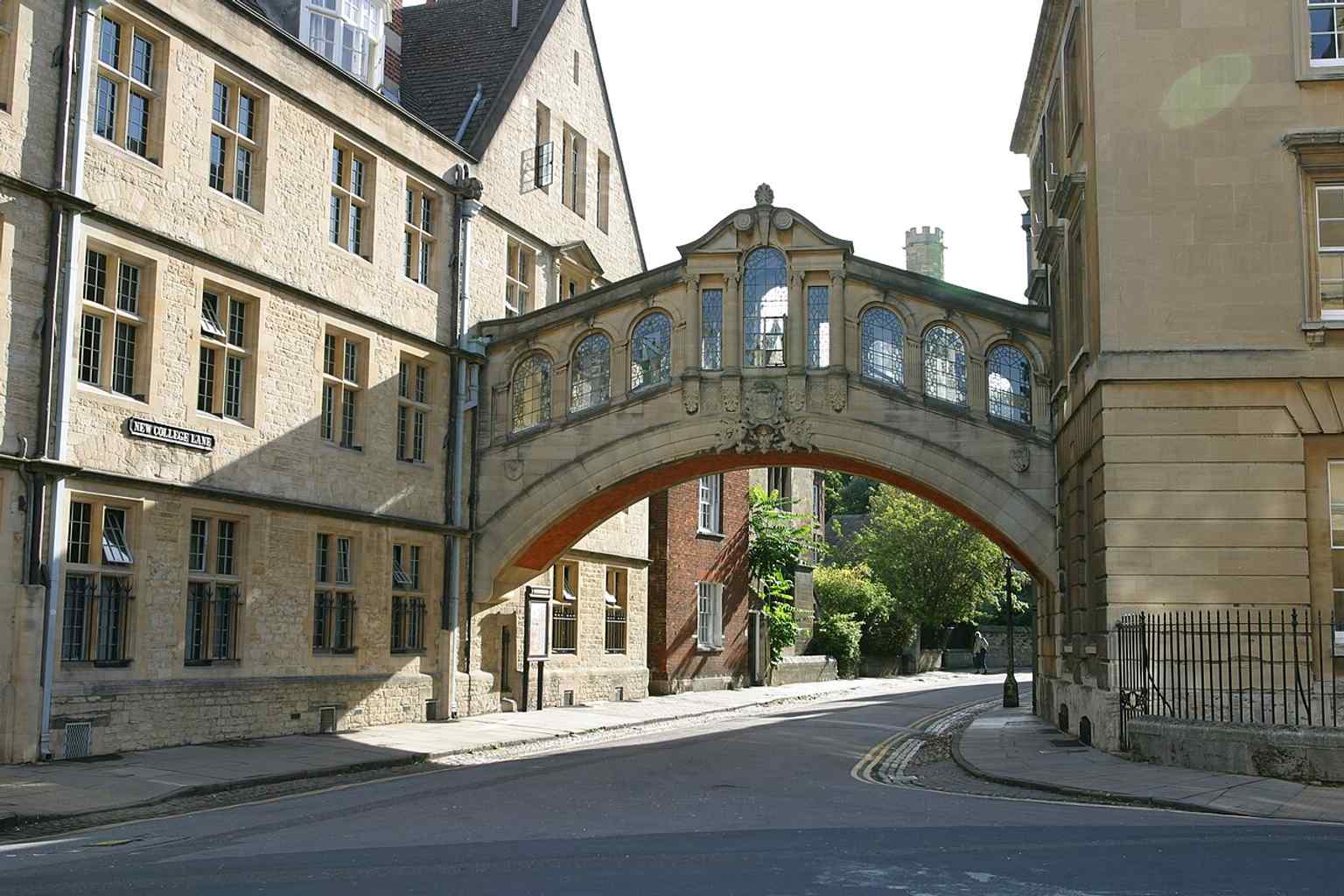
A classic full view of Hertford Bridge, the Oxford landmark often nicknamed the Bridge of Sighs.Photo: Unknown, Wikimedia Commons, CC BY-SA 3.0. Cropped & resized. 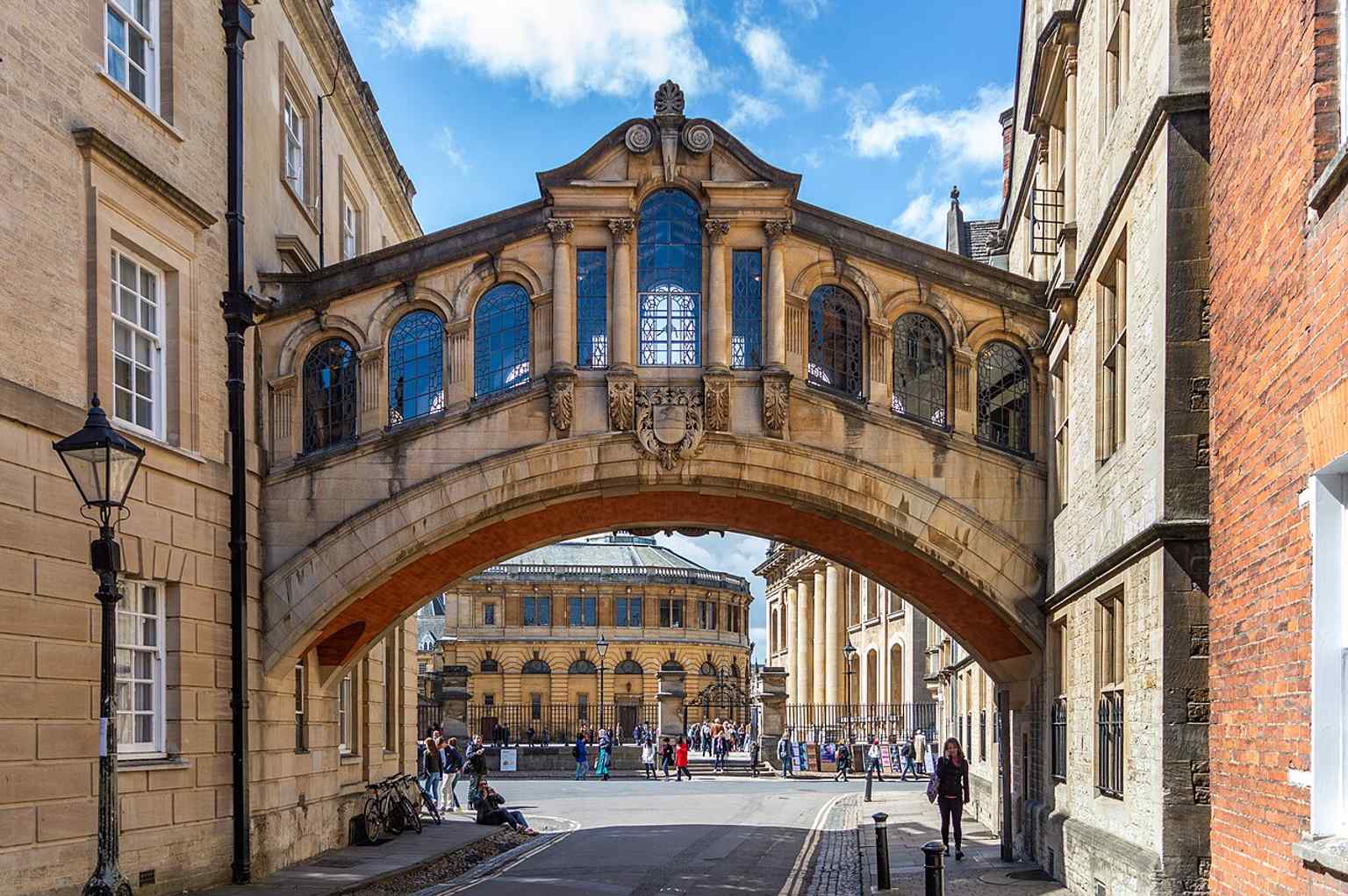
The east side of the bridge over New College Lane, with nearby college buildings and Oxford landmarks in the background.Photo: Tristan Surtel, Wikimedia Commons, CC BY-SA 4.0. Cropped & resized. 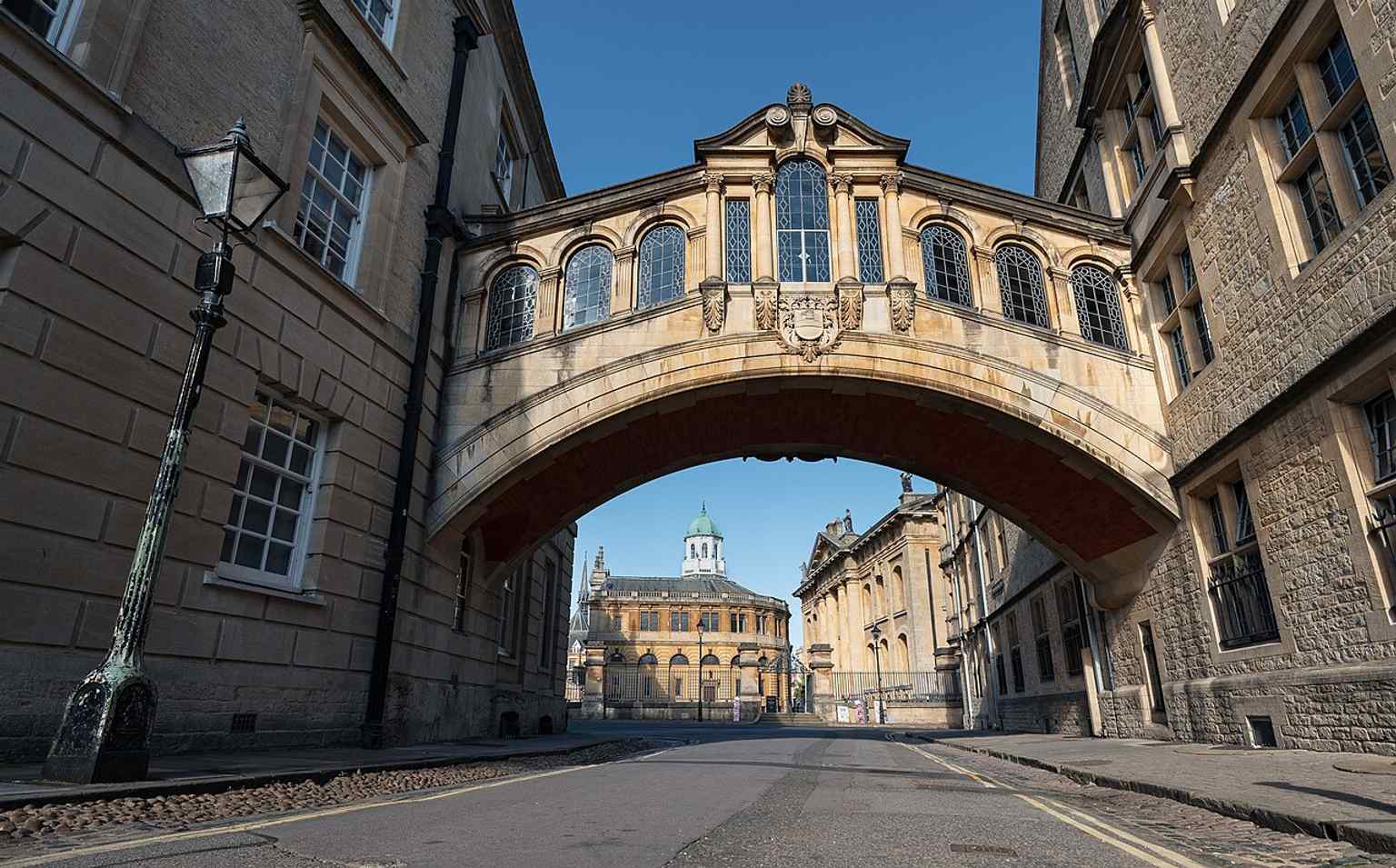
The bridge seen from the east with the Sheldonian Theatre behind it, placing the landmark in central Oxford’s historic setting.Photo: Julian Herzog (Website), Wikimedia Commons, CC BY 4.0. Cropped & resized. 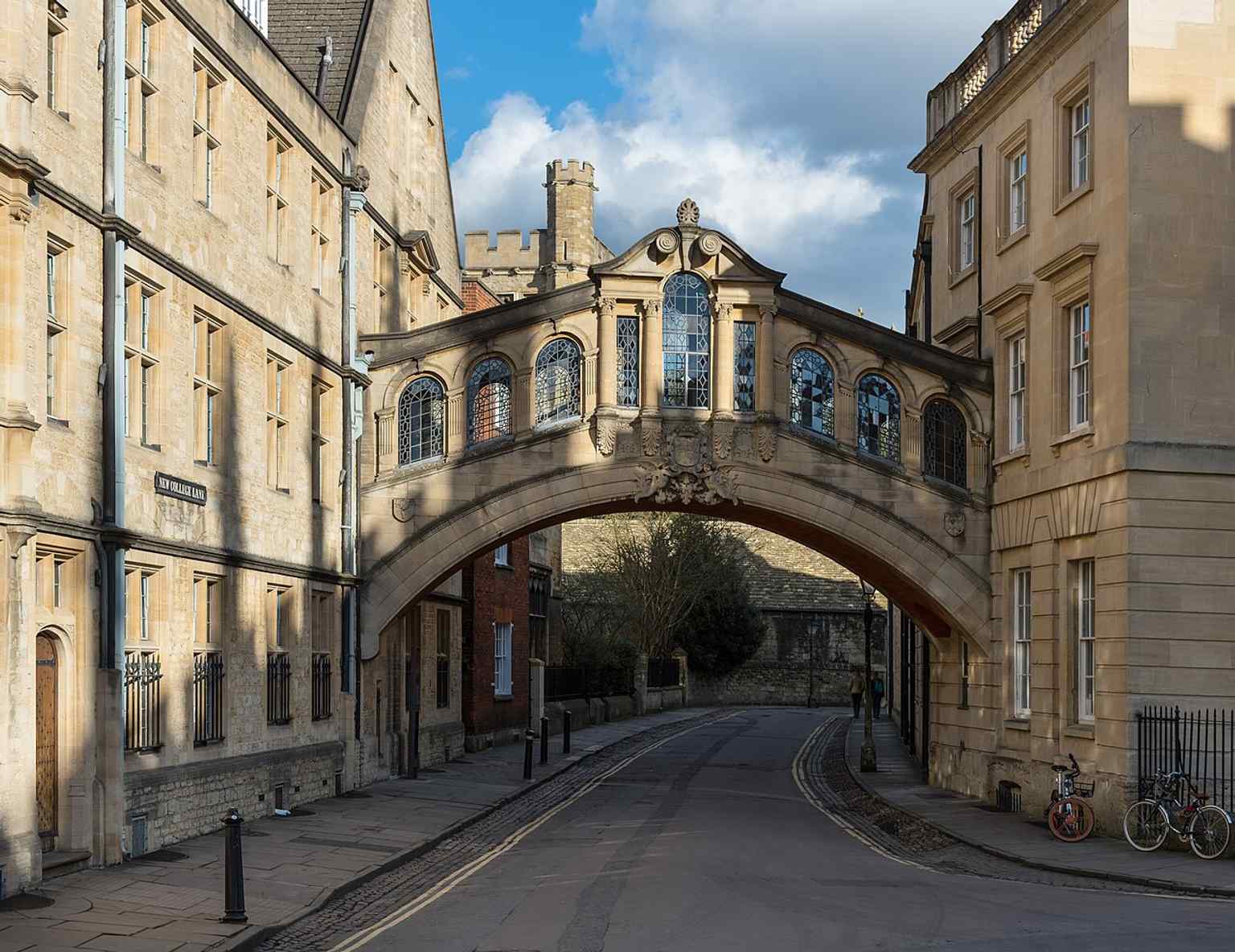
A dramatic west-facing view with shadow across the bridge, emphasizing its distinctive stonework and enclosed skyway form.Photo: Julian Herzog (Website), Wikimedia Commons, CC BY 4.0. Cropped & resized. 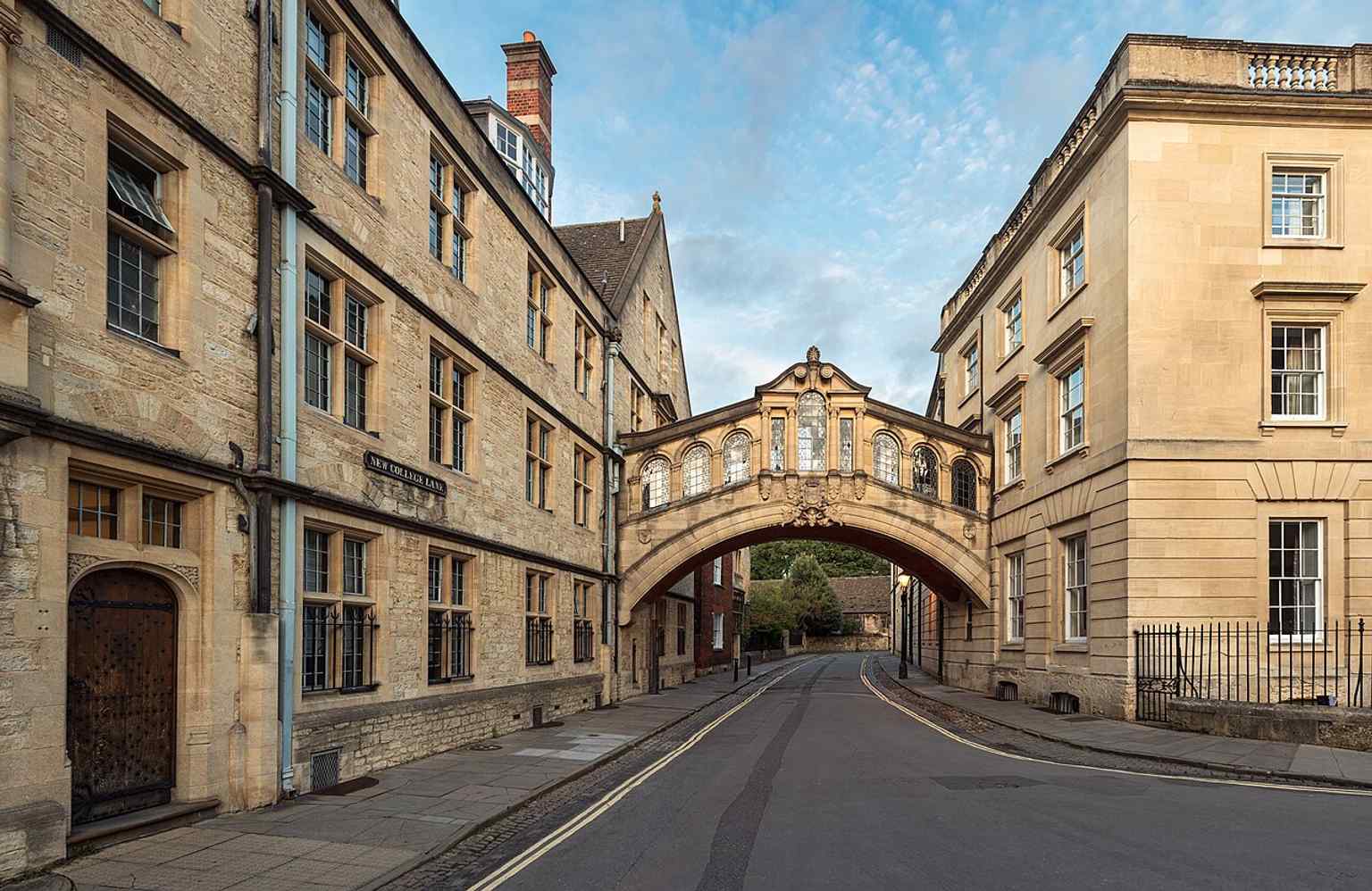
An evening view showing the bridge between Hertford College buildings over New College Lane, a good all-around landmark shot.Photo: Julian Herzog (Website), Wikimedia Commons, CC BY 4.0. Cropped & resized. 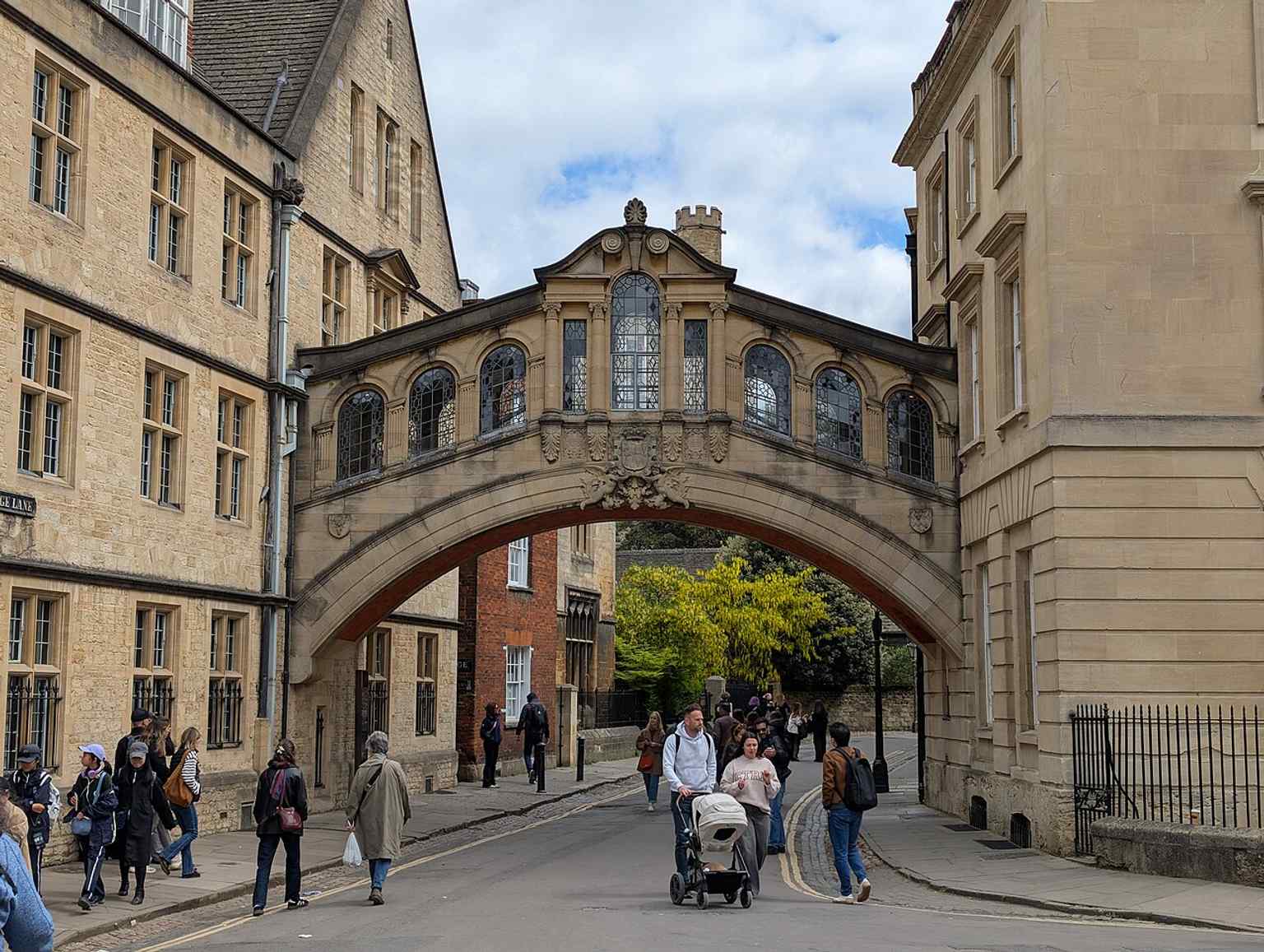
A recent high-resolution view of the Bridge of Sighs, showing its Grade II listed exterior in crisp detail.Photo: Andy Li, Wikimedia Commons, CC0. Cropped & resized. 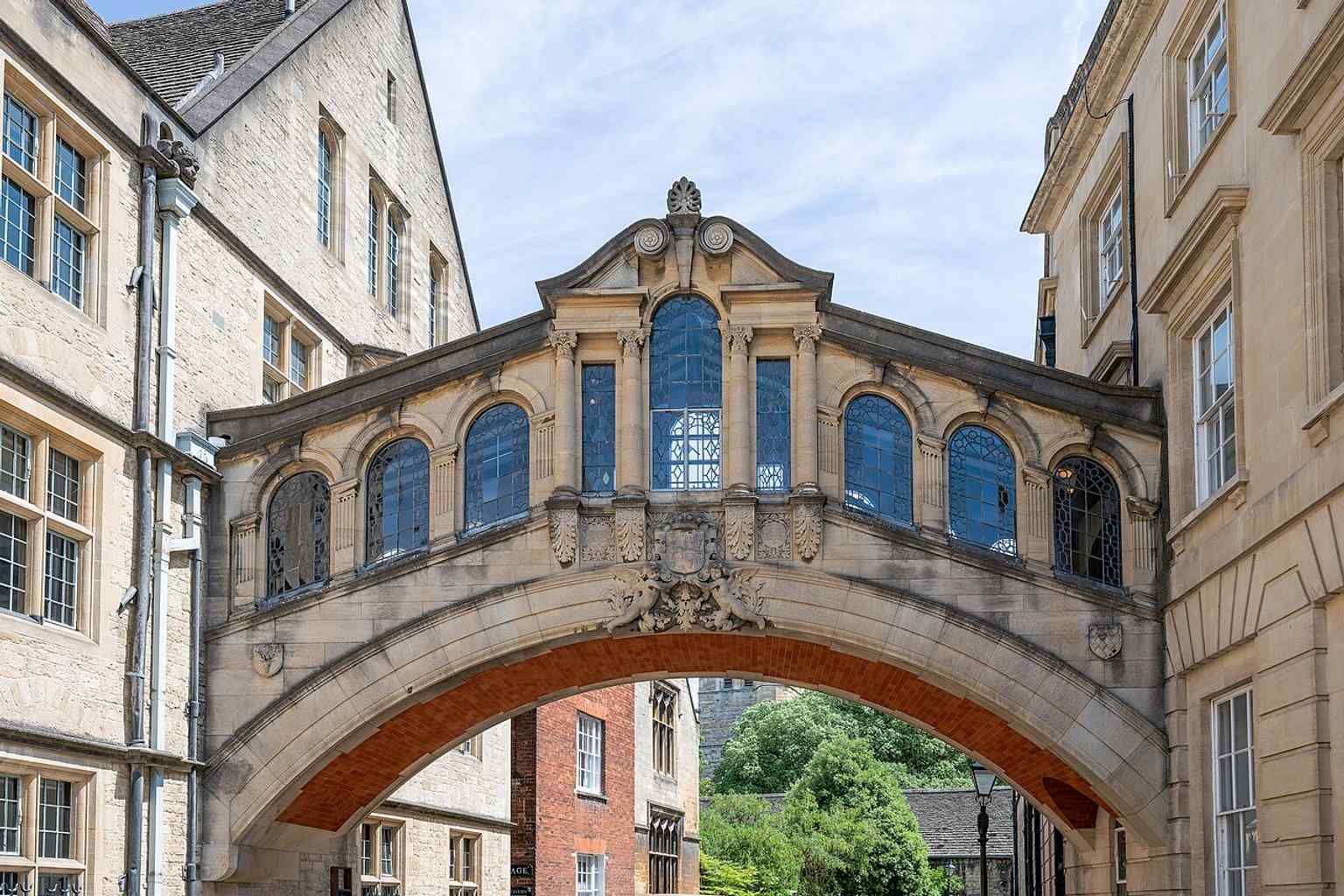
A modern record-style image of the listed bridge, useful for documenting its protected status as a historic Oxford building.Photo: Tilman2007, Wikimedia Commons, CC BY-SA 4.0. Cropped & resized. On your right, look for a long honey-colored stone building with a rectangular, crenellated roofline and an ornate gateway tower marked by stacked classical columns. This is the…Read moreShow less
Open dedicated page →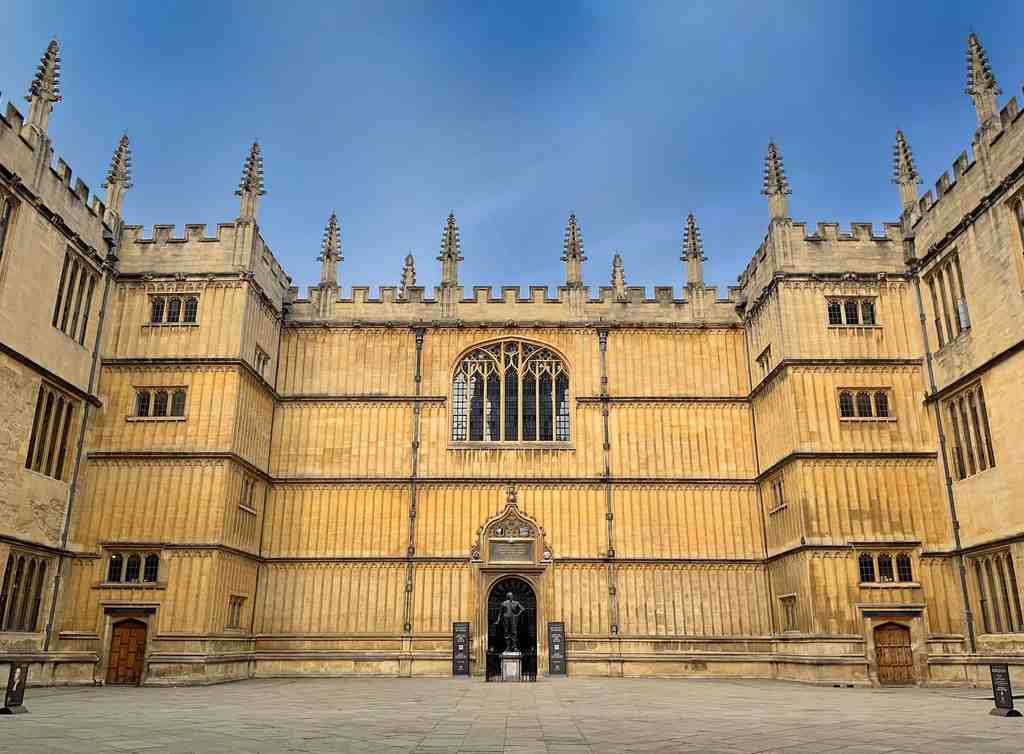
Bodleian LibraryPhoto: Honcques Laus, Wikimedia Commons, CC0. Cropped & resized. On your right, look for a long honey-colored stone building with a rectangular, crenellated roofline and an ornate gateway tower marked by stacked classical columns.
This is the Bodleian Library, Oxford’s great engine room of scholarship... and one of Europe’s oldest libraries still doing the job it was built for. Sir Thomas Bodley refounded it in sixteen oh two, after the university’s earlier library had fallen into a fairly dismal state. Furniture got sold off, books disappeared, and by the late sixteen hundreds only three of Duke Humfrey’s original books were left. Bodley stepped in, wrote to the vice chancellor, and essentially said: let me rescue this place.
What you see here grew from that rescue. The oldest heart of the library began in the fifteenth century with Duke Humfrey’s Library, a reading room above the Divinity School. When Bodley revived the library, he restocked it, reopened it, and then made a shrewd deal in sixteen ten with the Stationers’ Company so the library received a copy of every registered book printed in England. A wonderfully efficient way to make sure the shelves never enjoyed a moment of peace again.
That growth explains the scale of the Bodleian today. It holds more than thirteen million printed items, making it the second largest library in Britain after the British Library. It is also a legal deposit library, which means publishers in the United Kingdom must send in copies of their books, and it can request copies from Ireland too. So this isn’t just an Oxford library. For a long stretch, before the British Museum opened in seventeen fifty-three, it functioned much like England’s national library.
If you glance at your screen, image three shows the Tower of the Five Orders up close, with its layers of Tuscan, Doric, Ionic, Corinthian, and Composite columns stacked one above another like a stone textbook in classical architecture.
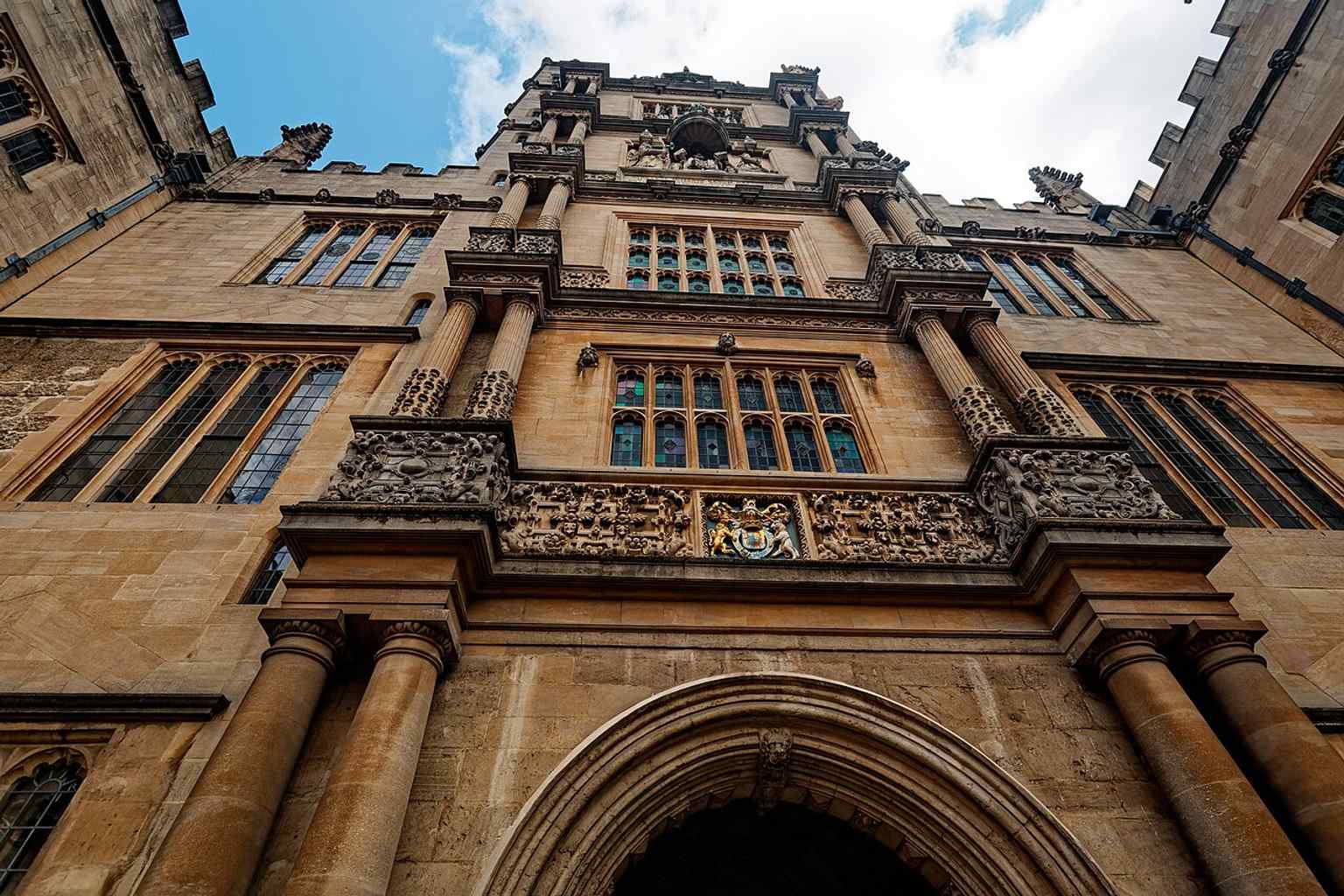
A close look up at the Tower of the Five Orders, whose Tuscan through Composite columns give the gateway its name.Photo: Txllxt TxllxT, Wikimedia Commons, CC BY-SA 4.0. Cropped & resized. The Bodleian has rules, naturally. New readers still make a formal declaration promising not to damage the books, bring in fire, or otherwise behave like the villain in a manuscript thriller. External readers often recite it aloud, and the library keeps translations in more than one hundred languages. Also, this is mainly a reference library, which means the books stay here. The Bod, as Oxford people call it, has spent centuries learning not to trust books with travel plans.
Its treasures are almost absurdly rich: four surviving copies of Magna Carta, a Gutenberg Bible, Shakespeare’s First Folio, the first book printed in Arabic with movable type, Tolkien manuscripts, and manuscripts by Jane Austen, Kafka, Mary Shelley, and C. S. Lewis. Beneath the old buildings, tunnels and underground stacks once carried books under Broad Street by conveyor and even pneumatic tube, which is exactly the kind of wonderfully overengineered idea librarians come up with when they have too many books and not enough floor.
This place has changed, but not as dramatically as you might think. Have a quick look at the before-and-after image if you like... the old Schools range looks uncannily familiar across more than one hundred and seventy years.
The Bodleian turns scholarship into stone: serious, patient, and very hard to outgrow.
When you’re ready, continue to the University Church of St Mary the Virgin, where Oxford’s library story began even before Bodley reclaimed it.
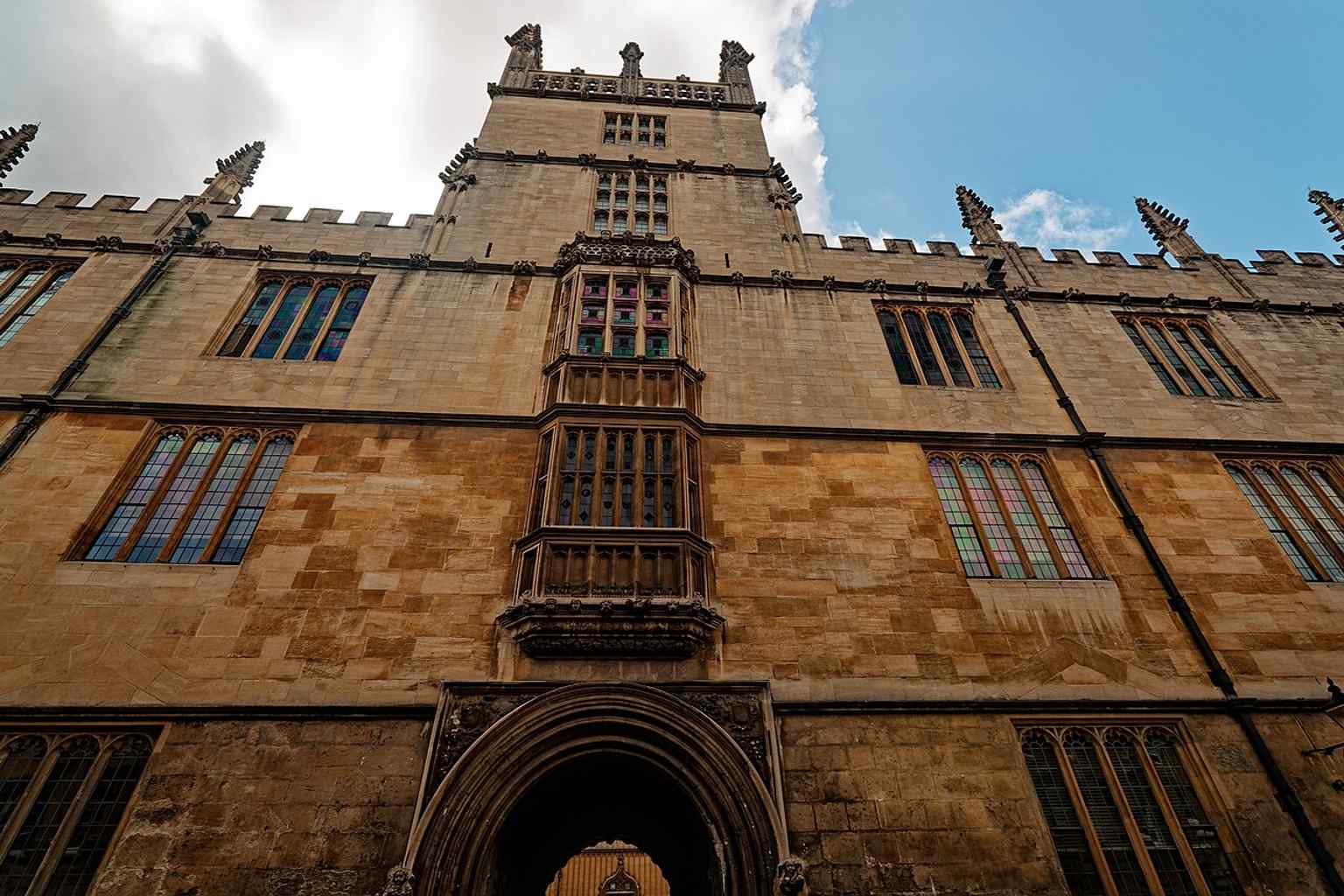
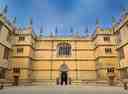
The Tower of the Five Orders marks the main entrance to the Bodleian’s Old Schools Quadrangle, named for its stacked classical columns.Photo: Txllxt TxllxT, Wikimedia Commons, CC BY-SA 4.0. Cropped & resized. 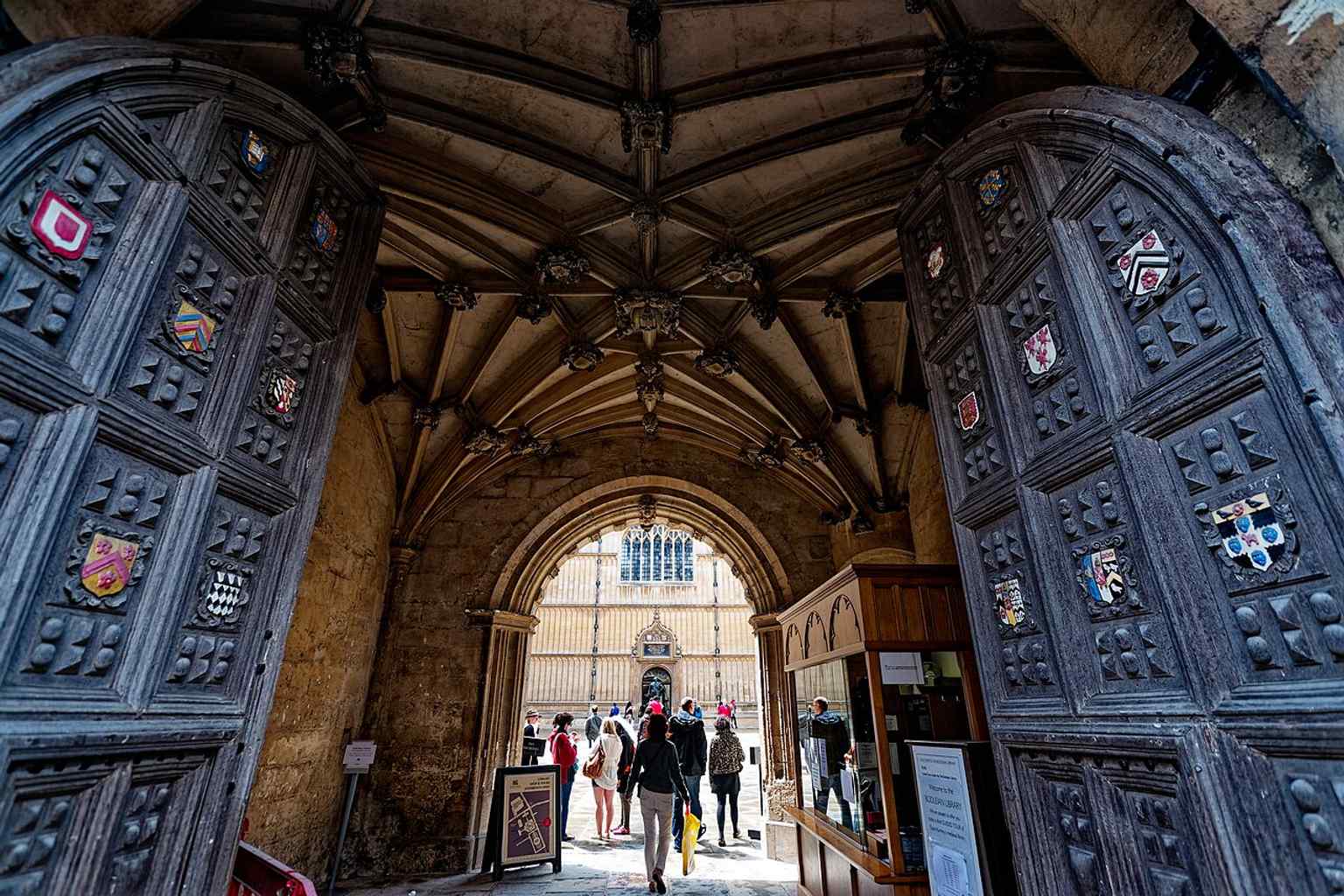
Inside the Great Gate, you enter the Old Schools Quadrangle, the 17th-century core that grew out of Bodley’s early-1600s re-founding.Photo: Txllxt TxllxT, Wikimedia Commons, CC BY-SA 4.0. Cropped & resized. 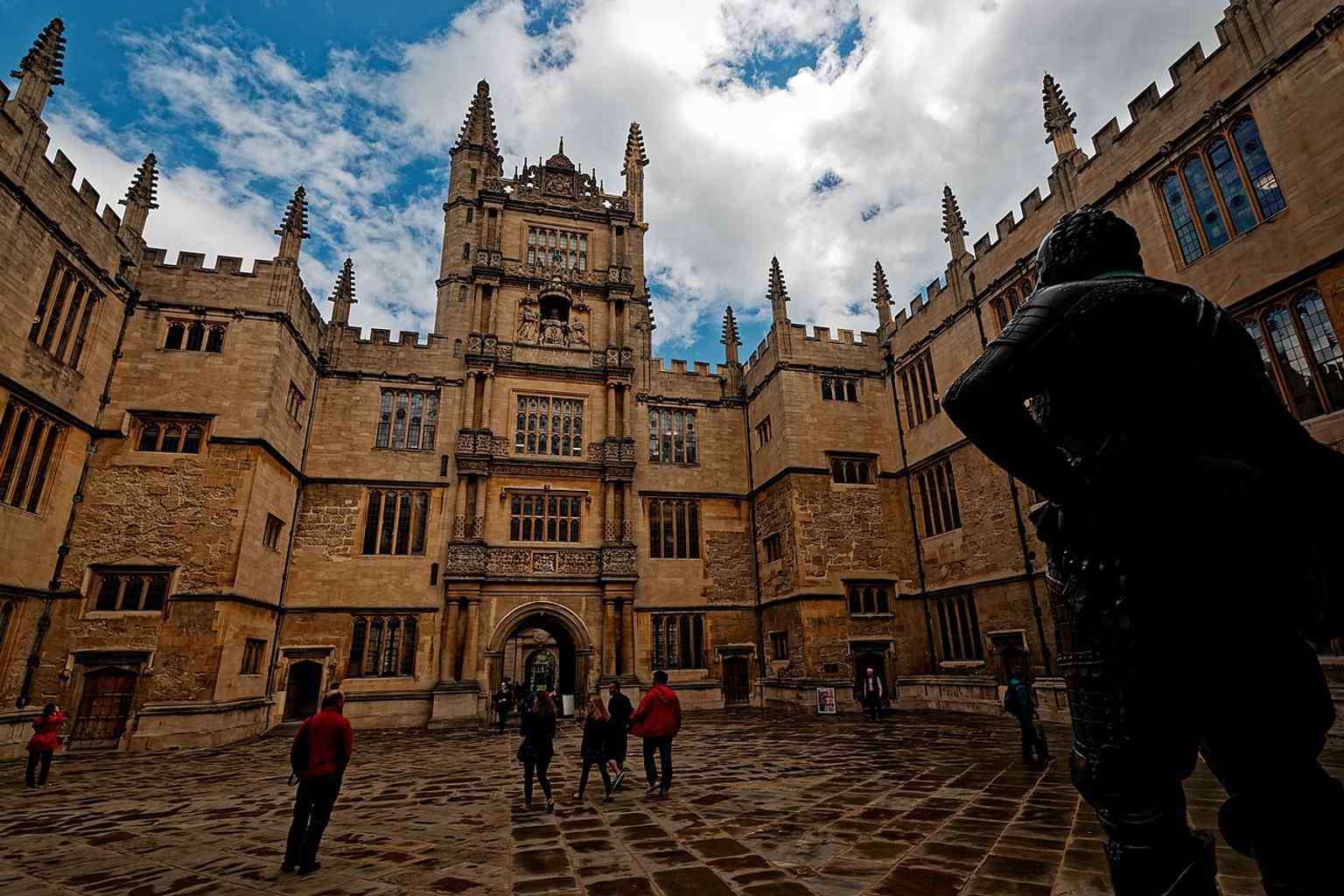
The courtyard statue of William Herbert, Earl of Pembroke, one of the Bodleian’s early benefactors, stands in the Old Schools Quadrangle.Photo: Txllxt TxllxT, Wikimedia Commons, CC BY-SA 4.0. Cropped & resized. 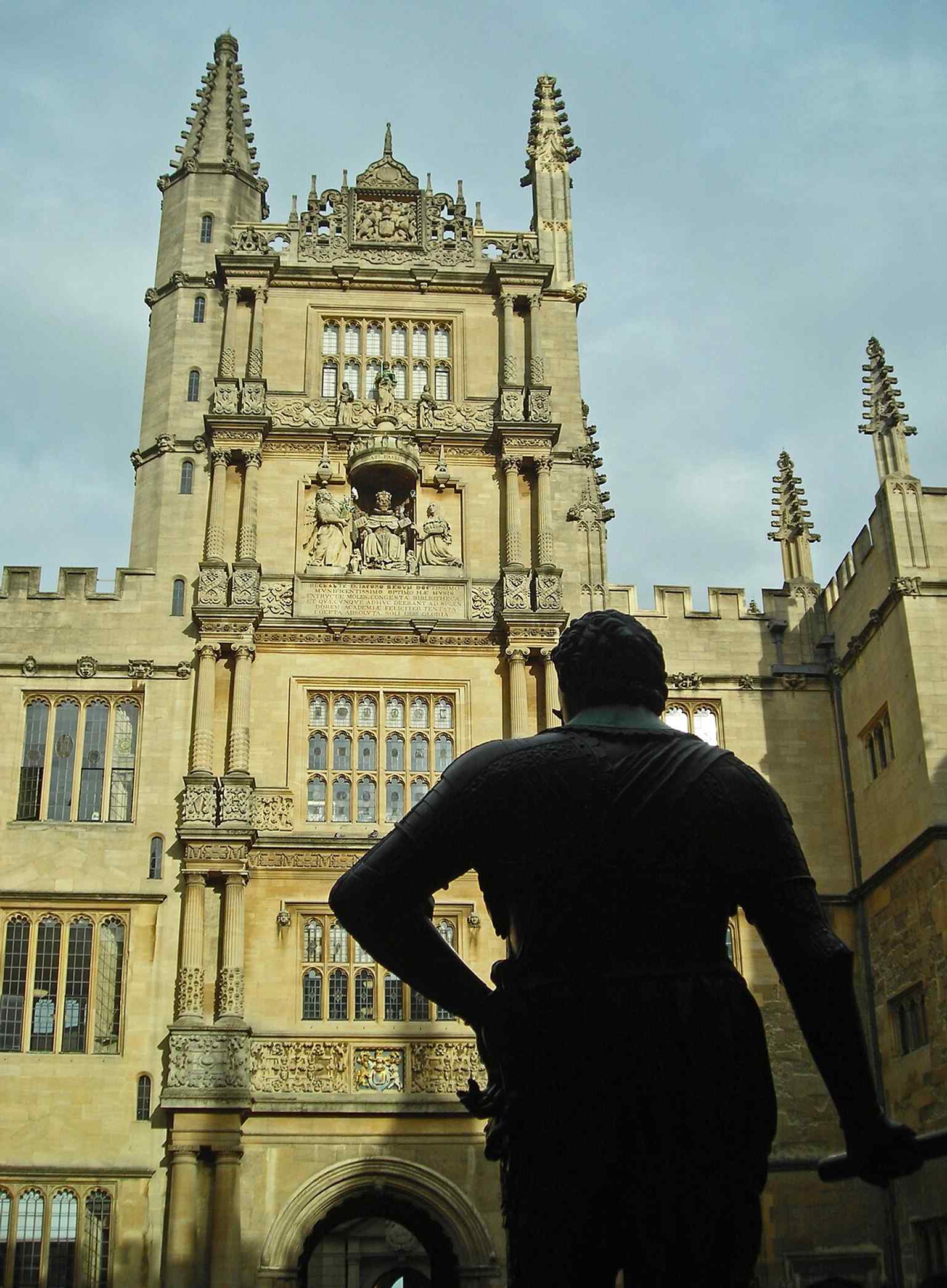
Seen from the courtyard, this view links the Bodleian’s historic interior to the statue-lined quadrangle outside.Photo: Decan, Wikimedia Commons, CC BY-SA 3.0. Cropped & resized. 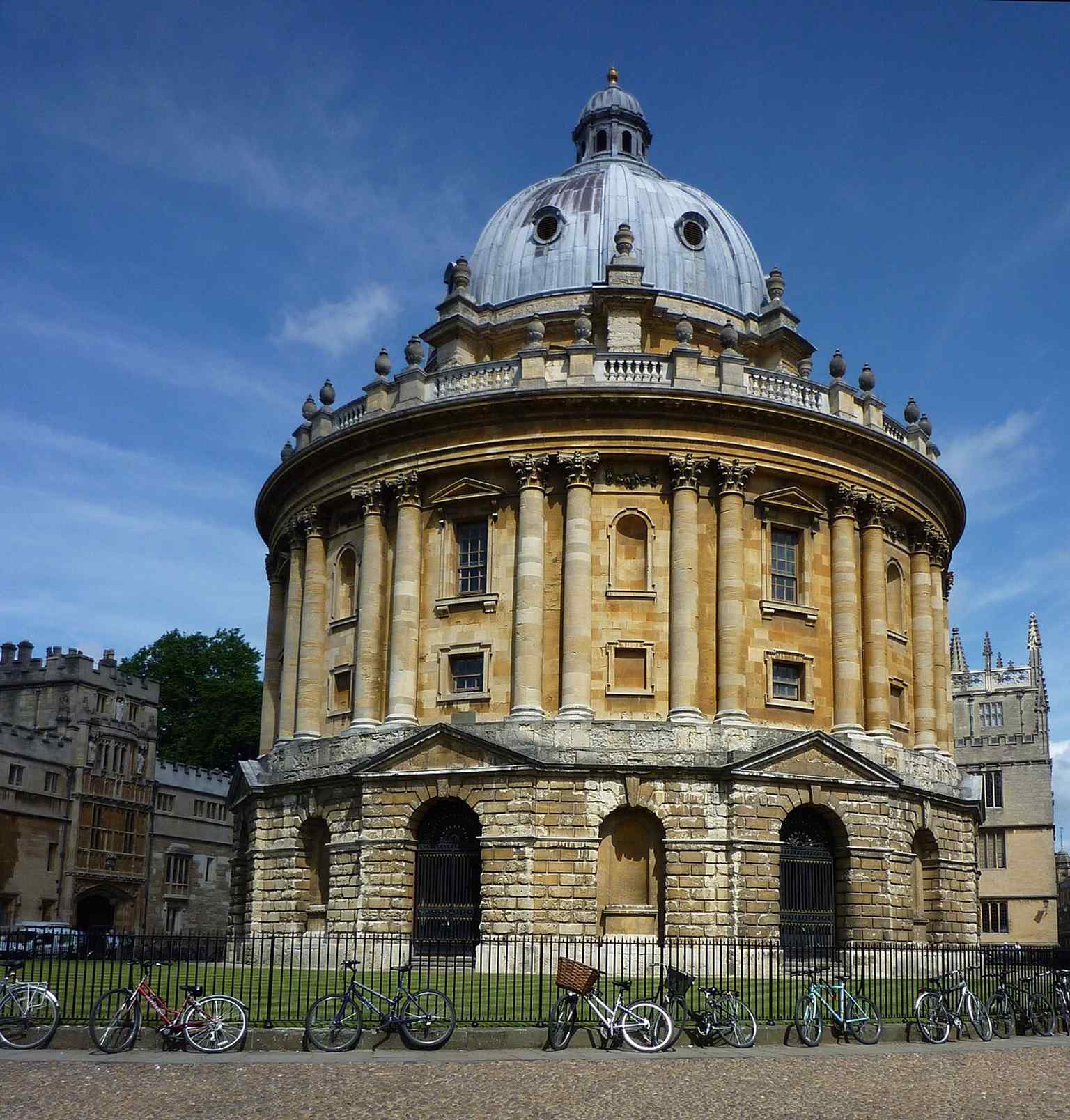
The Radcliffe Camera’s circular reading room became part of the Bodleian in the 19th century and remains one of Oxford’s icons.Photo: Franzfoto, Wikimedia Commons, CC BY-SA 3.0. Cropped & resized. 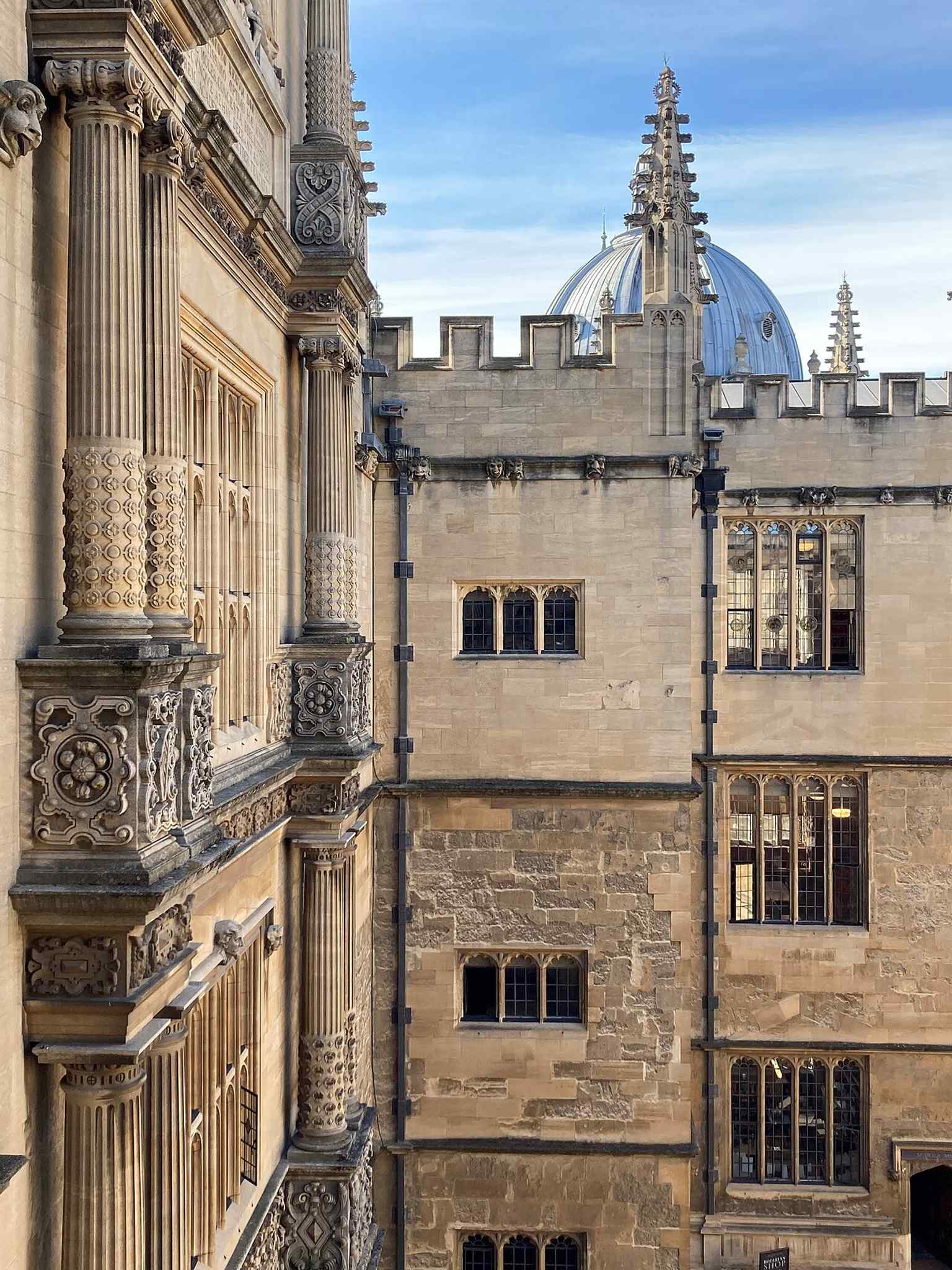
From the Upper Reading Room you can see the Old Library and the Radcliffe Camera together, showing the Bodleian’s layered growth.Photo: Locolates, Wikimedia Commons, CC BY-SA 4.0. Cropped & resized. 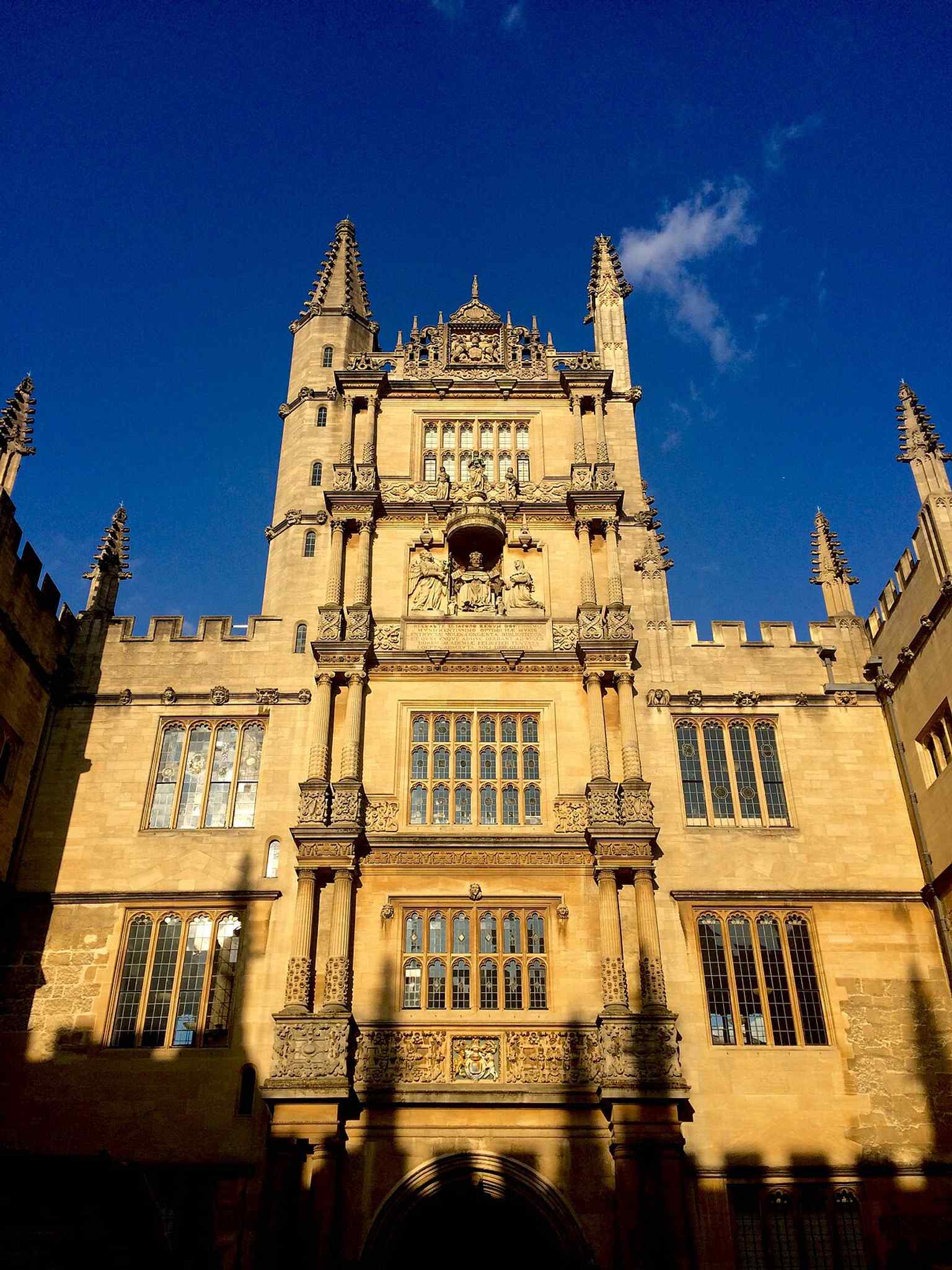
The Bodleian’s façade in Broad Street shows the monumental face of a library that grew from 1602 into a vast research collection.Photo: Emma Reynolds, Wikimedia Commons, CC BY-SA 4.0. Cropped & resized. 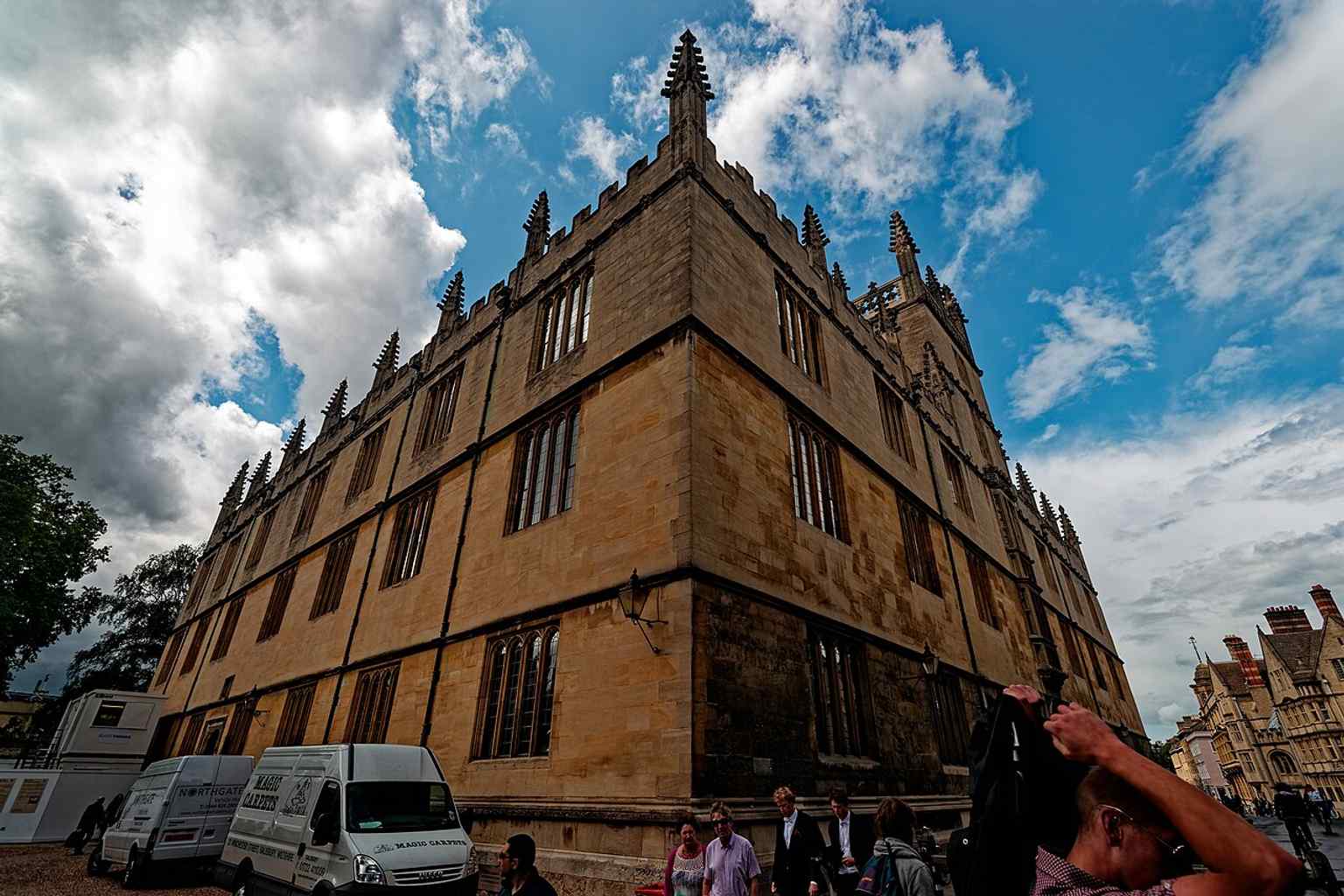
Catte Street gives a classic side view of the Bodleian’s 1602 building, still the heart of Oxford scholarship.Photo: Txllxt TxllxT, Wikimedia Commons, CC BY-SA 4.0. Cropped & resized. 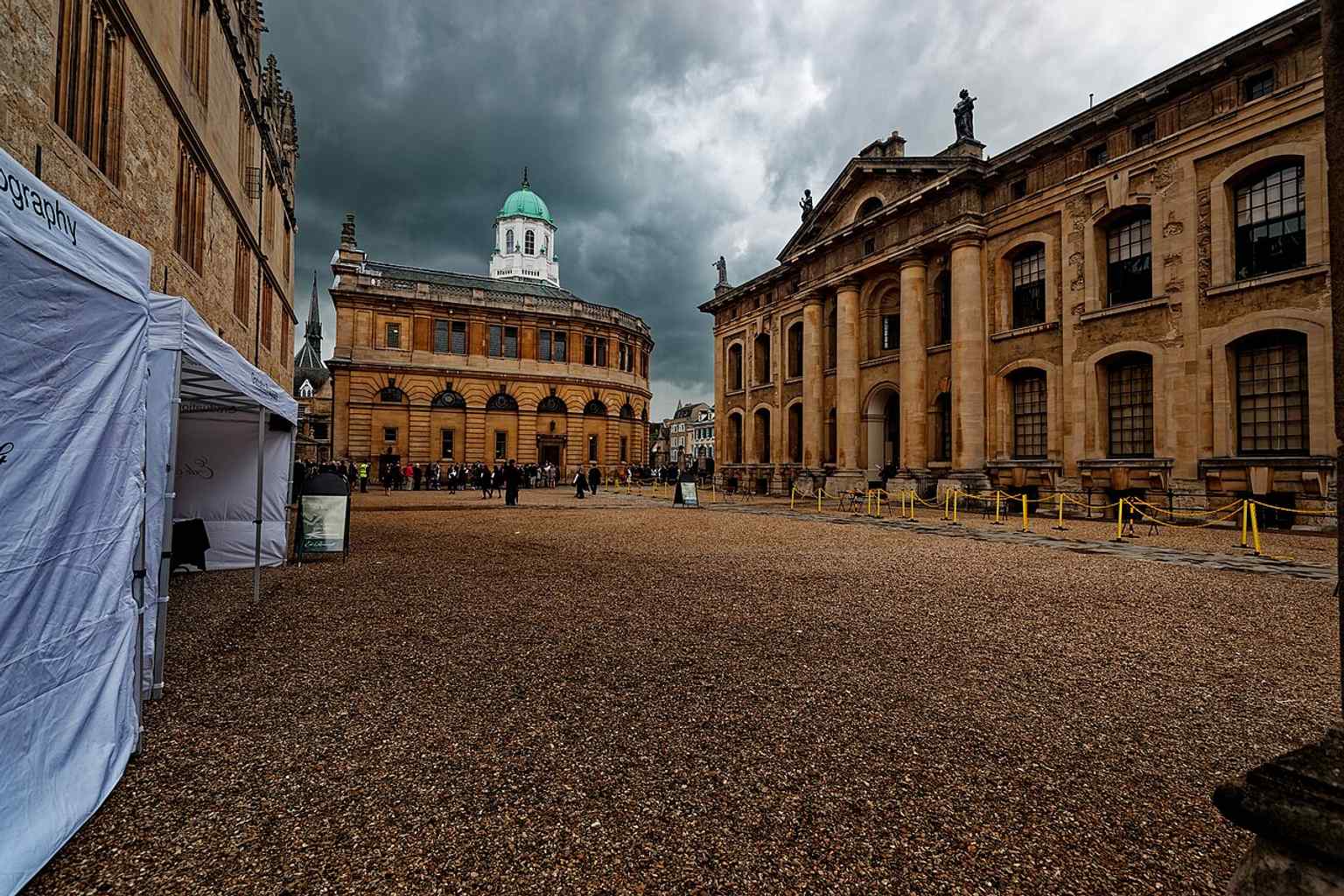
This Broad Street view places the Bodleian beside the Sheldonian Theatre and Clarendon Building, part of Oxford’s historic library district.Photo: Txllxt TxllxT, Wikimedia Commons, CC BY-SA 4.0. Cropped & resized. 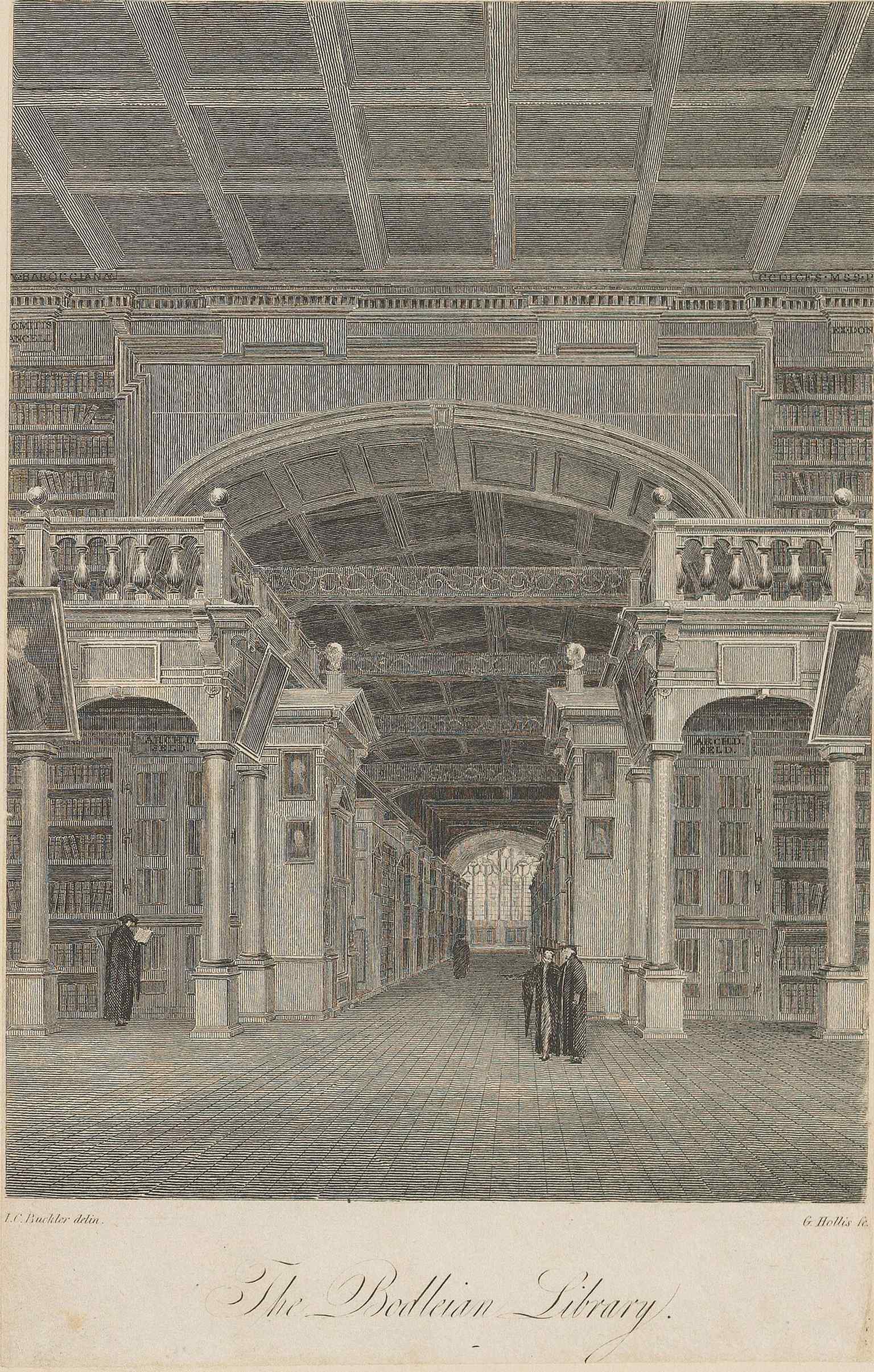
An old engraving of the Bodleian, showing how the library’s grand image was celebrated long before modern photography.Photo: John Chessell Buckler, Wikimedia Commons, Public domain. Cropped & resized. In front of you stands a pale stone church with a tall tapering spire, broad Gothic windows, and an extravagant porch twisted with spiral columns and a statue above the door.…Read moreShow less
Open dedicated page →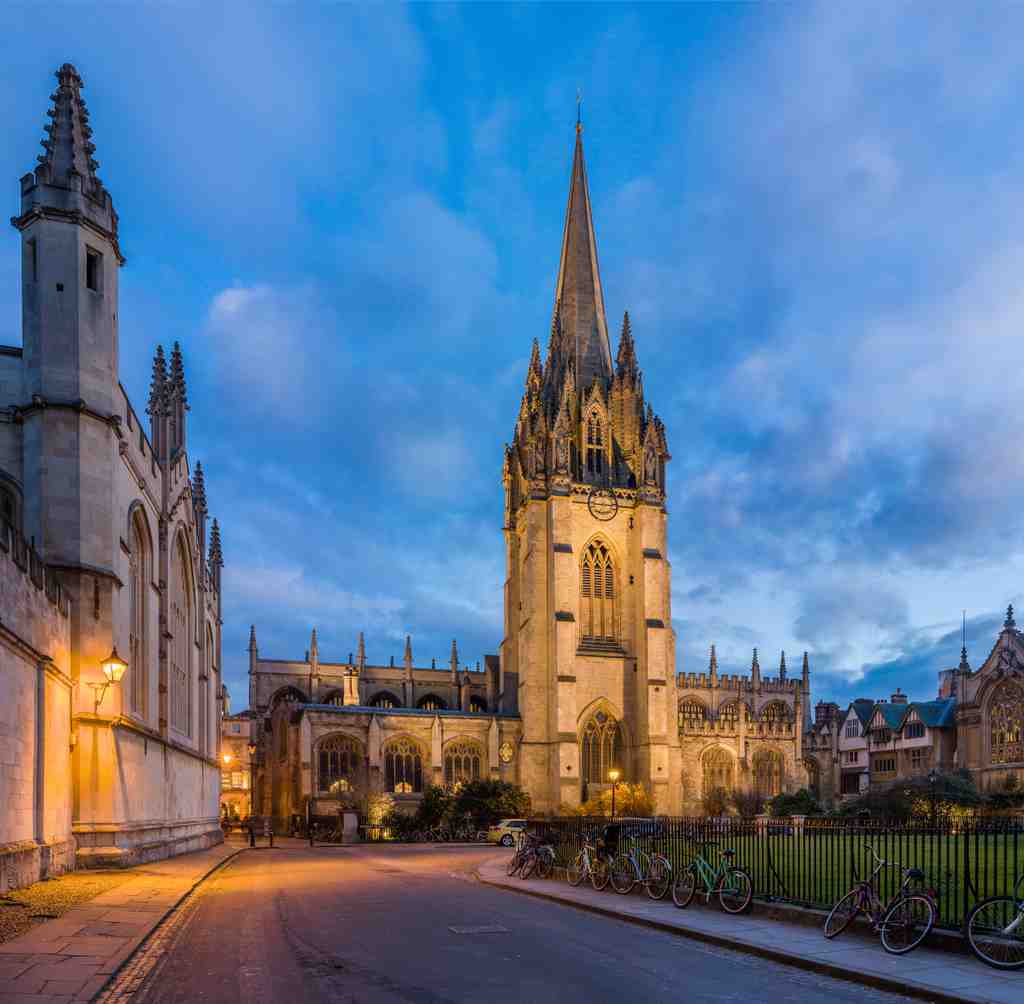
University Church of St Mary the VirginPhoto: Diliff, Wikimedia Commons, CC BY-SA 3.0. Cropped & resized. In front of you stands a pale stone church with a tall tapering spire, broad Gothic windows, and an extravagant porch twisted with spiral columns and a statue above the door.
This is St Mary the Virgin, and in a very real sense, this is where Oxford University first learned to be Oxford University. Long before colleges spread across the city, an Anglo-Saxon church stood here near the center of the old walled town, and by at least the mid-thirteenth century the university used this church as its meeting place, lecture hall, parliament, and degree venue... all tucked into one sacred building, which feels efficient and faintly chaotic.
Around thirteen twenty, the church gained a two-storey building beside the chancel, the space around the altar. Downstairs, university convocation met there; upstairs, books given by Thomas Cobham, Bishop of Worcester, formed the university’s first library. So before the Bodleian became the grand scholarly machine we know, Oxford’s books were starting out here, in much humbler quarters.
The church also tied itself closely to Oriel College through Adam de Brome, the rector who founded what became the college in the fourteen-twenties. He redirected church income to support it, which is a very Oxford kind of arrangement: prayer, property, and paperwork all shaking hands.
But St Mary’s also witnessed one of Oxford’s darkest scenes. In fifteen fifty-five, the trial of the Oxford Martyrs took place here: Latimer, Ridley, and then Cranmer, all charged with heresy. Inside, one pillar still preserves a cut-out ledge linked to Cranmer’s final appearance before his execution. He withdrew his recantations and declared that the hand which had signed them would burn first. It did.
Now look at the church’s south porch, the one facing the High Street. It is gloriously over the top: Baroque, meaning theatrical and full of movement, with spiral columns, a curling pediment, and a niche holding the Virgin and Child. If you want a closer look, check the image on your screen. In the sixteen thirties, puritans thought this porch looked suspiciously Roman Catholic, and they used it as evidence against Archbishop Laud at his trial. The statue still carries bullet marks from Cromwellian soldiers, which is one way to leave a review.
Lift your gaze to the tower and spire. The tower dates from around twelve seventy, and the spire followed in the thirteen twenties, bristling with pinnacles, gargoyles, and statues. Some historians call it one of the most beautiful spires in England, and for once that sort of claim doesn’t feel inflated. On your phone, image two gives you a fine close view of those details.
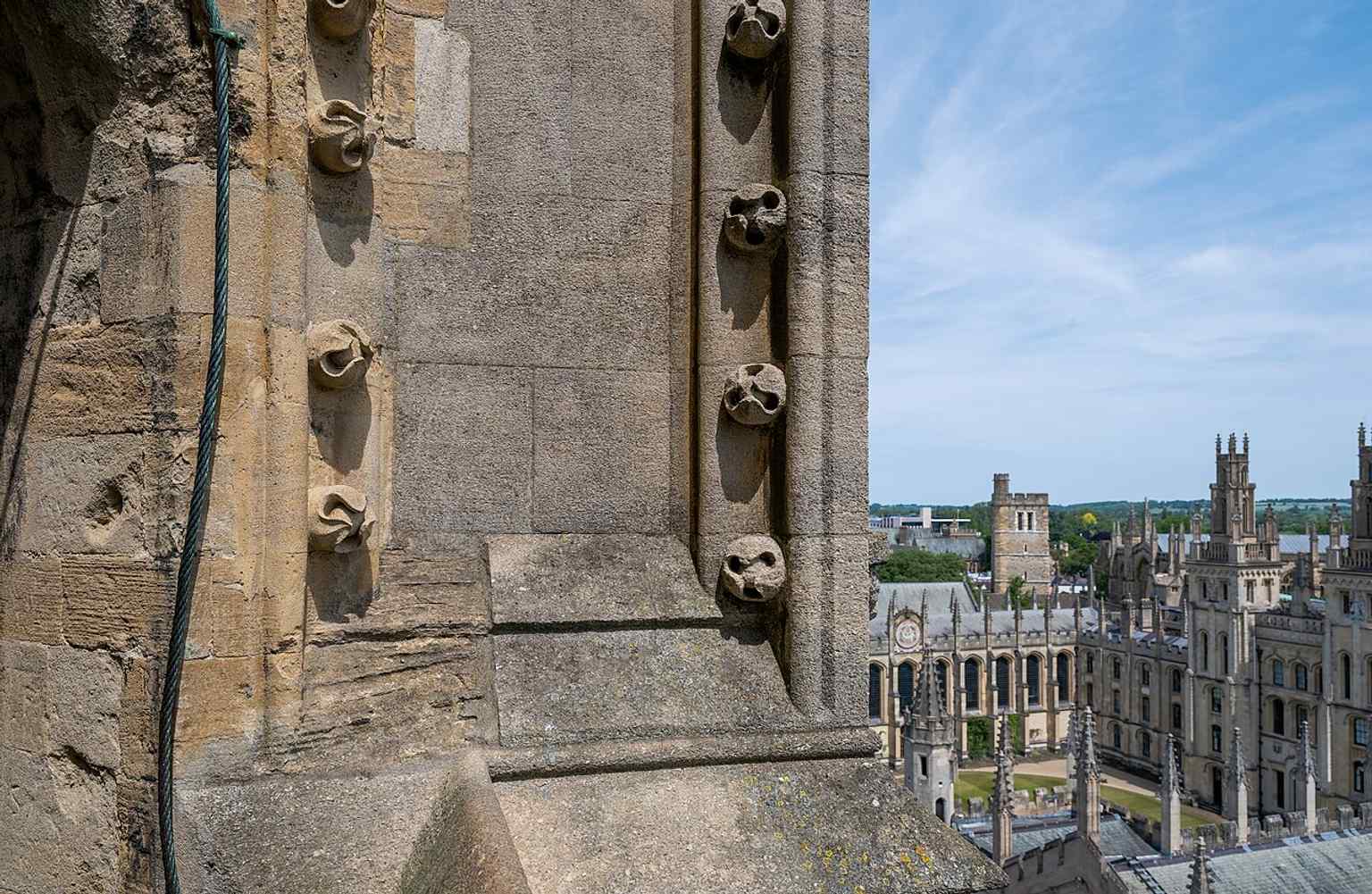
The church tower and spire, dating back to the 13th and 14th centuries, are among St Mary’s most recognisable features and rise above the university skyline.Photo: Tilman2007, Wikimedia Commons, CC BY-SA 4.0. Cropped & resized. St Mary’s kept shaping ideas long after the Middle Ages. Later, John Wesley preached here and annoyed the university so thoroughly that he was never invited back. Then came John Henry Newman, and in eighteen thirty-three John Keble preached from the pulpit inside a sermon often seen as the start of the Oxford Movement, which tried to revive older Catholic spirituality within the Church of England.
If you want to go inside later, the church usually opens from nine thirty to five, and from noon to five on Sundays.
St Mary’s stands at the point where Oxford’s faith, scholarship, and argument all meet.
When you’re ready, continue on to University College for the next piece of the story.
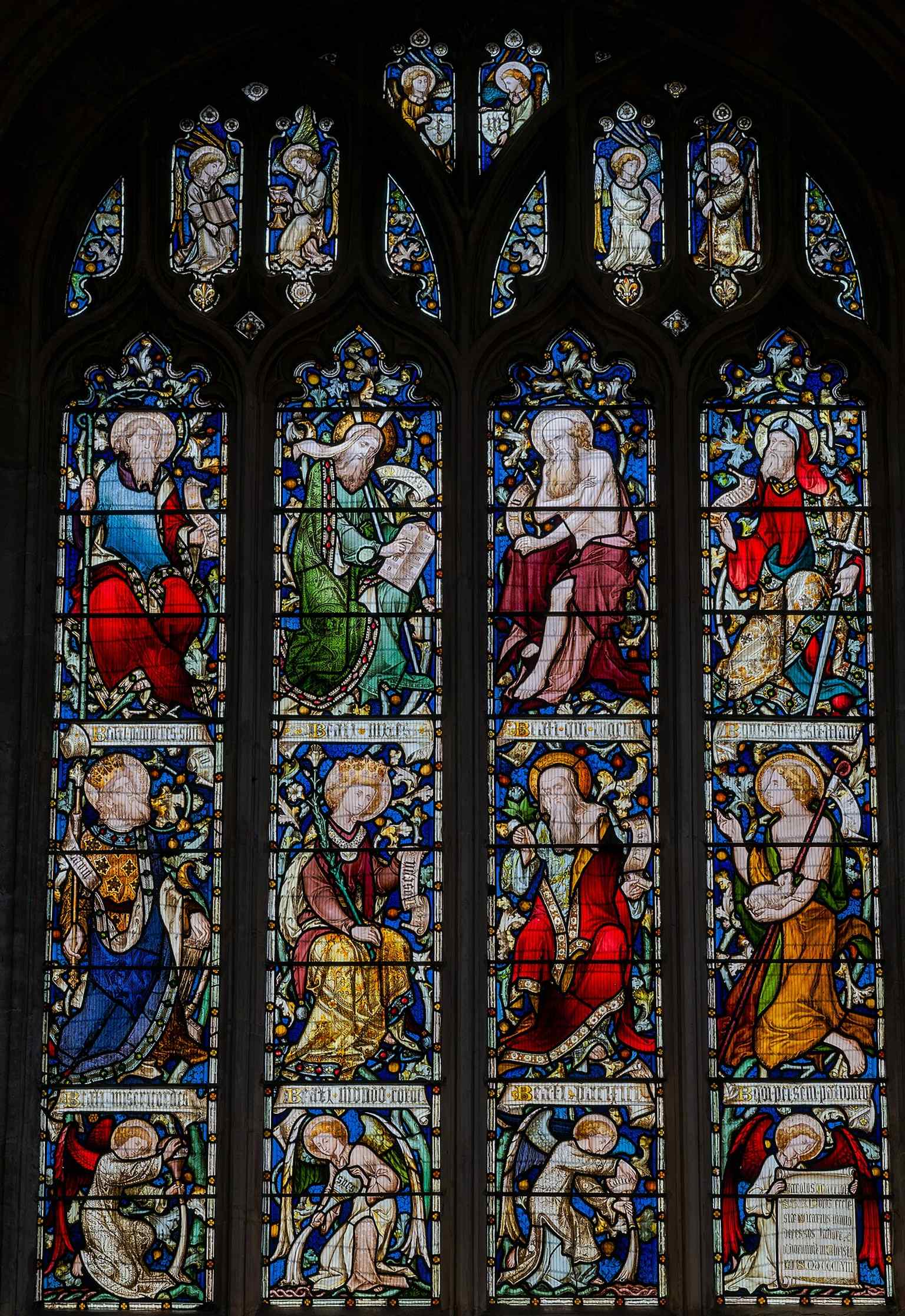
One of St Mary’s stained-glass windows, reflecting the church’s rich Victorian and medieval glazing mentioned in its history.Photo: Tilman2007, Wikimedia Commons, CC BY-SA 4.0. Cropped & resized. On your right, look for a long honey-colored stone frontage with rows of tall sash windows and a central arched gateway, picked out by the college arms above the entrance. This…Read moreShow less
Open dedicated page →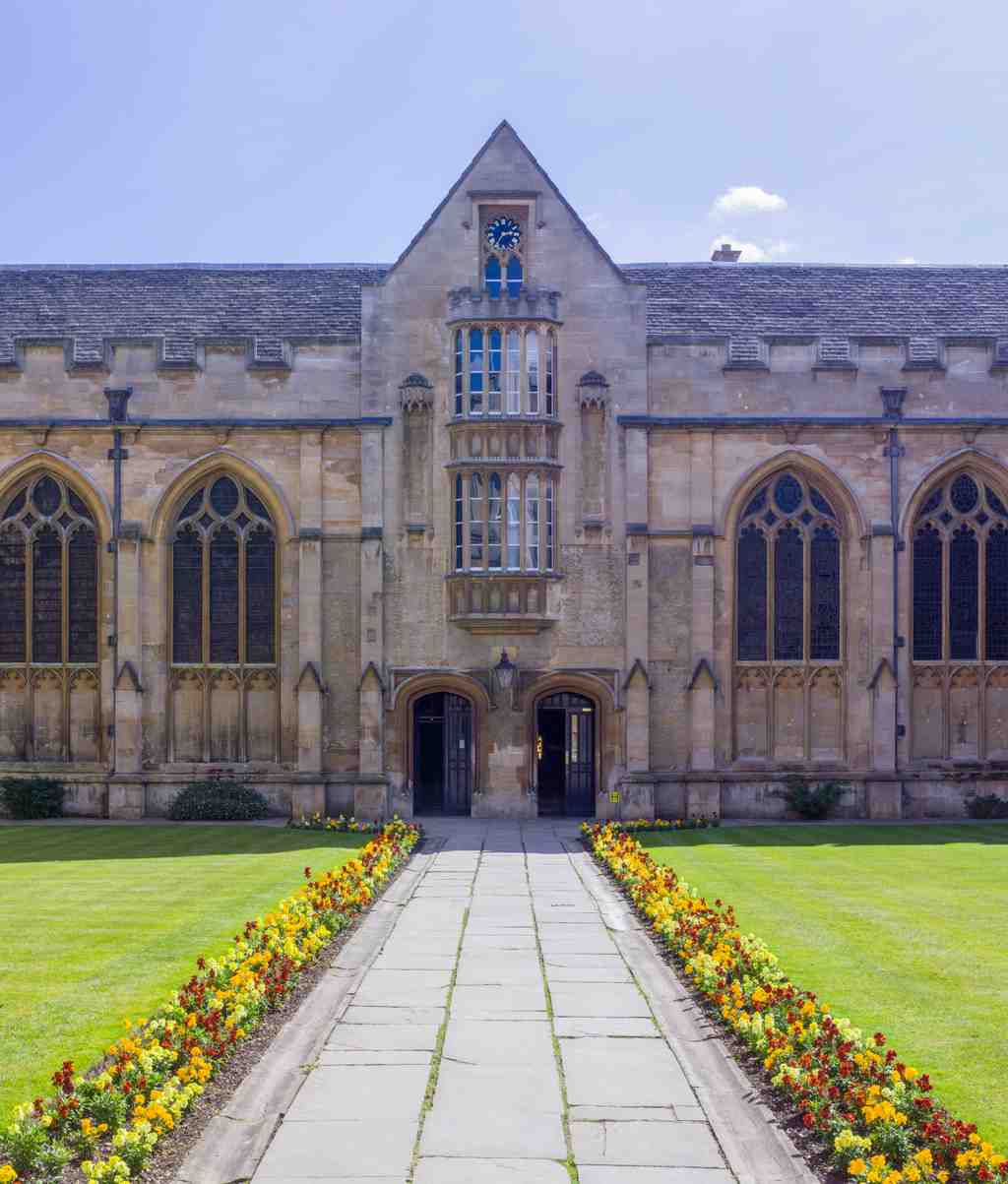
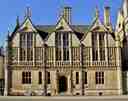
University College, OxfordPhoto: APK, Wikimedia Commons, CC BY 4.0. Cropped & resized. On your right, look for a long honey-colored stone frontage with rows of tall sash windows and a central arched gateway, picked out by the college arms above the entrance.
This is University College, usually called Univ... because Oxford likes tradition, but it also likes shorthand. Univ claims to be the oldest college in Oxford, and that argument has fueled plenty of polite academic eyebrow-raising. The college points to William of Durham, who left money in twelve forty-nine to support ten or twelve masters of arts studying divinity, which simply means advanced students focused on theology. A hall called Aula Universitatis, or University Hall, followed in twelve fifty-three. Balliol and Merton would each like a word about that claim to seniority, naturally.
Then there is the more colorful founding story. In the fourteen hundreds, people began saying King Alfred founded the college in eight hundred seventy-two. Very convenient. That legend explains why Univ used arms linked to Alfred, why the reigning monarch still serves as the college visitor - a sort of official guardian in ceremonial matters - and why the college celebrated a thousand years in eighteen seventy-two. Historians, with their tiresome attachment to evidence, usually prefer William of Durham.
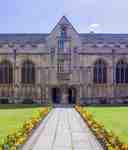
What you see from the street belongs mostly to a rebuilding campaign that replaced medieval structures as the college grew richer and more confident. The main quadrangle - a square courtyard enclosed by buildings - began in sixteen thirty-four, but the English Civil War interrupted the work, so completion dragged on until sometime in sixteen seventy-six. If you check the image in the app, you can see that ordered inner court for yourself. Oxford colleges love presenting calm symmetry even when history has plainly been doing its best to interfere.
Univ has produced, or at least hosted, an improbable cast. Clement Attlee and Harold Wilson both reached Number Ten. Bob Hawke became prime minister of Australia. Bill Clinton studied here, though he did not graduate. C. S. Lewis, Stephen Hawking, and the novelist R. F. Kuang all appear on the roll call too. And one figure deserves a slower mention: Christian Cole, the first Black student to graduate from Oxford, was associated with this college in the late seventeenth century. That is not just a college anecdote; it is part of the university widening, however slowly, beyond its old boundaries.
Percy Bysshe Shelley also studied here, briefly. He and his friend Thomas Jefferson Hogg got sent down - expelled, in plain English - after Shelley published The Necessity of Atheism in eighteen eleven. On your phone, there’s an image of the Shelley Memorial, where the college later placed a statue of him lying dead on an Italian shore. Oxford can be wonderfully unforgiving first, then deeply commemorative afterward.
The place kept changing. Univ admitted its first mixed-sex cohort in nineteen seventy-nine after centuries as a men-only college. It now has hundreds of undergraduates and postgraduates, strong music and rowing traditions, and one especially grand ritual: the longest grace in Oxford, possibly in Cambridge too, recited before Formal Hall on Tuesdays, Thursdays, and Sundays. Even dinner here comes with a full Latin performance.
So Univ stands here as both argument and institution: ancient, ambitious, and never entirely free of myth.
When you’re ready, continue on to the Ruskin School of Art, where Oxford loosens its collar a little.
On your right, look for the pale stone frontage, tall rectangular windows, and the tidy recessed entrance set squarely on the High Street. The Ruskin School of Art exists…Read moreShow less
Open dedicated page →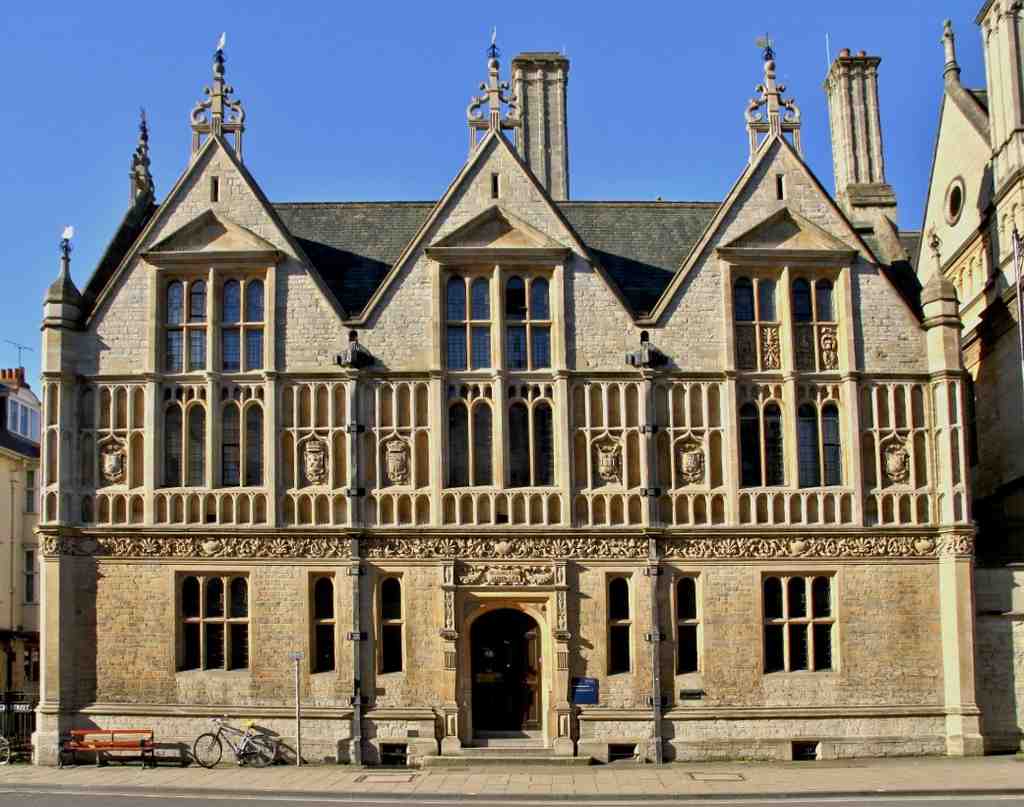
Ruskin School of ArtPhoto: Motacilla, Wikimedia Commons, CC BY-SA 4.0. Cropped & resized. On your right, look for the pale stone frontage, tall rectangular windows, and the tidy recessed entrance set squarely on the High Street.
The Ruskin School of Art exists because John Ruskin took one look at Oxford’s art teaching and decided, no, that will not do. In eighteen sixty-nine, Oxford appointed him Slade Professor of Fine Art. Two years later, after criticizing the methods at the Oxford School of Art, he founded the Ruskin School of Drawing in reworked university gallery rooms. He kept Alexander Macdonald in charge, which was practical rather than theatrical, and Macdonald became the first Ruskin Master, leading the school until nineteen twenty-one. During the Second World War, the Slade School of Fine Art even moved in here for a time.
If you glance at your screen, you can see Ruskin himself... a man whose answer to bad teaching was to rebuild the institution. The school started by training artisans in technical skill, but it now teaches visual art as a living part of contemporary culture, with history and theory folded in. That shift has worked rather well: the Ruskin ranks among the top art schools in Britain and led its field in the twenty twenty-one Research Excellence Framework.
This High Street site became its home in nineteen seventy-five, after leaving the Ashmolean. Then in two thousand and fifteen, the school added a second building at one hundred twenty-eight Bullingdon Road, a former warehouse redesigned as studios and awarded by the Royal Institute of British Architects.
If you want to visit, it generally opens Monday to Friday from ten in the morning to five in the afternoon, and stays closed on weekends. It is an art school with an Oxford habit of turning criticism into architecture. When you’re ready, continue on to the Botanic Garden for the final stop.
The Ruskin School of Drawing and Fine Art on Oxford High Street, shown in a historic view that places the school beside the Examination Schools and near the university centre.Photo: Txllxt TxllxT, Wikimedia Commons, CC BY-SA 4.0. Cropped & resized. 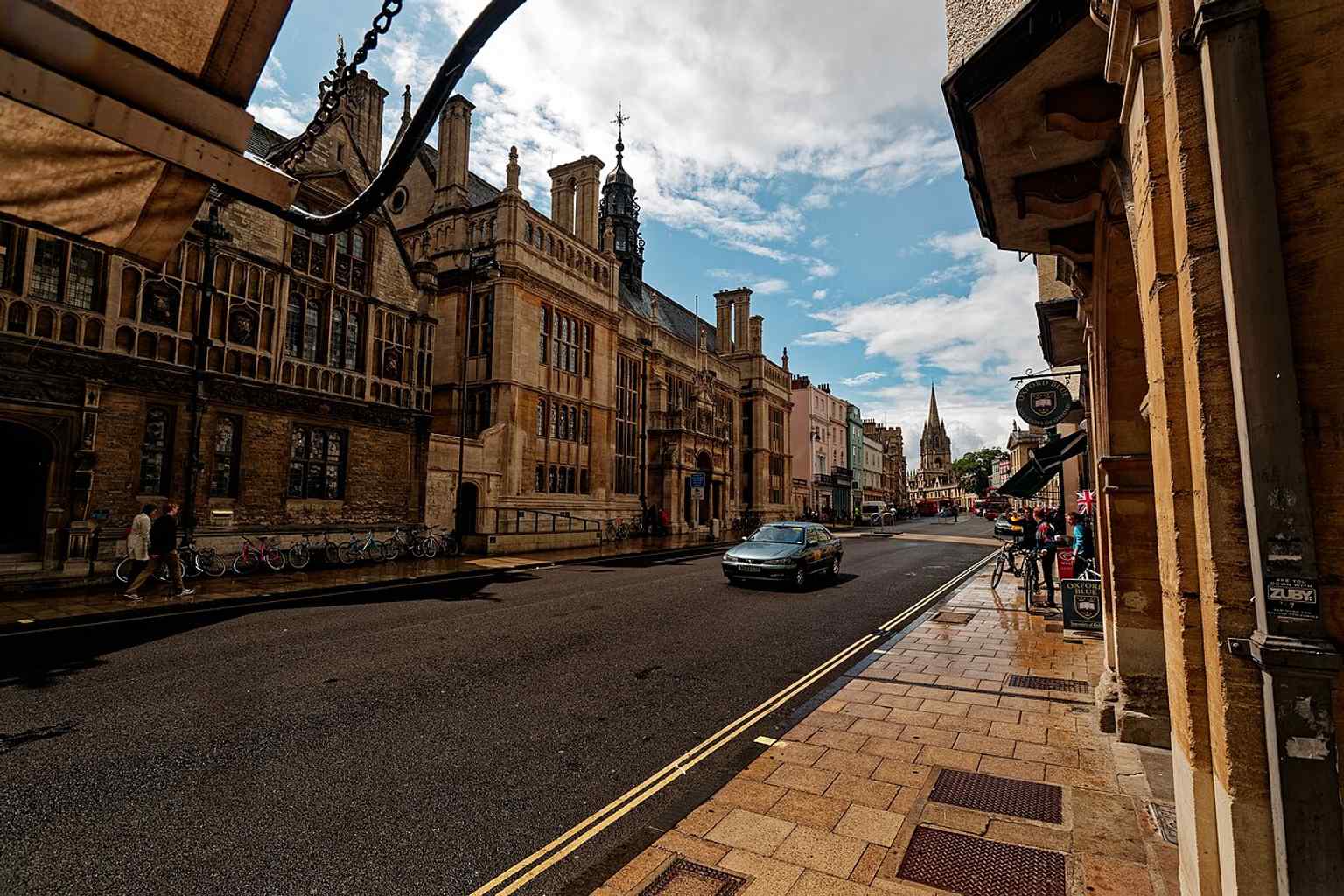
A west-facing view of the Ruskin School’s High Street frontage, linking the school to its long Oxford history in the former University Galleries area.Photo: Txllxt TxllxT, Wikimedia Commons, CC BY-SA 4.0. Cropped & resized. In front of you is a honey-colored stone gateway shaped as a three-bay arch, crowned with triangular pediments and marked by statues flanking its richly carved central entrance.…Read moreShow less
Open dedicated page →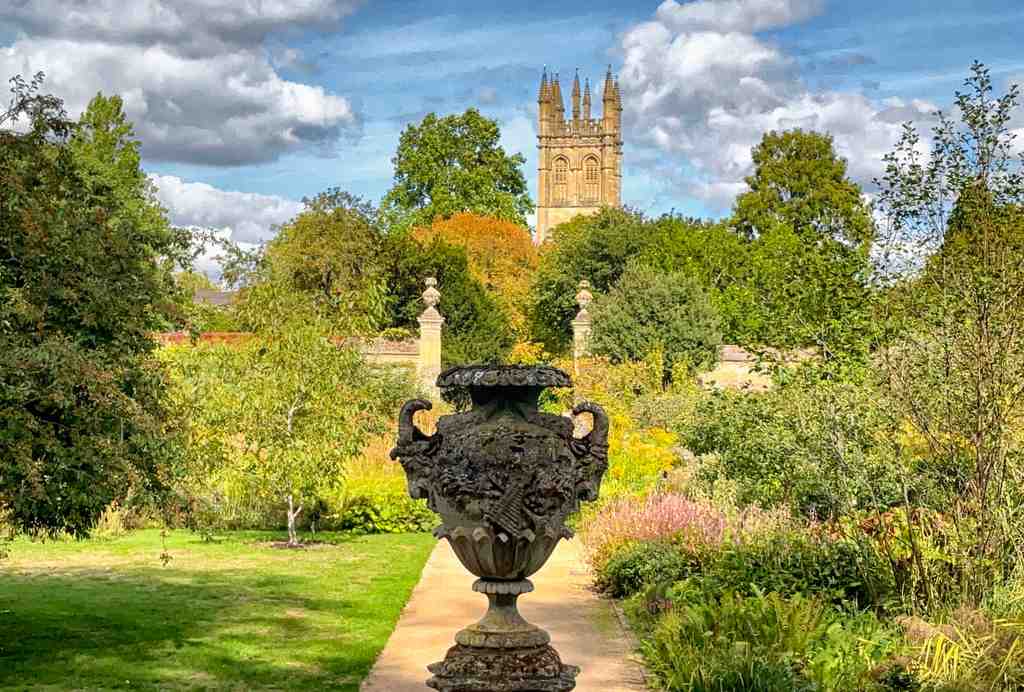
University of Oxford Botanic GardenPhoto: Honcques Laus, Wikimedia Commons, CC0. Cropped & resized. In front of you is a honey-colored stone gateway shaped as a three-bay arch, crowned with triangular pediments and marked by statues flanking its richly carved central entrance.
This is the University of Oxford Botanic Garden... the oldest botanic garden in Great Britain, and one of the oldest scientific gardens anywhere. Oxford founded it in sixteen twenty-one as a physic garden, which simply means a garden for growing plants used in medicine. So yes, this place began as a living pharmacy... just with fewer plastic bottles and much better landscaping.
Henry Danvers, the first Earl of Danby, gave five thousand pounds to create it - more than five million pounds in modern terms - for what he called the glorification of God’s works and the furtherance of learning. He chose this patch beside the River Cherwell, but there was a catch. The ground sat on a floodplain, and part of it had once been a Jewish cemetery before the expulsion of Jews from Oxford and England in twelve ninety. To make the site usable, workers hauled in four thousand cartloads of what the records cheerfully call “mucke and dunge.” Scholarship, in Oxford, has always rested on firm principles... and occasionally a heroic amount of manure.
The great entrance in front of you is the Danby Gate, designed by Nicholas Stone in the early sixteen thirties. If the porch at the University Church of Saint Mary the Virgin looked familiar earlier, that is not your imagination; Stone worked there too. Here he went full flourish. This is early Baroque - a style that liked drama, movement, and decoration. If you glance at the image on your screen, you can pick out the heavy carved stonework and the stately figures in their niches more easily. The gate even took gunfire during the English Civil War, which feels rude, frankly, given the workmanship.
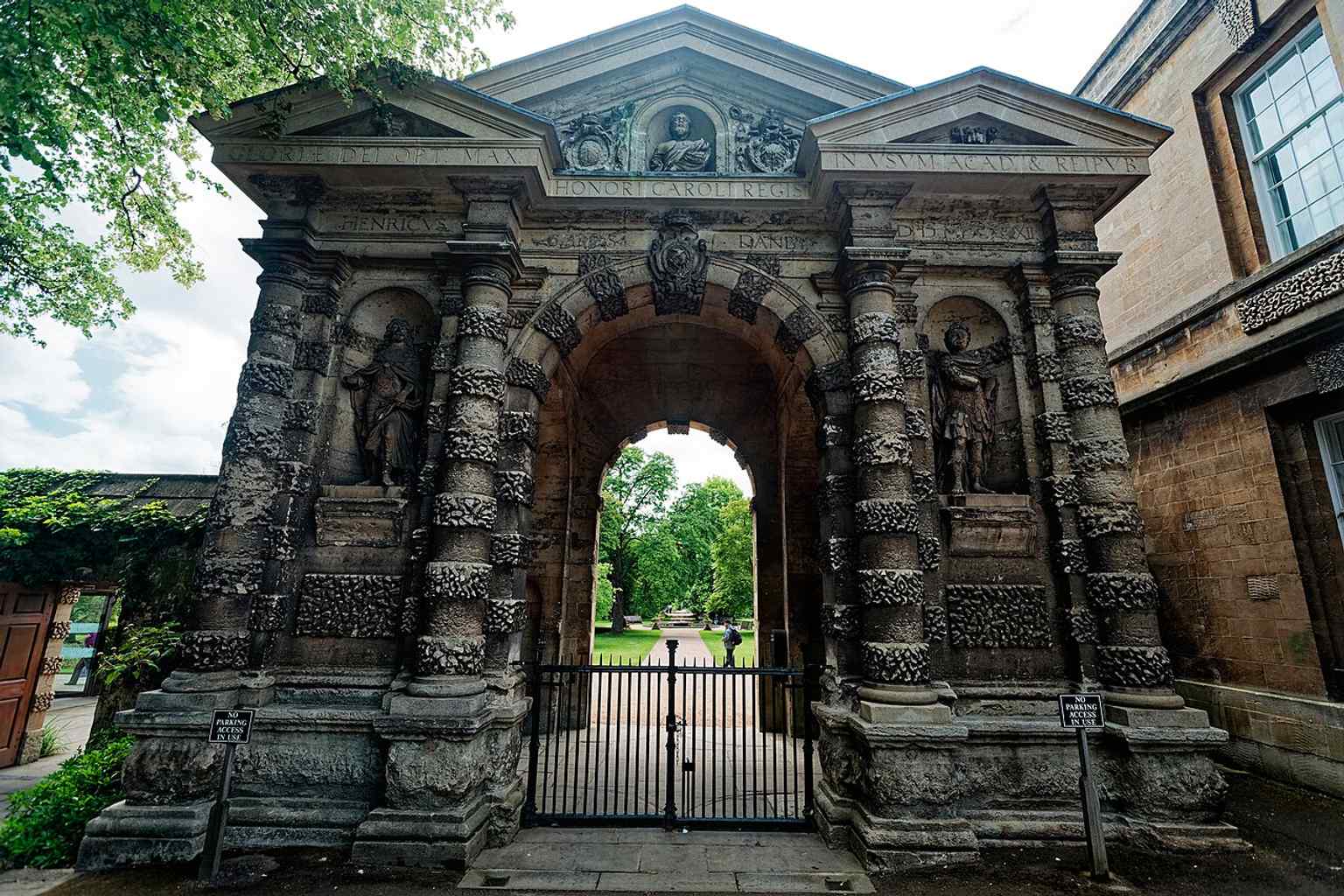
The ornate Danby Gate, the Garden’s 17th-century main entrance designed by Nicholas Stone.Photo: Txllxt TxllxT, Wikimedia Commons, CC BY-SA 4.0. Cropped & resized. Beyond this entrance lies an astonishingly compact collection: more than five thousand species packed into just one point eight hectares, representing over ninety percent of the higher plant families. It is a small garden with an outrageously ambitious social life. The layout falls into the walled garden, the glasshouses, and the lower garden near the river. Inside the old walls, plants are grouped by family in long narrow beds, a kind of botanical filing system. There is also a modern medicinal collection arranged by what the plants help treat - the heart, lungs, skin, blood, nerves, and more - a quiet reminder that many modern drugs began as leaves, roots, bark, and human curiosity.
Oxford’s first head gardener, Jacob Bobart, published a catalog in sixteen forty-eight listing sixteen hundred plants in both Latin and English. That was not just gardening; that was an argument that naming and studying the living world mattered.
If you peek at your app, the water lily image hints at one of the garden’s best-loved interiors. Lewis Carroll brought the Liddell children here in the eighteen sixties, and the lily house slipped into the visual world of Alice in Wonderland. J. R. R. Tolkien liked to sit here beneath a huge Austrian pine, and Philip Pullman turned a bench in the garden into one of Oxford’s most quietly heartbreaking literary shrines.

A close-up of a water lily in the Oxford Botanic Garden, echoing the famous lily house and its long botanical history.Photo: ImagePerson, Wikimedia Commons, CC BY 4.0. Cropped & resized. For a final stop, this place feels right: science, story, beauty, and a little stubborn survival, all behind one splendid gate. If you plan to go in, the garden is open every day from ten in the morning until five in the afternoon.
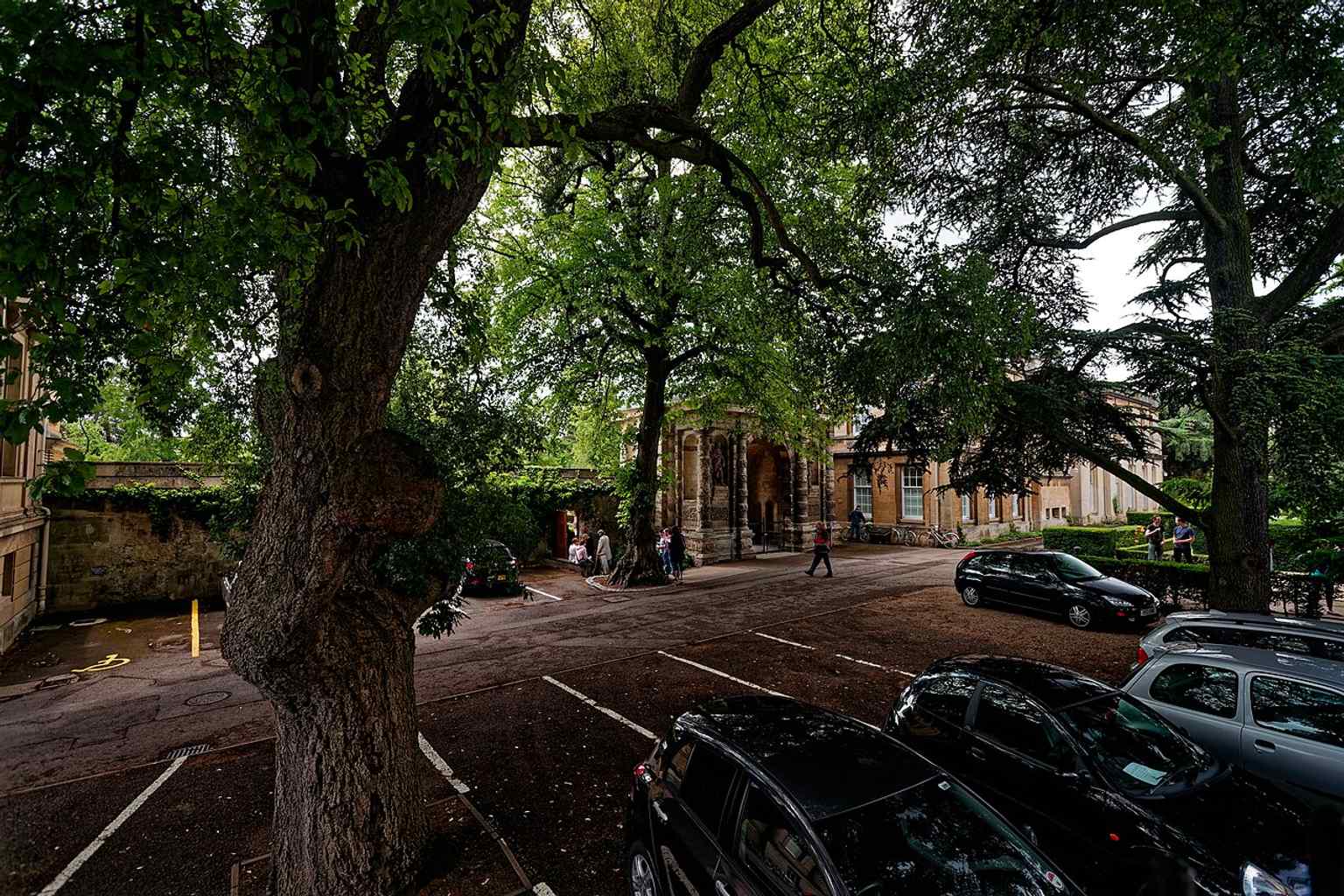
A clear view of the Danby Gate from the street, the Baroque gateway that has welcomed visitors since the 1630s.Photo: Txllxt TxllxT, Wikimedia Commons, CC BY-SA 4.0. Cropped & resized. 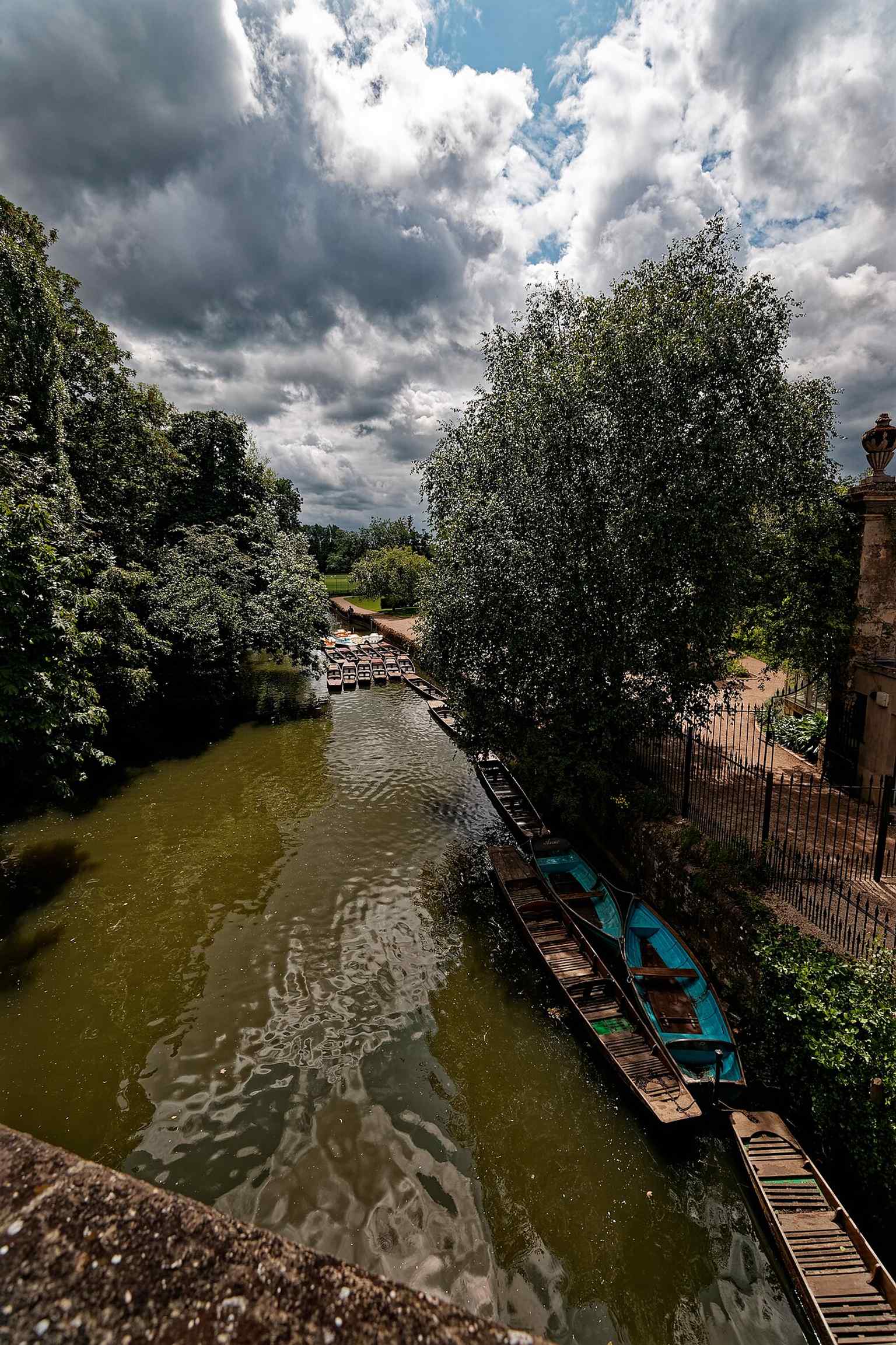
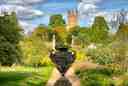
The garden beside the River Cherwell, matching the site chosen in 1621 on the floodplain by Magdalen College.Photo: Txllxt TxllxT, Wikimedia Commons, CC BY-SA 4.0. Cropped & resized. 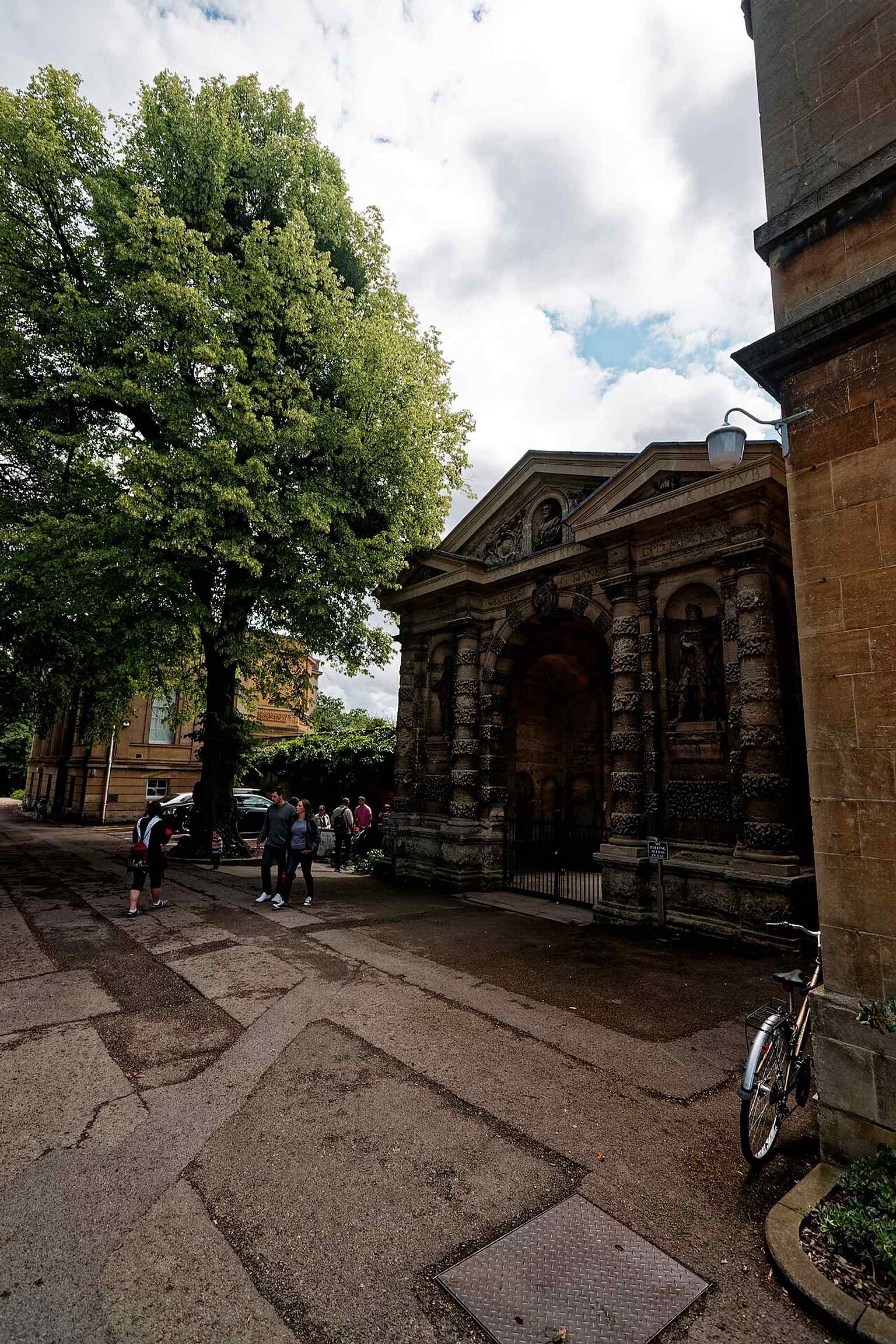
Danby Gateway from Magdalen College side, highlighting the classical entrance that predates many of Oxford’s later buildings.Photo: Txllxt TxllxT, Wikimedia Commons, CC BY-SA 4.0. Cropped & resized.

Frequently asked questions
How do I start the tour?
After purchase, download the AudaTours app and enter your redemption code. The tour will be ready to start immediately - just tap play and follow the GPS-guided route.
Do I need internet during the tour?
No! Download the tour before you start and enjoy it fully offline. Only the chat feature requires internet. We recommend downloading on WiFi to save mobile data.
Is this a guided group tour?
No - this is a self-guided audio tour. You explore independently at your own pace, with audio narration playing through your phone. No tour guide, no group, no schedule.
How long does the tour take?
Most tours take 60–90 minutes to complete, but you control the pace entirely. Pause, skip stops, or take breaks whenever you want.
What if I can't finish the tour today?
No problem! Tours have lifetime access. Pause and resume whenever you like - tomorrow, next week, or next year. Your progress is saved.
What languages are available?
All tours are available in 50+ languages. Select your preferred language when redeeming your code. Note: language cannot be changed after tour generation.
Where do I access the tour after purchase?
Download the free AudaTours app from the App Store or Google Play. Enter your redemption code (sent via email) and the tour will appear in your library, ready to download and start.
If you don't enjoy the tour, we'll refund your purchase. Contact us at [email protected]
Checkout securely with 





.jpg)


%20-%20Christ%20Church%201546%2003.jpg)


.JPG)


.jpg)


.jpg)


%201613.jpg)

%20by%20Hubert%20Le%20Sueur.jpg)
%20by%20Hubert%20Le%20Sueur%2003%20-%20Tower%20of%20the%20Five%20Orders%20of%20Architecture%20(Tuscan%2C%20Doric%2C%20Ionic%2C%20Corinthian%2C%20Composite)%201613.jpg)


%20Bodleian%20Library%201602%20-%20(On%20the%20right)%20Clarendon%20Building%20(Oxford%20University%20Press)%201711-15%20by%20Nicholas%20Hawksmoor.jpg)
%20Bodleian%20Library.jpg)


%20-%20View%20South%20on%20River%20Cherwell%2C%20Punts%20%26%20University%20of%20Oxford%20Botanic%20Garden%201621.jpg)
%20-%20View%20SSE%20on%20Danby%20Gateway%201633%20by%20Nicholas%20Stone%20-%20Baroque%20architecture%20-%20Entrance%20gate%20to%20University%20of%20Oxford%20Botanic%20Garden.jpg)