
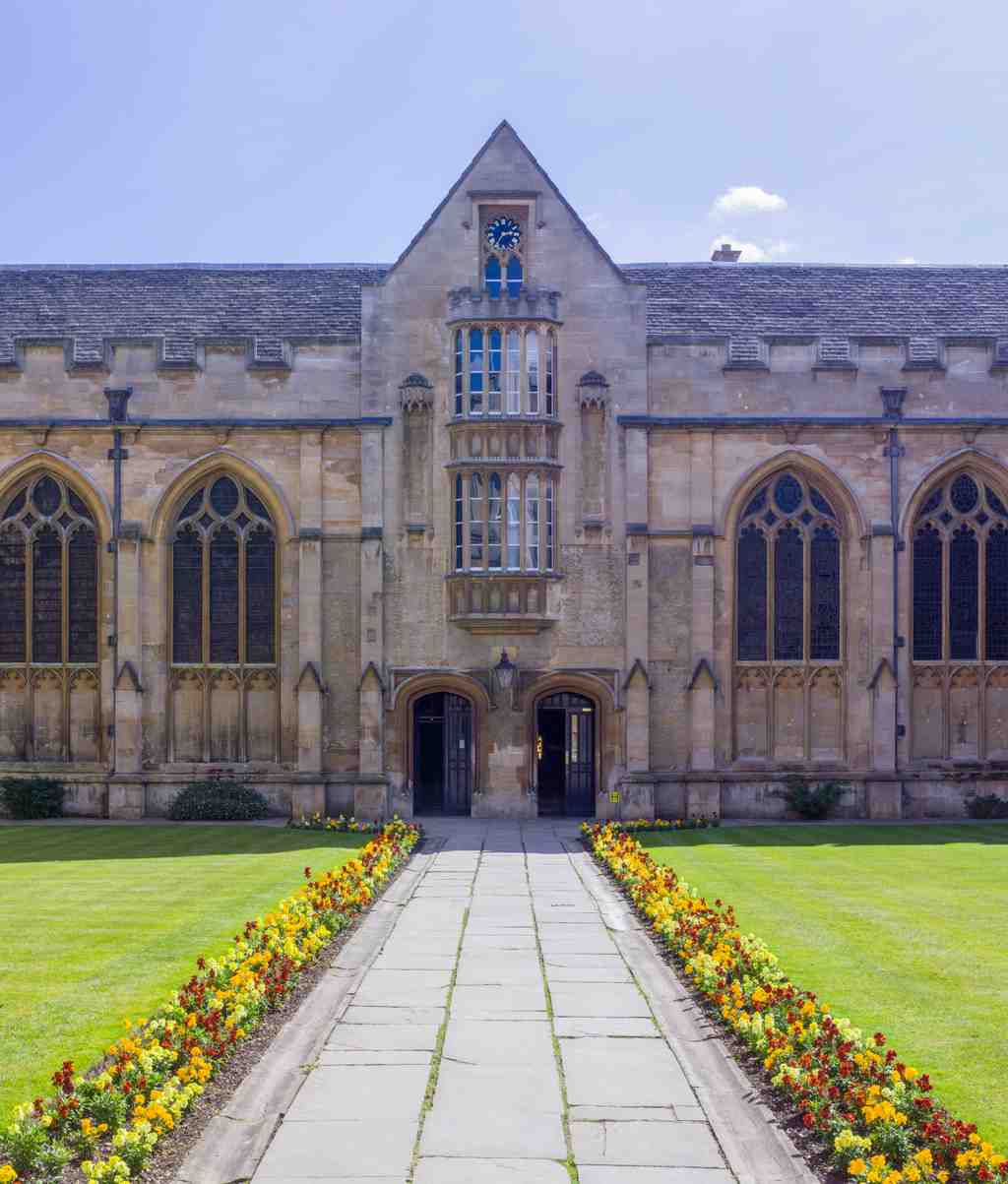
On your right, look for a long honey-colored stone frontage with rows of tall sash windows and a central arched gateway, picked out by the college arms above the entrance.
This is University College, usually called Univ... because Oxford likes tradition, but it also likes shorthand. Univ claims to be the oldest college in Oxford, and that argument has fueled plenty of polite academic eyebrow-raising. The college points to William of Durham, who left money in twelve forty-nine to support ten or twelve masters of arts studying divinity, which simply means advanced students focused on theology. A hall called Aula Universitatis, or University Hall, followed in twelve fifty-three. Balliol and Merton would each like a word about that claim to seniority, naturally.
Then there is the more colorful founding story. In the fourteen hundreds, people began saying King Alfred founded the college in eight hundred seventy-two. Very convenient. That legend explains why Univ used arms linked to Alfred, why the reigning monarch still serves as the college visitor - a sort of official guardian in ceremonial matters - and why the college celebrated a thousand years in eighteen seventy-two. Historians, with their tiresome attachment to evidence, usually prefer William of Durham.
What you see from the street belongs mostly to a rebuilding campaign that replaced medieval structures as the college grew richer and more confident. The main quadrangle - a square courtyard enclosed by buildings - began in sixteen thirty-four, but the English Civil War interrupted the work, so completion dragged on until sometime in sixteen seventy-six. If you check the image in the app, you can see that ordered inner court for yourself. Oxford colleges love presenting calm symmetry even when history has plainly been doing its best to interfere.
Univ has produced, or at least hosted, an improbable cast. Clement Attlee and Harold Wilson both reached Number Ten. Bob Hawke became prime minister of Australia. Bill Clinton studied here, though he did not graduate. C. S. Lewis, Stephen Hawking, and the novelist R. F. Kuang all appear on the roll call too. And one figure deserves a slower mention: Christian Cole, the first Black student to graduate from Oxford, was associated with this college in the late seventeenth century. That is not just a college anecdote; it is part of the university widening, however slowly, beyond its old boundaries.
Percy Bysshe Shelley also studied here, briefly. He and his friend Thomas Jefferson Hogg got sent down - expelled, in plain English - after Shelley published The Necessity of Atheism in eighteen eleven. On your phone, there’s an image of the Shelley Memorial, where the college later placed a statue of him lying dead on an Italian shore. Oxford can be wonderfully unforgiving first, then deeply commemorative afterward.
The place kept changing. Univ admitted its first mixed-sex cohort in nineteen seventy-nine after centuries as a men-only college. It now has hundreds of undergraduates and postgraduates, strong music and rowing traditions, and one especially grand ritual: the longest grace in Oxford, possibly in Cambridge too, recited before Formal Hall on Tuesdays, Thursdays, and Sundays. Even dinner here comes with a full Latin performance.
So Univ stands here as both argument and institution: ancient, ambitious, and never entirely free of myth.
When you’re ready, continue on to the Ruskin School of Art, where Oxford loosens its collar a little.




