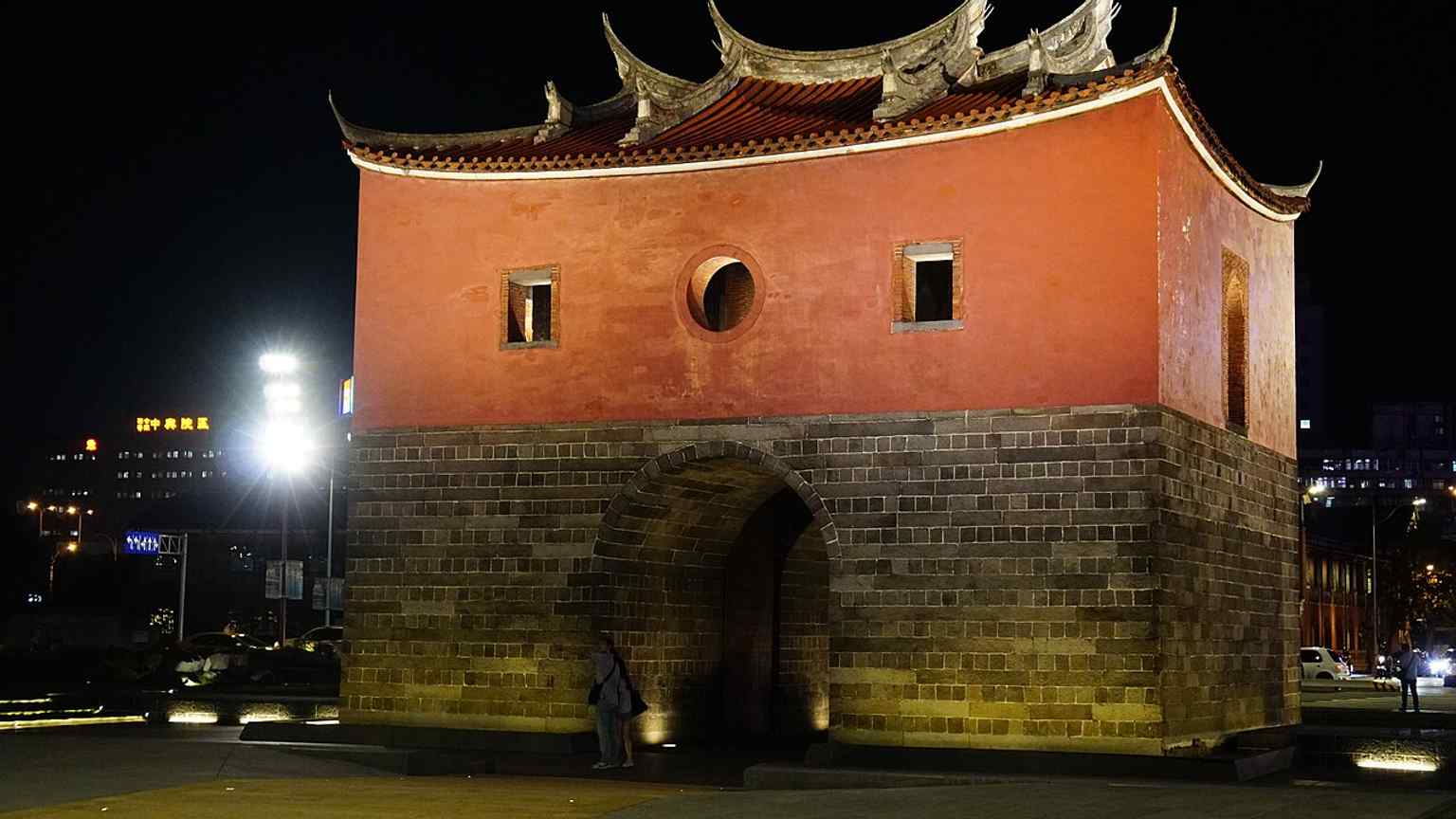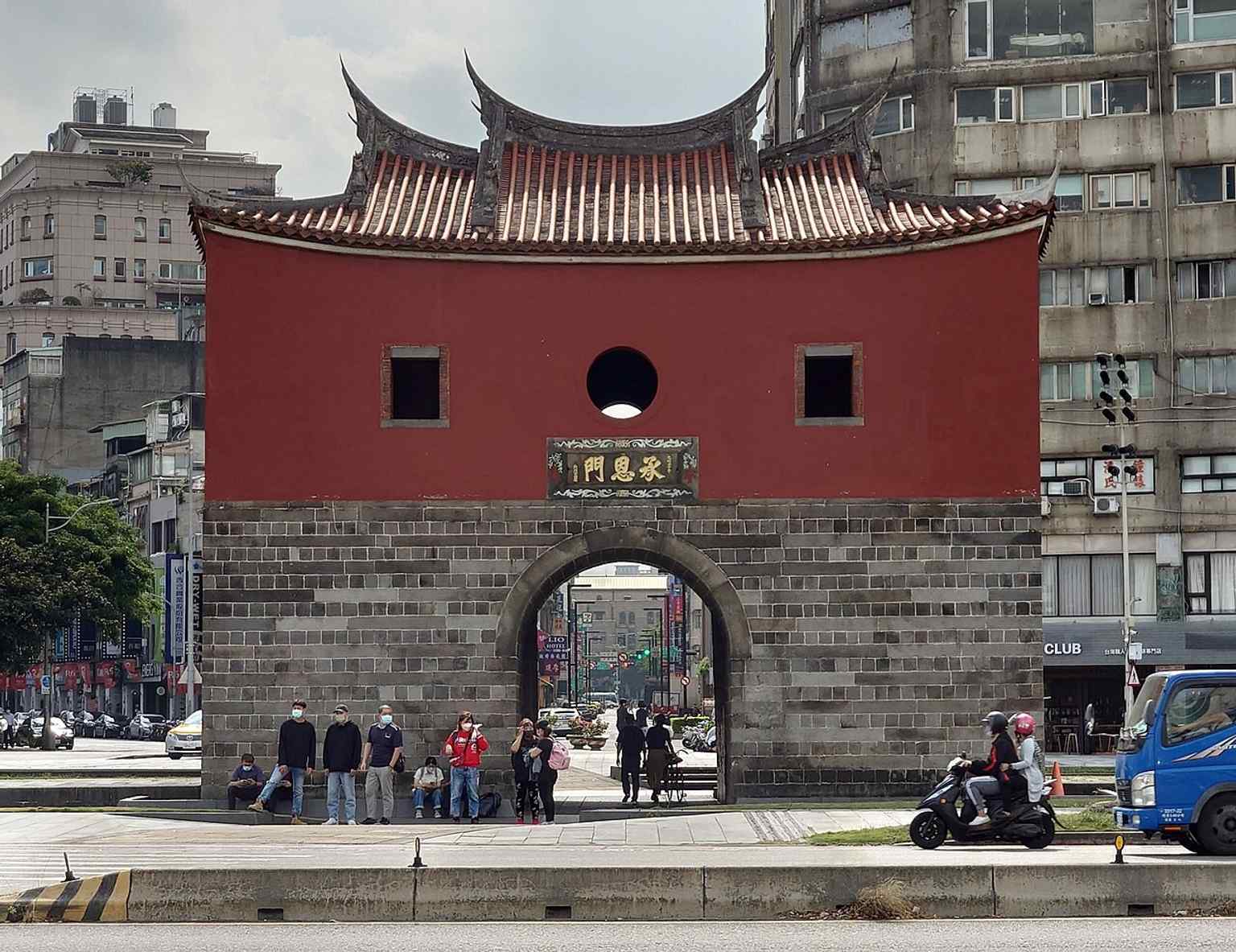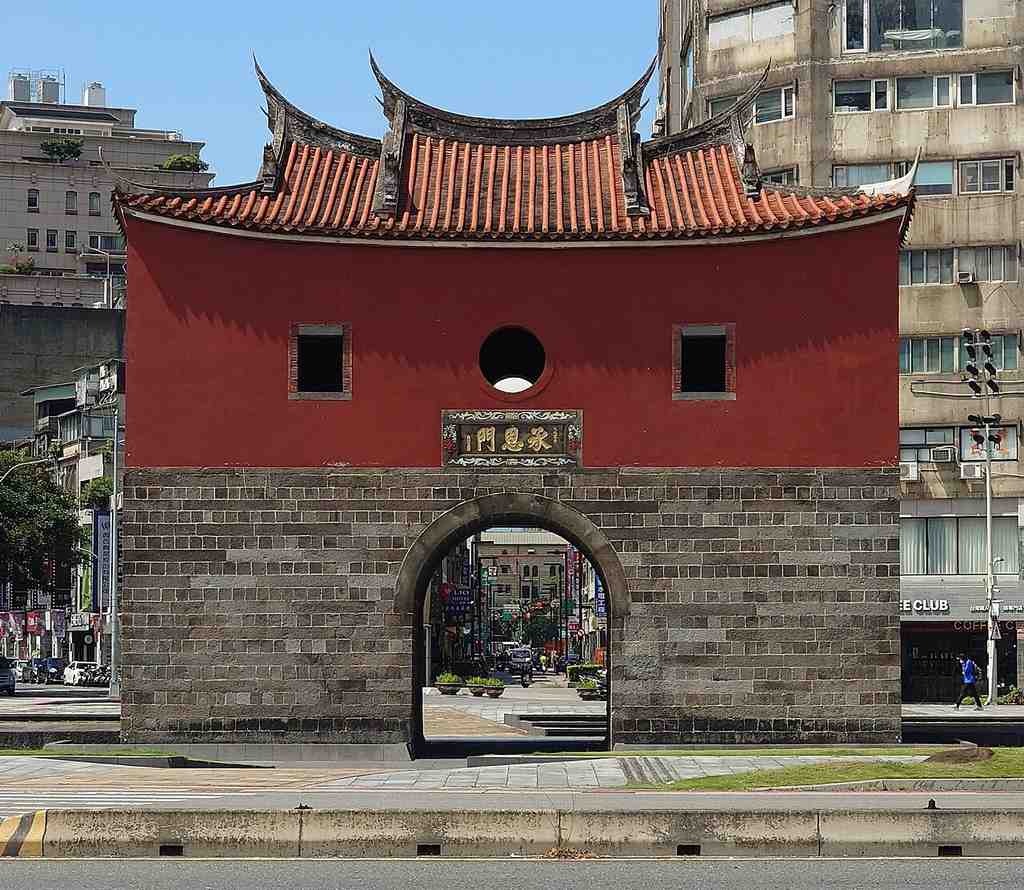
In front of you is a squat andesite stone base carrying a red-brick gatehouse with a broad arched opening, topped by a dark tiled roof and marked by the plaque reading Cheng'en Gate.
This is Taipei City North Gate, formally Cheng'en Gate, finished in eighteen eighty-four as the main gate of the Qing walled city. More than that, it is the old city threshold: one of the rare surviving anchors of Qing Taipei, and the only one of the five major gates that still keeps its original form. That alone makes it a small miracle... and a slightly stubborn one.
The gate faced the Tamsui River approach, so it was never just decorative. Qing officials often arrived by boat, landed not far from here, and entered through this opening on their way to the governor's offices. The name Cheng'en means something like “receiving imperial grace,” which tells you the gate was doing politics as well as traffic control. Ordinary movement had its own rules; official arrival had ceremony.
Before I go on, give the building a proper look. Notice the rough dark stone below and the red brick wrapped tightly around the upper chamber. Unlike so much around it, this gate still lets you read Taipei before boulevards, ministries, and impatient road engineers started rearranging the script.
It also had sharper teeth than it first appears. North of the gate once stood an outer defensive enclosure, a kind of smaller fort that half-wrapped the entrance, with its own arch deliberately offset from this one so attackers could not charge straight through. Inside, the gatehouse uses a double-wall plan, almost like a box within a box, protecting the central space. Even the small window openings mattered: two square and one round, sized for watching and defense, not for romance.
Then came the pivot. In June of eighteen ninety-five, as Qing rule collapsed and Japanese forces approached Taipei, local notable Gu Xianrong helped negotiate their entry. A city legend adds an unnamed old woman outside this very gate, guiding the soldiers forward when they hesitated. Either way, the result was the same: the Japanese entered through North Gate without a battle here, and a Qing threshold became the doorway to colonial rule. One regime built it to stage authority; another walked through it and kept the stage.
And then, modern progress nearly finished the job. The Japanese removed most of the city wall. Later, planners under the Republic of China nearly demolished this gate too. Scholars pushed back, and North Gate survived, only to spend decades visually smothered by an elevated road pressed right beside it. Taipei did not exactly forget the gate... it just hid it in plain sight with concrete. If you want, check the before-and-after image in the app; the difference is pretty blunt.
When the flyover finally came down in twenty sixteen, and the plaza opened in twenty seventeen, the city could see this landmark again as more than a traffic obstacle. In the app, the aerial image helps show how the redesigned square finally gave the gate some breathing room.
Even now, repairs continue because age never takes the day off. But the important thing is this: the gate still stands as a doorway between different Taipeis - the walled Qing city, the Japanese colonial capital, and the contemporary metropolis flowing around it. From here, we head toward Ximen Red House, about a seventeen-minute walk away, and deeper into the parts of Taipei that never fit neatly inside official walls.