
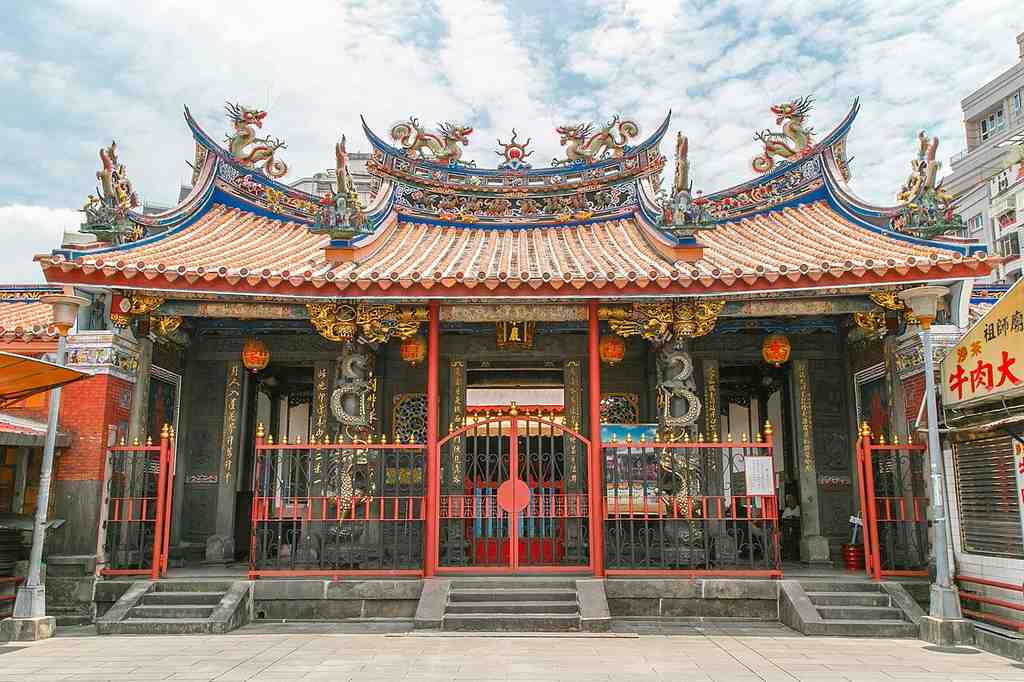
On your left is a broad stone-and-brick temple front with three shadowed doorways, squat dragon-carved columns, and roof ridges crowded with ceramic immortals that seem to be holding a meeting above the street.
This is Mengjia Qingshui Rock, better known as the Ancestor Temple, and from where you’re standing it looks solid, almost stubborn. That fits the story. In seventeen eighty-seven, Quanzhou migrant communities from Anxi in Fujian chose a man named Weng Youlai to organize a temple here. He brought incense lineage from the mother temple in Anxi, and settlers in Bangka pooled their money and labor to establish this place. For those migrants, a temple was never just a religious stop. It was a neighborhood headquarters, a mutual-aid office, a place to settle trust, status, and belonging without waiting for some distant official to notice them.
The main deity, Qingshui Zushi, was a monk from the Song dynasty, but this temple never kept a tidy one-god arrangement. Inside, people also venerate Mazu, the sea goddess, Guan Gong for loyalty and war, Wenchang for learning, the Earth God, and others. That mix tells you how Wanhua grew: merchants, families, sailors, scholars, and craftsmen building one social world together.
Locals speak most warmly about the Penglai Ancestor, the most revered of the temple’s seven Qingshui images. This is the detail many passersby never hear. He is also called the black-faced ancestor, because legend says ghosts scorched him with fire during meditation. And he is the falling-nose ancestor: when danger approaches, his nose is said to drop off as a warning. Government offices issue notices; old neighborhood gods, apparently, prefer stronger visual communication.
This temple also sat inside very real conflict. In eighteen fifty-three came the Dingxiaojiao conflict, a violent struggle between different Fujian merchant groups in Bangka. The Quanzhou San-yi side wanted to strike rivals from Tong’an and needed a route across swampy ground. They pressured the Anxi community to let this temple burn so troops could pass, promising they would rebuild it afterward. They did not exactly honor that promise. They donated only a pair of dragon columns. Which is a bold interpretation of “we’ll take care of it.” So the Anxi community raised funds again and rebuilt the temple between eighteen sixty-seven and eighteen seventy-five. Much of what you see still carries that mid-Qing rebuilding, which makes this one of Taipei’s rare places where the old structure still speaks for itself.
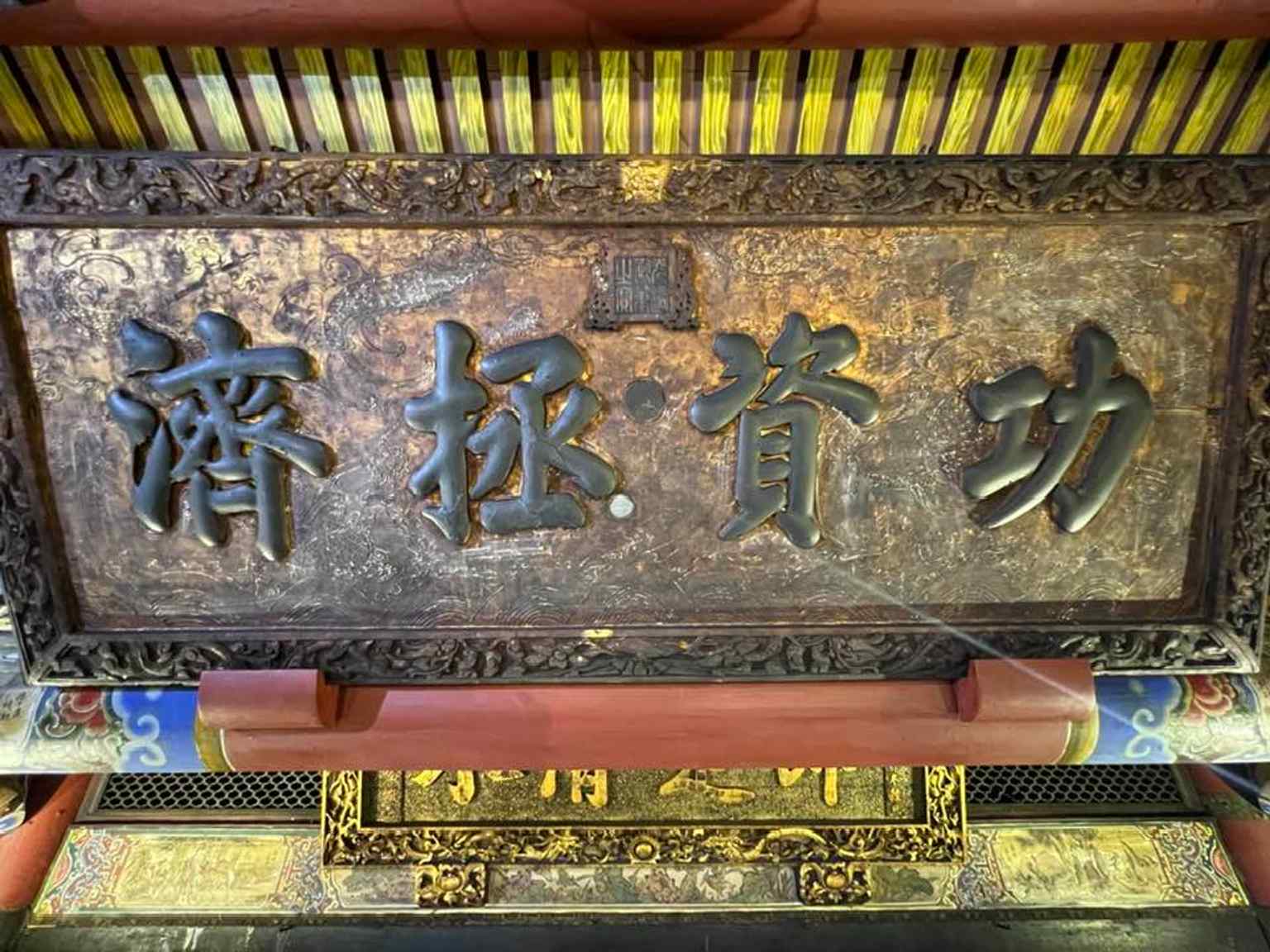
Take a glance at the app and you’ll see the imperial plaque reading “Meritorious in Rescue.” The Qing court awarded it after the Sino-French War, when believers said the Penglai Ancestor helped protect Tamsui and, by extension, Taipei. Official history gave the temple a plaque. Local memory gave it miracles, lawsuits over who owned the statue, and eventually a shared rotation between Mengjia and Tamsui. Even the gods here ended up with a commuting schedule.
Then, under Japanese rule, officials turned the temple into a language-school annex. Later it also served as an early campus site for schools that became Chenggong High School. So buildings kept getting repurposed from above. But here, the deeper claim stayed with the neighborhood below: ritual, donations, argument, rebuilding, and memory.
In about five minutes, Monga Green Mountain Temple shows you another face of that local power. If you want to come back inside later, Qingshui Rock is generally open daily from six in the morning to six in the evening.





