
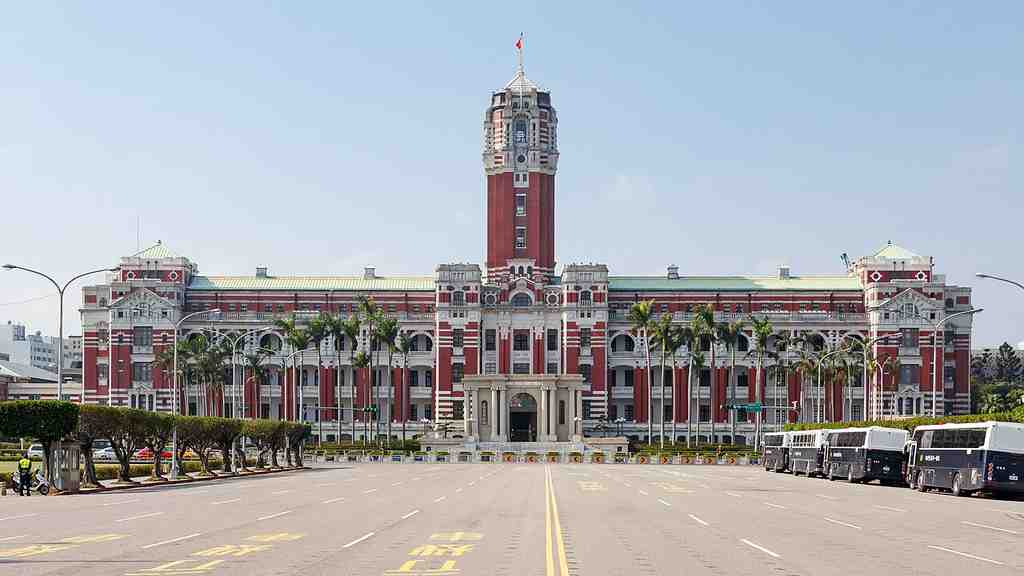
In front of you stands a long red-brick facade on a gray stone base, laid out in strict symmetry and pinned at the center by a tall square tower.
This is where our walk really begins, because this building tells you what central Taipei has been doing for more than a century: keeping power in the same monumental shell while the people inside, the flags above, and the language of authority all change. What you’re looking at is layered power in stone. One regime raised it to command the colony; another took it over and kept using the same walls to command the state.
The building began as the Taiwan Governor-General’s Office under Japanese rule. In nineteen oh seven, officials launched a design competition. The first-place scheme looked suspiciously like the Peace Palace in The Hague, which is an elegant way of saying someone may have borrowed a little too enthusiastically. So the judges turned instead to the runner-up by Nagano Uheiji, a student of Tatsuno Kingo, the architect tied to Tokyo Station. Then another architect, Moriyama Matsunosuke, or 森山松之助, reworked that plan into the version you see now: broader, sterner, and crowned with that commanding tower.
Take a moment and study the facade... the tower in the middle, the wings spreading out, the almost military rhythm of the whole front. Does it feel like a mere office building? Not exactly. It was designed to be read from a distance, like a sentence that only says one thing: obey.
Construction started in nineteen twelve and finished in nineteen nineteen. At the time, this was the tallest building in Taiwan, and it sat at the center of a remade capital. The main front faces east, aligned with the city’s new planning and the old East Gate axis, so the district around it became part of the performance. This was never just one building. It was the hub of an administrative machine.
Most visitors miss a local little correction here: people often assume the address is Ketagalan Boulevard number one because the ceremonial front sits there. It isn’t. The official address is on Chongqing South Road, and Ketagalan Boulevard number one actually belongs to Taipei Guest House. Taipei likes to keep its formalities slightly mischievous.
War hit this place hard. In nineteen forty-five, U-S air raids damaged the front section. After the war, local donors helped fund repairs, and by the late nineteen forties the building returned under a new name, Jieshou Hall. Then in nineteen forty-nine, when the Republic of China government moved to Taiwan, the same structure became the Presidential Office. Different state, same commanding address.
If you glance at the image on your screen, you can see how that old colonial shell still hosts modern ceremonies inside. And another image shows something even more telling: performances and public events in front of the building. By the nineteen nineties, Lee Teng-hui opened it more directly to the public and even encouraged concerts here, as if music might soften stone. It helps... a little.
Since nineteen nineteen, apart from its repair years, this building has almost continuously served as Taiwan’s highest political center. That continuity is impressive, and a little unsettling.
Ahead, the district keeps unfolding that same story in different accents. We’ll head next toward the National History Museum, about a six-minute walk away. If you ever want to go inside here, public visits are usually limited to weekday mornings from nine to eleven-thirty.




