
Lucerne Audio Tour: Artful Legends and Bridges of Time
Discover the heart of Lucerne on this captivating tour, beginning at the iconic Lion Monument Lucerne, where history and artistry converge in a powerful tribute. Wander through the vibrant Lucerne Central, a perfect blend of modern life and charming Swiss culture. Immerse yourself in knowledge and heritage at the elegant University Library, a treasure trove for book lovers. Finally, step into the serene courtyard of St. Leodegar, a stunning Renaissance church that showcases exquisite architecture and timeless beauty. Experience the rich tapestry of Lucerne’s past and present on this unforgettable journey.
Tour preview
About this tour
- scheduleDuration 90–110 minsGo at your own pace
- straighten3.2 km walking routeFollow the guided path
- location_onLocationLucerne, Switzerland
- wifi_offWorks offlineDownload once, use anywhere
- all_inclusiveLifetime accessReplay anytime, forever
- location_onStarts at Museum of Fine Arts Lucerne
Stops on this tour
lock_open 3 free previews · 11 unlock with purchase
To spot the Museum of Fine Arts Lucerne, look for a huge, modern glass building with large banners and the words “KKL Luzern” and “Kunstmuseum Luzern Museum of Art Lucerne”…Read moreShow less
To spot the Museum of Fine Arts Lucerne, look for a huge, modern glass building with large banners and the words “KKL Luzern” and “Kunstmuseum Luzern Museum of Art Lucerne” proudly displayed near the Lucerne train station. Welcome to the Kunstmuseum Luzern! Now, you might need to stretch your neck a little-it’s way up on the fourth floor of this gleaming contemporary building, which, frankly, looks like the secret headquarters of Switzerland’s most creative minds. As you stand here, imagine the, and inside, the world of Swiss and international art opens up before you. The story of this museum is like a painting splashed with surprises, color, and a twist of drama. It all began back in 1819, when a group of art-loving Lucerne folks got together, determined to create a lively meeting place for artists and ordinary people who just had a soft spot for lovely pictures. Fast forward to 1932, and voilà! The Kunstmuseum was officially founded-proving that sometimes dreams need just over a hundred years and a good dose of patience. But of course, nothing stays still in art or in Lucerne! The museum moved in 1933 to its own home designed by Armin Meili, only to be completely transformed in the 1990s. Imagine the spectacle: the old building is torn down, a cloud of dust floating over Lake Lucerne, and in its place, the sensational Kultur- und Kongresszentrum Luzern, or KKL, designed by the star architect Jean Nouvel, rises from the spot like a giant futuristic ship by the water. Jean Nouvel’s galleries are thoughtfully lit by daylight from above-so even the paintings get to enjoy a bit of Swiss sunshine. The collection itself is bursting with wonder. Thousands of works take you from the glories of the Renaissance all the way up to the present day-think of it as an enormous, ever-changing treasure chest. There’s something for everyone: Swiss classics, the funky and experimental art of the 1970s, plus vibrant pieces from today’s hottest artists. This is a “cultural archive” of Central Switzerland, packed with gems by legends like Albert Anker, Ferdinand Hodler, Meret Oppenheim, and even some international giants: Picasso, Kandinsky, Hockney, and Miró have all featured here. Artworks come and go-you might fall in love with a landscape by Turner or be wowed by an installation by Ugo Rondinone, but the next time you visit, the rooms could be filled with something completely different. It’s like Lucerne’s very own magic picture book. Speaking of surprises, one of the museum’s most playful pieces is found in its foyer: the bronze sculpture “Selfportrait as an artist” by Urs Lüthi shows the artist himself sweeping with a broom. If you listen closely you can almost imagine the. Lüthi says it’s a symbol for how artists sort, tidy, and search for meaning in the wild, messy world-proof that even art needs a good cleaning sometimes! Care for a snack while you admire creativity? The museum café, opened in 2015, is an artwork itself, crafted with love and quirky details by Urs Lüthi. Cushions, counters, and even vitrines filled with personal items make you feel like you’ve wandered into the lounge of a particularly chic artist. Every year, the museum welcomes tens of thousands of visitors, drawn in by blockbuster exhibitions. Imagine the buzz in 2019 when over 80,000 people came to see J.W.M. Turner’s spectacular landscapes-his watercolors actually captured the magic of Lucerne itself, painted during his travels through Switzerland. Or picture the excitement when David Hockney’s works filled these halls-his bright pool paintings, two-person portraits, and even digital animations taking visitors for a dip in dazzling color. And it wouldn’t be Lucerne without a bit of competition: every winter, the museum hosts a big juried show celebrating the best new Central Swiss art. Some artists win a prize and the chance for their very own solo exhibition-a bit like discovering a hidden talent and making them a star! So, take a deep breath and step through those modern glass doors-whether you love classic landscapes or wild installations, you’re entering a slice of Lucerne where curiosity and creativity have danced together for over a century. And who knows, maybe by the end, you’ll be inspired to pick up a broom-or just a paintbrush!
Open dedicated page →
Show 11 more stopsShow fewer stopsexpand_moreexpand_less
To spot the Lucerne Festival headquarters, just look for the enormous modern glass and steel building right on the edge of the lake-it's the dramatic structure with a flat…Read moreShow less
To spot the Lucerne Festival headquarters, just look for the enormous modern glass and steel building right on the edge of the lake-it's the dramatic structure with a flat greenish roof and a big fountain splashing in front, making it hard to miss! Now, as you stand in front of this striking building, I want you to imagine the air thrumming with a sense of possibility. Every summer, the space you see before you transforms. Musicians and music lovers from every corner of the globe flock here, their hearts pounding with excitement, their minds buzzing with anticipation. And why? Because the Lucerne Festival is no ordinary event-oh no, this is where the giants of classical music rub shoulders with young rebels and musical visionaries, all under that sweeping roof. Let’s rewind the clock for a moment! Picture it: the year is 1938. Europe is tense, the world unsure, but in the gardens of Richard Wagner’s villa here in Lucerne, something magical is about to happen. Picture grand old trees reflected in lake water, strings of lanterns glowing softly as dusk settles, and the hush of a crowd-then, suddenly, the world-famous conductor Arturo Toscanini steps up. He lifts his baton in the stillness, surrounded by elite musicians he’s gathered from across Europe. Their music soars into a night laced with nerves and hope, and the very first Lucerne Festival begins. A little dramatic? Sure! But what do you expect-this is Switzerland, where even the cows know how to yodel in perfect harmony. As the decades passed, the Lucerne Festival grew into the heartbeat of global classical music. In the 1940s, it became home to the Swiss Festival Orchestra-think of it as the musical equivalent of assembling the Swiss Army Knife: brilliant, versatile, and ready for anything. The festival was rebranded the International Music Festival Weeks Lucerne, but everyone just called it their “musical home,” no matter where they were from. Want a plot twist? In the year 2000, the festival took on the streamlined name “Lucerne Festival”-snazzy, right? But it wasn’t just about the name. It was about a bold vision, the future bubbling up beneath that glassy lake. Enter Michael Haefliger, Executive and Artistic Director since 1999, whose mission was to ensure the festival kept surprising and delighting. And here’s a fun fact: coming soon, in 2026, Sebastian Nordmann will pick up the conductor’s baton as the new director. Change is always in the air around here! These days, Lucerne Festival isn’t just one event-it’s a year-long celebration divided into four creative seasons. The legendary Summer Festival is the blockbuster, filling this dazzling Jean Nouvel-designed hall with over 100 concerts. Imagine music that ripples out from the stage to lap gently against the glass walls, then drifts over the water like mist. Symphony orchestras, soloists who can make violins weep and pianos dance, and resident stars all fill the city with sound. Recent guests have included the Berlin Philharmonic and Vienna Philharmonic, and visionaries like Bernard Haitink and Anne-Sophie Mutter. The themes shift every year-from “Identity” to “Childhood” to “Power”-so it’s a bit like opening a new chapter in a favorite book every August. But that’s not all, folks! Lucerne Festival is something of a musical mad scientist’s laboratory. With the Lucerne Festival Academy, created by Pierre Boulez and Michael Haefliger in 2003, you’ll find the brightest young composers and musicians experimenting, inventing, and sometimes blowing the dust off the rules. If you hear a strange sound, don’t worry-it might just be genius at work. There are surprises around every corner. In 2021, a new format called Lucerne Festival Forward was launched, bringing fresh energy, public involvement, and digital magic. And for the grand finale under Michael Haefliger in 2025, get ready for the Ark Nova-the world’s first inflatable mobile concert hall, floating into Lucerne like a musical spaceship. Even I can’t wait to see that. So as you’re standing here, close your eyes for just a second and listen. You might almost hear the echoes: a violin sighing, a conductor’s whispered countdown, a thunder of applause rolling out onto Lake Lucerne. Every stone, every pane of glass, every ripple in the water carries a piece of this ever-growing musical legend. And remember: at Lucerne Festival, the music never really stops-it just gets ready for its next grand overture.
Open dedicated page →To spot the Jesuit Church, just look riverside for a grand, creamy white building with twin green onion-shaped domes - it stands out proudly right by the water with its decorative…Read moreShow less
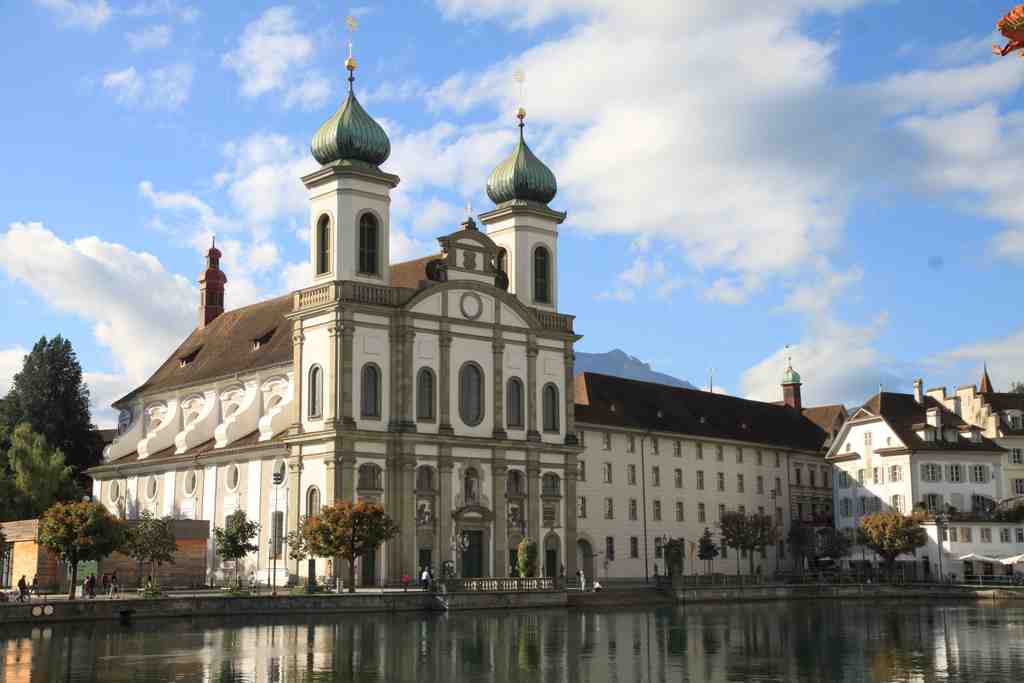
To spot the Jesuit Church, just look riverside for a grand, creamy white building with twin green onion-shaped domes - it stands out proudly right by the water with its decorative baroque facade. Now, as you stand before the shimmering waters of the Reuss and gaze up at these twin towers topped with their quirky green onion domes, let’s step back in time together. Imagine it’s the mid-1600s: Lucerne’s Old Town bustles nearby, while here, skilled builders and pious Jesuits put the finishing touches on Switzerland’s very first grand Baroque church. But don’t let that beautiful calm fool you - in those days, religious and political tides were as choppy as the river after a thunderstorm. A grand plan was hatched: to build not just any church, but one dedicated to Francis Xavier, the famous Jesuit missionary - talk about a man of adventure! If you peek at the facade, you’ll count five divisions and two impressive stories, lined with elegant pilasters and crowned with gables and a vibrant golden cross that glints in the sunlight. The look is meant to dazzle, and honestly, if you think it’s impressive now, you should’ve seen the jaw-drops back in 1677 when the church first opened its doors. Inside, you’d find more than just quiet prayers and candlelight. There’s the lingering sweet smell of incense and, flashing before your eyes, a painter named Domenico Torriani from Mendrisio busily working on the main altar painting, while the Torricelli brothers create sweeping murals depicting heroic travels and even the odd elephant pulling a heavenly chariot (really, how often do you get to see an elephant in a Lucerne church?). These wild animals weren’t just for show; they symbolized the far-off places Francis Xavier brought his message-from India to Japan and back again. Of course, no grand church would be complete without a little competitive spirit. The Jesuits commissioned designs rumored to be from architectural powerhouses like Michael Beer or Michael Thumb. Still, Father Heinrich Mayer, a Jesuit himself, drew the actual plans for the chapel’s stunning stucco decorations. He set the trend for a whole style of Swiss and South German church-building. By the way, if you stroll in, try imagining the splendor Mayer envisioned while wrestling with the tricky Swiss weather and the endless debate over pillars - everyone’s a critic, even in the 17th century! The magic didn’t stop there. The structure took shape with careful layers: the lower story with its arched doors welcomes both humble townsfolk and mighty dignitaries, while above, the windows flood the church with a golden, ethereal light. Take a glance at the towers, too - those iconic domes were a 19th-century update by designer Heinrich Viktor von Segesser, turning the church’s silhouette into Lucerne’s ultimate skyline calling card. Inside, the high altar, created by Christoph Bruck, is a masterpiece of layers - topped with the divine rays of glory and a golden eye representing God. But look closer: among the saints, clouds, and a host of angels, Francis Xavier himself kneels beneath the gaze of Mary and child, stars twinkling in her crown, his hand on a flaming heart. There’s even a fresco showing Xavier cruising through history in a chariot pulled by an unlikely crew: an elephant, a dromedary, a horse, and a cheetah! Those animals were chosen for where the saint’s legendary adventures took him, showing that here, faith had no borders. As for music - after all, what’s a church without a little organ thunder? The current organ, built in 1982 but still echoing with pipes from 1897, can make the very stones vibrate and your heart skip a beat, especially on a Sunday morning. But don’t let all this devotion fool you - the Jesuit Church has a sense of humor, too. It played a cameo role in the satirical Swiss film “Beresina,” where - spoiler alert - a Russian call girl is crowned Empress of Switzerland! If you hear a little extra laughter echoing through the halls, now you know why. So whether you’re drawn here by awe, curiosity, or just to rest your feet along the river, the Jesuit Church stands as Lucerne’s palace of light, history, and unending stories - and now, you’re part of its tapestry, too. Fascinated by the architecture, equipment or the organ? Let's chat about it
Open dedicated page →Look to the river in front of you and you’ll spot the Chapel Bridge - a long, covered wooden walkway crossing the water, easily recognized by its steeply sloped roof, a colorful…Read moreShow less
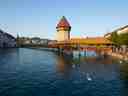
Look to the river in front of you and you’ll spot the Chapel Bridge - a long, covered wooden walkway crossing the water, easily recognized by its steeply sloped roof, a colorful row of flowers, and the tall, octagonal Water Tower rising dramatically from the middle of the bridge. Welcome to Lucerne’s Chapel Bridge, or as the locals call it, Kapellbrücke - a place so full of stories, if its wooden planks could talk, I’m sure they’d never stop! Imagine yourself in medieval times. The year is 1365, the city is busy building new defenses, and suddenly, right across the Reuss River, they decide to construct not just a beautiful bridge, but a mighty strong one. This isn’t any ordinary wooden bridge. It’s covered, it’s fortress-like, and it was built to connect the two sides of Lucerne - the Old Town and the New - and to keep out any cheeky invaders. If you listen closely, you might almost hear the river lapping against those ancient posts. Back then, Lucerne had walls, gates, and towers everywhere, but the river was still a weak spot in its armor. So, not only did they build the bridge, they put up a palisade in the water to stop enemy ships. They even raised the side of the bridge facing the lake to give archers a little surprise advantage - now that’s what I call thinking ahead! Right at the heart of the bridge stands the Water Tower, older than the bridge itself. This odd, octagonal structure has lived many lives: it’s been a watchtower, a prison, a torture chamber, a treasury, and even now, holds a souvenir shop and the meeting room of a local artillery club. Just don’t ask if they’ve kept the dungeon as a feature, or you might get more chills than you bargained for. Let’s jump to the 15th century, when the Chapel Bridge transforms from a fortress to a kind of medieval social media hotspot. They installed benches, and suddenly everyone wanted to linger here, gossip about the latest news, or just get the city’s best river views. The bridge also got dressed up with a grand series of triangular paintings in the gables above your head. These pictures, painted by Hans Heinrich Wägmann and his sons, tell dramatic tales from Lucerne’s and Switzerland’s history - think knights, saints, epic battles, and a giant called the “Giant of Reiden”! Talk about an action-packed timeline - Netflix, eat your heart out. But the bridge’s career wasn’t always smooth sailing. In the 1800s, parts were torn down to make way for urban projects; the bridge was shortened, bent, and even separated from the buildings it used to protect. There was talk of tearing it down altogether, but after loud protests from locals and tourists alike (just imagine the Swiss shaking their fists - politely, of course), the city decided to keep the bridge. Sometimes history is saved by the power of nostalgia - or perhaps a good postcard industry. Then, in 1993, disaster struck. On a peaceful night, a fire broke out, likely from a single careless cigarette. Flames tore through the wooden bridge in minutes, destroying much of its structure and burning seventy-eight of the precious paintings. The loss was heartbreaking. The city’s heart ached, but like any legend worth telling, the story didn’t end there! Within months, the bridge rose from the ashes. Volunteers, craftspeople, and artists poured in, and by the next year, the Chapel Bridge reopened, strong as ever, with thirty restored pictures and paintings moved in from other places to fill its middle section. If you look closely where the original meets the reconstructed, you might see some charred remnants - little scars that remind us this bridge is tough as well as beautiful. The paintings themselves are a masterpiece of Renaissance group work. Each city council member of Lucerne got to sponsor a painting (with their own coat of arms, naturally - can’t pass up PR like that), with verses and legends teaching lessons of faith, good citizenship, and the proud stories of Swiss soldiers, saints, and heroes. And just because the Swiss love their festivals, during Carnival, local groups hang new paintings right over these masterpieces for the season, giving the bridge a fresh new look every year. It’s a historical fashion show and a living gallery rolled into one. So as you stand by the river, listen for the tales carried on the breeze, and feel free to linger for a while, just as people have done here for centuries. And whatever you do, don’t light a cigarette near the wood - unless you want to see some very concerned Swiss appear faster than you can say “Kapellbrücke”!
Open dedicated page →To spot St. Peter's Chapel, look just ahead for a modest cream-colored church with a steep reddish-brown tiled roof and a distinctive square bell tower topped with a little green…Read moreShow less
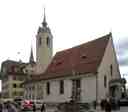
To spot St. Peter's Chapel, look just ahead for a modest cream-colored church with a steep reddish-brown tiled roof and a distinctive square bell tower topped with a little green spire, right beside a lively square and an ornate fountain. Now, pause for a moment and take it all in-the gentle hum of footsteps on ancient cobblestones, the smell of coffee from the nearby cafés, and the sight of this quiet old chapel standing in the heart of Lucerne’s Old Town. But don’t let its humble appearance fool you! St. Peter’s Chapel, or as locals call it in their charming dialect, “Chappele” or “Chappelchile,” is like the secret keeper of Lucerne. This is the oldest church within the old city walls, built right where the Reuss River leaves Lake Lucerne. Imagine, back long before Lucerne itself was founded, in the mists of medieval Europe, there might have been a simple wooden church here-a tiny outpost for early monks from Ireland, wandering adventurers with names like Gallus and Columban, who set off to bring faith to new lands. If these walls could talk, they’d whisper to you in Latin, Irish, and Swiss German! The chapel’s first recorded mention dates all the way back to 1178, which makes it a true ancient mariner. But the real stories began to unfold centuries later. By 1259, there was so much happening here-renovations, expansions-that even Bishop Eberhard II made the trek from Konstanz to re-consecrate it. In the late 1400s, workers were bustling over the bell tower, and in 1511, the chapel was re-consecrated yet again, probably with quite the local celebration and maybe a mug (or three) of Swiss beer. St. Peter’s saw more than prayers within its walls. This was the biggest gathering place in old Lucerne. Townsfolk would crowd in for meetings, swearing solemn oaths to the city’s constitution during the “Schwurtage.” Here, in 1483, after the wild adventure of the Burgundian Wars, eager Lucerners lined up to receive their share of the spoils-treasures of armor and gold echoing in the candlelight. Later, aspiring actors in the city’s Easter play would gather at dawn, not just to pray for divine help but to sneak in some last-minute costume adjustments! But don’t think this chapel’s history was all meetings and mayhem. For centuries, it was a hive of spiritual learning, especially after the big Council of Trent changed the rules of the Church. Jesuits came here to teach local youth, and later, different language communities-from French to Tamil to Italian-found a spiritual home between these walls. There were baptisms and weddings and tearful funerals, each echoing with the melody of different cultures, all woven into the fabric of Lucerne life. If you peer through the windows or step inside later, you’ll spot treasures from across time. The oldest object is a massive 14th-century crucifix-yes, the “oldest big sculpture still in the city!” From the 1700s, there are colorful saints carved by Anton Schlegel and a series of medallions by Jacob Carl Stauder, each depicting mysteries from the life of Mary. Along the south wall stand proud figures: St. Catherine with her broken wheel, Mary as a crowned Queen holding baby Jesus, and St. Barbara with a palm and chalice. Can you imagine their stories as the sunlight hits their ancient faces? Let your eyes drift up to the altar area for dramatic 19th-century paintings by Melchior Paul von Deschwanden depicting moments from the life of Christ, nestled above the choir. Since the latest renovation, there’s also a modern altar crafted from creamy Melchtaler marble, connecting past to present with a beautiful sense of continuity. Even today, St. Peter’s isn’t stuck in history. Since 2018, its pastoral team is breaking new ground. They explore ways to nurture community and spirituality-holding lunchtime talks, open reading corners, and themed weeks that welcome everyone. And don’t forget, the English-speaking community of Lucerne gathers here too, making St. Peter’s a truly global chapel at the crossroads of faith. So here you stand: outside a chapel where medieval warriors once counted their gold, where students whispered secrets, where artists and actors and entire cities made promises that shaped Lucerne. The bell tower silently rings out ages past and present. If you listen quietly, maybe you’ll hear one last echo of a monk’s footsteps, a chorus of voices, or the laughter of a city that continues to live and grow around its oldest heart.
Open dedicated page →Standing at the foot of the steps, look up to spot St. Leodegar with its imposing twin towers shooting high into the sky, their steep dark roofs and ornate facade making it…Read moreShow less
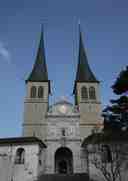
Standing at the foot of the steps, look up to spot St. Leodegar with its imposing twin towers shooting high into the sky, their steep dark roofs and ornate facade making it impossible to miss. Ah, you’ve arrived at one of Lucerne’s proudest symbols-and trust me, those dramatic spires are no accident. Now, picture this: It’s the year 735, and a few noble folks from south Germany decide this very hilltop is just perfect for a tiny monastery. The place starts out as a humble spot dedicated to Saint Maurice, but a few generations later, King Pepin the Short-yes, Charlemagne’s dad-donates land and people for the monks, and thus Lucerne’s name first appears in the archives. Fast forward a bit, and after a few ups and downs (including the whole monastery vanishing for a while-imagine if your house did that), it rises again stronger, becomes part of the Benedictine order, and finally, Saint Leodegar is chosen as the star patron. As you gaze at those towers-each 69 meters high-see the dragon-headed gargoyles peeking from the corners, and maybe even squint to spot a golden lily cross on the north tower and a rooster weathervane on the south. These towers survived a wild and fiery disaster: In 1633, on Easter Sunday, a clueless roofer is told to clear out the pesky jackdaws from the spires. Let’s just say, he took “cleaning” a bit too literally, and with a few shots, the dry, ancient wood goes up in flames. By morning, the entire church is a smoldering ruin-except, miraculously, for these very towers, a few treasures, and a sculpture of Mary. But Lucerne’s spirit isn’t so easily doused! Straight away, the city vows to rebuild. They hire Jakob Kurrer, a Jesuit from Ingolstadt, and by 1639, an architectural marvel rises-a blend of Gothic (the tough old towers), Renaissance (look at that impressive central doorway), and Baroque (the flourishes atop). Above the main entrance, St. Leodegar stands with his trusty drill-he’s something of a mascot here, and next to him, St. Maurice with his flag. Enter through the great portal and you’d find soaring corridors, woodcarvings, and a gleaming black marble altar donated by a papal diplomat who wanted true Roman style even this far from Rome. Now, for a peculiar quirk: This church owns one of Switzerland’s oldest and heaviest sets of bells, with some giants over five tons. On feast days, these legends come to life overhead. Can you feel it rumble in your bones? And there’s more. Through centuries of history-whether under the Benedictines, Habsburgs, or even as a home base for the Pope’s ambassador during the Catholic Reformation-this spot has witnessed wild swings of fortune. Important families are buried all around, and rumor has it, the cemetery is like a VIP lounge for Lucerne’s history. The legendary Hoforgel organ, with pipes reaching nearly eleven meters and weighing as much as a small elephant, can whip up sounds from a whisper to a full thunderstorm. There’s even a “rain machine” inside the organ for the ultimate musical drama. Don’t miss that tiny little door to the north-the secretive-looking one. Behind that, a treasure chamber hides some of the country’s most dazzling relics and nearly life-sized silver saints-art so rare that some pieces had to be smuggled out to save them from being melted for war repair money. Year after year, the Hofkirche is the stage for processions where knights, altar boys (“Zwergli”), and even a saintly Santa parade solemnly (or sometimes joyfully) through Lucerne, rain or shine. All told, this church is where stories, music, fire, and faith have collided for over a thousand years. If those stone seats and bright stained glass could talk, they’d have more tales than a Swiss cheese has holes-although, lucky for you, I get to do the storytelling today. Ready to ring in the next chapter? Let’s carry on! Ready to delve deeper into the exterior of the court church, inside or the treasury and lucerne abbey treasure? Join me in the chat section for an enriching discussion.
Open dedicated page →To spot the Bourbaki Panorama, look ahead for a striking, sixteen-sided round building with a modern glass extension-like a grand drum right on Löwenplatz-its unique shape and…Read moreShow less
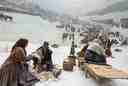
To spot the Bourbaki Panorama, look ahead for a striking, sixteen-sided round building with a modern glass extension-like a grand drum right on Löwenplatz-its unique shape and large size make it stand out from the surrounding architecture. Now, get ready for a step into the heart of history-sometimes a snowy, dramatic, and, let’s be honest, a little bit chilly place! Imagine this: it’s the winter of 1871, the Franco-Prussian war is coming to a bitter end, and here in Switzerland, history is about to brush past, wrapped in scarves and heavy boots. But don’t worry, all you have to do is listen-no mittens required. Before you is the Bourbaki Panorama, an absolute giant of a painting-112 meters long, and (originally) rising over 14 meters tall. That’s longer than a football field, and high enough to make you wonder if the artist ever took coffee breaks! Painted by Edouard Castres in 1881, this circular artwork stretches all around you, pulling visitors into the middle of one of Europe’s most heartbreaking and hopeful moments. Step inside and-wham-you’re at the snowy border of Switzerland in Les Verrières, watching as 87,000 exhausted French soldiers, still shivering from war and winter, stagger into a new chapter of their lives. The scene bursts with life-and hardship. You’ll see soldiers limping, horses steaming in the cold, and townsfolk hurrying to offer bread and blankets. And it’s not just a painting. The scene spills out into 3D, with lifelike objects and figures popping from the panorama-like history’s own pop-up book! Somewhere among the faces, young Castres himself appears as a Red Cross worker, treating wounds and bandaging broken spirits, while fellow painter Ferdinand Hodler stands frozen in time as a stern Berner soldier. It's like Where’s Waldo, but with more snow and a lot more mustaches. And every stroke is telling a story bigger than itself. When the desperate French army was allowed to cross into neutral Switzerland, the world took notice: this was not just about survival. It was an act of mercy, solidarity, and-dare I say-a sprinkle of Swiss hospitality. “Here, have a warm soup… and don’t track snow on the carpet!” Switzerland’s willingness to care for these soldiers helped shape its legendary reputation for humanitarianism and neutrality-a myth born right here, under your very nose. But time works its magic everywhere, and even the mightiest panorama can’t escape change. In the 1920s, with cinema dazzling everyone’s eyes, our round friend here struggled to compete. Someone came up with a wild idea-why not turn the bottom floor into Europe’s first mechanical parking garage? Yes, really! For a while, instead of applause, you might’ve heard the clank and rattle of cars spinning on a Schindler-built turntable downstairs. Upstairs, the painting was hoisted higher and even… a little trimmed. It lost a couple of meters-imagine being told to cut a few inches off your beloved scarf. But the giant survived, adapting and reinventing itself time and time again. In the 1980s and a big renovation at the turn of the millennium, the round building got a bright glass overcoat-and turned into not just a museum, but a real cultural beehive: there’s a city library, eco-counseling center, cafés, shops, and even five cinemas orbiting that old turntable. If you hear a film reel rolling, well, that’s just Lucerne’s way of saying, “We love a good story.” Inside, things feel as fresh as ever thanks to a major restoration in 2024. Technicians zipped around above your head (no capes required), replacing 1,600 square meters of cloth to diffuse daylight just right-enough fabric to smother King Kong, by the way. The lighting’s now LED, gentle on those priceless brushstrokes, and the old benches and ornate iron railings on the viewing platform shine again after loving repairs. And if the grand chandelier above you is twinkling, give a little salute-it’s brand new and dimmable, proving that even a 19th-century masterpiece loves a modern glow. So, take a deep breath-can you smell imagined campfire smoke, or maybe just a little popcorn from the cinema?-and let yourself get swept into a moment when war, peace, art, and compassion all collided. The Bourbaki Panorama isn’t just a painting; it’s Lucerne’s revolving door between history and now. Ready to turn the page? Let’s march on-but don’t worry, you won’t have to carry any injured soldiers! Curious about the painting, building or the restoration 2024? Don't hesitate to reach out in the chat section for additional details.
Open dedicated page →
Frequently asked questions
How do I start the tour?
After purchase, download the AudaTours app and enter your redemption code. The tour will be ready to start immediately - just tap play and follow the GPS-guided route.
Do I need internet during the tour?
No! Download the tour before you start and enjoy it fully offline. Only the chat feature requires internet. We recommend downloading on WiFi to save mobile data.
Is this a guided group tour?
No - this is a self-guided audio tour. You explore independently at your own pace, with audio narration playing through your phone. No tour guide, no group, no schedule.
How long does the tour take?
Most tours take 60–90 minutes to complete, but you control the pace entirely. Pause, skip stops, or take breaks whenever you want.
What if I can't finish the tour today?
No problem! Tours have lifetime access. Pause and resume whenever you like - tomorrow, next week, or next year. Your progress is saved.
What languages are available?
All tours are available in 50+ languages. Select your preferred language when redeeming your code. Note: language cannot be changed after tour generation.
Where do I access the tour after purchase?
Download the free AudaTours app from the App Store or Google Play. Enter your redemption code (sent via email) and the tour will appear in your library, ready to download and start.
If you don't enjoy the tour, we'll refund your purchase. Contact us at [email protected]
Checkout securely with 




