
Bilbao Audio Tour: Urban Gems and Green Retreats of Indautxu
A steel titan once ruled these streets while surreal masterpieces and hidden scandals simmered behind grand facades. Beneath Bilbao’s bold avenues and elegant museums lie stories eager to break free from the stone. Set off on an immersive self-guided audio tour that uncovers the city’s secret heart. Discover not just what the guidebooks show but what history has tried to conceal around Indautxu, Gran Vía, the Bilbao Fine Arts Museum, and the shadowed docks of Itsasmuseum. Who risked everything in a midnight plot on Gran Vía? What lost artifact vanished from the Fine Arts Museum and set off a citywide hunt? Which legendary brawl at the riverfront changed Bilbao forever? Stride through shifting sights where echoes of rebellion and revelation wait in every square. Feel past and present collide as each step pulls you deeper into Bilbao’s untold drama. Unlock the secrets behind Bilbao’s iconic face. Press play and let the city transform.
Tour preview
About this tour
- scheduleDuration 100–120 minsGo at your own pace
- straighten3.8 km walking routeFollow the guided path
- location_on
- wifi_offWorks offlineDownload once, use anywhere
- all_inclusiveLifetime accessReplay anytime, forever
- location_onStarts at Azkuna Zentroa
Stops on this tour
lock_open 3 free previews · 12 unlock with purchase
Look to your left for an open expanse anchored by dark, geometric granite sculptures and framed by an imposing building with a wavy, glass-paneled facade. This is Plaza Bizkaia,…Read moreShow less
Look to your left for an open expanse anchored by dark, geometric granite sculptures and framed by an imposing building with a wavy, glass-paneled facade. This is Plaza Bizkaia, completely remodeled in 2008. It looks remarkably polished, but beneath your feet, this site hides a history of spectacular failure. The previous version of this plaza featured cascading waterfalls. Unfortunately, their engineering was shockingly poor. The pumping equipment was shoved into blind, windowless rooms on the first floor of the municipal parking garage, completely disconnected from the city's drainage network. It was as if the physical space itself began rebelling against the planners' neat, arrogant designs. Water seeped through the cracks and poured down, flooding the garage below and dripping relentlessly onto parked cars. The concrete simply refused to hold the forced waterfalls, turning an architectural dream into a subterranean disaster. This rebellion forced the city to pay nearly 10,000 euros in damages to furious vehicle owners in 2007. To fix this, the city removed the old water features and hired architect Lorenzo Fernández Ordóñez to create a modern fog fountain, dotting the space with heavy granite blocks carved by sculptor Juan Asensio. But once again, the space refused to cooperate. When the fountain first opened, it had no barriers. Pedestrians were invited to walk through the thick vapor. The problem was that the dense fog completely hid the ground and those massive black stones. People walked blindly into the mist, tripping and falling. After a young girl from a nearby school was injured, the city panicked. They hastily threw up a protective perimeter fence, permanently transforming what was meant to be an immersive experience into a caged, purely visual exhibit. So much for the grand artistic vision. Before the fountains, this ground housed the Santiago Apóstol school, a massive educational complex run by friars. Its crown jewel was a monumental cinema seating 1,400 people. In its early days, the floors and seats were made of wood. If the students disliked a film, they would stomp their feet in unison, creating a deafening roar that drove the strict friars crazy. During Spain's mid-century dictatorship, that same room quietly morphed into a hub for political resistance, hosting underground communist film clubs that kept government censors working overtime. Eventually, the school was demolished. Its void was filled by the striking Plaza Bizkaia building you see here. Architect Federico Soriano faced a nightmare. Because the garage was already active, he could not dig traditional foundations. He had to balance a 32-meter-tall building directly on top of the subterranean structure... a feat urban experts compared to tailoring a suit for a man already wearing shoes. And that curving, wavy glass skin? It is actually a thermal barrier designed to deflect harsh sunlight, keeping workers inside from roasting. Let us keep moving toward Calle Iparraguirre, a three-minute walk away, where I will tell you about a tiny house that stubbornly fought back against the city.
Open dedicated page →You are now standing on a wide street paved in smooth light granite, framed by slender Japanese cherry trees and marked by diamond shaped glass windows set directly into the…Read moreShow less
You are now standing on a wide street paved in smooth light granite, framed by slender Japanese cherry trees and marked by diamond shaped glass windows set directly into the ground. This is Calle Iparraguirre. It forms a grand corridor leading all the way from the Guggenheim Museum to the deeper residential neighborhoods of the city. While it is surrounded by some of Bilbao's most imposing institutional architecture, its pristine surface conceals a remarkably defiant spirit. The street takes its name from José María Iparraguirre, a nineteenth century Basque bard who composed the region's beloved anthem. This song celebrated ancient freedoms, matching his sprawling, epic life. He fought and was wounded in battle, suffered exile in France, and toured across Europe as a celebrated singer before being suddenly deported. He eventually crossed the ocean to South America, where he worked as a humble shepherd for two decades. Just as his homeland had given him up for dead, he made a triumphant return in eighteen seventy seven, living out his final years supported by a special pension from the Basque councils. That exact brand of stubborn resilience is literally built into this block. Hidden entirely out of sight, accessible only through a narrow, dark passageway at number 51 B, sits a startling survivor. In an interior courtyard, completely swallowed by towering modern apartment complexes, stands an ancient rustic farmhouse. It originally operated as a carpentry workshop for the Alhóndiga, the massive structure we visited earlier. As developers bought up land and bulldozers leveled the area, the owners of this little structure staged a quiet urban rebellion. They simply refused to sell. It remains there today, a solitary architectural holdout resisting the crushing weight of modern urban expansion, like something out of a storybook. Before the great blocks of flats arrived, this entire district was a peaceful expanse of small orchards and traditional taverns known as chacolís. These were rustic spots where locals gathered under the shade of heavy grapevines to drink regional wine. The famous Chacolí de Zollo, run by Tomasa Asúa Bilbao, was a beloved bohemian hangout legendary for its rich garlic soup and traditional cod. Decades later, the street hosted another kind of sanctuary. During the late nineteen seventies, a rented industrial basement here became Txoko Landa, one of the first safe social clubs for the local LGBT community. It was a rare, secure haven where people could eat, dance, and exist openly, far from the marginalized fringes of society. Recently, the city transformed the street into the pedestrian boulevard you see now. The redesign abandoned a highly controversial plan for suspended zig zag lighting due to safety concerns, opting instead for a calmer aesthetic. Those seven glass windows in the pavement are by artist Olafur Eliasson. Designed to force rushing pedestrians to slow down, each steel chamber holds raw minerals from the regional subsoil, like basalt and siderite, honoring the intense mining history of the area. Mirrors inside multiply the raw textures of the stones, projecting infinite geometric shapes upward. Let these layers of survival linger with you. Now, continue walking straight ahead to reach the Gran Vía, the ultimate symbol of the city's vast industrial wealth, just a short two minute walk away.
Open dedicated page →
Show 12 more stopsShow fewer stopsexpand_moreexpand_less
Turn your attention to the Gran Vía, which stretches out as a wide ribbon of smooth asphalt, framed by towering, ornate stone facades and a perfectly straight line of leafy shade…Read moreShow less
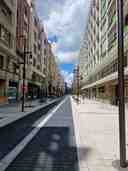
Turn your attention to the Gran Vía, which stretches out as a wide ribbon of smooth asphalt, framed by towering, ornate stone facades and a perfectly straight line of leafy shade trees. We just left the quieter charm of Calle Iparraguirre, and now you are standing on the edge of Bilbao's most commanding artery. This is the Gran Vía de Don Diego López de Haro. The creation of this avenue is a story of immense ambition, revealing how a city's very shape is dictated by those who hold power. In the late nineteenth century, a new and fiercely competitive bourgeoisie was rising, fueled by the explosive industrial wealth of local iron mines and sprawling shipyards. They were amassing fortunes on a scale this region had never seen, and they desperately needed a grand, sweeping stage to display their newfound dominance. The cramped, medieval streets of the old town could no longer contain their massive aspirations, so they demanded the construction of an entirely new city district. This avenue was built to be their ultimate, unapologetic showcase. To anchor this massive display of modern power in deep history, the city named the thoroughfare after Diego López the Fifth of Haro. He was the formidable Lord of Biscay who originally founded the town of Bilbao back in the year thirteen hundred. This magnificent street became the centerpiece of the Ensanche plan. Ensanche is a Spanish urban planning term that simply means expansion or widening. Presented in eighteen seventy six, this successful plan adopted modern European urban solutions, mimicking cities like Barcelona by utilizing gridded streets with chamfered, angled corners to open up intersections. But this triumph of design was born from a hidden struggle for space. Fourteen years earlier, in eighteen sixty two, an engineer named Amado de Lázaro proposed the very first expansion plan for Bilbao. He envisioned a city of wide open public spaces, prioritizing parks and breathing room for the everyday residents. The ruling elite immediately and aggressively rejected his proposal. They publicly dismissed his design as utopian and disproportionate. What they really meant was that his vision did not carve out enough profitable land for their railways, their heavy industry, and their palatial residential blocks. Space in Bilbao was a battleground, and the industrialists won. The city handed the reins to a trio of pragmatic designers: Severino Achúcarro, Pablo de Alzola, and Ernesto de Hoffmeyer. This trio gave the elite exactly what they wanted, laying down a boulevard fifty meters wide and a kilometer and a half long. As you look down its length, you can imagine the grand buildings that quickly rose here, like the Provincial Council Palace. Inaugurated in nineteen hundred, it is a staggering example of Alfonsine eclecticism, an architectural style characterized by heavy, highly decorated classical elements. Critics at the time argued the facade was far too excessive and flashy. The wealthy owners brushed off the criticism, declaring that such extreme lavishness was absolutely necessary to prove the region's prosperity to the world. This immense industrial wealth did not just reshape the physical streets of Bilbao, it also profoundly shaped its culture. Let us follow the lingering echoes of that fortune
Open dedicated page →Straight ahead is a long, rectangular red brick building distinguished by its pale stone central portico and the word MVSEO carved squarely above the glass doors. As we leave the…Read moreShow less
Straight ahead is a long, rectangular red brick building distinguished by its pale stone central portico and the word MVSEO carved squarely above the glass doors. As we leave the commercial energy of the Gran Vía behind us, you are standing before the Bilbao Fine Arts Museum. This neoclassical facade, a style defined by its return to the balanced, symmetrical columns and lines of ancient Rome, looks like an imposing, top-down government institution. Yet the collection inside was actually born from the quiet defiance and deep pockets of everyday citizens and local painters. For over a century, the people of this city have constantly fought to shape what is remembered here, and who controls the narrative. The museum's foundation in the early twentieth century relied heavily on a bachelor named Laureano de Jado. He was a local philanthropist, meaning he used his vast personal wealth to fund the public good. Despite owning massive estates across the region, he lived an incredibly frugal life. He poured his fortune into his sole obsession, collecting art. When he donated his massive collection to the museum in nineteen twenty-seven, he did so with absolute terms. He demanded a dignified space, strictly forbidding his pieces from being mixed with art from any other source. But wealth alone did not build this sanctuary. Local artists defended it with their lives. Manuel Losada, a prominent painter from Bilbao who had trained in Paris, became the museum's first director. When the Spanish Civil War erupted and bombs threatened to erase the city's cultural heritage, Losada, despite his advanced age, personally orchestrated the frantic relocation of the collection. He hid the canvases in a secure local warehouse, physically guarding the city's visual memory while the world collapsed outside. Meanwhile, Aurelio Arteta, the director of the modern art section, faced harsh political censorship from the city council over his contemporary acquisitions. He chose to resign in protest, eventually fleeing into exile in Mexico, where his life ended tragically in a streetcar accident. This fierce tradition of citizen ownership is not just history. In twenty twenty, during the darkest months of the global pandemic, a discreet local woman named Begoña María Azkue passed away. In her will, she left a specific financial legacy to the museum. Her gift allowed them to purchase a rare, wildly expressive painting of a bullring by Mariano Fortuny. It was a final, graceful act of a citizen ensuring her community's culture continued to grow. Yet, the physical space of this museum remains a battleground. Recently, an ambitious architectural expansion named Agravitas was designed to quite literally hover over the very red brick building you are looking at. This massive modern canopy sparked intense protests from hundreds of architects and residents. They formed a civic defense group, arguing that the new floating structure would crush the historic identity of the original site. It is a constant tug of war between preserving old layers and imposing modern visions. That tension between honoring the past and reshaping the present stretches far beyond this red brick boundary. If you follow the path just to the right of the museum, you will find the adjacent walkway. Let us head that way now, toward Paseo Eduardo Victoria de Lecea, about a four minute walk from here, where a modern legal battle over this very landscape recently took place.
Open dedicated page →Notice the paved, gently curving pathway ahead, framed by the blocky, reddish-brown facade of the hotel on your left and the sleek, cylindrical glass skyscraper rising in the…Read moreShow less
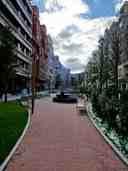
Notice the paved, gently curving pathway ahead, framed by the blocky, reddish-brown facade of the hotel on your left and the sleek, cylindrical glass skyscraper rising in the distance. We just left the quiet halls of the Fine Arts Museum behind us, but out here on the pavement, a distinctly different kind of cultural battle played out. When we walk down a city street, we rarely pause to think about the name written on the metal signs above us. But those plaques are very real battlegrounds where history is actively rewritten and erased in the modern era. A street name dictates who a society chooses to remember, and perhaps more importantly, who it deliberately decides to forget, burying their legacy beneath the quiet footsteps of everyday pedestrians. This path, Paseo Eduardo Victoria de Lecea, looks incredibly peaceful now. Yet the name it carries is the direct result of a fierce legal fight over memory itself. Originally, this very walkway was named after Rafael Sánchez Mazas. He was a recognized writer, but he was also a founding member of the Falange, the Spanish fascist political party, and a minister during Francisco Franco's regime. The Falange was an extremist organization that supported the military uprising leading to the Spanish Civil War, promoting severe authoritarian rule... a system of government demanding absolute obedience to the state. When Spain passed laws to remove public honors for those who aided the dictatorship, the Bilbao city council initially resisted changing this street's name. They argued that the plaque honored Sánchez Mazas strictly for his literary and cultural contributions, entirely separate from his political career. In essence, the city wanted to separate the art from the artist. But a local memorial association called Lau Haizetara Gogoan refused to let that stand. They took the city to court. In October of two thousand fourteen, a judge delivered a definitive and forceful ruling against the city council. The court stated that the man's artistic facet, which actually included co-writing the official fascist anthem, was a minor footnote compared to his major role in establishing a brutal dictatorship. Following that ruling, the mayor finally signed the order, and the old plaques were officially stripped from the walls. In their place came Eduardo Victoria de Lecea. He was a liberal, nineteenth-century mayor of Bilbao from a deeply rooted political family. He served two terms long before the civil war, in the eighteen sixties and eighties. During his tenure, he was deeply involved in the civic expansion of Bilbao, even initiating the construction of the current City Hall building over the ancient ruins of a convent. He was also a man who opened the grand salons of his home for literary evenings and amateur theater, promoting culture without the dark shadow of oppression. By walking this path today, you are stepping over a conquered legacy. You are experiencing the silent, ongoing struggle over civic space, where a fascist shadow was legally erased to honor a mayor who actually helped build the modern city. The struggle over who gets a pedestal and who gets forgotten does not end here. Let us walk further down the pathway and step under the welcoming canopy of the trees ahead, where another complex piece of history waits for us inside Casilda Iturrizar Park.
Open dedicated page →To your left, you will see the park unfolding with paved walkways curving gently past lush green lawns and a distinct white vintage style lamppost. This is Casilda Iturrizar Park.…Read moreShow less
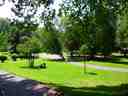
To your left, you will see the park unfolding with paved walkways curving gently past lush green lawns and a distinct white vintage style lamppost. This is Casilda Iturrizar Park. Its very existence is tied to a woman whose life reads like an improbable novel. Born into poverty in 1818 in a humble Bilbao neighborhood, Casilda Margarita de Iturrizar lived a quiet life until, at the age of forty one, she married Tomás José de Epalza. He was a wealthy businessman who helped found the Bank of Bilbao. When she was widowed in 1873, she inherited a staggering fortune. Instead of hoarding it, she stepped out of the shadows to become the city's greatest philanthropist. She devoted her immense wealth to improving the lives of the working class, eventually donating the very land you are looking at right now. In 1907, city planners transformed her gift into a magnificent English style garden, a landscape specifically designed to look like idealized, untamed nature rather than rigid geometric patterns. They planted over one thousand five hundred trees from five continents, creating a living museum where native oaks stand beside exotic camphor trees from Asia. The Fine Arts Museum we passed a few minutes ago was actually built entirely within these expansive grounds in the 1940s. Yet, as you walk these beautiful paths, you are moving through a space defined by erasure. Despite her incredible generosity, Casilda was methodically forgotten. A 2025 scientific study by researcher Garazi López de Aguileta proved that Casilda was doubly invisibilized by history. First, she suffered the standard erasure common for women in a male dominated era. But the second erasure was purely political. Casilda was deeply conservative and fiercely religious. That made her a highly uncomfortable figure for modern progressive movements to champion. Because she did not fit the desired narrative of later generations, her story was quietly dropped, leaving most people who stroll under her trees with no idea who she actually was. The park itself suffered its own identity crisis as the city's political tides shifted. After the Spanish Civil War, the early Franco dictatorship stripped away its original identity entirely. The authoritarian regime officially renamed it the Park of the Three Nations. This was a direct and dark homage to the fascist governments of Germany, Italy, and Portugal that had supported the military uprising. It took until 1945 for the park to officially become the Park of Doña Casilda. City officials needed to erase those painful wartime associations, so they moved a marble bust of Casilda from a busy city square into the quiet greenery here. It was a calculated move to anchor her legacy, yet the woman herself remains a ghost in her own garden. Even the iconic central fountain, surrounded by a majestic pergola shaped like a seashell and adorned with stained glass, has lost some of its magic after the city permanently shut off its famous light and sound shows to save money. Her gift to the city was vast, but over time, even the physical borders of her generosity were encroached upon by the powerful. As we leave the park, our next stop is just a four minute walk away. I will point you toward the Lezama Leguizamon House, a massive mansion that quite literally swallowed up a piece of the very land Casilda gave to the people. Let us head there now.
Open dedicated page →On your right stands a monumental building made of smooth, sandy-yellow stone, rising in a massive rectangular block anchored by striking semicircular corner towers crowned with…Read moreShow less
On your right stands a monumental building made of smooth, sandy-yellow stone, rising in a massive rectangular block anchored by striking semicircular corner towers crowned with intricate carved balustrades. This is the Lezama-Leguizamón House, completed in nineteen twenty. It is a triumph of classical design, but its elegant exterior conceals a bitter history about who really controlled the map of Bilbao. The brothers who commissioned it, Luis and Manuel, were titans of the iron ore industry. They amassed staggering wealth from massive open-pit mines just outside the city limits. When it came time to build their urban residence, they demanded the most prestigious address possible, right here on the Gran Vía. There was just one significant problem. The space they wanted was not for sale. In fact, just four minutes ago, you were walking through the very land they desired. This exact plot originally belonged to the Casilda Iturrizar Park, a leafy sanctuary meant for all the citizens of Bilbao. But the brothers possessed the kind of capital that could redraw boundaries. In the ultimate flex of industrial wealth, they arranged for the city to carve out a piece of the public park to construct their private mansion. The decision sparked a fierce political storm. To the working people, it was a glaring demonstration of how the elite could simply devour shared public spaces for personal luxury. To design this controversial monument, they hired the prominent Bilbao architect Ricardo Bastida. His involvement here is a fascinating callback to the civic warehouse we explored earlier, showing how the same hands shaped both utilitarian structures and private palaces. Together with his partner, he designed this fortress-like structure. Notice the classical pilasters, those flat, decorative columns attached directly to the walls, and the smooth, round columns framing the windows on those sweeping corner towers. It was designed to look immovable, an eternal fixture of the ruling class. But power is rarely as permanent as stone. When the Spanish Civil War erupted in nineteen thirty six, the world of the Lezama-Leguizamón family violently collapsed. Luis was arrested by Republican forces. He perished tragically while held captive on a prison ship anchored in the nearby Nervión River. Shortly after his death, the newly formed Basque Government legally seized this mansion. Its grand halls, filled with priceless art, were abruptly transformed into the headquarters for the Department of Commerce. When Bilbao fell to Francoist forces a year later, the building changed hands once more, becoming a rigid military headquarters. It took several decades until nineteen seventy nine, after democracy was restored in Spain, for the property to be returned to the family's heirs. In a deeply ironic twist of history, nearly a century after the founders took this land from a park, modern residents of this building found themselves in a legal battle with local teenagers. Their complaint? The noise from young people playing street basketball outside. They demanded their right to peace and quiet, completely ignoring that their luxurious sanctuary was built on stolen playgrounds. Let us leave this monument to old money behind. Our next stop is just a four minute walk away, where we will explore how local influence was measured in maritime might
Open dedicated page →To your right at the roundabout, you will find the entrance to Rodriguez Arias Street, marked by a curved stone facade, an ornate blue metal street sign, and a stretch of smooth…Read moreShow less
To your right at the roundabout, you will find the entrance to Rodriguez Arias Street, marked by a curved stone facade, an ornate blue metal street sign, and a stretch of smooth gray paving slabs leading into the distance. This wide avenue feels incredibly polished today. But the gritty reality is that Bilbao's soaring elegance was funded largely by heavy maritime industry, smoke, and massive naval contracts. This street is a perfect example of how money shapes a city's memory. It is named after Rafael Rodriguez Arias, a nineteenth-century Spanish Minister of the Navy. He was not from Bilbao, nor was he a local hero. The city honored him for a purely economic reason. During his tenure, he awarded Bilbao the contracts to build three cruisers for the Spanish Navy. This massive injection of capital fueled the local shipyards and enriched the city's industrial tycoons. That decision left a complicated legacy. Today, local anti-military groups regularly protest the street's name. They argue that public spaces should not glorify a man whose legacy is tied to warships and destruction, suggesting instead that the street honor figures of non-violence. It is a quiet but persistent struggle over who gets to be remembered in the very fabric of the city. As you look down the street, notice the distinct architecture from the 1930s. This area is famous for Art Deco buildings. You will find portals designed in Zigzag Moderne, a style defined by sharp, geometric angles and stepped facades. Right alongside them are examples of Streamline Moderne. This is an architectural style that mimics the aerodynamic curves of ships and airplanes, featuring smooth, rounded corners and horizontal lines. It gives the block a cinematic elegance. In fact, the first iteration of the Bilbao Fine Arts Museum, which we visited earlier, was quietly housed right on this street before moving to the park. But beneath this refined surface, tension over how this space is controlled never really stops. Recently, a major bank headquarters at the start of the street was demolished to make way for a luxury complex called Residencial Acrux. The demolition quickly became an engineering nightmare. Workers realized the bank's structure physically overlapped with the historic residential building next door. To avoid collapsing the neighboring apartments, heavy machinery was banned. Workers had to dismantle concrete pillars completely by hand, stretching the demolition into seven grueling months. The friction here is not just structural. Just down the block, residents recently launched a fierce campaign against the city over a nightclub. Locals documented massive crowds taking over the street at dawn with flares and fireworks, demanding their right to sleep. Decades earlier, the stakes were much higher. During the violent political upheavals of the 1970s, an apartment at number 56 was the home of a student militant for the separatist group ETA. He later fled the country, and police eventually identified him as one of the men who assassinated a local mayor in 1976. From naval warships and political violence to luxury apartments and neighborhood noise disputes, this street holds the heavy, often unseen weight of the city's evolution. Now, we are going to follow that trail of industrial wealth a bit further. Let us head deeper into Indautxu, about a five-minute walk away, where this maritime money eventually built an entire neighborhood of sprawling elite villas.
Open dedicated page →Straight ahead is a wide circular plaza, defined by its smooth stone paving and the striking modern canopy suspended in the center. You are standing in Indautxu Plaza, the modern…Read moreShow less
Straight ahead is a wide circular plaza, defined by its smooth stone paving and the striking modern canopy suspended in the center. You are standing in Indautxu Plaza, the modern public heart of a neighborhood that completely reinvented itself, not just once, but twice. Today, Indautxu is one of Bilbao's most affluent quarters, known for its private clinics, upscale commerce, and the large Society of Jesus school. But the elegant commercial streets and towering apartment buildings rising around you mask a fierce, century long contest over who gets to claim this valuable land. It is a story of wealth erasing what came before it, only to be erased itself. To understand the shifting identity of the city, we have to strip away the modern concrete. Before eighteen seventy, if you stood on this exact spot, you would not see pavement or glass. You would see a sprawling, entirely flat plain of rural farmland. This area belonged to the former elizate of Abando, a traditional rural parish district operating just outside the original city limits. But the late nineteenth century brought a massive explosion of industrial wealth to Bilbao. Iron mining, shipbuilding, and banking created a powerful new class of industrial bourgeoisie. And this newly minted elite wanted space. They looked at the flat rural expanse of Indautxu and saw a blank canvas. By nineteen o seven, the area was formally integrated into the expanding urban grid of Bilbao. The small farms vanished, replaced by sprawling, luxurious villas and grand chalets. These opulent estates were not simply comfortable places to live. They were deliberate, imposing symbols of power, physical proof of the massive fortunes being pulled from the river and the sea. The wealthy families who built them fundamentally altered the geography of the area, erasing the agricultural past to build a private paradise of manicured gardens and ornate mansions. The sheer scale of wealth was staggering. One of these grand chalets even served as the founding site for the French Lyceum of Bilbao in nineteen thirty three, established by a group of French businessmen before the school outgrew the space. But modern cities are rarely sentimental when extreme profit is on the line. The golden reign of the luxury villas was surprisingly brief. During the nineteen fifties and sixties, Bilbao experienced a massive population boom. The demand for urban housing skyrocketed, and this prime, centrally located real estate became the target of intense, aggressive speculation. The grand estates were systematically targeted for demolition. The descendants of the original industrialists sold their family homes to aggressive developers. The sprawling gardens and ornate architectural masterpieces were torn down to maximize spatial profit, replaced by the dense, towering apartment blocks that surround you right now. By the turn of the twenty first century, almost none of the original aristocratic homes remained standing. The elegant landscape of exclusive wealth had been ruthlessly consumed by the machinery of modern urban density. The memory of that erased architectural era still lingers in the rigid grid of the streets, and in the few cultural institutions that managed to survive the mid century demolition wave. As we continue, we will explore how this powerful class sought to leave their mark on the soul of the city, not just its skyline. Let us walk toward the Church of Nuestra Señora del Carmen, just about two minutes away. It is a striking building woven right into the urban fabric, built to anchor the spiritual life of the very district these industrial magnates originally carved out of the farmland.
Open dedicated page →To your right stands the Church of Nuestra Señora del Carmen, easily recognizable by its vertically ribbed white concrete walls that form a sharp pyramidal shape, all crowned by a…Read moreShow less
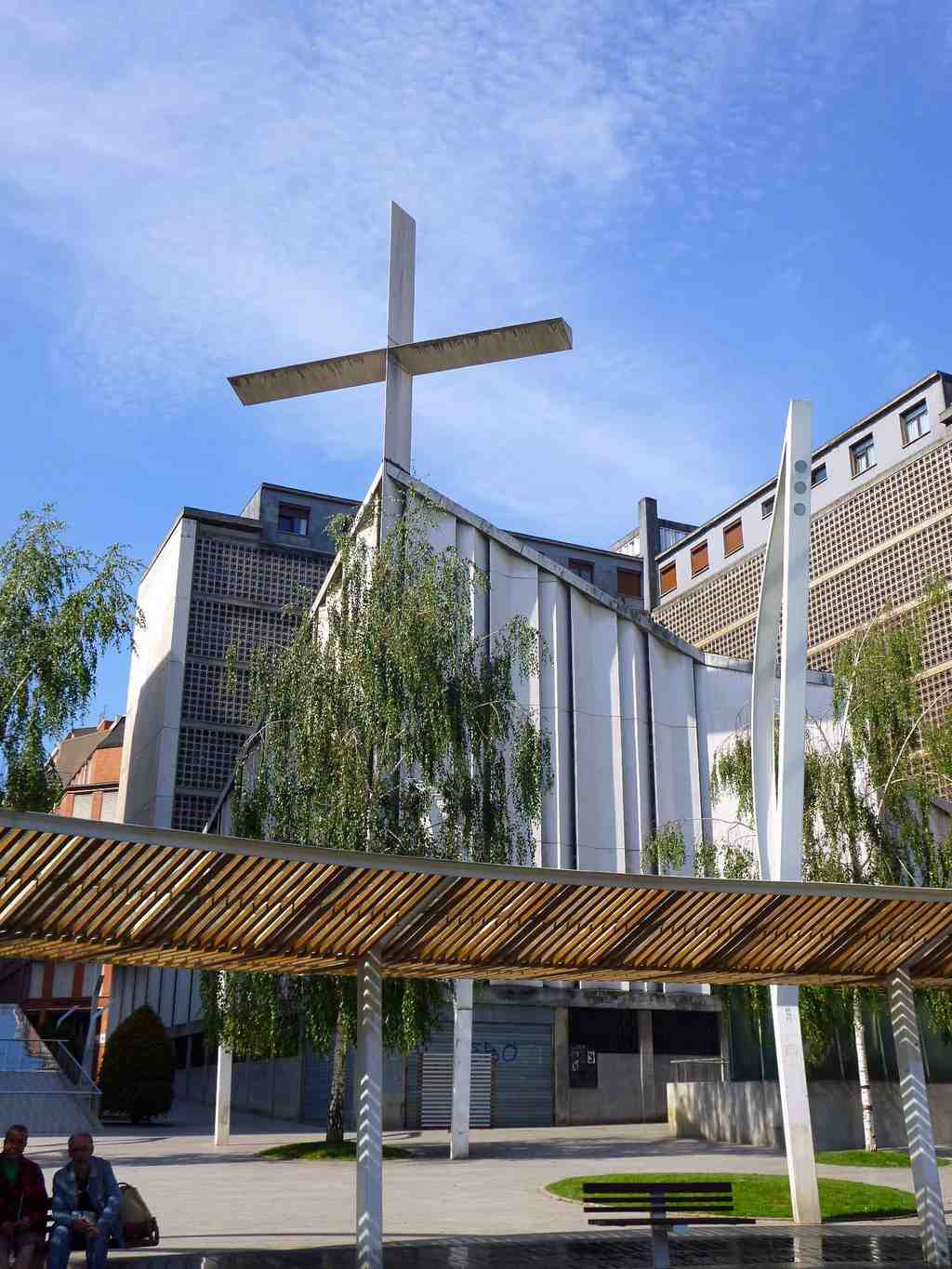
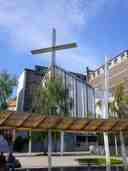
To your right stands the Church of Nuestra Señora del Carmen, easily recognizable by its vertically ribbed white concrete walls that form a sharp pyramidal shape, all crowned by a massive, unadorned cross. Just steps from the bustling heart of Indautxu where we stood a few minutes ago, this bold, aggressively modern structure holds a deeply buried history of ambition, erased legacies, and the fierce battle for urban space. The story begins back in nineteen zero seven, when two highly influential brothers, Plácido and José Allende-Plágaro, donated this land to build a new church. The brothers were wealthy power players in Bilbao. Plácido, for instance, was a prominent mining engineer and one of the original founders of the Banco de Vizcaya. In a tragic twist of fate, Plácido died the very month the church was finally inaugurated in nineteen eleven, never living to see the finished result of his grand religious donation. That original church was designed by Leonardo Rucabado, a young architect for whom this project was a profound professional turning point. With this building, he definitively abandoned his early modernism and fully embraced historicism. Historicism was an architectural movement dedicated to reviving romantic, medieval European building styles in an attempt to forge a unified national identity. His design featured classic gothic vaults and romantic arches. Thanks to his close ties to the wealthy Allende-Plágaro family, Rucabado effectively monopolized the grand architectural projects of this rapidly growing neighborhood. But as the city swelled, the elegant little church became hopelessly overcrowded. Long before the current modern structure was ever conceived, an astonishing, pharaonic plan nearly changed the face of this neighborhood forever. In nineteen forty four, another famed architect named Ricardo Bastida proposed demolishing Rucabado's delicate work entirely to build the absolute largest temple in all of Bilbao. His design was a colossal concrete basilica featuring massive parabolic arches. These are steep, mathematically curved vaults designed to carry immense weight without the need for inner columns. It was designed to hold four thousand people. The proposed budget was a staggering six point seven million pesetas, an astronomical sum that translates to tens of millions of dollars in today's money. Bastida's colossal design included two massive, asymmetrical brick towers meant to visually overpower the surrounding plaza. But this raw display of architectural dominance collided hard with the city's meticulous urban planners. Municipal architects Hilario Imaz and Estanislao Segurola were completely alarmed by the sheer scale of the looming monument. They argued the brick design lacked the architectural dignity required for the neighborhood and would utterly ruin the public aesthetic. The dispute grew so bitter that the initiative was permanently paralyzed. The ambitious blueprints were shoved into a drawer forever, and the original chapel was temporarily saved from the wrecking ball. Yet, the reprieve did not last. By nineteen sixty seven, the congregation had grown so large that Rucabado's original historicist church was demolished without any hesitation. The physical legacy of the founding brothers was wiped from the map entirely to make way for the stark, pyramidal structure of concrete you see today. The city's face shifted once again, burying its past to accommodate the present. Our journey through the shifting layers of this city continues. We are now heading to a street named after a formidable woman who fiercely defended her own birthright against immense opposition. It is just a four minute walk away, leading us to María Díaz de Haro Street.
Open dedicated page →To your right is a dark blue enameled street plaque with crisp white lettering, mounted directly onto the smooth stone corner of the building. You are standing at the edge of…Read moreShow less
To your right is a dark blue enameled street plaque with crisp white lettering, mounted directly onto the smooth stone corner of the building. You are standing at the edge of María Díaz de Haro Street. This long avenue cuts straight through the heart of the city, but its very placement is a permanent, defiant piece of urban irony. You see, María Díaz de Haro was known as the Good, the legitimate tenth Lady of Biscay. But in the year twelve ninety-five, her uncle, Diego López the Fifth of Haro, usurped her title with the backing of local nobles. María spent years fighting against being erased from the line of succession, battling medieval intrigue to reclaim her birthright. She finally succeeded in thirteen ten when her uncle died. In a twist of fate, it was María who officially confirmed Bilbao's founding charter that same year, taking ownership of a decree her usurping uncle had issued a decade prior. Today, her street directly and perpetually intersects the Gran Vía of Don Diego López de Haro, forcing her rival uncle to cross her path forever. The defiant spirit of this street did not end in the Middle Ages. In the late nineteenth century, city ordinances strictly classified this entire area as the outskirts. That meant building residential apartments was illegal, with land reserved exclusively for factories or farmhouses. But several rebellious landowners simply ignored the law. They began constructing their own unauthorized mini-ensanches. These developers, however, were essentially building rogue, miniature city blocks right under the council's nose. They engaged in a fierce legal tug-of-war, forcing the city to adapt to their chaotic development until it was finally formalized in nineteen o six. In more recent times, this asphalt witnessed struggles of a much darker nature. In the nineteen eighties, the street hosted the very first traffic headquarters of the newly formed Basque police. But on an April night in twenty twelve, following a football match, the police launched a controversial charge into a crowded alleyway perpendicular to this street. They fired rubber bullets to disperse the fans. Twenty-eight-year-old Iñigo Cabacas was struck in the head and died days later. The loss of the young fan was a profound shock. The tragedy fractured the relationship between the city and its police. That small alley transformed into a grieving sanctuary of flowers, candles, and photographs demanding answers. His parents led an agonizing legal battle against an incredibly flawed investigation, eventually securing a conviction for a commanding officer and forcing a total overhaul of police riot protocols. Now, this battle-scarred street is finding peace. Through a massive, multi-year urban project, it is being reborn as a green corridor. The lanes of traffic have been drastically reduced, making way for wide pedestrian spaces, new trees, and an innovative central median filled with vegetation. Neighbors who endured years of disruptive construction trenches finally have a quiet, pacified space to sit and breathe. It is a fitting evolution for a street born from defiance, now claiming its own serene space. Let us continue to the end of the Gran Vía, where a massive monument awaits us. Our next stop, Plaza del Sagrado Corazón de Jesús, is about an eight minute walk away.
Open dedicated page →Directly in front of you stands a massive limestone obelisk soaring into the sky, crowned by a ten-meter bronze statue of Jesus with his arms wide open. This towering structure…Read moreShow less
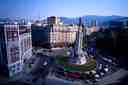
Directly in front of you stands a massive limestone obelisk soaring into the sky, crowned by a ten-meter bronze statue of Jesus with his arms wide open. This towering structure acts as the grand, concluding punctuation mark to the Ensanche expansion, the meticulously planned urban grid we walked through earlier. Back in 1920, an anonymous local proposed erecting a monument right here. The sheer scale of the idea demanded a massive international contest, launched in 1923. It drew over seventy proposals from top architects and sculptors across Europe... from Germany to Italy to Belgium. The jury ultimately chose a staggering design by Pedro Muguruza and Lorenzo Coullaut Valera. At forty meters tall, it was so ostentatious that locals called it a bilbainada... a term used for the wonderfully exaggerated, over-the-top undertakings typical of Bilbao. But after its inauguration in 1927, this quiet monument became the epicenter of a fierce political war. During the Second Republic in 1933, Spain embraced a new constitution establishing laicism, the strict separation of church and state. Citing this new secular law, republican leaders pushed to demolish the towering religious symbol. A republican councilman attacked the work as a provocation. Conversely, Basque nationalist politicians fiercely defended it, arguing the law should not crush the beliefs of the people. The tension culminated in a razor-thin council vote... twenty-three votes in favor of demolition, and twenty-one against. The statue was doomed. Yet, when citizens heard the news, they formed resistance pickets around this very base, physically blocking the assault guards. The chaos was so intense that the civil governor publicly criticized the political manipulation of the statue, famously asking... who assures us that Jesus Christ hasn't become a republican? The monument survived, but its meaning was soon hijacked. When fascist troops captured Bilbao in 1937 during the Spanish Civil War, the new dictatorship carved the names of their fallen soldiers into the limestone base. They appropriated a purely religious piece to exalt an authoritarian regime. Even recently, the fight over this space continued. During a 2004 restoration, the city removed a large bronze inscription at the feet of the statue that read Reinaré en España, meaning I will reign in Spain. This sparked bitter accusations. Conservative factions accused the city of ideologically censoring the word Spain. However, defenders of the removal pointed out that the inscription was never part of the original design... it was an addition forced upon the monument by the dictatorship in 1940. Every inch of this statue represents a century of factions fighting to claim the physical and historical landscape of Bilbao. Now, let us turn toward the river, where the polished city gives way to its heavy industrial roots, as we head toward the Euskalduna Conference Centre just a short walk away.
Open dedicated page →To your right stands the Euskalduna Conference Centre, a massive seven-story structure clad in rusted metal plates that echo the shape of a ship docked along the estuary. Look…Read moreShow less
To your right stands the Euskalduna Conference Centre, a massive seven-story structure clad in rusted metal plates that echo the shape of a ship docked along the estuary. Look closely at those oxidized steel walls. They are not merely a bold architectural choice... they are a deliberate, towering memorial to the ground beneath your feet. In the nineteen eighties, this exact spot housed the colossal Euskalduna Shipyards. As heavy industry collapsed across Europe, the shipyard faced permanent closure, sparking what became known as the Battle of Euskalduna. This was the ultimate, desperate urban rebellion. Workers fought violent, pitched battles against heavily armed riot police. It was a brutal struggle for survival that culminated in profound tragedy, when a veteran shipyard worker named Pablo González Larrazábal collapsed and died from a heart attack amid the chaotic police charges. For years afterward, this land lay dormant, burdened by the weight of profound human and industrial trauma. When local leaders proposed a grand music hall for the site, the fight simply shifted from the barricades to the boardroom. Political opponents fiercely resisted the project, arguing that another grand venue was completely unnecessary. But a local official named Josu Bergara outmaneuvered the critics. He consolidated power and expanded the vision into a massive, twenty-five-thousand-square-meter convention center. A passionate music lover, Bergara stubbornly insisted on installing a monumental pipe organ. He spent two hundred twenty-five million pesetas on a German-made masterpiece by Karl Schuke with over five thousand pipes, determined that Bilbao would host world-class concerts. Designed by architects Federico Soriano and Dolores Palacios, the fifty-three-meter-tall building was ready by February nineteen ninety-nine. But its opening carried a heavy emotional weight. Instead of snipping a delicate ceremonial ribbon, the city inaugurated the center exactly as they used to launch massive steel freighters. They smashed a bottle of champagne against the rusted metal facade. The two people chosen for this honor perfectly captured the shifting soul of the city. One was Sebastián, a veteran shipyard worker who had lived through the industrial glory and the violent collapse. The other was Ana, an eleven-year-old music student. It was a poetic gesture... the old industrial muscle handing the city over to a new era of art and culture. It is a triumphant transformation. Outside, near the water, you can even find a five-meter-tall bronze sculpture by Salvador Dalí representing the Greek muse of dance, a two-ton masterpiece placed there thanks to a corporate donation in two thousand three. Yet, the ghosts of the shipyards have a long memory. Decades after the factories closed, the specter of labor conflict returned. In two thousand seventeen, the theater's subcontracted workers, including stagehands and box office staff, went on strike to protest grueling sixteen-hour shifts. In a powerful tribute to the past, the modern strikers marched wearing the heavy work coveralls of the old shipbuilders, linking their modern fight directly to the historic battle fought on this very soil. The city has traded its steel ships for soaring symphonies, but the fighting spirit of Bilbao remains etched into its elegant landscape. Now, we will walk to our final stop, a museum that preserves the memory of the estuary. Please continue toward the Itsasmuseum Bilbao, a four-minute walk away.
Open dedicated page →





Frequently asked questions
How do I start the tour?
After purchase, download the AudaTours app and enter your redemption code. The tour will be ready to start immediately - just tap play and follow the GPS-guided route.
Do I need internet during the tour?
No! Download the tour before you start and enjoy it fully offline. Only the chat feature requires internet. We recommend downloading on WiFi to save mobile data.
Is this a guided group tour?
No - this is a self-guided audio tour. You explore independently at your own pace, with audio narration playing through your phone. No tour guide, no group, no schedule.
How long does the tour take?
Most tours take 60–90 minutes to complete, but you control the pace entirely. Pause, skip stops, or take breaks whenever you want.
What if I can't finish the tour today?
No problem! Tours have lifetime access. Pause and resume whenever you like - tomorrow, next week, or next year. Your progress is saved.
What languages are available?
All tours are available in 50+ languages. Select your preferred language when redeeming your code. Note: language cannot be changed after tour generation.
Where do I access the tour after purchase?
Download the free AudaTours app from the App Store or Google Play. Enter your redemption code (sent via email) and the tour will appear in your library, ready to download and start.
If you don't enjoy the tour, we'll refund your purchase. Contact us at [email protected]
Checkout securely with 




