
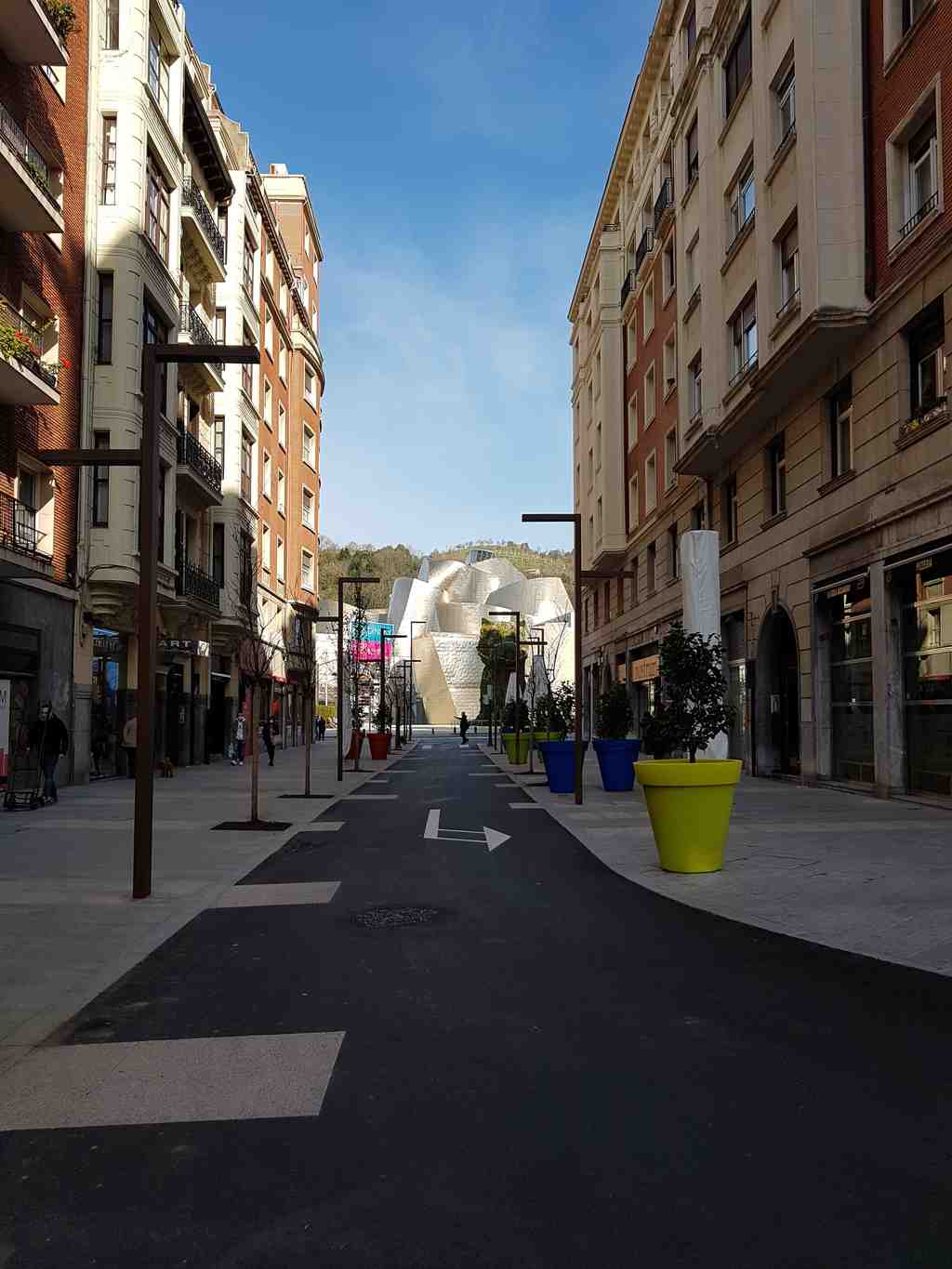
You are now standing on a wide street paved in smooth light granite, framed by slender Japanese cherry trees and marked by diamond shaped glass windows set directly into the ground. This is Calle Iparraguirre. It forms a grand corridor leading all the way from the Guggenheim Museum to the deeper residential neighborhoods of the city. While it is surrounded by some of Bilbao's most imposing institutional architecture, its pristine surface conceals a remarkably defiant spirit.
The street takes its name from José María Iparraguirre, a nineteenth century Basque bard who composed the region's beloved anthem. This song celebrated ancient freedoms, matching his sprawling, epic life. He fought and was wounded in battle, suffered exile in France, and toured across Europe as a celebrated singer before being suddenly deported. He eventually crossed the ocean to South America, where he worked as a humble shepherd for two decades. Just as his homeland had given him up for dead, he made a triumphant return in eighteen seventy seven, living out his final years supported by a special pension from the Basque councils.
That exact brand of stubborn resilience is literally built into this block. Hidden entirely out of sight, accessible only through a narrow, dark passageway at number 51 B, sits a startling survivor. In an interior courtyard, completely swallowed by towering modern apartment complexes, stands an ancient rustic farmhouse. It originally operated as a carpentry workshop for the Alhóndiga, the massive structure we visited earlier. As developers bought up land and bulldozers leveled the area, the owners of this little structure staged a quiet urban rebellion. They simply refused to sell. It remains there today, a solitary architectural holdout resisting the crushing weight of modern urban expansion, like something out of a storybook.
Before the great blocks of flats arrived, this entire district was a peaceful expanse of small orchards and traditional taverns known as chacolís. These were rustic spots where locals gathered under the shade of heavy grapevines to drink regional wine. The famous Chacolí de Zollo, run by Tomasa Asúa Bilbao, was a beloved bohemian hangout legendary for its rich garlic soup and traditional cod. Decades later, the street hosted another kind of sanctuary. During the late nineteen seventies, a rented industrial basement here became Txoko Landa, one of the first safe social clubs for the local LGBT community. It was a rare, secure haven where people could eat, dance, and exist openly, far from the marginalized fringes of society.
Recently, the city transformed the street into the pedestrian boulevard you see now. The redesign abandoned a highly controversial plan for suspended zig zag lighting due to safety concerns, opting instead for a calmer aesthetic. Those seven glass windows in the pavement are by artist Olafur Eliasson. Designed to force rushing pedestrians to slow down, each steel chamber holds raw minerals from the regional subsoil, like basalt and siderite, honoring the intense mining history of the area. Mirrors inside multiply the raw textures of the stones, projecting infinite geometric shapes upward.
Let these layers of survival linger with you. Now, continue walking straight ahead to reach the Gran Vía, the ultimate symbol of the city's vast industrial wealth, just a short two minute walk away.




